

SIST EN 1804-3:2021
(Main)Machines for underground mines - Safety requirements for hydraulic powered roof supports - Part 3: Hydraulic and electro hydraulic control systems
General Information
- Abstract
This document specifies the safety requirements for hydraulic and electro hydraulic control devices, including hydraulic valves and their control elements, valve combinations, control systems, pipes and hose assemblies, measuring devices, built-in pressure limiting and check valves in legs and rams and, as well emergency stop, start warning, blocking- and control unit when used as specified by the manufacturer or his authorized representative. Excluded are pressure generators, and internal valves of legs and rams (e.g. leg bottom valves, see EN 1804-2:2020).
NOTE Some components are dealt with in other parts of this standard.
This document applies to hydraulic and electro hydraulic control devices at ambient temperatures from -10 °C to 60 °C.
This document identifies and takes into account:
- possible hazards which can be caused by the operation of hydraulic and electro hydraulic control devices;
- areas and operating conditions which can create such hazards;
- hazardous situations which can cause injury or can be damaging to health;
- hazards which can be caused by firedamp and/or combustible dusts.
This document describes methods for the reduction of these hazards.
A list of significant hazards covered appears in Clause 4.
This document does not specify any additional requirements for:
- use in particularly corrosive environments;
- hazards occurring during construction, transportation, decommissioning;
- earthquakes.
A complete hydraulic powered roof support consists of the support units (EN 1804-1:2020), legs and support rams (EN 1804-2:2020) and the hydraulic and electro hydraulic controls (EN 1804-3:2020). Each part of this multipart document addresses the safety requirements of the components mentioned in the scopes of the respective parts of this multipart series.
This document is not applicable to hydraulic and electro hydraulic control systems manufactured before the date of its publication.
- Status
- Published
- Public Enquiry End Date
- 24-Apr-2019
- Publication Date
- 03-Mar-2021
- Technical Committee
- VSN - Safety of machinery
- Current Stage
- 6060 - National Implementation/Publication (Adopted Project)
- Start Date
- 05-Jan-2021
- Due Date
- 12-Mar-2021
- Completion Date
- 04-Mar-2021
- Directive
- 2006/42/EC - Directive 2006/42/EC of the European Parliament and of the Council of 17 May 2006 on machinery, and amending Directive 95/16/EC (recast)OJ Ref: L 366, L 366 (C), TIP C, L 7.9.2026 UMIK 20.1.2027 OJ Date: 15-Oct-2021 Conflicting Date: 20-Jan-2027



Overview
EN 1804-3:2020 - published by CEN - defines safety requirements for hydraulic and electro-hydraulic control systems used with hydraulic powered roof supports in underground mines. This part of the EN 1804 series covers hydraulic valves and their control elements, valve combinations, control systems, pipe and hose assemblies, measuring devices, built-in pressure-limiting and check valves in legs and rams, and emergency stop / start / warning / blocking control units when used as specified by the manufacturer. Applicable ambient temperature range is -10 °C to 60 °C. Excluded are pressure generators and internal leg/ram valves (see EN 1804-2:2020). The standard supersedes EN 1804-3:2006+A1:2010 and is not retroactive to systems manufactured before its publication.
Key Topics
- Scope & hazards: Identifies hazards from hydraulic and electro-hydraulic control devices, including those associated with firedamp and combustible dusts; lists significant hazards (Clause 4, Annex B).
- Design & performance requirements: Requirements for valve types (Type A, B, C, D), pressure limiting, travel speed, resistance to back pressure, leaktightness and operating reliability.
- Hydraulic components: Rules for hydraulic valves, control elements, pipe and hose assemblies, seals and materials, and built-in pressure limiting/check valves.
- Electro-hydraulic systems: Requirements for electro-hydraulic valves, control units, pressure transducers, stroke measurement devices and cable routing.
- Installation, testing & verification: Type testing and additional tests (Annex A) for load, valve performance and safety verification.
- User information & maintenance: Mandatory documentation: technical data, handling, storage, installation, commissioning, preventive maintenance schedules, spare parts and marking.
- Exclusions: No additional requirements for corrosive environments, construction/transport/decommissioning hazards or earthquakes.
Applications
Who uses EN 1804-3 and why:
- Manufacturers of hydraulic and electro-hydraulic control systems for powered roof supports - for design compliance and product testing.
- Mine operators and safety engineers - to select, install and maintain compliant control systems that reduce hazardous situations underground.
- Certifiers and inspectors - to verify conformity during type testing and commissioning.
- Maintenance teams - for preventive maintenance, fault diagnosis and spare-parts identification.
Practical uses include specifying valve performance, designing hose/cable routing within shielded areas, setting pressure-limiting measures, implementing emergency stop/control logic, and preparing user manuals and maintenance schedules.
Related Standards
- EN 1804-1:2020 - support units and general requirements
- EN 1804-2:2020 - legs and support rams (internal leg/ram valves excluded from EN 1804-3)
- Annex ZA relates EN 1804-3 to Directive 2006/42/EC (machinery safety)
Keywords: EN 1804-3, hydraulic control systems, electro-hydraulic, hydraulic valves, roof supports, underground mines, safety requirements, pipe and hose assemblies, mining machinery safety.
Relations
- Effective Date
- 30-Dec-2020
- Effective Date
- 31-Mar-2026
- Effective Date
- 20-Feb-2026
- Effective Date
- 09-Feb-2026
- Effective Date
- 09-Feb-2026
- Effective Date
- 09-Feb-2026
- Effective Date
- 09-Feb-2026
- Effective Date
- 09-Feb-2026
- Effective Date
- 09-Feb-2026
- Effective Date
- 09-Feb-2026
- Effective Date
- 09-Feb-2026
- Effective Date
- 09-Feb-2026
- Effective Date
- 09-Feb-2026
- Effective Date
- 09-Feb-2026
- Effective Date
- 09-Feb-2026
Get Certified
Connect with accredited certification bodies for this standard

Bureau Veritas Chile
Bureau Veritas certification services in Chile.
Bureau Veritas Peru
Bureau Veritas certification services in Peru.
BVQI Peru
Bureau Veritas certification in Peru.
Sponsored listings
Frequently Asked Questions
SIST EN 1804-3:2021 is a standard published by the Slovenian Institute for Standardization (SIST). Its full title is "Machines for underground mines - Safety requirements for hydraulic powered roof supports - Part 3: Hydraulic and electro hydraulic control systems". This standard covers: This document specifies the safety requirements for hydraulic and electro hydraulic control devices, including hydraulic valves and their control elements, valve combinations, control systems, pipes and hose assemblies, measuring devices, built-in pressure limiting and check valves in legs and rams and, as well emergency stop, start warning, blocking- and control unit when used as specified by the manufacturer or his authorized representative. Excluded are pressure generators, and internal valves of legs and rams (e.g. leg bottom valves, see EN 1804-2:2020). NOTE Some components are dealt with in other parts of this standard. This document applies to hydraulic and electro hydraulic control devices at ambient temperatures from -10 °C to 60 °C. This document identifies and takes into account: - possible hazards which can be caused by the operation of hydraulic and electro hydraulic control devices; - areas and operating conditions which can create such hazards; - hazardous situations which can cause injury or can be damaging to health; - hazards which can be caused by firedamp and/or combustible dusts. This document describes methods for the reduction of these hazards. A list of significant hazards covered appears in Clause 4. This document does not specify any additional requirements for: - use in particularly corrosive environments; - hazards occurring during construction, transportation, decommissioning; - earthquakes. A complete hydraulic powered roof support consists of the support units (EN 1804-1:2020), legs and support rams (EN 1804-2:2020) and the hydraulic and electro hydraulic controls (EN 1804-3:2020). Each part of this multipart document addresses the safety requirements of the components mentioned in the scopes of the respective parts of this multipart series. This document is not applicable to hydraulic and electro hydraulic control systems manufactured before the date of its publication.
This document specifies the safety requirements for hydraulic and electro hydraulic control devices, including hydraulic valves and their control elements, valve combinations, control systems, pipes and hose assemblies, measuring devices, built-in pressure limiting and check valves in legs and rams and, as well emergency stop, start warning, blocking- and control unit when used as specified by the manufacturer or his authorized representative. Excluded are pressure generators, and internal valves of legs and rams (e.g. leg bottom valves, see EN 1804-2:2020). NOTE Some components are dealt with in other parts of this standard. This document applies to hydraulic and electro hydraulic control devices at ambient temperatures from -10 °C to 60 °C. This document identifies and takes into account: - possible hazards which can be caused by the operation of hydraulic and electro hydraulic control devices; - areas and operating conditions which can create such hazards; - hazardous situations which can cause injury or can be damaging to health; - hazards which can be caused by firedamp and/or combustible dusts. This document describes methods for the reduction of these hazards. A list of significant hazards covered appears in Clause 4. This document does not specify any additional requirements for: - use in particularly corrosive environments; - hazards occurring during construction, transportation, decommissioning; - earthquakes. A complete hydraulic powered roof support consists of the support units (EN 1804-1:2020), legs and support rams (EN 1804-2:2020) and the hydraulic and electro hydraulic controls (EN 1804-3:2020). Each part of this multipart document addresses the safety requirements of the components mentioned in the scopes of the respective parts of this multipart series. This document is not applicable to hydraulic and electro hydraulic control systems manufactured before the date of its publication.
SIST EN 1804-3:2021 is classified under the following ICS (International Classification for Standards) categories: 73.100.10 - Tunnelling and tubbing equipment. The ICS classification helps identify the subject area and facilitates finding related standards.
SIST EN 1804-3:2021 has the following relationships with other standards: It is inter standard links to SIST EN 1804-3:2006+A1:2010, SIST EN IEC 60079-15:2019/A11:2026, SIST EN IEC 60079-28:2026, SIST EN 62061:2005, SIST EN IEC 60079-14:2025, SIST EN IEC 60079-25:2022/A1:2026, SIST EN IEC 60079-0:2018, SIST EN 62061:2005/A2:2016, SIST EN IEC 60079-7:2016/A1:2018, SIST EN IEC 60079-17:2024, SIST EN IEC 60079-45:2025, SIST EN IEC 60079-18:2025, SIST EN IEC 60079-15:2019, SIST EN IEC 60079-11:2025, SIST EN IEC 60079-26:2024. Understanding these relationships helps ensure you are using the most current and applicable version of the standard.
SIST EN 1804-3:2021 is associated with the following European legislation: EU Directives/Regulations: 2006/42/EC; Standardization Mandates: M/396. When a standard is cited in the Official Journal of the European Union, products manufactured in conformity with it benefit from a presumption of conformity with the essential requirements of the corresponding EU directive or regulation.
SIST EN 1804-3:2021 is available in PDF format for immediate download after purchase. The document can be added to your cart and obtained through the secure checkout process. Digital delivery ensures instant access to the complete standard document.
Standards Content (Sample)
SLOVENSKI STANDARD
01-april-2021
Nadomešča:
SIST EN 1804-3:2006+A1:2010
Stroji za podzemne rudnike - Varnostne zahteve za hidravlično podporje - 3. del:
Hidravlični in elektrohidravlični krmilni sistemi
Machines for underground mines - Safety requirements for hydraulic powered roof
supports - Part 3: Hydraulic and electro hydraulic control systems
Maschinen für den Bergbau unter Tage - Sicherheitsanforderungen für hydraulischen
Schreitausbau - Teil 1: Ausbaugestelle und allgemeine Anforderungen
Machines pour mines souterraines - Exigences de sécurité relatives aux soutènements
marchants applicables aux piles - Partie 3 : Systèmes de commande hydrauliques et
électro-hydrauliques
Ta slovenski standard je istoveten z: EN 1804-3:2020
ICS:
73.100.10 Oprema za gradnjo predorov Tunnelling and tubbing
in podzemnih železnic equipment
2003-01.Slovenski inštitut za standardizacijo. Razmnoževanje celote ali delov tega standarda ni dovoljeno.
EN 1804-3
EUROPEAN STANDARD
NORME EUROPÉENNE
December 2020
EUROPÄISCHE NORM
ICS 73.100.10 Supersedes EN 1804-3:2006+A1:2010
English Version
Machines for underground mines - Safety requirements for
hydraulic powered roof supports - Part 3: Hydraulic and
electro hydraulic control systems
Machines pour mines souterraines - Exigences de Maschinen für den Bergbau unter Tage -
sécurité relatives aux soutènements marchants Sicherheitsanforderungen an hydraulischen
applicables aux piles - Partie 3 : Systèmes de Schreitausbau - Teil 3: Hydraulische und elektro-
commande hydrauliques et électro-hydrauliques hydraulische Steuerungen
This European Standard was approved by CEN on 25 October 2020.
CEN members are bound to comply with the CEN/CENELEC Internal Regulations which stipulate the conditions for giving this
European Standard the status of a national standard without any alteration. Up-to-date lists and bibliographical references
concerning such national standards may be obtained on application to the CEN-CENELEC Management Centre or to any CEN
member.
This European Standard exists in three official versions (English, French, German). A version in any other language made by
translation under the responsibility of a CEN member into its own language and notified to the CEN-CENELEC Management
Centre has the same status as the official versions.
CEN members are the national standards bodies of Austria, Belgium, Bulgaria, Croatia, Cyprus, Czech Republic, Denmark, Estonia,
Finland, France, Germany, Greece, Hungary, Iceland, Ireland, Italy, Latvia, Lithuania, Luxembourg, Malta, Netherlands, Norway,
Poland, Portugal, Republic of North Macedonia, Romania, Serbia, Slovakia, Slovenia, Spain, Sweden, Switzerland, Turkey and
United Kingdom.
EUROPEAN COMMITTEE FOR STANDARDIZATION
COMITÉ EUROPÉEN DE NORMALISATION
EUROPÄISCHES KOMITEE FÜR NORMUNG
CEN-CENELEC Management Centre: Rue de la Science 23, B-1040 Brussels
© 2020 CEN All rights of exploitation in any form and by any means reserved Ref. No. EN 1804-3:2020 E
worldwide for CEN national Members.
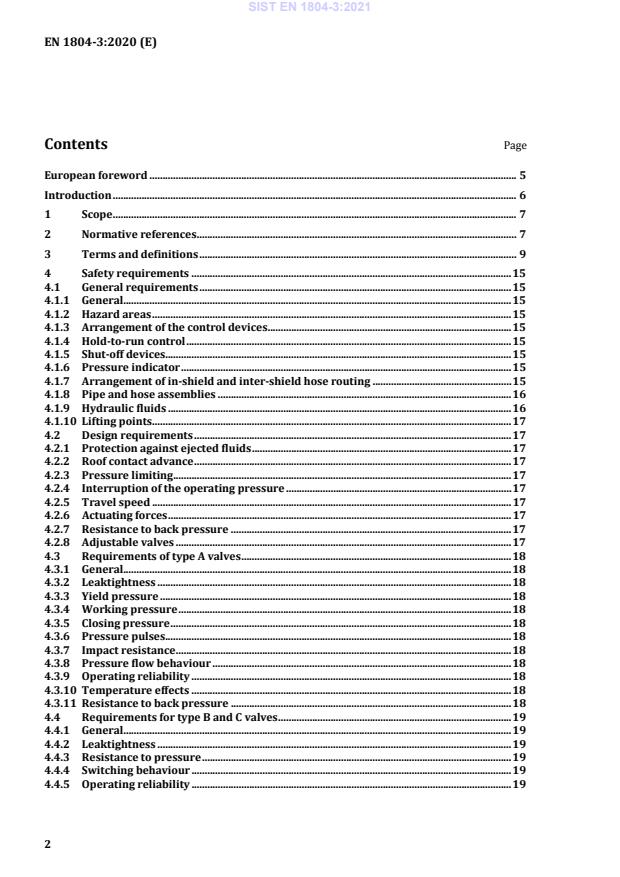
Contents Page
European foreword . 5
Introduction . 6
1 Scope . 7
2 Normative references . 7
3 Terms and definitions . 9
4 Safety requirements . 15
4.1 General requirements . 15
4.1.1 General. 15
4.1.2 Hazard areas . 15
4.1.3 Arrangement of the control devices . 15
4.1.4 Hold-to-run control . 15
4.1.5 Shut-off devices. 15
4.1.6 Pressure indicator . 15
4.1.7 Arrangement of in-shield and inter-shield hose routing . 15
4.1.8 Pipe and hose assemblies . 16
4.1.9 Hydraulic fluids . 16
4.1.10 Lifting points . 17
4.2 Design requirements . 17
4.2.1 Protection against ejected fluids . 17
4.2.2 Roof contact advance . 17
4.2.3 Pressure limiting . 17
4.2.4 Interruption of the operating pressure . 17
4.2.5 Travel speed . 17
4.2.6 Actuating forces . 17
4.2.7 Resistance to back pressure . 17
4.2.8 Adjustable valves . 17
4.3 Requirements of type A valves . 18
4.3.1 General. 18
4.3.2 Leaktightness . 18
4.3.3 Yield pressure . 18
4.3.4 Working pressure . 18
4.3.5 Closing pressure . 18
4.3.6 Pressure pulses. 18
4.3.7 Impact resistance . 18
4.3.8 Pressure flow behaviour . 18
4.3.9 Operating reliability . 18
4.3.10 Temperature effects . 18
4.3.11 Resistance to back pressure . 18
4.4 Requirements for type B and C valves . 19
4.4.1 General. 19
4.4.2 Leaktightness . 19
4.4.3 Resistance to pressure . 19
4.4.4 Switching behaviour . 19
4.4.5 Operating reliability . 19
4.4.6 Resistance to back pressure . 19
4.5 Requirements for type D valves . 19
4.6 Materials . 19
4.6.1 Metallic materials . 19
4.6.2 Light metal . 19
4.6.3 Other materials . 19
4.6.4 Seals . 20
4.7 General electro hydraulic . 20
4.7.1 General requirements . 20
4.7.2 Arrangement of in-shield and inter-shield cable routing . 20
4.7.3 Electro hydraulic valves . 20
4.7.4 Stroke measurement devices . 20
4.7.5 Pressure indicator . 20
4.7.6 Pressure transducer . 20
4.7.7 Electro hydraulic control unit . 20
5 Verification of the safety requirements . 23
5.1 Type testing . 23
5.2 Additional tests . 23
6 User Information . 25
6.1 General requirements . 25
6.2 Technical and application data. 26
6.2.1 Introduction . 26
6.2.2 General description . 26
6.2.3 Performance data . 26
6.2.4 Hydraulic data . 26
6.2.5 List of additional drawings and documents . 26
6.3 Handling, transport and storage . 26
6.3.1 Introduction . 26
6.3.2 Handling and transport . 26
6.3.3 Storage . 27
6.4 Installation and commissioning . 27
6.4.1 Installation . 27
6.4.2 Commissioning . 27
6.5 Operation . 27
6.6 Maintenance . 27
6.6.1 Introduction . 27
6.6.2 Technical description . 27
6.6.3 Maintenance instructions . 27
6.6.4 Fault diagnosis and correction . 28
6.6.5 Preventive maintenance schedules . 28
6.7 Spare parts identification lists . 28
6.8 Marking . 28
6.9 Residual risks . 28
Annex A (normative) Test for verification of the safety requirements . 29
A.1 Load tests . 29
A.1.1 General . 29
A.1.2 Lifting points . 29
A.1.3 Testing of type A valves . 29
A.1.4 Testing of type B valves . 33
A.1.5 Testing of type C valves . 36
A.1.6 Testing of type D valves . 37
Annex B (informative) List of significant hazards . 38
Annex ZA (informative) Relationship between this European Standard and the essential
requirements of Directive 2006/42/EC aimed to be covered . 41
Bibliography . 43
European foreword
This document (EN 1804-3:2020) has been prepared by Technical Committee CEN/TC 196 “Mining
machinery and equipment - Safety”, the secretariat of which is held by DIN.
This European Standard shall be given the status of a national standard, either by publication of an
identical text or by endorsement, at the latest by June 2021, and conflicting national standards shall be
withdrawn at the latest by June 2021.
Attention is drawn to the possibility that some of the elements of this document may be the subject of
patent rights. CEN shall not be held responsible for identifying any or all such patent rights.
This document supersedes EN 1804-3:2006+A1:2010.
The main differences between this document and EN 1804-3:2006+A1:2010 are as follows:
a) Normative references (updated);
b) Terms and definitions (revised/modified/enhanced);
c) List of significant hazards (revised/enhanced) (see Annex B);
d) Requirements for automatic hydraulic functions (deleted);
e) Requirements for in- and inter-shield hose routing (added);
f) Requirements for pipe and hose assemblies (updated);
g) Requirements for type “A” valves (modified);
h) Requirements for electro hydraulic control systems (added);
i) List of verification tests (updated/enhanced);
j) Figures and pictures (revised/added).
This document has been prepared under a mandate given to CEN by the European Commission and the
European Free Trade Association and supports essential requirements of EU Directive(s).
For relationship with EU Directive(s), see informative Annex ZA, which is an integral part of this
document.
According to the CEN-CENELEC Internal Regulations, the national standards organisations of the
following countries are bound to implement this European Standard: Austria, Belgium, Bulgaria, Croatia,
Cyprus, Czech Republic, Denmark, Estonia, Finland, France, Germany, Greece, Hungary, Iceland, Ireland,
Italy, Latvia, Lithuania, Luxembourg, Malta, Netherlands, Norway, Poland, Portugal, Republic of North
Macedonia, Romania, Serbia, Slovakia, Slovenia, Spain, Sweden, Switzerland, Turkey and the United
Kingdom.
Introduction
This document is a type C standard as stated in EN ISO 12100.
The machinery concerned and the extent to which hazards, hazardous situations and events are covered
are indicated in the scope of this document.
This document is of relevance, in particular, for the following stakeholder groups representing the market
players with regard to machinery safety:
— machine manufacturers (small, medium and large enterprises);
— health and safety bodies (regulators, accident prevention organizations, market surveillance, etc.).
Others can be affected by the level of machinery safety achieved with the means of the document by the
above-mentioned stakeholder groups:
— machine users/employers (small, medium and large enterprises);
— machine users/employees (e.g. trade unions, organizations for people with special needs);
— service providers, e.g. for maintenance (small, medium and large enterprises);
— consumers (in the case of machinery intended for use by consumers).
The above-mentioned stakeholder groups have been given the possibility to participate at the drafting
process of this document.
The machinery concerned and the extent to which hazards, hazardous situations or hazardous events are
covered are indicated in the Scope of this document.
When requirements of this type-C standard are different from those which are stated in type-A or type-B
standards, the requirements of this type-C standard take precedence over the requirements of the other
standards for machines that have been designed and built according to the requirements of this type-C
standard. The extent to which hazards are covered is indicated in the scope of this document.
While preparing this document, it was assumed that:
— only trained and competent persons operate the machine;
— components without specific requirements are:
— designed in accordance with the usual engineering practice and calculation code;
— of sound mechanical construction;
— free of defects;
— components are kept in good working condition / order;
— a negotiation took place between the user and the manufacturer concerning the use of the machinery.
1 Scope
This document specifies the safety requirements for hydraulic and electro hydraulic control devices,
including hydraulic valves and their control elements, valve combinations, control systems, pipes and
hose assemblies, measuring devices, built-in pressure limiting and check valves in legs and rams and, as
well emergency stop, start warning, blocking- and control unit when used as specified by the
manufacturer or his authorized representative. Excluded are pressure generators, and internal valves of
legs and rams (e.g. leg bottom valves, see EN 1804-2:2020).
NOTE Some components are dealt with in other parts of this standard.
This document applies to hydraulic and electro hydraulic control devices at ambient temperatures from
–10 °C to 60 °C.
This document identifies and takes into account:
— possible hazards which can be caused by the operation of hydraulic and electro hydraulic control
devices;
— areas and operating conditions which can create such hazards;
— hazardous situations which can cause injury or can be damaging to health;
— hazards which can be caused by firedamp and/or combustible dusts.
This document describes methods for the reduction of these hazards.
A list of significant hazards covered appears in Clause 4.
This document does not specify any additional requirements for:
— use in particularly corrosive environments;
— hazards occurring during construction, transportation, decommissioning;
— earthquakes.
A complete hydraulic powered roof support consists of the support units (EN 1804-1:2020), legs and
support rams (EN 1804-2:2020) and the hydraulic and electro hydraulic controls (EN 1804-3:2020).
Each part of this multipart document addresses the safety requirements of the components mentioned
in the scopes of the respective parts of this multipart series.
This document is not applicable to hydraulic and electro hydraulic control systems manufactured before
the date of its publication.
2 Normative references
The following documents are referred to in the text in such a way that some or all of their content
constitutes requirements of this document. For dated references, only the edition cited applies. For
undated references, the latest edition of the referenced document (including any amendments) applies.
EN 853:2015, Rubber hoses and hose assemblies — Wire braid reinforced hydraulic type — Specification
EN 854:2015, Rubber hoses and hose assemblies — Textile reinforced hydraulic type — Specification
EN 856:2015+AC:2019, Rubber hoses and hose assemblies — Rubber-covered spiral wire reinforced
hydraulic type — Specification
EN 857:2015, Rubber hoses and hose assemblies — Wire braid reinforced compact type for hydraulic
applications — Specification
EN 981:1996+A1:2008, Safety of machinery — System of auditory and visual danger and information
signals
EN 1804-1:2020, Machines for underground mines — Safety requirements for hydraulic powered roof
supports — Part 1: Support units and general requirements
EN 1804-2:2020, Machines for underground mines — Safety requirements for hydraulic powered roof
supports — Part 2: Power set legs and rams
EN ISO 3949:2020, Plastics hoses and hose assemblies — Textile-reinforced types for hydraulic applications
— Specification (ISO 3949:2020)
EN 62061:2005 , Safety of machinery — Functional safety of safety-related electrical, electronic and
programmable electronic control systems (IEC 62061:2005 + A1:2012 + A2:2015)
EN ISO 80079-36:2016 , Explosive atmospheres — Part 36: Non-electrical equipment for explosive
atmospheres — Basic method and requirements (ISO 80079-36:2016)
EN ISO 4413:2010, Hydraulic fluid power — General rules and safety requirements for systems and their
components (ISO 4413:2010)
EN ISO 12100:2010, Safety of machinery — General principles for design – Risk assessment and risk
reduction (ISO 12100:2010)
EN ISO 13849-1:2015, Safety of machinery — Safety-related parts of control systems — Part 1: General
principles for design (ISO 13849-1:2015)
EN ISO 13849-2:2012, Safety of machinery — Safety-related parts of control systems — Part 2: Validation
(ISO 13849-2:2012)
EN ISO 13850:2015, Safety of machinery — Emergency stop function — Principles for design
(ISO 13850:2015)
EN IEC 60079 (all parts), Explosive atmospheres (IEC 60079)
ISO 6805:2020, Rubber hoses and hose assemblies for underground mining — Wire-reinforced hydraulic
types for coal mining — Specification
ISO 7745:2010, Hydraulic fluid power — Fire-resistant (FR) fluids — Requirements and guidelines for use
DIN 22100-5:2010, Articles and materials from synthetic for use in underground mines — Part 5: Tubes,
tube isolations and hoses — Safety requirements, testing, marking
As impacted by EN 62061:2005/A1:2013, EN 62061:2005/A2:2015 and EN 62061:2005/corrigendum Feb. 2012.
As impacted by EN ISO 80079-36:2016/AC:2019.
3 Terms and definitions
For the purposes of this document, the terms and definitions given in EN ISO 12100:2010,
EN 1804-1:2020, EN 1804-2:2020 and the following apply.
ISO and IEC maintain terminological databases for use in standardization at the following addresses:
— ISO Online browsing platform: available at https://www.iso.org/obp
— IEC Electropedia: available at http://www.electropedia.org/
3.1
hydraulic control devices
system required to control all the functions of the hydraulic powered roof supports
3.2
sensor
measuring element
3.3
pressures
3.3.1
yield pressure of a pressure limiting valve
hydraulic pressure to which a pressure limiting valve is adjusted and at which it should operate (pressure
specified by manufacturer)
3.3.2
cracking pressure of a pressure limiting valve
hydraulic pressure at which a valve begins to open and hydraulic fluid is passing through it
3.3.3
working pressure of a pressure limiting valve
pressure during operation of a pressure limiting valve
3.3.4
closing pressure of a pressure limiting valve
pressure at which the valve is closed and the flow of hydraulic fluid is shut off
3.3.5
maximum permissible working pressure
pressure specified by manufacturer
3.4
valves
3.4.1
type A valves
(pressure limiting valves) limit the internal hydraulic pressure of actuators
3.4.2
type B valves
(e.g. check valves) shut off the hydraulic fluid directly from the actuators
3.4.3
type C valves
(e.g. directional control valves) in their neutral position, block off the fluid supply to the actuators and
supply fluid to the actuators in all other positions
3.4.4
type D valves
all those valves, valves combination and control units which cannot be classified specifically in one of the
types A to C
3.5
type of control systems
3.5.1
adjacent control system
type of control system in which the individual functions of one support unit are manually operated from
an adjacent support unit
3.5.2
unit sequence control system
control system in which a functional sequence, (e.g. lowering - advancing - setting) operates in one single
support unit
3.5.3
batch sequence control
control type with a sequence of processes in a defined number of roof supports
3.5.4
automatic positive setting control system
type of control system where the setting function of legs and/or support rams is operated automatically,
at least until the rated value of the setting pressure of legs and/or support rams in the support unit has
been attained
3.6
hold to run control
function is only activated, for the time the button or lever is being operated
3.7
type of control
3.7.1
automatic water spray control
3.7.1.1
automatic canopy water spray control system
control system where the canopy water spray system is operated as a function of the time/date and/or
position of the mineral production machine and/or the internal condition of the working face or the
shield
3.7.1.2
automatic water curtain control system
control system where the water spraying system for the mineral production machine track is operated
as a function of the mineral production machine position, direction and speed of travel, and direction of
ventilation
3.7.2
automatic control system for conveyor push
control system, which pushes the conveyor automatically by initiated different criteria
3.7.3
automatic conveyor horizon control system
control system where the transverse inclination of the conveyor above the steering ram is controlled as
a function of the position and direction of travel of the mineral production machine, the rate of advance
and the inclination of the conveyor from set points
3.7.4
automatic base lift control system
control system where the base lift ram(s) are operated as a function of the movement of the support unit
3.7.5
automatic conveyor creep control system
control system where the anchor rams can be control by a number of functions including the movement
of the support unit, the position and direction of travel of the mineral production machine
3.7.6
automatic face sprag control system
control system where the face sprags are operated as a function of the position and direction of travel of
the mineral production machine and the movement of the support unit
3.7.7
automatic control system for the stabilizing rams
control system where the stabilizing ram(s) are operated as a function of the movement of the support
unit and of the pressure in the legs
3.7.8
automatic control system for support steering
control system where the steering rams of the advancing support and of the adjacent support units are
operated, in order to steer the advancing support
3.7.9
automatic control system for conveyor pullback
control system where the conveyor is pulled back a specified amount
3.7.10
limited remote
control system where support units, beyond the adjacent unit (e.g. next but one) are operated as in the
normal adjacent control mode (visible range)
3.7.11
remote control
control system where support units are controlled by a means other than adjacent control
3.7.12
cordless control unit
control system where data and control commands are transmitted by a means other than galvanic or
fibre-optic connections
3.7.13
minimum setting pressure for pushing the conveyor
minimum pressure in at least one of the legs of the support unit to allow automatic pushing of the
conveyor
3.7.14
minimum setting pressure for pulling back the conveyor
minimum pressure in at least one leg of the support unit to allow automatic pulling back of the conveyor
3.7.15
transfer pressure
minimum pressure in at least one leg of a support unit to allow an auto sequence in the adjacent support
unit(s)
3.7.16
residual leg pressure
maximum pressure in at least one leg of the support unit to allow that support unit to be advanced
3.7.17
control device
device by which control commands can be given
3.7.18
auditory warning signal
audible signal indicating the possibility or actual occurrence of dangerous situation
Note 1 to entry: See EN ISO 7731:2008, 3.2.3.
3.7.19
visible warning signal
visible signal indicating the possibility or actual occurrence of dangerous situation
Note 1 to entry: See EN 842:1996+A1:2008, 3.1.1.
3.7.20
normal stop device
device for interrupting the progress of the automatic support sequence
3.7.21
single function
single movement in a support unit
3.7.22
electro-hydraulic control device
control device combining electrical and hydraulic elements
3.7.23
transducer
device converting physical variables (e.g. distances, pressures) into electrical signals
3.7.24
electromechanical actuator
device converting electrical energy into mechanical energy (e.g. solenoid)
3.7.25
emergency stop device
arrangement of components intended to achieve the emergency stop function
Note 1 to entry: See EN ISO 13850:2015.
3.7.26
emergency stop function for support units
function which interrupts movements immediately in case of emergency and which prevents restart
3.7.27
program
specifies the relationship between input signals and output functions or commands for a control unit
3.7.28
locked-on function
an initiated function retained until deliberately cancelled
3.7.29
manual in support control
mode of operation in which single functions are operable only by hydraulic controls in that support
3.7.30
local blockout
device ensuring that individual support units are prevented from electrical activation
3.8
control units
3.8.1
control unit
IO device in which control commands are processed
3.8.2
central control unit
control unit for gathering, processing, transmitting and displaying face data
Note 1 to entry: It provides communication with other control units and can be used for controlling support units.
3.8.2.1
underground central control unit
central control unit mounted in the face end or gate area and conforming to the requirements for use
below ground
3.8.2.2
surface central control unit
central control unit installed above ground
3.8.3
single control unit
control unit mounted in a support unit or used as a portable device on the face
3.8.4
user interface
single control unit with which commands can be given and/or information received
3.8.5
cabled user interface
single control unit that communicates by cable with other control units
3.8.6
cable less user interface
single control unit that communicates with other control units without the use of a cable
3.8.7
integral user interface
single control unit that is incorporated into another control unit
3.8.8
electromechanical actuator/transducer interface module
control unit that is connected between a support control unit and electromechanical actuators or
transducers
3.8.9
installation control unit
control unit used to install and withdraw support units
3.8.10
support control unit
control unit in a support unit that receives and processes data, outputs control commands for the support
unit and relays control commands for connected control units
3.8.11
pushbutton override control
function that remains active for as long a pushbutton is pressed
3.8.12
ambient temperature
average temperature measured in the general body of air across the face length, when all equipment
associated with the face, is installed but not working when the temperature has normalized at the
specified minimum ventilation quantity
3.8.13
operating temperature
maximum surface temperature of a device or component under normal operating conditions
Note 1 to entry: This will be influenced by the ambient temperature, the proximity of the working fluid or other
components, any self-generating thermal effect and its location within the support unit.
3.8.14
safe state of electro-hydraulic control system
state in which all outputs to actuators are disabled
3.8.15
face safety valve
electro-hydraulic control device which shuts off the hydraulic power supply and depressurizes the main
feed line(s) to the face
3.8.16
test device
apparatus used to verify the functionality of other defined items of equipment, e.g. control device, or to
evaluate system performance
4 Safety requirements
4.1 General requirements
4.1.1 General
Hydraulic and electro hydraulic control systems of hydraulic roof supports shall comply with the safety
requirements of EN ISO 4413:2010.
Hydraulic and electro hydraulic control systems of hydraulic powered roof supports which are designed
according to this part of EN 1804:2020 shall also meet the requirements of the other parts of
EN 1804:2020, if relevant.
Machinery shall comply with the safety requirements and/or protective/risk reduction measures of this
clause. In addition, the machine shall be designed according to the principles of EN ISO 12100:2010 for
relevant but not significant hazards which are not dealt with by this document.
NOTE E.g. longwall safety valves are the appropriate instrument to keep the complete longwall unpressurized.
4.1.2 Hazard areas
Hydraulic and electro hydraulic control devices shall be designed and positioned so that it is not
necessary for personnel to be located in the area of the operated support units (e.g. by operating with
adjacent control system according to 3.5.1) excluding operation of the rear caving door in a top coal
caving application with a second conveyor behind the roof support.
4.1.3 Arrangement of the control devices
Hydraulic and electro hydraulic control devices shall be designed and located so that they cannot be
operated unintentionally from the walkway. They shall not restrict the walkway (see EN 1804-1:2020,
4.1.2). Information and warning devices (e.g. symbols, pressure indicators) shall be arranged so that they
are clearly visible from the walkway.
4.1.4 Hold-to-run control
The controls for operating the individual functions to move the hydraulic powered support (lowering,
advancing, setting) shall interrupt the movement when the control is released. This also applies to other
individual functions which may lead to the narrowing of the walkway and/or the alignment functions.
4.1.5 Shut-off devices
Each support unit shall be able to be isolated from the hydraulic power supply.
4.1.6 Pressure indicator
Hydraulic circuits of each leg of the support unit shall be fitted with a device indicating the pressure in
the leg.
4.1.7 Arrangement of in-shield and inter-shield hose routing
Components and hoses need to be protected against mechanical damages during the complete movement
of the support unit.
4.1.8 Pipe and hose assemblies
Pipe and hose assemblies for hydraulic control systems of hydraulic support units shall be designed to
withstand the maximum permissible working pressure in that system.
Pipes and hose assemblies shall be arranged, assembled and, if necessary, also fixed and protected so that
external damage is minimized and ejecting fluids are deflected.
Hose assemblies shall meet either conditions a) or b) as follows:
a) hose assemblies shall comply with the requirements of ISO 6805:2020. Additionally, type 4 hoses
shall be extended to sizes DN 6 and DN 10 which shall comply with the requirements listed in the
Table 1.
Table 1 — Maximum working pressure
Maximum Pressure for additional Pressure at which
a
working pressure 5 000 cycle test all hoses are tested
MPa MPa MPa
DN 6 45 76 86
DN 10 38 65,5 80
a
The test requirement shown above are additional to those test requirements for
Type 4 hoses in ISO 6805:2020.
Type 6 hose assemblies shall be pressure impulse tested either:
— in accordance with the requirements of ISO 6805:2020 or;
— with 400 000 cycles at 1,33 times of the maximum working pressure at 100 °C.
b) hose assemblies shall meet the appropriate mechanical requirements of EN 853:2015, EN 854:2015,
EN ISO 3949:2020, EN 856:2015+AC:2019 and EN 857:2015 and SAE 100 R15.
DN 10 hoses of type 2ST/2SN (EN 853:2015) and 2SC (EN 857:2015) may be tested to the common
working pressure of 35MPa.
With type 2 ST (EN 853:2015) and 4 SP (EN 856:2015+AC:2019) hose assemblies which are
subjected mainly to static loading, the maximum permissible working pressure may be increased to
1,4 times the nominal pressure given in EN 853:2015 and EN 856:2015+AC:2019.
NOTE EN 853, EN 854, EN 856 and EN 857 are included in the absence of specific standards for hydraulic
hoses for underground mining.
Special requirements of EN ISO 80079-36:2016 and DIN 22100-5:2010 for underground hose
assemblies with respect to their fire and electrical resistance properties, shall be taken into account.
4.1.9 Hydraulic fluids
Hydraulic control systems on roof supports for coal mines and other mines with potentially explosive
atmospheres shall be designed for use with non-toxic and fire-resistant fluids in accordance with the
SHCMOEI 7th report (see Bibliography).
Hydraulic control systems shall be either designed so that they may be used with:
a) fire-resistant fluids category HFA (ISO 7745:2010) specified by the support unit manufacturer in
accordance with ISO 7745:2010, 6.2.1;
or
b) water without additives (temperatures from +5 °C to +60 °C).
4.1.10 Lifting points
Where lifting points are fitted to hydraulic and electro hydraulic control systems they shall be suitable
for their intended purpose. They shall be designed to have a calculated minimum factor of safety of 4 on
ultimate breaking load in relation to their intended load carrying capacity. They shall be clearly and
permanently marked with their load carrying capacity, e.g. by welding.
4.2 Design requirements
4.2.1 Protection against ejected fluids
Hydraulic and electro hydraulic control systems shall be designed, located or guarded to minimize the
risk from ejection of flui
...