

SIST EN 12131:2026
(Main)Feather and down - Test methods - Determination of the quantitative composition of feather and down (manual method)
- Abstract
This document specifies a method for the determination of the composition of feather and/or down fit for or constituting filled manufactured articles in order to label and/or mark it or to verify the denominations reported on the label.
- Status
- Published
- Public Enquiry End Date
- 19-Nov-2025
- Publication Date
- 12-Jul-2026
- Technical Committee
- I13 - Imaginarni 13
- Current Stage
- 6060 - National Implementation/Publication (Adopted Project)
- Start Date
- 09-Jul-2026
- Due Date
- 13-Sep-2026
- Completion Date
- 13-Jul-2026

SIST EN 12131:2026 is a CEN European Standard for the manual test method used to determine the quantitative composition of feather and/or down in fillings for manufactured articles. It is used to support labelling and marking, or to check whether the label description matches the actual filling.
What does SIST EN 12131:2026 specify?
SIST EN 12131:2026 specifies a hand-separation method for feather and/or down fillings used in, or suitable for, filled manufactured articles. The document covers sampling, conditioning, manual separation, calculation of component percentages, testing variance, and the test report.
The main structure is:
- Clause 4 - principle of the method
- Clause 5 - apparatus
- Clause 6 - sampling, conditioning and preparation of test specimens
- Clause 7 - procedure, including first separation, second separation and milled feathers
- Clause 8 - calculation and expression of results
- Clause 9 - testing variance
- Clause 10 - test report
What are the key requirements of SIST EN 12131:2026?
Sampling and preparation
SIST EN 12131:2026 requires sampling according to EN 1883 and conditioning according to EN ISO 139. A laboratory global sample of at least 30 g is mixed by hand, then at least three test specimens are drawn from different places.
In practice, the specimen mass depends on expected down content: about 5 g when down is below 60 %, and about 3 g when down is 60 % or more. The method also expects spare specimens, because at least two valid determinations are needed.
First separation
SIST EN 12131:2026 requires the specimen to be manually separated in a conditioned room at (23 ± 2) °C, and the sample must be weighed within 1 h before testing. The separation box, tweezers, containers and balance are part of the method, and the balance readability must be 0.1 mg or better.
The first separation sorts the material into feather and down groups, residual matter and foreign matter. This matters in practice because the operator must identify and isolate each material class before calculating the composition.
Second separation and milled feathers
SIST EN 12131:2026 uses a second separation on the contents of the down-related fraction from the first step. The method separates down, plumules and nestling down from feather fibres and other elements, again with foreign matter removed and checked.
Clause 7.4 treats milled feathers as chopped and/or curled feathers with multiple fractures along the quill. This is important because the method allows damaged or fibre-rich feather material to be classified consistently instead of being counted as intact feather.
Calculation, validity and reporting
SIST EN 12131:2026 calculates the percentage of each component from both separations and expresses the final result as the mean of the determinations to two decimal points. If any substantial element is 34 % or more of the total mass, the difference between two tests must be below 4 %; otherwise it must be below 3 %.
The document also sets testing variance at ± 3 % relative variance with a minimum of ± 1 % absolute variance. The test report must identify the standard, the laboratory, the tested material, the component results, any deviations, mass loss and gain, and unusual features.
What terms does SIST EN 12131:2026 define?
- Substantial element - any element with a mass of 7 % or more of the total mass in any specimen.
- Foreign matter (FM) - non-plumage material and visually unidentifiable items collected during separation.
- Residual matter (Q) - the remaining material that cannot be assigned to the main named fractions during separation.
- Down, plumules, nestling down - the fine plumage fraction separated in the second stage and used in the composition calculation.
- Milled feathers - chopped and/or curled feathers with multiple fractures along the quill.
- Waterfowl feather / landfowl feather - the two feather categories used throughout the sorting and calculation steps.
Who uses SIST EN 12131:2026?
SIST EN 12131:2026 is used by laboratories that test feather and down fillings, by manufacturers of filled textile articles, and by quality control teams that need to check filling composition. It is also relevant to buyers, inspectors and certification teams that verify whether a product’s label matches the actual feather and down content.
What changed in SIST EN 12131:2026 from the previous edition?
SIST EN 12131:2026 supersedes EN 12131:2018. The foreword states three technical changes:
- term and definition 3.1 were newly introduced
- a new note was added to 5.1
- Clause 8.3 now uses two decimal points instead of at least one
Which standards are used with SIST EN 12131:2026?
- EN 1883 - provides the sampling method for feather and down before testing.
- EN 1885 - provides the terms and definitions used by the document.
- EN ISO 139 - provides the standard atmosphere for conditioning and testing textiles.
- EN 12934 - is cited in the testing-variance note as the reference for minimum labelling requirements.
What does the SIST EN 12131:2026 document contain?
The document contains two separation stages, the associated weighing steps, and the calculation routes for each material fraction. Table 1 sets out the container groups for the first separation, and Table 2 does the same for the second separation. Figure 1 shows the shaking action used when separating down, plumules and nestling down.
Clause 8 contains the formulas used to calculate component portions, including residual matter and foreign matter, and the rule for deciding when additional testing is needed. Clause 10 lists the minimum contents of the test report, so the document supports routine laboratory work, product verification and label checking.
Relations
- Effective Date
- 12-Aug-2026
- Refers
SIST EN ISO 139:2005 - Textiles - Standard atmospheres for conditioning and testing (ISO 139:2005) - Effective Date
- 12-Aug-2026
- Effective Date
- 12-Aug-2026
- Effective Date
- 08-Jul-2026
- Effective Date
- 08-Jul-2026
- Effective Date
- 08-Jul-2026
- Referred By
SIST EN 13186:2005 - Feather and down - Specification for feather and down filled bedding articles - Effective Date
- 08-Jul-2026
- Effective Date
- 24-Jan-2024
Get Certified
Connect with accredited certification bodies for this standard

Control Union Certifications
Global certification for agriculture and sustainability.

Hohenstein Institut
Textile testing and certification.

Bureau Veritas Bangladesh
Bureau Veritas certification services in Bangladesh.
Sponsored listings
Frequently Asked Questions
SIST EN 12131:2026 is a standard published by the Slovenian Institute for Standardization (SIST). Its full title is "Feather and down - Test methods - Determination of the quantitative composition of feather and down (manual method)". This standard covers: This document specifies a method for the determination of the composition of feather and/or down fit for or constituting filled manufactured articles in order to label and/or mark it or to verify the denominations reported on the label.
This document specifies a method for the determination of the composition of feather and/or down fit for or constituting filled manufactured articles in order to label and/or mark it or to verify the denominations reported on the label.
SIST EN 12131:2026 is classified under the following ICS (International Classification for Standards) categories: 59.040 - Textile auxiliary materials. The ICS classification helps identify the subject area and facilitates finding related standards.
SIST EN 12131:2026 has the following relationships with other standards: It is inter standard links to SIST EN 1885:2018+A1:2025, SIST EN ISO 139:2005, SIST EN 1883:2018, SIST EN 12934:2000, SIST EN 13536:2004, SIST EN 13854:2004, SIST EN 13186:2005, SIST EN 12131:2018. Understanding these relationships helps ensure you are using the most current and applicable version of the standard.
SIST EN 12131:2026 is available in PDF format for immediate download after purchase. The document can be added to your cart and obtained through the secure checkout process. Digital delivery ensures instant access to the complete standard document.
Standards Content (Sample)
SLOVENSKI STANDARD
01-september-2026
Perje in puh - Preskusne metode - Ugotavljanje količinske sestave perja in puha
(ročna metoda)
Feather and down - Test methods - Determination of the quantitative composition of
feather and down (manual method)
Federn und Daunen - Prüfverfahren - Bestimmung der quantitativen Zusammensetzung
von Federn und Daunen (manuelles Verfahren)
Plumes et duvets - Méthodes d'essais - Détermination de la composition quantitative de
plumes et duvets (méthode manuelle)
Ta slovenski standard je istoveten z: EN 12131:2026
ICS:
59.040 Pomožni materiali za tekstilije Textile auxiliary materials
2003-01.Slovenski inštitut za standardizacijo. Razmnoževanje celote ali delov tega standarda ni dovoljeno.
EN 12131
EUROPEAN STANDARD
NORME EUROPÉENNE
July 2026
EUROPÄISCHE NORM
ICS 59.040 Supersedes EN 12131:2018
English Version
Feather and down - Test methods - Determination of the
quantitative composition of feather and down (manual
method)
Plumes et duvets - Méthodes d'essai - Détermination Federn und Daunen - Prüfverfahren - Bestimmung der
de la composition quantitative des plumes et duvets quantitativen Zusammensetzung von Federn und
(méthode manuelle) Daunen (manuelles Verfahren)
This European Standard was approved by CEN on 31 May 2026.
CEN members are bound to comply with the CEN/CENELEC Internal Regulations which stipulate the conditions for giving this
European Standard the status of a national standard without any alteration. Up-to-date lists and bibliographical references
concerning such national standards may be obtained on application to the CEN-CENELEC Management Centre or to any CEN
member.
This European Standard exists in three official versions (English, French, German). A version in any other language made by
translation under the responsibility of a CEN member into its own language and notified to the CEN-CENELEC Management
Centre has the same status as the official versions.
CEN members are the national standards bodies of Austria, Belgium, Bulgaria, Croatia, Cyprus, Czech Republic, Denmark, Estonia,
Finland, France, Germany, Greece, Hungary, Iceland, Ireland, Italy, Latvia, Lithuania, Luxembourg, Malta, Netherlands, Norway,
Poland, Portugal, Republic of North Macedonia, Romania, Serbia, Slovakia, Slovenia, Spain, Sweden, Switzerland, Türkiye and
United Kingdom.
EUROPEAN COMMITTEE FOR STANDARDIZATION
COMITÉ EUROPÉEN DE NORMALISATION
EUROPÄISCHES KOMITEE FÜR NORMUNG
CEN-CENELEC Management Centre: Rue de la Science 23, B-1040 Brussels
© 2026 CEN All rights of exploitation in any form and by any means reserved Ref. No. EN 12131:2026 E
worldwide for CEN national Members.
Contents Page
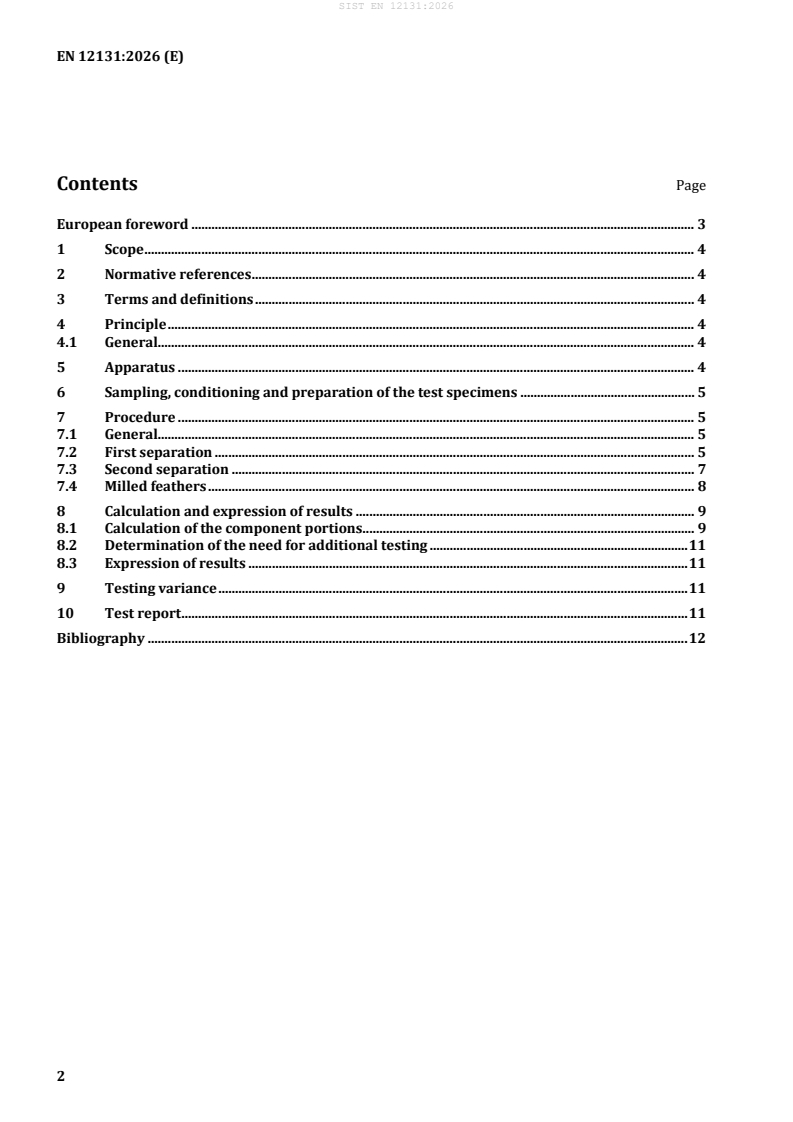
European foreword . 3
1 Scope . 4
2 Normative references . 4
3 Terms and definitions . 4
4 Principle . 4
4.1 General. 4
5 Apparatus . 4
6 Sampling, conditioning and preparation of the test specimens . 5
7 Procedure . 5
7.1 General. 5
7.2 First separation . 5
7.3 Second separation . 7
7.4 Milled feathers . 8
8 Calculation and expression of results . 9
8.1 Calculation of the component portions . 9
8.2 Determination of the need for additional testing . 11
8.3 Expression of results . 11
9 Testing variance . 11
10 Test report . 11
Bibliography . 12
European foreword
This document (EN 12131:2026) has been prepared by Technical Committee CEN/TC 443 “Feather and
down”, the secretariat of which is held by UNI.
This European Standard shall be given the status of a national standard, either by publication of an
identical text or by endorsement, at the latest by January 2027 and conflicting national standards shall
be withdrawn at the latest by January 2027.
Attention is drawn to the possibility that some of the elements of this document may be the subject of
patent rights. CEN shall not be held responsible for identifying any or all such patent rights.
This document supersedes EN 12131:2018.
In comparison with the previous edition, the following technical modifications have been made:
— term and definition 3.1 have been newly introduced;
— a new note to 5.1 has been added;
— in 8.3 the decimal points have been upgraded from at least one to two decimal points.
Any feedback and questions on this document should be directed to the users’ national standards body.
A complete listing of these bodies can be found on the CEN website.
According to the CEN-CENELEC Internal Regulations, the national standards organizations of the
following countries are bound to implement this European Standard: Austria, Belgium, Bulgaria, Croatia,
Cyprus, Czech Republic, Denmark, Estonia, Finland, France, Germany, Greece, Hungary, Iceland, Ireland,
Italy, Latvia, Lithuania, Luxembourg, Malta, Netherlands, Norway, Poland, Portugal, Republic of North
Macedonia, Romania, Serbia, Slovakia, Slovenia, Spain, Sweden, Switzerland, Türkiye and the United
Kingdom.
1 Scope
This document specifies a method for the determination of the composition of feather and/or down fit
for or constituting filled manufactured articles in order to label and/or mark it or to verify the
denominations reported on the label.
2 Normative references
The following documents are referred to in the text in such a way that some or all of their content
constitutes requirements of this document. For dated references, only the edition cited applies. For
undated references, the latest edition of the referenced document (including any amendments) applies.
EN 1883, Feather and down — Sampling in view of tests
EN 1885, Feather and down — Terms and definitions
EN ISO 139, Textiles — Standard atmospheres for conditioning and testing (ISO 139)
3 Terms and definitions
For the purposes of this document, the terms and definitions given in EN 1885 and the following apply.
ISO and IEC maintain terminology databases for use in standardization at the following addresses:
— ISO Online browsing platform: available at https://www.iso.org/obp/
— IEC Electropedia: available at https://www.electropedia.org/
3.1
substantial element
any element having a mass ≥ 7 % of the total mass in any of the specimen
Note 1 to entry: The average mass is calculated with two tests.
4 Principle
4.1 General
A known quantity of the filling material, sampled according to EN 1883, is separated by hand into its
elements. The elements are collected into separate containers, which are suitably marked.
The content of each container is weighed in order to determine the mass of the element concerned and
therefore to calculate the relative percentages.
5 Apparatus
5.1 Box for the manual separation (separation box), usually consisting of the following parts:
— dark coloured and smooth base about 450 mm in length and about 300 mm in width, having a
suitable fixture or area to insert the containers into;
— front part about 150 mm high open or provided with two openings wide enough to permit the
operators’ hands to enter the box;
— back part about 300 mm high;
— two side parts fit for front and back parts;
— cover, to avoid air draughts during the execution of the test, made of glass or other transparent
material to permit the separation of the elements;
— lamp to allow the illumination of the box.
NOTE It has been experienced that lamps with heat emission especially if placed too close to the specimen
might decrease its moisture content.
5.2 Weighing containers, made of aluminium or other light antistatic material fit to contain and weigh
the different elements of the filling, with a capacity up to 400 ml.
5.3 Tweezers, fit to pick the single elements.
5.4 Analytical balance, with a readability (d) of 0,1 mg or better.
Keep attention on a non-ionized electro statical environment around the balance.
5.5 Mixing container with base dimensions of 300 mm × 300 mm and 150 mm high.
5.6 Flat, soft, non-electrostatic brush, from 2 cm to 3 cm wide.
6 Sampling, conditioning and preparation of the test specimens
6.1 Carry the sampling out according to EN 1883.
6.2 Condition the samples according to EN ISO 139.
6.3 Draw a sample of no less than 30 g from the conditioned laboratory global sample. Pu
...