

SIST-TS ISO/TS 19303-1:2021
(Main)Graphic technology - Guidelines for schema writers - Part 1: Packaging printing
General Information
- Abstract
This document provides recommended guidelines for the evaluation of colour reproduction capability in the printing of packaging materials. It provides a basis for the development of colour certification schemes by individual brand owners and/or industry associations and for the evaluation of printed results against those schemes.
Because the package printing supply chain involves multiple partners, both the potential impact of each partner on the overall colour control and the individual responsibilities of each partner are identified in this document. The unique requirements of the individual reproduction processes and their impact on colour reproduction are also identified.
- Status
- Published
- Publication Date
- 09-Jun-2021
- Technical Committee
- GRT - Graphical technology
- Current Stage
- 6060 - National Implementation/Publication (Adopted Project)
- Start Date
- 09-Nov-2020
- Due Date
- 14-Jan-2021
- Completion Date
- 10-Jun-2021
Buy Documents






ISO/TS 19303-1:2020 - Graphic technology — Guidelines for schema writers — Part 1: Packaging printing Released:9/8/2020

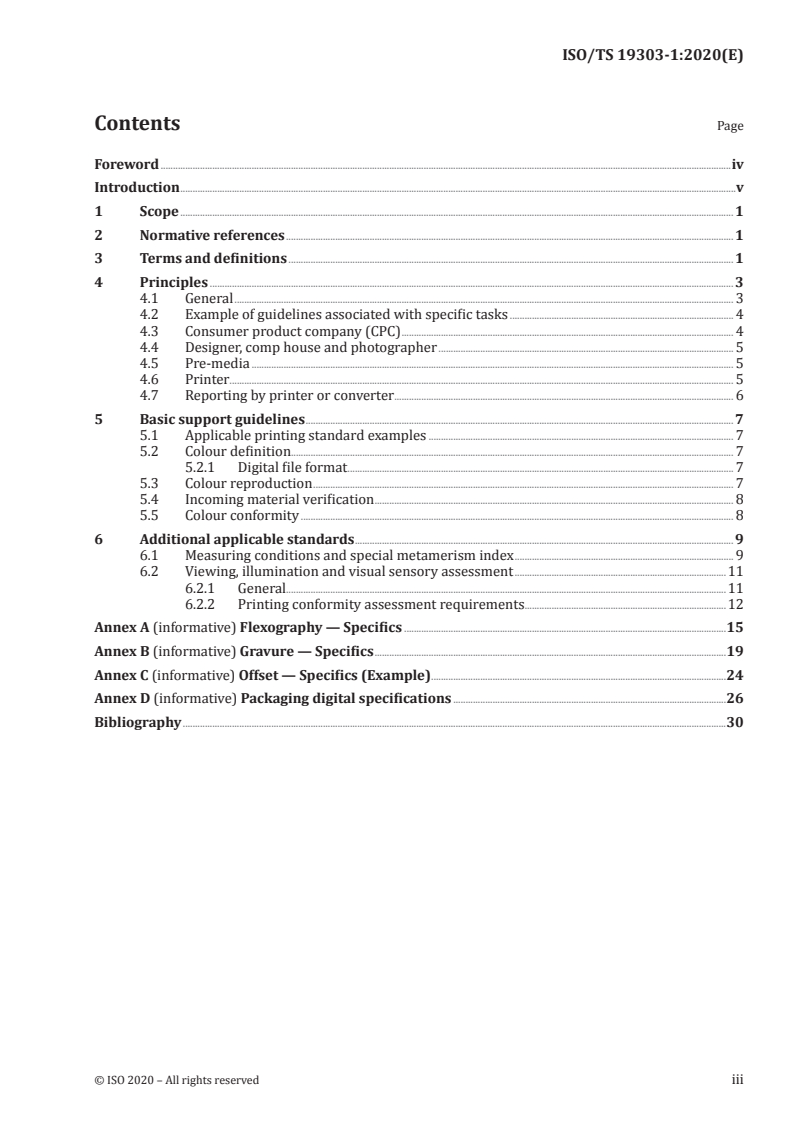

ISO/TS 19303-1:2020 - Graphic technology — Guidelines for schema writers — Part 1: Packaging printing/8/2020
Overview
ISO/TS 19303-1:2020 - Graphic technology: Guidelines for schema writers - Part 1: Packaging printing provides recommended guidelines for evaluating colour reproduction capability in the printing of packaging materials. It is designed as a technical framework to help brand owners, industry associations and certification bodies develop consistent, auditable colour certification schemes and to evaluate printed results against those schemes across a multi‑partner packaging supply chain.
Key topics and requirements
- Scope and purpose: Establishes principles and practices for specifying, communicating and assessing intended colour appearance for packaging across different substrates and printing processes.
- Supply‑chain roles & responsibilities: Identifies the potential impact of each partner (consumer product company, designer, pre‑media, printer/converter) on overall colour control and defines their responsibilities.
- Colour aims and conformity: Describes the use of a Characterized Reference Printing Condition (CRPC) as an aim and the need to evaluate printed output against defined aims and tolerances.
- Measurement & metamerism: Addresses measurement conditions and the special metamerism index, recognizing how illuminant changes affect perceived colour.
- Viewing & sensory assessment: Includes guidance on viewing conditions, illumination and visual conformity assessment procedures.
- Process specifics & annexes: Contains process‑dependent guidance and examples for flexography, gravure, offset and digital packaging specifications (informative annexes).
- Documentation & certification artifacts: Covers certificate types (Certificate of Conformance, Certificate of Analysis), incoming material verification and reporting practices to support conformity assessment.
- Normative references: Links to related standards (for example, ISO 19302 on colour conformity of printing workflows and other ISO TC 130 standards) as the technical basis for aims, tolerances and test methods.
Practical applications - who uses it
- Brand owners and print buyers: To define reproducible colour requirements and commissioning criteria for packaging suppliers.
- Certification bodies and industry associations: To develop or harmonize colour certification schemes and mutual recognition frameworks.
- Printers, converters and pre‑media houses: To implement workflow controls, measurement protocols and reporting practices for colour conformity.
- Designers and comp houses: To prepare files and mock‑ups (comps) aligned with the CRPC and certification aims.
- Auditors, consultants and equipment manufacturers: To verify system qualification, measurement environments and production capability.
Related standards
- ISO 19302 - Graphic technology - Colour conformity of printing workflows (normative reference).
- Other ISO TC 130 standards referenced in the document provide aims, tolerances and test methods that underpin certification schemes.
Keywords: ISO/TS 19303-1:2020, packaging printing, colour reproduction, colour certification, colour management, printing workflows, CMYK, spot colour, metamerism, printing standards.
Buy Documents
ISO/TS 19303-1:2020 - Graphic technology — Guidelines for schema writers — Part 1: Packaging printing Released:9/8/2020
ISO/TS 19303-1:2020 - Graphic technology — Guidelines for schema writers — Part 1: Packaging printing/8/2020
Get Certified
Connect with accredited certification bodies for this standard

BRCGS (Brand Reputation Compliance Global Standards)
Global food safety and quality standards owner.
Sponsored listings
Frequently Asked Questions
SIST-TS ISO/TS 19303-1:2021 is a technical specification published by the Slovenian Institute for Standardization (SIST). Its full title is "Graphic technology - Guidelines for schema writers - Part 1: Packaging printing". This standard covers: This document provides recommended guidelines for the evaluation of colour reproduction capability in the printing of packaging materials. It provides a basis for the development of colour certification schemes by individual brand owners and/or industry associations and for the evaluation of printed results against those schemes. Because the package printing supply chain involves multiple partners, both the potential impact of each partner on the overall colour control and the individual responsibilities of each partner are identified in this document. The unique requirements of the individual reproduction processes and their impact on colour reproduction are also identified.
This document provides recommended guidelines for the evaluation of colour reproduction capability in the printing of packaging materials. It provides a basis for the development of colour certification schemes by individual brand owners and/or industry associations and for the evaluation of printed results against those schemes. Because the package printing supply chain involves multiple partners, both the potential impact of each partner on the overall colour control and the individual responsibilities of each partner are identified in this document. The unique requirements of the individual reproduction processes and their impact on colour reproduction are also identified.
SIST-TS ISO/TS 19303-1:2021 is classified under the following ICS (International Classification for Standards) categories: 37.100.01 - Graphic technology in general; 55.020 - Packaging and distribution of goods in general. The ICS classification helps identify the subject area and facilitates finding related standards.
SIST-TS ISO/TS 19303-1:2021 is available in PDF format for immediate download after purchase. The document can be added to your cart and obtained through the secure checkout process. Digital delivery ensures instant access to the complete standard document.
Standards Content (Sample)
SLOVENSKI STANDARD
01-julij-2021
Grafična tehnologija - Smernice za zapisovalce shem - 1. del: Tiskanje embalaže
Graphic technology - Guidelines for schema writers - Part 1: Packaging printing
Technologie graphique -- Lignes directrices pour les auteurs de schémas
Ta slovenski standard je istoveten z: ISO/TS 19303-1:2020
ICS:
37.100.01 Grafična tehnologija na Graphic technology in
splošno general
55.020 Pakiranje in distribucija blaga Packaging and distribution of
na splošno goods in general
2003-01.Slovenski inštitut za standardizacijo. Razmnoževanje celote ali delov tega standarda ni dovoljeno.
TECHNICAL ISO/TS
SPECIFICATION 19303-1
First edition
2020-09
Graphic technology — Guidelines for
schema writers —
Part 1:
Packaging printing
Reference number
©
ISO 2020
© ISO 2020
All rights reserved. Unless otherwise specified, or required in the context of its implementation, no part of this publication may
be reproduced or utilized otherwise in any form or by any means, electronic or mechanical, including photocopying, or posting
on the internet or an intranet, without prior written permission. Permission can be requested from either ISO at the address
below or ISO’s member body in the country of the requester.
ISO copyright office
CP 401 • Ch. de Blandonnet 8
CH-1214 Vernier, Geneva
Phone: +41 22 749 01 11
Email: copyright@iso.org
Website: www.iso.org
Published in Switzerland
ii © ISO 2020 – All rights reserved
Contents Page
Foreword .iv
Introduction .v
1 Scope . 1
2 Normative references . 1
3 Terms and definitions . 1
4 Principles . 3
4.1 General . 3
4.2 Example of guidelines associated with specific tasks . 4
4.3 Consumer product company (CPC) . 4
4.4 Designer, comp house and photographer . 5
4.5 Pre-media . 5
4.6 Printer. 5
4.7 Reporting by printer or converter . . 6
5 Basic support guidelines . 7
5.1 Applicable printing standard examples . 7
5.2 Colour definition. 7
5.2.1 Digital file format . . 7
5.3 Colour reproduction . 7
5.4 Incoming material verification . 8
5.5 Colour conformity . 8
6 Additional applicable standards . 9
6.1 Measuring conditions and special metamerism index . 9
6.2 Viewing, illumination and visual sensory assessment .11
6.2.1 General.11
6.2.2 Printing conformity assessment requirements . .12
Annex A (informative) Flexography — Specifics .15
Annex B (informative) Gravure — Specifics .19
Annex C (informative) Offset — Specifics (Example) .24
Annex D (informative) Packaging digital specifications .26
Bibliography .30
Foreword
ISO (the International Organization for Standardization) is a worldwide federation of national standards
bodies (ISO member bodies). The work of preparing International Standards is normally carried out
through ISO technical committees. Each member body interested in a subject for which a technical
committee has been established has the right to be represented on that committee. International
organizations, governmental and non-governmental, in liaison with ISO, also take part in the work.
ISO collaborates closely with the International Electrotechnical Commission (IEC) on all matters of
electrotechnical standardization.
The procedures used to develop this document and those intended for its further maintenance are
described in the ISO/IEC Directives, Part 1. In particular, the different approval criteria needed for the
different types of ISO documents should be noted. This document was drafted in accordance with the
editorial rules of the ISO/IEC Directives, Part 2 (see www .iso .org/ directives).
Attention is drawn to the possibility that some of the elements of this document may be the subject of
patent rights. ISO shall not be held responsible for identifying any or all such patent rights. Details of
any patent rights identified during the development of the document will be in the Introduction and/or
on the ISO list of patent declarations received (see www .iso .org/ patents).
Any trade name used in this document is information given for the convenience of users and does not
constitute an endorsement.
For an explanation of the voluntary nature of standards, the meaning of ISO specific terms and
expressions related to conformity assessment, as well as information about ISO's adherence to the
World Trade Organization (WTO) principles in the Technical Barriers to Trade (TBT), see www .iso .org/
iso/ foreword .html.
This document was prepared by Technical Committee ISO/TC 130, Graphic technology.
A list of all parts in the ISO 19303 series can be found on the ISO website.
Any feedback or questions on this document should be directed to the user’s national standards body. A
complete listing of these bodies can be found at www .iso .org/ members .html.
iv © ISO 2020 – All rights reserved
Introduction
Packaging brand owners and procurement teams are experts in their products and are often not
experts in printing technology. This document is intended to be used as a tool to develop global and
technically consistent requirements by, for example, certification bodies certifying packaging, national
certification groups, trade associations, or brand owners to communicate their expectations throughout
the supply chain.
This document recognizes a set of best practices and International Standards related to packaging
printing. This document points to those International Standards to align requirements defined
inside schemes used in certification programs. See the Bibliography for the list of these International
Standards. Packaging and packaging graphics have a significant influence on the consumer buying
decision. The packaging printing industry is made up of a large supply chain with many workflows,
which produce a variety of printed products.
To ensure tone and colour reproduction quality, many ISO TC 130 standards specify the aims and
tolerances that are necessary for the implementation of colour-managed workflows. Even though
technical standards specify aims and tolerances, the printer’s ability to demonstrate conformity of his
production workflow to these standards is both a technical issue and a conformity assessment issue.
The packaging printing industry has unique technical and conformity assessment requirements that
are common to its stakeholders.
Certification schemes are developed by certification bodies, such as national certification groups, trade
associations, or brand owners, to address market needs. They are regional, workflow-dependent, and
with varying technical requirements. This document provides technical and conformity assessment
to allow that the various certifications are based on common principles and are comparable. As such,
this document enables the individual organizations to more readily agree to mutual recognition of the
certifications of other bodies as well as enable international trade organizations to identify comparable
competencies on a worldwide basis.
This document provides a framework for typical packaging printing workflow, either using CMYK,
CMYK with spot colour, non-CMYK, spot colour only, and multi-colour printing. It also provides a
corpus of International Standards, including aims, tolerances, and test methods, applicable at each
stage of packaging printing workflow. In addition, supply chain communication guidelines and process-
dependent checklists are also included in this document.
This document is also intended to aid the following stakeholders in understanding packaging printing
conformity assessment at an international level.
— Print buyers and brand owners
— Printing associations
— Printing organizations
— Printing production personnel
— Printing equipment manufacturers and suppliers
— Printing professionals, including auditors, consultants, etc.
TECHNICAL SPECIFICATION ISO/TS 19303-1:2020(E)
Graphic technology — Guidelines for schema writers —
Part 1:
Packaging printing
1 Scope
This document provides recommended guidelines for the evaluation of colour reproduction capability
in the printing of packaging materials. It provides a basis for the development of colour certification
schemes by individual brand owners and/or industry associations and for the evaluation of printed
results against those schemes.
Because the package printing supply chain involves multiple partners, both the potential impact of each
partner on the overall colour control and the individual responsibilities of each partner are identified in
this document. The unique requirements of the individual reproduction processes and their impact on
colour reproduction are also identified.
2 Normative references
The following documents are referred to in the text in such a way that some or all of their content
constitutes requirements of this document. For dated references, only the edition cited applies. For
undated references, the latest edition of the referenced document (including any amendments) applies.
ISO 19302, Graphic technology — Colour conformity of printing workflows
3 Terms and definitions
For the purposes of this document, the terms and definitions given in ISO 19302 and the following apply.
ISO and IEC maintain terminological databases for use in standardization at the following addresses:
— ISO Online browsing platform: available at https:// www .iso .org/ obp
— IEC Electropedia: available at http:// www .electropedia .org/
3.1
actual printing condition
APC
condition of the actual system printing the job defined by colourimetric and/or densitometric
parameters
3.2
comp
proof formed to the shape of the final productNote 1 to entry: It is also called mock up.
3.3
certificate of conformance
CoC
document that certifies that the supplied services or goods meet the required specifications
Note 1 to entry: The CoC is normally issued by a recognized authority and is also known as a certificate of
compliance.
3.4
certificate of analysis
CoA
document that provides all the required specification and test results about a particular material,
including a description of the test or examination method(s) used, limits of the test or examinations
and actual results of the tests or examinations, to demonstrate that the requirements of the end user/
customer are met
3.5
consumer product company
CPC
company that delivers merchandise or other item of common or daily use, ordinarily bought by
individuals or households for private consumption
3.6
device colour
colour designed to be printed using a specific devices process inks
Note 1 to entry: Device colour is typically used to define device specific values that allow reproduction of a spot
or brand colour using only process inks, not spot inks
3.7
pre-media
part of the printing or publishing process preceding preparation of a printing plate
3.8
print buyer
organization, individual or group of individuals that prepares data for printing and delivers digital
materials to the print service provider (3.9)
Note 1 to entry: The print buyer may be the distributor of digital files, the designer, a consumer products company
or a trade shop.
3.9
print service provider
organization, individual or group of individuals that receives the files and is responsible for print
product delivery
Note 1 to entry: The print service provider may be a prepress company, a printer or a converter.
3.10
process colour
colour that is the outcome of a colour separation operation
Note 1 to entry: A process colour typically requires one or more printing units and process inks to be reproduced.
3.11
process ink
ink that is used to print process colours (3.10)
3.12
characterized reference printing condition
CRPC
identified printing condition and its colour characterization data that is used as the aim for a particular
printing task (job)
[SOURCE: ISO/PAS 15339-1:2015, 3.4]
3.13
special effect
object inside a PDF that has an impact on colour but is not defined as an ink (for example a varnish) or
any non-printed element that should be processed specifically (for example by a cutting line)
2 © ISO 2020 – All rights reserved
3.14
special metamerism index
extent to which colour matching changes with a change of illuminant
[SOURCE: CIE Publication 15]
3.15
spot colour
colour originally designed to be printed using one printing unit and a spot ink
Note 1 to entry: When associated with a corporate product identity, a spot colour is also known as brand colour.
Note 2 to entry: Spot colours are sometimes replicated with process colours or extended process colours.
3.16
spot ink
ink that is primarily used to print a spot colour (3.15)
Note 1 to entry: A spot ink may replace or be mixed with process inks to achieve a desired gamut.
3.17
system qualification
assessment operations used to qualify the ability of a print device or a printing process to reproduce a
defined colour data set
Note 1 to entry: This qualification is also named “extended scrutiny”, because it cannot usually be performed by
producers during production as it requires specific testing conditions and protocols.
3.18
total indicated runout
TIR
measure of the out-of-roundness of a printing press roller or cylinder
Note 1 to entry: The difference in the lengths of a roller’s radius as measured from the centre to the outside
surface. A perfectly round roller would have zero TIR.
4 Principles
4.1 General
The printing of packaging is the most diverse and complicated of any of the many segments of the
printing industry. It makes use of any (and all) of the marking technologies available, both analogue
and digital, and can use virtually any material as a substrate. The key participants in the packaging
workflow are the consumer products companies, the design firms that support them and finally the
printer that produces the packaging product. This document provides a collection of packaging industry
best practices that may be used as a source for the any stakeholder to build a certification scheme.
While each individual package printed should meet the individual specifications associated with
its design, the most important issue is related to the methods used to specify the intended colour
appearance of the final product, the exchange of the data necessary for that to be accomplished, and
finally the procedures for evaluation of the printed product against the specified aims.
This is often further complicated by the requirement that products printed on different substrates or
by different processes may be expected to match colourimetrically.
Certification schemes may be established by any individual consumer product company, groups of
consumer product companies, trade associations, or national certification bodies. These guidelines are
based on an understanding of the typical workflow, the standards available, and the perceived needs of
the industry. It is anticipated that the use of these guidelines will facilitate a commonality between the
various schemas prepared.
It is expected that each of the participants associated with the application of a specific schema will
demonstrate their ability to conform to the requirements of the schema both during a specific
performance evaluation and on an ongoing basis.
Clause 4 describes the guidelines for each of the various tasks in the workflow. Individual schemas
may involve some or all of these guidelines, depending on the specifics of the application for which the
schema is intended. Subclause 4.2 describes the basic support requirements that all participants may
be expected to meet. Subclause 4.3 provides guidance on the definition of the intended colours to be
printed and 4.4 describes the encoding of both content data and colour data in the digital file.
Subclause 4.5 covers proofing requirements that may be required. Subclause 4.7 provides for incoming
material verification and the printing itself is defined in 4.6
While individual printing processes are expected to produce results that meet common requirements,
it is recognized that each process has specific unique requirements and/or options. These are described
in Annexes A to D.
4.2 Example of guidelines associated with specific tasks
Each partner in the supply chain has responsibilities to provide one or two communications from the
CPC through the supply chain; the base responsibilities for each partner are examples of responsibilities.
These requirements should be complied to across multiple CPC’s and supply chain partners in order to
provide communication across all partners. Subclauses 4.3 to 4.7 define a schema and deliverables from
each partner in the supply chain so that deliverables are aligned.
4.3 Consumer product company (CPC)
The consumer product company (CPC) should define:
— viewing conditions according to ISO 3664;
— instrument and settings for measurement verification conforming with ISO 13655;
— specification of aims and tolerances;
— CMYK – aims ICC profile or characterization data;
— spot or brand colours – CxF/X-4 or CxF/X-1 with spectral reflectance;
— minimum size and type of acceptable defect;
— registration – requirements;
— design guide – overview of objectives;
— structural requirements;
— print sequence – (creating an overprint simulation profile);
— die lines indications;
— minimum requirements for print and reporting;
— certificate of analysis (CoA) and certificate of conformance (CoC) testing requirements and reporting
requirements;
— standard operating procedure (SOP), documenting all procedures and equipment upgrades.
4 © ISO 2020 – All rights reserved
4.4 Designer, comp house and photographer
The designer, comp house and photographer are responsible for:
— viewing conditions according to ISO 3664;
— instrument for measurement verification according to ISO 13655;
— file format (native files or PDF/X-4)
— validation print protocol – validation of colour accuracy – Verified according to ISO12647-8;
— soft proofing according to ISO 12646 and ISO 14861;
— software compatible with vector/raster formats;
— pre-flighted file delivery – PDF/X-4 – GWG Packaging 2015;
— photography RAW and TIFF with embedded colour profiles;
— standard operating procedure (SOP) documenting all procedures and equipment upgrades.
4.5 Pre-media
Pre-media partners are responsible for:
— viewing conditions according to ISO 3664;
— pre-flight with reporting to supplier the procedure for process improvement;
— instrument for measurement verification according to ISO 13655;
— file format – according to ISO 15390-7 PDF/X-4;
— pre-flighted file delivery – PDF/X-4 – GWG Sheet Spot 2015;
— validation print protocol – validation of colour accuracy – Verified according to ISO12647-8;
— contract proofs per ISO 12647-7 with documentation;
— soft proofing according to ISO 12646 and ISO 14861;
— workflow according to ISO TS 10128;
a) the matching of tone value curves,
b) the use of near-neutral scales, and
c) the use of CMYK to CMYK multi-dimensional transforms;
— Pre-flighted file delivery – PDF/X-4 – GWG Packaging Specification or agreed specification;
— SOP documenting all procedures and equipment upgrades.
Plate supplier should provide:
— micro enlargement and measurement on minimums, and 50 % – all plate delivery.
4.6 Printer
Printer partners are responsible for:
— pre-flighted- conforming that elements received are accurate – with reporting to supplier the
procedure for process improvement;
— communicate the actual printing aim to their client if contractual aims cannot be met;
— accurate viewing conditions according to ISO 3664;
— soft proofing according to ISO 12646 and ISO 14861;
— instrument for measurement verification compliant according to ISO 13655;
— bar code verification per ISO/IEC 15426-1;
— CoA for all incoming receivables;
— substrate – documentation per ISO 15397;
— inks – provide CoA with spectral data and conformance
— colour aims met,
— light-fast requirement,
— in case of food packaging conformity to the final use,
— any specific fastness related to the requested packaging,
— scuff resistance;
— Laminates and special effects meeting customer requirements;
— Print consistently – optimize to meet requirements of ANSI TR012;
— Reporting of aims and production variation– according to ISO 20616-2;
— SOP documenting all procedures, and equipment upgrades converter or printer.
4.7 Reporting by printer or converter
Converter or printer are responsible to preform testing and report as required:
— CoA and CoC per customer requirements – document and delivery – ASTM/ISO testing and reporting
protocols;
— rub resistance;
— solvent rub testing and documentation - Alcohol or any simulant related to final application rub;
— solvent retention in case of packaging inks by solvent based inks;
— repetition and width dimensional verification;
— lightfast testing and documentation;
— coefficient of friction (COF) testing and documentation
— custom testing protocol – defined by consumer products company;
— additional product-specific test as required and documented;
— SOP for all procedures and documentation.
6 © ISO 2020 – All rights reserved
5 Basic support guidelines
5.1 Applicable printing standard examples
Figure 1 extends the reference packaging printing workflow, to include applicable printing standards,
at each step of the packaging printing workflow.
Figure 1 — Applicable printing standards
Colour definition Colour production Colour conformity
ISO 15930-7 (PDF/X-4) ISO/TS 10128 ISO 20616-2
ISO 17972-4 CxF/X-4 ISO 15076-1 ASTM D 5264
ISO 12647-8 ISO 12647-2-8 ASTM D3359
ISO 12646 ANSI/CGATS TR015 ISO 12040
ISO 14861 ISO/PAS 15339-1 ASTM D1894
ISO 12647-7 ISO/PAS 15339-2 ASTM D4518
ISO 13655 ISO 3664 ASTM 1729
5.2 Colour definition
5.2.1 Digital file format
Digital files should be prepared in agreement with ISO 15930-7 (PDF/X-4). For spot colour definition,
ISO 17972-4 CxF/X-4 spot colour characterization data and spectral definition should be used.
The validation print that is supplied by print buyer to print service provider should be produced in
accordance with ISO 12647-8 and contain the intended ICC profile or characterization data.
Hard proof provided by print buyer to print service provider should be produced in conformance with
ISO 12647-7.
Soft proofing should be in accordance with ISO 12646 and ISO 14861 for accurate soft proofing.
Packaging mock-ups and comps should have a colour control bar containing a minimum of patches:
Solids, 50 % and 25 %, RGB overprints and RGB and neutral patches - measured and reported with
DE00 tolerances.
5.3 Colour reproduction
ISO/TS 10128 identified three general methods by which compensation for differences in printing
conditions can be accomplished.
Colour management should be used where TVI or near neutral calibration alone does not allow the
printed sample to match the reference data set. This operation can be performed using dedicated
software and technologies.
Colour management tools and software should be in accordance with ISO 15076-1 (ICC specification),
ISO 18619 (black point compensation) and ISO/TS 10128 (CMYK to CMYK multi-dimensional transform
method).
Without any other agreement between stakeholders, every digital file should be pre-flighted and fixed
to be in conformance using a proper specification defined by the printer or converter (for example
GWG 2015 Packaging Specifications Sheet Spot).
Hard proof and validation print are required and should be identified and controlled respectively
according to ISO 12647-7 and ISO 12647-8 before being transferred to production workshop. In the case
where the provided proof or validation print fails assessment, the customer should be informed, and a
new compliant proof or validation print should be provided.
Regardless of the conformance results, the control report should be joined to the proof or validation
print and passed to the next printing workflow step.
If any substrate colour-corrected aims have been used as hard proof or validation print simulation
target, reference paper colour and actual paper colour used should be notified on the document.
When required, process colour tone reproduction curves (TRC) may be defined within the framework
of process control. Tone response curves should be adjusted and maintained to enable compliance to a
defined standard, such as ISO 12647-2 to 6 or ANSI/CGATS TR015.
Prepress should define and document SOPs and be able to demonstrate their ability to adjust files using
one of the methods described in ISO/TS 10128.
Tone response curves for spot colours should be characterized. This characterization should be based
on spectral reflection values or on colourimetric values. The characterization curve should be used to
adjust the printing form to provide a desired tone curve.
Process control is used to check that the solids and tone reproduction curves of a print device are in
conformity with defined printing conditions. Process control is normally used during production to
ensure that device settings, calibration and stability are within tolerance.
A print device is defined by its regular process colourant units and sequence. Print device colour
reproduction can be extended with the addition of spot or special inks in order to meet specific colour
requirements.
Process assessment should be made according to defined aims and tolerances. Such aims can be extracted
from relevant standards such as the ISO 12647 process control standards series, the ISO/PAS 15339
characterized reference printing condition, or any other agreed-on colour characterization data set.
The control strip should be in conformance with the normative requirements (if existing) provided in
process control standards.
If spot ink is used, the control strip and colour bar should conform the requirements of the schema
owner and include at least one solid patch for each spot colour. In case of use of spot colour(s), the colour
bar and the control strip should include at least one solid patch for each spot colour. In spot colour using
tonal ramp, a minimum of a 50 % value should be included. ISO 20654 defines a metric that aligns spot
colour tone value across printing processes.
5.4 Incoming material verification
All incoming materials i.e. inks, substrates, coatings, should be verified upon reception using a
certificate of conformity with agreed tolerances by the supplier and their customers
5.5 Colour conformity
Print control is used to check the ability of a print device to reproduce pre-determined process colours.
These process colours can be defined in a characterization chart such as ISO 12642-2, generally known
8 © ISO 2020 – All rights reserved
as an IT8. In this case print control allows checking of the data set conformance of a printing process
and enables printing system qualification.
Print or data set conformance should be defined and performed according to the defined aims and
tolerances.
Print control aims are extracted from the characterization data set that is mutually agreed between
stakeholders. The targeted characterization data set can be one from ISO/PAS 15339-2 or any other
colour characterization data set.
Ink qualification should be made with spectral reflectance data measurement. After ink qualification,
given reference L*a*b* values for a specified density, control during production process can be
performed by press operators using density and L*a*b* measurements.
Without any other agreement, the deviation of spot colour solid and device colour of the OK sheet is
restricted by the condition that the colour differences between the OK sheet and the specified aims
should align with the requirements of the schema owner. If conformance is not possible, the receiver
should communicate deliverables to the schema supplier.
Table 1 — CIELAB example tolerances for the solids of the process colours and spot colours in
the following format taken from ISO 12647-6
Black Cyan Magenta Yellow Spot colours
Deviation tolerance ΔL* < 5 Δh < 6° Δh < 6° Δh < 6° Δh < 6°
ab ab ab ab
Variation tolerance 2 ΔE 2 ΔE 2 ΔE 2 ΔE 1,5 ΔE
00 00 00 00 00
For relevant and exact tolerances, it is suggested to use the latest published applicable ISO 12647
standard.
In addition, the variation of spot colour solids and device colour is restricted by the condition that for
at least 68 % of the production prints the colour differences between printed sheets and specified aims
should not exceed the appropriate variation tolerance specified in Table 1.
Communication of spot colour data conformance should be in conformance with ISO 12647-6 or with
the schema writer’s definitions. ISO 17972-4 defines spot colour characterization data in an XML format
and should be used when spot colours are communicated.
NOTE Refer to ISO 12647-6:—, Annex for measurement of brand or special spot colours. For
recommendations for computing narrow-band optical density of spot colour ink, see ISO 13655:2017, Annex C.
6 Additional applicable standards
6.1 Measuring conditions and special metamerism index
For a 0°:45°measurement device, computation of the density values of process colours, CIELAB colour
coordinates and CIELAB colour differences should be calculated in conformance with ISO 12647-1,
ISO 13655 and ISO 5-4.
Measuring conditions should be specified and communicated between the different actors directly
involved in the printing workflow. Communication of such information is crucial to avoid any
misunderstanding about data interpretation or conformance assessment results that would be caused
by inconsistent measuring conditions.
Measuring conditions include source, aperture size, geometry, m conditions.
For spot colour measurement, alternative measuring conditions should be defined. For the time being,
no ISO standards or technical specification address this issue.
For a sphere-based instrument, the measurement systems should be in conformance with ISO 2469 for
paper or with ASTM E1164 for coatings.
The spot-colour special metameric index should be computed according to CIE Publication 15. If the
CIELAB colour difference between the pair of colour data under the reference illuminants is not an
exact match then the multiplicative correction should be applied to the test specimen data to move
it to the location where the trial colour values exactly match the reference colour values. That same
translation will be applied to the trial colour coordinates under the test illuminants and the metameric
index is given by CIELAB colour difference between the aim and trial colours under the test illuminants.
Effects of metamerism are of concern and importance in many colour formulation and production
applications, in particular in packaging for alignment in multiple or mixed lighting conditions see
Figure 2 a and b.
10 © ISO 2020 – All rights reserved
a) Spectral curves for two high metameric index colours that match in D50 lighting
b) Spectral curves for two colours with a low metameric Index that match in D50 lighting
Key
Y reflectance (%)
X wavelength (nm)
1 standard
2 sample
Figure 2 — Sample spectral curves for two high-metameric index colours which match in D50
lighting
6.2 Viewing, illumination and visual sensory assessment
6.2.1 General
Viewing and illumination conditions used for visual assessment of printed products should be in
agreement with ISO 3664. The printer should be able to provide a certificate of conformance.
All stakeholders that are required to make critical colour decisions and communicate colour to the
brand owners should complete a set of colour visions tests such as the Ishihara pseudo-isochromatic
screening and the Farnsworth-Munsell 100 Hue test to verify that they have normal colour vision and
discrimination.
When significant colour vision abnormalities are detected for a test subject, this last cannot be qualified
as a valid inspector of colour goods, colour graders and colour matchers.
The test should be administered on a quarterly basis to all team members involved in colour-related
decision-making. All test results should be shared, so as to understand each operator’s visual colour
discrimination. All operators involved in colour discrimination tasks should minimally achieve a score
of "Average Discrimination".
6.2.2 Printing conformity assessment requirements
6.2.2.1 General
This document refers to ISO 19301 and ISO 19302 for sector-specific conformity assessment
requirements. Sector-specific conformity assessment requirements are tied to their unique workflows.
Packaging printing certification schemes should specify the following requirements before, during, and
after the workflow audit.
6.2.2.2 Preparation
To prepare for the certification, the interested party should form an internal project team responsible
for planning and executing the steps leading up to the certification. Typically, this team consists of a
team leader plus representatives from prepress, quality control, and printing. It is possible that a
consultant is also involved in the preparation.
The team should specify the workflow(s) to be certified. For advertising agencies, only digital file
creation, colour proofing, and proper viewing condition are of interest. For printing organizations,
platemaking, colour measurement, viewing conditions, colour deviation, and production variation are
of interest.
An audit is required to assess applicable activities based on the scope of the certification schema. Thus,
the scope of certification directly affects the time required to complete the audit process and the costs
incurred to achieve the printer’s certification objectives.
6.2.2.3 Selecting the standards
Choosing a standard is an important business decision that should meet the needs of both the
organization and its customers.
6.2.2.4 Site audit
The site audit should follow a standardized sequence of events beginning with an introductory briefing
between the project team leader and participants.
The briefing establishes the scheduled activities and responsibilities for conducting each activity. For
example, the participants should confirm the standard, scope, and test files for the participants to
process.
Following the briefing, each of the areas identified in the scope of the audit will be assessed using
the protocols described. During this phase of the audit, the printer is expected to independently
demonstrate its ability to operate a workflow conforming to the standard(s) selected. If the printer has
employed a consultant to help in the preparation of the audit, the consultant is allowed to attend the
audit, but only as an observer.
12 © ISO 2020 – All rights reserved
The audit team collects a series of test forms (processed files and printed samples) for colour
measurement and analysis. The person responsible for sampling should be specified. All samples should
be should and timed. Samples should be dried prior to shipment or handling. Samples should be kept for
a specified time period.
6.2.2.5 Determination
The certification body should meet the requirements in ISO/IEC 17065.
The colour measurement instrument, or spectrophotometers, should be calibrated and traceable to
standards. The average of measurements is used for conformance assessment.
6.2.2.6 Statement of conformity
The audit report is first provided to the printing organization seeking certification in case there are
non-conformance issues that need to be addressed prior to the certification.
The certification body should assign at least one person not from the audit team, to make the
certification decision based on all information related to the evaluation, its review, and any other
relevant information (see ISO/IEC 17065).
If the audit report demonstrates that the printer met or exceeded the level of performance required to
achieve certification, a certificate will accompany the audit report. Certified companies are recognized
on the certification body’s website and are authorized to use the certified logo and service mark.
6.2.2.7 Surveillance
Surveillance is a systematic iteration of conformity assessment activities as a basis for maintaining the
validity of the statement of conformity. For the printing industry
a) printing of the IT8.7/4 target as a dedicated press run is not recommended,
b) samples from open markets are not recommended because colour bars are removed in the finished
products, and
c) samples, containing colour bars, should be drawn from the printing factory to verify production
variation conformity only.
Frequency of surveillance may be semi-annually or annually.
6.2.2.8 Certification of analysis or conformance
In addition to tone and colour conformity, CoA/CoC testing is required by consumer products companies
(CPC). These tests are designed to ensure that all packaging components maintain the desired design
intent and equity by withstanding the rigours of the CPC’s converting operations, transportation, and
the distribution chain to retail.
Typical testing required could be:
— Brand colour validation – print quality
— Sutherland rub test (see ASTM D 5264)
— Alcohol rub
— Scratch resistance test
— Tape test (see ASTM D3359)
— Light -fastness testing (see ISO 12040)
— Slide angle test COF (coefficient of friction) (see ASTM D 1894, ASTM D4518)
— Burst test
— Brand colour statistical process control reporting
— Print quality
— Flop index (metallic inks) (see ASTM D1729)
— Bar code verification (see ISO/IEC 15426-1)
— Specific requirements from schema or brand owners for their specific products
14 © ISO 2020 – All rights reserved
Annex A
(
...
TECHNICAL ISO/TS
SPECIFICATION 19303-1
First edition
2020-09
Graphic technology — Guidelines for
schema writers —
Part 1:
Packaging printing
Reference number
©
ISO 2020
© ISO 2020
All rights reserved. Unless otherwise specified, or required in the context of its implementation, no part of this publication may
be reproduced or utilized otherwise in any form or by any means, electronic or mechanical, including photocopying, or posting
on the internet or an intranet, without prior written permission. Permission can be requested from either ISO at the address
below or ISO’s member body in the country of the requester.
ISO copyright office
CP 401 • Ch. de Blandonnet 8
CH-1214 Vernier, Geneva
Phone: +41 22 749 01 11
Email: copyright@iso.org
Website: www.iso.org
Published in Switzerland
ii © ISO 2020 – All rights reserved
Contents Page
Foreword .iv
Introduction .v
1 Scope . 1
2 Normative references . 1
3 Terms and definitions . 1
4 Principles . 3
4.1 General . 3
4.2 Example of guidelines associated with specific tasks . 4
4.3 Consumer product company (CPC) . 4
4.4 Designer, comp house and photographer . 5
4.5 Pre-media . 5
4.6 Printer. 5
4.7 Reporting by printer or converter . . 6
5 Basic support guidelines . 7
5.1 Applicable printing standard examples . 7
5.2 Colour definition. 7
5.2.1 Digital file format . . 7
5.3 Colour reproduction . 7
5.4 Incoming material verification . 8
5.5 Colour conformity . 8
6 Additional applicable standards . 9
6.1 Measuring conditions and special metamerism index . 9
6.2 Viewing, illumination and visual sensory assessment .11
6.2.1 General.11
6.2.2 Printing conformity assessment requirements . .12
Annex A (informative) Flexography — Specifics .15
Annex B (informative) Gravure — Specifics .19
Annex C (informative) Offset — Specifics (Example) .24
Annex D (informative) Packaging digital specifications .26
Bibliography .30
Foreword
ISO (the International Organization for Standardization) is a worldwide federation of national standards
bodies (ISO member bodies). The work of preparing International Standards is normally carried out
through ISO technical committees. Each member body interested in a subject for which a technical
committee has been established has the right to be represented on that committee. International
organizations, governmental and non-governmental, in liaison with ISO, also take part in the work.
ISO collaborates closely with the International Electrotechnical Commission (IEC) on all matters of
electrotechnical standardization.
The procedures used to develop this document and those intended for its further maintenance are
described in the ISO/IEC Directives, Part 1. In particular, the different approval criteria needed for the
different types of ISO documents should be noted. This document was drafted in accordance with the
editorial rules of the ISO/IEC Directives, Part 2 (see www .iso .org/ directives).
Attention is drawn to the possibility that some of the elements of this document may be the subject of
patent rights. ISO shall not be held responsible for identifying any or all such patent rights. Details of
any patent rights identified during the development of the document will be in the Introduction and/or
on the ISO list of patent declarations received (see www .iso .org/ patents).
Any trade name used in this document is information given for the convenience of users and does not
constitute an endorsement.
For an explanation of the voluntary nature of standards, the meaning of ISO specific terms and
expressions related to conformity assessment, as well as information about ISO's adherence to the
World Trade Organization (WTO) principles in the Technical Barriers to Trade (TBT), see www .iso .org/
iso/ foreword .html.
This document was prepared by Technical Committee ISO/TC 130, Graphic technology.
A list of all parts in the ISO 19303 series can be found on the ISO website.
Any feedback or questions on this document should be directed to the user’s national standards body. A
complete listing of these bodies can be found at www .iso .org/ members .html.
iv © ISO 2020 – All rights reserved
Introduction
Packaging brand owners and procurement teams are experts in their products and are often not
experts in printing technology. This document is intended to be used as a tool to develop global and
technically consistent requirements by, for example, certification bodies certifying packaging, national
certification groups, trade associations, or brand owners to communicate their expectations throughout
the supply chain.
This document recognizes a set of best practices and International Standards related to packaging
printing. This document points to those International Standards to align requirements defined
inside schemes used in certification programs. See the Bibliography for the list of these International
Standards. Packaging and packaging graphics have a significant influence on the consumer buying
decision. The packaging printing industry is made up of a large supply chain with many workflows,
which produce a variety of printed products.
To ensure tone and colour reproduction quality, many ISO TC 130 standards specify the aims and
tolerances that are necessary for the implementation of colour-managed workflows. Even though
technical standards specify aims and tolerances, the printer’s ability to demonstrate conformity of his
production workflow to these standards is both a technical issue and a conformity assessment issue.
The packaging printing industry has unique technical and conformity assessment requirements that
are common to its stakeholders.
Certification schemes are developed by certification bodies, such as national certification groups, trade
associations, or brand owners, to address market needs. They are regional, workflow-dependent, and
with varying technical requirements. This document provides technical and conformity assessment
to allow that the various certifications are based on common principles and are comparable. As such,
this document enables the individual organizations to more readily agree to mutual recognition of the
certifications of other bodies as well as enable international trade organizations to identify comparable
competencies on a worldwide basis.
This document provides a framework for typical packaging printing workflow, either using CMYK,
CMYK with spot colour, non-CMYK, spot colour only, and multi-colour printing. It also provides a
corpus of International Standards, including aims, tolerances, and test methods, applicable at each
stage of packaging printing workflow. In addition, supply chain communication guidelines and process-
dependent checklists are also included in this document.
This document is also intended to aid the following stakeholders in understanding packaging printing
conformity assessment at an international level.
— Print buyers and brand owners
— Printing associations
— Printing organizations
— Printing production personnel
— Printing equipment manufacturers and suppliers
— Printing professionals, including auditors, consultants, etc.
TECHNICAL SPECIFICATION ISO/TS 19303-1:2020(E)
Graphic technology — Guidelines for schema writers —
Part 1:
Packaging printing
1 Scope
This document provides recommended guidelines for the evaluation of colour reproduction capability
in the printing of packaging materials. It provides a basis for the development of colour certification
schemes by individual brand owners and/or industry associations and for the evaluation of printed
results against those schemes.
Because the package printing supply chain involves multiple partners, both the potential impact of each
partner on the overall colour control and the individual responsibilities of each partner are identified in
this document. The unique requirements of the individual reproduction processes and their impact on
colour reproduction are also identified.
2 Normative references
The following documents are referred to in the text in such a way that some or all of their content
constitutes requirements of this document. For dated references, only the edition cited applies. For
undated references, the latest edition of the referenced document (including any amendments) applies.
ISO 19302, Graphic technology — Colour conformity of printing workflows
3 Terms and definitions
For the purposes of this document, the terms and definitions given in ISO 19302 and the following apply.
ISO and IEC maintain terminological databases for use in standardization at the following addresses:
— ISO Online browsing platform: available at https:// www .iso .org/ obp
— IEC Electropedia: available at http:// www .electropedia .org/
3.1
actual printing condition
APC
condition of the actual system printing the job defined by colourimetric and/or densitometric
parameters
3.2
comp
proof formed to the shape of the final productNote 1 to entry: It is also called mock up.
3.3
certificate of conformance
CoC
document that certifies that the supplied services or goods meet the required specifications
Note 1 to entry: The CoC is normally issued by a recognized authority and is also known as a certificate of
compliance.
3.4
certificate of analysis
CoA
document that provides all the required specification and test results about a particular material,
including a description of the test or examination method(s) used, limits of the test or examinations
and actual results of the tests or examinations, to demonstrate that the requirements of the end user/
customer are met
3.5
consumer product company
CPC
company that delivers merchandise or other item of common or daily use, ordinarily bought by
individuals or households for private consumption
3.6
device colour
colour designed to be printed using a specific devices process inks
Note 1 to entry: Device colour is typically used to define device specific values that allow reproduction of a spot
or brand colour using only process inks, not spot inks
3.7
pre-media
part of the printing or publishing process preceding preparation of a printing plate
3.8
print buyer
organization, individual or group of individuals that prepares data for printing and delivers digital
materials to the print service provider (3.9)
Note 1 to entry: The print buyer may be the distributor of digital files, the designer, a consumer products company
or a trade shop.
3.9
print service provider
organization, individual or group of individuals that receives the files and is responsible for print
product delivery
Note 1 to entry: The print service provider may be a prepress company, a printer or a converter.
3.10
process colour
colour that is the outcome of a colour separation operation
Note 1 to entry: A process colour typically requires one or more printing units and process inks to be reproduced.
3.11
process ink
ink that is used to print process colours (3.10)
3.12
characterized reference printing condition
CRPC
identified printing condition and its colour characterization data that is used as the aim for a particular
printing task (job)
[SOURCE: ISO/PAS 15339-1:2015, 3.4]
3.13
special effect
object inside a PDF that has an impact on colour but is not defined as an ink (for example a varnish) or
any non-printed element that should be processed specifically (for example by a cutting line)
2 © ISO 2020 – All rights reserved
3.14
special metamerism index
extent to which colour matching changes with a change of illuminant
[SOURCE: CIE Publication 15]
3.15
spot colour
colour originally designed to be printed using one printing unit and a spot ink
Note 1 to entry: When associated with a corporate product identity, a spot colour is also known as brand colour.
Note 2 to entry: Spot colours are sometimes replicated with process colours or extended process colours.
3.16
spot ink
ink that is primarily used to print a spot colour (3.15)
Note 1 to entry: A spot ink may replace or be mixed with process inks to achieve a desired gamut.
3.17
system qualification
assessment operations used to qualify the ability of a print device or a printing process to reproduce a
defined colour data set
Note 1 to entry: This qualification is also named “extended scrutiny”, because it cannot usually be performed by
producers during production as it requires specific testing conditions and protocols.
3.18
total indicated runout
TIR
measure of the out-of-roundness of a printing press roller or cylinder
Note 1 to entry: The difference in the lengths of a roller’s radius as measured from the centre to the outside
surface. A perfectly round roller would have zero TIR.
4 Principles
4.1 General
The printing of packaging is the most diverse and complicated of any of the many segments of the
printing industry. It makes use of any (and all) of the marking technologies available, both analogue
and digital, and can use virtually any material as a substrate. The key participants in the packaging
workflow are the consumer products companies, the design firms that support them and finally the
printer that produces the packaging product. This document provides a collection of packaging industry
best practices that may be used as a source for the any stakeholder to build a certification scheme.
While each individual package printed should meet the individual specifications associated with
its design, the most important issue is related to the methods used to specify the intended colour
appearance of the final product, the exchange of the data necessary for that to be accomplished, and
finally the procedures for evaluation of the printed product against the specified aims.
This is often further complicated by the requirement that products printed on different substrates or
by different processes may be expected to match colourimetrically.
Certification schemes may be established by any individual consumer product company, groups of
consumer product companies, trade associations, or national certification bodies. These guidelines are
based on an understanding of the typical workflow, the standards available, and the perceived needs of
the industry. It is anticipated that the use of these guidelines will facilitate a commonality between the
various schemas prepared.
It is expected that each of the participants associated with the application of a specific schema will
demonstrate their ability to conform to the requirements of the schema both during a specific
performance evaluation and on an ongoing basis.
Clause 4 describes the guidelines for each of the various tasks in the workflow. Individual schemas
may involve some or all of these guidelines, depending on the specifics of the application for which the
schema is intended. Subclause 4.2 describes the basic support requirements that all participants may
be expected to meet. Subclause 4.3 provides guidance on the definition of the intended colours to be
printed and 4.4 describes the encoding of both content data and colour data in the digital file.
Subclause 4.5 covers proofing requirements that may be required. Subclause 4.7 provides for incoming
material verification and the printing itself is defined in 4.6
While individual printing processes are expected to produce results that meet common requirements,
it is recognized that each process has specific unique requirements and/or options. These are described
in Annexes A to D.
4.2 Example of guidelines associated with specific tasks
Each partner in the supply chain has responsibilities to provide one or two communications from the
CPC through the supply chain; the base responsibilities for each partner are examples of responsibilities.
These requirements should be complied to across multiple CPC’s and supply chain partners in order to
provide communication across all partners. Subclauses 4.3 to 4.7 define a schema and deliverables from
each partner in the supply chain so that deliverables are aligned.
4.3 Consumer product company (CPC)
The consumer product company (CPC) should define:
— viewing conditions according to ISO 3664;
— instrument and settings for measurement verification conforming with ISO 13655;
— specification of aims and tolerances;
— CMYK – aims ICC profile or characterization data;
— spot or brand colours – CxF/X-4 or CxF/X-1 with spectral reflectance;
— minimum size and type of acceptable defect;
— registration – requirements;
— design guide – overview of objectives;
— structural requirements;
— print sequence – (creating an overprint simulation profile);
— die lines indications;
— minimum requirements for print and reporting;
— certificate of analysis (CoA) and certificate of conformance (CoC) testing requirements and reporting
requirements;
— standard operating procedure (SOP), documenting all procedures and equipment upgrades.
4 © ISO 2020 – All rights reserved
4.4 Designer, comp house and photographer
The designer, comp house and photographer are responsible for:
— viewing conditions according to ISO 3664;
— instrument for measurement verification according to ISO 13655;
— file format (native files or PDF/X-4)
— validation print protocol – validation of colour accuracy – Verified according to ISO12647-8;
— soft proofing according to ISO 12646 and ISO 14861;
— software compatible with vector/raster formats;
— pre-flighted file delivery – PDF/X-4 – GWG Packaging 2015;
— photography RAW and TIFF with embedded colour profiles;
— standard operating procedure (SOP) documenting all procedures and equipment upgrades.
4.5 Pre-media
Pre-media partners are responsible for:
— viewing conditions according to ISO 3664;
— pre-flight with reporting to supplier the procedure for process improvement;
— instrument for measurement verification according to ISO 13655;
— file format – according to ISO 15390-7 PDF/X-4;
— pre-flighted file delivery – PDF/X-4 – GWG Sheet Spot 2015;
— validation print protocol – validation of colour accuracy – Verified according to ISO12647-8;
— contract proofs per ISO 12647-7 with documentation;
— soft proofing according to ISO 12646 and ISO 14861;
— workflow according to ISO TS 10128;
a) the matching of tone value curves,
b) the use of near-neutral scales, and
c) the use of CMYK to CMYK multi-dimensional transforms;
— Pre-flighted file delivery – PDF/X-4 – GWG Packaging Specification or agreed specification;
— SOP documenting all procedures and equipment upgrades.
Plate supplier should provide:
— micro enlargement and measurement on minimums, and 50 % – all plate delivery.
4.6 Printer
Printer partners are responsible for:
— pre-flighted- conforming that elements received are accurate – with reporting to supplier the
procedure for process improvement;
— communicate the actual printing aim to their client if contractual aims cannot be met;
— accurate viewing conditions according to ISO 3664;
— soft proofing according to ISO 12646 and ISO 14861;
— instrument for measurement verification compliant according to ISO 13655;
— bar code verification per ISO/IEC 15426-1;
— CoA for all incoming receivables;
— substrate – documentation per ISO 15397;
— inks – provide CoA with spectral data and conformance
— colour aims met,
— light-fast requirement,
— in case of food packaging conformity to the final use,
— any specific fastness related to the requested packaging,
— scuff resistance;
— Laminates and special effects meeting customer requirements;
— Print consistently – optimize to meet requirements of ANSI TR012;
— Reporting of aims and production variation– according to ISO 20616-2;
— SOP documenting all procedures, and equipment upgrades converter or printer.
4.7 Reporting by printer or converter
Converter or printer are responsible to preform testing and report as required:
— CoA and CoC per customer requirements – document and delivery – ASTM/ISO testing and reporting
protocols;
— rub resistance;
— solvent rub testing and documentation - Alcohol or any simulant related to final application rub;
— solvent retention in case of packaging inks by solvent based inks;
— repetition and width dimensional verification;
— lightfast testing and documentation;
— coefficient of friction (COF) testing and documentation
— custom testing protocol – defined by consumer products company;
— additional product-specific test as required and documented;
— SOP for all procedures and documentation.
6 © ISO 2020 – All rights reserved
5 Basic support guidelines
5.1 Applicable printing standard examples
Figure 1 extends the reference packaging printing workflow, to include applicable printing standards,
at each step of the packaging printing workflow.
Figure 1 — Applicable printing standards
Colour definition Colour production Colour conformity
ISO 15930-7 (PDF/X-4) ISO/TS 10128 ISO 20616-2
ISO 17972-4 CxF/X-4 ISO 15076-1 ASTM D 5264
ISO 12647-8 ISO 12647-2-8 ASTM D3359
ISO 12646 ANSI/CGATS TR015 ISO 12040
ISO 14861 ISO/PAS 15339-1 ASTM D1894
ISO 12647-7 ISO/PAS 15339-2 ASTM D4518
ISO 13655 ISO 3664 ASTM 1729
5.2 Colour definition
5.2.1 Digital file format
Digital files should be prepared in agreement with ISO 15930-7 (PDF/X-4). For spot colour definition,
ISO 17972-4 CxF/X-4 spot colour characterization data and spectral definition should be used.
The validation print that is supplied by print buyer to print service provider should be produced in
accordance with ISO 12647-8 and contain the intended ICC profile or characterization data.
Hard proof provided by print buyer to print service provider should be produced in conformance with
ISO 12647-7.
Soft proofing should be in accordance with ISO 12646 and ISO 14861 for accurate soft proofing.
Packaging mock-ups and comps should have a colour control bar containing a minimum of patches:
Solids, 50 % and 25 %, RGB overprints and RGB and neutral patches - measured and reported with
DE00 tolerances.
5.3 Colour reproduction
ISO/TS 10128 identified three general methods by which compensation for differences in printing
conditions can be accomplished.
Colour management should be used where TVI or near neutral calibration alone does not allow the
printed sample to match the reference data set. This operation can be performed using dedicated
software and technologies.
Colour management tools and software should be in accordance with ISO 15076-1 (ICC specification),
ISO 18619 (black point compensation) and ISO/TS 10128 (CMYK to CMYK multi-dimensional transform
method).
Without any other agreement between stakeholders, every digital file should be pre-flighted and fixed
to be in conformance using a proper specification defined by the printer or converter (for example
GWG 2015 Packaging Specifications Sheet Spot).
Hard proof and validation print are required and should be identified and controlled respectively
according to ISO 12647-7 and ISO 12647-8 before being transferred to production workshop. In the case
where the provided proof or validation print fails assessment, the customer should be informed, and a
new compliant proof or validation print should be provided.
Regardless of the conformance results, the control report should be joined to the proof or validation
print and passed to the next printing workflow step.
If any substrate colour-corrected aims have been used as hard proof or validation print simulation
target, reference paper colour and actual paper colour used should be notified on the document.
When required, process colour tone reproduction curves (TRC) may be defined within the framework
of process control. Tone response curves should be adjusted and maintained to enable compliance to a
defined standard, such as ISO 12647-2 to 6 or ANSI/CGATS TR015.
Prepress should define and document SOPs and be able to demonstrate their ability to adjust files using
one of the methods described in ISO/TS 10128.
Tone response curves for spot colours should be characterized. This characterization should be based
on spectral reflection values or on colourimetric values. The characterization curve should be used to
adjust the printing form to provide a desired tone curve.
Process control is used to check that the solids and tone reproduction curves of a print device are in
conformity with defined printing conditions. Process control is normally used during production to
ensure that device settings, calibration and stability are within tolerance.
A print device is defined by its regular process colourant units and sequence. Print device colour
reproduction can be extended with the addition of spot or special inks in order to meet specific colour
requirements.
Process assessment should be made according to defined aims and tolerances. Such aims can be extracted
from relevant standards such as the ISO 12647 process control standards series, the ISO/PAS 15339
characterized reference printing condition, or any other agreed-on colour characterization data set.
The control strip should be in conformance with the normative requirements (if existing) provided in
process control standards.
If spot ink is used, the control strip and colour bar should conform the requirements of the schema
owner and include at least one solid patch for each spot colour. In case of use of spot colour(s), the colour
bar and the control strip should include at least one solid patch for each spot colour. In spot colour using
tonal ramp, a minimum of a 50 % value should be included. ISO 20654 defines a metric that aligns spot
colour tone value across printing processes.
5.4 Incoming material verification
All incoming materials i.e. inks, substrates, coatings, should be verified upon reception using a
certificate of conformity with agreed tolerances by the supplier and their customers
5.5 Colour conformity
Print control is used to check the ability of a print device to reproduce pre-determined process colours.
These process colours can be defined in a characterization chart such as ISO 12642-2, generally known
8 © ISO 2020 – All rights reserved
as an IT8. In this case print control allows checking of the data set conformance of a printing process
and enables printing system qualification.
Print or data set conformance should be defined and performed according to the defined aims and
tolerances.
Print control aims are extracted from the characterization data set that is mutually agreed between
stakeholders. The targeted characterization data set can be one from ISO/PAS 15339-2 or any other
colour characterization data set.
Ink qualification should be made with spectral reflectance data measurement. After ink qualification,
given reference L*a*b* values for a specified density, control during production process can be
performed by press operators using density and L*a*b* measurements.
Without any other agreement, the deviation of spot colour solid and device colour of the OK sheet is
restricted by the condition that the colour differences between the OK sheet and the specified aims
should align with the requirements of the schema owner. If conformance is not possible, the receiver
should communicate deliverables to the schema supplier.
Table 1 — CIELAB example tolerances for the solids of the process colours and spot colours in
the following format taken from ISO 12647-6
Black Cyan Magenta Yellow Spot colours
Deviation tolerance ΔL* < 5 Δh < 6° Δh < 6° Δh < 6° Δh < 6°
ab ab ab ab
Variation tolerance 2 ΔE 2 ΔE 2 ΔE 2 ΔE 1,5 ΔE
00 00 00 00 00
For relevant and exact tolerances, it is suggested to use the latest published applicable ISO 12647
standard.
In addition, the variation of spot colour solids and device colour is restricted by the condition that for
at least 68 % of the production prints the colour differences between printed sheets and specified aims
should not exceed the appropriate variation tolerance specified in Table 1.
Communication of spot colour data conformance should be in conformance with ISO 12647-6 or with
the schema writer’s definitions. ISO 17972-4 defines spot colour characterization data in an XML format
and should be used when spot colours are communicated.
NOTE Refer to ISO 12647-6:—, Annex for measurement of brand or special spot colours. For
recommendations for computing narrow-band optical density of spot colour ink, see ISO 13655:2017, Annex C.
6 Additional applicable standards
6.1 Measuring conditions and special metamerism index
For a 0°:45°measurement device, computation of the density values of process colours, CIELAB colour
coordinates and CIELAB colour differences should be calculated in conformance with ISO 12647-1,
ISO 13655 and ISO 5-4.
Measuring conditions should be specified and communicated between the different actors directly
involved in the printing workflow. Communication of such information is crucial to avoid any
misunderstanding about data interpretation or conformance assessment results that would be caused
by inconsistent measuring conditions.
Measuring conditions include source, aperture size, geometry, m conditions.
For spot colour measurement, alternative measuring conditions should be defined. For the time being,
no ISO standards or technical specification address this issue.
For a sphere-based instrument, the measurement systems should be in conformance with ISO 2469 for
paper or with ASTM E1164 for coatings.
The spot-colour special metameric index should be computed according to CIE Publication 15. If the
CIELAB colour difference between the pair of colour data under the reference illuminants is not an
exact match then the multiplicative correction should be applied to the test specimen data to move
it to the location where the trial colour values exactly match the reference colour values. That same
translation will be applied to the trial colour coordinates under the test illuminants and the metameric
index is given by CIELAB colour difference between the aim and trial colours under the test illuminants.
Effects of metamerism are of concern and importance in many colour formulation and production
applications, in particular in packaging for alignment in multiple or mixed lighting conditions see
Figure 2 a and b.
10 © ISO 2020 – All rights reserved
a) Spectral curves for two high metameric index colours that match in D50 lighting
b) Spectral curves for two colours with a low metameric Index that match in D50 lighting
Key
Y reflectance (%)
X wavelength (nm)
1 standard
2 sample
Figure 2 — Sample spectral curves for two high-metameric index colours which match in D50
lighting
6.2 Viewing, illumination and visual sensory assessment
6.2.1 General
Viewing and illumination conditions used for visual assessment of printed products should be in
agreement with ISO 3664. The printer should be able to provide a certificate of conformance.
All stakeholders that are required to make critical colour decisions and communicate colour to the
brand owners should complete a set of colour visions tests such as the Ishihara pseudo-isochromatic
screening and the Farnsworth-Munsell 100 Hue test to verify that they have normal colour vision and
discrimination.
When significant colour vision abnormalities are detected for a test subject, this last cannot be qualified
as a valid inspector of colour goods, colour graders and colour matchers.
The test should be administered on a quarterly basis to all team members involved in colour-related
decision-making. All test results should be shared, so as to understand each operator’s visual colour
discrimination. All operators involved in colour discrimination tasks should minimally achieve a score
of "Average Discrimination".
6.2.2 Printing conformity assessment requirements
6.2.2.1 General
This document refers to ISO 19301 and ISO 19302 for sector-specific conformity assessment
requirements. Sector-specific conformity assessment requirements are tied to their unique workflows.
Packaging printing certification schemes should specify the following requirements before, during, and
after the workflow audit.
6.2.2.2 Preparation
To prepare for the certification, the interested party should form an internal project team responsible
for planning and executing the steps leading up to the certification. Typically, this team consists of a
team leader plus representatives from prepress, quality control, and printing. It is possible that a
consultant is also involved in the preparation.
The team should specify the workflow(s) to be certified. For advertising agencies, only digital file
creation, colour proofing, and proper viewing condition are of interest. For printing organizations,
platemaking, colour measurement, viewing conditions, colour deviation, and production variation are
of interest.
An audit is required to assess applicable activities based on the scope of the certification schema. Thus,
the scope of certification directly affects the time required to complete the audit process and the costs
incurred to achieve the printer’s certification objectives.
6.2.2.3 Selecting the standards
Choosing a standard is an important business decision that should meet the needs of both the
organization and its customers.
6.2.2.4 Site audit
The site audit should follow a standardized sequence of events beginning with an introductory briefing
between the project team leader and participants.
The briefing establishes the scheduled activities and responsibilities for conducting each activity. For
example, the participants should confirm the standard, scope, and test files for the participants to
process.
Following the briefing, each of the areas identified in the scope of the audit will be assessed using
the protocols described. During this phase of the audit, the printer is expected to independently
demonstrate its ability to operate a workflow conforming to the standard(s) selected. If the printer has
employed a consultant to help in the preparation of the audit, the consultant is allowed to attend the
audit, but only as an observer.
12 © ISO 2020 – All rights reserved
The audit team collects a series of test forms (processed files and printed samples) for colour
measurement and analysis. The person responsible for sampling should be specified. All samples should
be should and timed. Samples should be dried prior to shipment or handling. Samples should be kept for
a specified time period.
6.2.2.5 Determination
The certification body should meet the requirements in ISO/IEC 17065.
The colour measurement instrument, or spectrophotometers, should be calibrated and traceable to
standards. The average of measurements is used for conformance assessment.
6.2.2.6 Statement of conformity
The audit report is first provided to the printing organization seeking certification in case there are
non-conformance issues that need to be addressed prior to the certification.
The certification body should assign at least one person not from the audit team, to make the
certification decision based on all information related to the evaluation, its review, and any other
relevant information (see ISO/IEC 17065).
If the audit report demonstrates that the printer met or exceeded the level of performance required to
achieve certification, a certificate will accompany the audit report. Certified companies are recognized
on the certification body’s website and are authorized to use the certified logo and service mark.
6.2.2.7 Surveillance
Surveillance is a systematic iteration of conformity assessment activities as a basis for maintaining the
validity of the statement of conformity. For the printing industry
a) printing of the IT8.7/4 target as a dedicated press run is not recommended,
b) samples from open markets are not recommended because colour bars are removed in the finished
products, and
c) samples, containing colour bars, should be drawn from the printing factory to verify production
variation conformity only.
Frequency of surveillance may be semi-annually or annually.
6.2.2.8 Certification of analysis or conformance
In addition to tone and colour conformity, CoA/CoC testing is required by consumer products companies
(CPC). These tests are designed to ensure that all packaging components maintain the desired design
intent and equity by withstanding the rigours of the CPC’s converting operations, transportation, and
the distribution chain to retail.
Typical testing required could be:
— Brand colour validation – print quality
— Sutherland rub test (see ASTM D 5264)
— Alcohol rub
— Scratch resistance test
— Tape test (see ASTM D3359)
— Light -fastness testing (see ISO 12040)
— Slide angle test COF (coefficient of friction) (see ASTM D 1894, ASTM D4518)
— Burst test
— Brand colour statistical process control reporting
— Print quality
— Flop index (metallic inks) (see ASTM D1729)
— Bar code verification (see ISO/IEC 15426-1)
— Specific requirements from schema or brand owners for their specific products
14 © ISO 2020 – All rights reserved
Annex A
(informative)
Flexography — Specifics
A.1 General
Flexography is a method of direct rotary printing that uses resilient relief image plates made of rubber
or photopolymer material. Anilox rollers, which deliver a precise amount of ink, are the heart of
flexography, and set it apart from other printing processes. Flexography utilizes fast-drying fluid inks
that print onto virtually any substrate, absorbent or non-absorbent.
Throughout the flexographic workflow there are many process control points that are specific to the
flexographic printing process.
A.2 Digitally imaged photopolymer plates
A.2.1 General
The digitally imaged photopolymer plate is made without the use of photographic film. The sheet
photopolymer material is supplied to the plate maker with a carbon black layer on the surface that is
imaged from an electronic file using a laser.
The laser removes, or ablates, the carbon black layer in the image areas of the design. After ablation,
the carbon black layer acts as a mask, blocking the ultraviolet light in the non-image areas, during the
platemaking exposure process.
The carbon black mask should have a density greater than 3,0, have a uniform consistency of coating,
and be free of visual defects (such as pinholes, scratches, abrasions, and smudges) prior to ablation. After
ablation, the carbon black opening “stain level” should have a density of 0,06 or less on a transmission
densitometer.
A.2.2 Mask imaging insp
...
TECHNICAL ISO/TS
SPECIFICATION 19303-1
First edition
2020-09
Graphic technology — Guidelines for
schema writers —
Part 1:
Packaging printing
Reference number
©
ISO 2020
© ISO 2020
All rights reserved. Unless otherwise specified, or required in the context of its implementation, no part of this publication may
be reproduced or utilized otherwise in any form or by any means, electronic or mechanical, including photocopying, or posting
on the internet or an intranet, without prior written permission. Permission can be requested from either ISO at the address
below or ISO’s member body in the country of the requester.
ISO copyright office
CP 401 • Ch. de Blandonnet 8
CH-1214 Vernier, Geneva
Phone: +41 22 749 01 11
Email: copyright@iso.org
Website: www.iso.org
Published in Switzerland
ii © ISO 2020 – All rights reserved
Contents Page
Foreword .iv
Introduction .v
1 Scope . 1
2 Normative references . 1
3 Terms and definitions . 1
4 Principles . 3
4.1 General . 3
4.2 Example of guidelines associated with specific tasks . 4
4.3 Consumer product company (CPC) . 4
4.4 Designer, comp house and photographer . 5
4.5 Pre-media . 5
4.6 Printer. 5
4.7 Reporting by printer or converter . . 6
5 Basic support guidelines . 7
5.1 Applicable printing standard examples . 7
5.2 Colour definition. 7
5.2.1 Digital file format . . 7
5.3 Colour reproduction . 7
5.4 Incoming material verification . 8
5.5 Colour conformity . 8
6 Additional applicable standards . 9
6.1 Measuring conditions and special metamerism index . 9
6.2 Viewing, illumination and visual sensory assessment .11
6.2.1 General.11
6.2.2 Printing conformity assessment requirements . .12
Annex A (informative) Flexography — Specifics .15
Annex B (informative) Gravure — Specifics .19
Annex C (informative) Offset — Specifics (Example) .24
Annex D (informative) Packaging digital specifications .26
Bibliography .30
Foreword
ISO (the International Organization for Standardization) is a worldwide federation of national standards
bodies (ISO member bodies). The work of preparing International Standards is normally carried out
through ISO technical committees. Each member body interested in a subject for which a technical
committee has been established has the right to be represented on that committee. International
organizations, governmental and non-governmental, in liaison with ISO, also take part in the work.
ISO collaborates closely with the International Electrotechnical Commission (IEC) on all matters of
electrotechnical standardization.
The procedures used to develop this document and those intended for its further maintenance are
described in the ISO/IEC Directives, Part 1. In particular, the different approval criteria needed for the
different types of ISO documents should be noted. This document was drafted in accordance with the
editorial rules of the ISO/IEC Directives, Part 2 (see www .iso .org/ directives).
Attention is drawn to the possibility that some of the elements of this document may be the subject of
patent rights. ISO shall not be held responsible for identifying any or all such patent rights. Details of
any patent rights identified during the development of the document will be in the Introduction and/or
on the ISO list of patent declarations received (see www .iso .org/ patents).
Any trade name used in this document is information given for the convenience of users and does not
constitute an endorsement.
For an explanation of the voluntary nature of standards, the meaning of ISO specific terms and
expressions related to conformity assessment, as well as information about ISO's adherence to the
World Trade Organization (WTO) principles in the Technical Barriers to Trade (TBT), see www .iso .org/
iso/ foreword .html.
This document was prepared by Technical Committee ISO/TC 130, Graphic technology.
A list of all parts in the ISO 19303 series can be found on the ISO website.
Any feedback or questions on this document should be directed to the user’s national standards body. A
complete listing of these bodies can be found at www .iso .org/ members .html.
iv © ISO 2020 – All rights reserved
Introduction
Packaging brand owners and procurement teams are experts in their products and are often not
experts in printing technology. This document is intended to be used as a tool to develop global and
technically consistent requirements by, for example, certification bodies certifying packaging, national
certification groups, trade associations, or brand owners to communicate their expectations throughout
the supply chain.
This document recognizes a set of best practices and International Standards related to packaging
printing. This document points to those International Standards to align requirements defined
inside schemes used in certification programs. See the Bibliography for the list of these International
Standards. Packaging and packaging graphics have a significant influence on the consumer buying
decision. The packaging printing industry is made up of a large supply chain with many workflows,
which produce a variety of printed products.
To ensure tone and colour reproduction quality, many ISO TC 130 standards specify the aims and
tolerances that are necessary for the implementation of colour-managed workflows. Even though
technical standards specify aims and tolerances, the printer’s ability to demonstrate conformity of his
production workflow to these standards is both a technical issue and a conformity assessment issue.
The packaging printing industry has unique technical and conformity assessment requirements that
are common to its stakeholders.
Certification schemes are developed by certification bodies, such as national certification groups, trade
associations, or brand owners, to address market needs. They are regional, workflow-dependent, and
with varying technical requirements. This document provides technical and conformity assessment
to allow that the various certifications are based on common principles and are comparable. As such,
this document enables the individual organizations to more readily agree to mutual recognition of the
certifications of other bodies as well as enable international trade organizations to identify comparable
competencies on a worldwide basis.
This document provides a framework for typical packaging printing workflow, either using CMYK,
CMYK with spot colour, non-CMYK, spot colour only, and multi-colour printing. It also provides a
corpus of International Standards, including aims, tolerances, and test methods, applicable at each
stage of packaging printing workflow. In addition, supply chain communication guidelines and process-
dependent checklists are also included in this document.
This document is also intended to aid the following stakeholders in understanding packaging printing
conformity assessment at an international level.
— Print buyers and brand owners
— Printing associations
— Printing organizations
— Printing production personnel
— Printing equipment manufacturers and suppliers
— Printing professionals, including auditors, consultants, etc.
TECHNICAL SPECIFICATION ISO/TS 19303-1:2020(E)
Graphic technology — Guidelines for schema writers —
Part 1:
Packaging printing
1 Scope
This document provides recommended guidelines for the evaluation of colour reproduction capability
in the printing of packaging materials. It provides a basis for the development of colour certification
schemes by individual brand owners and/or industry associations and for the evaluation of printed
results against those schemes.
Because the package printing supply chain involves multiple partners, both the potential impact of each
partner on the overall colour control and the individual responsibilities of each partner are identified in
this document. The unique requirements of the individual reproduction processes and their impact on
colour reproduction are also identified.
2 Normative references
The following documents are referred to in the text in such a way that some or all of their content
constitutes requirements of this document. For dated references, only the edition cited applies. For
undated references, the latest edition of the referenced document (including any amendments) applies.
ISO 19302, Graphic technology — Colour conformity of printing workflows
3 Terms and definitions
For the purposes of this document, the terms and definitions given in ISO 19302 and the following apply.
ISO and IEC maintain terminological databases for use in standardization at the following addresses:
— ISO Online browsing platform: available at https:// www .iso .org/ obp
— IEC Electropedia: available at http:// www .electropedia .org/
3.1
actual printing condition
APC
condition of the actual system printing the job defined by colourimetric and/or densitometric
parameters
3.2
comp
proof formed to the shape of the final productNote 1 to entry: It is also called mock up.
3.3
certificate of conformance
CoC
document that certifies that the supplied services or goods meet the required specifications
Note 1 to entry: The CoC is normally issued by a recognized authority and is also known as a certificate of
compliance.
3.4
certificate of analysis
CoA
document that provides all the required specification and test results about a particular material,
including a description of the test or examination method(s) used, limits of the test or examinations
and actual results of the tests or examinations, to demonstrate that the requirements of the end user/
customer are met
3.5
consumer product company
CPC
company that delivers merchandise or other item of common or daily use, ordinarily bought by
individuals or households for private consumption
3.6
device colour
colour designed to be printed using a specific devices process inks
Note 1 to entry: Device colour is typically used to define device specific values that allow reproduction of a spot
or brand colour using only process inks, not spot inks
3.7
pre-media
part of the printing or publishing process preceding preparation of a printing plate
3.8
print buyer
organization, individual or group of individuals that prepares data for printing and delivers digital
materials to the print service provider (3.9)
Note 1 to entry: The print buyer may be the distributor of digital files, the designer, a consumer products company
or a trade shop.
3.9
print service provider
organization, individual or group of individuals that receives the files and is responsible for print
product delivery
Note 1 to entry: The print service provider may be a prepress company, a printer or a converter.
3.10
process colour
colour that is the outcome of a colour separation operation
Note 1 to entry: A process colour typically requires one or more printing units and process inks to be reproduced.
3.11
process ink
ink that is used to print process colours (3.10)
3.12
characterized reference printing condition
CRPC
identified printing condition and its colour characterization data that is used as the aim for a particular
printing task (job)
[SOURCE: ISO/PAS 15339-1:2015, 3.4]
3.13
special effect
object inside a PDF that has an impact on colour but is not defined as an ink (for example a varnish) or
any non-printed element that should be processed specifically (for example by a cutting line)
2 © ISO 2020 – All rights reserved
3.14
special metamerism index
extent to which colour matching changes with a change of illuminant
[SOURCE: CIE Publication 15]
3.15
spot colour
colour originally designed to be printed using one printing unit and a spot ink
Note 1 to entry: When associated with a corporate product identity, a spot colour is also known as brand colour.
Note 2 to entry: Spot colours are sometimes replicated with process colours or extended process colours.
3.16
spot ink
ink that is primarily used to print a spot colour (3.15)
Note 1 to entry: A spot ink may replace or be mixed with process inks to achieve a desired gamut.
3.17
system qualification
assessment operations used to qualify the ability of a print device or a printing process to reproduce a
defined colour data set
Note 1 to entry: This qualification is also named “extended scrutiny”, because it cannot usually be performed by
producers during production as it requires specific testing conditions and protocols.
3.18
total indicated runout
TIR
measure of the out-of-roundness of a printing press roller or cylinder
Note 1 to entry: The difference in the lengths of a roller’s radius as measured from the centre to the outside
surface. A perfectly round roller would have zero TIR.
4 Principles
4.1 General
The printing of packaging is the most diverse and complicated of any of the many segments of the
printing industry. It makes use of any (and all) of the marking technologies available, both analogue
and digital, and can use virtually any material as a substrate. The key participants in the packaging
workflow are the consumer products companies, the design firms that support them and finally the
printer that produces the packaging product. This document provides a collection of packaging industry
best practices that may be used as a source for the any stakeholder to build a certification scheme.
While each individual package printed should meet the individual specifications associated with
its design, the most important issue is related to the methods used to specify the intended colour
appearance of the final product, the exchange of the data necessary for that to be accomplished, and
finally the procedures for evaluation of the printed product against the specified aims.
This is often further complicated by the requirement that products printed on different substrates or
by different processes may be expected to match colourimetrically.
Certification schemes may be established by any individual consumer product company, groups of
consumer product companies, trade associations, or national certification bodies. These guidelines are
based on an understanding of the typical workflow, the standards available, and the perceived needs of
the industry. It is anticipated that the use of these guidelines will facilitate a commonality between the
various schemas prepared.
It is expected that each of the participants associated with the application of a specific schema will
demonstrate their ability to conform to the requirements of the schema both during a specific
performance evaluation and on an ongoing basis.
Clause 4 describes the guidelines for each of the various tasks in the workflow. Individual schemas
may involve some or all of these guidelines, depending on the specifics of the application for which the
schema is intended. Subclause 4.2 describes the basic support requirements that all participants may
be expected to meet. Subclause 4.3 provides guidance on the definition of the intended colours to be
printed and 4.4 describes the encoding of both content data and colour data in the digital file.
Subclause 4.5 covers proofing requirements that may be required. Subclause 4.7 provides for incoming
material verification and the printing itself is defined in 4.6
While individual printing processes are expected to produce results that meet common requirements,
it is recognized that each process has specific unique requirements and/or options. These are described
in Annexes A to D.
4.2 Example of guidelines associated with specific tasks
Each partner in the supply chain has responsibilities to provide one or two communications from the
CPC through the supply chain; the base responsibilities for each partner are examples of responsibilities.
These requirements should be complied to across multiple CPC’s and supply chain partners in order to
provide communication across all partners. Subclauses 4.3 to 4.7 define a schema and deliverables from
each partner in the supply chain so that deliverables are aligned.
4.3 Consumer product company (CPC)
The consumer product company (CPC) should define:
— viewing conditions according to ISO 3664;
— instrument and settings for measurement verification conforming with ISO 13655;
— specification of aims and tolerances;
— CMYK – aims ICC profile or characterization data;
— spot or brand colours – CxF/X-4 or CxF/X-1 with spectral reflectance;
— minimum size and type of acceptable defect;
— registration – requirements;
— design guide – overview of objectives;
— structural requirements;
— print sequence – (creating an overprint simulation profile);
— die lines indications;
— minimum requirements for print and reporting;
— certificate of analysis (CoA) and certificate of conformance (CoC) testing requirements and reporting
requirements;
— standard operating procedure (SOP), documenting all procedures and equipment upgrades.
4 © ISO 2020 – All rights reserved
4.4 Designer, comp house and photographer
The designer, comp house and photographer are responsible for:
— viewing conditions according to ISO 3664;
— instrument for measurement verification according to ISO 13655;
— file format (native files or PDF/X-4)
— validation print protocol – validation of colour accuracy – Verified according to ISO12647-8;
— soft proofing according to ISO 12646 and ISO 14861;
— software compatible with vector/raster formats;
— pre-flighted file delivery – PDF/X-4 – GWG Packaging 2015;
— photography RAW and TIFF with embedded colour profiles;
— standard operating procedure (SOP) documenting all procedures and equipment upgrades.
4.5 Pre-media
Pre-media partners are responsible for:
— viewing conditions according to ISO 3664;
— pre-flight with reporting to supplier the procedure for process improvement;
— instrument for measurement verification according to ISO 13655;
— file format – according to ISO 15390-7 PDF/X-4;
— pre-flighted file delivery – PDF/X-4 – GWG Sheet Spot 2015;
— validation print protocol – validation of colour accuracy – Verified according to ISO12647-8;
— contract proofs per ISO 12647-7 with documentation;
— soft proofing according to ISO 12646 and ISO 14861;
— workflow according to ISO TS 10128;
a) the matching of tone value curves,
b) the use of near-neutral scales, and
c) the use of CMYK to CMYK multi-dimensional transforms;
— Pre-flighted file delivery – PDF/X-4 – GWG Packaging Specification or agreed specification;
— SOP documenting all procedures and equipment upgrades.
Plate supplier should provide:
— micro enlargement and measurement on minimums, and 50 % – all plate delivery.
4.6 Printer
Printer partners are responsible for:
— pre-flighted- conforming that elements received are accurate – with reporting to supplier the
procedure for process improvement;
— communicate the actual printing aim to their client if contractual aims cannot be met;
— accurate viewing conditions according to ISO 3664;
— soft proofing according to ISO 12646 and ISO 14861;
— instrument for measurement verification compliant according to ISO 13655;
— bar code verification per ISO/IEC 15426-1;
— CoA for all incoming receivables;
— substrate – documentation per ISO 15397;
— inks – provide CoA with spectral data and conformance
— colour aims met,
— light-fast requirement,
— in case of food packaging conformity to the final use,
— any specific fastness related to the requested packaging,
— scuff resistance;
— Laminates and special effects meeting customer requirements;
— Print consistently – optimize to meet requirements of ANSI TR012;
— Reporting of aims and production variation– according to ISO 20616-2;
— SOP documenting all procedures, and equipment upgrades converter or printer.
4.7 Reporting by printer or converter
Converter or printer are responsible to preform testing and report as required:
— CoA and CoC per customer requirements – document and delivery – ASTM/ISO testing and reporting
protocols;
— rub resistance;
— solvent rub testing and documentation - Alcohol or any simulant related to final application rub;
— solvent retention in case of packaging inks by solvent based inks;
— repetition and width dimensional verification;
— lightfast testing and documentation;
— coefficient of friction (COF) testing and documentation
— custom testing protocol – defined by consumer products company;
— additional product-specific test as required and documented;
— SOP for all procedures and documentation.
6 © ISO 2020 – All rights reserved
5 Basic support guidelines
5.1 Applicable printing standard examples
Figure 1 extends the reference packaging printing workflow, to include applicable printing standards,
at each step of the packaging printing workflow.
Figure 1 — Applicable printing standards
Colour definition Colour production Colour conformity
ISO 15930-7 (PDF/X-4) ISO/TS 10128 ISO 20616-2
ISO 17972-4 CxF/X-4 ISO 15076-1 ASTM D 5264
ISO 12647-8 ISO 12647-2-8 ASTM D3359
ISO 12646 ANSI/CGATS TR015 ISO 12040
ISO 14861 ISO/PAS 15339-1 ASTM D1894
ISO 12647-7 ISO/PAS 15339-2 ASTM D4518
ISO 13655 ISO 3664 ASTM 1729
5.2 Colour definition
5.2.1 Digital file format
Digital files should be prepared in agreement with ISO 15930-7 (PDF/X-4). For spot colour definition,
ISO 17972-4 CxF/X-4 spot colour characterization data and spectral definition should be used.
The validation print that is supplied by print buyer to print service provider should be produced in
accordance with ISO 12647-8 and contain the intended ICC profile or characterization data.
Hard proof provided by print buyer to print service provider should be produced in conformance with
ISO 12647-7.
Soft proofing should be in accordance with ISO 12646 and ISO 14861 for accurate soft proofing.
Packaging mock-ups and comps should have a colour control bar containing a minimum of patches:
Solids, 50 % and 25 %, RGB overprints and RGB and neutral patches - measured and reported with
DE00 tolerances.
5.3 Colour reproduction
ISO/TS 10128 identified three general methods by which compensation for differences in printing
conditions can be accomplished.
Colour management should be used where TVI or near neutral calibration alone does not allow the
printed sample to match the reference data set. This operation can be performed using dedicated
software and technologies.
Colour management tools and software should be in accordance with ISO 15076-1 (ICC specification),
ISO 18619 (black point compensation) and ISO/TS 10128 (CMYK to CMYK multi-dimensional transform
method).
Without any other agreement between stakeholders, every digital file should be pre-flighted and fixed
to be in conformance using a proper specification defined by the printer or converter (for example
GWG 2015 Packaging Specifications Sheet Spot).
Hard proof and validation print are required and should be identified and controlled respectively
according to ISO 12647-7 and ISO 12647-8 before being transferred to production workshop. In the case
where the provided proof or validation print fails assessment, the customer should be informed, and a
new compliant proof or validation print should be provided.
Regardless of the conformance results, the control report should be joined to the proof or validation
print and passed to the next printing workflow step.
If any substrate colour-corrected aims have been used as hard proof or validation print simulation
target, reference paper colour and actual paper colour used should be notified on the document.
When required, process colour tone reproduction curves (TRC) may be defined within the framework
of process control. Tone response curves should be adjusted and maintained to enable compliance to a
defined standard, such as ISO 12647-2 to 6 or ANSI/CGATS TR015.
Prepress should define and document SOPs and be able to demonstrate their ability to adjust files using
one of the methods described in ISO/TS 10128.
Tone response curves for spot colours should be characterized. This characterization should be based
on spectral reflection values or on colourimetric values. The characterization curve should be used to
adjust the printing form to provide a desired tone curve.
Process control is used to check that the solids and tone reproduction curves of a print device are in
conformity with defined printing conditions. Process control is normally used during production to
ensure that device settings, calibration and stability are within tolerance.
A print device is defined by its regular process colourant units and sequence. Print device colour
reproduction can be extended with the addition of spot or special inks in order to meet specific colour
requirements.
Process assessment should be made according to defined aims and tolerances. Such aims can be extracted
from relevant standards such as the ISO 12647 process control standards series, the ISO/PAS 15339
characterized reference printing condition, or any other agreed-on colour characterization data set.
The control strip should be in conformance with the normative requirements (if existing) provided in
process control standards.
If spot ink is used, the control strip and colour bar should conform the requirements of the schema
owner and include at least one solid patch for each spot colour. In case of use of spot colour(s), the colour
bar and the control strip should include at least one solid patch for each spot colour. In spot colour using
tonal ramp, a minimum of a 50 % value should be included. ISO 20654 defines a metric that aligns spot
colour tone value across printing processes.
5.4 Incoming material verification
All incoming materials i.e. inks, substrates, coatings, should be verified upon reception using a
certificate of conformity with agreed tolerances by the supplier and their customers
5.5 Colour conformity
Print control is used to check the ability of a print device to reproduce pre-determined process colours.
These process colours can be defined in a characterization chart such as ISO 12642-2, generally known
8 © ISO 2020 – All rights reserved
as an IT8. In this case print control allows checking of the data set conformance of a printing process
and enables printing system qualification.
Print or data set conformance should be defined and performed according to the defined aims and
tolerances.
Print control aims are extracted from the characterization data set that is mutually agreed between
stakeholders. The targeted characterization data set can be one from ISO/PAS 15339-2 or any other
colour characterization data set.
Ink qualification should be made with spectral reflectance data measurement. After ink qualification,
given reference L*a*b* values for a specified density, control during production process can be
performed by press operators using density and L*a*b* measurements.
Without any other agreement, the deviation of spot colour solid and device colour of the OK sheet is
restricted by the condition that the colour differences between the OK sheet and the specified aims
should align with the requirements of the schema owner. If conformance is not possible, the receiver
should communicate deliverables to the schema supplier.
Table 1 — CIELAB example tolerances for the solids of the process colours and spot colours in
the following format taken from ISO 12647-6
Black Cyan Magenta Yellow Spot colours
Deviation tolerance ΔL* < 5 Δh < 6° Δh < 6° Δh < 6° Δh < 6°
ab ab ab ab
Variation tolerance 2 ΔE 2 ΔE 2 ΔE 2 ΔE 1,5 ΔE
00 00 00 00 00
For relevant and exact tolerances, it is suggested to use the latest published applicable ISO 12647
standard.
In addition, the variation of spot colour solids and device colour is restricted by the condition that for
at least 68 % of the production prints the colour differences between printed sheets and specified aims
should not exceed the appropriate variation tolerance specified in Table 1.
Communication of spot colour data conformance should be in conformance with ISO 12647-6 or with
the schema writer’s definitions. ISO 17972-4 defines spot colour characterization data in an XML format
and should be used when spot colours are communicated.
NOTE Refer to ISO 12647-6:—, Annex for measurement of brand or special spot colours. For
recommendations for computing narrow-band optical density of spot colour ink, see ISO 13655:2017, Annex C.
6 Additional applicable standards
6.1 Measuring conditions and special metamerism index
For a 0°:45°measurement device, computation of the density values of process colours, CIELAB colour
coordinates and CIELAB colour differences should be calculated in conformance with ISO 12647-1,
ISO 13655 and ISO 5-4.
Measuring conditions should be specified and communicated between the different actors directly
involved in the printing workflow. Communication of such information is crucial to avoid any
misunderstanding about data interpretation or conformance assessment results that would be caused
by inconsistent measuring conditions.
Measuring conditions include source, aperture size, geometry, m conditions.
For spot colour measurement, alternative measuring conditions should be defined. For the time being,
no ISO standards or technical specification address this issue.
For a sphere-based instrument, the measurement systems should be in conformance with ISO 2469 for
paper or with ASTM E1164 for coatings.
The spot-colour special metameric index should be computed according to CIE Publication 15. If the
CIELAB colour difference between the pair of colour data under the reference illuminants is not an
exact match then the multiplicative correction should be applied to the test specimen data to move
it to the location where the trial colour values exactly match the reference colour values. That same
translation will be applied to the trial colour coordinates under the test illuminants and the metameric
index is given by CIELAB colour difference between the aim and trial colours under the test illuminants.
Effects of metamerism are of concern and importance in many colour formulation and production
applications, in particular in packaging for alignment in multiple or mixed lighting conditions see
Figure 2 a and b.
10 © ISO 2020 – All rights reserved
a) Spectral curves for two high metameric index colours that match in D50 lighting
b) Spectral curves for two colours with a low metameric Index that match in D50 lighting
Key
Y reflectance (%)
X wavelength (nm)
1 standard
2 sample
Figure 2 — Sample spectral curves for two high-metameric index colours which match in D50
lighting
6.2 Viewing, illumination and visual sensory assessment
6.2.1 General
Viewing and illumination conditions used for visual assessment of printed products should be in
agreement with ISO 3664. The printer should be able to provide a certificate of conformance.
All stakeholders that are required to make critical colour decisions and communicate colour to the
brand owners should complete a set of colour visions tests such as the Ishihara pseudo-isochromatic
screening and the Farnsworth-Munsell 100 Hue test to verify that they have normal colour vision and
discrimination.
When significant colour vision abnormalities are detected for a test subject, this last cannot be qualified
as a valid inspector of colour goods, colour graders and colour matchers.
The test should be administered on a quarterly basis to all team members involved in colour-related
decision-making. All test results should be shared, so as to understand each operator’s visual colour
discrimination. All operators involved in colour discrimination tasks should minimally achieve a score
of "Average Discrimination".
6.2.2 Printing conformity assessment requirements
6.2.2.1 General
This document refers to ISO 19301 and ISO 19302 for sector-specific conformity assessment
requirements. Sector-specific conformity assessment requirements are tied to their unique workflows.
Packaging printing certification schemes should specify the following requirements before, during, and
after the workflow audit.
6.2.2.2 Preparation
To prepare for the certification, the interested party should form an internal project team responsible
for planning and executing the steps leading up to the certification. Typically, this team consists of a
team leader plus representatives from prepress, quality control, and printing. It is possible that a
consultant is also involved in the preparation.
The team should specify the workflow(s) to be certified. For advertising agencies, only digital file
creation, colour proofing, and proper viewing condition are of interest. For printing organizations,
platemaking, colour measurement, viewing conditions, colour deviation, and production variation are
of interest.
An audit is required to assess applicable activities based on the scope of the certification schema. Thus,
the scope of certification directly affects the time required to complete the audit process and the costs
incurred to achieve the printer’s certification objectives.
6.2.2.3 Selecting the standards
Choosing a standard is an important business decision that should meet the needs of both the
organization and its customers.
6.2.2.4 Site audit
The site audit should follow a standardized sequence of events beginning with an introductory briefing
between the project team leader and participants.
The briefing establishes the scheduled activities and responsibilities for conducting each activity. For
example, the participants should confirm the standard, scope, and test files for the participants to
process.
Following the briefing, each of the areas identified in the scope of the audit will be assessed using
the protocols described. During this phase of the audit, the printer is expected to independently
demonstrate its ability to operate a workflow conforming to the standard(s) selected. If the printer has
employed a consultant to help in the preparation of the audit, the consultant is allowed to attend the
audit, but only as an observer.
12 © ISO 2020 – All rights reserved
The audit team collects a series of test forms (processed files and printed samples) for colour
measurement and analysis. The person responsible for sampling should be specified. All samples should
be should and timed. Samples should be dried prior to shipment or handling. Samples should be kept for
a specified time period.
6.2.2.5 Determination
The certification body should meet the requirements in ISO/IEC 17065.
The colour measurement instrument, or spectrophotometers, should be calibrated and traceable to
standards. The average of measurements is used for conformance assessment.
6.2.2.6 Statement of conformity
The audit report is first provided to the printing organization seeking certification in case there are
non-conformance issues that need to be addressed prior to the certification.
The certification body should assign at least one person not from the audit team, to make the
certification decision based on all information related to the evaluation, its review, and any other
relevant information (see ISO/IEC 17065).
If the audit report demonstrates that the printer met or exceeded the level of performance required to
achieve certification, a certificate will accompany the audit report. Certified companies are recognized
on the certification body’s website and are authorized to use the certified logo and service mark.
6.2.2.7 Surveillance
Surveillance is a systematic iteration of conformity assessment activities as a basis for maintaining the
validity of the statement of conformity. For the printing industry
a) printing of the IT8.7/4 target as a dedicated press run is not recommended,
b) samples from open markets are not recommended because colour bars are removed in the finished
products, and
c) samples, containing colour bars, should be drawn from the printing factory to verify production
variation conformity only.
Frequency of surveillance may be semi-annually or annually.
6.2.2.8 Certification of analysis or conformance
In addition to tone and colour conformity, CoA/CoC testing is required by consumer products companies
(CPC). These tests are designed to ensure that all packaging components maintain the desired design
intent and equity by withstanding the rigours of the CPC’s converting operations, transportation, and
the distribution chain to retail.
Typical testing required could be:
— Brand colour validation – print quality
— Sutherland rub test (see ASTM D 5264)
— Alcohol rub
— Scratch resistance test
— Tape test (see ASTM D3359)
— Light -fastness testing (see ISO 12040)
— Slide angle test COF (coefficient of friction) (see ASTM D 1894, ASTM D4518)
— Burst test
— Brand colour statistical process control reporting
— Print quality
— Flop index (metallic inks) (see ASTM D1729)
— Bar code verification (see ISO/IEC 15426-1)
— Specific requirements from schema or brand owners for their specific products
14 © ISO 2020 – All rights reserved
Annex A
(informative)
Flexography — Specifics
A.1 General
Flexography is a method of direct rotary printing that uses resilient relief image plates made of rubber
or photopolymer material. Anilox rollers, which deliver a precise amount of ink, are the heart of
flexography, and set it apart from other printing processes. Flexography utilizes fast-drying fluid inks
that print onto virtually any substrate, absorbent or non-absorbent.
Throughout the flexographic workflow there are many process control points that are specific to the
flexographic printing process.
A.2 Digitally imaged photopolymer plates
A.2.1 General
The digitally imaged photopolymer plate is made without the use of photographic film. The sheet
photopolymer material is supplied to the plate maker with a carbon black layer on the surface that is
imaged from an electronic file using a laser.
The laser removes, or ablates, the carbon black layer in the image areas of the design. After ablation,
the carbon black layer acts as a mask, blocking the ultraviolet light in the non-image areas, during the
platemaking exposure process.
The carbon black mask should have a density greater than 3,0, have a uniform consistency of coating,
and be free of visual defects (such as pinholes, scratches, abrasions, and smudges) prior to ablation. After
ablation, the carbon black opening “stain level” should have a density of 0,06 or less on a transmission
densitometer.
A.2.2 Mask imaging insp
...