


SIST EN 1111:2026
(Main)Sanitary tapware - Thermostatic mixing valves (PN 10) - General technical specification
Sanitary tapware - Thermostatic mixing valves (PN 10) - General technical specification
This document specifies general construction, performance and material requirements for PN 10 thermostatic mixing valves (TMV) and includes test methods for the verification of mixed water temperature performance at the point of use below 45 °C. This does not exclude the selection of higher temperatures where available. When these devices are used to provide anti-scald protection for children, elderly and disabled persons, the mixed water temperature needs to be set at a suitable temperature (body temperature approximately 38 °C). In particular children are at risk to scalding at lower temperatures than adults. This does not obviate the need for supervision of young children.
It applies to valves intended for use on sanitary appliances in kitchens, washrooms (incl. all rooms with sanitary tapware, e.g. toilets and cloakrooms) and bath rooms operating under the conditions specified in Table 1.
This document allows TMVs to supply a single outlet or a small number of outlets in a “domestic” application (e.g. one valve controlling a shower, bath, basin and/or bidet), excluding valves specifically designed for supplying a large number of outlets (i.e. for institutional use).
The tests described are type tests (laboratory tests) and not quality control tests carried out during manufacture.
Table 1 - Conditions of use
[...table not reproduced...]
Sanitärarmaturen - Thermostatischer Mischer (PN 10) - Allgemeine technische Spezifikation
Dieses Dokument legt allgemeine Anforderungen an Konstruktion (Ausführung), Verhalten (Funktion) und an Werkstoffe für thermostatische Mischer, PN 10, (Mischer) für den Niederdruckbereich fest und sie enthält Prüfverfahren für die Verifizierung des Verhaltens der Mischwassertemperatur an der Entnahmestelle unter 45 °C. Das schließt die Auswahl höherer Temperaturen nicht aus, sofern sie verfügbar sind. Werden diese Vorrichtungen für die Bereitstellung des Verbrühungsschutzes für Kinder, ältere und behinderte Dieses Dokument legt allgemeine Anforderungen an Konstruktion (Ausführung), Verhalten (Funktion) und an Werkstoffe für thermostatische Mischer, PN 10, (Mischer) für den Niederdruckbereich fest und sie enthält Prüfverfahren für die Verifizierung des Verhaltens der Mischwassertemperatur an der Entnahmestelle unter 45 °C. Das schließt die Auswahl höherer Temperaturen nicht aus, sofern sie verfügbar sind. Werden diese Vorrichtungen für die Bereitstellung des Verbrühungsschutzes für Kinder, ältere und behinderte Personen eingesetzt, muss die Mischwassertemperatur auf eine geeignete Temperatur (Körpertemperatur etwa 38 °C) eingestellt werden. Insbesondere bei Kindern besteht die Gefahr, sich bereits bei niedrigeren Temperaturen als Erwachsene zu verbrühen. Das macht jedoch nicht die Beaufsichtigung von Kleinkindern überflüssig.
Diese Norm gilt für die Verwendung an Sanitärausstattungsgegenständen in Küchen, Waschräumen (einschließlich aller Räume mit Sanitärarmaturen, z. B. Toiletten) und Bädern unter den in Tabelle 1 festgelegten Bedingungen.
Dieses Dokument behandelt die Verwendung von Mischern, die in Anlagen mit nur einer oder wenigen Entnahmestellen im häuslichen Bereich verwendet werden (z. B. ein Mischer für Brause, Badewanne, Waschbecken und/oder Sitzwaschbecken). Ausgeschlossen sind jedoch Mischer, die speziell für die Versorgung einer großen Anzahl von Entnahmestellen ausgelegt sind (d. h. für die Verwendung in Reihenwaschanlagen).
Die beschriebenen Prüfungen sind Typprüfungen (Laborprüfungen) und nicht als Prüfungen zur Qualitätskontrolle während der Herstellung vorgesehen.
Tabelle 1 — Anwendungsbedingungen
[...table not reproduced...]
Robinetterie sanitaire - Mitigeurs thermostatiques (PN 10) - Spécifications techniques générales
Le présent document spécifie des exigences générales relatives à la construction, aux performances et aux matériaux applicables aux mitigeurs thermostatiques PN 10 et comprend des méthodes d'essai permettant de vérifier les performances en température d'eau mitigée au point d'utilisation inférieur à 45 °C. Ces méthodes n'excluent pas la sélection de températures supérieures, si elles sont disponibles. Lorsque ces dispositifs sont utilisés pour assurer une protection contre les brûlures pour les enfants, les personnes âgées et les personnes présentant un handicap, la température de l'eau mitigée doit être réglée à une température appropriée (température du corps d'environ 38 °C). En particulier, les enfants sont exposés à un risque de brûlure à des températures plus basses que les adultes. Cela ne dispense pas de surveiller les enfants en bas âge.
La présente norme s'applique aux mitigeurs destinés à l'équipement des appareils sanitaires installés dans les cuisines, les locaux d'hygiène corporelle (y compris tous les locaux équipés de robinetteries sanitaires, par exemple les toilettes et les vestiaires) et les salles de bains, et utilisés dans les conditions spécifiées dans le Tableau 1.
Le présent document traite des mitigeurs thermostatiques avec une seule sortie ou un petit nombre de points de puisage, qui sont destinés à une utilisation « domestique » (par exemple, un mitigeur alimentant une douche, une baignoire, un lavabo et/ou un bidet). Sont exclus les mitigeurs spécialement conçus pour alimenter un grand nombre de sorties (par exemple, pour une utilisation dans une collectivité).
Les essais décrits sont des essais de type (essais en laboratoire) et non des essais de contrôle qualité effectués en cours de fabrication.
Tableau 1 — Conditions d'utilisation [table not reproduced]
Sanitarne armature - Termostatska mešalna armatura (PN 10) - Splošne tehnične zahteve
Ta dokument določa splošne zahteve za konstrukcijo, delovanje in materiale za termostatske mešalne ventile (TMV) PN 10 ter vključuje preskusne metode za preverjanje delovanja temperature mešane vode na mestu uporabe pod 45 °C. To ne izključuje izbire višjih temperatur, kjer so na voljo. Kadar se te naprave uporabljajo za zaščito pred opeklinami pri otrocih, starejših in invalidnih osebah, je treba temperaturo mešane vode nastaviti na primerno temperaturo (približno 38 °C, kar je telesna temperatura). Zlasti otroci so izpostavljeni tveganju opeklin pri nižjih temperaturah kot odrasli. To ne odpravlja potrebe po nadzoru nad majhnimi otroki.
Uporablja se za ventile, namenjene uporabi na sanitarnih napravah v kuhinjah, umivalnicah (vključno z vsemi prostori s sanitarno opremo, npr. stranišča in garderobe) in kopalnicah, ki delujejo pod pogoji, določenimi v Tabeli 1.
Ta dokument omogoča, da TMV oskrbuje en izhod ali majhno število izhodov v "domači" uporabi (npr. en ventil, ki nadzoruje prho, kad, umivalnik in/ali bide), izključuje pa ventile, posebej zasnovane za oskrbo velikega števila izhodov (tj. za institucionalno uporabo).
Opisani preskusi so tipski preskusi (laboratorijski preskusi) in ne preskusi kakovosti, ki se izvajajo med proizvodnjo.
Tabela 1 - Pogoji uporabe
[...tabela ni reproducirana...]
General Information
- Status
- Published
- Public Enquiry End Date
- 30-Jul-2024
- Publication Date
- 08-Apr-2026
- Technical Committee
- IOVO - Water supply and waste water engineering
- Current Stage
- 6060 - National Implementation/Publication (Adopted Project)
- Start Date
- 31-Mar-2026
- Due Date
- 05-Jun-2026
- Completion Date
- 09-Apr-2026
Relations
- Effective Date
- 22-Apr-2026
- Effective Date
- 22-Apr-2026
- Effective Date
- 22-Apr-2026
- Refers
SIST EN 248:2003 - Sanitary tapware - General specification for electrodeposited coatings of Ni-Cr - Effective Date
- 22-Apr-2026
- Effective Date
- 22-Apr-2026
- Effective Date
- 22-Apr-2026
- Effective Date
- 22-Apr-2026
- Refers
SIST EN 60584-1:2014 - Thermocouples - Part 1: EMF specifications and tolerances (IEC 60584-1:2013) - Effective Date
- 22-Apr-2026
- Effective Date
- 22-Apr-2026
- Effective Date
- 22-Apr-2026
- Effective Date
- 22-Apr-2026
- Effective Date
- 22-Apr-2026
- Effective Date
- 22-Apr-2026
- Effective Date
- 22-Apr-2026
- Effective Date
- 22-Apr-2026
Overview
SIST EN 1111:2026 is the European standard issued by CEN for sanitary tapware thermostatic mixing valves (TMV) classified for PN 10 applications. This standard specifies the construction, performance, and material requirements for TMVs intended to supply mixed water at point-of-use temperatures below 45 °C, with specific consideration for anti-scald protection. It addresses not only the technical requirements but also the type test methods for verifying temperature control and stability, making it a key reference for manufacturers and professionals involved in the selection, installation, and maintenance of thermostatic mixing valves in domestic sanitary installations.
Key Topics
Scope of Application: Applies to PN 10 thermostatic mixing valves used on sanitary appliances (kitchens, washrooms, bathrooms, toilets, cloakrooms), typically for domestic settings with single or small numbers of outlets. Not intended for institutional or large-scale applications.
Temperature Control: Sets requirements for mixed water temperature performance, especially below 45 °C. For vulnerable users (children, elderly, or disabled), recommendations highlight the importance of setting the temperature around 38 °C to minimize risks of scalding.
Construction and Performance:
- General requirements for design, materials, marking, and identification.
- Valve types: including single or dual control, sequential control, and models with or without user-adjustable settings.
- Safety: Anti-scald features, backflow protection, and leaktightness checks.
Testing and Verification:
- Outlines laboratory-based type tests for performance validation, flow rates, pressure resistance, temperature stability, fidelity (temperature adjustment reproducibility), acoustic properties, and mechanical endurance.
Marking and Identification: Specifies labeling requirements for traceability and correct installation, including guidance for water-saving properties.
Applications
SIST EN 1111:2026 compliant thermostatic mixing valves play a vital role in:
- Domestic sanitary installations:
- Kitchens, bathrooms, washrooms, toilets, cloakrooms
- Shower, basin, bath, and bidet outlets
- Anti-scald protection:
- Essential for households with children, elderly, and people with disabilities, reducing the risk of accidental burns by maintaining safe, stable water temperatures.
- Water and energy efficiency:
- Supports consistent temperature control, improving user comfort and preventing water wastage.
- Product selection and specification:
- Helps architects, engineers, plumbers, and specifiers choose suitable TMVs to meet both regulatory and practical requirements.
- Compliance and quality assurance:
- TMVs adhering to SIST EN 1111:2026 ensure compatibility with European regulations and demonstrate rigorous safety and performance testing.
Related Standards
For comprehensive sanitary installation compliance, the following related standards are referenced in SIST EN 1111:2026:
- EN 200 - General technical specification for single taps and combination taps
- EN 246 - Aerators for sanitary tapware
- EN 248 - Nickel-chromium coatings for tapware
- EN 1057 - Copper tubes for water and gas in sanitary installations
- EN 1112 & EN 1113 - Shower outlets and shower hoses for sanitary tapware
- EN 1717 - Protection against backflow in potable water installations
- EN 13618 - Flexible hose assemblies in drinking water installations
- EN 13959 - Anti-pollution check valves
- EN 14506 - Devices to prevent backflow (automatic diverter)
- EN 16145 - Extractable outlets for sink and basin mixers
- EN ISO 228-1 - Pipe threads
- EN ISO 3822 series - Acoustics and noise emission testing for water supply appliances
Practical Value
Adhering to SIST EN 1111:2026 ensures that thermostatic mixing valves deliver reliable temperature control, anti-scald safety, and long-term durability in sanitary applications. This improves user safety and comfort, provides regulatory assurance, and supports the water industry’s commitment to quality and sustainability. For specifiers, installers, and manufacturers, SIST EN 1111:2026 is an essential benchmark for modern domestic water control solutions.

Get Certified
Connect with accredited certification bodies for this standard

DIBt (Deutsches Institut für Bautechnik)
German Institute for Building Technology.
DIN CERTCO
DIN Group product certification.

Aboma Certification B.V.
Specialized in construction, metal, and transport sectors.
Sponsored listings
Frequently Asked Questions
SIST EN 1111:2026 is a standard published by the Slovenian Institute for Standardization (SIST). Its full title is "Sanitary tapware - Thermostatic mixing valves (PN 10) - General technical specification". This standard covers: This document specifies general construction, performance and material requirements for PN 10 thermostatic mixing valves (TMV) and includes test methods for the verification of mixed water temperature performance at the point of use below 45 °C. This does not exclude the selection of higher temperatures where available. When these devices are used to provide anti-scald protection for children, elderly and disabled persons, the mixed water temperature needs to be set at a suitable temperature (body temperature approximately 38 °C). In particular children are at risk to scalding at lower temperatures than adults. This does not obviate the need for supervision of young children. It applies to valves intended for use on sanitary appliances in kitchens, washrooms (incl. all rooms with sanitary tapware, e.g. toilets and cloakrooms) and bath rooms operating under the conditions specified in Table 1. This document allows TMVs to supply a single outlet or a small number of outlets in a “domestic” application (e.g. one valve controlling a shower, bath, basin and/or bidet), excluding valves specifically designed for supplying a large number of outlets (i.e. for institutional use). The tests described are type tests (laboratory tests) and not quality control tests carried out during manufacture. Table 1 - Conditions of use [...table not reproduced...]
This document specifies general construction, performance and material requirements for PN 10 thermostatic mixing valves (TMV) and includes test methods for the verification of mixed water temperature performance at the point of use below 45 °C. This does not exclude the selection of higher temperatures where available. When these devices are used to provide anti-scald protection for children, elderly and disabled persons, the mixed water temperature needs to be set at a suitable temperature (body temperature approximately 38 °C). In particular children are at risk to scalding at lower temperatures than adults. This does not obviate the need for supervision of young children. It applies to valves intended for use on sanitary appliances in kitchens, washrooms (incl. all rooms with sanitary tapware, e.g. toilets and cloakrooms) and bath rooms operating under the conditions specified in Table 1. This document allows TMVs to supply a single outlet or a small number of outlets in a “domestic” application (e.g. one valve controlling a shower, bath, basin and/or bidet), excluding valves specifically designed for supplying a large number of outlets (i.e. for institutional use). The tests described are type tests (laboratory tests) and not quality control tests carried out during manufacture. Table 1 - Conditions of use [...table not reproduced...]
SIST EN 1111:2026 is classified under the following ICS (International Classification for Standards) categories: 91.140.70 - Sanitary installations. The ICS classification helps identify the subject area and facilitates finding related standards.
SIST EN 1111:2026 has the following relationships with other standards: It is inter standard links to SIST EN ISO 3822-4:1999, SIST EN 1057:2006+A1:2010, SIST EN ISO 228-1:2003, SIST EN 248:2003, SIST EN 16145:2013, SIST EN 1112:2009, SIST EN 13618:2017, SIST EN 60584-1:2014, SIST EN ISO 3822-1:1999, SIST EN 200:2024, SIST EN 60584-3:2008, SIST EN 246:2022, SIST EN ISO 3822-3:2018, SIST EN ISO 3822-2:1999, SIST EN 13959:2005. Understanding these relationships helps ensure you are using the most current and applicable version of the standard.
SIST EN 1111:2026 is available in PDF format for immediate download after purchase. The document can be added to your cart and obtained through the secure checkout process. Digital delivery ensures instant access to the complete standard document.
Standards Content (Sample)
SLOVENSKI STANDARD
01-maj-2026
Sanitarne armature - Termostatska mešalna armatura (PN 10) - Splošne tehnične
zahteve
Sanitary tapware - Thermostatic mixing valves (PN 10) - General technical specification
Sanitärarmaturen - Thermostatischer Mischer (PN 10) - Allgemeine technische
Spezifikation
Robinetterie sanitaire - Mitigeurs thermostatiques (PN 10) - Spécifications techniques
générales
Ta slovenski standard je istoveten z: EN 1111:2026
ICS:
91.140.70 Sanitarne naprave Sanitary installations
2003-01.Slovenski inštitut za standardizacijo. Razmnoževanje celote ali delov tega standarda ni dovoljeno.
EN 1111
EUROPEAN STANDARD
NORME EUROPÉENNE
March 2026
EUROPÄISCHE NORM
ICS 91.140.70 Supersedes EN 1111:2017
English Version
Sanitary tapware - Thermostatic mixing valves (PN 10) -
General technical specification
Robinetterie sanitaire - Mitigeurs thermostatiques (PN Sanitärarmaturen - Thermostatischer Mischer (PN 10)
10) - Spécifications techniques générales - Allgemeine technische Spezifikation
This European Standard was approved by CEN on 26 January 2026.
CEN members are bound to comply with the CEN/CENELEC Internal Regulations which stipulate the conditions for giving this
European Standard the status of a national standard without any alteration. Up-to-date lists and bibliographical references
concerning such national standards may be obtained on application to the CEN-CENELEC Management Centre or to any CEN
member.
This European Standard exists in three official versions (English, French, German). A version in any other language made by
translation under the responsibility of a CEN member into its own language and notified to the CEN-CENELEC Management
Centre has the same status as the official versions.
CEN members are the national standards bodies of Austria, Belgium, Bulgaria, Croatia, Cyprus, Czech Republic, Denmark, Estonia,
Finland, France, Germany, Greece, Hungary, Iceland, Ireland, Italy, Latvia, Lithuania, Luxembourg, Malta, Netherlands, Norway,
Poland, Portugal, Republic of North Macedonia, Romania, Serbia, Slovakia, Slovenia, Spain, Sweden, Switzerland, Türkiye and
United Kingdom.
EUROPEAN COMMITTEE FOR STANDARDIZATION
COMITÉ EUROPÉEN DE NORMALISATION
EUROPÄISCHES KOMITEE FÜR NORMUNG
CEN-CENELEC Management Centre: Rue de la Science 23, B-1040 Brussels
© 2026 CEN All rights of exploitation in any form and by any means reserved Ref. No. EN 1111:2026 E
worldwide for CEN national Members.
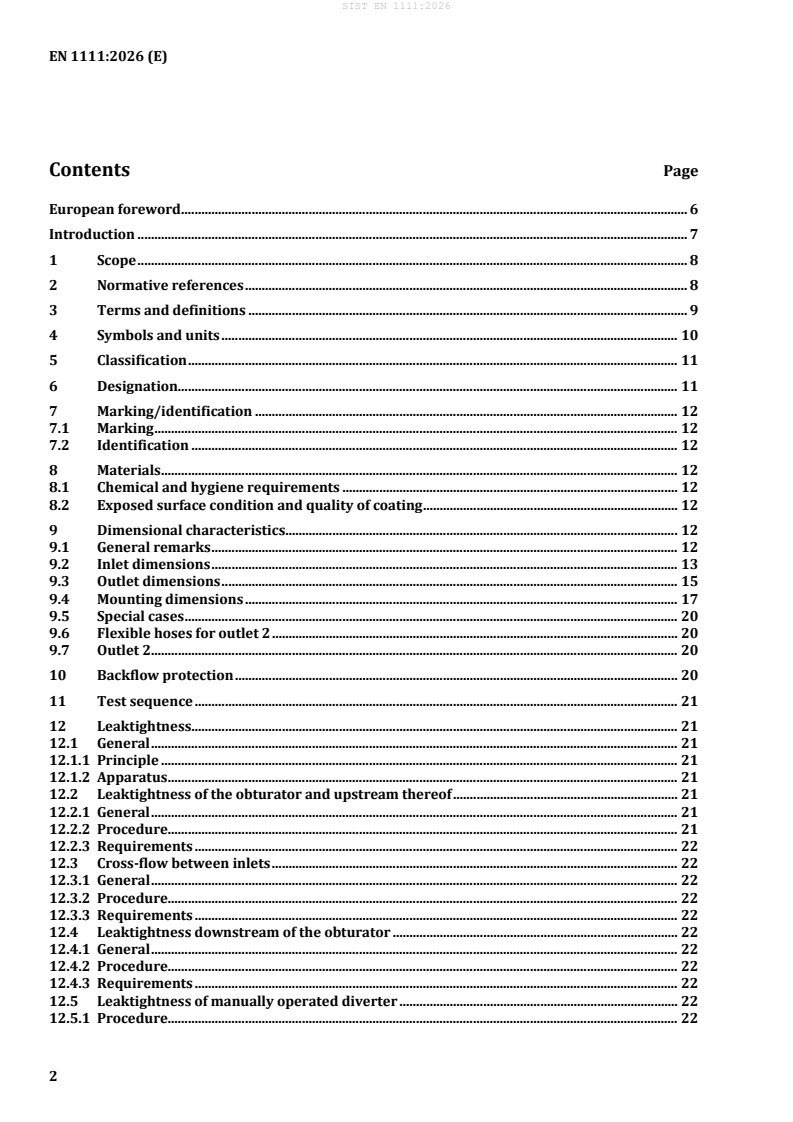
Contents Page
European foreword . 6
Introduction . 7
1 Scope . 8
2 Normative references . 8
3 Terms and definitions . 9
4 Symbols and units . 10
5 Classification . 11
6 Designation. 11
7 Marking/identification . 12
7.1 Marking . 12
7.2 Identification . 12
8 Materials . 12
8.1 Chemical and hygiene requirements . 12
8.2 Exposed surface condition and quality of coating . 12
9 Dimensional characteristics. 12
9.1 General remarks . 12
9.2 Inlet dimensions . 13
9.3 Outlet dimensions . 15
9.4 Mounting dimensions . 17
9.5 Special cases . 20
9.6 Flexible hoses for outlet 2 . 20
9.7 Outlet 2 . 20
10 Backflow protection . 20
11 Test sequence . 21
12 Leaktightness . 21
12.1 General . 21
12.1.1 Principle . 21
12.1.2 Apparatus . 21
12.2 Leaktightness of the obturator and upstream thereof . 21
12.2.1 General . 21
12.2.2 Procedure. 21
12.2.3 Requirements . 22
12.3 Cross-flow between inlets . 22
12.3.1 General . 22
12.3.2 Procedure. 22
12.3.3 Requirements . 22
12.4 Leaktightness downstream of the obturator . 22
12.4.1 General . 22
12.4.2 Procedure. 22
12.4.3 Requirements . 22
12.5 Leaktightness of manually operated diverter . 22
12.5.1 Procedure. 22
12.5.2 Requirement . 23
12.6 Leaktightness of diverters with automatic return . 23
12.6.1 Procedure . 23
12.6.2 Requirement . 23
13 Performance . 23
13.1 General . 23
13.1.1 Initial settings . 23
13.1.2 Apparatus . 24
13.1.3 Procedure . 24
13.2 Determination of flow rate . 25
13.2.1 Principle . 25
13.2.2 Procedure . 25
13.2.3 Evaluation of the results . 26
13.2.4 Requirements . 26
13.3 Sensitivity . 26
13.3.1 General . 26
13.3.2 Principle . 26
13.3.3 Procedure . 26
13.3.4 Evaluation of results . 27
13.3.5 Requirements . 27
13.4 Fidelity . 28
13.4.1 General . 28
13.4.2 Principle . 28
13.4.3 Procedure . 28
13.4.4 Evaluation of results . 28
13.4.5 Requirements . 28
13.5 Temperature stability . 29
13.5.1 Temperature control operation . 29
13.5.2 Flow rate reduction . 30
13.5.3 Cold supply failure and restoration . 31
13.5.4 Supply pressure variation . 32
13.5.5 Supply temperature variation . 33
13.5.6 Temperature override stops . 35
14 Pressure resistance . 36
14.1 General . 36
14.2 Apparatus . 36
14.3 Testing of mechanical performance of the thermostatic mixing valve upstream of the
obturator in the closed position . 36
14.3.1 Procedure . 36
14.3.2 Requirement . 36
14.4 Mechanical behaviour downstream of the obturator – Obturator in the open position . 36
14.4.1 Procedure . 36
14.4.2 Requirement . 36
15 Torsional resistance of the operating controls . 37
15.1 General . 37
15.2 Test method . 37
15.2.1 Principle . 37
15.2.2 Apparatus . 37
15.2.3 Procedure . 37
16 Mechanical endurance characteristics . 37
16.1 General . 37
16.2 Endurance test for single sequential control device . 38
16.2.1 Principle . 38
16.2.2 Apparatus . 38
16.2.3 Procedure. 38
16.2.4 Requirement . 38
16.3 Endurance test for on/off flow control device operated by rotating the control handle
............................................................................................................................................................................. 39
16.3.1 Principle . 39
16.3.2 General . 39
16.4 Endurance test for on/off flow control device, combined with diverter mechanism . 39
16.4.1 Principle . 39
16.4.2 Apparatus . 39
16.4.3 Procedure. 39
16.4.4 Requirement . 40
16.5 Endurance test for other on-off flow control device . 40
16.5.1 Principle . 40
16.5.2 Apparatus . 40
16.5.3 Procedure. 40
16.5.4 Requirement . 40
16.6 Mechanical endurance of diverters of thermostatic mixing valves . 40
16.6.1 General . 40
16.6.2 Test method . 41
16.6.3 Requirements . 42
16.7 Mechanical endurance of swivel spouts . 42
16.7.1 General . 42
16.7.2 Test method . 42
16.7.3 Requirements . 42
16.8 Thermal Element . 43
16.8.1 Principle . 43
16.8.2 Temperature adjustable valves (Type 1, 2, 4) . 43
16.8.3 Temperature set valves (Type 5) . 43
16.8.4 Other valves with special control devices (Type 6) . 44
17 Acoustic characteristics . 44
17.1 General . 44
17.2 Procedure. 44
17.2.1 Fitting and operating conditions for thermostatic mixing valves . 44
17.2.2 Test method . 44
17.3 Requirements . 45
17.3.1 Expression of results . 45
17.3.2 Determination of acoustic groups . 45
17.3.3 Flow rate classes (thermostatic mixing valves Type 1, 2, 3) . 45
Annex A (normative) Test set-up descriptions. 46
A.1 General . 46
A.2 Inlet pipework . 46
A.2.1 Thermostat endurance. 46
A.2.2 Performance . 47
A.3 Outlet pipework . 47
A.3.1 General . 47
A.3.2 Outlet for valves without integral atmospheric discharge spouts . 48
A.3.3 Outlet for valves with atmospheric discharge nozzles . 51
Annex B (informative) Measurements . 52
B.1 Pressure . 52
B.2 Flow . 52
B.3 Temperature . 52
B.3.1 Mounting . 52
B.3.2 Accuracy . 52
B.3.3 Response time . 52
B.4 Angular position . 52
B.5 Duration of transients . 52
Annex C (informative) Temperature transient . 55
C.1 Positive temperature transient . 55
C.2 Negative temperature transient . 56
Annex D (informative) Acoustic classification (example) . 57
D.1 TMV with nozzle . 57
D.2 TMV with shower or shower head outlet . 57
D.3 TMV with nozzle and shower or shower head outlet . 57
Bibliography . 59
European foreword
This document (EN 1111:2026) has been prepared by Technical Committee CEN/TC 164 “Water Supply”,
the secretariat of which is held by AFNOR.
This European Standard shall be given the status of a national standard, either by publication of an
identical text or by endorsement, at the latest by September 2026, and conflicting national standards shall
be withdrawn at the latest by September 2026.
Attention is drawn to the possibility that some of the elements of this document may be the subject of
patent rights. CEN shall not be held responsible for identifying any or all such patent rights.
This document supersedes EN 1111:2017.
— to Clause 13 clarifications of the requirements with new figures being introduced;
— the standard was revised editorially.
Any feedback and questions on this document should be directed to the users’ national standards body.
A complete listing of these bodies can be found on the CEN website.
According to the CEN-CENELEC Internal Regulations, the national standards organisations of the
following countries are bound to implement this European Standard: Austria, Belgium, Bulgaria, Croatia,
Cyprus, Czech Republic, Denmark, Estonia, Finland, France, Germany, Greece, Hungary, Iceland, Ireland,
Italy, Latvia, Lithuania, Luxembourg, Malta, Netherlands, Norway, Poland, Portugal, Republic of North
Macedonia, Romania, Serbia, Slovakia, Slovenia, Spain, Sweden, Switzerland, Türkiye and the United
Kingdom.
Introduction
In respect of potential adverse effects on the quality of water intended for human consumption, caused
by the product covered by this document, it provides no information as to whether the product can be
used without restriction in any of the Member state of the EU or EFTA.
NOTE While awaiting the adoption of verifiable European criteria, attention is also drawn to national
regulations that can apply.
1 Scope
This document specifies general construction, performance and material requirements for PN 10
thermostatic mixing valves (TMV) and includes test methods for the verification of mixed water
temperature performance at the point of use below 45 °C. This does not exclude the selection of higher
temperatures where available. When these devices are used to provide anti-scald protection for children,
elderly and disabled persons, the mixed water temperature needs to be set at a suitable temperature
(body temperature approximately 38 °C). In particular children are at risk to scalding at lower
temperatures than adults. This does not obviate the need for supervision of young children.
It applies to valves intended for use on sanitary appliances in kitchens, washrooms (incl. all rooms with
sanitary tapware, e.g. toilets and cloakrooms) and bath rooms operating under the conditions specified
in Table 1.
This document allows TMVs to supply a single outlet or a small number of outlets in a “domestic”
application (e.g. one valve controlling a shower, bath, basin and/or bidet), excluding valves specifically
designed for supplying a large number of outlets (i.e. for institutional use).
The tests described are type tests (laboratory tests) and not quality control tests carried out during
manufacture.
Table 1 — Conditions of use
Supply Operating range
limits recommended
Pressure
-Static ≤ 1 MPa [≤ 10 bar]
-Dynamic ≥ 0,05 MPa [≥0,5 bar] (0,1 to 0,5) MPa [(1 to 5) bar]
Temperature
-Hot ≤ 70 °C ≤ 65 °C
-Cold ≤ 25 °C —
2 Normative references
The following documents are referred to in the text in such a way that some or all of their content
constitutes requirements of this document. For dated references, only the edition cited applies. For
undated references, the latest edition of the referenced document (including any amendments) applies.
EN 200, Sanitary tapware — Single taps and combination taps for water supply systems of type 1 and
type 2 — General technical specification
EN 246, Sanitary tapware — General specifications for aerators
EN 248, Sanitary tapware — General specification for electrodeposited coatings of Ni-Cr
EN 1057, Copper and copper alloys — Seamless, round copper tubes for water and gas in sanitary and
heating applications
EN 1112, Sanitary tapware — Shower outlets for sanitary tapware for water supply systems of type 1 and
type 2 — General technical specification
EN 1113, Sanitary tapware — Shower hoses for sanitary tapware for water supply systems of type 1 and
type 2 — General technical specification
EN 1717, Protection against pollution of potable water in water installations and general requirements of
devices to prevent pollution by backflow
EN 13618, Flexible hose assemblies in drinking water installations — Functional requirements and test
methods
EN 13959, Anti-pollution check valves — DN 6 to DN 250 inclusive family E, type A, B, C and D
EN 14506, Devices to prevent pollution by backflow of potable water — Automatic diverter — Family H,
type C
EN 16145, Sanitary tapware — Extractable outlets for sink and basin mixers — General technical
specification
EN 60584 (all parts), Thermocouples (IEC 60584)
EN ISO 228-1, Pipe threads where pressure-tight joints are not made on the threads — Part 1: Dimensions,
tolerances and designation (ISO 228-1)
EN ISO 3822-1, Acoustics — Laboratory tests on noise emission from appliances and equipment used in
water supply installations — Part 1: Method of measurement (ISO 3822-1)
EN ISO 3822-2, Acoustics — Laboratory tests on noise emission from appliances and equipment used in
water supply installations — Part 2: Mounting and operating conditions for draw-off taps and mixing valves
(ISO 3822-2)
EN ISO 3822-3, Acoustics — Laboratory tests on noise emission from appliances and equipment used in
water supply installations — Part 3: Mounting and operating conditions for in-line valves and appliances
(ISO 3822-3)
EN ISO 3822-4:1997, Acoustics — Laboratory tests on noise emission from appliances and equipment used
in water supply installations — Part 4: Mounting and operating conditions for special appliances
(ISO 3822-4)
3 Terms and definitions
For the purposes of this document, the following terms and definitions apply.
ISO and IEC maintain terminology databases for use in standardization at the following addresses:
— ISO Online browsing platform: available at https://www.iso.org/obp/
— IEC Electropedia: available at https://www.electropedia.org/
3.1
thermostatic mixing valve
TMV
valve, with one or more outlets, which mixes hot and cold water and automatically controls the mixed
water to a selected temperature
3.2
fidelity
reproducibility and accuracy of temperature selection
3.3
obturator
movable component of the valve whose position in the fluid flow path permits, restricts or obstructs the
fluid flow
Note 1 to entry: The flow rate between no flow and maximum flow conditions can be affected either by the same
control device or a separate flow control device, where fitted.
3.4
outlet 1
default position of the diverter
3.5
outlet 2
outlet(s) other than outlet 1
4 Symbols and units
For the purposes of this document, the symbols and units given in Table 2 apply.
Table 2 — Symbols and units
Symbol Characteristic Unit
D internal diameter of tube or casing mm
f thickness of the annular slit of Type C pressure take-off mm
tees
i width of the annular slit of Type C pressure take-off tees mm
ϑ temperature peak to peak °C
PP
p pressure of cold water supply MPa (bar)
c
p pressure of hot water supply MPa (bar)
h
Q flow rate of cold water l/s (l/min)
c
Q flow rate of hot water l/s (l/min)
h
Q + Q flow rate of mixed water l/s (l/min)
c h
t time when equilibrium is disturbed s
0, 1, 2, 3…
T temperature of cold water supply °C
c
T temperature of hot water supply °C
h
T temperature of mixed water °C
m
T Temperature in °C °C
0, 1, 2, 3,
…
Symbol Characteristic Unit
x distance mm
x distance mm
ϑ Set temperature °C
ϑ Mixed water temperature °C
mix
5 Classification
This classification covers the following types of TMVs:
a) Type 1 – Single control: valves with a single control device regulating flow and temperature (actuator
movement in two planes);
b) Type 2 –Dual control: valves with separate control devices regulating flow and temperature;
c) Type 3 – Single sequential control: valves with a single control operating through a predetermined
sequence of flow and temperature. These shall have a shut-off device (actuator movement in one
plane);
d) Type 4 – TMVs without flow control device;
e) Type 5 – Preset: valves not adjustable by the user of a sanitary appliance;
f) Type 6 – Other: valves with special control devices.
6 Designation
TMVs covered by this document are designated as follows:
a) its nominal inlet size, with or without diverter (see Table 3);
b) type of body (see Table 3);
c) type of outlet (see Table 3);
d) the sanitary appliance on which it shall be used (Table 3);
e) the method of mounting (see Table 3);
f) its acoustic group and flow rate classes (Clause 17 and Clause 13);
g) the reference to this document (EN 1111).
EXAMPLE TMV 1/2 with diverter, exposed body, fixed nozzle outlet bath/shower, horizontal mounting,
group I class C/B EN 1111.
Table 3 — Designation
Type of tap TMV with or without diverter and type of diverter (if
applicable)
Type of body Single- or multi-hole, exposed, or concealed
Type of outlet Fixed, moveable spout, with or without aerator
Intended use Basin, bidet, sink, bath or shower
Mounting method Horizontal or vertical surfaces
Acoustic group and classification Group I, or group II, or unclassified/U
Flow rate class Z, A, S, B, C, D
Reference to this document EN 1111
Water saving properties Yes / No
7 Marking/identification
7.1 Marking
TMVs shall be permanently and legibly marked with the manufacturer's or agent's name or identification
on the body or handle.
For water saving mixing valves, appropriate information to installers and users shall be provided.
7.2 Identification
The temperature control device for the valve shall be identified by means of a scale or symbols or colours
or any combination thereof.
TMVs shall be legibly marked to indicate cold / hot inlets.
NOTE Exposed valves need only one identification of cold or hot inlet.
8 Materials
8.1 Chemical and hygiene requirements
All materials coming into contact with water intended for human consumption shall present no health
risk nor cause any change to the water in terms of quality, appearances, smell or taste.
8.2 Exposed surface condition and quality of coating
Exposed surfaces shall comply with the scope and requirements of EN 248.
9 Dimensional characteristics
9.1 General remarks
The design and construction of components without defined dimensions permits various design solutions
to be adopted by the manufacturer.
Special cases are covered in 9.5.
9.2 Inlet dimensions
Inlet dimensions shall be as specified in Table 4, Figure 1, Figure 2 and Figure 3.
Table 4 — Inlet dimensions (Single- and multi-hole combination TMVs)
Dimensions (mm) Comments
Shank, Union, Captive nut
A G 1/2 B In accordance with EN ISO 228-1
(When the no-go gauge fits, the thread form
Shank, Union
should be considered acceptable as long as
A 1 G 3/4 B
the function of the threaded joint can be
verified.)
A 2 ≥ 9 Captive nut
Useful thread length
Shank, Union (straight
A 3 ≥ 15
or eccentric)
Connecting centres
a
(150 ± 1) Supply connection, Straight unions
G
2 – hole wall mounted
with eccentric unions (extension of this
G 1 (140 to 160)
range is permitted)
a
(150 ± 1)
G
Multi-hole
G 2 (200 ± 3,5)
combination TMV
G 3 (180 ± 5)
Inlet connections
+0,2
(12,3 )
N 1
Type A size 1/2
N 2 ≥ 5
N 1 (15,2 ± 0,05) mm
Type B size 1/2
30° chamfer/flat 0,3
N 2 ≥ 13
+0,3
(14,7 )
N 1
Type C size 1/2
N 2 6,4
+0,3
N 1 (19,9 )
Type C size 3/4
N 2 ≥ 6,4
∅ 10 , 12 , 15 mm, Plain end, male or
T Copper tube(s) or flexible hose(s)
G 1/2 or G 3/8 female
Tube(s) or flexible hose(s)
U ≥ 350
Flexible hoses in accordance with EN 13618
a
Other dimensions are permissible (for replacement) when market tradition requires it, provided the
manufacturer specifies the actual dimension in literature to avoid confusion with the standard dimension – which
can be achieved using an excentric connection.
Key
1 flexible hose
2 plain tube
Figure 1 — Inlet dimensions – Single-hole TMVs
Figure 2 — Multi-hole combination TMVs
Type A Type B Type C
Figure 3 — Supply connections for TMVs and remote outlets
9.3 Outlet dimensions
Outlet dimensions shall be as specified in Table 5, Figure 4, Figure 5, Figure 6.
When nozzle outlets are used with aerator conforming with EN 246, the manufacturing tolerances chosen
for the connecting threads of the outlets shall be compatible with those of the connecting threads of the
aerator, in order to ensure interchangeability.
Table 5 — Outlet dimensions (Remote outlets, single- and multi-hole combination TMVs)
a
Comments
Dimensions (mm)
Dimension from lowest point of the outlet
Outlet orifice
orifice including any aerator or flow
straightener, to the mounting surface.
Lowest point
E ≥ 25
NOTE Regulations exist in some EU Member
All TMVs and outlets States that set dimensions greater than those
indicated in this document.
Horizontal mounted
D 1 ≥ 90 —
combination TMV
Wall mounted
combination TMV
D 3 ≥ 115 —
Separate spout
A G 1/2 B In accordance with EN ISO 228-1
(When the no-go gauge fits, the thread form
Remote outlet
should be considered acceptable as long as the
A 1 G 3/4 B
function of the threaded joint can be verified.)
A 4 ≥ 7,5 Useful thread length
Outlet 2
A 5 ≥ 9,5 Free length of connection
NOTE Nozzle outlets which are not in accordance with EN 246 are covered by 9.5.
a
Nozzle outlets to accept aerator shall be in accordance with EN 246.
Figure 4 — Remote outlet
Figure 5 — Single-hole combination of remote outlet
Figure 6 — Bath shower combination or remote outlet
9.4 Mounting dimensions
Mounting dimensions shall be as specified in Table 6, Figure 7, Figure 8 and Figure 9.
Table 6 — Mounting dimensions (single- and multi-hole TMVs)
Dimensions (mm) Comments
Shank diameter
H 1 ≥ 24 Two-hole TMVs size 1/2 Fixed centres
separate outlet, side spray, three-hole TMV
H 2 ≥ 29
size 1/2 Adjustable centres
Single-hole TMV, two-hole TMV size 1/2 or
3/4
H 3 ≥ 33,5
three-hole TMV size 1/2
Base or flange
J 1
...
Questions, Comments and Discussion
Ask us and Technical Secretary will try to provide an answer. You can facilitate discussion about the standard in here.
Loading comments...