

oSIST prEN 746-2:2020
(Main)Industrial thermoprocessing equipment - Part 2: Safety requirements for combustion and fuel handling systems
General Information
- Abstract
This part of EN 746 specifies the safety requirements for combustion and fuel handling systems that are part of industrial furnaces and associated processing equipment (TPE).
NOTE The general safety requirements common to TPE are provided in prEN 746 1:2020 (See introduction).
This part of EN 746 deals with significant hazards, hazardous situations and events relevant to combustion and fuel handling systems as listed in Annex A, when used as intended and under the conditions foreseen by the manufacturer.
This part of EN 746 covers:
- fuel pipework downstream of and including the manual isolating valve;
- combustion air supply (including oxygen and oxygen enriched combustion air) and flue gas system;
- burner(s), burner system and ignition device;
- functional requirements for safety related control system.
This part of EN 746 applies to any oxidation with air or other gases containing free oxygen of gaseous and liquid fuels or any combustion of them to release thermal energy in TPE.
For thermal or catalytic post combustion and waste incineration, this part of EN 746 applies only to auxiliary burners designed to start-up and/or support the process.
The pressure hazard of the piping and components covered by this part of EN 746 is within the maximum pressure/size relationship of category I as described in normative Annex E.
This part of EN 746 also gives the necessary requirements regarding information for use.
This part of EN 746 does not cover hazards from heating generated by electricity.
This part of EN 746 does not deal with the hazards created by the release of flammable substances from the products processed in the TPE.
This part of EN 746 is not applicable to combustion and fuel handling systems:
- of gas welding and allied processes;
- up-stream of the TPE manual isolating valve.
This part of EN 746 is not applicable to electrical cabling and power cabling upstream of the TPE control panel/protective system.
- Status
- Not Published
- Public Enquiry End Date
- 20-May-2020
- Technical Committee
- I13 - Imaginarni 13
- Current Stage
- 98 - Abandoned project (Adopted Project)
- Start Date
- 21-May-2024
- Due Date
- 26-May-2024
- Completion Date
- 21-May-2024

Overview
oSIST prEN 746-2:2020 is a draft European standard developed by the Slovenian Institute for Standardization (SIST) in alignment with CEN Technical Committee CEN/TC 186. Titled "Industrial thermoprocessing equipment - Part 2: Safety requirements for combustion and fuel handling systems", this standard outlines essential safety requirements for combustion and fuel handling systems used in industrial furnaces and associated processing equipment (TPE). Its aim is to minimize hazards related to the use and handling of gaseous and liquid fuels in thermoprocessing environments.
Focusing on significant hazards, hazardous situations, and events that may occur during normal and foreseeable abnormal operation, the standard addresses aspects such as the safe design and operation of fuel pipework, burners, ignition devices, combustion air supply, flue gas management, and safety-related control systems. It applies to processes utilizing oxidation with air or gases containing free oxygen, excluding systems for gas welding, electricity-generated heating, and processes upstream of the manual isolating valve.
Key Topics
oSIST prEN 746-2:2020 covers several critical safety areas for combustion and fuel handling systems in industrial thermoprocessing operations:
- Fuel Pipework Safety: Requirements for pipework downstream of and including the manual isolating valve, including material selection, tightness testing, and pressure resistance.
- Combustion Air and Flue Gas Systems: Safe supply of combustion air (including oxygen-enriched air), maintaining safe gas/air ratios, and ensuring proper evacuation of flue gases.
- Burners and Ignition Devices: Functional and safety requirements for burner systems, including safety-related automatic control systems and reliable ignition procedures.
- Safety Control Systems: Integration of control systems to ensure that fuels are supplied, ignited, and shut off safely. This includes requirements for risk assessment and compliance with functional safety standards (e.g., EN ISO 13849 and EN 61508).
- Pressure Relief and Flame Arrestors: Criteria for equipping pipework with relief devices and flame arrestors to handle overpressure and prevent backflow of flames.
- Hazard Management: Comprehensive identification and mitigation of significant hazards as listed in Annex A of the standard.
- Information for Use: Necessary requirements for marking, documentation, instruction handbooks, and maintenance guidance for safe operation.
Applications
The requirements specified in oSIST prEN 746-2:2020 are essential for organizations involved with:
- Industrial Furnaces: All types of industrial furnaces and processing equipment relying on combustion of gaseous or liquid fuels to generate thermal energy.
- Thermal and Catalytic Post-combustion Units: Applications where auxiliary burners are used for start-up or supporting the combustion process, such as in waste incineration or emission control systems.
- Process Equipment Design: Manufacturers designing, building, or retrofitting thermoprocessing equipment must apply these safety requirements to ensure compliance and minimize risks for operators.
- Operations and Maintenance: Plant operators, maintenance personnel, and safety managers must adhere to the standard's requirements for testing, inspection, and safe handling, thus supporting workplace safety and regulatory compliance.
Related Standards
For comprehensive safety and integration, the following related standards should be consulted:
- prEN 746-1:2020: General safety requirements for industrial thermoprocessing equipment.
- prEN 746-11:2020: Requirements for protective systems associated with TPE.
- EN ISO 12100:2010: Risk assessment and risk reduction for machinery.
- EN ISO 13849 and EN 61508: Functional safety for control systems.
- EN 161, EN 88-1/2, EN 125, EN 1854: Specific safety components such as shut-off valves, pressure regulators, and flame supervision devices.
By adopting oSIST prEN 746-2:2020, manufacturers and operators support a safer industrial environment, reduce the risk of accidents, and enhance the reliability of combustion and fuel handling systems in thermoprocessing settings. The standard is critical for those seeking compliance with European regulations and best practices in industrial furnace and heat technology applications.
Relations
- Effective Date
- 18-Jan-2023
- Effective Date
- 08-Aug-2018
Get Certified
Connect with accredited certification bodies for this standard

DVS-ZERT GmbH
German welding certification society.
CARES (UK Certification Authority for Reinforcing Steels)
UK certification for reinforcing steels and construction.
EWF/IIW (European/International Welding Federation)
International welding personnel certification.
Sponsored listings
Frequently Asked Questions
oSIST prEN 746-2:2020 is a draft published by the Slovenian Institute for Standardization (SIST). Its full title is "Industrial thermoprocessing equipment - Part 2: Safety requirements for combustion and fuel handling systems". This standard covers: This part of EN 746 specifies the safety requirements for combustion and fuel handling systems that are part of industrial furnaces and associated processing equipment (TPE). NOTE The general safety requirements common to TPE are provided in prEN 746 1:2020 (See introduction). This part of EN 746 deals with significant hazards, hazardous situations and events relevant to combustion and fuel handling systems as listed in Annex A, when used as intended and under the conditions foreseen by the manufacturer. This part of EN 746 covers: - fuel pipework downstream of and including the manual isolating valve; - combustion air supply (including oxygen and oxygen enriched combustion air) and flue gas system; - burner(s), burner system and ignition device; - functional requirements for safety related control system. This part of EN 746 applies to any oxidation with air or other gases containing free oxygen of gaseous and liquid fuels or any combustion of them to release thermal energy in TPE. For thermal or catalytic post combustion and waste incineration, this part of EN 746 applies only to auxiliary burners designed to start-up and/or support the process. The pressure hazard of the piping and components covered by this part of EN 746 is within the maximum pressure/size relationship of category I as described in normative Annex E. This part of EN 746 also gives the necessary requirements regarding information for use. This part of EN 746 does not cover hazards from heating generated by electricity. This part of EN 746 does not deal with the hazards created by the release of flammable substances from the products processed in the TPE. This part of EN 746 is not applicable to combustion and fuel handling systems: - of gas welding and allied processes; - up-stream of the TPE manual isolating valve. This part of EN 746 is not applicable to electrical cabling and power cabling upstream of the TPE control panel/protective system.
This part of EN 746 specifies the safety requirements for combustion and fuel handling systems that are part of industrial furnaces and associated processing equipment (TPE). NOTE The general safety requirements common to TPE are provided in prEN 746 1:2020 (See introduction). This part of EN 746 deals with significant hazards, hazardous situations and events relevant to combustion and fuel handling systems as listed in Annex A, when used as intended and under the conditions foreseen by the manufacturer. This part of EN 746 covers: - fuel pipework downstream of and including the manual isolating valve; - combustion air supply (including oxygen and oxygen enriched combustion air) and flue gas system; - burner(s), burner system and ignition device; - functional requirements for safety related control system. This part of EN 746 applies to any oxidation with air or other gases containing free oxygen of gaseous and liquid fuels or any combustion of them to release thermal energy in TPE. For thermal or catalytic post combustion and waste incineration, this part of EN 746 applies only to auxiliary burners designed to start-up and/or support the process. The pressure hazard of the piping and components covered by this part of EN 746 is within the maximum pressure/size relationship of category I as described in normative Annex E. This part of EN 746 also gives the necessary requirements regarding information for use. This part of EN 746 does not cover hazards from heating generated by electricity. This part of EN 746 does not deal with the hazards created by the release of flammable substances from the products processed in the TPE. This part of EN 746 is not applicable to combustion and fuel handling systems: - of gas welding and allied processes; - up-stream of the TPE manual isolating valve. This part of EN 746 is not applicable to electrical cabling and power cabling upstream of the TPE control panel/protective system.
oSIST prEN 746-2:2020 is classified under the following ICS (International Classification for Standards) categories: 25.180.01 - Industrial furnaces in general. The ICS classification helps identify the subject area and facilitates finding related standards.
oSIST prEN 746-2:2020 has the following relationships with other standards: It is inter standard links to SIST EN 746-2:2010, SIST EN 746-2:2010. Understanding these relationships helps ensure you are using the most current and applicable version of the standard.
oSIST prEN 746-2:2020 is associated with the following European legislation: EU Directives/Regulations: 2006/42/EC; Standardization Mandates: M/396. When a standard is cited in the Official Journal of the European Union, products manufactured in conformity with it benefit from a presumption of conformity with the essential requirements of the corresponding EU directive or regulation.
oSIST prEN 746-2:2020 is available in PDF format for immediate download after purchase. The document can be added to your cart and obtained through the secure checkout process. Digital delivery ensures instant access to the complete standard document.
Standards Content (Sample)
SLOVENSKI STANDARD
01-maj-2020
Industrijska termoprocesna oprema - 2. del: Varnostne zahteve za sisteme
zgorevanja in sisteme za ravnanje z gorivom
Industrial thermoprocessing equipment - Part 2: Safety requirements for combustion and
fuel handling systems
Industrielle Thermoprozessanlagen und dazugehörige Prozesskomponenten -
Sicherheitsanforderungen - Teil 2: Feuerungen und Brennstoffführungssysteme (ohne
Feststoffe)
Equipements thermiques industriels - Partie 2: Prescription de sécurité concernant la
combustion et la manutention des combustibles
Ta slovenski standard je istoveten z: prEN 746-2
ICS:
25.180.01 Industrijske peči na splošno Industrial furnaces in general
2003-01.Slovenski inštitut za standardizacijo. Razmnoževanje celote ali delov tega standarda ni dovoljeno.
DRAFT
EUROPEAN STANDARD
NORME EUROPÉENNE
EUROPÄISCHE NORM
February 2020
ICS 25.180.01 Will supersede EN 746-2:2010
English Version
Industrial thermoprocessing equipment - Part 2: Safety
requirements for combustion and fuel handling systems
Equipements thermiques industriels - Partie 2: Industrielle Thermoprozessanlagen und dazugehörige
Prescriptions de sécurité concernant la combustion et Prozesskomponenten - Sicherheitsanforderungen - Teil
la manutention des combustibles 2: Feuerungen und Brennstoffführungssysteme (ohne
Feststoffe)
This draft European Standard is submitted to CEN members for enquiry. It has been drawn up by the Technical Committee
CEN/TC 186.
If this draft becomes a European Standard, CEN members are bound to comply with the CEN/CENELEC Internal Regulations
which stipulate the conditions for giving this European Standard the status of a national standard without any alteration.
This draft European Standard was established by CEN in three official versions (English, French, German). A version in any other
language made by translation under the responsibility of a CEN member into its own language and notified to the CEN-CENELEC
Management Centre has the same status as the official versions.
CEN members are the national standards bodies of Austria, Belgium, Bulgaria, Croatia, Cyprus, Czech Republic, Denmark, Estonia,
Finland, France, Germany, Greece, Hungary, Iceland, Ireland, Italy, Latvia, Lithuania, Luxembourg, Malta, Netherlands, Norway,
Poland, Portugal, Republic of North Macedonia, Romania, Serbia, Slovakia, Slovenia, Spain, Sweden, Switzerland, Turkey and
United Kingdom.
Recipients of this draft are invited to submit, with their comments, notification of any relevant patent rights of which they are
aware and to provide supporting documentation.
Warning : This document is not a European Standard. It is distributed for review and comments. It is subject to change without
notice and shall not be referred to as a European Standard.
EUROPEAN COMMITTEE FOR STANDARDIZATION
COMITÉ EUROPÉEN DE NORMALISATION
EUROPÄISCHES KOMITEE FÜR NORMUNG
CEN-CENELEC Management Centre: Rue de la Science 23, B-1040 Brussels
© 2020 CEN All rights of exploitation in any form and by any means reserved Ref. No. prEN 746-2:2020 E
worldwide for CEN national Members.
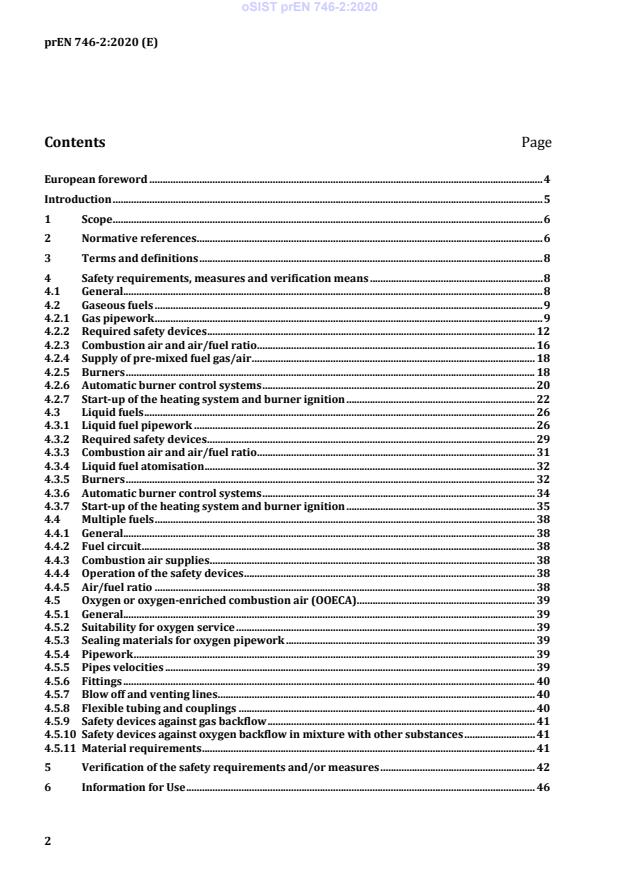
Contents Page
European foreword . 4
Introduction . 5
1 Scope . 6
2 Normative references . 6
3 Terms and definitions . 8
4 Safety requirements, measures and verification means . 8
4.1 General. 8
4.2 Gaseous fuels . 9
4.2.1 Gas pipework . 9
4.2.2 Required safety devices . 12
4.2.3 Combustion air and air/fuel ratio . 16
4.2.4 Supply of pre-mixed fuel gas/air . 18
4.2.5 Burners . 18
4.2.6 Automatic burner control systems . 20
4.2.7 Start-up of the heating system and burner ignition . 22
4.3 Liquid fuels . 26
4.3.1 Liquid fuel pipework . 26
4.3.2 Required safety devices . 29
4.3.3 Combustion air and air/fuel ratio . 31
4.3.4 Liquid fuel atomisation . 32
4.3.5 Burners . 32
4.3.6 Automatic burner control systems . 34
4.3.7 Start-up of the heating system and burner ignition . 35
4.4 Multiple fuels . 38
4.4.1 General. 38
4.4.2 Fuel circuit . 38
4.4.3 Combustion air supplies . 38
4.4.4 Operation of the safety devices . 38
4.4.5 Air/fuel ratio . 38
4.5 Oxygen or oxygen-enriched combustion air (OOECA). 39
4.5.1 General. 39
4.5.2 Suitability for oxygen service . 39
4.5.3 Sealing materials for oxygen pipework . 39
4.5.4 Pipework . 39
4.5.5 Pipes velocities . 39
4.5.6 Fittings . 40
4.5.7 Blow off and venting lines . 40
4.5.8 Flexible tubing and couplings . 40
4.5.9 Safety devices against gas backflow . 41
4.5.10 Safety devices against oxygen backflow in mixture with other substances . 41
4.5.11 Material requirements . 41
5 Verification of the safety requirements and/or measures . 42
6 Information for Use . 46
6.1 General . 46
6.2 Marking . 47
6.3 Instruction handbook . 47
6.3.1 General . 47
6.3.2 Description of equipment . 47
6.3.3 Inspection procedures . 47
6.3.4 Commissioning, start-up and operating procedures . 48
6.3.5 Shut-down procedures . 48
6.3.6 Maintenance procedures . 48
6.3.7 Documentation . 49
Annex A (informative) List of significant hazards . 50
Annex B (informative) Typical examples of fuels . 52
B.1 Classification of fuels . 52
B.2 Gaseous fuels . 52
B.3 Liquid fuels . 52
Annex C (informative) Typical example of piping and components . 53
Annex D (informative) Methods for burner start-up . 64
Annex E (normative) Maximum allowed pressure . 72
Annex F (informative) Examples for the determination of safety integrity level (SIL) using the
risk graph method . 77
Annex ZA (informative) Relationship between this European Standard and the essential
requirements of Directive 2006/42/EC aimed to be covered . 90
Bibliography . 92
European foreword
This document (prEN 746-2:2020) has been prepared by Technical Committee CEN/TC 186 “Industrial
Thermoprocess Equipment - Safety”, the secretariat of which is held by DIN.
This document is currently submitted to the CEN Enquiry.
This document will supersede EN 746-2:2010.
Based on EN 746-2:2010, ISO 13577-2 was developed in 2016. This ISO standard differs considerably
from the original EN 746-2:2010. The contents of this completely renewed prEN 746-2:2020 are based
on ISO 13577-2:2016.
In contrast to EN 746-2:2010, this prEN 746-2:2020 no longer contains solid fuels. These will be covered
in a separate standard EN 746-12.
This document has been prepared under a mandate given to CEN by the European Commission and the
European Free Trade Association, and supports essential requirements of EU Directive(s).
For relationship with EU Directive(s), see informative Annex ZA, which is an integral part of this
document.
Introduction
This document is a type-C standard as defined in EN ISO 12100:2010.
The machinery concerned and the extent to which hazards, hazardous situations or hazardous events are
covered, is indicated in the Scope of this document.
When requirements of this type-C standard are different from those which are stated in type-A or -B
standards, the requirements of this type-C standard take precedence over the requirements of the other
standards, for machines that have been designed and built according to the requirements of this type-C
standard.
This part of EN 746 assumes that the equipment is not creating any potentially explosive atmosphere and
is located in a normally ventilated area.
1) 2)
Compliance with product standards, e.g. EN 267 or EN 676 is not sufficient to ensure the minimum
safety requirements for industrial furnaces and associated processing equipment (TPE). This part of
EN 746 will always have priority for TPE.
Industrial furnaces and associated processing equipment (TPE) generally consists of the following
components:
— processing chamber (e.g. steel construction with lining and/or refractory);
— heating systems;
— protective system;
— control and instrumentation system / operator-control level.
prEN 746-1:2020 provides the general safety requirements common to TPE. This part of EN 746 details
in addition specific safety requirements for combustion and fuel handling systems that are part of TPE as
listed in the Scope.
NOTE As stated in its scope, prEN 746-1:2020 does not cover blast furnaces, converters (in steel plants),
boilers, fired heaters (including reformer furnaces or cracking furnaces) in the petrochemical and chemical
industries and equipment not covered by EN ISO 12100:2010.
The requirements for protective systems are specified in prEN 746-11:2020.
If a general requirement of prEN 746-1:2020 counters requirements in this part of EN 746, the
requirements of this part of EN 746 take precedence.
The requirements for reducing hazards from noise are given in prEN 746-1:2020.
It is assumed that TPE will only be operated and maintained by trained personnel.
1) Note: Reference in ISO 13577-2 is: ISO 22967
2) Note: Reference in ISO 13577-2 is: ISO 22968
1 Scope
This part of EN 746 specifies the safety requirements for combustion and fuel handling systems that are
part of industrial furnaces and associated processing equipment (TPE).
NOTE The general safety requirements common to TPE are provided in prEN 746-1:2020 (See introduction).
This part of EN 746 deals with significant hazards, hazardous situations and events relevant to
combustion and fuel handling systems as listed in Annex A, when used as intended and under the
conditions foreseen by the manufacturer.
This part of EN 746 covers:
— fuel pipework downstream of and including the manual isolating valve;
— combustion air supply (including oxygen and oxygen enriched combustion air) and flue gas system;
— burner(s), burner system and ignition device;
— functional requirements for safety related control system.
This part of EN 746 applies to any oxidation with air or other gases containing free oxygen of gaseous and
liquid fuels or any combustion of them to release thermal energy in TPE.
For thermal or catalytic post combustion and waste incineration, this part of EN 746 applies only to
auxiliary burners designed to start-up and/or support the process.
The pressure hazard of the piping and components covered by this part of EN 746 is within the maximum
pressure/size relationship of category I as described in normative Annex E.
This part of EN 746 also gives the necessary requirements regarding information for use.
This part of EN 746 does not cover hazards from heating generated by electricity.
This part of EN 746 does not deal with the hazards created by the release of flammable substances from
the products processed in the TPE.
This part of EN 746 is not applicable to combustion and fuel handling systems:
— of gas welding and allied processes;
— up-stream of the TPE manual isolating valve.
This part of EN 746 is not applicable to electrical cabling and power cabling upstream of the TPE control
panel/protective system.
2 Normative references
The following documents are referred to in the text in such a way that some or all of their content
constitutes requirements of this document. For dated references, only the edition cited applies. For
undated references, the latest edition of the referenced document (including any amendments) applies.
ISO 7-1:1994, Pipe threads where pressure-tight joints are made on the threads — Part 1: Dimensions,
tolerances and designation
EN 88-1:2011+A1:2016, Pressure regulators and associated safety devices for gas appliances - Part 1:
Pressure regulators for inlet pressures up to and including 50 kPa
EN 88-2:2007, Pressure regulators and associated safety devices for gas appliances - Part 2: Pressure
regulators for inlet pressures above 500 mbar up to and including 5 bar
EN 125:2010+A1:2015, Flame supervision devices for gas burning appliances - Thermoelectric flame
supervision devices
EN 161:2011+A3:2013, Automatic shut-off valves for gas burners and gas appliances
EN ISO 228-1:2003, Pipe threads where pressure-tight joints are not made on the threads - Part 1:
Dimensions, tolerances and designation (ISO 228-1:2000)
EN 298:2012, Automatic burner control systems for burners and appliances burning gaseous or liquid fuelss
EN 331:2015, Manually operated ball valves and closed bottom taper plug valves for gas installations for
buildings
EN 334:2019, Gas pressure regulators for inlet pressure up to 10 MPa (100 bar)
EN ISO 5175-1:2017, Gas welding equipment - Safety devices - Part 1: Devices incorporating a flame
(flashback) arrestor (ISO 5175-1:2017)
EN ISO 5175-2:2017, Gas welding equipment - Safety devices - Part 2: Devices not incorporating a flame
(flashback) arrestor (ISO 5175-2:2017, Corrected version 2019-01)
prEN 746-1:2020, Industrial thermoprocessing equipment - Part 1: Common safety requirements for
industrial thermoprocessing equipment (ISO 13577-1:2016, modified)
prEN 746-11:2020, Industrial furnace and associated processing equipment - Safety - Part 11: Protective
systems (ISO 13577-4:2014)
EN 1643:2014, Safety and control devices for gas burners and gas burning appliances - Valve proving
systems for automatic shut-off valvess
EN 1854:2010, Pressure sensing devices for gas burners and gas burning appliances
EN ISO 5817:2014, Welding - Fusion-welded joints in steel, nickel, titanium and their alloys (beam welding
excluded) - Quality levels for imperfections (ISO 5817:2014)
ISO 7005-1:2011, Pipe flanges - Part 1: Steel flanges for industrial and general service piping systems
ISO 7005-2:1988, Metallic flanges - Part 2: Cast iron flanges
ISO 7005-3:1988, Metallic flanges - Part 3: Copper alloy and composite flanges
EN ISO 8434-1:2018, Metallic tube connections for fluid power and general use - Part 1: 24° cone
connectors (ISO 8434-1:2018, Corrected version 2018-10)
ISO 8434-2:2007, Metallic tube connections for fluid power and general use - Part 2: 37 degree flared
connectors
ISO 8434-3:2005, Metallic tube connections for fluid power and general use - Part 3: O-ring face seal
connectors
EN 12067-2:2004, Gas/air ratio controls for gas burners and gas burning appliances - Part 2: Electronic
types
EN ISO 12100:2010, Safety of machinery - General principles for design - Risk assessment and risk reduction
(ISO 12100:2010)
EN 14382:2019, Gas safety shut-off devices for inlet pressure up to 10 MPa (100 bar)
ISO 13574:2015, Industrial furnaces and associated processing equipment - Vocabulary
EN ISO 13849 (all parts), Safety of machinery - Safety-related parts of control systems (ISO 13849)
EN ISO 19879:2010, Metallic tube connections for fluid power and general use - Test methods for hydraulic
fluid power connections (ISO 19879:2010)
EN ISO 23553-1:2014, Safety and control devices for oil burners and oil-burning appliances - Particular
requirements - Part 1: Automatic and semi-automatic valves (ISO 23553-1:2014)
EN 60204-1:2006, Safety of machinery - Electrical equipment of machines - Part 1: General requirements
(IEC 60204-1:2005)
EN 61508 (all parts), Functional safety of electrical/electronic/programmable electronic safety-related
systems (IEC 61508)
EN 61511 (all parts), Functional safety - Safety instrumented systems for the process industry sector
(IEC 61511)
EN 62061:2005, Safety of machinery - Functional safety of safety-related electrical, electronic and
programmable electronic control systems (IEC 62061:2005)
3 Terms and definitions
For the purposes of this document, the terms and definitions given in ISO 13574:2015 apply.
ISO and IEC maintain terminological databases for use in standardization at the following addresses:
• ISO Online browsing platform: available at https://www.iso.org/obp
• IEC Electropedia: available at http://www.electropedia.org/
4 Safety requirements, measures and verification means
4.1 General
The safety goals of this part of EN 746 shall include:
— choice of materials such that the construction and operation of the system are not detrimentally
affected. In particular, all the components of the fuel pipework shall be capable of withstanding the
mechanical, chemical and thermal loads to which they can be subjected during normal operation and
foreseeable abnormal operation (e.g. identified during a safety assessment);
— reliable and correct time for ignition of the air/fuel-mixture at the burner(s);
— prevention of unintentional release of unburned fuels;
— shut-off fuel-supply in case of relevant fault;
— protection of pipeline to preclude the propagation of flame in reverse direction;
— prevent firing when the evacuation of flue gas/combustion products is not ensured;
— prevent firing when the process conditions are not in the safe state.
— Electrical circuits shall be designed in accordance with EN 60204-1:2006.
A risk assessment according to EN ISO 12100:2010 shall be carried out. Safety function shall be designed
3)
in accordance with prEN 746-11:2020 , where the use of standards for functional safety EN 62061:2005,
EN ISO 13849 (all parts), EN 61511 (all parts) and EN 61508 (all parts) is included. Informative Annex F
provides information for the determination of the SIL or PL of safety-related functions covered in this
part of EN 746.
4.2 Gaseous fuels
4.2.1 Gas pipework
4.2.1.1 General
The pipework design shall take into account the composition and properties (e.g. pressure, temperature,
corrosiveness, specific gravity) of the fuel gas and the need for venting, purging and cleaning.
The pipework material shall comply with the relevant standards.
Due to durability, steel is the preferred material for pipes and components but where appropriate and
the same safety levels can be achieved then other materials may be utilized. Such materials and conditions
of service shall be specified in the instruction handbook. Oscillations which may cause damage to
pipework, components or safety systems shall be prevented (by firm anchoring and/or use of flexible
couplings).
For steel pipes, compliance with EN ISO 3183, EN 13480-2:2017 (Table A.3), or EN 10255 is considered
appropriate. For copper pipes compliance with EN 1057 is considered appropriate. Copper Soldering
4)
connections shall not be used for gas carrying parts where the temperature could exceed 100°C .
5)
Threaded pipe fittings shall comply with EN 10241 or EN 10242 .
For typical examples of gaseous fuels, see informative Annex B.
4.2.1.2 Connections
Gas pipework connections shall be metallic and shall be of threaded, compression, flanged, welded or
brazed types. The number of connections shall be kept to a minimum.
Threaded connections shall be used only for the following pressure/diameter combinations:
— pressures up to 15 kPa, and diameters up to DN 100
— pressures up to 200 kPa, and diameters up to DN 50
— pressures up to 500 kPa, and diameters up to DN 25
— pressures up to 1 MPa, and diameters up to DN 15
3) Note: Reference in ISO 13577-2 is: ISO 13577-4.
4) Note: Paragraph is not in the body text of ISO 13577-2
5) Note: Paragraph is not in the body text of ISO 13577-2
For fittings according to EN 10242, the following limitations shall be observed:
— fittings must be class “A”;
— maximum allowed pressure is 50 kPa;
— for dimensions DN 25 or less, the maximum pressure is 500 kPa.
Where the equipment has a threaded connection, this thread shall comply with EN ISO 228-1:2003 or
ISO 7-1:1994 as appropriate. The use of threads complying with EN ISO 228-1:2003 is limited to diameter
up to DN 50. In case of threads according to EN ISO 228-1:2003, the tightness shall be ensured by a ring
gasket. Hemp shall not be used in threaded connections unless reinforced with a suitable sealant.
Sealants for threads according to ISO 7-1:1994 shall comply with EN 751-1 or EN 751-2 as appropriate.
Other threaded connections may only be used providing they ensure tight connections and are suitably
identified.
The design of pipework shall be such as to avoid tensile loading of the joints.
Compression fittings shall comply with EN ISO 8434-1:2018, ISO 8434-2:2007 and ISO 8434-3:2005 or
EN ISO 19879:2010. They shall only be used for pressures up to 500 kPa and diameters up to 42 mm.
Any pipe passing through an unventilated space shall not have a connection except welded joints.
Flanges shall comply with ISO 7005-1:2011 and ISO 7005-2:1988 as appropriate.
Arc welding shall comply with EN ISO 5817:2014, quality level C.
4.2.1.3 Unconnected pipework
Any unconnected pipework shall be plugged, capped or blank flanged by means of metallic parts.
4.2.1.4 Galvanic cells
The formation of galvanic cells shall be avoided by suitable choice of materials.
4.2.1.5 Flexible tubing and couplings
Flexible tubing shall comply with the general requirements of 4.2.1.1, together with the following:
— shall be as short as practicable;
— shall be suitable for the maximum and minimum working (fuel and ambient) temperatures;
— shall be suitable for a pressure 1,5 times the working operating pressure (with a minimum of 15 kPa),
at the maximum and minimum working temperatures;
— shall have a directly accessible, upstream manual shut-off valve;
— shall be mounted in such a way as to avoid distortion, whiplash and damage;
— shall have end fittings as integral parts of the tubing;
— shall be constructed from suitable material both metallic and/or non-metallic selected for the
application duty and not be easily damaged.
— Couplings for removable equipment shall ensure a gastight connection with the equipment
connected and disconnected.
4.2.1.6 Marking
The pipework shall be identified as gas pipework.
NOTE Identification of gas pipework is dealt with by national regulations.
4.2.1.7 Soundness/tightness
The gas pipework shall be tight and shall be designed to withstand the internal pressure. After assembly,
the gas pipework shall be submitted to its test pressure and tested for tightness. The test pressure shall
be not less than 1,1 times the maximum working pressure at any point with a minimum of 5 kPa.
The external leakage rate shall not give rise to a dangerous condition, flammable and/or toxic, in the
foreseen circumstances of the equipment or installation. The frequency of testing to determine the
external leakage shall be specified in the instruction handbook.
NOTE It is generally agreed that an external leak rate of ≈ 1 dm3(n)/h will not give rise to a dangerous
condition in typical ventilated industrial installations. The actual leak rate will depend upon the volume, number of
connections, test gas, number of valves and component parts contained.
The external leak rate test method shall take into account the volume, number of connections, test gas,
number of valves and component parts contained and temperature. Methods of testing shall include
spray bubble leak identification and/or pressure decay test.
4.2.1.8 Condensate drains
In cases where condensates can create a hazard, means shall be provided at the lowest points of the
equipment for draining any condensate. When moist gases are being used, condensate drains of a suitable
type shall be installed. Any condensate drains, siphons, etc. shall be in a position such that they can be
easily checked. Flammable condensates shall be collected by an appropriate means (e.g. piped into a
container).
Valves in condensate drains shall be suitably plugged, capped or blank flanged by metallic parts.
4.2.1.9 Purge points
Means shall be provided to facilitate purging of the gas system during commissioning and maintenance
to prevent the build-up of flammable substances.
4.2.1.10 Blow-off and breather pipes or conduits
Where blow-off or breather pipes or conduits are fitted on regulators or relief valves or vent valves,
adequate means shall be provided to facilitate the venting of gas from the system to a safe discharge area.
In case breathers or blow-off pipes are gathered, the cross section of the collector shall be suitable to
evacuate simultaneously total flow rates of the exhaust sources.
In case breathers are gathered with blow-off pipes, non-interaction of the collected lines, valves and
instruments shall be verified.
4.2.1.11 Pressure relief devices and flame arrestors on pipework
For equipment designed for situations in which flashback can occur, flame arrestors and/or pressure
relief devices shall be fitted.
Pressure relief devices shall be designed to yield at a pressure below the design pressure of the pipework
and shall be positioned such that the discharge flow and the pressure relief device does not constitute a
risk to the equipment, personnel or third parties.
A flashback at least shall trigger an alarm. The required measures after a flashback shall be described in
the instruction handbook.
4.2.1.12 Pressure oscillations
The gas pipework shall be designed so as to avoid the possibility of gas velocities and pressure
fluctuations causing oscillations which could cause damage to pipework, components or safety systems
(e.g. by designing the correct sizing of pipe, using pressure regulator,).
4.2.1.13 Equipment supplied with different fuel gases
Where a burner is intended for alternating use with more than one gaseous fuel, means shall be provided
to ensure that the supply pipework of the gas not being fired is positively isolated.
4.2.1.14 By-pass
By-passes shall not be fitted in parallel with any item of safety equipment.
This requirement shall not apply to valve proving systems (see 4.2.2.7) on automatic shut-off valves.
4.2.1.15 Isolation of required safety devices
Required safety devices (e.g. pressure switches, relief valves) shall not be isolated from the equipment
they protect during start-up or operation of the burner. In case isolating valves cannot be avoided and
are mounted between these required devices and the main lines, these isolating valves shall be locked in
the open position during operation of the equipment by adequate means (e.g. manual lock).
4.2.2 Required safety devices
4.2.2.1 Manual isolating valve
A manually operated isolation valve shall be fitted upstream of the first control device in the gas circuit.
Manual isolation valves shall be so designed or positioned as to prevent inadvertent operation but shall
be easily accessible and capable of rapid operation when required.
They shall be so designed that the “OPEN” and “CLOSED” positions are readily distinguishable (e.g. a 90°
turn valve if applicable and available).
If technically applicable, only manual isolating valves complying with EN 331:2015 shall be fitted. For
valves outside the scope of EN 331:2015, the safety requirements detailed in EN 331:2015 shall be met
6)
at an equivalent level .
4.2.2.2 Filter/strainer
Special care shall be taken to prevent the ingress of particles, either from the pipework or from the gas,
which would be detrimental to the operation of the equipment by the incorporation of a suitable filter or
strainer immediately downstream of the first manual isolating valve of the TPE. Additional
filters/strainers may be required (e.g. immediately upstream of the automatic shut-off valve). The filter
and/or the strainer shall be positioned in such a way that periodic servicing remains easy. The filtering
capacity of the filter/strainer has to be chosen according to the requirements of downstream equipment.
NOTE Normally safety and control devices for gas burners and gas-burning appliances require upstream filters
with filtering capacity ≤ 50 µm. Strainers with larger mesh size are only suitable for primary cleaning.
6) Note: Paragraph is not in the body text of ISO 13577-2
In case of the installation of a by-pass to the filter/strainer, an identical filtering device shall be installed
on the by-pass line.
The intervals for checking the filter and/or the strainer shall be specified in the instruction handbook.
4.2.2.3 Gas pressure regulator
A gas pressure regulator shall be incorporated where this is necessary for control of the pressure and the
flow rate.
Gas pressure regulators shall be in accordance with EN 88-1:2011+A1:2016, EN 88-2:2007 or
7)
EN 334:2019, as applicable .
If the outlet side of the gas pressure regulator and/or the following line section with equipment up to the
burner is/are not designed for the maximum supply pressure (inlet pressure upstream to the gas
pressure regulator under fault conditions) an over pressure cut-off device shall be installed upstream of
the gas pressure regulator shutting off the gas supply before an excessively high pressure occurs.
The over pressure cut-off device shall be:
8)
— a mechanical valve in accordance with EN 14382:2019 which measures the gas pressure
downstream of the gas pressure regulator by means of an impulse line and closes by spring force in
case the pressure exceeds the set response pressure, or
9)
— an automatic shut-off valve according to EN 161:2011+A3:2013 actuated by an overpressure
detector installed downstream of the gas pressure regulator. The overpressure detector shall comply
10)
with EN 1854:2010 or be evaluated to ensure appropriate reaction time and accuracy. In this case,
signal processing has to fulfil the requirements of a protective system according to
prEN 746-11:2020.
A small capacity relief valve (token relief valve) shall always be applied downstream of the gas pressure
regulator, if an over pressure cut-off device is installed to vent small leakages of the high pressure cut-
off.
Pressure adjustment on the gas pressure regulator shall only be possible with a special tool provided for
the task.
Where the gas for the pilot burner is taken from upstream of the gas pressure regulator to the main
burner(s), the pilot burner shall be equipped with a separate gas pressure regulator.
4.2.2.4 Low gas protection
Low gas pressure protection shall be fitted. The low gas pressure protection device has to provide
satisfactory and reliable proof of the pressure for all operation conditions.
The system shall prevent start-up or cause safety shut-down and lock-out in the event of pressure falling
below a pre-determined value. This function shall meet a requirement of the protective system according
to prEN 746-11:2020.
7) Note: Reference in ISO 3577-2 is: ISO 23551-2
8) Note: EN 14384 is not in the body text of ISO 13577-2
9) Note: Reference in ISO 13577-2 is: ISO 23551-1
10) Note: Reference in ISO 13577-2 is: ISO 60730-2-6
11)
Gas pressure detectors shall comply with EN 1854:2010 or shall be evaluated to ensure appropriate
reaction time and accuracy.
4.2.2.5 High gas protection
High gas pressure protection shall be fitted in all circumstances except when:
— the equipment supply pressure does not exceed 10 kPa, and
— regulator failure does not result in an unsafe start-gas rate being obtained.
Where high gas pressure protection is required, the system shall prevent start-up or cause safety shut-
down and lock-out in the event of a pre-determined pressure being exceeded. This function shall meet
the requirements of a protective system according to prEN 746-11:2020.
12)
Gas pressure detectors shall comply with EN 1854:2010 or shall be evaluated to ensure appropriate
reaction time and accuracy.
4.2.2.6 Automatic shut-off valves
The gas supply to each burner or group of burners shall be under the control of two automatic shut-off
valves in series in the gas pipework in accordance with the following subclauses of
13)
EN 161:2011+A3:2013 :
— for general requirements: subclause 7.1;
— for leak tightness: subclause 7.2;
— for durability: subclause 7.5;
— for the closing function: subclause 7.9.2;
— for the closing force: subclause 7.10;
— for the closing time: subclause 7.12.
The sealing force for automatic shut-off valves shall be equal to or greater than 15 kPa.
For natural draught burner with a controlled capacity below 70 kW the sealing force for automatic shut-
off valves shall be at least 5 kPa.
A thermo-electric flame supervision device complying with EN 125:2010+A1:2015 is acceptable for
natural draught burners operating in open air with controlled capacities below 70 kW and for natural
14)
draft burners operating in combustion chamber with controlled capacities below 2,5 kW .
The automatic shut-off valve shall endure the intended number of cycles in the TPE.
Valves construction and materials shall be suitable for the used gas composition.
Automatic shut-off valve shall be capable of withstanding all upstream pressures, backpressure and
differential pressure under all process circumstances.
11) Note: Reference in ISO 13577-2 is: ISO 60730-2-6
12) Note: Reference in ISO 13577-2 is: ISO 60730-2-6
13) Note: Reference in ISO 13577-2 is: ISO 23551-1:2012
14) Note: Paragraph is not in the body text of ISO 13577-2
High cycling applications over 100 000 cycles/year, (e.g. pulse firing, regenerative burners) shall use only
valves that are declared capable of the intended number of cycles and on/off cycling rate.
The instruction handbook shall specify the need to check automatic shut-off valves for correct operation,
the procedure to be adopted and the intervals at which this should be carried out and the requirements
for replacement. Means to permit the operator to determine when automatic shut-off valves require
replacement shall be supplied.
NOTE 1 It is commonly agreed that valves are to be tested annually unless longer testing intervals can be justified
by the risk analysis.
All systems shall have the ability for manual leak testing of the automatic shut-off valve.
Control valves may be used as safety shut-off valves provided they are designed as both safety shut-off
and modulation valves and tested for concurrent use.
The automatic shut-off valves shall not open or shall shut off the fuel to the burner when the limit of any
safety condition is reached. In this case, the relevant automatic shut-off valves shall be de-energised by a
protective system according to prEN 746-11:2020.
NOTE 2 Examples for safety related conditions to be considered are (but not limited to): minimum and/or
maximum gas flow, minimum and/or maximum gas pressure, minimum and/or maximum air flow, minimum
and/or maximum air pressure, failure of power supply and/or other utilities (e.g. compressed air, steam), failure of
heat transfer fluid, fume extraction malfunction, minimum and/or maximum operation temperature, minimum
and/or maximum combustion chamber pressure, flame failure, failure of valve proving as referred in 4.2.2.7,
incorrect air gas ratio as referred in 4.3.3.3.
It shall only be possible to manually reset (locally or remotely) the lock out of a closed automatic shut-off
valve.
Flame failure or process control shut down shall cause the closing of two automatic shut-off valves piped
in series except in the following cases where closing a single individual burner shut off valve is sufficient:
— in case of high-temperature equipment;
— in case of low-temperature equipment where the individual burner automatic shut-off valve is fitted
15)
with proof of closure according to EN 161:2011+A3:2013 , and the protective system closes an
upstream automatic shut-off valve (header valve) if one of the individual burner valve is not proven
closed by the prove of closure switch.
Flame fai
...