

SIST EN 12352:2024
(Main)Traffic control equipment - Warning and safety light devices
General Information
- Abstract
This European Standard specifies the requirements for individual electrically operated light devices, called warning lights, emitting a continuous or regular intermittent light of a single colour which, by their colour and position alone, are used to warn, inform or guide road users. It specifies the requirements for visual, structural and operational performances and the relevant test methods to be used. These devices rely upon existing furniture to provide the mounting.
This European Standard is not applicable to lighting devices which convey messages by additional means (e.g. variable message signs) or which convey a mandatory instruction (e.g. traffic signals) or which are covered by vehicle lighting regulations.
This European Standard does not consider horizontal loads because it is the mounting to which they are fixed, which is not covered by this European Standard, which has to resist applied horizontal loads.
- Status
- Published
- Public Enquiry End Date
- 04-Mar-2015
- Publication Date
- 26-Jun-2024
- Technical Committee
- OCE - Road equipment
- Current Stage
- 6060 - National Implementation/Publication (Adopted Project)
- Start Date
- 26-Jun-2024
- Due Date
- 31-Aug-2024
- Completion Date
- 27-Jun-2024

Overview
EN 12352:2024 - Traffic control equipment: Warning and safety light devices (CEN) defines requirements and test methods for individual electrically operated warning lights used to warn, inform or guide road users by colour and position alone. This European Standard covers visual, structural and operational performance for single‑colour continuous or regular intermittent light devices that rely on existing mounting furniture. It does not apply to variable message signs, mandatory traffic signals or devices covered by vehicle lighting regulations.
Key topics and technical requirements
The standard sets out measurable requirements and referenced test methods across these technical areas:
- Photometric and colorimetric performance (Clause 4.1): luminous intensity, light‑emitting surface, luminance uniformity and colour characteristics for effective visibility.
- Electrical and functional requirements (Clause 4.2): electrical safety (referencing EN 50556), EMC, continuity of emitted light, on‑time/flash behaviour and linked device groups.
- Construction and durability (Clause 4.3): mechanical strength (impact tests), weather and corrosion resistance, secure fastening, passive safety and avoidance of dangerous substances.
- Test methods (Clause 5): procedures for measuring luminous intensity, uniformity of luminance, colour, photosensitive switch behaviour, flash rate, mechanical impact tests (A, B, C) and marking durability.
- Assessment & conformity: Assessment and Verification of Constancy of Performance (AVCP), type testing, factory production control (FPC), marking and product information requirements.
Keywords in context: photometric performance, LED warning lights, EMC, luminous intensity, mechanical strength.
Practical applications and users
EN 12352:2024 is intended for equipment used in both permanent and temporary road scenarios:
- Permanent installations: pedestrian crossings, level crossings, emergency exits.
- Temporary installations: road works, construction sites, delineation of temporary lanes, warning beacons on signs, barriers or trailers.
Primary users:
- Manufacturers and designers of warning and safety light devices (including LED and xenon designs)
- Road authorities, traffic engineers and procurement teams specifying traffic control equipment
- Test laboratories performing photometric, mechanical and environmental testing
- Certification bodies responsible for AVCP, FPC and product marking
Related standards
- EN 12368 - Traffic control: Signal heads (for signal families)
- EN 50556 - Electrical safety specification referenced for traffic market LVD
- Vehicle lighting regulations (explicitly excluded from scope)
EN 12352:2024 helps ensure consistent visibility, safety and durability for warning lights used across European road networks - supporting manufacturers, specifiers and road operators in selecting compliant traffic control equipment.
Relations
- Effective Date
- 01-Sep-2024
- Effective Date
- 09-Feb-2026
- Effective Date
- 09-Feb-2026
- Effective Date
- 09-Feb-2026
- Effective Date
- 09-Feb-2026
- Refers
SIST EN IEC 60598-1:2021 - Luminaires - Part 1: General requirements and tests (IEC 60598-1:2020) - Effective Date
- 09-Feb-2026
- Effective Date
- 09-Feb-2026
- Effective Date
- 28-Jan-2026
- Effective Date
- 28-Jan-2026
- Effective Date
- 28-Jan-2026
- Effective Date
- 28-Jan-2026
Get Certified
Connect with accredited certification bodies for this standard

Zavod za gradbeništvo Slovenije (ZAG) - Inšpekcija
ZAG inspection body for construction products, structures, and materials.
Sponsored listings
Frequently Asked Questions
SIST EN 12352:2024 is a standard published by the Slovenian Institute for Standardization (SIST). Its full title is "Traffic control equipment - Warning and safety light devices". This standard covers: This European Standard specifies the requirements for individual electrically operated light devices, called warning lights, emitting a continuous or regular intermittent light of a single colour which, by their colour and position alone, are used to warn, inform or guide road users. It specifies the requirements for visual, structural and operational performances and the relevant test methods to be used. These devices rely upon existing furniture to provide the mounting. This European Standard is not applicable to lighting devices which convey messages by additional means (e.g. variable message signs) or which convey a mandatory instruction (e.g. traffic signals) or which are covered by vehicle lighting regulations. This European Standard does not consider horizontal loads because it is the mounting to which they are fixed, which is not covered by this European Standard, which has to resist applied horizontal loads.
This European Standard specifies the requirements for individual electrically operated light devices, called warning lights, emitting a continuous or regular intermittent light of a single colour which, by their colour and position alone, are used to warn, inform or guide road users. It specifies the requirements for visual, structural and operational performances and the relevant test methods to be used. These devices rely upon existing furniture to provide the mounting. This European Standard is not applicable to lighting devices which convey messages by additional means (e.g. variable message signs) or which convey a mandatory instruction (e.g. traffic signals) or which are covered by vehicle lighting regulations. This European Standard does not consider horizontal loads because it is the mounting to which they are fixed, which is not covered by this European Standard, which has to resist applied horizontal loads.
SIST EN 12352:2024 is classified under the following ICS (International Classification for Standards) categories: 93.080.30 - Road equipment and installations. The ICS classification helps identify the subject area and facilitates finding related standards.
SIST EN 12352:2024 has the following relationships with other standards: It is inter standard links to SIST EN 12352:2006, SIST EN 50293:2012, SIST EN IEC 60068-2-1:2026, SIST EN 60529:1997, SIST EN 50556:2019, SIST EN IEC 60598-1:2021, SIST EN IEC 60068-2-2:2026, SIST-TS CEN ISO/TS 24817:2012, SIST EN ISO 24817:2017, SIST EN ISO 14692-3:2004, SIST EN ISO 24817:2015. Understanding these relationships helps ensure you are using the most current and applicable version of the standard.
SIST EN 12352:2024 is associated with the following European legislation: EU Directives/Regulations: 2024-01-0765, 305/2011, 89/106/EEC; Standardization Mandates: M/111. When a standard is cited in the Official Journal of the European Union, products manufactured in conformity with it benefit from a presumption of conformity with the essential requirements of the corresponding EU directive or regulation.
SIST EN 12352:2024 is available in PDF format for immediate download after purchase. The document can be added to your cart and obtained through the secure checkout process. Digital delivery ensures instant access to the complete standard document.
Standards Content (Sample)
SLOVENSKI STANDARD
01-september-2024
Nadomešča:
SIST EN 12352:2006
Oprema za nadzor in vodenje cestnega prometa - Opozorilne in varnostne luči
Traffic control equipment - Warning and safety light devices
Anlagen zur Verkehrssteuerung - Warn- und Sicherheitsleuchten
Equipement de régulation du traffic - Feux de balisage et d'alerte
Ta slovenski standard je istoveten z: EN 12352:2024
ICS:
93.080.30 Cestna oprema in pomožne Road equipment and
naprave installations
2003-01.Slovenski inštitut za standardizacijo. Razmnoževanje celote ali delov tega standarda ni dovoljeno.
EN 12352
EUROPEAN STANDARD
NORME EUROPÉENNE
June 2024
EUROPÄISCHE NORM
ICS 93.080.30 Supersedes EN 12352:2006
English Version
Traffic control equipment - Warning and safety light
devices
Equipement de régulation du trafic - Feux de balisage Anlagen zur Verkehrssteuerung - Warn- und
et d'alerte Sicherheitsleuchten
This European Standard was approved by CEN on 29 April 2024.
CEN members are bound to comply with the CEN/CENELEC Internal Regulations which stipulate the conditions for giving this
European Standard the status of a national standard without any alteration. Up-to-date lists and bibliographical references
concerning such national standards may be obtained on application to the CEN-CENELEC Management Centre or to any CEN
member.
This European Standard exists in three official versions (English, French, German). A version in any other language made by
translation under the responsibility of a CEN member into its own language and notified to the CEN-CENELEC Management
Centre has the same status as the official versions.
CEN members are the national standards bodies of Austria, Belgium, Bulgaria, Croatia, Cyprus, Czech Republic, Denmark, Estonia,
Finland, France, Germany, Greece, Hungary, Iceland, Ireland, Italy, Latvia, Lithuania, Luxembourg, Malta, Netherlands, Norway,
Poland, Portugal, Republic of North Macedonia, Romania, Serbia, Slovakia, Slovenia, Spain, Sweden, Switzerland, Türkiye and
United Kingdom.
EUROPEAN COMMITTEE FOR STANDARDIZATION
COMITÉ EUROPÉEN DE NORMALISATION
EUROPÄISCHES KOMITEE FÜR NORMUNG
CEN-CENELEC Management Centre: Rue de la Science 23, B-1040 Brussels
© 2024 CEN All rights of exploitation in any form and by any means reserved Ref. No. EN 12352:2024 E
worldwide for CEN national Members.
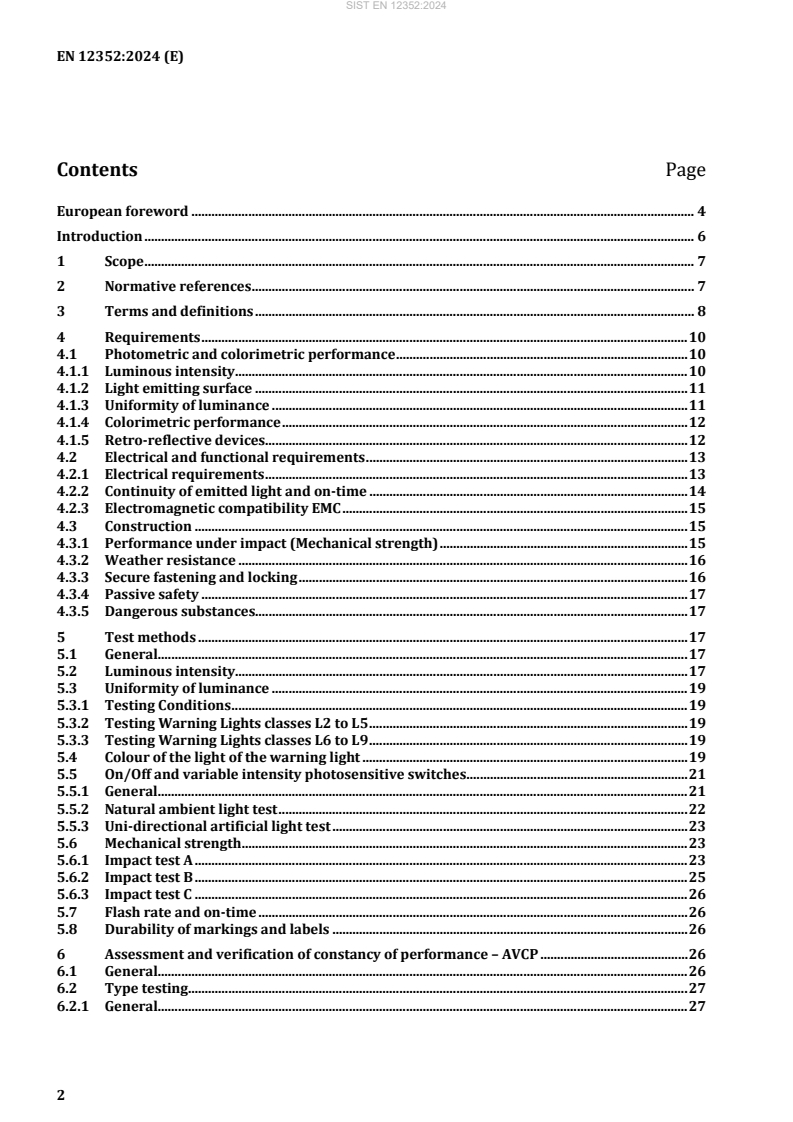
Contents Page
European foreword . 4
Introduction . 6
1 Scope . 7
2 Normative references . 7
3 Terms and definitions . 8
4 Requirements . 10
4.1 Photometric and colorimetric performance . 10
4.1.1 Luminous intensity. 10
4.1.2 Light emitting surface . 11
4.1.3 Uniformity of luminance . 11
4.1.4 Colorimetric performance . 12
4.1.5 Retro-reflective devices . 12
4.2 Electrical and functional requirements . 13
4.2.1 Electrical requirements . 13
4.2.2 Continuity of emitted light and on-time . 14
4.2.3 Electromagnetic compatibility EMC . 15
4.3 Construction . 15
4.3.1 Performance under impact (Mechanical strength) . 15
4.3.2 Weather resistance . 16
4.3.3 Secure fastening and locking . 16
4.3.4 Passive safety . 17
4.3.5 Dangerous substances. 17
5 Test methods . 17
5.1 General. 17
5.2 Luminous intensity. 17
5.3 Uniformity of luminance . 19
5.3.1 Testing Conditions . 19
5.3.2 Testing Warning Lights classes L2 to L5 . 19
5.3.3 Testing Warning Lights classes L6 to L9 . 19
5.4 Colour of the light of the warning light . 19
5.5 On/Off and variable intensity photosensitive switches . 21
5.5.1 General. 21
5.5.2 Natural ambient light test . 22
5.5.3 Uni-directional artificial light test . 23
5.6 Mechanical strength . 23
5.6.1 Impact test A . 23
5.6.2 Impact test B . 25
5.6.3 Impact test C . 26
5.7 Flash rate and on-time . 26
5.8 Durability of markings and labels . 26
6 Assessment and verification of constancy of performance – AVCP . 26
6.1 General. 26
6.2 Type testing . 27
6.2.1 General. 27
6.2.2 Test samples, testing and compliance criteria . 27
6.2.3 Test reports . 28
6.2.4 Shared other party results . 28
6.2.5 Cascading determination of the product type results . 29
6.3 Factory production control (FPC) . 30
6.3.1 General . 30
6.3.2 Requirements . 30
6.3.3 Product specific requirements . 32
6.3.4 Initial inspection of factory and of FPC . 33
6.3.5 Continuous surveillance of FPC . 33
6.3.6 Procedure for modifications . 34
6.3.7 One-off products, pre-production products (e.g. prototypes) and products produced
in very low quantity . 34
7 Designation . 35
8 Marking, labelling and product information . 35
8.1 Marking and labelling . 35
8.2 Product information . 36
Bibliography . 37
European foreword
This document (EN 12352:2024) has been prepared by Technical Committee CEN/TC 226 “Road
equipment”, the secretariat of which is held by AFNOR.
This European Standard shall be given the status of a national standard, either by publication of an
identical text or by endorsement, at the latest by December 2024, and conflicting national standards
shall be withdrawn at the latest by March 2026.
Attention is drawn to the possibility that some of the elements of this document may be the subject of
patent rights. CEN shall not be held responsible for identifying any or all such patent rights.
This document supersedes EN 12352:2006.
The main changes in this revision are as follows:
— The Introduction has been re written to clarify applications of warning lights.
— Definitions 3.1 to 3.4 added for additional clarity.
— Previous definition 3.10 “Principle Axis” removed, and “reference axis” definition updated, adding
clarity with fewer axes defined.
— 4.1.1. Descriptive note changed to improve clarity.
— 4.1.2.1 and 4.1.2.2. Reference to Lens changed to light emitting surface (allowing flexibility for those
solutions created without the use of a specific lens).
— 4.1.4. Wording changed to add flexibility in the types of light sources.
— 4.1.5. Clarified wording about plane of measurement.
— 4.2.1.1. Requirements for electrical safety clarified as being EN 50556 specification for the traffic
market now nominated under the LVD.
— 4.2.1.2.1. The idea of linked pairs or groups of warning lights added.
— 4.2.1.2.3. Classes added.
— 4.2.1.4. Clarified that it is the luminous intensity that is expected to be compliant over the voltage
range.
— 4.2.2.1. The idea of linked pairs or groups of warning lights added, classes F5 and F6 added.
— 4.2.2.2. Classes O4 and O5 added.
— 4.3.1. References to test method sections updated (due to the removal of the old Clause 5 “Samples”
the test method Clause 6 became 5).
— 4.3.2.3. Corrosion test specification reference updated.
— Old Clause 5 “Sampling” removed.
— Clause 6 “Test Methods” has now become Clause 5 with the removal of the old Clause 5 “Sampling”.
— 5.2. Luminous Intensity test method redefined.
— Clause 6 new Assessment and Verification of constancy of Performance AVCP.
— Clause 7 References updated.
— Old Clause 9 “Evaluation of conformity”, removed, as it is replaced by the earlier new Clause 6
AVCP.
Any feedback and questions on this document should be directed to the users’ national standards body.
A complete listing of these bodies can be found on the CEN website. According to the CEN-CENELEC
Internal Regulations, the national standards organisations of the following countries are bound to
implement this European Standard: Austria, Belgium, Bulgaria, Croatia, Cyprus, Czech Republic,
Denmark, Estonia, Finland, France, Germany, Greece, Hungary, Iceland, Ireland, Italy, Latvia, Lithuania,
Luxembourg, Malta, Netherlands, Norway, Poland, Portugal, Republic of North Macedonia, Romania,
Serbia, Slovakia, Slovenia, Spain, Sweden, Switzerland, Türkiye and the United Kingdom.
Introduction
Warning lights are installed on or at road areas for both permanent and temporary use.
Examples of permanent use are warning lights at pedestrian crossings, railway crossings, exits for fire
trucks and ambulances etc. Such warning lights are generally supplied by the mains or some other
permanent power supply with a lower voltage.
Permanently installed warnings lights may have properties in terms of photometric and colorimetric
performance, electrical and functional properties and construction as described in this document, or
they may be in family with signal heads having properties as described in EN 12368, Traffic control –
Signal heads.
Temporary use may be at construction sites to warn against uneven ground or obstacles. Warning lights
for this purpose often emit constant red light.
The predominant temporary use is, however, at road works. Warning lights for this purpose generally
emit flashing yellow light or in some cases alternating yellow light with longer light periods.
The use at road works is varied and includes warning lights mounted on obstacles, warning lights
mounted single or in pairs on road signs or barriers to create attention, warning lights used in groups to
form running lights to delineate temporary changes of the run of the road, and warning light used in
groups to form crosses or arrows mounted on trailers or vehicles in order to inform of blocked lanes or
change of lane.
Warnings lights for temporary use either have batteries incorporated into the housing of the warning
lights or are supplied by means of electrical wires to large batteries placed elsewhere. The intention of
using flashing or alternating light is to enhance the warning aspect and to draw more attention than is
obtained with constant light. Because of delay in the response of the eye, a flashing light appears with a
lower luminous intensity than the average intensity during the flash. In terms of visibility, the intensity
of a flashing light is described by an effective intensity derived by means of a particular equation.
There is some saving of emitted luminous flux associated with flashing or alternating light compared to
constant light. The corresponding saving of power from the battery supply has practical significance.
The classic warning lights are based on incandescent lamps, mostly low voltage halogen incandescent
lamps. The on-time of the flashes of these warnings’ lights cannot be short because of the delay in the
response of low voltage halogen incandescent lamps.
A development is based on xenon flash lamps with very short flashes. These lamps use less power than
low voltage halogen incandescent lamps. The shortness of the flash has the negative effect that it is
difficult to perceive the position of the warning light.
A further development is based on Light Emitting Diodes, LEDs. LEDs in themselves have characteristic
colours of the emitted light, for instance red, yellow, green and blue depending of the types, and are
used with the colour of light intended for the warning lights – mostly yellow. This eliminates the need
for obtaining the colour by means of filtering in a coloured front lens or glass and improves the overall
luminous efficacy.
The LEDs are well suited for control of the light output, the on-time and the cycle period. This has the
practical advantage that a single product can be used for more than one application.
1 Scope
This document specifies the requirements for individual electrically operated light devices, called
warning lights, emitting a continuous or regular intermittent light of a single colour, which by their
colour and position alone, are used to warn, inform or guide road users. It specifies the requirements
for visual, structural and operational performances and the relevant test methods to be used. These
devices rely upon existing furniture to provide the mounting.
This document is not applicable to lighting devices which convey messages by additional means (e.g.
variable message signs) or which convey a mandatory instruction (e.g. traffic signals) or which are
covered by vehicle lighting regulations.
This document does not consider horizontal loads because it is the mounting to which they are fixed,
which is not covered by this document, which has to resist applied horizontal loads.
2 Normative references
The following documents are referred to in the text in such a way that some or all of their content
constitutes requirements of this document. For dated references, only the edition cited applies. For
undated references, the latest edition of the referenced document (including any amendments) applies.
EN 50293, Road traffic signal systems - Electromagnetic compatibility
EN 60068-2-1, Environmental testing - Part 2-1: Tests - Test A: Cold
EN 60068-2-2, Environmental testing - Part 2-2: Tests - Test B: Dry heat
EN 60529, Degrees of protection provided by enclosures (IP Code)
EN IEC 60598-1:2021, Luminaires — Part 1: General requirements and tests
EN 12899-3, Fixed, vertical road traffic signs - Part 3: Delineator posts and retroreflectors
CIE 15, Colorimetry
CIE 54.2:2001, Retroflection — Definition and measurement
EN 50556, Road traffic signal systems
3 Terms and definitions
For the purposes of this document, the following terms and definitions apply.
ISO and IEC maintain terminology databases for use in standardization at the following addresses:
— ISO Online browsing platform: available at https://www.iso.org/obp
— IEC Electropedia: available at https://www.electropedia.org
3.1
steady, alternating and flashing lights
lights emitting respectively continuous light, continuous light in periods of minimum 0,5 seconds and
pulses of light in periods of less than 0,5 seconds
3.2
cycle period (flashing and alternating lights only)
t
cycle
duration of the complete on/off cycle measured in seconds (s)
3.3
flash or alternation rate (flashing and alternating lights only)
number of flashes or light periods per minute
3.4
on-time (flashing and alternating lights only)
t
on
flashing lights: part of a single light pulse during which the actual luminous intensity is equal to or
greater than the effective luminous intensity measured in seconds (s)
alternating lights: duration of a single light period in seconds (s)
3.5
state of dimming
actual state of dimming characterized in a unique manner
3.6
mode of operation
actual mode of operating a warning light defined by flash or alternation rate, on-time and state of
dimming
3.7
effective luminous intensity (flashing lights only)
l
eff
luminous intensity (cd) of a steady light source that would have the same visual range as the flashing
light in question effective luminous intensity l for flashing warning lights is that calculated using the
eff
Blondell-Rey equation (1):
t
f I t dt
( )
t
l =
eff
0,2+−tt
( )
(1)
Where
t and t , are time instants at which I (t) = l and define the on-time by t = t - t
1 2 eff on 2 1
3.8
horizontal plane (360° warning lights only)
plane which passes through the photometric centre of the warning light when the warning light is in its
normal operating position
3.9
light emitting surface
single continuous area of surface emitting light
3.10
minimum reference luminous intensity
I
Rmin
required minimum (effective) luminous intensity, at the nominal voltage, measured on the reference
axis or in the reference plane
3.11
minimum area luminous intensity
I
Amin
minimum permissible (effective) luminous intensity, at the nominal voltage, in any direction within a
specified angular range
Note 1 to entry: This is expressed as a percentage of IRmin in Table 1.
3.12
maximum area luminous intensity
I
Amax
maximum permissible (effective) luminous intensity at the nominal voltage, in any direction within a
specified angular range
3.13
minimum voltage luminous intensity
I
Umin
minimum permissible (effective) luminous intensity, at the minimum voltage specified by the
manufacturer, in any direction within a specified angular range
Note 1 to entry: This is expressed as a percentage of I in Table 1.
Rmin
3.14
rated voltage
voltage of the electrical power supply (battery or mains) as specified by the manufacturer
3.15
photometric centre
unless otherwise specified by the manufacturer, the photometric centre is the geometric centre of the
area of the light emitting surface
3.16
reference axis (excluding 360° warning lights)
axis specified by the manufacturer, used for environmental and optical tests
3.17
reference plane (360° lights only)
plane specified by the manufacturer, used for environmental and optical tests
3.18
test module
sample of the finished product
3.19
manufacturer
party with legal responsibility for placing the product on the market
3.20
supplier
producer of components (e.g. fixing devices, optical devices, luminous sources etc.) for the product
3.21
Factory Production Control (FPC)
permanent internal control of production exercised by the manufacturer
3.22
batch
quantity of a product manufactured with no change in raw material, equipment, settings or operation as
defined in the FPC system of the manufacturer
3.23
individual (and non-series)
where manufacturing process is different to the manufacturers usual process
4 Requirements
4.1 Photometric and colorimetric performance
4.1.1 Luminous intensity
When measured in accordance with Clause 5, within the angular range specified for the relevant class in
Table 1, the luminous intensities for warning lights emitting yellow light (C yellow 1 and C yellow 2 as
defined in 4.1.4) shall comply with the maximum and minimum limits specified in Table 1.
For warning lights emitting red light (C red as defined in 4.1.4) all minimum luminous intensity values
shall be reduced to 35 % of those specified in Table 1. Maximum luminous intensity values shall be as
specified in Table 1.
NOTE In Table 1 warning lights are divided into classes primarily by the area of the light emitting surface, the
angular range for photometric performance and the luminous intensity within those angular ranges. Class L2 is
sub-divided into Low (L) and High (H) luminous intensity; class L8 is subdivided into Very low (G), Low (L),
Medium (M) and High (H) luminous intensity and L9 is sub-divided into Low (L), Medium (M) and High (H)
luminous intensity.
All the values given for the luminous intensity in Table 1 are given as the actual continuous values for
steady and alternating warning lights and as effective luminous intensity for flashing warning lights.
In order to take account of uneven polar luminous intensity distribution for 360° warning lights only,
luminous intensities below the minimum values in Table 1 shall be disregarded provided that they are
contained within no more than two sectors each of 30° of the full 360°.
All angles given in Table 1 shall be measured from the reference plane for 360° warning lights (L1) and
from the reference axis for all other warning lights.
Table 1 — Classes of warning lights
Luminous intensity
Area of light
Angle ranges
At the minimum
emitting
At the nominal voltage
voltage
Class surface in
I I I I
Rmin Amin Amax Umin
cm
Horizontal Vertical
in cd (% of I ) in cd (% of I )
Rmin Rmin
L1 (See 4.1.2) 360° +5° to –5° 1 100 100 50
L2L ≥ 18 +7° to –7° +7° to –7° 25 25 100 25
L2H ≥ 18 +7° to –7° +7° to –7° 150 25 1 500 25
L3 ≥ 75 +10° to –10° +5° to –5° 2 50 100 25
a
L4 ≥ 140 +10° to –10° +5° to –5° 43 25 100 15
L5 ≥ 140 +2° to –2° +2° to –2° 500 25 2 000 25
L6 ≥ 2 × 250 +10° to –10° +5° to –5° 10 25 100 12,5
L7 ≥ 250 +10° to –10° +5° to –5° 20 25 100 12,5
L8G ≥ 250 +7,5° to –7,5° +5° to –5° 25 25 100 12,5
L8L ≥ 250 +7,5° to –7,5° +5° to –5° 250 25 500 12,5
L8M ≥ 250 +7,5° to –7,5° +5° to –5° 500 25 1 500 12,5
L8H ≥ 250 +7,5° to –7,5° +5° to –5° 1 500 25 5 000 12,5
L9L ≥ 700 +1,5° to –1,5° +1,5° to –1,5° 500 25 2 000 12,5
L9M ≥ 700 +1,5° to –1,5° +1,5° to –1,5° 2 000 25 8 000 12,5
L9H ≥ 700 +1,5° to –1,5° +1,5° to –1,5° 20 000 25 40 000 12,5
a
This class is used only for lights flashing in accordance with class F4.
4.1.2 Light emitting surface
4.1.2.1 For 360° warning lights (class L1) the minimum area of the light emitting surface projected
in any horizontal direction shall be not less than 30 cm and the height of the light emitting surface shall
be not less than 6 cm.
4.1.2.2 In all other classes (L2 to L9) the total area of the light emitting surface as indicated by the
manufacturer shall be not less than the values given in Table 1 and shall comply with the requirements
for uniformity of luminance (4.1.3). For the projection of the light emitting surface there shall be two
classes P defined:
— class P0: no requirements;
— class P1: the projection is a roundel.
4.1.3 Uniformity of luminance
4.1.3.1 There is no requirement for uniformity of luminance for warning lights in class L1.
4.1.3.2 The luminance of the light emitting surface of a warning light in classes L2 to L5 inclusive
shall be such that, when tested in accordance with 5.3.1 and 5.3.2, the ratio of luminance I /I
out total
is ≥ 0,17.
4.1.3.3 The luminance of the light emitting surface of a warning light in classes L6 to L9 inclusive
shall be such that when tested in accordance with 5.3.1 and 5.3.2 the ratio of the luminance L /L
min max
is ≥ 0,07.
4.1.4 Colorimetric performance
The class C for the colour of light emitted by warning lights shall be one of the following:
— class C red;
— class C yellow 1;
— class C yellow 2 (for light classes L2 and L5 only).
When tested in accordance with 5.4 light emitted from an assembled warning light, fitted with the light
source specified by the manufacturer or with inherent light source(s), shall be within the boundaries of
chromaticity specified in Table 2.
NOTE Warning lights meeting the requirements of class C yellow 1 will automatically meet the requirements
of class C yellow 2.
Table 2 — Colours of warning lights
Colour of warning light Equation Boundary
C red y = 0,290 red
y = 0,980 – x purple
y = 0,320 yellow
C yellow 1 y = 0,387 red
y = 0,980 – x white
y = 0,727 x + 0,054 green
C yellow 2 y = 0,380 red
y = 0,940 – x white
y = 0,500 green
4.1.5 Retro-reflective devices
All warning lights shall meet the requirements of one of the following three classes R for retro-
reflectivity:
— class R0: no requirements;
— class R1: shall not incorporate retro-reflective areas;
— class R2: shall be fitted with retro-reflectors of the night-time chromaticity specified for yellow in
EN 12899-3.
When projected in any direction in the reference plane for warning lights of class L1 and in the
direction of the reference axis for all other warning lights the retro-reflective area shall be minimum
50 cm .
For all retro-reflective areas the coefficient of retro-reflection RA shall be minimum as specified in
Table 3 when measured in accordance with CIE 54.2.
Table 3 — Coefficient of retroreflection
Entrance angle Observation angle Observation angle Observation angle
β (β = 0) 12' 20' 1°
1 2
−1 −2 −1 −2 −1 −2
5° 50 cd lx m 35 cd lx m 3 cd lx m
−1 −2 −1 −2 −1 −2
15° 35 cd lx m 20 cd lx m 2 cd lx m
4.2 Electrical and functional requirements
4.2.1 Electrical requirements
4.2.1.1 Electrical safety
Warning lights shall comply with the requirements for electrical safety of EN 50556.
4.2.1.2 On/Off and variable intensity photosensitive switches
4.2.1.2.1 General
Warning lights may be fitted with photosensitive devices to switch them on and off or to switch them
between different levels of luminous intensity in response to ambient light conditions. When tested in
accordance with 5.5.3, photosensitive switches shall not be actuated by a vertical plane illuminance of
500 lx or less.
A pair or a group of warning lights may be controlled by a photosensitive device fitted into one of the
warning lights or placed separately at a suitable location to switch them on and off, and/or to switch
them between different levels of luminous intensity in response to ambient light conditions.
NOTE A pair of warning lights may be used at a road sign or a barrier, while a group of warning lights may be
forming a running light or a flashing arrow.
4.2.1.2.2 Photosensitive On/Off switches
Automatic photosensitive On/Off switches shall comply with one of the following classes when tested in
accordance with 5.5.2:
— class A0: no requirements;
— class A1: warning lights shall be switched on at an ambient horizontal illuminance of minimum
250 lx and off at an ambient horizontal illuminance of maximum 1 000 lx.
4.2.1.2.3 Variable intensity photosensitive switch
A photosensitive device to switch the warning light between operation at different luminous intensities
shall operate automatically (both to increase and to decrease the luminous intensity) and shall comply
with one of the following classes when tested in accordance with 5.5.2.
— class V0: no requirements;
— class V1: the warning light, or a pair or a group of warning lights, shall be switched between the
different luminous intensities at ambient horizontal illuminance within the range of 500 lx to
3 000 lx;
— class V2: the warning light, or a pair or a group of warning lights, shall be switched between the
different luminous intensities I at ambient horizontal illuminance E within the range of 4 lx to
40 000 lx in a number of steps following a specified curve.
NOTE One such curve implies a change of the luminous intensity I by a factor of two for each change of the
ambient horizontal illuminance by a factor of ten. This curve is given by:
0,30103
I = I ⨯ (E/40 000)
40 000 lx
where
I is the luminous intensity at 40 000 lx ; and
40 000 lx
0,30103 is obtained as log(2).
EXAMPLE Example of specifications for the switching of luminous intensities of warning lights at road
works:
Effective intensity (cd) in dependence of the ambient horizontal illuminance (lx)
40 000 lx 4 000 lx 400 lx 40 lx 4 lx
Type of warning light
Full daylight Weak Dusk or dawn Road lighting Darkness
daylight
Warning lights on road
1 280 ± 30 % 640 ± 30 % 320 ± 30 % 160 ± 30 % 80 ± 30 %
signs
Running lights 640 ± 30 % 320 ± 30 % 160 ± 30 % 80 ± 30 % 40 ± 30 %
Warning lights on barriers 640 ± 30 % 320 ± 30 % 160 ± 30 % 80 ± 30 % 40 ± 30 %
Crosses and arrows on
1 280 ± 30 % 640 ± 30 % 320 ± 30 % 160 ± 30 % 80 ± 30 %
trailers or vehicles
4.2.1.3 Voltage indicator (battery operated warning lights only)
Where a battery operated warning light is fitted with a device to indicate that the battery voltage is at or
approaching the minimum voltage, the voltage indication shall comply with one of the following classes:
— class I0: no requirements;
— class I1: warning lights fitted with a device to indicate that the specified minimum voltage of the
warning light has been reached.
4.2.1.4 Minimum and maximum voltage for mains operated warning lights
The operating voltage of mains operated warning lights shall be within the range –15 % to +10 % of the
rated voltage. In this voltage range, the luminous intensity of the warning lights shall comply with 4.1.1.
4.2.2 Continuity of emitted light and on-time
4.2.2.1 Continuity of emitted light
The continuity of emitted light of a warning light or a pair or a group of warning lights shall comply with
one of the following classes:
— class F0: no requirement;
— class F1: lights emitting a continuous (steady) or alternating light;
— class F2: lights flashing at a flash rate between 55 flashes per minute and 75 flashes per minute;
— class F3: lights flashing at a flash rate between 40 flashes per minute and 80 flashes per minute;
— class F4: lights flashing at a flash rate between 120 flashes per minute and 150 flashes per minute;
— class F5: lights flashing or alternating with an adjustable rate;
— class F6: lights flashing or alternating with a specified rate.
NOTE 1 Warning lights meeting the requirements of class F2 will automatically meet the requirements of
class F3.
NOTE 2 Examples of specified rates are 60 ± 1 flashes per minute and 40 ± 1 flashes per minute.
4.2.2.2 On-time
When tested in accordance with 5.7 the on-time of a warning light or a pair or a group of warning lights
shall comply with the relevant one of the following classes:
— class O0: no requirements;
— class O1: 30 % < (t – t ) ≤ 60 %;
2 1
— class O : 10 % < (t – t ) ≤ 60 %;
2 2 1
— class O3: (t – t ) ≤ 10 %;
2 1
— class O4 : an adjustable on-time measured in percentage of the cycle period or in seconds;
— class O5 : a specified on-time.
EXAMPLE Example of specifications for the on-time and the cycle period for warning lights at road works:
Type of warning light On-time in seconds Cycle period in seconds
Warning lights on road signs 0,2 ± 5 % (20 %) 1,0 ± 5 % (60 flashes per minute)
a
Running lights 0,2 ± 5 % (13,3 %) 1,5 ± 5 % (40 flashes per minute)
b
Warning lights on barriers 0,2 ± 5 % (20 %) 1,0 ± 5 % (60 flashes per minute)
b
Crosses and arrows on trailers or vehicles 0,6 ± 5 % (40 %) 1,5 ± 5 % (40 periods per minute)
a
Warning lights forming running lights are to be synchronized with a delay of 0,15 s from one light to the next.
b
Warning lights on barriers or forming crosses and arrows on trailers or vehicles are to flash simultaneously.
4.2.3 Electromagnetic compatibility EMC
Warning lights shall comply with the requirements of the electromagnetic compatibility specified in
EN 50293.
4.3 Construction
4.3.1 Performance under impact (Mechanical strength)
Warning lights should be sufficiently robust to withstand use in their intended environment and shall
comply with the requirements of one or more of the following classes of performance under impact:
— class M0: no requirements;
— class M1: warning lights tested in accordance with Impact Test A in 5.6.1;
— class M2: warning lights tested in accordance with Impact Test B in 5.6.2;
— class M3: warning lights tested in accordance with Impact Test C in 5.6.3;
— class M4: warning lights tested in accordance with Impact Test B and Impact Test C in 5.6.2
and 5.6.3.
When warning lights are subjected to any of the above tests, no part of the warning light shall become
detached or damaged to such an extent that the device no longer complies with all the requirements of
this document. However, a failed light source that can be exchanged shall not indicate that the device is
considered non-compliant.
NOTE 1 Warning lights meeting the requirements of class M1 will automatically meet the requirements of
class M2.
NOTE 2 Warning lights meeting the requirements of class M4 will automatically meet the requirements of
classes M2 and M3.
4.3.2 Weather resistance
4.3.2.1 Ingress of water
All warning lights shall have a resistance to the ingress of water of at least IPX4 as specified in
EN 60529. After the water splash test the warning light shall operate normally.
4.3.2.2 Temperature resistance
The suitability of a warning light for specific climates shall be indicated using the following temperature
classes:
— class T1: warning lights complying with 4.2.2 of this document when operated continuously at any
temperature within the range +55 °C to –10 °C.
— class T2: warning lights complying with 4.2.2 of this document when operated at any temperature
within the range +55 °C to –40 °C.
NOTE Warning lights meeting the requirements of class T2 will automatically meet the requirements of
class T1.
4.3.2.3 Corrosion
All external metal parts shall be resistant to corrosion in accordance with 4.18 of EN IEC 60598-1:2021.
4.3.3 Secure fastening and locking
Warning lights may be fitted with locking devices which prevent access to the internal parts of the
warning light (including battery compartment). The locking device shall be such that access without a
special tool or key is not possible. Means may also be fitted for securely fastening a warning light to
another structure (e.g. a bollard, cone or traffic sign) to support it in its normal operating position.
Secure fastening and locking shall comply with one of the following classes:
— class S0: no requirement;
— class S1: warning lights fitted with a locking device;
— class S2: warning lights fitted with fastening means;
— class S3: warning lights fitted with both a locking device and fastening means (these may be
combined in a single device).
NOTE Warning lights meeting the requirements of class S3 will automatically meet the requirements of
class S2 and S1.
4.3.4 Passive safety
Warning lights shall have no sharp points or edges which could create a hazard for the user during
normal handling or when replacing a light source or batteries. Compliance with this requirement shall
be checked by visual inspection.
4.3.5 Dangerous substances
Materials used in the product shall not release any dangerous substances in excess of the maximum
permitted levels specified in a relevant document for the material or permitted in national regulations
of the Member State of destination.
5 Test methods
5.1 General
Unless otherwise stated, tests shall be conducted using the nominal voltage and at ambient temperature
(20 ± 5) °C.
5.2 Luminous intensity
The described test method is for indoor (laboratory) measurements in an environment of draft-free air
and a temperature of (25 ± 2) °C.
The photometer or spectrophotometer used for the measurement of luminous intensity shall be stable,
not subject to fatigue and have a linear response in the relevant range. In addition, the spectral
sensitivity shall closely follow the CIE spectral luminous efficiency curve V(λ) in order to ensure a
maximum error of 3 % even for light sources with emission in narrow bands of wavelengths such as red
and yellow LEDs.
NOTE 1 The photometer or spectrophotometer may be subjected to the following requirements according to
CIE 69:
— V(λ) match error f1 ≤ 3 %
≤ 1 %
— Linearity error f3
— Display unit error f ≤ 3 %
— Fatigue error f5 ≤ 0,5 %
— Temperature coefficient α ≤ 0,2 % / K
For this test a battery-operated warning light shall be operated at the rated and minimum voltages
specified by the manufacturer and as defined in 3.13 and 3.14. A mains operated warning light shall be
operated at 10 % above and 15 % below the nominal voltage specified by the manufacturer.
For all light sources the specification from the manufacturer shall include the reference axis and/or the
reference plane and position of the source in the optical geometry of the warning light. The
manufacturer shall provide the warning light with light sources and necessary specifications for the
luminous intensity measurements.
The luminous intensity is measured with the warning light on a goniometer. The horizontal and vertical
angles in Table 1 are chosen to correspond with a goniometer, where the horizontal axis is fixed and the
vertical axis is moveable in space, see Figure 1 (type 1 CIE 70). For a goniometer with another
arrangement the angles have to be recalculated correspondingly (see CIE 54.2:2001, Annex B).
The distance of measurement shall be such that the inverse square distance law is applicable (I = r ).
2E
The measuring equipment shall be such that the angular aperture of the detector viewed from the
reference centre of the lamp is ≤ 10’ (minutes of arc).
The total effect of systematic and random errors in the goniometer shall not exceed:
— For measurement of luminous intensity: 5 % of the actual intensity
— For measurement of angular direction: beams with half peak side angle:
2° <α < 4°: 0,1°
4° < α < 8°: 0,2°
8° < α: 0,4°
Light sources shall be suitably aged so that their
...