

SIST EN 16603-33-11:2019
(Main)Space engineering - Explosive subsystems and devices
General Information
- Abstract
This Standard defines the requirements for the use of explosives on all spacecraft and other space products including launch vehicles. It addresses the aspects of design, analysis, verification, manufacturing, operations and safety.
This standard may be tailored for the specific characteristics and constraints of a space project in conformance with ECSS-S-ST-00.
- Status
- Published
- Public Enquiry End Date
- 31-Aug-2018
- Publication Date
- 14-May-2019
- Technical Committee
- I13 - Imaginarni 13
- Current Stage
- 6060 - National Implementation/Publication (Adopted Project)
- Start Date
- 25-Apr-2019
- Due Date
- 30-Jun-2019
- Completion Date
- 15-May-2019

Overview
SIST EN 16603-33-11:2019 - Space engineering: Explosive subsystems and devices is a European space engineering standard that defines requirements for the use of explosives on spacecraft and other space products, including launch vehicles. Adopted by SIST from EN 16603-33-11:2019, it replaces EN 14607-6:2004 and originates from ECSS-E-ST-33-11C Rev.1. The standard covers the full lifecycle of explosive subsystems: design, analysis, verification, manufacturing, operations and safety, and may be tailored to project constraints in conformance with ECSS-S-ST-00.
Key Topics and Requirements
The standard provides structured requirements and guidance across technical and programmatic areas, including:
- Terms, definitions and symbols specific to explosive devices for space systems.
- Design requirements: reliability and confidence levels, performance, dimensioning, wanted vs unwanted responses.
- Mission and functionality: tailoring of properties to mission profiles and interfaces.
- Safety: prevention of unintentional function, safety caps, Faraday caps and safe‑and‑arm device requirements.
- Mechanical, electrical and thermal performance and status checking.
- Materials and non‑explosive components: connectors, wiring, shielding, plugs and harness considerations.
- Explosive components: initiators, cartridges, detonators, packaged charges, transfer devices, gas generators, shaped charges, expanding tube devices, distribution boxes, explosive delays.
- Explosively actuated devices: separation nuts/bolts, pullers, pushers, cutters, valves.
- Verification and testing: inspection, qualification tests, lot acceptance, safety tests and reliability methods.
- Logistics and operations: transport, handling, storage, ground support equipment (GSE), launch site procedures and in‑service monitoring.
- Product assurance: dependability, assembly, integration and test; annexes provide qualification test levels and a list of deliverables.
Practical Applications and Who Uses It
This standard is essential for organizations involved in the design, manufacture, verification and operation of explosive subsystems in space applications. Typical users include:
- Spacecraft and launch vehicle systems engineers
- Explosive component manufacturers and suppliers
- Integration, test and qualification laboratories
- Product assurance, safety and reliability teams
- Launch site and ground support personnel
- Procurement and project managers specifying component properties and acceptance criteria
Using SIST EN 16603-33-11:2019 ensures consistent, safety‑focused engineering of explosive devices and helps meet regulatory and mission assurance objectives.
Related Standards and References
- Originates from ECSS-E-ST-33-11C Rev.1 (ECSS family alignment)
- Supersedes EN 14607-6:2004
- Relevant ICS classifications: 49.140 (Space systems and operations) and 29.260.20 (Electrical apparatus for explosive atmospheres)
Keywords: SIST EN 16603-33-11:2019, space engineering, explosive subsystems, spacecraft explosives, launch vehicle explosive devices, explosive device safety, ECSS, verification and qualification.
Relations
- Effective Date
- 24-Apr-2019
- Effective Date
- 28-Jan-2026
- Effective Date
- 13-Jun-2018
Get Certified
Connect with accredited certification bodies for this standard

BUREAU VERITAS Certification Germany
Bureau Veritas certification in Germany.

Element Materials Technology
Materials testing and product certification.

IMQ S.p.A. (Certification)
Italian electrical product certification.
Sponsored listings
Frequently Asked Questions
SIST EN 16603-33-11:2019 is a standard published by the Slovenian Institute for Standardization (SIST). Its full title is "Space engineering - Explosive subsystems and devices". This standard covers: This Standard defines the requirements for the use of explosives on all spacecraft and other space products including launch vehicles. It addresses the aspects of design, analysis, verification, manufacturing, operations and safety. This standard may be tailored for the specific characteristics and constraints of a space project in conformance with ECSS-S-ST-00.
This Standard defines the requirements for the use of explosives on all spacecraft and other space products including launch vehicles. It addresses the aspects of design, analysis, verification, manufacturing, operations and safety. This standard may be tailored for the specific characteristics and constraints of a space project in conformance with ECSS-S-ST-00.
SIST EN 16603-33-11:2019 is classified under the following ICS (International Classification for Standards) categories: 29.260.20 - Electrical apparatus for explosive atmospheres; 49.140 - Space systems and operations. The ICS classification helps identify the subject area and facilitates finding related standards.
SIST EN 16603-33-11:2019 has the following relationships with other standards: It is inter standard links to SIST EN 14607-6:2005, SIST EN 14607-5-1:2005, SIST EN 14607-6:2005. Understanding these relationships helps ensure you are using the most current and applicable version of the standard.
SIST EN 16603-33-11:2019 is associated with the following European legislation: Standardization Mandates: M/496. When a standard is cited in the Official Journal of the European Union, products manufactured in conformity with it benefit from a presumption of conformity with the essential requirements of the corresponding EU directive or regulation.
SIST EN 16603-33-11:2019 is available in PDF format for immediate download after purchase. The document can be added to your cart and obtained through the secure checkout process. Digital delivery ensures instant access to the complete standard document.
Standards Content (Sample)
SLOVENSKI STANDARD
01-julij-2019
Nadomešča:
SIST EN 14607-6:2005
Vesoljska tehnika - Eksplozivni podsistemi in naprave
Space engineering - Explosive subsystems and devices
Raumfahrttechnik - Explosive Subsysteme und Geräte
Ingénierie spatiale - Sous-systèmes et dispositifs explosifs
Ta slovenski standard je istoveten z: EN 16603-33-11:2019
ICS:
29.260.20 Električni aparati za Electrical apparatus for
eksplozivna ozračja explosive atmospheres
49.140 Vesoljski sistemi in operacije Space systems and
operations
2003-01.Slovenski inštitut za standardizacijo. Razmnoževanje celote ali delov tega standarda ni dovoljeno.
EUROPEAN STANDARD
EN 16603-33-11
NORME EUROPÉENNE
EUROPÄISCHE NORM
April 2019
ICS 49.140
Supersedes EN 14607-6:2004
English version
Space engineering - Explosive subsystems and devices
Ingénierie spatiale - Sous-systèmes et dispositifs Raumfahrttechnik - Explosive Subsysteme und Geräte
explosifs
This European Standard was approved by CEN on 28 September 2018.
CEN and CENELEC members are bound to comply with the CEN/CENELEC Internal Regulations which stipulate the conditions for
giving this European Standard the status of a national standard without any alteration. Up-to-date lists and bibliographical
references concerning such national standards may be obtained on application to the CEN-CENELEC Management Centre or to
any CEN and CENELEC member.
This European Standard exists in three official versions (English, French, German). A version in any other language made by
translation under the responsibility of a CEN and CENELEC member into its own language and notified to the CEN-CENELEC
Management Centre has the same status as the official versions.
CEN and CENELEC members are the national standards bodies and national electrotechnical committees of Austria, Belgium,
Bulgaria, Croatia, Cyprus, Czech Republic, Denmark, Estonia, Finland, Former Yugoslav Republic of Macedonia, France, Germany,
Greece, Hungary, Iceland, Ireland, Italy, Latvia, Lithuania, Luxembourg, Malta, Netherlands, Norway, Poland, Portugal, Romania,
Serbia, Slovakia, Slovenia, Spain, Sweden, Switzerland, Turkey and United Kingdom.
CEN-CENELEC Management Centre:
Rue de la Science 23, B-1040 Brussels
© 2019 CEN/CENELEC All rights of exploitation in any form and by any means Ref. No. EN 16603-33-11:2019 E
reserved worldwide for CEN national Members and for
CENELEC Members.
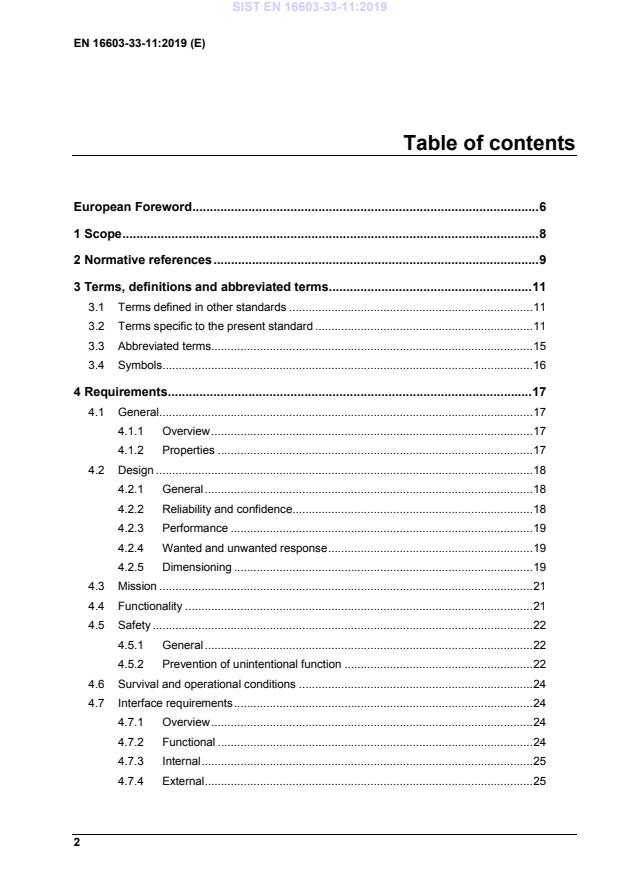
Table of contents
European Foreword . 6
1 Scope . 8
2 Normative references . 9
3 Terms, definitions and abbreviated terms . 11
3.1 Terms defined in other standards . 11
3.2 Terms specific to the present standard . 11
3.3 Abbreviated terms. 15
3.4 Symbols . 16
4 Requirements . 17
4.1 General . 17
4.1.1 Overview . 17
4.1.2 Properties . 17
4.2 Design . 18
4.2.1 General . 18
4.2.2 Reliability and confidence. 18
4.2.3 Performance . 19
4.2.4 Wanted and unwanted response . 19
4.2.5 Dimensioning . 19
4.3 Mission . 21
4.4 Functionality . 21
4.5 Safety . 22
4.5.1 General . 22
4.5.2 Prevention of unintentional function . 22
4.6 Survival and operational conditions . 24
4.7 Interface requirements . 24
4.7.1 Overview . 24
4.7.2 Functional . 24
4.7.3 Internal . 25
4.7.4 External . 25
4.8 Mechanical, electrical, and thermal requirements . 25
4.8.1 Mechanical . 25
4.8.2 Electrical . 27
4.8.3 Thermal . 30
4.8.4 Status check . 31
4.9 Materials . 32
4.10 Non-explosive components and equipment . 33
4.10.1 Connectors . 33
4.10.2 Wiring. 33
4.10.3 Shielding . 33
4.10.4 Faraday cap . 34
4.10.5 Safety cap . 34
4.10.6 Power. 34
4.10.7 Arm plug receptacle . 34
4.10.8 Safe plug . 35
4.10.9 Arm plug . 35
4.10.10 Test plug . 36
4.10.11 Safe and arm device . 36
4.10.12 Initiator harness connector . 38
4.10.13 Initiator test substitute . 38
4.11 Explosive components . 38
4.11.1 General . 38
4.11.2 Initiators, cartridges, detonators, and packaged charges. 40
4.11.3 Integral initiator connectors . 45
4.11.4 Transfer devices . 46
4.11.5 Safe and arm devices containing explosive . 48
4.11.6 Gas generators . 48
4.11.7 Shaped charges . 49
4.11.8 Expanding tube devices . 50
4.11.9 Distribution boxes . 52
4.11.10 Explosive delays . 53
4.12 Explosively actuated devices . 54
4.12.1 General . 54
4.12.2 Separation nuts and separation bolts . 55
4.12.3 Pullers . 56
4.12.4 Pusher . 56
4.12.5 Cutters . 57
4.12.6 Valves . 57
4.13 Items external to the flight equipment . 58
4.13.1 GSE . 58
4.13.2 Test equipment . 58
4.13.3 Launch site . 58
4.14 Verification . 59
4.14.1 General . 59
4.14.2 Inspection . 59
4.14.3 Tests . 59
4.14.4 Qualification and lot acceptance . 61
4.15 Transport, facilities, handling and storage . 64
4.15.1 General . 64
4.15.2 Transport . 64
4.15.3 Facilities . 65
4.15.4 Handling . 65
4.16 In-service . 66
4.16.1 Information feedback . 66
4.16.2 Launch site procedures . 66
4.16.3 Monitoring . 66
4.17 Product assurance . 66
4.17.1 General . 66
4.17.2 Dependability . 67
4.17.3 Assembly, integration and test . 67
Annex A (informative) Component qualification test levels . 68
Annex B (informative) List of deliverable documents . 70
Annex C (informative) Safety Data Sheet (example courtesy of GICAT) . 71
Tables
Table 4-1 <> . 21
Table 4-2 Explosive component colour code . 26
Table 4-3 Common requirements for initiator, cartridge, detonator, and packaged charge
properties . 41
Table 4-4 Requirements for low voltage initiator properties . 42
Table 4-5 Requirements for high voltage initiator properties . 43
Table 4-6 Requirements for laser initiator properties . 43
Table 4-7 Requirements for mechanical initiator properties . 44
Table 4-8 Requirements for packaged charge properties . 44
Table 4-9 Requirements for through-bulkhead initiators properties . 45
Table 4-10 General requirements for transfer device properties . 46
Table 4-11 Requirements for transfer line assembly properties . 47
Table 4-12 Common requirements for gas generator . 48
Table 4-13 Requirements for shaped charge properties . 49
Table 4-14 Requirements for expanding tube device properties . 51
Table 4-15 Requirements for distribution box properties . 52
Table 4-16 Requirements for explosive delay properties . 53
Table 4-17 General requirements for explosively actuated device properties . 54
Table 4-18 Requirements for separation nut and separation bolt properties . 55
Table 4-19 Requirements for puller properties . 56
Table 4-20 Requirements for pusher properties . 56
Table 4-21 Requirements for cutter properties . 57
Table 4-22 Requirements for valve properties . 57
Table 4-23 Safety tests. 60
Table 4-24 Reliability methods . 61
Table 4-25 Qualification tests . 62
Table 4-26 Acceptance tests . 63
Table A-1 Component qualification test levels . 68
Table A-2 Pyroshocks for launcher and satellites . 69
Table B-1 List of deliverable documents to be used in context of this standard . 70
European Foreword
This document (EN 16603-33-11:2019) has been prepared by Technical Committee
CEN-CENELEC/TC 5 “Space”, the secretariat of which is held by DIN.
This standard (EN 16603-33-11:2019) originates from ECSS-E-ST-33-11C Rev.1.
This European Standard shall be given the status of a national standard, either by
publication of an identical text or by endorsement, at the latest by October 2019, and
conflicting national standards shall be withdrawn at the latest by October 2019.
Attention is drawn to the possibility that some of the elements of this document may
be the subject of patent rights. CEN [and/or CENELEC] shall not be held responsible
for identifying any or all such patent rights.
This document supersedes EN 14607-6:2004.
Changes to EN 14607-6:2004 that was based on ECSS-E-30 Part 6A (25 April 2000) are:
Complete edit to conform to the ECSS Drafting Rules for "ECSS Issue C
standards"
Implementation of ECSS Change Requests and harmonization the standard
with ISO in ECSS Revision 1 (2017)
Change of the title from "Space engineering - Mechanical - Part 6:
Pryotechnics" to "Space engineering – Explosive subsystems and devices"
Use of the more accurate term "explosive" rather than "pyrotechnics" in
relation to the subject components and systems
Emphasis on reliability coupled with confidence level for performance
properties
Inclusion of detailed requirements for the different types of explosive device
Emphasis on the requirement for properties of components to be agreed with
the end user before commitment to purchase.
This document has been prepared under a standardization request given to CEN by
the European Commission and the European Free Trade Association.
This document has been developed to cover specifically space systems and has
therefore precedence over any EN covering the same scope but with a wider domain
of applicability (e.g. : aerospace).
According to the CEN-CENELEC Internal Regulations, the national standards
organizations of the following countries are bound to implement this European
Standard: Austria, Belgium, Bulgaria, Croatia, Cyprus, Czech Republic, Denmark,
Estonia, Finland, Former Yugoslav Republic of Macedonia, France, Germany, Greece,
Hungary, Iceland, Ireland, Italy, Latvia, Lithuania, Luxembourg, Malta, Netherlands,
Norway, Poland, Portugal, Romania, Serbia, Slovakia, Slovenia, Spain, Sweden,
Switzerland, Turkey and the United Kingdom.
Introduction
As any explosive item used for flight can function only once, it can never be fully
tested before its crucial mission operation. The required confidence can only be
established indirectly by the testing of identical items. Test results and theoretical
justification are essential for demonstration of fulfilment of the requirements. The
requirement for repeatability shows that product assurance plays a crucial role in
support of technical aspects.
The need for statistics requires that the explosive components used in the explosive
subsystem be tested and characterized extensively. The variability in components
requires that manufacturers prove to customers that delivered items are identical to
those qualified.
The failure or unintentional operation of an explosive item can be catastrophic for the
whole mission and life threatening. Specific requirements can exist for the items
associated with it. As all explosives where ever used are treated similarly, the same
requirements, regulations, practices and standards need to be applied to help
avoiding human error.
Scope
This Standard defines the requirements for the use of explosives on all spacecraft and
other space products including launch vehicles. It addresses the aspects of design,
analysis, verification, manufacturing, operations and safety.
This standard may be tailored for the specific characteristics and constraints of a space
project in conformance with ECSS-S-ST-00.
Normative references
The following normative documents contain provisions which, through reference in
this text, constitute provisions of this ECSS Standard. For dated references, subsequent
amendments to, or revision of any of these publications, do not apply. However,
parties to agreements based on this ECSS Standard are encouraged to investigate the
possibility of applying the more recent editions of the normative documents indicated
below. For undated references, the latest edition of the publication referred to applies.
EN reference Reference in text Title
EN 16601-00-01 ECSS-S-ST-00-01 ECSS system - Glossary of terms
EN 16603-10-02 ECSS-E-ST-10-02 Space engineering - Verification
EN 16603-10-03 ECSS-E-ST-10-03 Space engineering - Testing
EN 16603-20 ECSS-E-ST-20 Space engineering - Electrical and electronic
EN 16603-20-07 ECSS-E-ST-20-07 Space engineering – Electromagnetic compatibility
EN 16603-32-10 ECSS-E-ST-32-10 Space engineering - Reliability based mechanical factors of
safety
EN 16603-33-01 ECSS-E-ST-33-01 Space engineering - Mechanisms
EN 16602-20 ECSS-Q-ST-20 Space product assurance - Quality assurance
EN 16602-30 ECSS-Q-ST-30 Space product assurance - Dependability
EN 16602-40 ECSS-Q-ST-40 Space product assurance - Safety
EN 16602-70-01 ECSS-Q-ST-70-01 Space product assurance - Contamination and cleanliness
control
EN 16601-40 ECSS-M-ST-40 Space management - Configuration and information
management
ST/SG/AC.10/1 latest Recommendations on the Transport of Dangerous Goods –
version (UNECE Model Regulations
publication)
Commission Directive Commission Directive 2012/4/EU of 22 February 2012
2012/4/EU (22 amending Directive 2008/43/EC setting up, pursuant to
February 2012) Council Directive 93/15/EEC, a system for the identification
and traceability of explosives for civil uses
Commission Directive Commission Directive 2008/43/EC of 4 April 2008 setting
2008/43/EC (4 April up, pursuant to Council Directive 93/15/EEC, a system for
2008) the identification and traceability of explosives for civil uses
Council Directive Council Directive 93/15/EEC of 5 April 1993 on the
93/15/EEC (5 April harmonization of the provisions relating to the placing on
1993) the market and supervision of explosives for civil uses
Dictionary of explosive Groupe de Travail de Pyrotechnie, Dictionnaire de
related terms, 7th pyrotechnie
Edition, 2016
NOTE For launcher subsystems and Transfer Vehicle
programmes, the specific General Specification (SG)
or Design Rules (DR) documents are applicable for
designing, dimensioning and testing.
Terms, definitions and abbreviated terms
3.1 Terms defined in other standards
a. For the purpose of this Standard, the terms and definitions from
ECSS-S-ST-00-01 apply, in particular for the following terms:
1. lifetime
3.2 Terms specific to the present standard
3.2.1 all fire
stimulus with a probability of functioning equal to or better than 0,999 at 95 %
confidence level
3.2.2 arm plug receptacle
connector mounted on the skin of a spacecraft that can be connected to a Safe or Test
or Arm plug
3.2.3 armed
status of an explosive subsystem when all the safety devices have been disabled and
which can be triggered
[Adapted from Dictionary of explosive related terms]
3.2.4 cartridge
explosive device designed to produce pressure for performing a mechanical function
NOTE A cartridge is called an initiator if it is the first or only
explosive element in an explosive train (see definition
3.2.14).
3.2.5 charge
explosive loaded in a cartridge, detonator, or separate container for use in an
explosive device
3.2.6 component
smallest functional item in an explosive subsystem
3.2.7 deflagration
self-sustaining, exothermic decomposition reaction of an explosive substance, whose
apparent velocity is less than the velocity of sound in the substance and greater than
the speed of sound in air
NOTE It is generally accepted that the energy transmission
takes place via a mechanical compression wave. This
type of reaction is intermediary between combustion
and detonation. It differs from combustion through
the presence of a significant compression wave in the
surrounding environment.
[Dictionary of explosive related terms]
3.2.8 detonation
exothermic decomposition reaction of an explosive substance self-sustained by a
shock wave, whose velocity of propagation is greater than the velocity of sound in the
substance
NOTE The velocity of propagation is of the order of several
thousands of m/s.
[Dictionary of explosive related terms]
3.2.9 detonator
initiator whose function is to transform external energy directly into a shock wave
strong enough to detonate a secondary high explosive
NOTE External energy can be, for example, mechanical,
electrical and thermal.
[Dictionary of explosive related terms]
3.2.10 electro-explosive device
device containing some reaction mixture that is electrically initiated
NOTE 1 The output of the initiation is heat, shock or
mechanical action.
NOTE 2 The reaction mixture can be explosive or pyrotechnic.
[Dictionary of explosive related terms]
3.2.11 end-user
person who or organization that actually uses a product
NOTE 1 The end-user need not to be the owner or buyer.
NOTE 2 In the context of this standard the end user is
generally the first level customer.
3.2.12 energetic material
material consisting of, or containing, an explosive, oxidizer, fuel, or combination of
them, that can undergo, contribute to, or cause rapid exothermic decomposition,
combustion, deflagration, or detonation
3.2.13 explosively actuated device
device that converts the products of explosion into useful mechanical work
NOTE 1 The explosion can be combustion, deflagration or
detonation.
NOTE 2 Pyromechanisms and linear detonating separation
devices are explosively actuated devices.
3.2.14 explosive train
series of explosive components including the initiator, explosive transfer assembly
and explosively actuated device
3.2.15 explosive component
discrete item containing an explosive substance
3.2.16 explosive function
function that uses energy released from explosive substances for its operation
3.2.17 explosive subsystem
collection of all the explosive trains on the spacecraft or launcher system, and the
interface aspects of any on-board computers, launch operation equipment, ground
support and test equipment and all software associated with explosive functions
3.2.18 fail operational
mission capable after one failure
NOTE Maintaining operational conditions after one failure
and safety conditions after a second independent
failure is referred to as "Fail operational – Fail safe".
3.2.19 fail safe
design property of a subsystem, or part of it, which remains safe after one failure
NOTE Maintaining safety following two independent
failures is referred to as "Fail safe – Fail safe".
3.2.20 gas generators
explosive devices that produce a volume of gas or exothermic output or both
NOTE E.g. pyrotechnic igniters for solid propulsion
applications, gas generator for inflatable structures.
3.2.21 initiator
basic component located upstream of an explosive train, from which originates a
transformation of mechanical, electrical or optical energy, the effect produced being a
combustion, deflagration or detonation.
NOTE 1 It contains a small quantity of an energetic material.
NOTE 2 Examples: hot bridge wire initiator, exploding bridge
wire initiator
3.2.22 limit testing
testing to establish the limit of a performance characteristic of a component
3.2.23 lot
group of components produced in homogeneous groups and under uniform
conditions
NOTE A batch is the same as a lot.
3.2.24 lot acceptance
demonstration by measurement or test that a lot of items meets requirements
3.2.25 no fire
stimulus with a probability of functioning equal to or less than 0,001 at 95 %
confidence level
3.2.26 packaged charge
explosive material in a closed container
3.2.27 pyrotechnic device
a basic pyrotechnic object containing explosive substances and intended to perform an
initiation (ignition, priming), pyrotechnic effect transmission, amplification or
generation function
[Dictionary of explosive related terms]
3.2.28 pyromechanism
device intended to perform one or more mechanical actions, using the energy
produced by the reaction of an energetic material
[Dictionary of explosive related terms]
3.2.29 safe
condition that renders the probability of an unwanted event below an agreed limit
3.2.30 secondary characteristic
any characteristic other than the function
3.2.31 sequential firing
application of the firing pulses to initiators separated in time
3.2.32 success
simultaneous achievement by all characteristics of required performance
3.2.33 sympathetic firing
firing of other explosive devices due to the output of any other
3.2.34 transfer line
linear explosive assembly for propagation of deflagration or detonation
3.2.35 through-bulkhead initiator (TBI)
relay which provides transition between the detonation of a transmission line and the
combustion of an ignition charge, through a sealed bulkhead
[Dictionary of explosive related terms]
NOTE The bulkhead remains tight after functioning under
the specified environment, e.g. pressure and
temperature.
3.3 Abbreviated terms
For the purpose of this Standard, the abbreviated terms from ECSS-S-ST-00-01 and the
following apply:
Abbreviation Meaning
DC direct current
DMPL declared materials and processes list
DSC differential scanning calorimetry
DR design rules
DTA differential thermal analysis
EED electro-explosive device
EMC electromagnetic compatibility
EMI electromagnetic interference
ESD electrostatic discharge
FOSU ultimate design factor of safety
FOSY yield design factor of safety
GDIR general design and interface requirement
GSE ground support equipment
GTPS Groupe de Travail de Pyrotechnie
ICD interface control document
MEOP maximum expected operating pressure
N/A not applicable
NC normally closed
NO normally open
RF radio frequency
SDS Safety Data Sheet
SG general specification
SRS shock response spectrum
TBI through-bulkhead initiator
TBPM to be provided by manufacturer
TBPC to be provided by customer
TBPU to be provided by user
Abbreviation Meaning
TGA thermo gravimetric analysis
UNECE United Nations Economic Commission for Europe
VTS vacuum thermal stability
3.4 Symbols
@ at
g standard surface gravity (9,80665 m/s )
h drop height (m)
M mass of drop weight (kg)
σ standard deviation
A Ampere
V Volt
3.5 Nomenclature
The following nomenclature apply throughout this document:
a. The word “shall” is used in this standard to express requirements. All the
requirements are expressed with the word “shall”.
b. The word “should” is used in this standard to express recommendations. All
the recommendations are expressed with the word “should”.
NOTE It is expected that, during tailoring, all the
recommendations in this document are either
converted into requirements or tailored out.
c. The words “may” and “need not” are used in this standard to express positive
and negative permissions respectively. All the positive permissions are
expressed with the word “may”. All the negative permissions are expressed
with the words “need not”.
d. The word “can” is used in this standard to express capabilities or possibilities,
and therefore, if not accompanied by one of the previous words, it implies
descriptive text.
NOTE In ECSS “may” and “can” have a complete different
meaning: “may” is normative (permission) and “can”
is descriptive.
e. The present and past tense are used in this standard to express statement of
fact, and therefore they imply descriptive text.
Requirements
4.1 General
4.1.1 Overview
Being generally applicable, the requirements stated in this clause apply throughout
and are not repeated in the clauses relating to specific topics.
Explosive subsystem and devices use energetic materials (explosives, propellants,
powder) initiated by mechanical, electrical, thermal, or optical stimuli, for unique
(single shot) functions e.g. solid booster initiation, structure cutting, stage distancing,
pressurized venting, stage neutralisation, valve opening or closing, release of solar
arrays, antennas, booms, covers and instruments.
The properties of the initiator govern the major part of the behaviour of the
subsystem.
The requirements for initiators and their derivatives, such as cartridges and
detonators, are defined in specific requirements related to the specific types.
Properties of explosive components and subsystem, which cannot be covered by
requirements for the initiators alone, are defined in specific requirements relating to
the types of explosively actuated device or pyromechanisms.
Other components of the explosive subsystem, which can be tested and do not need
specific requirements, are subject to the general technical and product assurance
requirements. Detailed aspects of these components are included where they have a
significant influence on the success of the system.
Single-shot items can never be tested in advance. Particular care is needed in their
development, qualification, procurement and use. Explosive components are not
governed by the institutional component control organisations.
The content and phasing of deliverable documents are identified in each of the top
level discipline standards of each ECSS branch. A list of deliverable documents
specific to this standard is provided in informative Annex B.
4.1.2 Properties
a. The two states of the properties of the explosive subsystem before firing and
after firing shall be identified and listed.
b. For every explosive component the function, primary stimulus, unwanted
stimuli and secondary characteristics shall be identified and quantified.
c. Only qualified and lot accepted items shall be used in flight systems.
d. The properties of an explosive subsystem shall remain stable over time before
firing and after firing when subject to external loads or environmental
conditions, within the qualification values.
4.2 Design
4.2.1 General
a. In case of redundancy, no component shall adversely affect its substitute.
b. The system lay-out should facilitate the replacement of subsystems or
components.
c. Parts of the explosive subsystem and devices identified as critical on the basis of
a RAMS analysis shall be replaceable.
d. Replaceable parts shall be listed in the User’s Manual of the explosive
subsystem and devices.
4.2.2 Reliability and confidence
a. The explosive subsystem shall achieve the specified properties within the
required reliability and confidence level defined at system level.
b. The reliability demonstration shall be: .
1. used to justify design margins including the influence of ageing,
temperature and explosive batch,
2. justified according to clause 6.4.2 of ECSS-Q-ST-30 or dedicated system
specification, and
3. stated in a reliability prediction document as per Annex E of ECSS-Q-ST-
30.
NOTE Dedicated system specifications are, for example,
GDIR and SG.
c. The allocation of the probability and the confidence level of unwanted actuating
of an explosive device shall be determined and justified according to clause 7.5
of ECSS-Q-ST-40 or dedicated system specification.
NOTE Dedicated system specifications are, for example,
GDIR and SG.
d. <>
e. <>
f. For the reliability demonstration, the customer shall agree which performance
characteristics are declared as mean values with associated standard deviation.
NOTE The reliability demonstration is used to justify design
margins including the influence of ageing,
temperature and explosive batch.
g. The selection of the statistical methods and functional parameters shall be
justified and approved by the customer.
4.2.3 Performance
a. Performances shall be quantified by measurement versus time of initial,
transitional, and final values of the specified properties.
NOTE Specified properties are listed in clauses 4.11 and 4.12.
b. The time intervals specified in 4.2.3a shall be measured between a clear
reproducible initiation event and the attainment of the performance value.
NOTE For example, the initiation event and 90 % of the
maximum pressure value in a closed bomb.
c. <>
d. The basis of the time shall be specified and justified.
4.2.4 Wanted and unwanted response
a. For wanted response, the response of any component, when subjected to the
specified minimum probable stimulus, shall be demonstrated to be more than
the specified lower limit agreed between customer and supplier.
b. For unwanted response, the response of any component, when subjected to the
specified maximum possible disturbance, shall be demonstrated to be less than
the specified upper limit agreed between customer and supplier.
NOTE This applies to safety and failure.
4.2.5 Dimensioning
4.2.5.1 Strength
a. The explosive subsystem shall sustain, before, during and after firing:
1. the internal loads due to operation and
2. the external loads defined by the end-user.
NOTE These loads represent the sum of preload, static,
dynamic, thermal and any other load seen in service.
4.2.5.2 Integrity
a. The explosive subsystem shall maintain its integrity and position during its
lifetime.
b. Components that are intended not to rupture during operation, when installed
into their explosive subsystem interfaces, shall be able to withstand the
maximum expected operational loads times a FOSU factor.
c. The FOSU factor shall be in conformance with Tables 4-3 in ECSS-E-ST-32-10
depending on the material used.
d. Deformation of any component shall not:
1. reduce its specified performance,
2. affect any part of the subsystem,
3. cause leakage more than the specified limit,
4. cause debris more than the specified limit.
e. The FOSY factor shall be in conformance with Table 4-3 in ECSS-E-ST-32-10
depending on the material used.
4.2.5.3 Explosive charge sizing
a. The methodology for dimensioning the explosive charge of the explosive
devices shall be justified and be done by testing or modelling at the worst case
conditions.
NOTE Worst case conditions include temperature , ageing,
radiations effects.
b. A “margin policy” KMP factor shall be:
1. defined,
2. justified,
3. applied.
NOTE 1 This factor, used to give confidence to the design,
covers (not exhaustive list):
The lack of knowledge on the failure modes
and associated criteria.
The lack of knowledge on the effect of
interaction of loadings.
The non-tested zones.
NOTE 2 Justification can be performed based on relevant
historical practice, analytical or experimental means.
NOTE 3 KMP factor can have different values according to the
explosive materials or device behaviour in the mission
profile.
c. <>
d. When modelling is performed ,KMP shall include the uncertainty of the model:
1. defined,
2. justified,
3. applied during simulations and analysis.
e. Depending of the development phase KMP shall include a “project factor”
defined according to the uncertainty in the programme level requirement.
NOTE The “project factor” applies during the phase B of the
development and becomes equal to 1 after the PDR
with the updated technical specification.
f. KMP shall include an “Explosive factor” for uncertainties on the behaviour of
explosive materials in the mission profile and its use configuration.
NOTE 1 The uncertainties can be related to ageing, radiations,
temperature influence, batch influence, and chemical
compatibility, for example material, gases and
humidity.
NOTE 2 Use configuration can be, for example, loading
density, confinement and thermal exchanges.
Table 4-1 <>
g. <>
Figure 4-1 <>
4.2.5.4 Motorization
a. When a mechanical force or torque is complementary to the explosive energy to
achieve a motion in an explosive device, clause 5.7.5.3 of ECSS-E-ST-33-01 shall
apply to dimension the actuation force or torque.
NOTE 1 An example of mechanical force or torque is a spring.
NOTE 2 An example of motion is the separation and release of
the nut.
4.3 Mission
a. The use of explosive functions including those for flight termination and range
safety during all phases of the mission shall be specified.
b. The environmental conditions, life cycle and the functions being activated shall
be specified.
NOTE E.g. ground storage, transport, launcher ignition,
staging and safety functions, spacecraft separation,
motor ignition, solar array, antenna, boom or cover
release, propulsion subsystem branch opening or
closing, de-orbiting.
c. Mission-related requirements placed on the explosive subsystem shall be
specified.
4.4 Functionality
a. The firing sequence of each function of the explosive subsystem shall be
specified.
b. The explosive subsystem shall react only to a specified stimulus and be
insensitive to all others.
NOTE Specified stimulus: e.g. nature, range of values.
c. The explosive subsystem shall ensure that the correct stimulus arrives at the
specified place at the specified time.
d. The explosive subsystem shall prevent the stimulus reaching the initiator at any
other time.
e. Unwanted function or malfunction shall be prevented.
f. The firing sequence (simultaneous or sequential) shall cause no anomaly.
NOTE This applies to secondary characteristics as well as for
explosive functions.
g. Explosive subsystems shall be single-fa
...