

SIST IEC 60076-8:2001
(Main)Power transformers - Part 8: Application guide
- Abstract
Provides information to users about certain fundamental service characteristics of different transformer connections and magnetic circuit designs; system fault currents; parallel operation of transformers, calculation of voltage drop or rise under load; selection of rated quantities and tapping quantities; application of transformers of conventional design to convertor loading; measuring techniques etc.... Cancels and replaces IEC 60606
- Status
- Published
- Publication Date
- 30-Jun-2001
- Technical Committee
- ETR - Power transformers
- Current Stage
- 6100 - Translation of adopted SIST standards (Adopted Project)
- Start Date
- 10-May-2017
- Due Date
- 09-May-2018
- Completion Date
- 08-Dec-2022
Buy Documents
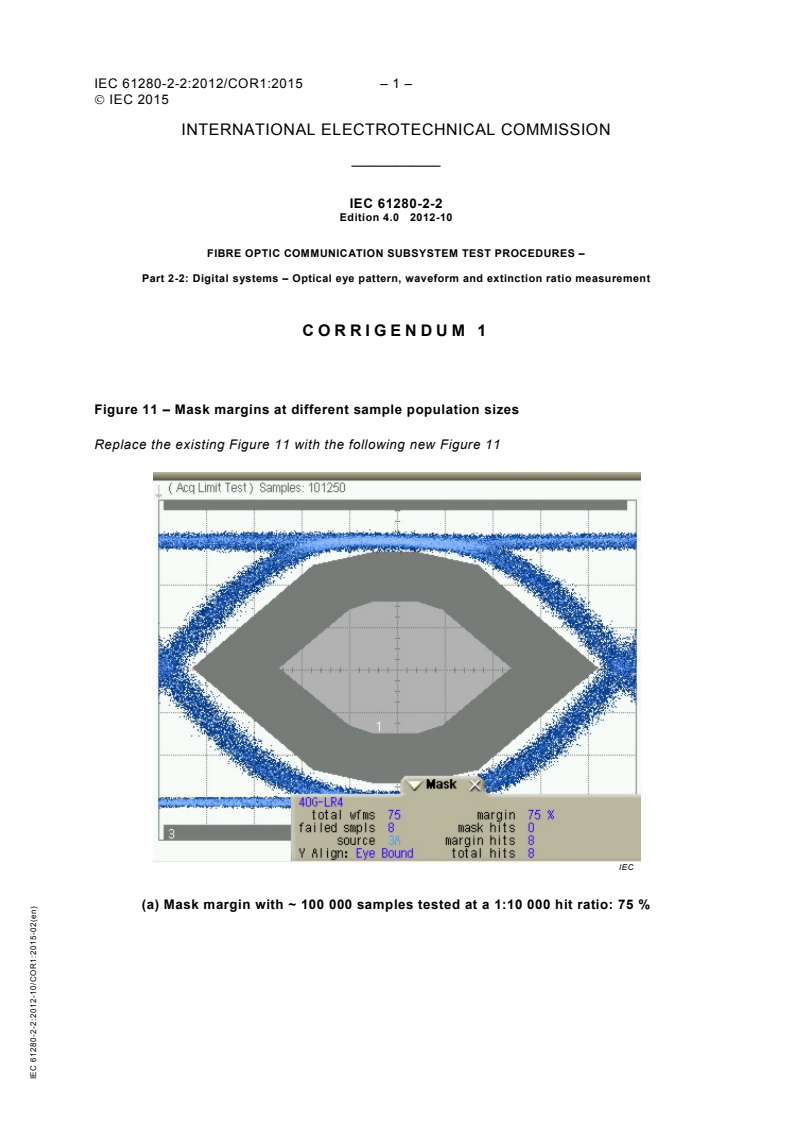


IEC 61280-2-2:2012/COR1:2015 - Corrigendum 1 - Fibre optic communication subsystem test procedures - Part 2-2: Digital systems - Optical eye pattern, waveform and extinction ratio measurement Released:2/17/2015

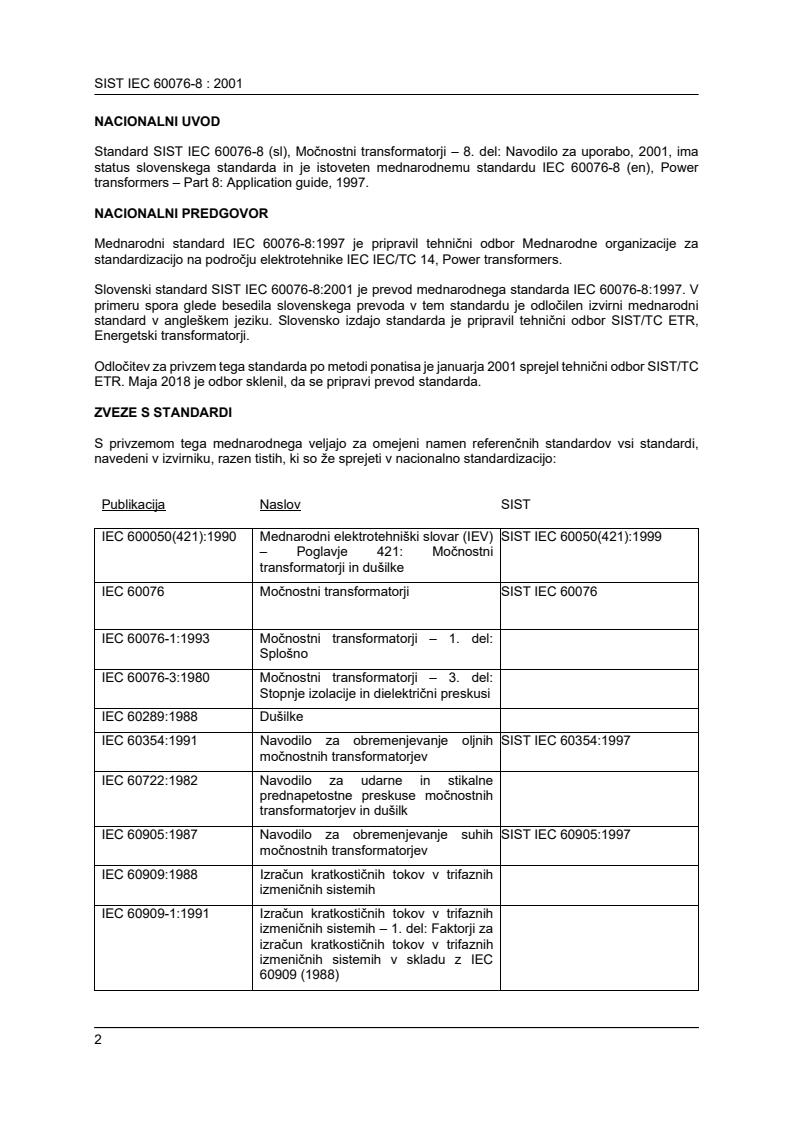
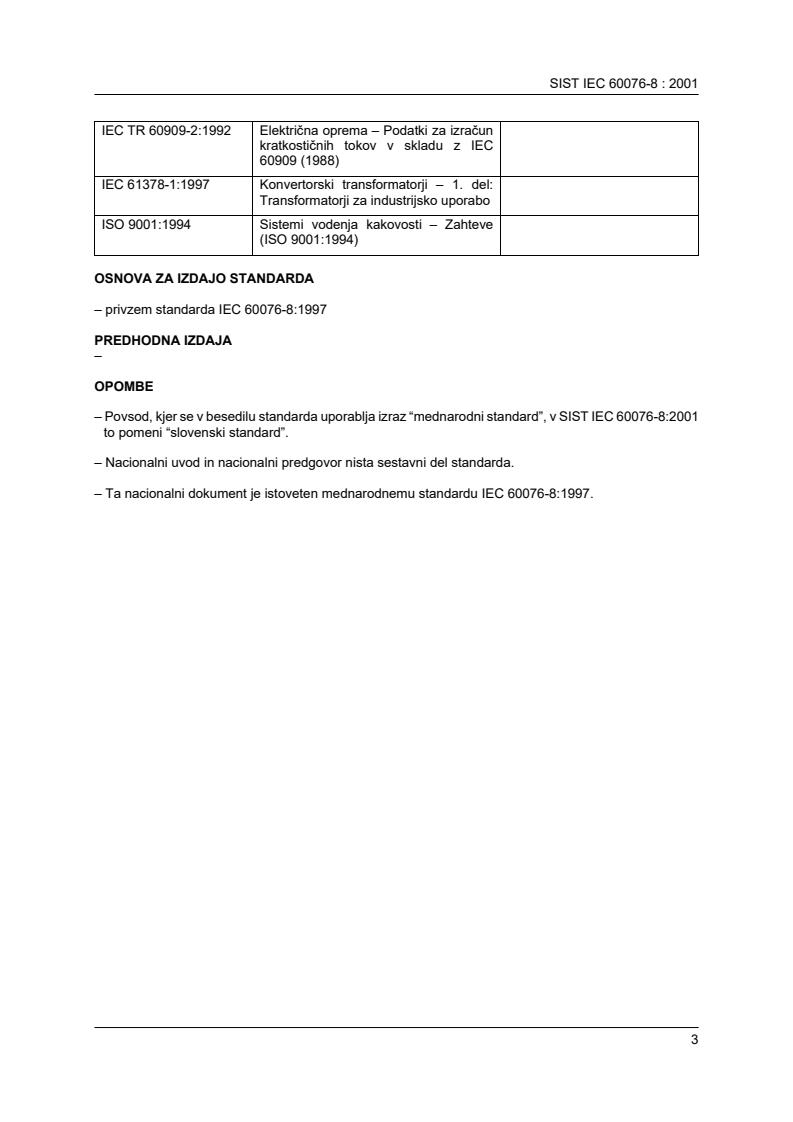
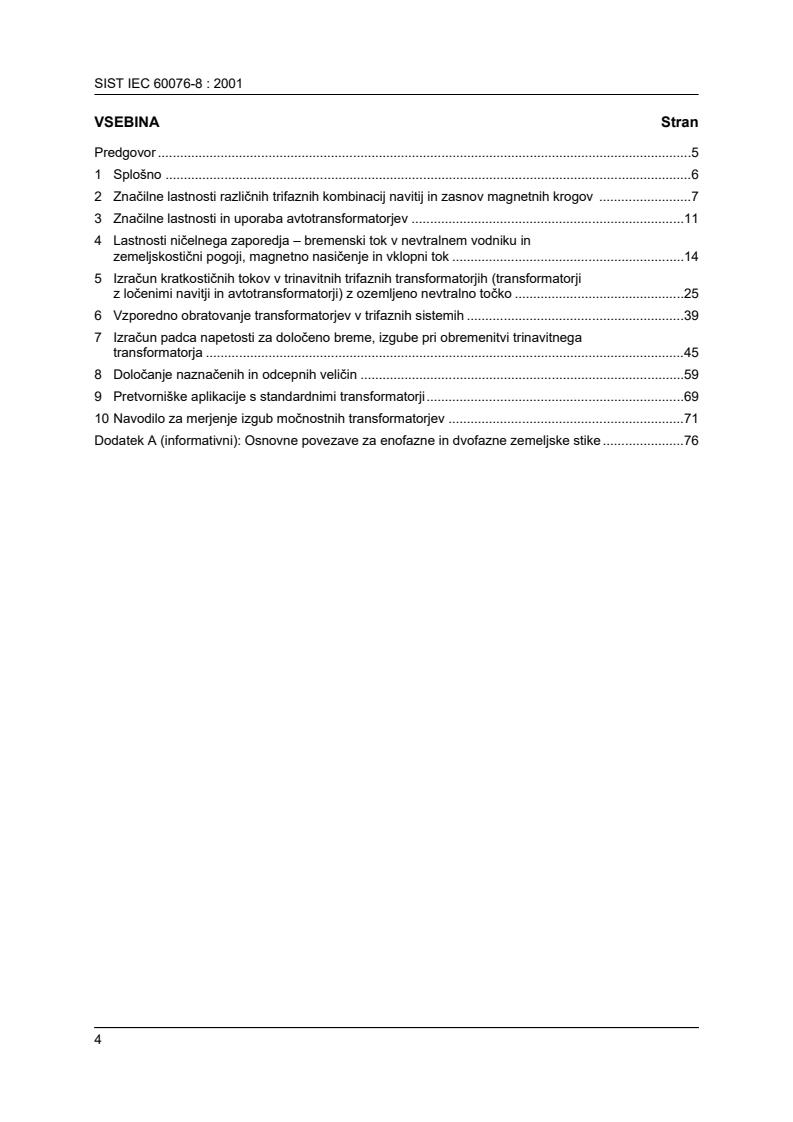
SIST IEC 60076-8:2001 is the Slovenian adoption of IEC 60076-8, published by SIST. It is an application guide for power transformers, explaining how transformer connections, magnetic circuit design, zero-sequence effects, fault currents, parallel operation, voltage drop, tap selection, convertor loading, and loss measurement are treated in practice. The document is intended for engineers, specifiers, buyers, and test personnel who need guidance on choosing and applying power transformers.
What does SIST IEC 60076-8:2001 specify?
SIST IEC 60076-8:2001 gives guidance for power transformers that comply with the IEC 60076 series. It is a guide, so the recommendations are informative rather than mandatory, but they are written to help users choose suitable transformer arrangements and operating data.
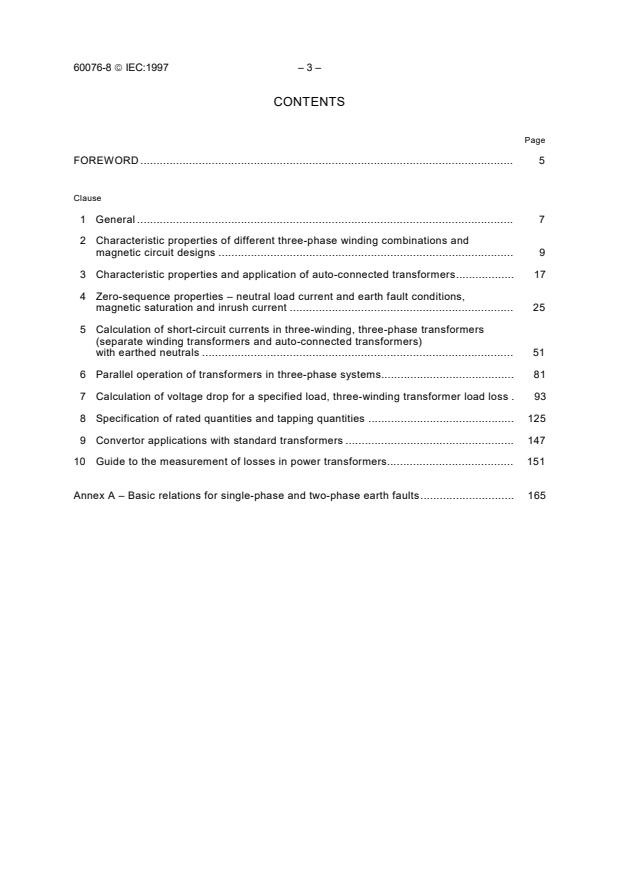
The document is organized into a general clause, eight technical clauses, and one informative annex.
| Part | What it covers |
|---|---|
| Clause 1 | General scope and normative references |
| Clause 2 | Three-phase winding combinations and magnetic circuit designs |
| Clause 3 | Auto-connected transformers |
| Clause 4 | Zero-sequence properties, neutral current, earth faults, saturation and inrush |
| Clause 5 | Short-circuit current calculation for three-winding transformers with earthed neutrals |
| Clause 6 | Parallel operation of transformers in three-phase systems |
| Clause 7 | Voltage drop calculation and three-winding load loss |
| Clause 8 | Rated quantities and tapping quantities |
| Clause 9 | Convertor applications with standard transformers |
| Clause 10 | Measurement of losses in power transformers |
| Annex A | Basic relations for single-phase and two-phase earth faults |
What are the key guidance points of SIST IEC 60076-8:2001?
SIST IEC 60076-8:2001 focuses on the operating behavior that matters when transformers are specified, connected, and tested. The guide is especially useful where zero-sequence current, tap changing, fault duty, or load sharing affects the design choice.
Winding connection and magnetic circuit behavior
Clause 2 compares Y, D, and Z windings and shows why the same transformer can behave very differently depending on connection and core design. In practice, this matters for neutral availability, earthing method, zero-sequence impedance, and the risk of voltage unbalance.
Auto-connected transformers
Clause 3 explains the auto-connected transformer, the reduction factor or auto-factor, and the idea of an equivalent two-winding rating. This is important when comparing physical size, loss level, impedance, insulation stress, and tapping arrangements for autotransformers versus separate-winding transformers.
Zero-sequence effects and earth faults
Clause 4 is the central technical part of the guide. It explains symmetrical components, zero-sequence current and voltage, the behavior of YN, D, and Z windings, the effect of three-limb and five-limb or shell-form magnetic circuits, and the limits that can arise from neutral loading, saturation, inrush current, and d.c. bias.
Short-circuit and parallel operation
Clause 5 gives a method for short-circuit current calculations in three-winding transformers with earthed neutrals. Clause 6 sets the practical conditions for parallel operation: compatible phase displacement, similar ratio, and similar short-circuit impedance. This helps readers avoid circulating currents and uneven load sharing.
Voltage drop, loss allocation, and rating selection
Clause 7 shows how to calculate voltage drop and how to handle three-winding load loss, including star-equivalent representation and loss allocation. Clause 8 then uses service loading cases to derive rated quantities and tapping quantities. In practice, this helps a purchaser define ratings that are high enough for service but not unnecessarily high.
What terms does SIST IEC 60076-8:2001 define?
Symmetrical components - The analytical method that splits an unbalanced three-phase set into positive, negative, and zero-sequence components.
Zero-sequence component - The part of current or voltage that has the same value in all three phases and represents the residual non-symmetrical part.
Auto-connected transformer - A transformer in which at least two windings have a common part.
Reduction factor or auto-factor - The factor used to relate the physical size and equivalent rating of an auto-connected transformer to a separate-winding transformer.
Earth fault factor - The ratio used to describe the voltage on an unfaulted phase during an earth fault relative to the pre-fault phase-to-earth voltage.
Rated quantities and tapping quantities - The specified reference values of power, voltage, and current at the principal tapping and at other tappings.
Who uses SIST IEC 60076-8:2001?
SIST IEC 60076-8:2001 is used by transformer manufacturers, utility engineers, system planners, and procurement teams. It also supports test laboratories and protection engineers who need to assess fault duty, load behavior, tap range choices, and loss measurement.
For buyers and specifiers, the guide helps translate service conditions into transformer data that can be put in a tender. For engineers, it provides the background needed to judge winding connections, neutral treatment, parallel operation, and convertor loading.
What changed in SIST IEC 60076-8:2001 from the previous edition?
SIST IEC 60076-8:2001 is the first edition of IEC 60076-8 and cancels and replaces IEC 60606. The foreword describes it as a technical revision.
Which standards are used with SIST IEC 60076-8:2001?
The guide cites several related standards that supply definitions, test methods, loading guides, and fault-calculation rules:
- IEC 60050(421) - terminology for power transformers and reactors
- IEC 60076 and IEC 60076-1 - the base transformer series and general definitions
- IEC 60076-3 - insulation levels and dielectric tests
- IEC 60289 - reactors
- IEC 60354 - loading guide for oil-immersed power transformers
- IEC 60722 - lightning impulse and switching impulse testing
- IEC 60905 - loading guide for dry-type power transformers
- IEC 60909, IEC 60909-1, and IEC 60909-2 - short-circuit current calculation
- IEC 61378-1 - convertor transformers for industrial applications
- ISO 9001:1994 - quality system model for design, production, installation, and servicing
What does the SIST IEC 60076-8:2001 document contain?
SIST IEC 60076-8:2001 contains explanatory text, connection diagrams, zero-sequence equivalent circuits, short-circuit calculation methods, and worked examples. It uses figures to compare three-limb, five-limb, shell-form, delta, and zigzag arrangements, and to show inrush and fault-current behavior.
It also includes formulas for fault current, voltage drop, tap-related ratio changes, and load-loss allocation in three-winding transformers. The examples are meant to support specification, system studies, testing, and design checks rather than to be copied as fixed design values.
Annex A gives basic relations for single-phase and two-phase earth faults.
Buy Documents
IEC 61280-2-2:2012/COR1:2015 - Corrigendum 1 - Fibre optic communication subsystem test procedures - Part 2-2: Digital systems - Optical eye pattern, waveform and extinction ratio measurement Released:2/17/2015
Get Certified
Connect with accredited certification bodies for this standard

IMQ S.p.A. (Certification)
Italian electrical product certification.

SLG Prüf- und Zertifizierungs GmbH
German testing and certification body.

UL Solutions
Global safety science company with testing, inspection and certification.
Sponsored listings
Frequently Asked Questions
SIST IEC 60076-8:2001 is a standard published by the Slovenian Institute for Standardization (SIST). Its full title is "Power transformers - Part 8: Application guide". This standard covers: Provides information to users about certain fundamental service characteristics of different transformer connections and magnetic circuit designs; system fault currents; parallel operation of transformers, calculation of voltage drop or rise under load; selection of rated quantities and tapping quantities; application of transformers of conventional design to convertor loading; measuring techniques etc.... Cancels and replaces IEC 60606
Provides information to users about certain fundamental service characteristics of different transformer connections and magnetic circuit designs; system fault currents; parallel operation of transformers, calculation of voltage drop or rise under load; selection of rated quantities and tapping quantities; application of transformers of conventional design to convertor loading; measuring techniques etc.... Cancels and replaces IEC 60606
SIST IEC 60076-8:2001 is classified under the following ICS (International Classification for Standards) categories: 29.180 - Transformers. Reactors; 33.180.01 - Fibre optic systems in general. The ICS classification helps identify the subject area and facilitates finding related standards.
SIST IEC 60076-8:2001 is available in PDF format for immediate download after purchase. The document can be added to your cart and obtained through the secure checkout process. Digital delivery ensures instant access to the complete standard document.
Standards Content (Sample)
IEC 2015
INTERNATIONAL ELECTROTECHNICAL COMMISSION
____________
IEC 61280-2-2
Edition 4.0 2012-10
FIBRE OPTIC COMMUNICATION SUBSYSTEM TEST PROCEDURES –
Part 2-2: Digital systems – Optical eye pattern, waveform and extinction ratio measurement
CORRIGENDUM 1
Figure 11 – Mask margins at different sample population sizes
Replace the existing Figure 11 with the following new Fi
...
2003-01.Slovenski inštitut za standardizacijo. Razmnoževanje celote ali delov tega standarda ni dovoljeno.Power transformers - Application guideTransformateurs de puissance - Partie 8: Guide d'applicationPower transformers - Part 8: Application guide29.180Transformatorji. DušilkeTransformers. ReactorsICS:Ta slovenski standard je istoveten z:IEC 60076-8SIST IEC 60076-8:2001en01-julij-2001SIST IEC 60076-8:2001SLOVENSKI
STANDARD
NORMEINTERNATIONALECEIIECINTERNATIONALSTANDARD60076-8Première éditionFirst edition1997-10Transformateurs de puissance –Guide d'applicationPower transformers –Application guide Commission Electrotechnique Internationale International Electrotechnical
CommissionPour prix, voir catalogue en vigueurFor price, see current
catalogueÓ IEC 1997
Droits de reproduction réservés
¾ Copyright - all rights reservedAucune partie de cette publication ne peut être reproduite niutilisée sous quelque forme que ce soit et par aucunprocédé, électronique ou mécanique, y compris la photo-copie et les microfilms, sans l'accord écrit de l'éditeur.No part of this publication may be reproduced or utilized inany form or by any means, electronic or mechanical,including photocopying and microfilm, without
permission inwriting
from the publisher.International Electrotechnical Commission3, rue de Varembé
Geneva, SwitzerlandTelefax: +41 22 919 0300e-mail: inmail@iec.ch IEC web site
http: //www.iec.chCODE PRIXPRICE CODEXC
60076-8 ã IEC:1997– 3 –CONTENTSPageFOREWORD.5Clause
1General.7
2Characteristic properties of different three-phase winding combinations andmagnetic circuit designs.9
3Characteristic properties and application of auto-connected transformers.17
4Zero-sequence properties – neutral load current and earth fault conditions,magnetic saturation and inrush current.25
5Calculation of short-circuit currents in three-winding, three-phase transformers(separate winding transformers and auto-connected transformers)with earthed neutrals.51
6Parallel operation of transformers in three-phase systems.81
7Calculation of voltage drop for a specified load, three-winding transformer load loss.93
8Specification of rated quantities and tapping quantities.125
9Convertor applications with standard transformers.14710Guide to the measurement of losses in power transformers.151Annex A – Basic relations for single-phase and two-phase earth faults.165
60076-8 ã IEC:1997– 5 –INTERNATIONAL ELECTROTECHNICAL COMMISSION_________POWER TRANSFORMERS –APPLICATION GUIDEFOREWORD1)The IEC (International Electrotechnical Commission) is a worldwide organization for standardization comprisingall national electrotechnical committees (IEC National Committees). The object of the IEC is to promoteinternational co-operation on all questions concerning standardization in the electrical and electronic fields. Tothis end and in addition to other activities, the IEC publishes International Standards. Their preparation isentrusted to technical committees; any IEC National Committee interested in the subject dealt with mayparticipate in this preparatory work. International, governmental and non-governmental organizations liaisingwith the IEC also participate in this preparation. The IEC collaborates closely with the International Organizationfor Standardization (ISO) in accordance with conditions determined by agreement between the twoorganizations.2)The formal decisions or agreements of the IEC on technical matters express, as nearly as possible, aninternational consensus of opinion on the relevant subjects since each technical committee has representationfrom all interested National Committees.3)The documents produced have the form of recommendations for international use and are published in the formof standards, technical reports or guides and they are accepted by the National Committees in that sense.4)In order to promote international unification, IEC National Committees undertake to apply IEC InternationalStandards transparently to the maximum extent possible in their national and regional standards. Anydivergence between the IEC Standard and the corresponding national or regional standard shall be clearlyindicated in the latter.5)The IEC provides no marking procedure to indicate its approval and cannot be rendered responsible for anyequipment declared to be in conformity with one of its standards.6)Attention is drawn to the possibility that some of the elements of this International Standard may be the subjectof patent rights. The IEC shall not be held responsible for identifying any or all such patent rights.International Standard IEC 60076-8 has been prepared by IEC technical committee 14: Powertransformers.This first edition of IEC 60076-8 cancels and replaces IEC 60606 published in 1978. Thisedition constitutes a technical revision.The text of this standard is based on the following documents:FDISReport on voting14/260/FDIS14/297/RVDFull information on the voting for the approval of this standard can be found in the report onvoting indicated in the above table.IEC 60076 consists of the following parts, under the general title: Power transformers.Part 1: 1993, GeneralPart 2: 1993, Temperature risePart 3: 1980, Insulation levels and dielectric testsPart 5: 1976, Ability to withstand short circuitPart 8: 1997, Application guideAnnex A is for information only.
60076-8 ã IEC:1997– 7 –POWER TRANSFORMERS –APPLICATION GUIDE1 General1.1 Scope and objectThis Standard applies to power transformers complying with the series of publicationsIEC 60076.It is intended to provide information to users about:–certain fundamental service characteristics of different transformer connections andmagnetic circuit designs, with particular reference to zero-sequence phenomena;–system fault currents in transformers with YNynd and similar connections;–parallel operation of transformers, calculation of voltage drop or rise under load, andcalculation of load loss for three-winding load combinations;–selection of rated quantities and tapping quantities at the time of purchase, based onprospective loading cases;–application of transformers of conventional design to convertor loading;–measuring technique and accuracy in loss measurement.Part of the information is of a general nature and applicable to all sizes of power transformers.Several chapters, however, deal with aspects and problems which are of the interest only forthe specification and utilization of large high-voltage units.The recommendations are not mandatory and do not in themselves constitute specificationrequirements.Information concerning loadability of power transformers is given in IEC 60354, for oil-immersed transformers, and IEC 60905, for dry-type transformers.Guidance for impulse testing of power transformers is given in IEC 60722.1.2 Normative referencesThe following normative documents contain provisions which, through reference in this text,constitute provisions of this International Standard. At the time of publication, the editionsindicated were valid. All normative documents are subject to revision, and parties toagreements based on this International Standard are encouraged to investigate the possibilityof applying the most recent edition of the normative documents indicated below. Members ofIEC and ISO maintain registers of currently valid International Standards.IEC 60050(421):1990, International Electrotechnical Vocabulary (IEV) – Chapter 421: Powertransformers and reactorsIEC 60076: Power transformersIEC 60076-1:1993, Power transformers – Part 1: General
60076-8 ã IEC:1997– 9 –IEC 60076-3:1980, Power transformers – Part 3: Insulation levels and dielectric testsIEC 60289:1988, ReactorsIEC 60354:1991, Loading guide for oil-immersed power transformersIEC 60722:1982, Guide to the lightning impulse and switching impulse testing of powertransformers and reactorsIEC 60905:1987, Loading guide for dry-type power transformersIEC 60909:1988, Short-circuit current calculation in three-phase a.c. systemsIEC 60909-1:1991, Short-circuit current calculation in three-phase a.c. systems – Part 1:Factors for the calculation of short-circuit currents in three-phase a.c. systems according toIEC 60909 (1988)IEC 60909-2:1992, Electrical equipment – Data for short-circuit current calculations inaccordance with IEC 60909 (1988)IEC 61378-1: 1997, Convertor transformers – Part 1: Transformers for industrial applicationsISO 9001: 1994, Quality systems – Model for quality assurance in design, development,production, installation and servicing2 Characteristic properties of different three-phase winding combinationsand magnetic circuit designsThis chapter is an overview of the subject. Additional information is given in clause 4 on zero-sequence properties.2.1 Y-, D-, and Z-connected windingsThere are two principal three-phase connections of transformer windings: star (Y-connection)and delta (D-connection). For special purposes, particularly in small power transformers,another connection named zigzag or Z is also used. Historically, several other schemes havebeen in use (such as "truncated delta", "extended delta", "T-connection", "V-connection", etc.).While such connections are used in transformers for special applications, they no longerappear in common power transmission systems.2.1.1 Advantages of a Y-connected windingThis type of winding:–is more economical for a high-voltage winding;–has a neutral point available;–permits direct earthing or earthing through an impedance;–permits reduced insulation level of the neutral (graded insulation);–permits the winding taps and tapchanger to be located at the neutral end of each phase;–permits single-phase loading with neutral current (see 2.2 and 4.8).
60076-8 ã IEC:1997– 11 –2.1.2 Advantages of a D-connected windingThis type of winding:–is more economical for a high-current, low-voltage winding;–in combination with a star-connected winding, reduces the zero-sequence impedance inthat winding.2.1.3 Advantages of a Z-connected windingThis type of winding:–permits neutral current loading with inherently low zero-sequence impedance. (It is usedfor earthing transformers to create an artificial neutral terminal of a system);–reduces voltage unbalance in systems where the load is not equally distributed betweenthe phases.2.2 Characteristic properties of combinations of winding connectionsThe notation of winding connections for the whole transformer follows the conventions inIEC 60076-1, clause 6.This subclause is a summary of the neutral current behaviour in different windingcombinations. Such conditions are referred to as having "zero-sequence components" ofcurrent and voltage. This concept is dealt with further in clauses 4 and 5.The statements are also valid for three-phase banks of single-phase transformers connectedtogether externally.2.2.1 YNyn and YNautoZero-sequence current may be transformed between the windings under ampere-turn balance,meeting low short-circuit impedance in the transformer. System transformers with suchconnections may in addition be provided with delta equalizer winding (see 4.7.2 and 4.8).2.2.2 YNy and YynZero-sequence current in the winding with earthed neutral does not have balancing ampere-turns in the opposite winding, where the neutral is not connected to earth. It thereforeconstitutes a magnetizing current for the iron core and is controlled by a zero-sequencemagnetizing impedance. This impedance is high or very high, depending on the design of themagnetic circuit (see 2.3). The symmetry of the phase-to-neutral voltages will be affected andthere may be limitations for the allowable zero-sequence current caused by stray-flux heating(see 4.8).2.2.3 YNd, Dyn, YNyd (loadable tertiary) or YNy + d (non-loadable delta equalizer winding)Zero-sequence current in the star winding with earthed neutral causes compensatingcirculating current to flow in the delta winding. The impedance is low, approximately equal tothe positive-sequence short-circuit impedance between the windings.If there are two star windings with earthed neutrals (including the case of auto-connection withcommon neutral), there is a three-winding loading case for zero-sequence current. This is dealtwith in 4.3.2 and 4.7.2, and in clause 5.
60076-8 ã IEC:1997– 13 –2.2.4 Yzn or ZNyZero-sequence current in the zigzag winding produces an inherent ampere-turn balancebetween the two halves of the winding on each limb, and provides a low short-circuitimpedance.2.2.5 Three-phase banks of large single-phase units – use of delta connected tertiary windingsIn some countries, transformers for high-voltage system interconnection are traditionally madeas banks of single-phase units. The cost, mass, and loss of such a bank is larger than for acorresponding three-phase transformer (as long as it can be made). The advantage of the bankconcept is the relatively low cost of providing a spare fourth unit as a strategic reserve. It mayalso be that a corresponding three-phase unit would exceed the transport mass limitation.The three single-phase transformers provide independent magnetic circuits, representing highmagnetizing impedance for a zero-sequence voltage component.It may be necessary to provide a delta equalizer winding function in the bank, or there may bea need for auxiliary power at relatively low-voltage from a tertiary winding. This can beachieved by external busbar connection from unit to unit in the station. The external connectionrepresents an additional risk of earth fault or short circuit on the combined tertiary winding ofthe bank.2.3 Different magnetic circuit designsThe most common magnetic circuit design for a three-phase transformer is the three-limb core-form (see figure 1). Three parallel, vertical limbs are connected at the top and bottom byhorizontal yokes.Figure 1 – Three-limb, core-form magnetic circuitThe five-limb, core-form magnetic circuit (see figure 2) has three limbs with windings and twounwound side limbs of lesser cross-section. The yokes connecting all five limbs also have areduced cross-section in comparison with the wound limbs.IEC
1119/97
60076-8 ã IEC:1997– 15 –IEC
1120/97Figure 2 – Five-limb, core-form magnetic circuitThe conventional shell-form three-phase design has a frame with the three wound limbshorizontal and having a common centre line (see figure 3). The core-steel limbs inside thewindings have an essentially rectangular cross-section and the adjoining parts of the magneticcircuit surround the windings like a shell.Figure 3 – Three-phase conventional shell-form magnetic circuitA new three-phase shell-form magnetic circuit is the seven-limb core, in which the wound limbsare oriented in a different way (see figure 4).Figure 4 – Three-phase seven-limb shell-form magnetic circuitIEC
1121/97IEC
1122/97
60076-8 ã IEC:1997– 17 –The principal difference between the designs, to be discussed here, lies in their behaviourwhen subjected to an asymmetrical three-phase set of voltages having a non-zero sum i.e.having a zero-sequence component.This condition may also be described as starting from a zero-sequence current withoutbalancing ampere-turns in any other winding. Such a current appears as a magnetizing currentfor the magnetic circuit and is controlled by a magnetizing impedance, across which a zero-sequence voltage drop is developed.The usual types of magnetic circuits behave as follows.2.3.1 Three-limb core-form magnetic circuitIn the three-limb core-form transformer, positive and negative sequence flux components in thewound limbs (which have a zero sum at every instant) cancel out via the yokes, but the residualzero-sequence flux has to find a return path from yoke to yoke outside the excited winding.This external yoke leakage flux sees high reluctance and, for a given amount of flux (a givenapplied zero-sequence voltage), a considerable magnetomotive force (high magnetizingcurrent) is required. In terms of the electrical circuit, the phenomenon therefore represents arelatively low zero-sequence (magnetizing) impedance. This impedance varies in a non-linearway with the magnitude of the zero-sequence component.Conversely, uncompensated zero-sequence current constitutes a magnetizing current which iscontrolled by the zero-sequence magnetizing impedance. The result is a superposedasymmetry of the phase-to-neutral voltages, the zero-sequence voltage component.The zero-sequence yoke leakage flux induces circulating and eddy currents in the clampingstructure and the tank, generating extra stray losses in these components. There could also beincreased eddy losses in the windings caused by the abnormal stray flux. There are limitationsto the magnitude of any long duration neutral current which is allowable in service. This isconsidered in 4.8.2.3.2 Five-limb core-form, or shell-form magnetic circuitIn a five-limb core-form, or a shell-form transformer, there are return paths available for thezero-sequence flux through unwound parts of the magnetic circuit (side limbs of five-limb core,outside parts of the shell frame plus, and for the seven-limb shell-form core, the two unwoundinter-winding limbs). The zero-sequence flux sees low magnetic reluctance equivalent to a veryhigh magnetizing impedance, similar to that of normal positive-sequence voltage. This appliesup to a limit, where the unwound parts of the magnetic circuit reach saturation. Above that, theimpedance falls off, resulting in peaked, distorted current.A three-phase bank of single-phase transformers reacts similarly. The magnetic circuits areseparate and independent at any applied service voltage.Due to the phenomena described above, it is customary to provide such transformers ortransformer banks with a delta-connected stabilizing winding (see clause 4).3 Characteristic properties and application of auto-connected transformers3.1
By definition, an auto-connected transformer is a transformer in which at least twowindings have a common part (see 3.1.2 of IEC 60076-1).
60076-8 ã IEC:1997– 19 –The single line diagram of an auto-transformer is shown in figure 5. The high-voltage side ofthe transformer (identified with U1, I1 in the figure) consists of the common winding togetherwith the series winding. The low-voltage side (U2, I2) consists of the common winding alone.The high- and low-voltage systems are electrically connected.UIUIS1122==UUUIII121212-=-=a()()UUIUIIS121221-=-=aIEC
1123/97U1I1U1 - U2U2I1 - I2I2i1I2Figure 5 – Auto-connected transformer, single-line diagram3.2
The reduction factor or auto-factor, aThe auto-transformer is physically smaller and has lower losses than a separate windingtransformer for the same throughput power. The relative saving is greater the closer thetransformation ratio is to unity. The two windings (series and common) represent the sameequivalent power ratings or, expressed in other terms, balancing ampere-turns. The relationsshown in figure 5 immediately explain the reduction factor, a, of the auto-connection. If S is therated power of the auto-connected windings, noted on the rating plate, then the transformer issimilar, with regard to physical size and mass, to a separate winding transformer having ratedpower a ´ S. This is often referred to with expressions such as intrinsic rated power orequivalent two-winding rating.ExampleAn auto-connected transformer 420/240 kV, 300 MVA, is comparable with a separatewinding transformer having a rated power of:((420 – 240)/420) ´ 300 = 129 MVAIf the transformer in addition is provided with a non-auto-connected tertiary winding of 100MVA rated power (YNauto d 300/300/100 MVA), then its equivalent two-winding rating willbe(129 + 129 + 100)/2 = 179 MVA3.3
Short-circuit impedance and leakage flux effectsThe short-circuit impedance of a transformer may be described physically in terms of thereactive power in the leakage field. This in turn depends on the physical size and geometry ofthe windings.
60076-8 ã IEC:1997– 21 –For an auto-transformer with its reduced dimensions, the reactive power in the leakage field isnaturally smaller than for a separate winding transformer with the same rated power. Itsimpedance, expressed as a percentage, will then be correspondingly lower. The auto-connection factor, a, is also a benchmark for the percentage impedance.However, it may also be observed that if the percentage impedance of an auto-transformer isspecified with an elevated value (with a view to limiting fault-current amplitudes in thesecondary-side system) then this transformer will, from a design point of view, be a physicallysmall unit with a quite large leakage field. This will be reflected as higher additional losses(winding eddy loss as well as stray field loss in mechanical parts) and possibly even saturationeffects due to leakage flux circulating in part through the magnetic circuit. Such effects wouldrestrict the loadability of the unit above rated conditions, but this is not revealed by standardtests.The transformer loading guide, IEC 60354, takes these phenomena into account whenseparating between large and medium power transformers. Auto-transformers are to beclassified according to their equivalent power rating, and the corresponding percentageimpedance, instead of by the rating-plate figures.3.4
System restrictions, insulation co-ordinationThe direct electrical connection between the primary and secondary (three-phase) systemsimplies that they will have a common neutral point and that the three-phase connection of theauto-transformer is in star. In practice, the systems will normally be effectively earthed and theneutral point of the auto-transformer will usually be specified with reduced insulation level.–If the transformer neutral is to be directly earthed, the necessary insulation level is verylow (see 5.5.2 of IEC 60076-3).–It may alternatively be foreseen that not all neutrals of several transformers in a stationwill be directly earthed. This is in order to reduce the prospective earth fault currents. Theunearthed neutrals will, however, usually be provided with a surge arrester for protectionagainst transient impulses. The specified arrester rated voltage and the insulation level ofthe neutral will be co-ordinated with the power frequency voltage appearing at the unearthedneutral during a system earth fault.–In extra-high-voltage systems with long overhead lines, the possibility of successfulsingle-pole reclosing may be improved by specially tuned reactor earthing. This requires arelatively high insulation of the transformer neutral, which is connected via the tuning reactorto earth.The series winding of an auto-transformer sometimes presents design difficulties for theinsulation across the winding. It is assumed that the X-terminal, the low-voltage side-line terminal,stays at low potential at the incidence of a transient overvoltage on the high-voltage side-lineterminal. The stress corresponding to the whole impulse insulation level of the high-voltage sidewill therefore be distributed along the series winding only. This represents a correspondinglyhigher turn-to-turn voltage, compared with an overvoltage across the low-voltage side, distributedalong the common winding.3.5
Voltage regulation in system-interconnection autotransformersVariation of the voltage ratio in an auto-connected transformer may be arranged in differentways. Some of these follow the underlying principles of 5.1 of IEC 60076-1. Others do notbecause the number of effective turns is changed in both windings simultaneously.
60076-8 ã IEC:1997– 23 –The tapping turns will be either at the neutral terminal or at the joint between the common andthe series windings (common point) (see figure 6).3.5.1
Tapping turns at the neutralRegulation at the neutral simultaneously increases or decreases the number of turns in both the high-voltageand low-voltage windings but the ratio between the windings changes. This type of regulation will be insufficientin the sense that it requires many regulating turns for the specified range of variation of ratio. Therefore, thevolts per turn in the transformer will vary considerably across the tapping range (variable flux). The phenomenongets more pronounced the closer the ratio of the transformer approaches unity (low a value). This has to becovered by a corresponding over-dimensioning of the magnetic circuit. It will also result in unequal voltages perstep.The obvious advantage of regulation in the neutral is that the tapping winding and the tap-changer will be closeto neutral potential and require only low insulation level to earth.Figure 6 – Tapping turns at the common neutral3.5.2
Tapping turns at the X-terminalRegulation arranged at the auto-interconnection in the transformer (the low-voltage side-lineterminal) requires the tapping winding and tapchanger to be designed with the insulation levelof the X-terminal. They will be directly exposed to steep-front voltage transients from lightningor switching surges. Figure 7 shows a number of different arrangements.IEC
1124/97X
60076-8 ã IEC:1997– 25 –IEC
1125/97XXXa)b)c)a)The number of turns in the common winding remains unchanged. This is a logical choice if the low-voltagesystem voltage remains relatively constant while the high-voltage system voltage is more variable.b)This alternative is the opposite to a). The number of turns facing the high-voltage system voltage remainsconstant, while the effective number of turns of the low-voltage side varies.c)The number of turns is constant on the high-voltage side, but for a specific number of reconnected turns, theratio varies more than in case b). Case b) on the other hand permits plus-minus utilization of the tappingwinding by reversing it as indicated in the figure.Figure 7 – Tapping turns at the lower voltage terminal4 Zero-sequence properties – neutral load current and earth fault conditions,magnetic saturation and inrush currentThis clause outlines the characteristics of three-phase transformers and banks of single-phasetransformers with regard to asymmetrical three-phase service conditions.There are differences depending on the geometry of the magnetic circuit and on thecombination of three-phase connections of the windings.The asymmetrical conditions comprise transient disturbances as well as asymmetries duringcontinuous service, giving rise to:–temporary loss of symmetry of three-phase voltages and, consequently, of the symmetryof magnetization of the core;–temporary or permanent asymmetry of load currents, particularly current in the neutral,which will affect the voltage stability, leakage flux and core magnetization.4.1 Introduction of the symmetrical components of a three-phase systemA short explanation of the conventional analytical method called symmetrical components,which is frequently referred to in power system analysis, is given in 4.1.1. For furtherinformation on this method and its application, see textbooks on power system analysis.
60076-8 ã IEC:1997– 27 –A further explanation regarding the practical aspects of earthing of the system throughtransformer neutrals is given in 4.1.2.4.1.1 Principles and terminology of symmetrical components of voltage and currentThe method, as conventionally applied, presupposes synchronous and sinusoidal voltages andcurrents, linked by circuit elements in the form of constant impedance or admittance, withequal value for the three phases. These assumptions imply that all circuit equations are linear,and that changes of variables by linear transformations are possible. One such transformationis that of symmetrical components.In the general asymmetrical case, the three individual phase voltages or phase current haveunequal amplitudes and are not spaced equally in time (not 120 electrical degrees apart). Thesum of the momentary values may be different from zero. The phasor picture is anasymmetrical star. The vectorial sum of the three phasors does not necessarily form a closedtriangle (non-zero sum).It is however always possible to replace the original three asymmetrical variables by acombination of the following three symmetrical components:–a positive sequence component having a fully symmetrical, ordinary set of three-phasevoltages or currents;–a negative sequence component having another symmetrical set, but with opposite phasesequence;–a zero sequence component having the same phasor value in all three phases with nophase rotation.The two first components each have zero sum at every instant. The third componentrepresents the residual, non-zero sum of the original variables, with one-third appearing ineach phase.The advantage of the method of symmetrical components for calculation of voltages andcurrents is that the original system of three coupled equations with three unknown variables isreplaced by three separate, single-phase equations with one unknown, one for eachcomponent. Each equation makes use of the relevant impedance or admittance parameters forthe respective component.The solution of the equations for the separate symmetrical components are then superposedback, phase by phase, to obtain the phase voltages or currents of the real system.The algorithms for transformation of the original phase quantities into symmetrical componentsand back again can be found in appropriate textbooks.4.1.2 Practical aspectsThe properties of the components have the following practical consequences with regard tocurrents and voltages.–The three line currents in a system without earth return or neutral conductor have zerosum. Their transformation into symmetrical components contains positive and negativesequence components but no zero-sequence component.The currents from a system to a delta-connected winding have this property.
60076-8 ã IEC:1997– 29 ––If there is neutral current to earth or through a neutral conductor (fourth wire), then thesystem of phase currents may have a zero-sequence component. This is a normal conditionin four-wire distribution systems with single-phase loads applied between phase and neutral.High-voltage transmission lines do not normally carry any intentional neutral load current. Tothe extent that load asymmetry exists, it rather has the character of load between twophases which results in a negative-sequence component, but no zero-sequence component.–A zero-sequence component is defined as existing in phase, and with the sameamplitude, in all three phases. A zero-sequence component of current is, consequently,precisely one-third of the neutral current.–The set of line-to-line voltages across a delta-connected winding have zero sum,because of the closed connection, and consequently do not contain any zero-sequencevoltage component. But inside the delta winding, there may flow zero-sequence current, ashort-circuit current circulating around the delta, which is induced from another winding(see 4.5).4.2 Impedance parameters for symmetrical componentsThe impedance (or admittance) parameters of different elements of the system may bedifferent for the three components. In practice, components such as transformers and reactorshave equal parameters for positive sequence and negative sequence impedance. For atransformer, they are taken as the values measured during the routine tests.The zero-sequence parameters of a transformer, however, are different. It may be thattransformers having equal values of positive-sequence reactance still have unequal zero-sequence characteristics depending on the type of magnetic circuit, the connection andlocation of the different winding, the way of guiding leakage flux, etc.In some cases, a zero-sequence impedance will be non-linear. This is described with referenceto the physics of the transformer in the following clauses. They also provide some approximatequantitative estimates for general guidance. If more accurate evidence about a specifictransformer is wanted, measurements of its zero-sequence characteristics may be carried outas a special test, on request (see 10.7 of IEC 60076-1).4.3 Single-line equivalent diagram of the transformer for zero-sequence phenomenaThe fundamentals of the symmetrical component method have been outlined in 4.1, 4.1.1,4.1.2 and 4.2. It was stated that the analysis of asymmetrical, linear, sinusoidal phenomena ishandled in the form of simultaneous, single-phase equations, one for each component. Forpositive and negative sequence, the transformer is represented with its normal no-load andshort-circuit impedances but, for zero-sequence, the diagram is sometimes different,depending on the design. Quantitative information about the zero-sequence parameters can befound in this subclause.
60076-8 ã IEC:1997– 31 –IEC
1126/97ZAZBZCIIIFigure 8 – Zero-sequence diagram for two-winding transformerThe equivalent diagram of a two-winding three-phase transformer for zero-sequence iscomposed of a series impedance and a shunt branch. In figure 8, the sum of the two seriesimpedance elements ZA and ZB is equal to the ordinary short-circuit impedance for positive-sequence current. The subdivision between the two elements is arbitrary, and either can be putequal to zero.Zm is a magnetizing impedance, the order of magnitude of which depends on the design of themagnetic circuit. A five-limb core or a shell-form three-phase magnetic circuit presents veryhigh magnetizing impedance for zero-sequence voltage (see 4.4).A three-limb core, on the other hand, has a moderate magnetizing impedance for zero-sequence voltage. This impedance is non-linear with the current or voltage magnitude andvaries from design to design. The yoke leakage flux (see 4.4) induces flow of eddy currentsaround the whole tank. There is, therefore, a difference between transformers havingcorrugated tanks of thin steel sheet and those having tanks of flat boilerplate. For boilerplatetank transformers, the per unit zero-sequence impedance is, in general, of the order of 0,25to 1,0 when the neutral current 3 x I0 is equal to the rated current of the winding. The generalvariation of impedance with current is shown in figure 9.For a new transformer, the manufacturer will perform a measurement of the zero-sequenceimpedance on request (see 10.1.3 and 10.7 of IEC 60076-1).IEC
1127/97Z0100 %50
0 0,5 1,0 1,5 (3 x I0)IIrFigure 9 –Variation with current of zero-sequence magnetizing impedanceof three-limb transformer without a delta winding
60076-8 ã IEC:1997– 33 –The consequences for particular cases of transformer connections are described in 4.3.1and 4.3.2.4.3.1 YNyn transformer without additional delta windingWhen both winding neutrals are connected to effectively earthed systems, zero-sequencecurrent may be transferred between the systems, meeting low impedance in the transformer.The system impedances are not, in this case, larger than the transformer series impedance.With a three-limb core, the moderate magnetizing impedance is not negligible. It lowers theeffective through impedance of the transformer to approximately 90 % to 95 % of the positive-sequence short-circuit impedance. With a five-limb core or a shell-form transformer, there is nosuch reduction.If the opposing winding system does not accept zero-sequence current, the input impedance ofeither winding is the magnetizing impedance, which is dependent on the magnetic circuitdesign as outlined above.If the opposing winding system has its neutral earthed through an impedance element Zn, thisis represented in the zero-sequence diagram by an additional series impedance equal to 3Zn(see figure 10).IEC
1128/97ZAZB3 ZnZmIIIFigure 10 –YNyn transformer with neutral earthing impedance –zero-sequence representation4.3.2 YNynd, or YNyn + d transformerThis is a three-winding combination. There is a star configuration of series impedance elements,in combination with the magnetizing impedance for zero-sequence. In figure 11, ZA + ZC is theshort-circuit impedance between winding A and the delta-connected third winding C, within whicha zero-sequence current may circulate (see 4.5). This impedance is the input impedance for zero-sequence current from system I into winding A.Similarly, the impedance for zero-sequence current from system II into winding B is ZB + ZC.
60076-8 ã IEC:1997– 35 –IEC
1129/97ZAZBZmIIIZCFigure 11 – YNynd transformer – zero-sequence representationThe magnetizing impedance Zm which is also indicated in figure 11, is usually neglected incalculations for this winding combination. It is accepted that the zero-sequence impedances ofthe diagram differ somewhat from values measured with positive sequence current. Thedifference depends on the arrangement of the windings with respect to each other and usuallystays within 10 % to 15 %.4.4 Magnetizing impedance under asymmetrical conditions – zero-sequence voltageand magnetic circuit geometryFor several reasons, the symmetry of three-phase voltages in transmission systems undernormal service conditions is maintained quite well and does not in general cause any concernfor the operation of the transformer.During asymmetrical earth faults in the network, the system of phase-to-earth voltagescontains a zero-sequence component. The degree of asymmetry depends on the method ofsystem earthing. The system is characterized by an earth fault factor which is, briefly, the ratiobetween phase-to-earth a.c. voltage on an unfaulted phase during the fault and thesymmetrical phase-to-earth voltage prior to the fault. This is of importance with regard toinsulation coordination.If the three-phase limbs of a transformer are subjected to a system of induced voltages whichcontains a zero-sequence component (i.e. has a non-zero sum), then the reaction depends onthe magnetic circuit geometry and the connection of the windings.In a three-limb core type transformer (see figure 12), the unequal flux contributions from thethree limbs do not cancel in the yokes. The residual, zero-sequence flux instead completes itspath outside the iron core. This represents high reluctance and a low magnetizing impedancefor zero-sequence voltage. Quantitative information is given in 4.3. The phenomenon ofconsiderable flux leaving the magnetic circuit and closing outside may also occur duringswitching transient conditions.
60076-8 ã IEC:1997– 37 –IEC
1130/97Figure 12 – Zero-sequence magnetization of three-limb and five-limb coresIn a five-limb core type transformer (see figure 12), the unwound outer limbs present a low-reluctance return path, where zero-sequence flux may pass. The corresponding magnetizingimpedance is high, as for normal positive-sequence flux. The same applies for shell-formthree-phase transformers, and, of course, for a bank of three separate single-phase units.However, applied zero-sequence voltage and current is also influenced by the winding three-phase connection; see the following clauses.4.5 Zero-sequence and delta windingsThe phase-to-phase voltages across a delta-connected winding automatically sum up to zerobecause of the closed triangle connection. Alternatively, a delta winding can be looked on as ashort circuit with regard to zero-sequence voltages.Zero-sequence current cannot be exchanged between the three terminals of the delta windingand an external system. But a circulating short-circuit current may be induced from another(YN-connected) winding (see figure 13). The zero-sequence impedance of the transformer,seen from the other winding, has the character of a short-circuit impedance between the otherwinding and the delta winding. For quantitative information, see 4.3.IEC
1131/97I0I0I03 I0I0Figure 13 – Zero-sequence short-circuit current induced in a delta winding
60076-8 ã IEC:1997– 39 –4.6 Zero-sequence and zigzag windingsIn a zigzag connected winding (see figure 14), each limb of the transformer carries partwindings from two phases which have opposite winding directions. The number of ampere-turns of a zero-sequence current component cancel out on each limb, with no resultingmagnetization. The current meets only a low short-circuit impedance associated with theleakage flux between the part windings on the limb (see also 4.7.3).IEC
1132/97I0I0I03 I0Figure 14 –A zigzag connected winding inherently balancedfor zero-sequence current4.7 Zero-sequence impedance properties of different transformer connectionsPrevious subclauses have described zero-sequence characteristics of specific magneticcircuits and of specific individual windings in transformers. This subclause summarizes thezero-sequence characteristics of whole transformers having usual winding combinations.Table 1 indicates approximate zero-sequence impedance values for two and three-windingcombinations when either of the windings is excited from a system. This table as it stands isvalid for designs with concentric windings, here numbered (1) – (2) – (3) with (1) as theoutermost winding. The winding symbols in the first column are written in the same order. It isunimportant which one is the high-voltage winding.The following subclauses provide further descriptive text.In table 1, the symbol YN indicates that the winding neutral is earthed directly or via a lowimpedance. Symbol Y indicates that the neutral is not connected to earth.Percentage figures, when given, are in relation to the usual reference impedance U2/S.Some connections are marked with an asterisk (*). In these cases, the zero-sequence currentin the excited winding is not balanced by current in any other winding. The zero-sequenceimpedance is then a magnetizing impedance of relatively high or very high value, depending onthe magnetic circuit.In all other cases, there is current balance between the windings, and the zero-sequenceimpedance is equal to, or at least close to, the ordinary short-circuit impedance between thewindings involved.The table only indicates the contribution of the transformer itself. Impedances of associatedsystems are regarded as negligible.
60076-8 ã IEC:1997– 41 –This means that, in the zero-sequence diagram representation, a YN output winding isregarded as having all three phases short-circuited to earth.Table 1 – Zero-sequence impedances, typical valuesImpedance %Excited winding, 3-limb coreExcited winding,5-limb core (or shell)Subclauses(1)(2)(3)(1)(2)(3)(1)(2)(3)YNY*» 50–» 104–4.3, 4.4YYN*–» 60–» 1044.3, 4.4YNYNa1z12a2z12z12z124.7.1YNDa1z12–z12–4.7.2DYN–a2z12–4.7.2YNYY*» 50––» 104––4.3, 4.4YYNY*–» 60––» 104–4.3, 4.4YYYN*––» 70––» 1044.3, 4.4YNYNYa1z12a2z12–z12z12–4.7.1YNYYN–a3z13z13–z134.7.1YYNYN–a3z23–z23z234.7.1YNYNDa(zzz)1123+a(zzz)2213+–zzz123+zzz213+–4.7.2YNDDa(zzz)1123+––zzz123+––4.7.2YNYD––z13––4.7.2DYNYN–a(zzz)2213+a(zzz)3312+–zzz213+zzz312+4.7.2DYNY–a2z12––z12–4.7.2DYYN––a3z13––z134.7.2DYND–a(zzz)2213+––zzz213+–4.7.2NOTES1z12, z13and z23are short-circuit positive-sequence impedances.2zzzz21121323=+-, similarly z2 and z33zz
zzz + z121212
similarly zz13 and zz234a1, a2 and a3 are multiplying factors generally in the range 0,8 < a1 < a2 < a3 < 15Particular aspects of zero-sequence impedance properties are given in 4.7.1, 4.7.2 and 4.7.3.6Connections marked with an asterisk (*) indicate cases where the zero-sequence impedance is a magnetizingimpedance of relatively high or very high value, depending on the nature of the magnetic circuit.Windingsymbol
60076-8 ã IEC:1997– 43 –4.7.1 YNyn or YNauto without delta windingThe transformer receives and transfers zero-sequence current between the two systems,provided that the neutrals are earthed. It then presents normal short-circuit impedance for thecurrent.If the neutral of an auto-connected transformer is not earthed, transfer of zero-sequencecurrent is still possible but it meets a different impedance.If no transfer of incoming zero-sequence current from a system to the opposing system ispossible, then the transformer presents magnetizing impedance to the current. Thismagnetizing impedance is very high in five-limb core-form transformers, in shell-formtransformers, and also in a bank of three single-phase transformers.4.7.2 YNd or Dyn or YNynd or YNyn + d (equalizer winding)The transformer presents low impedance (of short-circuit impedance character) to zero-sequence current from an effectively earthed system into a yn-connected winding. A circulatingcurrent around the delta winding provides compensating ampere-turns (see figure 15).IEC
1133/97I0I0I03 I0Figure 15 – The function of an equalizer windingThis is why an additional delta-connected equalizer winding in a Yy
...
SLOVENSKI SIST IEC 60076-8
STANDARD
julij 2001
Močnostni transformatorji – 8. del: Navodilo za uporabo
Power transformers – Part 8: Application guide
Transformateurs de puissance – Partie 8: Guide d'application
Referenčna oznaka
ICS 29.180 SIST IEC 60076-8:2001 (sl)
Nadaljevanje na straneh 2 do 77
© 2023-01: Slovenski inštitut za standardizacijo. Razmnoževanje ali kopiranje celote ali delov tega standarda ni dovoljeno.
SIST IEC 60076-8 : 2001
NACIONALNI UVOD
Standard SIST IEC 60076-8 (sl), Močnostni transformatorji – 8. del: Navodilo za uporabo, 2001, ima
status slovenskega standarda in je istoveten mednarodnemu standardu IEC 60076-8 (en), Power
transformers – Part 8: Application guide, 1997.
NACIONALNI PREDGOVOR
Mednarodni standard IEC 60076-8:1997 je pripravil tehnični odbor Mednarodne organizacije za
standardizacijo na področju elektrotehnike IEC IEC/TC 14, Power transformers.
Slovenski standard SIST IEC 60076-8:2001 je prevod mednarodnega standarda IEC 60076-8:1997. V
primeru spora glede besedila slovenskega prevoda v tem standardu je odločilen izvirni mednarodni
standard v angleškem jeziku. Slovensko izdajo standarda je pripravil tehnični odbor SIST/TC ETR,
Energetski transformatorji.
Odločitev za privzem tega standarda po metodi ponatisa je januarja 2001 sprejel tehnični odbor SIST/TC
ETR. Maja 2018 je odbor sklenil, da se pripravi prevod standarda.
ZVEZE S STANDARDI
S privzemom tega mednarodnega veljajo za omejeni namen referenčnih standardov vsi standardi,
navedeni v izvirniku, razen tistih, ki so že sprejeti v nacionalno standardizacijo:
Publikacija Naslov SIST
IEC 600050(421):1990 Mednarodni elektrotehniški slovar (IEV) SIST IEC 60050(421):1999
– Poglavje 421: Močnostni
transformatorji in dušilke
IEC 60076 Močnostni transformatorji SIST IEC 60076
IEC 60076-1:1993 Močnostni transformatorji – 1. del:
Splošno
IEC 60076-3:1980 Močnostni transformatorji – 3. del:
Stopnje izolacije in dielektrični preskusi
IEC 60289:1988 Dušilke
IEC 60354:1991 Navodilo za obremenjevanje oljnih SIST IEC 60354:1997
močnostnih transformatorjev
IEC 60722:1982 Navodilo za udarne in stikalne
prednapetostne preskuse močnostnih
transformatorjev in dušilk
IEC 60905:1987 Navodilo za obremenjevanje suhih SIST IEC 60905:1997
močnostnih transformatorjev
IEC 60909:1988 Izračun kratkostičnih tokov v trifaznih
izmeničnih sistemih
IEC 60909-1:1991 Izračun kratkostičnih tokov v trifaznih
izmeničnih sistemih – 1. del: Faktorji za
izračun kratkostičnih tokov v trifaznih
izmeničnih sistemih v skladu z IEC
60909 (1988)
SIST IEC 60076-8 : 2001
IEC TR 60909-2:1992 Električna oprema – Podatki za izračun
kratkostičnih tokov v skladu z IEC
60909 (1988)
IEC 61378-1:1997 Konvertorski transformatorji – 1. del:
Transformatorji za industrijsko uporabo
ISO 9001:1994 Sistemi vodenja kakovosti – Zahteve
(ISO 9001:1994)
OSNOVA ZA IZDAJO STANDARDA
– privzem standarda IEC 60076-8:1997
PREDHODNA IZDAJA
–
OPOMBE
– Povsod, kjer se v besedilu standarda uporablja izraz “mednarodni standard”, v SIST IEC 60076-8:2001
to pomeni “slovenski standard”.
– Nacionalni uvod in nacionalni predgovor nista sestavni del standarda.
– Ta nacionalni dokument je istoveten mednarodnemu standardu IEC 60076-8:1997.
SIST IEC 60076-8 : 2001
VSEBINA Stran
Predgovor . 5
1 Splošno . 6
2 Značilne lastnosti različnih trifaznih kombinacij navitij in zasnov magnetnih krogov . 7
3 Značilne lastnosti in uporaba avtotransformatorjev . 11
4 Lastnosti ničelnega zaporedja – bremenski tok v nevtralnem vodniku in
zemeljskostični pogoji, magnetno nasičenje in vklopni tok . 14
5 Izračun kratkostičnih tokov v trinavitnih trifaznih transformatorjih (transformatorji
z ločenimi navitji in avtotransformatorji) z ozemljeno nevtralno točko . 25
6 Vzporedno obratovanje transformatorjev v trifaznih sistemih . 39
7 Izračun padca napetosti za določeno breme, izgube pri obremenitvi trinavitnega
transformatorja . 45
8 Določanje naznačenih in odcepnih veličin . 59
9 Pretvorniške aplikacije s standardnimi transformatorji . 69
10 Navodilo za merjenje izgub močnostnih transformatorjev . 71
Dodatek A (informativni): Osnovne povezave za enofazne in dvofazne zemeljske stike . 76
SIST IEC 60076-8 : 2001
MEDNARODNA ELEKTROTEHNIŠKA KOMISIJA
MOČNOSTNI TRANSFORMATORJI –
Navodilo za uporabo
PREDGOVOR
1) Mednarodna elektrotehniška komisija (IEC) je svetovna organizacija za standardizacijo, ki
združuje vse nacionalne elektrotehniške komiteje (nacionalni komiteji IEC). Cilj IEC je pospeševati
mednarodno sodelovanje v vseh vprašanjih standardizacije s področja elektrotehnike in
elektronike. V ta namen poleg drugih aktivnosti izdaja mednarodne standarde. Za njihovo pripravo
so odgovorni tehnični odbori; vsak nacionalni komite IEC, ki ga zanima obravnavana tema, lahko
sodeluje v tem pripravljalnem delu. Prav tako lahko v pripravi sodelujejo mednarodne organizacije
ter vladne in nevladne ustanove, ki so povezane z IEC. IEC sodeluje v tesni povezavi z
mednarodno organizacijo za standardizacijo ISO skladno s pogoji, določenimi v soglasju med
obema organizacijama.
2) Uradne odločitve ali sporazumi IEC o tehničnih vprašanjih, pripravljeni v tehničnih odborih, kjer so
prisotni vsi nacionalni komiteji, ki jih ta tema zanima, izražajo, kolikor je mogoče, mednarodno
soglasje o obravnavani temi.
3) Dokumenti imajo obliko priporočil za mednarodno uporabo in so objavljeni v obliki standardov,
tehničnih poročil ali vodil in jih kot take sprejmejo nacionalni komiteji.
4) Da bi se pospeševalo mednarodno poenotenje, so nacionalni komiteji IEC v svojih nacionalnih in
regionalnih standardih dolžni čim pregledneje uporabljati mednarodne standarde IEC. Vsako
odstopanje med standardom IEC in ustreznim nacionalnim ali regionalnim standardom je treba v
slednjem jasno označiti.
5) IEC ne zagotavlja postopka označevanja za navedbo odobritve in ne more biti odgovoren za
kakršnokoli opremo, razglašeno, da je v skladu s katerim od standardov.
6) Opozoriti je treba na možnost, da je lahko kateri od elementov tega mednarodnega standarda
predmet patentnih pravic. IEC ni odgovoren za identificiranje nobene od teh patentnih pravic.
Mednarodni standard IEC 60076-8 je pripravil tehnični odbor IEC 14: Močnostni transformatorji.
Ta prva izdaja razveljavlja in nadomešča standard IEC 60606, objavljen leta 1978, in je popolna
tehnična revizija.
Besedilo tega standarda temelji na naslednjih dokumentih:
FDIS Poročilo o glasovanju
14/260/FDIS 14/297/RVD
Vse informacije o glasovanju za potrditev tega standarda so na voljo v poročilu o glasovanju v zgornji
preglednici.
Standard IEC 60076 sestavljajo naslednji deli s skupnim naslovom Močnostni transformatorji:
1. del: 1993, Splošno
2. del: 1993, Segretek
3. del: 1980, Stopnje izolacije in dielektrični preskusi
5. del: 1976, Kratkostična zmogljivost
8. del: 1997, Navodilo za uporabo
Dodatek A je informativen.
SIST IEC 60076-8 : 2001
MOČNOSTNI TRANSFORMATORJI –
Navodilo za uporabo
1 Splošno
1.1 Področje uporabe in namen
Ta standard se nanaša na močnostne transformatorje, ki so v skladu s publikacijami IEC 60076.
Namen standarda je, da se uporabnikom zagotovijo informacije glede:
– nekaterih osnovnih obratovalnih značilnosti različnih transformatorskih vezav in zasnov magnetnih
krogov s posebnim poudarkom na pojavu ničelnega zaporedja;
– sistemskih okvarnih tokov v transformatorjih z vezavami YNynd in podobnimi vezavami;
– vzporednega obratovanja transformatorjev, izračuna padca ali dviga napetosti pod obremenitvijo
in izračuna kratkostičnih izgub trinavitnih bremenskih kombinacij;
– izbire naznačenih in odcepnih veličin v času naročanja, ki temelji na pričakovanih primerih
obremenitve;
– uporabe konvencionalnih transformatorjev za pretvorniška bremena;
– merilnih tehnik in točnosti merjenja izgub.
Del informacij je splošne narave in se uporablja za vse velikosti močnostnih transformatorjev. Vendar
nekaj poglavij obravnava vidike in vprašanja, ki se nanašajo samo na specifikacijo in uporabo velikih
visokonapetostnih enot.
Priporočila niso obvezna in ne pomenijo zahtev v zvezi s specifikacijo.
Informacije o obremenljivosti močnostnih transformatorjev so za oljne transformatorje podane v
IEC 60354, za suhe transformatorje pa v IEC 60905.
Navodila za udarno preskušanje močnostnih transformatorjev so podana v IEC 60722.
1.2 Zveze s standardi
Naslednji normativni dokumenti vsebujejo določila, ki s sklicevanjem v tem besedilu predstavljajo
določila tega mednarodnega standarda. V času objave so bile navedene izdaje veljavne. Vsi normativni
dokumenti so predmet revizije in stranke naj v pogodbah, ki temeljijo na tem mednarodnem standardu,
uporabljajo, če je le mogoče, najnovejšo izdajo normativnih dokumentov, navedenih spodaj. Člani IEC
in ISO vzdržujejo seznam trenutno veljavnih mednarodnih standardov.
IEC 60050(421):1990 Mednarodni elektrotehniški slovar (IEV) – Poglavje 421: Močnostni
transformatorji in dušilke
IEC 60076 Močnostni transformatorji
IEC 60076-1:1993 Močnostni transformatorji – 1. del: Splošno
IEC 60076-3:1980 Močnostni transformatorji – 3. del: Stopnje izolacije in dielektrični preskusi
IEC 60289:1988 Dušilke
IEC 60354:1991 Navodilo za obremenjevanje oljnih močnostnih transformatorjev
IEC 60722:1982 Navodilo za udarne in stikalne prenapetostne preskuse močnostnih
transformatorjev in dušilk
IEC 60905:1987 Navodilo za obremenjevanje suhih močnostnih transformatorjev
SIST IEC 60076-8 : 2001
IEC 60909:1988 Izračun kratkostičnih tokov v trifaznih izmeničnih sistemih
IEC 60909-1:1991 Izračun kratkostičnih tokov v trifaznih izmeničnih sistemih – 1. del: Faktorji za
izračun kratkostičnih tokov v trifaznih izmeničnih sistemih v skladu z IEC 60909
(1988)
IEC 60909-2:1992 Električna oprema – Podatki za izračun kratkostičnih tokov v skladu z
IEC 60909 (1988)
IEC 61378-1:1997 Pretvorniški transformatorji – 1. del: Transformatorji za uporabo v industriji
ISO 9001:1994 Sistemi kakovosti – Model zagotavljanja kakovosti v snovanju, razvoju,
proizvodnji, vgradnji in servisiranju
2 Značilne lastnosti različnih trifaznih kombinacij navitij in zasnov magnetnih krogov
V tem poglavju je podan pregled področja. Dodatne informacije o lastnostih ničelnega zaporedja so
navedene v točki 4.
2.1 Navitja v vezavah Y, D in Z
Obstajata dve glavni trifazni vezavi navitij transformatorja: zvezda (vezava Y) in trikot (vezava D). Za
posebne namene, zlasti v manjših močnostnih transformatorjih, se uporablja tudi druga vezava,
imenovana cikcak ali Z. V preteklosti je bilo uporabljenih več drugih vezav (kot so “okrnjeni trikot”,
“razširjeni trikot”, “vezava T”, “vezava V” itd.). Medtem ko se take vezave uporabljajo v transformatorjih
za posebne namene, se le-te ne pojavljajo več v običajnih močnostnih prenosnih sistemih.
2.1.1 Prednosti navitja v vezavi Y
Ta vrsta navitja:
– je gospodarnejša za visokonapetostno navitje;
– ima na voljo nevtralno točko;
– dovoljuje neposredno ozemljitev ali ozemljitev preko impedance;
– dovoljuje znižano stopnjo izolacije nevtralne točke (stopnjevana izolacija);
– dovoljuje, da so odcepi navitja in odcepni preklopnik na nevtralnem koncu vsake faze;
– dovoljuje enofazno obremenitev z nevtralnim tokom (glej 2.2 in 4.8).
2.1.2 Prednosti navitja v vezavi D
Ta vrsta navitja:
– je gospodarnejša za visokotokovno, nizkonapetostno navitje;
– v kombinaciji z navitjem v zvezdni vezavi zmanjšuje ničelno impedanco tega navitja.
2.1.3 Prednosti navitja v vezavi Z
Ta vrsta navitja:
– dovoljuje obremenitev z nevtralnim tokom s svojstveno nizko ničelno impedanco. (Uporablja se za
ozemljitvene transformatorje, da se ustvari umetni nevtralni priključek omrežja);
– zmanjšuje napetostno neravnovesje v omrežjih z neenakomerno porazdelitvijo bremena po fazah.
2.2 Značilne lastnosti kombinacij vezav navitij
Pri zapisu vezave navitij celotnega transformatorja se upoštevajo določila v IEC 60076-1, točka 6.
SIST IEC 60076-8 : 2001
V tej podtočki je podan povzetek obnašanja nevtralnega toka v različnih kombinacijah navitij. Taki pogoji
se obravnavajo tako, kot da imajo "ničelne komponente" toka in napetosti. Ta koncept je nadalje
obravnavan v točkah 4 in 5.
Navedbe veljajo tudi za trifazne skupine enofaznih transformatorjev, ki so med seboj zunanje povezani.
2.2.1 YNyn in YNa (avtovezava)
Ničelni tok se lahko transformira med navitji z uravnoteženimi amper-ovoji, pri čemer naleti na nizko
kratkostično impedanco v transformatorju. Tako vezani omrežni transformatorji so lahko dodatno
opremljeni z izenačevalnim trikotnim navitjem (glej 4.7.2 in 4.8).
2.2.2 YNy in Yyn
Ničelni tok v navitju z ozemljenim zvezdiščem nima uravnoteženih amper-ovojev v nasprotnem navitju,
kjer zvezdišče ni ozemljeno. Zato predstavlja za jedro magnetilni tok, katerega učinek določa ničelna
magnetilna impedanca. Ta impedanca je visoka ali zelo visoka, odvisno od zasnove magnetnega kroga
(glej 2.3). To vpliva na simetrijo faznih napetosti in morda so potrebne omejitve dovoljenega ničelnega
toka zaradi segrevanja, ki ga povzroča stresani magnetni pretok (glej 4.8).
2.2.3 YNd, Dyn, YNyd (obremenljivo terciarno navitje) ali YNy + d (neobremenljivo izenačevalno
trikotno navitje)
Ničelni tok v zvezdnem navitju z ozemljenim zvezdiščem povzroča v trikotnem navitju kompenzacijski
izenačevalni tok. Impedanca je nizka, približno enaka kratkostični impedanci med navitji za pozitivno
zaporedje.
Če sta dve zvezdni navitji z ozemljenima zvezdiščema (vključno s primerom avtotransformatorske
vezave z skupnim zvezdiščem), potem je to za ničelni tok primer trinavitne obremenitve. To je
obravnavano v 4.3.2 in 4.7.2 ter v točki 5.
2.2.4 Yzn ali ZNy
Ničelni tok v cikcak navitju povzroča svojstveno ravnovesje amper-ovojev med dvema polovicama
navitja na vsakem stebru in zagotavlja nizko ničelno impedanco.
2.2.5 Trifazne skupine velikih enofaznih enot – Uporaba terciarnih navitij v trikotni vezavi
V nekaterih državah so transformatorji za visokonapetostne povezave omrežij običajno sestavljeni iz
skupin enofaznih enot. Cena, masa in izgube take skupine so večje kot pri ustreznih trifaznih
transformatorjih (dokler jih je mogoče izdelati). Prednost koncepta skupine je dokaj nizka cena
zagotavljanja rezervne četrte enote kot strateške rezerve. Ustrezna trifazna enota lahko tudi presega
omejitve glede mase transporta.
Trije enofazni transformatorji zagotavljajo neodvisne magnetne kroge, kar za ničelno zaporedje
napetosti predstavlja visoko magnetilno impedanco.
V skupini je morda treba zagotoviti funkcijo trikotnega izenačevalnega navitja ali pa se pojavi potreba
po dodatni moči relativno nizke napetosti iz terciarnega navitja. To se v postaji lahko doseže z zunanjo
povezavo zbiralk med enotami. Zunanja povezava pomeni dodatno tveganje zemeljskega stika ali
kratkega stika na kombiniranem terciarnem navitju skupine.
2.3 Različne zasnove magnetnih krogov
Najpogostejša zasnova skupnega magnetnega kroga za trifazni transformator je tristebrna oblika jedra
(glej sliko 1). Trije vzporedni navpični stebri so zgoraj in spodaj povezani z vodoravnimi jarmi.
SIST IEC 60076-8 : 2001
Slika 1: Magnetni krog s tristebrno obliko jedra
Magnetni krog s petstebrno obliko jedra (glej sliko 2) ima tri stebre z navitji in dva stranska stebra brez
navitij z manjšim prerezom. Jarmi, ki povezujejo vseh pet stebrov, imajo v primerjavi z navitimi stebri
prav tako zmanjšan prerez.
Slika 2: Magnetni krog s petstebrno obliko jedra
Običajna zasnova trifazne plaščne oblike jedra ima okvir s tremi navitimi vodoravnimi stebri s skupno
središčnico (glej sliko 3). Železni stebri jedra znotraj navitij imajo v osnovi pravokotni prerez, sosednji
deli magnetnega kroga pa obdajajo navitja kot plašč.
Slika 3: Trifazni običajni plaščni magnetni krog
SIST IEC 60076-8 : 2001
Novi trifazni plaščni magnetni krog je sedemstebrno jedro, v katerem so naviti stebri različno orientirani
(glej sliko 4).
Slika 4: Trifazni sedemstebrni plaščni magnetni krog
Glavna razlika pri obravnavanih zasnovah magnetnih krogov je v njihovem obnašanju, ko so ti podvrženi
nesimetričnemu trifaznemu nizu napetosti, katerih vsota ni enaka nič, kar pomeni, da imajo ničelno
komponento.
To stanje se lahko opiše, če se izhaja iz ničelnega toka brez uravnoteženih amper-ovojev v nobenem
drugem navitju. Za magnetni krog ta tok predstavlja magnetilni tok, katerega učinek določa magnetilna
impedanca, na kateri se pojavi ničelni padec napetosti.
Običajne vrste magnetnih krogov se obnašajo tako, kot je opisano v nadaljevanju.
2.3.1 Magnetni krog s tristebrno obliko jedra
V transformatorju s tristebrno obliko jedra se pozitivna in negativna komponenta magnetnega pretoka v
navitih stebrih (katerega vsota je v vsakem trenutku enaka nič) izničita v jarmih, vendar pa mora preostali
ničelni magnetni pretok najti povratno pot med jarmoma zunaj vzbujanega navitja. Ta stresani magnetni
pretok zazna veliko magnetno upornost, zato je za dano količino magnetnega pretoka (dano pritisnjeno
ničelno napetost) potrebna precejšnja magnetna napetost (velik magnetilni tok). V smislu električnega
vezja predstavlja ta pojav torej razmeroma nizko ničelno (magnetilno) impedanco. Ta impedanca se v
odvisnosti od velikosti ničelne komponente spreminja nelinearno.
Nasprotno pa nekompenziran ničelni tok predstavlja magnetilni tok, katerega učinek določa ničelna
magnetilna impedanca. Rezultat tega je ničelna komponenta napetosti kot posledica superpozicije
nesimetričnih faznih napetosti.
Ničelni stresani magnetni pretok jarma povzroča krožne in vrtinčne toke v vpenjalni strukturi in kotlu,
kjer generirajo dodatne stresane izgube. Zaradi nenormalnega stresanega magnetnega pretoka se
lahko povečajo tudi vrtinčne izgube v navitjih. Obstajajo omejitve velikosti vsakega dolgotrajnega
nevtralnega toka, dovoljenega med obratovanjem. To obravnava točka 4.8.
2.3.2 Petstebrna ali plaščna oblika magnetnega kroga
Pri petstebrni obliki jedra ali plaščnem transformatorju obstajajo povratne poti za ničelni magnetni pretok
skozi nenavite dele magnetnega kroga (stranski stebri petstebrnega jedra, zunanji deli plaščnega
okvirja, pri sedemstebrnem plaščnem jedru pa še dva nenavita mednavitna stebra). To za ničelni
magnetni pretok predstavlja nizko magnetno upornost, enakovredno zelo visoki magnetilni impedanci,
podobni tisti pri običajni pozitivni komponenti napetosti. To velja do meje, ko nenaviti deli magnetnega
kroga dosežejo nasičenje. Nad to mejo impedanca pade, posledica tega pa je koničast popačen tok.
SIST IEC 60076-8 : 2001
Trifazna skupina enofaznih transformatorjev se odziva podobno. Magnetni krogi so ločeni in neodvisni
pri kakršnikoli napajalni napetosti.
Zaradi zgoraj opisanih pojavov so taki transformatorji ali skupine transformatorjev navadno opremljeni
s trikotno vezanim izenačevalnim navitjem (glej točko 4).
3 Značilne lastnosti in uporaba avtotransformatorjev
3.1 Po definiciji je avtotransformator tak transformator, ki ima vsaj dve navitji s skupnim delom (glej
3.1.2 v standardu IEC 60076-1).
Enofazna shema avtotransformatorja je prikazana na sliki 5. Visokonapetostna stran transformatorja (na
sliki označena z U1, I1) je sestavljena iz skupnega in zaporednega navitja. Nizkonapetostno stran (U2,
I2) sestavlja samo skupno navitje. Visoko- in nizkonapetostno omrežje sta električno povezani.
Slika 5: Avtotransformator, enofazna shema
3.2 Redukcijski faktor ali avtofaktor α
Fizično je avtotransformator manjši in ima manjše izgube kot transformator z ločenimi navitji pri enaki
preneseni moči. Čim bližje je prestavno razmerje transformatorja vrednosti ena, večji je relativni
prihranek. Ti dve navitji (zaporedno in skupno) imata enaki nazivni moči oziroma je med njima
ravnovesje amper-ovojev. Povezave, prikazane na sliki 5, neposredno pojasnijo redukcijski faktor α
avtotransformatorske vezave. Če je S naznačena moč navitij v avtovezavi, zapisana na tablici z
naznačenimi podatki, je transformator glede fizične velikosti in mase podoben transformatorju z ločenimi
navitji in naznačeno močjo α × S. Za to moč se pogosto uporabita izraza, kot sta transformirana moč ali
ekvivalentna dvonavitna nazivna moč.
Primer
Avtotransformator 420/240 kV, 300 MVA, je primerljiv s transformatorjem z ločenimi navitji naznačene
moči:
((420 – 240)/420) × 300 = 129 MVA
Če je poleg tega transformator opremljen še s terciarnim navitjem, ki ni v avtovezavi, z naznačeno
močjo 100 MVA (YNauto d 300/300/100 MVA), bo njegova ekvivalentna dvonavitna navidezna moč:
(129 + 129 + 100)/2 = 179 MVA
SIST IEC 60076-8 : 2001
3.3 Kratkostična impedanca in vplivi stresanega magnetnega pretoka
Kratkostična impedanca transformatorja se lahko fizično opiše z jalovo močjo v stresanem polju. Ta pa
je odvisna od fizične velikosti in geometrije navitij.
Pri avtotransformatorju z zmanjšanimi dimenzijami je jalova moč v stresanem polju že po naravi manjša
kot pri transformatorju z ločenimi navitji in z enako naznačeno močjo. Impedanca, izražena v odstotkih,
je zato ustrezno manjša. Redukcijski faktor α je tudi merilo za impedanco v odstotkih.
Vendar je mogoče tudi opaziti, da bo v primeru, če je impedanca avtotransformatorja, izražena v
odstotkih, določena s povišano vrednostjo (s ciljem omejevanja ampiltud okvarnega toka na sekundarni
strani), ta transformator po zasnovi fizično majhna enota z dokaj velikim stresanim poljem. To se odraža
z večjimi dodatnimi izgubami (vrtinčne izgube v navitjih in tudi izgube stresanega magnetnega polja v
mehanskih delih) in morda celo z nasičenjem zaradi stresanega magnetnega pretoka, ki se delno
zaključuje po magnetnem krogu. Taki pojavi bi omejili obremenljivost enote nad naznačenimi pogoji,
česar pa običajni preskusi ne razkrijejo.
Navodilo za obremenjevanje transformatorja, IEC 60354, te pojave upošteva pri ločevanju med velikimi
in srednjimi močnostnimi transformatorji. Avtotransformatorje je treba namesto po podatkih na tablici z
naznačenimi podatki razvrščati v skladu z ekvivalentno dvonavitno naznačeno močjo in ustrezno
impedanco, izraženo v odstotkih.
3.4 Omejitve omrežja, koordinacija izolacije
Neposredna električna povezava primarnih in sekundarnih (trifaznih) sistemov pomeni, da imajo skupno
nevtralno točko in da je trifazna vezava avtotransformatorja zvezdna. V praksi so sistemi običajno
učinkovito ozemljeni in nevtralna točka avtotransformatorja je navadno določena z znižano stopnjo
izolacije.
– Če je nevtralna točka transformatorja neposredno ozemljena, je potrebna stopnja izolacije zelo
nizka (glej 5.5.2 standarda IEC 60076-3).
– Alternativno se lahko predvidi, da vse nevtralne točke več transformatorjev v postaji ne bodo
neposredno ozemljene. Na ta način se zmanjšajo pričakovani toki zemeljskega stika. Neozemljene
nevtralne točke so običajno opremljene s prenapetostnim odvodnikom za zaščito pred prehodnimi
impulzi. Določeno naznačeno napetost odvodnika in stopnjo izolacije nevtralne točke je treba
uskladiti z napetostjo omrežne frekvence, ki se pojavi na neozemljeni nevtralni točki med
zemeljskim stikom omrežja.
– V omrežjih z zelo visokimi napetostmi in dolgimi nadzemnimi vodi se možnost uspešnega
enopolnega ponovnega vklopa lahko izboljša s posebej uglašeno ozemljilno dušilko. To zahteva
razmeroma dobro izolacijo nevtralne točke transformatorja, ki je z uglasilno dušilko povezana z
zemljo.
Zaporedno navitje avtotransformatorja včasih predstavlja težave pri zasnovi izolacije čez navitije.
Predpostavlja se, da priključek X, nizkonapetostni linijski priključek, v primeru prehodne prenapetosti na
visokonapetostnem linijskem priključku ostane na nizkem potencialu. Obremenitev, ki ustreza stopnji
izolacije celotnega impulza na visokonapetostni strani, se zato porazdeli le vzdolž zaporednega navitja.
To predstavlja ustrezno višjo medovojno napetost v primerjavi s prenapetostjo na nizkonapetostni strani,
ki je porazdeljena vzdolž skupnega navitja.
3.5 Regulacija napetosti avtotransformatorjev v medomrežni povezavi
Sprememba napetostne prestave avtotransformatorja je lahko urejena na različne načine. Nekateri od
njih upoštevajo osnovna načela v 5.1 standarda IEC 60076-1, drugi pa jih ne upoštevajo, ker se število
efektivnih ovojev sočasno spreminja v obeh navitjih.
Odcepni ovoji so na nevtralnem priključku ali na stiku med skupnimi in zaporednimi navitji (skupna točka)
(glej sliko 6).
SIST IEC 60076-8 : 2001
3.5.1 Odcepni ovoji v nevtralni točki
Regulacija v nevtralni točki sočasno zvišuje ali znižuje število ovojev v visokonapetostnih in tudi nizkonapetostnih
navitjih, vendar se spreminja tudi razmerje med navitji. Ta način regulacije je pomanjkljiv, saj zahteva veliko
regulacijskih ovojev za določeno območje spreminjanja prestave. Zaradi tega se ovojna napetost v
transformatorju v odcepnem območju precej spreminja (spremenljiv magnetni pretok). Ta pojav postaja izrazitejši
z bližanjem prestave transformatorja vrednosti ena (nizka vrednost α). To mora biti urejeno z ustreznim
predimenzioniranjem magnetnega kroga. Povzroči tudi neenako napetost na stopnjo.
Očitna prednost regulacije v nevtralni točki je nizka stopnja dozemne izolacije odcepnega navitja in odcepnega
preklopnika, ker sta blizu nevtralnemu potencialu.
Slika 6: Odcepni ovoji v skupni nevtralni točki
3.5.2 Odcepni ovoji na priključku X
Pri regulaciji v točki avtopovezave transformatorja (linijski priključek na nizkonapetostni strani) morata
biti odcepno navitje in odcepni preklopnik zasnovana za stopnjo izolacije priključka X. Neposredno sta
izpostavljena prehodnim napetostim s strmim čelom, ki so posledica udarov strel ali stikalnih
prenapetosti. Na sliki 7 je prikazano več različnih izvedb.
SIST IEC 60076-8 : 2001
a) Število ovojev skupnega navitja ostane nespremenjeno. To je logična izbira, če napetost nizkonapetostnega
sistema ostane precej nespremenjena, medtem ko je napetost visokonapetostnega sistema bolj
spremenljiva.
b) Ta možnost je nasprotje možnosti a). Število ovojev za napetost visokonapetostnega sistema ostaja
nespremenjeno, medtem ko se efektivno število ovojev nizkonapetostne strani spreminja.
c) Število ovojev visokonapetostne strani je nespremenjeno, vendar se za določeno število priključenih
odcepnih ovojev prestava spreminja bolj kot v primeru b). Po drugi strani pa primer b) dovoljuje uporabo
odcepnega navitja v plus in minus z obračanjem, kot je prikazano na sliki 7.
Slika 7: Odcepni ovoji na nizkonapetostnem priključku
4 Lastnosti ničelnega zaporedja – bremenski tok v nevtralnem vodniku in
zemeljskostični pogoji, magnetno nasičenje in vklopni tok
V tej točki so opisane značilnosti trifaznih transformatorjev in skupin enofaznih transformatorjev glede
na trifazne nesimetrične obratovalne pogoje.
Razlike so odvisne od geometrije magnetnega kroga in od kombinacije trifaznih vezav navitij.
Nesimetrični pogoji obsegajo tako prehodne motnje kot tudi nesimetrije med obratovanjem, ki
povzročajo:
– začasno izgubo simetrije trifaznih napetosti in posledično nesimetrično magnetenje jedra;
– začasno ali stalno nesimetrijo bremenskih tokov, še posebej toka v nevtralnem vodniku, ki vpliva
na napetostno stabilnost, stresani magnetni pretok in magnetenje jedra.
4.1 Uvedba simetričnih komponent trifaznega sistema
Kratka razlaga konvencionalnih analitičnih metod, imenovanih simetrične komponente, ki je pogosto
navedena v analizah elektroenergetskega sistema, je podana v 4.1.1. Za nadaljnje informacije o metodi
in njeni uporabi glej učbenike o analizah elektroenergetskih sistemov.
Nadaljnja razlaga v zvezi s praktičnimi vidiki ozemljitve sistema po nevtralni točki transformatorja je
podana v 4.1.2.
SIST IEC 60076-8 : 2001
4.1.1 Načela in izrazoslovje simetričnih komponent napetosti in toka
Metoda, ki se konvencionalno uporablja, predpostavlja sinhrone in sinusne napetosti in toke, povezane
z elementi tokokroga, v obliki konstantne impedance ali admitance z enakimi vrednostmi v treh fazah.
Te predpostavke pomenijo, da so vse enačbe tokokrogov linearne in da so spremembe spremenljivk
možne z linearnimi transformacijami. Ena takih je transformacija v simetrične komponente.
V splošnem nesimetričnem primeru imajo tri posamezne fazne napetosti ali fazni toki neenake amplitude
z neenakim časovnim razmikom (niso 120 električnih stopinj narazen). Vsota trenutnih vrednosti je lahko
različna od nič. Slika kazalcev je nesimetrična zvezda. Vektorska vsota treh kazalcev ne tvori nujno
zaprtega trikota (vsota ni enaka nič).
Kljub temu je vedno mogoče zamenjati tri prvotne nesimetrične spremenljivke s kombinacijo naslednjih
treh simetričnih komponent:
– pozitivna komponenta, ki ima popolnoma simetričen, običajen niz trifaznih napetosti in tokov;
– negativna komponenta z drugim simetričnim naborom, vendar z nasprotnim faznim zaporedjem;
– ničelna komponenta z enakimi kazalci v vseh treh fazah, med katerimi ni faznega zamika.
Prvi dve komponenti imata v vsakem trenutku vsoto nič. Tretja komponenta predstavlja ostanek,
neničelno vsoto prvotnih spremenljivk, z eno tretjino te vrednosti v vsaki fazi.
Prednost metode simetričnih komponent za izračun napetosti in tokov je v tem, da se prvotni sistem treh
sklopljenih enačb s tremi neznankami zamenja s tremi ločenimi enofaznimi enačbami z eno neznanko,
vsako za eno komponento. Vsaka enačba uporablja ustrezne impedančne ali admitančne parametre za
pripadajočo komponento.
Rešitve enačb za ločene simetrične komponente se nato po posameznih fazah superponirajo nazaj, da
se dobijo fazne napetosti ali tokovi dejanskega sistema.
Algoritme za transformacijo prvotnih faznih veličin v simetrične komponente in obratno je mogoče najti
v ustreznih učbenikih.
4.1.2 Praktični vidiki
Lastnosti komponent imajo v zvezi s toki in napetostmi praktične posledice, navedene spodaj.
– Vsota treh linijskih tokov v sistemu brez zemeljskega povratnega toka ali nevtralnega vodnika je
enaka nič. Transformacija v simetrične komponente vsebuje pozitivne in negativne komponente,
ne pa ničelne komponente.
To lastnost imajo toki iz omrežja v navitje, ki je vezano v trikot.
– Če obstaja ničelni zemeljski tok ali tok v nevtralnem vodniku (četrti vodnik), ima sistem faznih tokov
lahko komponento ničelnega zaporedja. To je normalno stanje v štirivodnih distribucijskih sistemih
z enofaznimi bremeni, priključenimi med fazo in nevtralno točko. Visokonapetostni prenosni vodi
običajno ne prenašajo nobenega namernega ničelnega bremenskega toka. Če obstaja nesimetrija
bremena, ima predvsem značaj medfaznega bremena, kar povzroči negativno komponento, ne pa
tudi ničelne.
– Komponenta ničelnega zaporedja je opredeljena s kazalci, ki so v fazi in imajo enako amplitudo v
vseh treh fazah. Komponenta ničelnega zaporedja toka je posledično natančno ena tretjina
nevtralnega toka.
– Vsota medfaznih napetosti na navitju, vezanem v trikot, je zaradi zaprte vezave enaka nič in
posledično ne vsebuje ničelne komponente napetosti. Vendar pa v trikotnem navitju lahko teče
ničelni tok, to je kratkostični tok, ki kroži v samem trikotnem navitju, induciran iz drugega navitja
(glej 4.5).
SIST IEC 60076-8 : 2001
4.2 Impedančni parametri simetričnih komponent
Impedančni (ali admitančni) parametri različnih elementov sistema (omrežja) so lahko za posamezne
simetrične komponente različni. V praksi imajo naprave, kot so transformatorji in dušilke, enake
pozitivne in negativne impedančne parametre. Pri transformatorjih so to vrednosti, izmerjene med
rednimi preskusi.
Parametri ničelnega zaporedja transformatorja pa so drugačni. Transformatorji imajo lahko enake
vrednosti pozitivne reaktance, vendar neenake lastnosti ničelnega zaporedja, ki so odvisne od vrste
magnetnega kroga, vezave in položaja različnih navitij, načina vodenja stresanega magnetnega pretoka
itd.
V nekaterih primerih je impedanca ničelnega zaporedja nelinearna. To je opisano s fizikalno sliko
transformatorja v naslednjih točkah. Tam so navedene tudi nekatere približne kvantitativne ocene za
splošna navodila. Če je za določen transformator zaželena točnejša opredelitev, se lahko na zahtevo in
kot poseben preskus izvedejo meritve njegovih lastnosti ničelnega zaporedja (glej 10.7 standarda
IEC 60076-1).
4.3 Enofazna nadomestna shema transformatorja pri ničelnem zaporedju
Osnove metode simetričnih komponent so bile opisane v 4.1, 4.1.1, 4.1.2 in 4.2. Navedeno je bilo, da
se analize nesimetričnih, linearnih, sinusnih pojavov obravnavajo v obliki sočasnih enofaznih enačb, z
eno enačbo za vsako komponento. Za pozitivno in negativno zaporedje je transformator opisan z
običajnimi impedancami prostega teka in kratkega stika, shema za ničelno zaporedje pa je včasih
drugačna, odvisno od zasnove. Kvantitativne informacije glede parametrov ničelnega zaporedja so
navedene v tej podtočki.
Slika 8: Shema za ničelno zaporedje pri dvonavitnem transformatorju
Nadomestna shema dvonavitnega trifaznega transformatorja je za ničelno zaporedje sestavljena iz
zaporedne impedance in prečne veje. Vsota zaporednih impedančnih elementov ZA in ZB na sliki 8 je
enaka običajni kratkostični impedanci pozitivnega toka. Delitev med dvema elementoma je poljubna in
je lahko enaka nič.
Zm je magnetilna impedanca, katere velikostni razred je odvisen od zasnove magnetnega kroga.
Petstebrno jedro ali plaščna oblika trifaznega magnetnega kroga predstavlja za napetost ničelnega
zaporedja zelo visoko magnetilno impedanco (glej 4.4).
Po drugi strani pa je magnetilna impedanca za napetost pozitivnega zaporedja tristebrnega jedra
zmerna. Ta impedanca je nelinearna z velikostjo toka ali napetosti in je odvisna od zasnove. Stresani
magnetni pretok jarma (glej 4.4) inducira pretok vrtinčnih tokov okoli celotnega kotla. Zato obstaja razlika
med transformatorji z valovitim kotlom iz tanke jeklene pločevine in transformatorji s kotlom iz ravne
debelejše pločevine. Za transformatorje s kotlom iz ravne pločevine je ničelna impedanca na enoto v
splošnem velikosti od 0,25 do 1,0, če je nevtralni tok 3 × I enak naznačenemu toku navitja. Splošno
spreminjanje impedance v odvisnosti od toka ja prikazano na sliki 9.
SIST IEC 60076-8 : 2001
Pri novem transformatorju mora proizvajalec na zahtevo izvesti meritev ničelne impedance (glej 10.1.3
in 10.7 standarda IEC 60076-1).
Slika 9: Odvisnost ničelne magnetilne impedance od toka za tristebrni transformator brez
trikotnega navitja
Posledice pri posebnih primerih transformatorskih vezav so opisane v 4.3.1 in 4.3.2.
4.3.1 Transformator YNyn brez dodatnega trikotnega navitja
Kadar sta nevtralni točki obeh navitij priključeni na učinkovito ozemljen sistem, se ničelni tok ob nizki
impedanci transformatorja lahko prenaša med sistemi. V tem primeru impedance sistema niso večje od
zaporedne impedance transformatorja. Zmerna magnetilna impedanca pri tristebrnem jedru ni
zanemarljiva. Ta zniža efektivno prepustno impedanco transformatorja na približno 90 % do 95 %
kratkostične impedance pozitivnega zaporedja. Pri petstebrnem jedru ali plaščnem transformatorju
takšnega znižanja ni.
Če sistem nasprotnega navitja ne sprejme ničelnega toka, je vhodna impedanca enega ali drugega
navitja magnetilna impedanca, ki je odvisna od zasnove magnetnega kroga, kot je opisano zgoraj.
Če ima sistem nasprotnega navitja nevtralno točko ozemljeno z elementom impedance Zn, je to v shemi
za ničelno zaporedje prikazano z dodatno zaporedno impedanco, ki je enaka 3 Z (glej sliko 10).
n
Slika 10: Transformator YNyn z ozemljitveno impedanco v nevtralni točki – Shema za
ničelno zaporedje
4.3.2 Transformator YNynd ali YNyn + d
To je trinavitna kombinacija. Je zvezdna razporeditev elementov zaporednih impedanc v kombinaciji z
magnetilno impedanco za ničelno zaporedje. Na sliki 11 je ZA + ZC kratkostična impedanca med navitjem
SIST IEC 60076-8 : 2001
A in trikotnim tretjim navitjem C, v katerem ničelni tok lahko kroži (glej 4.5). Ta impedanca je vhodna
impedanca za ničelni tok iz sistema I v navitje A.
Podobno je impedanca Z + Z za ničelni tok iz sistema II v navitje B.
B C
Slika 11: Transformator YNynd – Shema za ničelno zaporedje
Magnetilna impedanca Z , ki je tudi navedena na sliki 11, je v izračunih za to kombinacijo navitij običajno
m
zanemarjena. Sprejeto je, da se ničelne impedance v shemi nekoliko razlikujejo od vrednosti, izmerjenih
s tokom pozitivnega zaporedja. Razlika je odvisna od medsebojne razporeditve navitij in običajno ostane
znotraj 10 % do 15 %.
4.4 Magnetilna impedanca v nesimetričnih pogojih – Ničelna napetost in geometrija magnetnega
kroga
Iz več razlogov se simetrija trifaznih napetosti prenosnih omrežij pri normalnih obratovalnih pogojih dokaj
dobro vzdržuje in na splošno ne povzroča skrbi za obratovanje transformatorja.
Med nesimetričnimi zemeljskimi stiki v omrežju vsebuje sistem faznih napetosti ničelno komponento.
Stopnja nesimetrije je odvisna od načina ozemljitve omrežja. Za omrežje je značilen faktor zemeljskega
stika, ki je, na kratko, razmerje med fazno izmenično napetostjo neokvarjene faze ob okvari in simetrično
fazno napetostjo pred okvaro. To je pomembno za koordinacijo izolacije.
Če so trifazni stebri transformatorja podvrženi sistemu induciranih napetosti, ki vsebujejo ničelno
komponento (tj. vsota ni enaka nič), je odziv odvisen od geometrije magnetnega kroga in od vezave
navitij.
Pri tristebrnem tipu jedra transformatorja (glej sliko 12) se neenaki prispevki magnetnega pretoka treh
stebrov ne izničijo v jarmih. Preostali ničelni magnetni pretok se namesto tega zaključuje zunaj
železnega jedra. To za ničelno napetost predstavlja veliko reluktanco in majhno magnetilno impedanco.
Kvantitativna informacija je podana v 4.3. Pojav precejšnjega magnetnega pretoka, ki se zaključi zunaj
magnetnega kroga, lahko nastane tudi med stikalnimi prehodnimi stanji.
Slika 12: Ničelno magnetenje tri- in petstebrnih jeder
SIST IEC 60076-8 : 2001
V petstebrnem jedru transformatorja (glej sliko 12) predstavljata nenavita zunanja stebra nizko
reluktančno povratno pot, po kateri se zaključi ničelni magnetni pretok. Ustrezna magnetilna impedanca
je visoka kot pri normalni pozitivni komponenti magnetnega pretoka. Enako velja za trifazni
transformator plaščnega tipa in tudi za skupino treh ločenih enofaznih enot.
Vendar pa na pritisnjeno ničelno napetost in tok vpliva tudi trifazna vezava navitij; glej naslednje točke.
4.5 Ničelna komponenta in trikotna navitja
Vsota medfaznih napetosti navitja, vezanega v trikot, je zaradi zaprte trikotne vezave avtomatično enaka
nič. Drugače pa se lahko z vidika ničelnih napetosti na trikotno navitje gleda kot na kratek stik.
Ničelni tok se med tremi priključki trikotnega navitja in zunanjim sistemom ne more izmenjevati. Vendar
se lahko iz drugega navitja (v vezavi YN) inducira krožeči kratkostični tok (glej sliko 13). Ničelna
impedanca transformatorja ima, gledano s strani drugega navitja, značaj kratkostične impedance
transformatorja med tem drugim navitjem in trikotnim navitjem. Za kvantitativne informacije glej 4.3.
Slika 13: Ničelni kratkostični tok, induciran v trikotno navitje
4.6 Ničelna komponenta in cikcak navitja
Pri navitju, vezanem v cikcak (glej sliko 14), je na vsakem stebru transformatorja del navitij dveh faz,
katerih smeri navijanja sta nasprotni. Število amper-ovojev ničelne komponente toka se na vsakem
stebru izniči in ne pride do magnetizacije. Tok zazna le majhno kratkostično impedanco, ki je povezana
s stresanim magnetnim pretokom med deli navitij na stebru (glej še 4.7.3).
Slika 14: Cikcak navitje, ki je svojstveno uravnoteženo za ničelni tok
SIST IEC 60076-8 : 2001
4.7 Lastnosti ničelnih impedanc različnih vezav transformatorja
V prejšnjih točkah so opisane značilnosti ničelnega zaporedja pri določenih magnetnih krogih in
določenih vezavah posameznih navitij v transformatorjih. V tej točki so povzete značilnosti ničelnega
zaporedja celotnih transformatorjev, ki imajo običajne kombinacije navitij.
V preglednici 1 so navedene približne vrednosti ničelne impedance za dvo- in trinavitne kombinacije, ko
omrežje vzbuja eno od navitij. Preglednica v tej obliki velja za zasnove s koncentričnimi navitji, tukaj
oštevilčenimi z (1) – (2) – (3), kjer (1) pomeni zunanje navitje. Oznake navitij v prvem stolpcu so
navedene v enakem vrstnem redu. Ni pomembno, katero navitje je visokonapetostno.
Nadaljnji opis je podan v naslednjih točkah.
Znak YN v preglednici 1 pomeni, da je nevtralna točka navitja ozemljena neposredno ali z nizko
impedanco. Znak Y pomeni, da nevtralna točka ni ozemljena.
Številke v odstotkih, če so podane, se nanašajo na običajno referenčno impedanco U /S.
Nekatere vezave so označene z zvezdico (*). V teh primerih ničelni tok v vzbujanem navitju ni v
ravnovesju s tokom kateregakoli drugega navitja. Ničelna impedanca takrat predstavlja magnetilno
impedanco in je razmeroma velika ali zelo velika, odvisno od magnetnega kroga.
V vseh drugih primerih je med navitji tokovno ravnovesje in ničelna impedanca je enaka ali vsaj približno
enaka navadni kratkostični impedanci med temi navitji.
V preglednici je naveden le prispevek samega transformatorja. Impedance povezanih sistemov se
štejejo za zanemarljive.
V shemi ničelnega zaporedja to pomeni, da se za izhodno navitje YN šteje, kot da ima vse tri faze v
kratkem stiku z zemljo.
SIST IEC 60076-8 : 2001
Preglednica 1: Ničelne impedance, tipične vrednosti
Impedanca %
Vzbujano navitje, 3-stebrno jedro Vzbujano navitje,
Znak navitja
Podtočke
5-stebrno jedro (ali plašč)
(1) (2) (3) (1) (2) (3)
(1) (2) (3)
YN Y * – – 4.3, 4.4
50 10
Y YN * – ̶ 4.3, 4.4
60 10
YN YN 4.7.1
a z a z z z
1 12 12 12 12
YN D – – 4.7.2
a z z
1 12 12
D YN – ̶ 4.7.2
a z
2 12
YN Y Y* – – – – 4.3, 4.4
50 10
Y YN Y* – – – – 4.3, 4.4
60 10
Y Y YN* – – – – 4.3, 4.4
70 10
...