

SIST EN 15891:2011
(Main)Foodstuffs - Determination of deoxynivalenol in cereals, cereal products and cereal based foods for infants and young children - HPLC method with immunoaffinity column cleanup and UV detection
General Information
- Abstract
This European Standard specifies a method for the determination of deoxynivalenol (DON) in cereals (grain and flour), cereal based foods and cereal based foods for infants and young children by high performance liquid chromatography (HPLC) with immunoaffinity cleanup and UV detection. This method has been validated in three interlaboratory studies. The first study was for the analysis of samples of wheat, rice flour, oat flour, maize, polenta, and wheat based breakfast cereal ranging from 85,4 µg/kg to 1 768 µg/kg, the second study was for wheat and maize ranging from 165 µg/kg to 4 700 µg/kg and the third study was for cereal based foods for infants and young children ranging from 58 µg/kg to 452 µg/kg.
For further information on the validation, see Clause 9 and Annex B.
WARNING — The use of this standard can involve hazardous materials, operations and equipment. This standard does not purport to address all the safety problems associated with its use. It is the responsibility of the user of this standard to establish appropriate safety and health practices and determine the applicability of regulatory limitations prior to use.
- Status
- Published
- Publication Date
- 03-Feb-2011
- Technical Committee
- KŽP - Agricultural food products
- Current Stage
- 6060 - National Implementation/Publication (Adopted Project)
- Start Date
- 05-Jan-2011
- Due Date
- 12-Mar-2011
- Completion Date
- 04-Feb-2011



Overview
EN 15891:2010 is a CEN European Standard for the determination of deoxynivalenol (DON) in cereals, cereal products and cereal‑based foods for infants and young children. The method specifies extraction with water, immunoaffinity column (IA) cleanup, and quantification by high performance liquid chromatography (HPLC) with UV detection. The method has been validated in three interlaboratory studies covering common matrices (wheat, rice flour, oat flour, maize, polenta, breakfast cereals and infant cereal foods) over a broad concentration range. For validation details see Clause 9 and Annex B of the standard.
Key Topics and Technical Requirements
- Scope: DON analysis in grain, flour, cereal products and infant/young‑child cereal foods using HPLC‑UV following IA cleanup.
- Validated matrices and ranges:
- Study 1: wheat, rice flour, oat flour, maize, polenta, breakfast cereal (85.4–1 768 µg/kg)
- Study 2: wheat and maize (165–4 700 µg/kg)
- Study 3: cereal‑based infant foods (58–452 µg/kg)
- Sample preparation: aqueous extraction (water), use of polyethylene glycol (PEG) in some matrices, centrifugation/filtration.
- Immunoaffinity cleanup: IA column with antibodies against DON; capacity ≥ 1 000 ng DON and recovery ≥ 80 % when 500 ng applied. Follow manufacturer instructions for flow rates and solvents.
- HPLC conditions: reverse‑phase column (e.g., C18), UV detection typically at 220 nm; mobile phase commonly methanol/water with acetic acid (adjustments allowed for column choice). Injection volumes and flow rates are specified to achieve <10 % peak overlap.
- Reagents & standards: use analytical‑grade solvents (acetonitrile, methanol), PBS, DON reference materials and calibrated standard solutions. EN ISO 3696 (water quality) is a normative reference.
- Safety: DON and solvents (acetonitrile) are hazardous - use fume cupboards, PPE and appropriate lab safety practices.
Applications and Who Uses It
- Food testing laboratories performing mycotoxin analysis and regulatory compliance testing.
- Quality assurance teams in grain milling, cereal processing and infant food manufacturing for routine monitoring of DON levels.
- Public health and regulatory bodies enforcing maximum levels for DON in cereals and infant foods.
- Research labs comparing analytical performance or developing complementary methods (e.g., LC‑MS confirmation).
Practical uses include routine surveillance, batch release testing, compliance verification and inter‑laboratory method comparison.
Related Standards (if applicable)
- EN ISO 3696:1995 - Water for analytical laboratory use (normative reference cited in EN 15891).
- Refer to Clause 9 and Annex B of EN 15891:2010 for full validation and precision data.
Keywords: EN 15891:2010, deoxynivalenol (DON) detection, HPLC method, immunoaffinity column cleanup, UV detection, cereals, cereal‑based infant foods, mycotoxin analysis, CEN standard.
Relations
- Effective Date
- 28-Jan-2026
Get Certified
Connect with accredited certification bodies for this standard

BSI Group
BSI (British Standards Institution) is the business standards company that helps organizations make excellence a habit.

Bureau Veritas
Bureau Veritas is a world leader in laboratory testing, inspection and certification services.

DNV
DNV is an independent assurance and risk management provider.
Sponsored listings
Frequently Asked Questions
SIST EN 15891:2011 is a standard published by the Slovenian Institute for Standardization (SIST). Its full title is "Foodstuffs - Determination of deoxynivalenol in cereals, cereal products and cereal based foods for infants and young children - HPLC method with immunoaffinity column cleanup and UV detection". This standard covers: This European Standard specifies a method for the determination of deoxynivalenol (DON) in cereals (grain and flour), cereal based foods and cereal based foods for infants and young children by high performance liquid chromatography (HPLC) with immunoaffinity cleanup and UV detection. This method has been validated in three interlaboratory studies. The first study was for the analysis of samples of wheat, rice flour, oat flour, maize, polenta, and wheat based breakfast cereal ranging from 85,4 µg/kg to 1 768 µg/kg, the second study was for wheat and maize ranging from 165 µg/kg to 4 700 µg/kg and the third study was for cereal based foods for infants and young children ranging from 58 µg/kg to 452 µg/kg. For further information on the validation, see Clause 9 and Annex B. WARNING — The use of this standard can involve hazardous materials, operations and equipment. This standard does not purport to address all the safety problems associated with its use. It is the responsibility of the user of this standard to establish appropriate safety and health practices and determine the applicability of regulatory limitations prior to use.
This European Standard specifies a method for the determination of deoxynivalenol (DON) in cereals (grain and flour), cereal based foods and cereal based foods for infants and young children by high performance liquid chromatography (HPLC) with immunoaffinity cleanup and UV detection. This method has been validated in three interlaboratory studies. The first study was for the analysis of samples of wheat, rice flour, oat flour, maize, polenta, and wheat based breakfast cereal ranging from 85,4 µg/kg to 1 768 µg/kg, the second study was for wheat and maize ranging from 165 µg/kg to 4 700 µg/kg and the third study was for cereal based foods for infants and young children ranging from 58 µg/kg to 452 µg/kg. For further information on the validation, see Clause 9 and Annex B. WARNING — The use of this standard can involve hazardous materials, operations and equipment. This standard does not purport to address all the safety problems associated with its use. It is the responsibility of the user of this standard to establish appropriate safety and health practices and determine the applicability of regulatory limitations prior to use.
SIST EN 15891:2011 is classified under the following ICS (International Classification for Standards) categories: 67.060 - Cereals, pulses and derived products; 67.230 - Prepackaged and prepared foods. The ICS classification helps identify the subject area and facilitates finding related standards.
SIST EN 15891:2011 has the following relationships with other standards: It is inter standard links to SIST EN ISO 3696:1998. Understanding these relationships helps ensure you are using the most current and applicable version of the standard.
SIST EN 15891:2011 is associated with the following European legislation: Standardization Mandates: M/383. When a standard is cited in the Official Journal of the European Union, products manufactured in conformity with it benefit from a presumption of conformity with the essential requirements of the corresponding EU directive or regulation.
SIST EN 15891:2011 is available in PDF format for immediate download after purchase. The document can be added to your cart and obtained through the secure checkout process. Digital delivery ensures instant access to the complete standard document.
Standards Content (Sample)
2003-01.Slovenski inštitut za standardizacijo. Razmnoževanje celote ali delov tega standarda ni dovoljeno.Lebensmittel - Bestimmung von Deoxynivalenol in Getreide, Getreideerzeugnissen und Kleinkindernahrung auf Getreidebasis - HPLC-Verfahren mit Reinigung an einer Immunoaffinitätssäule und UV-DetektionDenrées alimentaires - Dosage du déoxynivalénol dans les céréales, les produits céréaliers, et céréales pour déjeuner en alimentation infantile - Méthode par CLHP avec purification sur colonne d'immunoaffinité et détection UVFoodstuffs - Determination of deoxynivalenol in cereals, cereal products and cereal based foods for infants and young children - HPLC method with immunoaffinity column cleanup and UV detection67.230Predpakirana in pripravljena hranaPrepackaged and prepared foods67.060QMLKCereals, pulses and derived productsICS:Ta slovenski standard je istoveten z:EN 15891:2010SIST EN 15891:2011en,fr,de01-marec-2011SIST EN 15891:2011SLOVENSKI
STANDARD
EUROPEAN STANDARD NORME EUROPÉENNE EUROPÄISCHE NORM
EN 15891
September 2010 ICS 67.060; 67.230 English Version
Foodstuffs - Determination of deoxynivalenol in cereals, cereal products and cereal based foods for infants and young children -HPLC method with immunoaffinity column cleanup and UV detection
Denrées alimentaires - Dosage du déoxynivalénol dans les céréales, les produits céréaliers, et céréales pour déjeuner en alimentation infantile - Méthode par CLHP avec purification sur colonne d'immunoaffinité et détection UV
Lebensmittel - Bestimmung von Deoxynivalenol in Getreide, Getreideerzeugnissen und Säuglings- und Kleinkindernahrung auf Getreidebasis - HPLC-Verfahren mit Reinigung an einer Immunoaffinitätssäule und UV-Detektion This European Standard was approved by CEN on 28 August 2010.
CEN members are bound to comply with the CEN/CENELEC Internal Regulations which stipulate the conditions for giving this European Standard the status of a national standard without any alteration. Up-to-date lists and bibliographical references concerning such national standards may be obtained on application to the CEN Management Centre or to any CEN member.
This European Standard exists in three official versions (English, French, German). A version in any other language made by translation under the responsibility of a CEN member into its own language and notified to the CEN Management Centre has the same status as the official versions.
CEN members are the national standards bodies of Austria, Belgium, Bulgaria, Croatia, Cyprus, Czech Republic, Denmark, Estonia, Finland, France, Germany, Greece, Hungary, Iceland, Ireland, Italy, Latvia, Lithuania, Luxembourg, Malta, Netherlands, Norway, Poland, Portugal, Romania, Slovakia, Slovenia, Spain, Sweden, Switzerland and United Kingdom.
EUROPEAN COMMITTEE FOR STANDARDIZATION
COMITÉ EUROPÉEN DE NORMALISATION EUROPÄISCHES KOMITEE FÜR NORMUNG
Management Centre:
Avenue Marnix 17,
B-1000 Brussels © 2010 CEN All rights of exploitation in any form and by any means reserved worldwide for CEN national Members. Ref. No. EN 15891:2010: ESIST EN 15891:2011
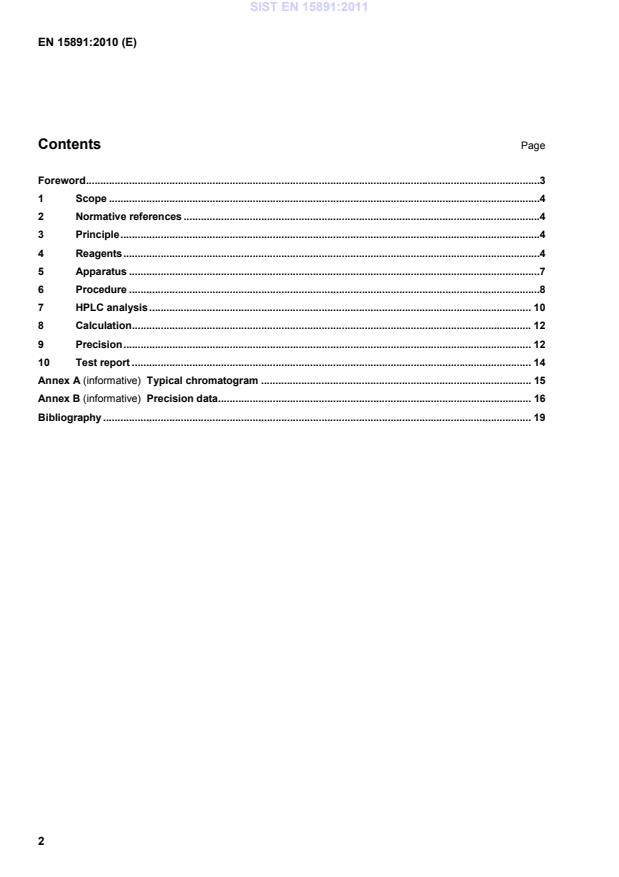
Typical chromatogram . 15Annex B (informative)
Precision data . 16Bibliography . 19 SIST EN 15891:2011
≈ 1,25 mg/ml. Add 4,0 ml of acetonitrile (4.11) to approximately 5 mg of deoxynivalenol (4.19) to form a solution with a concentration of approximately 1,25 mg/ml. Alternatively, available commercial solutions with equivalent properties can be used. Store this solution in a freezer at approximately - 18 °C. A solution stored in this way is stable for 12 months. Confirm the concentration of the solution if it is older than six months. 4.21 Deoxynivalenol stock solution 2,
≈ 250 µg/ml. Dilute 800 µl of stock solution 1 (4.20) to 4 ml with acetonitrile (4.11) to form a solution with a concentration of approximately 250 µg/ml. Store this solution in a freezer at approximately - 18 °C. A solution stored in this way is stable for 12 months. Confirm the concentration of the solution if it is older than six months. 4.22 Deoxynivalenol standard solution A. Dilute 200 µl of stock solution 2 (4.21) to 2,0 ml with acetonitrile (4.11) to form a solution with a concentration of approximately 25 µg/ml. To determine the exact mass concentration, record the absorption curve between a wavelength of 200 nm to 270 nm, e.g. in 5 nm steps; in the spectrometer (5.16) against acetonitrile as reference. Identify the wavelength for maximum absorption and calculate the mass concentration of deoxynivalenol, DON, in micrograms per millilitre using Equation (1):
bMA×××=ερ100maxDON (1) where Amax is the absorption determined at the maximum of the absorption curve (here: at 220 nm); M is the molar mass, in grams per mole, of deoxynivalenol (M = 296,3 g/mol); 0 is the molar absorption coefficient, in square metres per mole, of deoxynivalenol in acetonitrile (4.11) (here: 681 m2/mol, see [1]); b is the optical path length, in centimetres, of the quartz cell. Calculate the mass concentration of the stock solution 2 (4.21), DON2, in micrograms per millilitre using Equation (2):
10DONDON2×=ρρ (2) Store this solution in a freezer at approximately - 18 °C. A solution stored in this way is stable for 12 months. Confirm the concentration of the solution if it is older than six months. NOTE Preparation of standard solutions can be carried out gravimetrically by accurately weighing the deoxynivalenol standard material and the solvent used to dissolve it.
= 100 µg/ml. Pipette an aliquot of the stock solution 2 (4.21) equivalent to 500 µg of deoxynivalenol in a 5 ml volumetric flask. Dilute to the mark with acetonitrile (4.11). Store this solution in a freezer at approximately - 18 °C. A solution stored in this way is stable for 12 months. Confirm the concentration of the solution if it is older than six months. 4.24 Deoxynivalenol standard solution B,
= 10 µg/ml. Pipette 500 µl of the spiking solution (4.23) in a 5 ml volumetric flask. Dilute to the mark with acetonitrile (4.11). Store this solution in a freezer at approximately - 18 °C. A solution stored in this way is stable for 12 months. Confirm the concentration of the solution if it is older than six months. 5 Apparatus 5.1 General Usual laboratory glassware and equipment and, in particular the following. 5.2 Analytical balance, capable of weighing to 0,000 1 g. 5.3 Laboratory balance, capable of weighing to 0,1 g. 5.4 High speed blender or homogenizer. 5.5 Laboratory shaker or magnetic stirrer, speed adjustable to approximately 500 min-1. 5.6 Vortex mixer, or equivalent. 5.7 Centrifuge, capable of a centrifugal force of 2 500 g. 5.8 Centrifuge tube, of 250 ml capacity. 5.9 Filter paper, qualitative, strong, fast flow, pre-folded and with a diameter of 18,5 cm. 5.10 Glass fibre filter, fast flow, fine porosity, retention size 1,6 µm or smaller. 5.11 Pipettes, e.g. of 10 ml, 5 ml, 1 ml, and 25 µl to 250 µl capacity. 5.12 Reservoirs for immunoaffinity columns, of for example 20 ml capacity, with appropriate adaptors. 5.13 Glass vials or assay tubes, of various size. 5.14 Heating block or thermostatic waterbath, capable of maintaining approximately 50 °C. 5.15 HPLC apparatus, comprising the following: SIST EN 15891:2011
The maximum overlapping of peaks shall be less than 10 %. It can be necessary to adjust the mobile phase for a sufficient baseline resolution. A suitable corresponding reverse-phase guard column should be used. 5.15.4 UV detector, set at 220 nm. 5.15.5 Recorder, integrator or computer based data processing system. 5.15.6 Mobile phase switching unit, or second HPLC pump, if necessary. 5.16 UV spectrometer. 6 Procedure 6.1 General This method has been validated in three interlaboratory studies. These studies were performed by different laboratories at different times. This is the reason that slightly different procedures were used for extraction and immunoaffinity column cleanup for wheat, rice flour, oat flour, maize, polenta and wheat based breakfast cereal (described in 6.2 and 6.4) and for cereal based food for infants and young children (described in 6.3 and 6.5). The procedures described here are similar to the ones described in the original interlaboratory studies. 6.2 Extraction for wheat, rice flour, oat flour, maize, polenta and wheat based breakfast cereal Weigh, to the nearest 0,1 g, a 25 g (ms) test portion and 5 g of PEG (4.12) into a centrifuge tube (5.8). Add 200 ml (V1) of water (or another volume as specified by the IA column manufacturer) and homogenize at high speed for 3 min using a homogenizer (5.4). Alternative extraction procedures have been shown to give equivalent results.
Either shake the sample and the extraction solvent on a wrist action shaker for 2 h or add a magnetic stirrer bar to the flask, cap it and place it on a magnetic stirrer (5.5) to mix at medium-high speed for 30 min.
In both cases, shake the sample and reagents together thoroughly by hand to ensure they are well mixed before placing on shaker. Centrifuge the homogenized sample for 15 min at 2 500 g. After centrifugation filter the sample with a glass fibre filter (5.10). NOTE It has been shown during the validation study that for some matrices (maize), samples that have been extracted on a magnetic stirrer do not require centrifugation. 6.3 Extraction for cereal based food for infants and young children Weigh, to the nearest 0,1 g, a 25 g (ms) test portion into a 250 ml or 500 ml conical flask. Add 200 ml (V1) of water, cap and shake for 1 h on a laboratory shaker (5.5). Allow the sample to settle after shaking and transfer 50 ml of supernatant to a centrifuge tube (5.8) and centrifuge for 15 min at 2 500 g.
Prep
...