

SIST ISO 20539:2024
(Main)Translation, interpreting and related technology - Vocabulary
General Information
- Abstract
This document defines terms for International Standards on translation, interpreting and related technology.
- Status
- Published
- Publication Date
- 06-Oct-2024
- Technical Committee
- IDT - Information, documentation, language and terminology
- Current Stage
- 6060 - National Implementation/Publication (Adopted Project)
- Start Date
- 17-Sep-2024
- Due Date
- 22-Nov-2024
- Completion Date
- 07-Oct-2024
Buy Documents



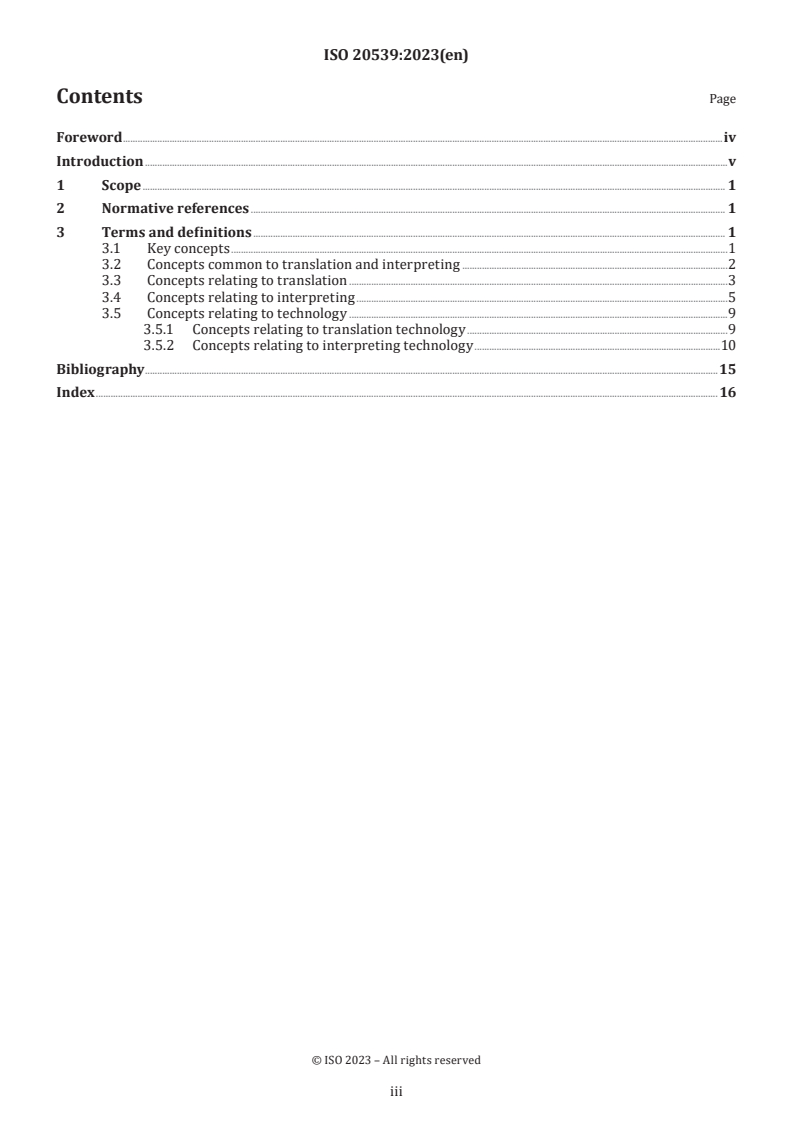
ISO 20539:2023 - Translation, interpreting and related technology — Vocabulary Released:13. 12. 2023

ISO 20539:2023 - Traduction, interprétation et technologies apparentées — Vocabulaire Released:13. 12. 2023
Overview
SIST ISO 20539:2024 - Translation, interpreting and related technology - Vocabulary is the second edition of an ISO International Standard that defines standardized terms and concepts used across translation, interpreting and related technology standards. Rather than prescribing processes or performance limits, SIST ISO 20539:2024 provides an authoritative vocabulary to ensure consistent language in standards, specifications, contracts, training and software documentation for the language industry.
Key topics (technical scope and structure)
- Purpose and scope
- Defines terms for International Standards on translation, interpreting and related technology.
- Contains no normative references; focuses on terminology and concept definitions.
- Document structure
- Organized into thematic groups: key concepts, concepts common to translation and interpreting, concepts relating to translation, interpreting and technology.
- Terminology entries follow ISO 10241-1 editorial rules and grouping principles from ISO 1087.
- Core terms provided
- Key concepts: language, content, source language, target language, signed language, translate/interpret, translator/interpreter.
- Common concepts: domain, language register, language proficiency, competence, qualification, continuing professional development (CPD), authorization, client/end user.
- Translation-specific: text, document, translation output, translation service, translation service provider (TSP), translation workflow, review, revision, proofreading, project and project management, correction/corrective action, verification, style guide, localization (locale, locale convention).
- Interpreting-specific: spoken/signed language interpreting, speaker/signer, working languages classified as A/B/C, interpreting modes (simultaneous, consecutive, whispered/chuchotage), note-taking technique.
- Technology-related: entries are split into translation technology and interpreting technology (terminology for tooling and technology concepts relevant to both domains).
- Supportive materials
- Includes a bibliography and an alphabetical index of terms for easy lookup.
Practical applications and who uses SIST ISO 20539:2024
- Language service providers (LSPs) and translation service providers (TSPs) use the vocabulary to standardize bids, contracts, SLAs and workflow documentation.
- Project managers and localization engineers adopt consistent terms for workflow, quality checks and toolchains.
- Interpreters, translators, trainers and certification bodies rely on the definitions for curricula, accreditation and performance frameworks.
- Software developers and product teams building translation/interpreting tools benefit from consistent metadata and API terminology.
- Legal, healthcare and public-sector organizations use the standard to clarify roles (e.g., authorized legal translator) and service requirements in procurement and compliance documents.
- Standards writers and policy makers reference SIST ISO 20539:2024 to align terminology across related ISO standards.
Related standards and resources
- Prepared by ISO/TC 37/SC 5 (Language and terminology - translation, interpreting and related technology).
- Linked references within the document include ISO 10241-1, ISO 1087, ISO/TR 20694, ISO/IEC 17024 and ISO 9000 where terminology or editorial practice is cited.
- Terminology databases: ISO Online Browsing Platform (OBP) and IEC Electropedia.
Using SIST ISO 20539:2024 helps organizations, practitioners and tool vendors achieve clarity, reduce ambiguity and improve interoperability across translation, interpreting and technology ecosystems.
Relations
- Effective Date
- 01-Nov-2024
Buy Documents
ISO 20539:2023 - Translation, interpreting and related technology — Vocabulary Released:13. 12. 2023
ISO 20539:2023 - Traduction, interprétation et technologies apparentées — Vocabulaire Released:13. 12. 2023
Get Certified
Connect with accredited certification bodies for this standard

Great Wall Tianjin Quality Assurance Center
Established 1993, first batch to receive national accreditation with IAF recognition.
Hong Kong Quality Assurance Agency (HKQAA)
Hong Kong's leading certification body.

Innovative Quality Certifications Pvt. Ltd. (IQCPL)
Known for integrity, providing ethical & impartial Assessment & Certification. CMMI Institute Partner.
Sponsored listings
Frequently Asked Questions
SIST ISO 20539:2024 is a standard published by the Slovenian Institute for Standardization (SIST). Its full title is "Translation, interpreting and related technology - Vocabulary". This standard covers: This document defines terms for International Standards on translation, interpreting and related technology.
This document defines terms for International Standards on translation, interpreting and related technology.
SIST ISO 20539:2024 is classified under the following ICS (International Classification for Standards) categories: 01.020 - Terminology (principles and coordination); 01.040.01 - Generalities. Terminology. Standardization. Documentation (Vocabularies); 03.080.99 - Other services. The ICS classification helps identify the subject area and facilitates finding related standards.
SIST ISO 20539:2024 has the following relationships with other standards: It is inter standard links to SIST ISO 20539:2021. Understanding these relationships helps ensure you are using the most current and applicable version of the standard.
SIST ISO 20539:2024 is available in PDF format for immediate download after purchase. The document can be added to your cart and obtained through the secure checkout process. Digital delivery ensures instant access to the complete standard document.
Standards Content (Sample)
SLOVENSKI STANDARD
01-november-2024
Prevajanje, tolmačenje in sorodne tehnologije - Slovar
Translation, interpreting and related technology — Vocabulary
Traduction, interprétation et technologies apparentées — Vocabulaire
Ta slovenski standard je istoveten z: ISO 20539:2023
ICS:
01.020 Terminologija (načela in Terminology (principles and
koordinacija) coordination)
01.040.01 Splošno. Terminologija. Generalities. Terminology.
Standardizacija. Standardization.
Dokumentacija (Slovarji) Documentation
(Vocabularies)
03.080.99 Druge storitve Other services
2003-01.Slovenski inštitut za standardizacijo. Razmnoževanje celote ali delov tega standarda ni dovoljeno.
International
Standard
ISO 20539
Second edition
Translation, interpreting and
2023-12
related technology — Vocabulary
Traduction, interprétation et technologies apparentées —
Vocabulaire
Reference number
© ISO 2023
All rights reserved. Unless otherwise specified, or required in the context of its implementation, no part of this publication may
be reproduced or utilized otherwise in any form or by any means, electronic or mechanical, including photocopying, or posting on
the internet or an intranet, without prior written permission. Permission can be requested from either ISO at the address below
or ISO’s member body in the country of the requester.
ISO copyright office
CP 401 • Ch. de Blandonnet 8
CH-1214 Vernier, Geneva
Phone: +41 22 749 01 11
Email: copyright@iso.org
Website: www.iso.org
Published in Switzerland
ii
Contents Page
Foreword .iv
Introduction .v
1 Scope . 1
2 Normative references . 1
3 Terms and definitions . 1
3.1 Key concepts .1
3.2 Concepts common to translation and interpreting .2
3.3 Concepts relating to translation .3
3.4 Concepts relating to interpreting .5
3.5 Concepts relating to technology .9
3.5.1 Concepts relating to translation technology .9
3.5.2 Concepts relating to interpreting technology .10
Bibliography .15
Index . 16
iii
Foreword
ISO (the International Organization for Standardization) is a worldwide federation of national standards
bodies (ISO member bodies). The work of preparing International Standards is normally carried out through
ISO technical committees. Each member body interested in a subject for which a technical committee
has been established has the right to be represented on that committee. International organizations,
governmental and non-governmental, in liaison with ISO, also take part in the work. ISO collaborates closely
with the International Electrotechnical Commission (IEC) on all matters of electrotechnical standardization.
The procedures used to develop this document and those intended for its further maintenance are described
in the ISO/IEC Directives, Part 1. In particular, the different approval criteria needed for the different types
of ISO document should be noted. This document was drafted in accordance with the editorial rules of the
ISO/IEC Directives, Part 2 (see www.iso.org/directives).
ISO draws attention to the possibility that the implementation of this document may involve the use of (a)
patent(s). ISO takes no position concerning the evidence, validity or applicability of any claimed patent
rights in respect thereof. As of the date of publication of this document, ISO had not received notice of (a)
patent(s) which may be required to implement this document. However, implementers are cautioned that
this may not represent the latest information, which may be obtained from the patent database available at
www.iso.org/patents. ISO shall not be held responsible for identifying any or all such patent rights.
Any trade name used in this document is information given for the convenience of users and does not
constitute an endorsement.
For an explanation of the voluntary nature of standards, the meaning of ISO specific terms and expressions
related to conformity assessment, as well as information about ISO's adherence to the World Trade
Organization (WTO) principles in the Technical Barriers to Trade (TBT), see www.iso.org/iso/foreword.html.
This document was prepared by Technical Committee ISO/TC 37, Language and terminology, Subcommittee
SC 5, Translation, interpreting and related technology.
This second edition cancels and replaces the first edition (ISO 20539:2019), which has been technically
revised.
The main changes are as follows:
— new terminological entries arising from the publication of new and revised International Standards in
the fields of translation, interpreting and related technology have been added;
— some terminological entries have been updated.
Any feedback or questions on this document should be directed to the user’s national standards body. A
complete listing of these bodies can be found at www.iso.org/members.html.
iv
Introduction
This document is intended to provide a description of concepts used in International Standards on
translation, interpreting and related technologies. Some of the concepts in these domains are referred
to in different ways by practitioners. It is not expected that these differences will disappear in the short
term. However, it is likely that in the long term, consistency in terms and definitions across the related
International Standards will have a standardizing effect in practice.
Information within terminological entries in this document has been structured in accordance with
ISO 10241-1, and concepts have been grouped, as far as was possible, according to thematic order, as defined
in ISO 1087:2019, 3.7.11. Related concepts are grouped together under subheadings. The subheadings are:
— key concepts;
— concepts common to translation and interpreting;
— concepts relating to translation;
— concepts relating to interpreting;
— concepts relating to technology.
The last subheading is divided into two parts: technology relating to translation and that relating to
interpreting.
An effort has been made to avoid using terms without having defined the relevant concept first. This is to
ensure that the reader does not come across a term for the first time within the definition of another concept,
with no clear understanding of it. For example, “floor” is defined before the term is used in the definition of
“language distribution”.
For the convenience of readers, an index is provided at the end of this document, in which all terms are listed
alphabetically, with their relevant terminological entry numbers.
v
International Standard ISO 20539:2023(en)
Translation, interpreting and related technology —
Vocabulary
1 Scope
This document defines terms for International Standards on translation, interpreting and related technology.
2 Normative references
There are no normative references in this document.
3 Terms and definitions
ISO and IEC maintain terminology databases for use in standardization at the following addresses:
— ISO Online browsing platform: available at https:// www .iso .org/ obp
— IEC Electropedia: available at https:// www .electropedia .org/
3.1 Key concepts
3.1.1
language
systematic use of voice, characters, symbols or signs by which to communicate
3.1.2
content
information in any form
EXAMPLE Text (3.3.1), audio, video.
3.1.3
source language
language (3.1.1) from which content (3.1.2) is translated (3.1.8) or interpreted (3.1.10)
3.1.4
target language
language (3.1.1) into which content (3.1.2) is translated (3.1.8) or interpreted (3.1.10)
3.1.5
source language content
content (3.1.2) to be translated (3.1.8) or interpreted (3.1.10)
3.1.6
target language content
content (3.1.2) translated (3.1.8) or interpreted (3.1.10) from a source language (3.1.3)
3.1.7
signed language
language (3.1.1) which uses a combination of hand shapes, orientation and movement of the hands, arms or
body, and facial expressions
3.1.8
translate
render source language content (3.1.5) into target language content (3.1.6) in written form or signed language
(3.1.7)
3.1.9
translation
rendering source language content (3.1.5) into target language content (3.1.6) in written form or signed
language (3.1.7)
3.1.10
interpret
render spoken or signed information from a source language (3.1.3) into a target language (3.1.4) in spoken
or signed form, conveying both the meaning and language register (3.2.2) of the source language content
(3.1.5)
3.1.11
interpreting
interpretation
rendering spoken or signed information from a source language (3.1.3) into a target language (3.1.4) in
spoken or signed form, conveying both the meaning and language register (3.2.2) of the source language
content (3.1.5)
3.1.12
translator
person who translates (3.1.8)
3.1.13
interpreter
person who interprets (3.1.10)
3.2 Concepts common to translation and interpreting
3.2.1
domain
sphere of knowledge or activity
Note 1 to entry: A domain can have its own culture, social context and linguistic characteristics.
3.2.2
language register
language (3.1.1) variety used for a particular purpose or in an event of language use, depending on the type
of situation, especially its degree of formality
Note 1 to entry: A person usually has more than one language register in their linguistic repertoire and can vary their
use of language register according to their perception of what is appropriate for different purposes or domains (3.2.1).
[SOURCE: ISO/TR 20694:2018, 3.3, modified — The wording “An individual usually has” has been changed
to “A person usually has”, “verbal repertoire” has been changed to “linguistic repertoire” and the word
“language” has been added before “register” in Note 1 to entry.]
3.2.3
language proficiency
ability of a person to understand or communicate in a given language (3.1.1)
Note 1 to entry: Language proficiency generally refers to speaking, listening, reading and writing skills.
3.2.4
competence
ability to apply knowledge, experience and skills to achieve intended results
3.2.5
qualification
demonstrated education, training and work experience, where applicable
[SOURCE: ISO/IEC 17024:2012, 3.7]
3.2.6
continuing professional development
CPD
continuing education
maintaining, improving or increasing knowledge and skills related to a professional activity
3.2.7
authorization
third-party attestation of a person’s right to provide a specialized service
3.2.8
end user
person or group of persons that ultimately uses a service
3.2.9
client
customer
person, or organization, who enters into a formal agreement for the provision of a service
Note 1 to entry: The formal agreement can, for example, take the form of a contract or an interdepartmental service
agreement between units of an organization.
Note 2 to entry: The client can be the end user (3.2.8), but this does not have to be the case.
3.3 Concepts relating to translation
3.3.1
text
content (3.1.2) in written form
3.3.2
document
information and the medium on which it is contained
[SOURCE: ISO 9000:2015, 3.8.5, modified — The Example and notes to entry have been removed.]
3.3.3
translation output
result of translation (3.1.9)
3.3.4
translation service
production and delivery of target language content (3.1.6) according to specifications issued by a client
(3.2.9)
3.3.5
translation service provider
TSP
person or organization that performs a translation service (3.3.4)
3.3.6
translation workflow
sequence of activities required to produce target language content (3.1.6)
3.3.7
review
monolingual editing
examination of the entire target language content (3.1.6) to ensure its domain (3.2.1) accuracy
3.3.8
reviewer
person who performs review (3.3.7)
3.3.9
revision
bilingual editing
examination of the entire target language content (3.1.6) against the source language content (3.1.5) to
ensure linguistic accuracy and faithfulness to the source language content
3.3.10
reviser
person who performs revision (3.3.9)
3.3.11
check
translator’s (3.1.12) examination of target language content (3.1.6) upon completion of translation (3.1.9)
3.3.12
proofread
examine the final target language content (3.1.6) and apply corrections (3.3.18) before submission to the
client (3.2.9)
3.3.13
proofreader
person who proofreads (3.3.12)
3.3.14
process
set of interrelated and interacting activities performed in order to achieve an objective
3.3.15
project
unique process (3.3.14), consisting of a set of coordinated and controlled activities with start and finish
dates, undertaken to achieve an objective conforming to specific requirements, including the constraints of
time, cost and resources
[SOURCE: ISO 9000:2015, 3.4.2, modified — The notes to entry have been removed.]
3.3.16
project management
planning, organizing, monitoring, controlling and reporting of all aspects of a project (3.3.15) to achieve the
project objectives
[SOURCE: ISO 9000:2015, 3.3.12, modified — The wording “and the motivation of all those involved in it” has
been removed.]
3.3.17
project manager
PM
person responsible for project management (3.3.16)
3.3.18
correction
action to eliminate an error
Note 1 to entry: In translation (3.1.9), corrections are made when errors are detected during a check (3.3.11), or when
errors are reported by a reviser (3.3.10), reviewer (3.3.8), proofreader (3.3.13) or client (3.2.9).
3.3.19
corrective action
action to eliminate the cause of a failure to comply with a requirement in the process (3.3.14) of translation
(3.1.9), with a view to preventing recurrence
3.3.20
verification
action taken to determine whether specifications have been fulfilled
3.3.21
style guide
set of editing and formatting instructions
3.3.22
specialist field
area of expertise of a person
3.3.23
legal translation
translation (3.1.9) of legal texts (3.3.1)
3.3.24
legal translator
translator (3.1.12) who is qualified to provide legal translation (3.3.23)
Note 1 to entry: Legal translators can be required to be authorized by law.
3.3.25
authorized legal translator
legal translator (3.3.24) who has been granted authorization (3.2.7) by a court or government body
3.3.26
locale
geographic region in which people use linguistic, cultural and technical conventions specific to that region
3.3.27
localization
adaption of products and services for distinct locales (3.3.26)
3.3.28
locale convention
accepted usage or standard practice in a locale (3.3.26), which is generally expected to apply
Note 1 to entry: This may include date or time formatting rules.
3.4 Concepts relating to interpreting
3.4.1
spoken language
language (3.1.1) expressed orally
3.4.2
spoken language interpreting
interpreting (3.1.11) between two spoken languages (3.4.1)
3.4.3
signed language interpreting
interpreting (3.1.11) between two signed languages (3.1.7) or between a signed language and a spoken
language (3.4.1)
3.4.4
signed language interpreter
interpreter (3.1.13) who performs signed language interpreting (3.4.3)
3.4.5
speaker
person addressing others using spoken language (3.4.1)
3.4.6
signer
person addressing others using signed language (3.1.7)
3.4.7
working language
language (3.1.1) from or into which an interpreter (3.1.13) is qualified to interpret (3.1.10)
Note 1 to entry: An interpreter’s working languages are classified as ‘A’ language (3.4.8), ‘B’ language (3.4.9) or ‘C’
language (3.4.10).
3.4.8
‘A’ language
primary language (3.1.1) or its strict equivalent of which the interpreter (3.1.13) has complete command
and into which the interpreter interprets (3.1.10) from all their other ‘A’ languages, ‘B’ languages (3.4.9) or ‘C’
languages (3.4.10)
3.4.9
‘B’ language
language (3.1.1) in which the interpreter (3.1.13) is proficient, but which is not their primary language or its
strict equivalent
Note 1 to entry: An interpreter interprets (3.1.10) into this language from one or more other languages.
3.4.10
‘C’ language
language (3.1.1) from which the interpreter (3.1.13) interprets (3.1.10) into their ‘A’ languages (3.4.8) or ‘B’
languages (3.4.9)
Note 1 to entry: An interpreter can have more than one ‘A’ language, ‘B’ language or ‘C’ language.
3.4.11
mode
established method for the delivery of spoken language interpreting (3.4.2) and signed language interpreting
(3.4.3)
3.4.12
simultaneous interpreting
mode (3.4.11) of interpreting (3.1.11) performed while a speaker (3.4.5) or signer (3.4.6) is still speaking or
signing
3.4.13
consecutive interpreting
mode (3.4.11) of interpreting (3.1.11) performed after the speaker (3.4.5) or signer (3.4.6) pauses
Note 1 to entry: Interpreters (3.1.13) can use note-taking (3.4.14) to help in rendering lengthy passages.
3.4.14
note-taking
technique in consecutive interpreting (3.4.13) used by interpreters (3.1.13) for remembering, conceptualizing
and summarizing information
Note 1 to entry: Note-taking is highly individual and can involve a mixture of symbols, abbreviations, words and
diagrams.
3.4.15
whispered interpreting
chuchotage
simultaneous interpreting (3.4.12) where the interpreter (3.1.13) speaks very quietly in close pr
...
International
Standard
ISO 20539
Second edition
Translation, interpreting and
2023-12
related technology — Vocabulary
Traduction, interprétation et technologies apparentées —
Vocabulaire
Reference number
© ISO 2023
All rights reserved. Unless otherwise specified, or required in the context of its implementation, no part of this publication may
be reproduced or utilized otherwise in any form or by any means, electronic or mechanical, including photocopying, or posting on
the internet or an intranet, without prior written permission. Permission can be requested from either ISO at the address below
or ISO’s member body in the country of the requester.
ISO copyright office
CP 401 • Ch. de Blandonnet 8
CH-1214 Vernier, Geneva
Phone: +41 22 749 01 11
Email: copyright@iso.org
Website: www.iso.org
Published in Switzerland
ii
Contents Page
Foreword .iv
Introduction .v
1 Scope . 1
2 Normative references . 1
3 Terms and definitions . 1
3.1 Key concepts .1
3.2 Concepts common to translation and interpreting .2
3.3 Concepts relating to translation .3
3.4 Concepts relating to interpreting .5
3.5 Concepts relating to technology .9
3.5.1 Concepts relating to translation technology .9
3.5.2 Concepts relating to interpreting technology .10
Bibliography .15
Index . 16
iii
Foreword
ISO (the International Organization for Standardization) is a worldwide federation of national standards
bodies (ISO member bodies). The work of preparing International Standards is normally carried out through
ISO technical committees. Each member body interested in a subject for which a technical committee
has been established has the right to be represented on that committee. International organizations,
governmental and non-governmental, in liaison with ISO, also take part in the work. ISO collaborates closely
with the International Electrotechnical Commission (IEC) on all matters of electrotechnical standardization.
The procedures used to develop this document and those intended for its further maintenance are described
in the ISO/IEC Directives, Part 1. In particular, the different approval criteria needed for the different types
of ISO document should be noted. This document was drafted in accordance with the editorial rules of the
ISO/IEC Directives, Part 2 (see www.iso.org/directives).
ISO draws attention to the possibility that the implementation of this document may involve the use of (a)
patent(s). ISO takes no position concerning the evidence, validity or applicability of any claimed patent
rights in respect thereof. As of the date of publication of this document, ISO had not received notice of (a)
patent(s) which may be required to implement this document. However, implementers are cautioned that
this may not represent the latest information, which may be obtained from the patent database available at
www.iso.org/patents. ISO shall not be held responsible for identifying any or all such patent rights.
Any trade name used in this document is information given for the convenience of users and does not
constitute an endorsement.
For an explanation of the voluntary nature of standards, the meaning of ISO specific terms and expressions
related to conformity assessment, as well as information about ISO's adherence to the World Trade
Organization (WTO) principles in the Technical Barriers to Trade (TBT), see www.iso.org/iso/foreword.html.
This document was prepared by Technical Committee ISO/TC 37, Language and terminology, Subcommittee
SC 5, Translation, interpreting and related technology.
This second edition cancels and replaces the first edition (ISO 20539:2019), which has been technically
revised.
The main changes are as follows:
— new terminological entries arising from the publication of new and revised International Standards in
the fields of translation, interpreting and related technology have been added;
— some terminological entries have been updated.
Any feedback or questions on this document should be directed to the user’s national standards body. A
complete listing of these bodies can be found at www.iso.org/members.html.
iv
Introduction
This document is intended to provide a description of concepts used in International Standards on
translation, interpreting and related technologies. Some of the concepts in these domains are referred
to in different ways by practitioners. It is not expected that these differences will disappear in the short
term. However, it is likely that in the long term, consistency in terms and definitions across the related
International Standards will have a standardizing effect in practice.
Information within terminological entries in this document has been structured in accordance with
ISO 10241-1, and concepts have been grouped, as far as was possible, according to thematic order, as defined
in ISO 1087:2019, 3.7.11. Related concepts are grouped together under subheadings. The subheadings are:
— key concepts;
— concepts common to translation and interpreting;
— concepts relating to translation;
— concepts relating to interpreting;
— concepts relating to technology.
The last subheading is divided into two parts: technology relating to translation and that relating to
interpreting.
An effort has been made to avoid using terms without having defined the relevant concept first. This is to
ensure that the reader does not come across a term for the first time within the definition of another concept,
with no clear understanding of it. For example, “floor” is defined before the term is used in the definition of
“language distribution”.
For the convenience of readers, an index is provided at the end of this document, in which all terms are listed
alphabetically, with their relevant terminological entry numbers.
v
International Standard ISO 20539:2023(en)
Translation, interpreting and related technology —
Vocabulary
1 Scope
This document defines terms for International Standards on translation, interpreting and related technology.
2 Normative references
There are no normative references in this document.
3 Terms and definitions
ISO and IEC maintain terminology databases for use in standardization at the following addresses:
— ISO Online browsing platform: available at https:// www .iso .org/ obp
— IEC Electropedia: available at https:// www .electropedia .org/
3.1 Key concepts
3.1.1
language
systematic use of voice, characters, symbols or signs by which to communicate
3.1.2
content
information in any form
EXAMPLE Text (3.3.1), audio, video.
3.1.3
source language
language (3.1.1) from which content (3.1.2) is translated (3.1.8) or interpreted (3.1.10)
3.1.4
target language
language (3.1.1) into which content (3.1.2) is translated (3.1.8) or interpreted (3.1.10)
3.1.5
source language content
content (3.1.2) to be translated (3.1.8) or interpreted (3.1.10)
3.1.6
target language content
content (3.1.2) translated (3.1.8) or interpreted (3.1.10) from a source language (3.1.3)
3.1.7
signed language
language (3.1.1) which uses a combination of hand shapes, orientation and movement of the hands, arms or
body, and facial expressions
3.1.8
translate
render source language content (3.1.5) into target language content (3.1.6) in written form or signed language
(3.1.7)
3.1.9
translation
rendering source language content (3.1.5) into target language content (3.1.6) in written form or signed
language (3.1.7)
3.1.10
interpret
render spoken or signed information from a source language (3.1.3) into a target language (3.1.4) in spoken
or signed form, conveying both the meaning and language register (3.2.2) of the source language content
(3.1.5)
3.1.11
interpreting
interpretation
rendering spoken or signed information from a source language (3.1.3) into a target language (3.1.4) in
spoken or signed form, conveying both the meaning and language register (3.2.2) of the source language
content (3.1.5)
3.1.12
translator
person who translates (3.1.8)
3.1.13
interpreter
person who interprets (3.1.10)
3.2 Concepts common to translation and interpreting
3.2.1
domain
sphere of knowledge or activity
Note 1 to entry: A domain can have its own culture, social context and linguistic characteristics.
3.2.2
language register
language (3.1.1) variety used for a particular purpose or in an event of language use, depending on the type
of situation, especially its degree of formality
Note 1 to entry: A person usually has more than one language register in their linguistic repertoire and can vary their
use of language register according to their perception of what is appropriate for different purposes or domains (3.2.1).
[SOURCE: ISO/TR 20694:2018, 3.3, modified — The wording “An individual usually has” has been changed
to “A person usually has”, “verbal repertoire” has been changed to “linguistic repertoire” and the word
“language” has been added before “register” in Note 1 to entry.]
3.2.3
language proficiency
ability of a person to understand or communicate in a given language (3.1.1)
Note 1 to entry: Language proficiency generally refers to speaking, listening, reading and writing skills.
3.2.4
competence
ability to apply knowledge, experience and skills to achieve intended results
3.2.5
qualification
demonstrated education, training and work experience, where applicable
[SOURCE: ISO/IEC 17024:2012, 3.7]
3.2.6
continuing professional development
CPD
continuing education
maintaining, improving or increasing knowledge and skills related to a professional activity
3.2.7
authorization
third-party attestation of a person’s right to provide a specialized service
3.2.8
end user
person or group of persons that ultimately uses a service
3.2.9
client
customer
person, or organization, who enters into a formal agreement for the provision of a service
Note 1 to entry: The formal agreement can, for example, take the form of a contract or an interdepartmental service
agreement between units of an organization.
Note 2 to entry: The client can be the end user (3.2.8), but this does not have to be the case.
3.3 Concepts relating to translation
3.3.1
text
content (3.1.2) in written form
3.3.2
document
information and the medium on which it is contained
[SOURCE: ISO 9000:2015, 3.8.5, modified — The Example and notes to entry have been removed.]
3.3.3
translation output
result of translation (3.1.9)
3.3.4
translation service
production and delivery of target language content (3.1.6) according to specifications issued by a client
(3.2.9)
3.3.5
translation service provider
TSP
person or organization that performs a translation service (3.3.4)
3.3.6
translation workflow
sequence of activities required to produce target language content (3.1.6)
3.3.7
review
monolingual editing
examination of the entire target language content (3.1.6) to ensure its domain (3.2.1) accuracy
3.3.8
reviewer
person who performs review (3.3.7)
3.3.9
revision
bilingual editing
examination of the entire target language content (3.1.6) against the source language content (3.1.5) to
ensure linguistic accuracy and faithfulness to the source language content
3.3.10
reviser
person who performs revision (3.3.9)
3.3.11
check
translator’s (3.1.12) examination of target language content (3.1.6) upon completion of translation (3.1.9)
3.3.12
proofread
examine the final target language content (3.1.6) and apply corrections (3.3.18) before submission to the
client (3.2.9)
3.3.13
proofreader
person who proofreads (3.3.12)
3.3.14
process
set of interrelated and interacting activities performed in order to achieve an objective
3.3.15
project
unique process (3.3.14), consisting of a set of coordinated and controlled activities with start and finish
dates, undertaken to achieve an objective conforming to specific requirements, including the constraints of
time, cost and resources
[SOURCE: ISO 9000:2015, 3.4.2, modified — The notes to entry have been removed.]
3.3.16
project management
planning, organizing, monitoring, controlling and reporting of all aspects of a project (3.3.15) to achieve the
project objectives
[SOURCE: ISO 9000:2015, 3.3.12, modified — The wording “and the motivation of all those involved in it” has
been removed.]
3.3.17
project manager
PM
person responsible for project management (3.3.16)
3.3.18
correction
action to eliminate an error
Note 1 to entry: In translation (3.1.9), corrections are made when errors are detected during a check (3.3.11), or when
errors are reported by a reviser (3.3.10), reviewer (3.3.8), proofreader (3.3.13) or client (3.2.9).
3.3.19
corrective action
action to eliminate the cause of a failure to comply with a requirement in the process (3.3.14) of translation
(3.1.9), with a view to preventing recurrence
3.3.20
verification
action taken to determine whether specifications have been fulfilled
3.3.21
style guide
set of editing and formatting instructions
3.3.22
specialist field
area of expertise of a person
3.3.23
legal translation
translation (3.1.9) of legal texts (3.3.1)
3.3.24
legal translator
translator (3.1.12) who is qualified to provide legal translation (3.3.23)
Note 1 to entry: Legal translators can be required to be authorized by law.
3.3.25
authorized legal translator
legal translator (3.3.24) who has been granted authorization (3.2.7) by a court or government body
3.3.26
locale
geographic region in which people use linguistic, cultural and technical conventions specific to that region
3.3.27
localization
adaption of products and services for distinct locales (3.3.26)
3.3.28
locale convention
accepted usage or standard practice in a locale (3.3.26), which is generally expected to apply
Note 1 to entry: This may include date or time formatting rules.
3.4 Concepts relating to interpreting
3.4.1
spoken language
language (3.1.1) expressed orally
3.4.2
spoken language interpreting
interpreting (3.1.11) between two spoken languages (3.4.1)
3.4.3
signed language interpreting
interpreting (3.1.11) between two signed languages (3.1.7) or between a signed language and a spoken
language (3.4.1)
3.4.4
signed language interpreter
interpreter (3.1.13) who performs signed language interpreting (3.4.3)
3.4.5
speaker
person addressing others using spoken language (3.4.1)
3.4.6
signer
person addressing others using signed language (3.1.7)
3.4.7
working language
language (3.1.1) from or into which an interpreter (3.1.13) is qualified to interpret (3.1.10)
Note 1 to entry: An interpreter’s working languages are classified as ‘A’ language (3.4.8), ‘B’ language (3.4.9) or ‘C’
language (3.4.10).
3.4.8
‘A’ language
primary language (3.1.1) or its strict equivalent of which the interpreter (3.1.13) has complete command
and into which the interpreter interprets (3.1.10) from all their other ‘A’ languages, ‘B’ languages (3.4.9) or ‘C’
languages (3.4.10)
3.4.9
‘B’ language
language (3.1.1) in which the interpreter (3.1.13) is proficient, but which is not their primary language or its
strict equivalent
Note 1 to entry: An interpreter interprets (3.1.10) into this language from one or more other languages.
3.4.10
‘C’ language
language (3.1.1) from which the interpreter (3.1.13) interprets (3.1.10) into their ‘A’ languages (3.4.8) or ‘B’
languages (3.4.9)
Note 1 to entry: An interpreter can have more than one ‘A’ language, ‘B’ language or ‘C’ language.
3.4.11
mode
established method for the delivery of spoken language interpreting (3.4.2) and signed language interpreting
(3.4.3)
3.4.12
simultaneous interpreting
mode (3.4.11) of interpreting (3.1.11) performed while a speaker (3.4.5) or signer (3.4.6) is still speaking or
signing
3.4.13
consecutive interpreting
mode (3.4.11) of interpreting (3.1.11) performed after the speaker (3.4.5) or signer (3.4.6) pauses
Note 1 to entry: Interpreters (3.1.13) can use note-taking (3.4.14) to help in rendering lengthy passages.
3.4.14
note-taking
technique in consecutive interpreting (3.4.13) used by interpreters (3.1.13) for remembering, conceptualizing
and summarizing information
Note 1 to entry: Note-taking is highly individual and can involve a mixture of symbols, abbreviations, words and
diagrams.
3.4.15
whispered interpreting
chuchotage
simultaneous interpreting (3.4.12) where the interpreter (3.1.13) speaks very quietly in close proximity to
participants (3.4.33)
Note 1 to entry: Whispered interpreting is used for interpreting (3.1.11) to a very small number of listeners, ideally one
or two.
Note 2 to entry: Headphones (3.5.2.34) and a wireless (3.5.2.40) receiver can be used if the interpreter is performing relay
interpreting (3.4.18) or if the volume of the sound reinforcement system (3.5.2.24) transmitting the speaker (3.4.5) is
very low or at zero.
3.4.16
distance interpreting
remote interpreting
interpreting (3.1.11) of a speaker (3.4.5) or signer (3.4.6) in a
...
Norme
internationale
ISO 20539
Deuxième édition
Traduction, interprétation et
2023-12
technologies apparentées —
Vocabulaire
Translation, interpreting and related technology — Vocabulary
Numéro de référence
DOCUMENT PROTÉGÉ PAR COPYRIGHT
© ISO 2023
Tous droits réservés. Sauf prescription différente ou nécessité dans le contexte de sa mise en œuvre, aucune partie de cette
publication ne peut être reproduite ni utilisée sous quelque forme que ce soit et par aucun procédé, électronique ou mécanique,
y compris la photocopie, ou la diffusion sur l’internet ou sur un intranet, sans autorisation écrite préalable. Une autorisation peut
être demandée à l’ISO à l’adresse ci-après ou au comité membre de l’ISO dans le pays du demandeur.
ISO copyright office
Case postale 401 • Ch. de Blandonnet 8
CH-1214 Vernier, Genève
Tél.: +41 22 749 01 11
E-mail: copyright@iso.org
Web: www.iso.org
Publié en Suisse
ii
Sommaire Page
Avant-propos .iv
Introduction .v
1 Domaine d’application . 1
2 Références normatives . 1
3 Termes et définitions . 1
3.1 Concepts clés .1
3.2 Concepts communs à la traduction et à l’interprétation .2
3.3 Concepts liés à la traduction .3
3.4 Concepts liés à l’interprétation .5
3.5 Concepts liés à la technologie .9
3.5.1 Concepts liés à la technologie de traduction .9
3.5.2 Concepts liés à la technologie d’interprétation .11
Bibliographie .16
Index . 17
iii
Avant-propos
L'ISO (Organisation internationale de normalisation) est une fédération mondiale d'organismes nationaux
de normalisation (comités membres de l'ISO). L'élaboration des Normes internationales est en général
confiée aux comités techniques de l'ISO. Chaque comité membre intéressé par une étude a le droit de faire
partie du comité technique créé à cet effet. Les organisations internationales, gouvernementales et non
gouvernementales, en liaison avec l'ISO participent également aux travaux. L'ISO collabore étroitement avec
la Commission électrotechnique internationale (IEC) en ce qui concerne la normalisation électrotechnique.
Les procédures utilisées pour élaborer le présent document et celles destinées à sa mise à jour sont
décrites dans les Directives ISO/IEC, Partie 1. Il convient, en particulier, de prendre note des différents
critères d'approbation requis pour les différents types de documents ISO. Le présent document a
été rédigé conformément aux règles de rédaction données dans les Directives ISO/IEC, Partie 2 (voir
www.iso.org/directives).
L’ISO attire l’attention sur le fait que la mise en application du présent document peut entraîner l’utilisation
d’un ou de plusieurs brevets. L’ISO ne prend pas position quant à la preuve, à la validité et à l’applicabilité de
tout droit de brevet revendiqué à cet égard. À la date de publication du présent document, l’ISO n'avait pas
reçu notification qu’un ou plusieurs brevets pouvaient être nécessaires à sa mise en application. Toutefois,
il y a lieu d’avertir les responsables de la mise en application du présent document que des informations
plus récentes sont susceptibles de figurer dans la base de données de brevets, disponible à l'adresse
www.iso.org/brevets. L’ISO ne saurait être tenue pour responsable de ne pas avoir identifié tout ou partie de
tels droits de propriété.
Les appellations commerciales éventuellement mentionnées dans le présent document sont données pour
information, par souci de commodité, à l’intention des utilisateurs et ne sauraient constituer un engagement.
Pour une explication de la nature volontaire des normes, la signification des termes et expressions
spécifiques de l'ISO liés à l'évaluation de la conformité, ou pour toute information au sujet de l'adhésion de
l'ISO aux principes de l’Organisation mondiale du commerce (OMC) concernant les obstacles techniques au
commerce (OTC), voir www.iso.org/avant-propos.
Le présent document a été élaboré par le comité technique ISO/TC 37, Langage et terminologie, sous-comité
SC 5, Traduction, interprétation et technologies apparentées.
Cette deuxième édition annule et remplace la première édition (ISO 20539:2019), qui a fait l’objet d’une
révision technique.
Les principales modifications sont les suivantes:
— de nouveaux articles terminologiques issus de la publication de nouvelles Normes internationales
révisées dans les domaines de la traduction, de l’interprétation et des technologies apparentées ont été
ajoutés;
— certains articles terminologiques ont été mis à jour.
Il convient que l’utilisateur adresse tout retour d’information ou toute question concernant le présent
document à l’organisme national de normalisation de son pays. Une liste exhaustive desdits organismes se
trouve à l’adresse www.iso.org/fr/members.html.
iv
Introduction
Le présent document est destiné à fournir une description des concepts utilisés dans les Normes
internationales relatives à la traduction, à l’interprétation et aux technologies apparentées. Certains des
concepts dans ces domaines ont des significations différentes pour les professionnels. Il n’est pas attendu
que ces différences disparaissent à court terme. Toutefois, il est probable qu’à long terme la cohérence des
termes et définitions dans les Normes internationales connexes aura un effet normalisateur dans la pratique.
Les informations dans les articles terminologiques du présent document ont été structurées conformément
à l’ISO 10241-1, et les concepts ont été regroupés, dans la mesure du possible, selon un ordre thématique,
comme défini dans l’ISO 1087:2019, 3.7.11. Les concepts apparentés sont regroupés dans des sous-rubriques.
Les sous-rubriques sont les suivantes:
— concepts clés;
— concepts communs à la traduction et à l’interprétation;
— concepts liés à la traduction;
— concepts liés à l’interprétation;
— concepts liés à la technologie.
La dernière sous-rubrique est divisée en deux parties: technologie liée à la traduction et technologie liée à
l’interprétation.
Un effort a été fait pour éviter d’utiliser des termes sans avoir défini au préalable le concept correspondant.
Cela permet de s’assurer que le lecteur ne rencontre pas un terme pour la première fois dans la définition
d’un autre concept, sans le comprendre vraiment. Par exemple, le terme «original» est défini avant d’être
employé dans la définition de «distribution linguistique».
Pour des raisons pratiques pour les lecteurs, un index regroupant tous les termes classés par ordre
alphabétique, avec les numéros d’articles terminologiques correspondants, est fourni à la fin du présent
document.
v
Norme internationale ISO 20539:2023(fr)
Traduction, interprétation et technologies apparentées —
Vocabulaire
1 Domaine d’application
Le présent document définit les termes utilisés dans les Normes internationales relatives à la traduction, à
l’interprétation et aux technologies apparentées.
2 Références normatives
Le présent document ne contient aucune référence normative.
3 Termes et définitions
L’ISO et l’IEC tiennent à jour des bases de données terminologiques destinées à être utilisées en normalisation,
consultables aux adresses suivantes:
— ISO Online browsing platform: disponible à l’adresse https:// www .iso .org/ obp
— IEC Electropedia: disponible à l’adresse https:// www .electropedia .org/
3.1 Concepts clés
3.1.1
langue
utilisation systématique de la voix, de caractères, de symboles ou de signes pour communiquer
3.1.2
contenu
information sous quelque forme que ce soit
EXEMPLE Texte (3.3.1), audio, vidéo.
3.1.3
langue source
langue (3.1.1) à partir de laquelle du contenu (3.1.2) est traduit (3.1.8) ou interprété (3.1.10)
3.1.4
langue cible
langue (3.1.1) dans laquelle du contenu (3.1.2) est traduit (3.1.8) ou interprété (3.1.10)
3.1.5
contenu dans la langue source
contenu (3.1.2) à traduire (3.1.8) ou à interpréter (3.1.10)
3.1.6
contenu dans la langue cible
contenu (3.1.2) traduit (3.1.8) ou interprété (3.1.10) à partir d’une langue source (3.1.3)
3.1.7
langue des signes
langue (3.1.1) qui utilise une combinaison de formes des mains, d’orientation et de mouvement des mains,
des bras ou du corps, et d’expressions faciales
3.1.8
traduire
restituer un contenu dans la langue source (3.1.5) en un contenu dans la langue cible (3.1.6) sous forme écrite
ou en langue des signes (3.1.7)
3.1.9
traduction
restitution d’un contenu dans la langue source (3.1.5) en un contenu dans la langue cible (3.1.6) sous forme
écrite ou en langue des signes (3.1.7)
3.1.10
interpréter
restituer des informations parlées ou signées d’une langue source (3.1.3) dans une langue cible (3.1.4) sous
forme parlée ou signée, en transmettant à la fois la signification et le registre de langue (3.2.2) du contenu
dans la langue source (3.1.5)
3.1.11
interprétation
restitution des informations parlées ou signées d’une langue source (3.1.3) dans une langue cible (3.1.4) sous
forme parlée ou signée, en transmettant à la fois la signification et le registre de langue (3.2.2) du contenu
dans la langue source (3.1.5)
3.1.12
traducteur
personne qui traduit (3.1.8)
3.1.13
interprète
personne qui interprète (3.1.10)
3.2 Concepts communs à la traduction et à l’interprétation
3.2.1
domaine
sphère de connaissance ou d’activité
Note 1 à l'article: Un domaine peut avoir sa propre culture, son propre contexte social et ses propres caractéristiques
linguistiques.
3.2.2
registre de langue
variété d’une langue (3.1.1) utilisée dans un but particulier ou dans le cadre d’une utilisation particulière de
la langue en fonction du type de situation, notamment du degré de formalité
Note 1 à l'article: Une personne a en général plusieurs registres de langue dans son répertoire linguistique et peut
adapter le registre de langue qu’elle utilise en fonction de sa perception de ce qui est approprié pour différents objectifs
ou dans différents domaines (3.2.1).
[SOURCE: ISO/TR 20694:2018, 3.3, modifiée — La formulation «Les individus ont en général» a été remplacée
par «Une personne a en général», «répertoire verbal» est devenu «répertoire linguistique» et «de langue» a
été ajouté après «registre» dans la Note 1 à l’article.]
3.2.3
compétence linguistique
aptitude d’une personne à comprendre ou à communiquer dans une langue (3.1.1) donnée
Note 1 à l'article: La compétence linguistique fait généralement référence aux compétences en communication orale,
en compréhension, en lecture et en écriture.
3.2.4
compétence
aptitude à utiliser ses connaissances, son expérience et ses compétences pour atteindre des résultats prévus
3.2.5
qualification
enseignement, formation et expérience professionnelle, démontrés, lorsque applicable
[SOURCE: ISO/IEC 17024:2012, 3.7]
3.2.6
développement professionnel continu
DPC
formation continue
maintien, amélioration ou accroissement des connaissances et des compétences liées à une activité
professionnelle
3.2.7
autorisation
attestation par une tierce partie du droit d’une personne à fournir un service spécialisé
3.2.8
utilisateur final
personne ou groupe de personnes qui au final bénéficie d’un service
3.2.9
client
personne ou organisation qui conclut un accord formel pour la prestation d’un service
Note 1 à l'article: L’accord formel peut, par exemple, prendre la forme d’un contrat ou d’un accord de service
interdépartemental entre les entités d’une organisation.
Note 2 à l'article: Le client peut être l’utilisateur final (3.2.8), mais cela n’est pas obligatoirement le cas.
3.3 Concepts liés à la traduction
3.3.1
texte
contenu (3.1.2) sous forme écrite
3.3.2
document
support d’information et l’information qu’il contient
[SOURCE: ISO 9000:2015, 3.8.5, modifiée — L’Exemple et les notes à l’article ont été supprimés.]
3.3.3
résultat de traduction
résultat d’une traduction (3.1.9)
3.3.4
service de traduction
production et livraison d’un contenu dans la langue cible (3.1.6) selon les spécifications émises par un client
(3.2.9)
3.3.5
prestataire de services de traduction
PST
personne ou organisation qui fournit un service de traduction (3.3.4)
3.3.6
flux de traduction
séquence des activités requises pour produire un contenu dans la langue cible (3.1.6)
3.3.7
relecture
édition unilingue
examen de l’ensemble du contenu dans la langue cible (3.1.6) pour s’assurer de sa précision par rapport au
domaine (3.2.1)
3.3.8
relecteur
personne qui réalise une relecture (3.3.7)
3.3.9
révision
édition bilingue
examen de l’ensemble du contenu dans la langue cible (3.1.6) par rapport au contenu dans la langue source
(3.1.5) pour s’assurer de la précision linguistique et de la fidélité par rapport au contenu dans la langue
source
3.3.10
réviseur
personne qui réalise une révision (3.3.9)
3.3.11
contrôle
examen par le traducteur (3.1.12) du contenu dans la langue cible (3.1.6) après la réalisation de la traduction
(3.1.9)
3.3.12
correction d’épreuves
examen du contenu dans la langue cible (3.1.6) final et application des corrections (3.3.18) avant soumission
au client (3.2.9)
3.3.13
correcteur d’épreuves
personne qui réalise la correction d’épreuves (3.3.12)
3.3.14
processus
ensemble d’activités interdépendantes et imbriquées réalisées afin d’atteindre un objectif
3.3.15
projet
processus (3.3.14) unique qui consiste en un ensemble d’activités coordonnées et maîtrisées comportant des
dates de début et de fin, entrepris dans le but d’atteindre un objectif conforme à des exigences spécifiques,
incluant les contraintes de délais, de coûts et de ressources
[SOURCE: ISO 9000:2015, 3.4.2, modifiée — Les notes à l’article ont été supprimées.]
3.3.16
gestion de projet
planification, organisation, surveillance, contrôle et compte rendu de tous les aspects d’un projet (3.3.15)
pour atteindre les objectifs du projet
[SOURCE: ISO 9000:2015, 3.3.12, modifiée — La formulation «et de la motivation des personnes impliquées»
a été supprimée]
3.3.17
chef de projet
PM (de l’anglais Project Manager)
personne responsable de la gestion de projet (3.3.16)
3.3.18
correction
action consistant à éliminer une erreur
Note 1 à l'article: En traduction (3.1.9), des corrections sont faites lorsque des erreurs sont détectées au cours d’un
contrôle (3.3.11) ou lorsque des erreurs sont signalées par un réviseur (3.3.10), un relecteur (3.3.8), un correcteur
d’épreuves (3.3.13) ou le client (3.2.9).
3.3.19
action corrective
action consistant à éliminer la cause du non-respect d’une exigence au cours du processus (3.3.14) de
traduction (3.1.9), en vue d’empêcher sa récurrence
3.3.20
vérification
action entreprise pour déterminer si les spécifications ont été remplies
3.3.21
guide de style
ensemble des instructions d’édition et de formatage
3.3.22
domaine de spécialisation
domaine d’expertise d’une personne
3.3.23
traduction juridique
traduction (3.1.9) de textes (3.3.1) juridiques
3.3.24
traducteur juridique
traducteur (3.1.12) qui est qualifié pour fournir des services de traduction juridique (3.3.23)
Note 1 à l'article: Les traducteurs juridiques peuvent devoir être habilités par la loi.
3.3.25
traducteur juridique habilité
traducteur juridique (3.3.24) à qui une autorisation (3.2.7) a été accordée par un tribunal ou un organisme
gouvernemental
3.3.26
lieu
zone géographique dans laquelle les personnes utilisent des conventions linguistiques, culturelles et
techniques spécifiques de cette région
3.3.27
localisation
adaptation des produits et services à des lieux (3.3.26) distincts
3.3.28
convention locale
usage accepté ou pratique courante dans un lieu (3.3.26), que l’on est généralement tenu d’appliquer
Note 1 à l'article: Cela peut inclure les règles de formatage de la date ou de l’heure.
3.4 Concepts liés à l’interprétation
3.4.1
langue orale
langue (3.1.1) exprimée oralement
3.4.2
interprétation en langue orale
interprétation (3.1.11) entre deux langues orales (3.4.1)
3.4.3
interprétation en langue des signes
interprétation (3.1.11) entre deux langues des signes (3.1.7) ou entre une langue des signes et une langue
orale (3.4.1)
3.4.4
interprète en langue des signes
interprète (3.1.13) qui réalise une interprétation en langue des signes (3.4.3)
3.4.5
orateur
personne s’adressant à d’autres en langue orale (3.4.1)
3.4.6
signeur
personne s’adressant à d’autres en langue des signes (3.1.7)
3.4.7
langue de travail
langue (3.1.1) à partir de laquelle ou vers laquelle un interprète (3.1.13) est qualifié pour interpréter (3.1.10)
Note 1 à l'article: Les langues de travail d’un interprète sont classées comme étant la langue «A » (3.4.8), la langue «B »
(3.4.9) ou la langue «C » (3.4.10).
3.4.8
langue « A »
langue (3.1.1) maternelle ou son strict équivalent, entièrement maîtrisée par l’interprète (3.1.13) ou dans
laquelle l’interprète interprète (3.1.10) à partir de toutes ses autres langues « A », langues «B » (3.4.9) ou
langues «C » (3.4.10)
3.4.9
langue « B »
langue (3.1.1) maîtrisée par l’interprète (3.1.13), mais qui n’est pas sa langue maternelle ou son strict
équivalent
Note 1 à l'article: Un interprète interprète (3.1.10) dans cette langue à partir d’une ou plusieurs autres langues.
3.4.10
langue « C »
langue (3.1.1) à partir de laquelle l’interprète (3.1.13) interprète (3.1.10) dans ses langues « A » (3.4.8) ou
langues «B » (3.4.9)
Note 1 à l'article: Un interprète peut avoir plusieurs langues «A», langues «B» ou langues «C».
3.4.11
mode
méthode établie pour la distribution d’une interprétation en langue orale (3.4.2) et d’une interprétation en
langue des signes (3.4.3)
3.4.12
interprétation simultanée
mode (3.4.11) d’interprétation (3.1.11) réalisé pendant qu’un orateur (3.4.5) ou un signeur (3.4.6) continue de
parler ou de signer
3.4.13
interprétation consécutive
mode (3.4.11) d’interprétation (3.1.11) réalisé une fois que l’orateur (3.4.5) ou le signeur (3.4.6) s’est arrêté
Note 1 à l'article: Les interprètes (3.1.13) peuvent utiliser la prise de notes (3.4.14) pour faciliter la restitution de longs
passages.
3.4.14
prise de notes
technique d’interprétation consécutive (3.4.13) employée par des interprètes (3.1.13) pour mémoriser,
conceptualiser et résumer des informations
Note 1 à l'article: La prise de notes est très personnelle et peut impliquer un mélange de symboles, d’abréviations, de
mots et de diagrammes.
3.4.15
interprétation par chuchotage
chuchotage
interprétation simultanée (3.4.12) dans laquelle l’interprète (3.1.13) parle tout bas, près des participants
(3.4.33)
Note 1 à l'article: L’interprétation par chuchotage est utilisée pour interpréter (3.1.11) pour un très petit nombre
d’auditeurs, idéalement un ou deux.
Note 2 à l'article: Des écouteurs (3.5.2.34) et un récepteur sans fil (3.5.2.40) peuvent être utilisés si l’interprète réalise
une interprétation en relais (3.4.18) ou si le volume du système d’amplification du son (3.5.2.24) transmettant à l’orateur
(3.4.5) est très faible ou à zéro.
3.4.16
interprétation à distance
télé-interprétation
interprétation (3.1.11) d’un orateur (3.4.5) ou d’un signeur (3.4.6) situé à un endroit différent de celui de
l’interprète (3.1.13), rendue possible par les technologies de l’information et de la communication
3.4.17
traduction à vue
interprétation à vue
restitu
...