

kSIST FprEN IEC 62031:2026
(Main)LED modules - Safety requirements
General Information
- Abstract
IEC 62031:2026 specifies safety requirements for LED modules for operation on DC supplies up to 1 500 V or on AC supplies up to 1 000 V. This document does not include requirements for performance characteristics of LED modules.
This document does not apply to:
- LED packages;
- LED modules for automotive lighting;
- OLED modules;
- LED lamps.
This third edition cancels and replaces the second edition published in 2018. This edition constitutes a technical revision.
This edition includes the following significant technical changes with respect to the previous edition:
a) Complete review of the document structure, detailed technical requirements and tests, including but not limited to what is individually described under items b) to i);
b) Clarification of the scope and revision of the applicability of this document to independent and integral LED modules;
c) Updated terms and definitions;
d) Clearer specification for clause general requirements and clause general test requirements;
e) Update of the marking clause, such as marking of control terminals;
f) A full review and update of the electrical safety, thermal safety, and mechanical safety requirements preventing misinterpretation and ambiguity;
g) Updated photobiological safety requirements;
h) Revised and updated fault conditions and abnormal conditions requirements;
i) Removal of the annex relating to conformity testing during manufacture.
- Status
- Not Published
- Public Enquiry End Date
- 30-Jun-2025
- Technical Committee
- STV - Steklo, svetloba in razsvetljava v gradbeništvu
- Current Stage
- 5020 - Formal vote (FV) (Adopted Project)
- Start Date
- 18-Dec-2025
- Due Date
- 05-Feb-2026
- Completion Date
- 04-Feb-2026
Buy Documents


Overview
The upcoming standard kSIST FprEN IEC 62031:2026, titled LED Modules - Safety Requirements, establishes essential safety guidelines for LED modules. Published by the International Electrotechnical Commission (IEC) and managed by the European Committee for Electrotechnical Standardization (CLC), this standard ensures LED modules comply with rigorous safety criteria. This document targets manufacturers, designers, and safety assessors seeking compliance with internationally recognized safety parameters for LED modules used in lighting applications.
This standard reflects the third edition (IEC 62031 ED3), projected for stability until 2028, and incorporates updated classifications, testing methods, and safety provisions. It addresses electrical, thermal, mechanical, and photobiological safety aspects crucial for modern LED modules, thus enhancing reliability and user protection.
Key Topics
Classification and Definitions
Comprehensive terminology and classification guide users to understand different LED module types and their safety requirements.Electrical Safety
Covers protection against electric shock including construction, accessibility of live parts, clearance distances, earthing, and tests such as electric strength and capacitor discharge. The standard details requirements for SELV (Safety Extra Low Voltage) and PELV (Protective Extra Low Voltage) circuits.Thermal Safety
Specifies heat resistance and fire safety tests, including flame retardance and ignition resistance. Proper heat management techniques like thermal interface materials and testing protocols mitigate overheating risks.Mechanical Safety
Encompasses the mechanical structure, strength testing, and secure attachment methods to ensure physical durability and safe operation.Photobiological Safety
Defines safety limits related to ultraviolet (UV) radiation, blue light hazards to the retina, infrared radiation, and thermal effects on skin and eyes, protecting users from potential light-induced injuries.Fault and Abnormal Conditions
Describes electrical and mechanical fault conditions with corresponding test procedures to verify module resilience during unexpected events or misuse scenarios.Marking and Labeling
Standards for clear, durable, and legible markings including identification of control terminals and warnings to enhance safe handling and installation.Testing Requirements
Detailed mandatory tests include type tests, electrical strength tests, touch current measurements, and abnormal temperature assessments, providing assurance of safety under normal and stress conditions.
Applications
Lighting Manufacturers
Implement this standard to certify LED modules for use in indoor and outdoor luminaires, ensuring safety compliance for general lighting, automotive, architectural, and commercial lighting products.Product Designers and Engineers
Utilize the guidelines for incorporating thermal management and electrical safety features into LED module designs, optimizing performance while maintaining user protection.Safety Inspectors and Certification Bodies
Apply the defined testing methods and fault condition scenarios to evaluate LED modules before market approval or certification.Installation and Maintenance Professionals
Rely on marking requirements and safety classifications to correctly install, troubleshoot, and maintain LED lighting systems safely and effectively.
Related Standards
- IEC 60598 - Luminaires - General requirements and tests for complete lighting devices.
- IEC 62471 - Photobiological safety of lamps and lamp systems.
- IEC 60950 / IEC 62368 - Safety of information technology and audio/video equipment, relevant for systems integrating LED modules.
- IEC 60065 - Audio, video and similar electronic apparatus safety, which may interact with LED controlgear.
Practical Value
Adopting kSIST FprEN IEC 62031:2026 ensures LED modules achieve internationally harmonized safety levels, minimizing risks related to electric shock, fire, thermal hazards, and photobiological effects. Its extensive coverage of fault and abnormal operation conditions supports the development of robust, safe LED lighting solutions. By complying with these safety requirements, manufacturers can enhance customer trust, meet regulatory demands, and ensure reliability across LED lighting applications.
Keywords: LED module safety, IEC 62031, LED electrical safety standards, thermal management LED modules, photobiological safety LED, LED module testing, LED lighting compliance, electrical shock protection, mechanical strength LED modules, LED safety standards 2025
Relations
- Effective Date
- 27-Feb-2024
- Revises
SIST EN IEC 62031:2020 - LED modules for general lighting - Safety specifications (IEC 62031:2018) - Effective Date
- 27-Feb-2024
Buy Documents
Get Certified
Connect with accredited certification bodies for this standard

IMQ S.p.A. (Certification)
Italian electrical product certification.

SLG Prüf- und Zertifizierungs GmbH
German testing and certification body.

UL Solutions
Global safety science company with testing, inspection and certification.
Sponsored listings
Frequently Asked Questions
kSIST FprEN IEC 62031:2026 is a draft published by the Slovenian Institute for Standardization (SIST). Its full title is "LED modules - Safety requirements". This standard covers: IEC 62031:2026 specifies safety requirements for LED modules for operation on DC supplies up to 1 500 V or on AC supplies up to 1 000 V. This document does not include requirements for performance characteristics of LED modules. This document does not apply to: - LED packages; - LED modules for automotive lighting; - OLED modules; - LED lamps. This third edition cancels and replaces the second edition published in 2018. This edition constitutes a technical revision. This edition includes the following significant technical changes with respect to the previous edition: a) Complete review of the document structure, detailed technical requirements and tests, including but not limited to what is individually described under items b) to i); b) Clarification of the scope and revision of the applicability of this document to independent and integral LED modules; c) Updated terms and definitions; d) Clearer specification for clause general requirements and clause general test requirements; e) Update of the marking clause, such as marking of control terminals; f) A full review and update of the electrical safety, thermal safety, and mechanical safety requirements preventing misinterpretation and ambiguity; g) Updated photobiological safety requirements; h) Revised and updated fault conditions and abnormal conditions requirements; i) Removal of the annex relating to conformity testing during manufacture.
IEC 62031:2026 specifies safety requirements for LED modules for operation on DC supplies up to 1 500 V or on AC supplies up to 1 000 V. This document does not include requirements for performance characteristics of LED modules. This document does not apply to: - LED packages; - LED modules for automotive lighting; - OLED modules; - LED lamps. This third edition cancels and replaces the second edition published in 2018. This edition constitutes a technical revision. This edition includes the following significant technical changes with respect to the previous edition: a) Complete review of the document structure, detailed technical requirements and tests, including but not limited to what is individually described under items b) to i); b) Clarification of the scope and revision of the applicability of this document to independent and integral LED modules; c) Updated terms and definitions; d) Clearer specification for clause general requirements and clause general test requirements; e) Update of the marking clause, such as marking of control terminals; f) A full review and update of the electrical safety, thermal safety, and mechanical safety requirements preventing misinterpretation and ambiguity; g) Updated photobiological safety requirements; h) Revised and updated fault conditions and abnormal conditions requirements; i) Removal of the annex relating to conformity testing during manufacture.
kSIST FprEN IEC 62031:2026 is classified under the following ICS (International Classification for Standards) categories: 29.140.99 - Other standards related to lamps. The ICS classification helps identify the subject area and facilitates finding related standards.
kSIST FprEN IEC 62031:2026 has the following relationships with other standards: It is inter standard links to SIST EN IEC 62031:2020/A11:2022, SIST EN IEC 62031:2020. Understanding these relationships helps ensure you are using the most current and applicable version of the standard.
kSIST FprEN IEC 62031:2026 is associated with the following European legislation: EU Directives/Regulations: 2014/35/EU; Standardization Mandates: M/511. When a standard is cited in the Official Journal of the European Union, products manufactured in conformity with it benefit from a presumption of conformity with the essential requirements of the corresponding EU directive or regulation.
kSIST FprEN IEC 62031:2026 is available in PDF format for immediate download after purchase. The document can be added to your cart and obtained through the secure checkout process. Digital delivery ensures instant access to the complete standard document.
Standards Content (Sample)
SLOVENSKI STANDARD
oSIST prEN IEC 62031:2024
01-junij-2024
Moduli LED - Varnostne zahteve
LED modules - Safety requirements
Ta slovenski standard je istoveten z: prEN IEC 62031:2024
ICS:
29.140.99 Drugi standardi v zvezi z Other standards related to
žarnicami lamps
oSIST prEN IEC 62031:2024 en
2003-01.Slovenski inštitut za standardizacijo. Razmnoževanje celote ali delov tega standarda ni dovoljeno.
oSIST prEN IEC 62031:2024
oSIST prEN IEC 62031:2024
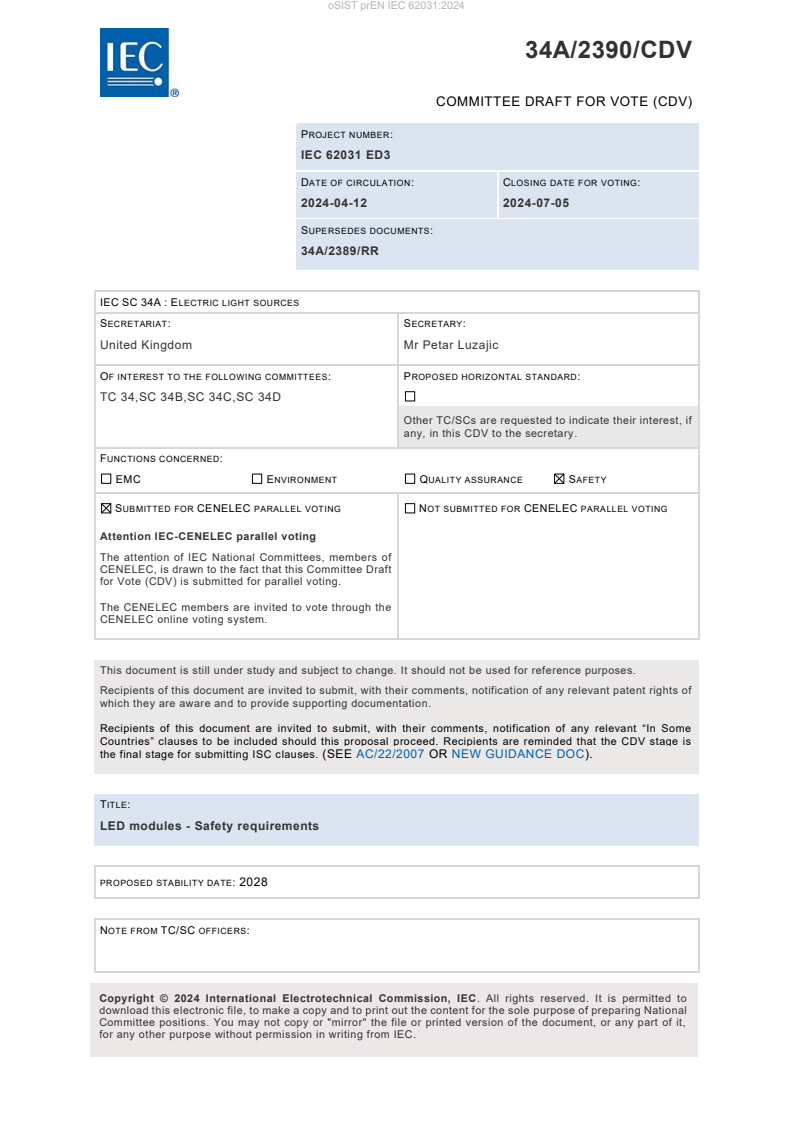
34A/2390/CDV
COMMITTEE DRAFT FOR VOTE (CDV)
PROJECT NUMBER:
IEC 62031 ED3
DATE OF CIRCULATION: CLOSING DATE FOR VOTING:
2024-04-12 2024-07-05
SUPERSEDES DOCUMENTS:
34A/2389/RR
IEC SC 34A : ELECTRIC LIGHT SOURCES
SECRETARIAT: SECRETARY:
United Kingdom Mr Petar Luzajic
OF INTEREST TO THE FOLLOWING COMMITTEES: PROPOSED HORIZONTAL STANDARD:
TC 34,SC 34B,SC 34C,SC 34D
Other TC/SCs are requested to indicate their interest, if
any, in this CDV to the secretary.
FUNCTIONS CONCERNED:
EMC ENVIRONMENT QUALITY ASSURANCE SAFETY
SUBMITTED FOR CENELEC PARALLEL VOTING NOT SUBMITTED FOR CENELEC PARALLEL VOTING
Attention IEC-CENELEC parallel voting
The attention of IEC National Committees, members of
CENELEC, is drawn to the fact that this Committee Draft
for Vote (CDV) is submitted for parallel voting.
The CENELEC members are invited to vote through the
CENELEC online voting system.
This document is still under study and subject to change. It should not be used for reference purposes.
Recipients of this document are invited to submit, with their comments, notification of any relevant patent rights of
which they are aware and to provide supporting documentation.
Recipients of this document are invited to submit, with their comments, notification of any relevant “In Some
Countries” clauses to be included should this proposal proceed. Recipients are reminded that the CDV stage is
the final stage for submitting ISC clauses. (SEE AC/22/2007 OR NEW GUIDANCE DOC).
TITLE:
LED modules - Safety requirements
PROPOSED STABILITY DATE: 2028
NOTE FROM TC/SC OFFICERS:
download this electronic file, to make a copy and to print out the content for the sole purpose of preparing National
Committee positions. You may not copy or "mirror" the file or printed version of the document, or any part of it,
for any other purpose without permission in writing from IEC.
oSIST prEN IEC 62031:2024
IEC CDV 62031 © IEC 2024 2 34A/2390/CDV
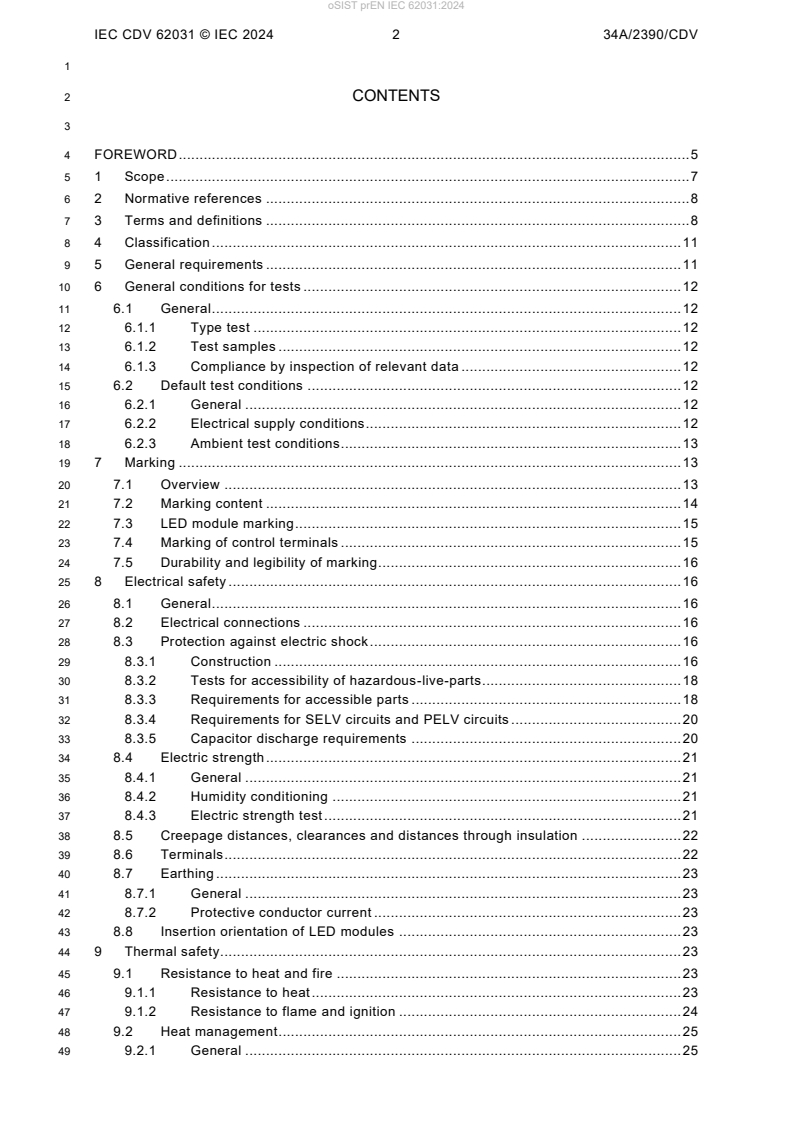
2 CONTENTS
4 FOREWORD . 5
5 1 Scope . 7
6 2 Normative references . 8
7 3 Terms and definitions . 8
8 4 Classification . 11
9 5 General requirements . 11
10 6 General conditions for tests . 12
11 6.1 General . 12
12 6.1.1 Type test . 12
13 6.1.2 Test samples . 12
14 6.1.3 Compliance by inspection of relevant data . 12
15 6.2 Default test conditions . 12
16 6.2.1 General . 12
17 6.2.2 Electrical supply conditions. 12
18 6.2.3 Ambient test conditions. 13
19 7 Marking . 13
20 7.1 Overview . 13
21 7.2 Marking content . 14
22 7.3 LED module marking . 15
23 7.4 Marking of control terminals . 15
24 7.5 Durability and legibility of marking. 16
25 8 Electrical safety . 16
26 8.1 General . 16
27 8.2 Electrical connections . 16
28 8.3 Protection against electric shock . 16
29 8.3.1 Construction . 16
30 8.3.2 Tests for accessibility of hazardous-live-parts . 18
31 8.3.3 Requirements for accessible parts . 18
32 8.3.4 Requirements for SELV circuits and PELV circuits . 20
33 8.3.5 Capacitor discharge requirements . 20
34 8.4 Electric strength . 21
35 8.4.1 General . 21
36 8.4.2 Humidity conditioning . 21
37 8.4.3 Electric strength test . 21
38 8.5 Creepage distances, clearances and distances through insulation . 22
39 8.6 Terminals . 22
40 8.7 Earthing . 23
41 8.7.1 General . 23
42 8.7.2 Protective conductor current . 23
43 8.8 Insertion orientation of LED modules . 23
44 9 Thermal safety. 23
45 9.1 Resistance to heat and fire . 23
46 9.1.1 Resistance to heat . 23
47 9.1.2 Resistance to flame and ignition . 24
48 9.2 Heat management . 25
49 9.2.1 General . 25
oSIST prEN IEC 62031:2024
IEC CDV 62031 © IEC 2024 3 34A/2390/CDV
50 9.2.2 Thermal interface material . 25
51 9.2.3 Testing . 25
52 9.2.4 Compliance . 26
53 10 Mechanical safety . 26
54 10.1 General . 26
55 10.2 Common requirements for mechanical safety . 27
56 10.3 Mechanical strength . 27
57 10.4 Fixing of conductors . 27
58 10.4.1 Requirements . 27
59 10.4.2 Compliance criteria . 27
60 10.5 Screws and mechanical connections . 27
61 10.6 Ingress protection . 28
62 11 Photobiological safety. 28
63 11.1 Actinic UV hazards for skin and eye (200 nm to 400 nm wavelength) . 28
64 11.2 UV-A hazard for the eye lens (315 nm to 400 nm) . 29
65 11.3 Retinal blue light hazard (300 nm to 700 nm) . 29
66 11.4 Retinal thermal hazard (380 nm to 1 400 nm) . 29
67 11.5 Infrared radiation hazard for the eye (780 nm to 3 000 nm) . 29
68 11.6 Thermal hazard for the skin (380 nm to 3 000 nm) . 29
69 12 Fault conditions . 29
70 12.1 General . 29
71 12.2 Applicable fault conditions . 30
72 12.2.1 Electronic components . 30
73 12.2.2 PCB tracks . 30
74 12.2.3 Insulation layers . 30
75 12.3 Test power supply requirements . 30
76 12.3.1 LED modules supplied by voltage sources . 30
77 12.3.2 LED modules supplied by current sources . 30
78 12.4 Test procedures and compliance. 30
79 12.4.1 Test procedures. 30
80 12.4.2 Compliance . 31
81 13 Abnormal conditions . 31
82 13.1 General . 31
83 13.2 DC supply polarity test . 32
84 13.3 Maximum load at output terminals . 32
85 13.4 LED light sources specified for AC mains operation which are declared not
86 suitable for use with phase cut dimmers . 32
87 13.4.1 Requirements . 32
88 13.4.2 Tests . 32
89 13.5 Compliance . 33
90 Annex A (normative) Measurement of touch current and protective conductor current . 34
91 A.1 General conditions . 34
92 A.2 Measurement of protective conductor current . 34
93 A.3 Measurement of touch current in case of normal and abnormal conditions . 34
94 A.4 Measurement of touch current in case of failure of basic protection . 35
95 A.5 Test procedure. 35
96 Annex B (informative) Information for luminaire design . 38
97 B.1 General . 38
98 B.2 Water contact . 38
99 B.3 Blue light hazard assessment . 38
100 B.3.1 LED modules classified as BLH-A . 38
oSIST prEN IEC 62031:2024
IEC CDV 62031 © IEC 2024 4 34A/2390/CDV
101 B.3.2 LED modules classified as BLH-B . 38
102 B.3.3 LED modules classified as BLH-C. 38
103 B.4 Special information . 38
104 B.4.1 Interchangeability . 38
105 B.4.2 Heat management . 38
106 B.4.3 Working voltage . 40
107 B.4.4 LED module protection against electric shock . 40
108 B.4.5 LEDi module not suitable for use in phase cut circuits . 40
109 Annex C (informative) Information for controlgear design . 41
110 C.1 Guidelines for safe LED module operation . 41
111 Bibliography . 42
113 Figure 1 – Symbol for built-in LED modules . 15
114 Figure 2 – Marking on control terminals, if control circuits are not insulated from the
115 mains supply . 15
116 Figure 3 – Ball-pressure test apparatus . 24
117 Figure 4 – Abnormal temperature test set-up . 26
118 Figure 5 – Test circuit . 32
119 Figure A.1 – Test configuration: single-phase equipment on star TN or TT system . 35
120 Figure A.2 – Measuring network, touch current weighted for perception or reaction . 36
121 Figure A.3 – Measuring network, touch current weighted for let-go . 36
122 Figure A.4 – Measuring network, weighted for high frequency . 36
123 Figure A.5 – Test configuration for touch currents between different accessible parts . 37
124 Figure B.1 – Diagrammatic cross section of an LED module fixed by means of a holder
125 for LED modules to a luminaire . 39
127 Table 1 – Informative overview on marking provisions . 13
128 Table 2 – Required number and type of Y capacitors . 17
129 Table 3 – Touch voltage limits . 19
130 Table 4 – Reduced touch voltage limits . 19
131 Table 5 – Touch current limits . 19
132 Table 6 – Voltage limits for a charged capacitor . 21
133 Table 7 – Electric strength test voltage . 22
134 Table 8 – Torque tests on screws . 28
135 Table A.1 – Position of switches n and p for the measurement . 35
oSIST prEN IEC 62031:2024
IEC CDV 62031 © IEC 2024 5 34A/2390/CDV
138 INTERNATIONAL ELECTROTECHNICAL COMMISSION
139 ____________
141 LED MODULES – SAFETY REQUIREMENTS
145 FOREWORD
146 1) The International Electrotechnical Commission (IEC) is a worldwide organization for standardization comprising
147 all national electrotechnical committees (IEC National Committees). The object of IEC is to promote international
148 co-operation on all questions concerning standardization in the electrical and electronic fields. To this end and
149 in addition to other activities, IEC publishes International Standards, Technical Specifications, Technical Reports,
150 Publicly Available Specifications (PAS) and Guides (hereafter referred to as “IEC Publication(s)”). Their
151 preparation is entrusted to technical committees; any IEC National Committee interested in the subject dealt with
152 may participate in this preparatory work. International, governmental and non-governmental organizations liaising
153 with the IEC also participate in this preparation. IEC collaborates closely with the International Organization for
154 Standardization (ISO) in accordance with conditions determined by agreement between the two organizations.
155 2) The formal decisions or agreements of IEC on technical matters express, as nearly as possible, an international
156 consensus of opinion on the relevant subjects since each technical committee has representation from all
157 interested IEC National Committees.
158 3) IEC Publications have the form of recommendations for international use and are accepted by IEC National
159 Committees in that sense. While all reasonable efforts are made to ensure that the technical content of IEC
160 Publications is accurate, IEC cannot be held responsible for the way in which they are used or for any
161 misinterpretation by any end user.
162 4) In order to promote international uniformity, IEC National Committees undertake to apply IEC Publications
163 transparently to the maximum extent possible in their national and regional publications. Any divergence between
164 any IEC Publication and the corresponding national or regional publication shall be clearly indicated in the latter.
165 5) IEC itself does not provide any attestation of conformity. Independent certification bodies provide conformity
166 assessment services and, in some areas, access to IEC marks of conformity. IEC is not responsible for any
167 services carried out by independent certification bodies.
168 6) All users should ensure that they have the latest edition of this publication.
169 7) No liability shall attach to IEC or its directors, employees, servants or agents including individual experts and
170 members of its technical committees and IEC National Committees for any personal injury, property damage or
171 other damage of any nature whatsoever, whether direct or indirect, or for costs (including legal fees) and
172 expenses arising out of the publication, use of, or reliance upon, this IEC Publication or any other IEC
173 Publications.
174 8) Attention is drawn to the Normative references cited in this publication. Use of the referenced publications is
175 indispensable for the correct application of this publication.
176 9) Attention is drawn to the possibility that some of the elements of this IEC Publication may be the subject of patent
177 rights. IEC shall not be held responsible for identifying any or all such patent rights.
178 IEC 62031 ED3 has been prepared by subcommittee 34A: Electric light sources, of IEC
179 technical committee 34: Lighting. It is an International Standard.
180 This third edition cancels and replaces the second edition IEC 62031:2018. This edition
181 constitutes a technical revision.
182 This edition includes the following significant technical changes with respect to the documents
183 it cancels and replaces:
184 a) Complete review of the document structure, detailed technical requirements and tests,
185 including but not limited to what is individually described under items b) to i);
186 b) Clarification of the scope and revision of the applicability of this document to independent
187 and integral LED modules;
188 c) Updated terms and definitions;
189 d) Clearer specification for clause general requirements and clause general test requirements;
190 e) Update of the marking clause, such as marking of control terminals;
191 f) A full review and update of the electrical safety, thermal safety, and mechanical safety
192 requirements preventing misinterpretation and ambiguity;
193 g) Updated photobiological safety requirements;
194 h) Revised and updated fault conditions and abnormal conditions requirements.
oSIST prEN IEC 62031:2024
IEC CDV 62031 © IEC 2024 6 34A/2390/CDV
195 i) Removal of the annex relating to conformity testing during manufacture.
196 The text of this International Standard is based on the following documents:
Draft Report on voting
34A/XX/FDIS 34A/XX/RVD
198 Full information on the voting for its approval can be found in the report on voting indicated in
199 the above table.
200 The language used for the development of this International Standard is English.
201 This document was drafted in accordance with ISO/IEC Directives, Part 2, and developed in
202 accordance with ISO/IEC Directives, Part 1 and ISO/IEC Directives, IEC Supplement, available
203 at www.iec.ch/members_experts/refdocs. The main document types developed by IEC are
204 described in greater detail at www.iec.ch/standardsdev/publications.
205 NOTE In this document, the following print type is used:
206 – compliance statements: in italic type.
207 The committee has decided that the contents of this document will remain unchanged until the
208 stability date indicated on the IEC website under webstore.iec.ch in the data related to the
209 specific document. At this date, the document will be
210 • reconfirmed,
211 • withdrawn,
212 • replaced by a revised edition, or
213 • amended.
IMPORTANT – The "colour inside" logo on the cover page of this document indicates that it
contains colours which are considered to be useful for the correct understanding of its
contents. Users should therefore print this document using a colour printer.
oSIST prEN IEC 62031:2024
IEC CDV 62031 © IEC 2024 7 34A/2390/CDV
217 LED MODULES – SAFETY REQUIREMENTS
220 1 Scope
221 This document specifies safety requirements for LED modules for operation at supply of a DC
222 supply of up to 1 500 V or an AC supply up to 1 000 V. This document does not include
223 requirements for performance characteristics of LED light sources.
224 NOTE 1 LED light sources as defined in IEC 60050-845:2020, 845-27-053 can take the form of an LED module or
225 an LED lamp.
226 This document does not apply to:
227 – LED packages;
228 – LED light sources for automotive lighting;
229 – OLED light sources;
230 NOTE 2 Independent LED modules (see IEC 60050, 845-27-064) are considered luminaires with integral LED
231 module(s) and are covered by the IEC 60598 series.
232 NOTE 3 LED modules that are an integral component of the luminaire are covered by the requirements within IEC
233 60598-1:XXXX, Clause 4.3.1, referencing this document as far as applicable.
234 NOTE 4 Where the word "LED module" is used in this document, it is understood to be "built -in LED module” as
235 defined in IEC 60050-845:2020, 845-27-062.”
oSIST prEN IEC 62031:2024
IEC CDV 62031 © IEC 2024 8 34A/2390/CDV
237 2 Normative references
238 The following documents are referred to in the text in such a way that some or all of their content
239 constitutes requirements of this document. For dated references, only the edition cited applies.
240 For undated references, the latest edition of the referenced document (including any
241 amendments) applies.
242 IEC 60384-14, Fixed capacitors for use in electronic equipment – Part 14: Sectional
243 specification – Fixed capacitors for electromagnetic interference suppression and connection
244 to the supply mains
245 IEC 60417, Graphical symbols for use on equipment (available from: http://www.graphical-
246 symbols.info/equipment)
247 IEC 60598 (all parts), Luminaires
248 IEC 60598-1:2020, Luminaires – Part 1: General requirements and tests
249 IEC 60695-2-10, Fire hazard testing – Part 2-10: Glowing/hot-wire based test methods – Glow-
250 wire apparatus and common test procedure
251 IEC 60695-2-11:2021, Fire hazard testing – Part 2-11: Glowing/hot-wire based test methods –
252 Glow-wire flammability test method for end products (GWEPT)
253 IEC 60990:2016, Methods of measurement of touch current and protective conductor current
254 IEC 61032:1997, Protection of persons and equipment by enclosures – Probes for verification
255 IEC 61347-1:202X, Controlgear for electric light sources – Safety, Part 1: General requirements
256 IEC 62471-7:2023, Photobiological safety of lamps and lamp systems
257 ISO 4046-4:2016, Paper, board, pulp and related terms – Vocabulary – Part 4: Paper and board
258 grades and converted products
259 ISO 7089:2000, Plain washers – Normal series – Product grade A
260 3 Terms and definitions
261 For the purposes of this document, the following terms and definitions apply.
262 ISO and IEC maintain terminological databases for use in standardization at the following
263 addresses:
264 – IEC Electropedia: available at http://www.electropedia.org/
265 – ISO Online browsing platform: available at http://www.iso.org/obp
266 3.1
267 ultraviolet hazard efficacy of luminous radiation
268 K
S,v
269 quotient of an ultraviolet hazard quantity by the corresponding photometric quantity
270 Note 1 to entry: Ultraviolet hazard efficacy of luminous radiation is expressed in mW/klm.
271 Note 2 to entry: The ultraviolet hazard efficacy of luminous radiation is obtained by weighting the spectral power
272 distribution of the lamp or LED module with the UV hazard function S (). Information about the relevant UV hazard
UV
273 function is given in IEC 62471:2006. It only relates to possible hazards regarding UV exposure of human beings. It
274 does not deal with the possible influence of optical radiation on materials, such as mechanical damage or
275 discoloration.
276 3.2
277 replaceable LED module
278 LED module designed to be replaced by an ordinary person or a qualified person
279 Note 1 to entry: When incorporated into a luminaire, a replaceable LED module can be classified as replaceable,
280 non-user replaceable or non-replaceable depending on the luminaire design.
281 3.3
282 non-user replaceable LED module
283 LED module designed to be replaced only by the manufacturer, his service agent, or similar
284 qualified person
oSIST prEN IEC 62031:2024
IEC CDV 62031 © IEC 2024 9 34A/2390/CDV
285 Note 1 to entry: When incorporated into a luminaire a non-user replaceable LED module can become classified as
286 non-replaceable due to the luminaire design.
287 3.4
288 LED light source
289 electric light source based on LED technology
290 Note 1 to entry: An LED light source can take the form of an LED module or an LED lamp.
291 [SOURCE: IEC 60050-845:2020, 845-27-053]
292 3.5
293 integrated LED module
294 LEDi module
295 LED module, incorporating controlgear and any additional elements necessary for stable
296 operation of the light source, designed for direct connection to the supply voltage
297 [SOURCE: IEC 60050-845:2020, 845-27-059]
298 3.6
299 semi-integrated LED module
300 LEDsi module
301 LED module that carries the control unit of the controlgear, and is operated by the separated
302 power supply of the controlgear
303 Note 1 to entry: The term control unit is specified in IEC 60050-845-28-057.
304 [SOURCE: IEC 60050-845:2020, 845-27-060]
305 3.7
306 non-integrated LED module
307 LEDni module
308 LED module which needs a separate control circuitry or control gear to operate
309 Note 1 to entry: One or more LED packages on a printed circuit board or substrate in a geometric structure are
310 regarded as an LED array. No further components are included like electrical, optical, mechanical, and thermal
311 components.
312 [SOURCE: IEC 60050-845:2020, 845-27-061]
313 3.8
314 rated value
315 value of a quantity, used for specification purposes, declared by the
316 manufacturer or responsible vendor and established under standard test conditions
317 Note 1 to entry: To express the "rated value" of a particular quantity, the term "value" is replaced by the quantity
318 name; for example, rated power, rated voltage, rated current, and rated temperature.
319 Note 2 to entry: The standard test conditions are given in this document.
320 [SOURCE: IEC 60050-845:2020, 845-27-100 modified – “…the relevant standard” in note to
321 entry 2 replaced by “…this document”]
322 3.9
323 type test
324 test or series of tests for the purpose of checking compliance of the design of a given product
325 with the requirements of the relevant standard
326 3.10
327 type test sample
328 sample consisting of one or more similar units being representative of the production and
329 submitted by the manufacturer or responsible vendor for the purpose of the type test
330 3.11
331 t -point
c
332 designated location of the point where to measure the t -temperatures at the surface of the LED
c
333 module
334 3.12
335 t -temperature
c
336 temperature at the t -point, related to the safety of the LED module
c
oSIST prEN IEC 62031:2024
IEC CDV 62031 © IEC 2024 10 34A/2390/CDV
337 3.13
338 maximum operating temperature
339 t
c rated
340 maximum operating temperature to which the rated safety characteristics
341 are declared by the manufacturer or responsible vendor
342 3.14
343 thermal power
344 P
d
345 power to be transferred from an LED light source to the luminaire by means of heat conduction
346 Note 1 to entry: Thermal power is expressed in Watt (W).
347 Note 2 to entry: P is below the rated power of an LED light source.
d
348 Note 3 to entry: For LED light sources which do not require heat conduction to the luminaire, P is equal to zero.
d
349 3.15
350 terminal
351 conductive part of an LED module, provided for connecting that LED module to one or more
352 external conductors
353 [SOURCE: IEC 60050-151:2001, 151-12-12, modified – "device, electric circuit or electric
354 network" has been replaced by "LED module" and the Note has been deleted]
355 3.16
356 mains
357 AC or DC power distribution system that supplies operating power to electrical equipment
358 Note 1 to entry: Mains include public or private utilities and, unless otherwise specified in this document, equivalent
359 sources such as motor-driven generators and uninterruptible power supplies.
360 3.17
361 interrupted DC voltage
362 voltage changing periodically between a DC level and zero
363 Note 1 to entry: In interrupted DC voltage waveforms, the duration of the signal at the DC level can vary within one
364 period.
365 3.18
366 live part
367 conductive part intended to be energized under normal operating conditions, including the
368 neutral conductor and mid-point conductor, but excluding the PEN conductor, PEM conductor
369 and PEL conductor
370 Note 1 to entry: PEN conductor, PEM conductor and PEL conductor are defined in IEC 60050 -195:2021, 195-02-12,
371 195-02-13 and 195-02-14.
372 Note 2 to entry: This concept does not necessarily imply a risk of electric shock.
373 [SOURCE: IEC 60050-195:2021, 195-02-19, modified – Note 1 and Note 2 to entry added]
374 3.19
375 hazardous-live-part
376 live part that, under certain conditions, can give a harmful electric shock
377 [SOURCE: IEC 60050-195:2021, 195-06-05, modified – Note 1 to entry removed]
378 3.20
379 pulse width modulation control
380 PWM control
381 pulse control in which the pulse width or frequency or both are modulated within each
382 fundamental period to produce a certain output waveform
383 [SOURCE: IEC 60050-551:1998, 551-16-30]
384 3.21
385 working voltage
386 highest RMS voltage across any insulation at any rated electrical supply conditions, transients
387 being neglected, under normal and under abnormal conditions
oSIST prEN IEC 62031:2024
IEC CDV 62031 © IEC 2024 11 34A/2390/CDV
388 Note 1 to entry: The rated electrical supply conditions can be the rated voltage, the rated current or a rated supply
389 range.
390 3.22
391 extra-low voltage
392 ELV
393 voltage which does not exceed 50 V AC or 120 V ripple-free DC between conductors or between
394 any conductor and earth
395 Note 1 to entry: Ripple-free is conventionally defined as an RMS ripple voltage of not more than 10 % of the d.c.
396 component.
397 Note 2 to entry: Extra-low voltage (ELV) is part of the low-voltage (LV) band, See Clause 4.2 and Table 1 of IEC
398 61140:2016.
399 3.23
400 SELV circuit
401 electric circuit in which the voltage cannot exceed the value of extra-low voltage:
402 – under normal conditions and
403 – under single fault conditions, including earth faults in other electric circuits
404 Note 1 to entry: SELV is the abbreviation for safety extra-low voltage.
405 [SOURCE: IEC 61140:2016, 3.26.1. Modified “system” replaced by “circuit”]
406 3.24
407 PELV circuit
408 electric circuit in which the voltage cannot exceed the value of extra-low voltage:
409 – under normal conditions and
410 – under single fault conditions, except earth faults in other electric circuits
411 Note 1 to entry: PELV is the abbreviation for protective extra-low voltage.
412 [SOURCE: IEC 61140:2016, 3.26.2. Modified “system” replaced by “circuit]
413 3.25
414 FELV circuit
415 electrical circuit in which the voltage cannot exceed the value of ELV used for functional
416 purposes and having simple separation from LV
417 Note 1 to entry: FELV is the abbreviation for functional extra-low voltage.
418 Note 2 to entry: An FELV circuit does not fulfil the requirements for SELV circuits (or PELV circuits).
419 Note 3 to entry: An FELV circuit is not safe to touch and may be connected to protective earth.
420 [SOURCE: IEC 60669-2-5, 3.204]
421 4 Classification
422 LED modules are classified, according to the level of controlgear integration, as:
423 – integrated LED modules, LEDi;
424 – semi-integrated LED modules, LEDsi;
425 – non-integrated LED modules, LEDni.
426 5 General requirements
427 LED modules shall be so designed and constructed that, for their intended use, they cause no
428 danger to the user or surroundings.
429 Parts of LED modules providing hazard protection, as covered by this document, shall not
430 become loose during normal operation and handling.
431 Requirements, tests and compliances are provided in this document to reduce the risk of harm
432 to a tolerable level under normal operating conditions, abnormal operating conditions and single
433 fault conditions.
434 Where the terms "voltage" and "current" are used, they imply the RMS values unless otherwise
435 stated.
436 Annex B and Annex C provide information for luminaire design and information for controlgear
437 design, respectively.
oSIST prEN IEC 62031:2024
IEC CDV 62031 © IEC 2024 12 34A/2390/CDV
438 6 General conditions for tests
439 6.1 General
440 6.1.1 Type test
441 Tests according to this document are type tests.
442 NOTE The requirements and tolerances specified in this document are related to testing of a type test sample
443 submitted by the manufacturer for that purpose. Compliance of type test samples does not ensure compliance of the
444 whole production of a manufacturer with this document. Conformity of production is the responsibility of the
445 manufacturer and routine tests and quality insurance in addition to the type test can be necessary.
446 6.1.2 Test samples
447 Tests shall be carried out with type test samples.
448 NOTE 1 For example, damage to marking as a result of the marking test has no impact on electrical testing, thus
449 the light source is still considered to be representative of production for other tests.
450 Unless otherwise specified, the type test shall be carried out on one sample consisting of one
451 or more sample items submitted for the purpose of the type test.
452 In general, all tests shall be carried out on each type of the LED module. Where there is a range
453 of similar LED modules for testing, samples representing the most onerous case within the
454 range shall be selected as relevant to the test criteria and agreed with the manufacturer.
455 NOTE 2 As an example, it is not necessary to carry out overload condition tests separately on LED modules of one
456 type having different colour temperatures.
457 Factory-sealed LED modules shall not be opened for any tests unless otherwise required in this
458 document.
459 If required in this document, tests shall be performed using sample items specially prepared in
460 agreement with the manufacturer or responsible vendor.
461 6.1.3 Compliance by inspection of relevant data
462 Where in this document compliance of materials, components or subassemblies is checked by
463 inspection or by testing of properties, compliance may be confirmed by reviewing any relevant
464 data or previous test results that are available.
465 6.2 Default test conditions
466 6.2.1 General
467 Unless otherwise specified in this document, the tests shall be conducted under the most
468 onerous operating conditions within the specified operating range. It can be necessary to
469 request information about the most onerous test conditions from the manufacturer. In addition
470 to 6.2.2 and 6.2.3 the following parameters shall be taken into account:
471 – operating mode, including loading by external connected equipment;
472 – control settings;
473 – position of movable parts;
474 – operating position.
475 6.2.2 Electrical supply conditions
476 6.2.2.1 General
477 Where the terms "voltage" and "current" are used without modifiers, they imply the RMS values.
478 The supply voltage, current and frequency shall be stabilized within ±1 % of the specified test
479 value.
480 6.2.2.2 LED modules supplied by voltage sources
481 LED modules supplied by voltage sources usually comprise means to adjust their operating
482 current so that they can be supplied by a voltage source that, ideally, has no impedance.
483 EXAMPLE Mains driven integrated LED modules (LEDi modules).
484 In case of a single rated voltage, tests shall be carried out at the most onerous boundary of the
485 90 % to 110 % range around that rated voltage.
oSIST prEN IEC 62031:2024
IEC CDV 62031 © IEC 2024 13 34A/2390/CDV
486 In case of a rated voltage range, tests shall be carried out at the minimum voltage of that range
487 -10 % or at the maximum value of that range +10 %, whichever is the most onerous.
488 In case of alternative rated voltages or voltage ranges, tests shall be carried out separately for
489 each rated voltage or voltage range.
490 For AC rated LED modules, tests shall be carried out at the most onerous rated frequency.
491 For LED modules rated for both AC and DC, each test shall be carried out with the most onerous
492 voltage source condition.
493 The peak-to-peak ripple of the DC test voltage shall not exceed 10 % of the average value of
494 the test voltage.
495 Where LED modules are intended for use from a battery supply, a DC power source may supply
496 the LED module under test, provided that the source impedance is equivalent to that of a battery.
497 NOTE A non-inductive capacitor of appropriate rated voltage and with a capacitance of at least 50 F, connected
498 across the supply terminals of the units under test normally provides a source impedance simulating that of a battery.
499 6.2.2.3 LED modules supplied by current sources
500 LED modules supplied by current sources usually do not comprise means to adjust their
501 operating current, the operating voltage of such LED modules results from the operating current.
502 EXAMPLE Non-integrated LED module (LEDni module).
503 Tests shall be carried out at the rated maximum current +10 %.
504 The peak-to-peak ripple of the DC test current shall not exceed 10 % of the average value of
505 the test current.
506 6.2.3 Ambient test conditions
507 Tests shall be carried out at an ambient temperature within the range of 20 °C to 30 °C unless
508 otherwise specified.
509 7 Marking
510 7.1 Overview
511 The requirements of 7.2, 7.3, 7.4 and 7.5 apply. Table 1 gives an overview for information.
512 Table 1 – Informative overview on marking provisions
Entry according to 7.2 LED modules
a) Mark of origin Required
On the LED module
b) Model number or type reference Required
On the LED module
c) Rated supply Required on one or more of the following:
- the LED module;
- the data sheet;
- the technical literature.
d) Rated power Required on one or more of the following:
- the LED module;
- the data sheet;
- the technical literature.
e) Connections Required on one or more of the following:
- the LED module;
- the data sheet;
- the technical literature.
f) t and t -point Required on one or more of the following:
c rated c
- the LED module;
- the data sheet;
- the technical literature.
...
SLOVENSKI STANDARD
oSIST prEN IEC 62031:2025
01-junij-2025
Moduli LED - Varnostne zahteve
LED modules - Safety requirements
Modules LED - Exigences de sécurité
Ta slovenski standard je istoveten z: prEN IEC 62031:2025
ICS:
29.140.99 Drugi standardi v zvezi z Other standards related to
žarnicami lamps
oSIST prEN IEC 62031:2025 en
2003-01.Slovenski inštitut za standardizacijo. Razmnoževanje celote ali delov tega standarda ni dovoljeno.
oSIST prEN IEC 62031:2025
oSIST prEN IEC 62031:2025
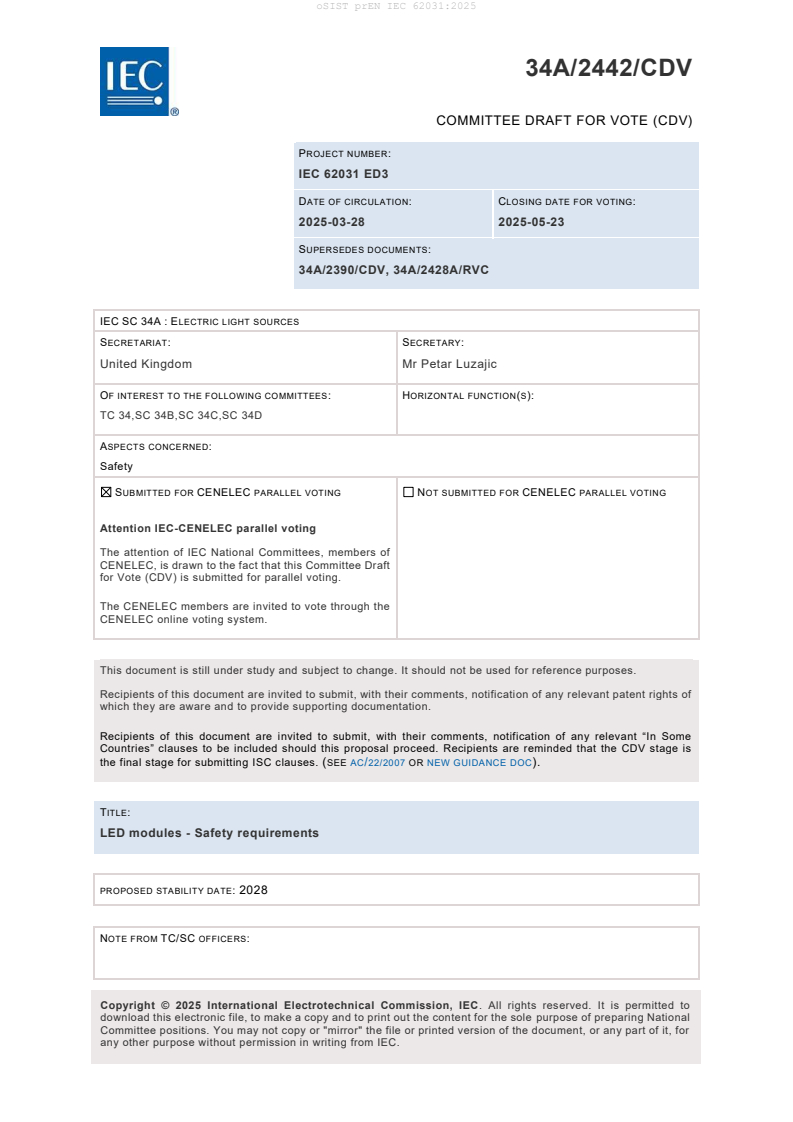
34A/2442/CDV
COMMITTEE DRAFT FOR VOTE (CDV)
PROJECT NUMBER:
IEC 62031 ED3
DATE OF CIRCULATION: CLOSING DATE FOR VOTING:
2025-03-28 2025-05-23
SUPERSEDES DOCUMENTS:
34A/2390/CDV, 34A/2428A/RVC
IEC SC 34A : ELECTRIC LIGHT SOURCES
SECRETARIAT: SECRETARY:
United Kingdom Mr Petar Luzajic
OF INTEREST TO THE FOLLOWING COMMITTEES: HORIZONTAL FUNCTION(S):
TC 34,SC 34B,SC 34C,SC 34D
ASPECTS CONCERNED:
Safety
SUBMITTED FOR CENELEC PARALLEL VOTING NOT SUBMITTED FOR CENELEC PARALLEL VOTING
Attention IEC-CENELEC parallel voting
The attention of IEC National Committees, members of
CENELEC, is drawn to the fact that this Committee Draft
for Vote (CDV) is submitted for parallel voting.
The CENELEC members are invited to vote through the
CENELEC online voting system.
This document is still under study and subject to change. It should not be used for reference purposes.
Recipients of this document are invited to submit, with their comments, notification of any relevant patent rights of
which they are aware and to provide supporting documentation.
Recipients of this document are invited to submit, with their comments, notification of any relevant “In Some
Countries” clauses to be included should this proposal proceed. Recipients are reminded that the CDV stage is
the final stage for submitting ISC clauses. (SEE AC/22/2007 OR NEW GUIDANCE DOC).
TITLE:
LED modules - Safety requirements
PROPOSED STABILITY DATE: 2028
NOTE FROM TC/SC OFFICERS:
download this electronic file, to make a copy and to print out the content for the sole purpose of preparing National
Committee positions. You may not copy or "mirror" the file or printed version of the document, or any part of it, for
any other purpose without permission in writing from IEC.
oSIST prEN IEC 62031:2025
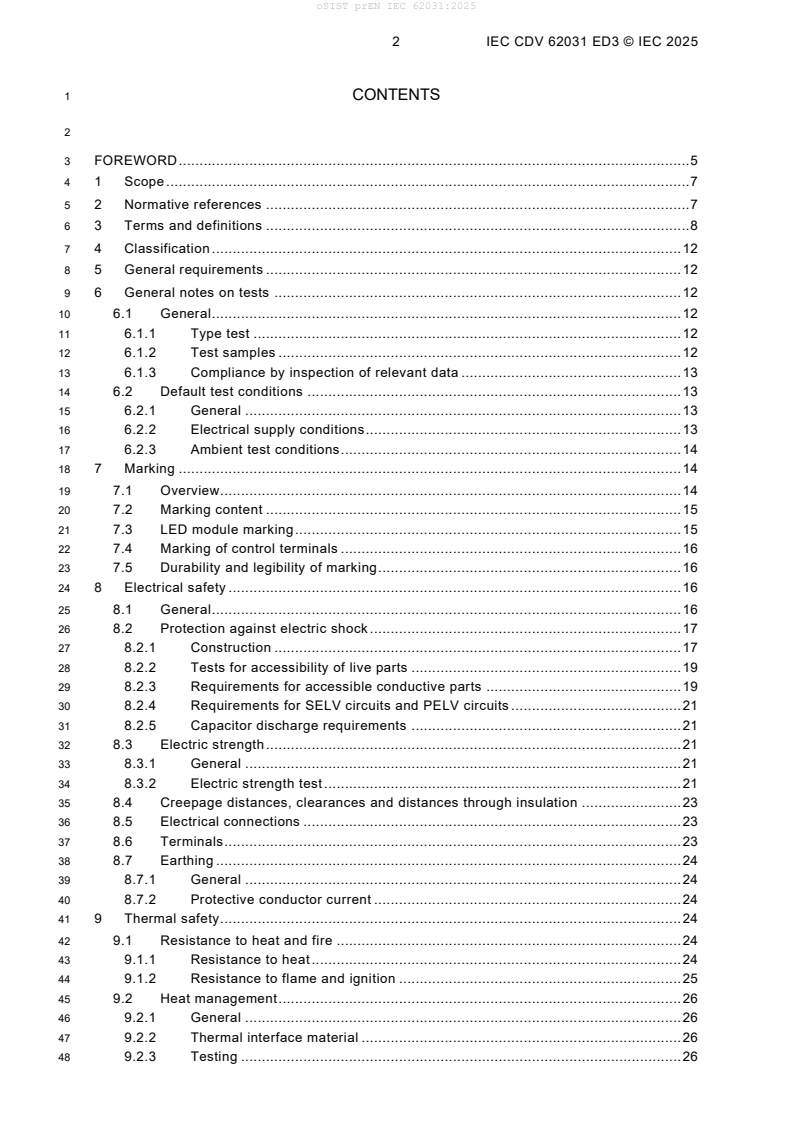
2 IEC CDV 62031 ED3 © IEC 2025
1 CONTENTS
3 FOREWORD . 5
4 1 Scope . 7
5 2 Normative references . 7
6 3 Terms and definitions . 8
7 4 Classification . 12
8 5 General requirements . 12
9 6 General notes on tests . 12
10 6.1 General . 12
11 6.1.1 Type test . 12
12 6.1.2 Test samples . 12
13 6.1.3 Compliance by inspection of relevant data . 13
14 6.2 Default test conditions . 13
15 6.2.1 General . 13
16 6.2.2 Electrical supply conditions . 13
17 6.2.3 Ambient test conditions . 14
18 7 Marking . 14
19 7.1 Overview. 14
20 7.2 Marking content . 15
21 7.3 LED module marking . 15
22 7.4 Marking of control terminals . 16
23 7.5 Durability and legibility of marking . 16
24 8 Electrical safety . 16
25 8.1 General . 16
26 8.2 Protection against electric shock . 17
27 8.2.1 Construction . 17
28 8.2.2 Tests for accessibility of live parts . 19
29 8.2.3 Requirements for accessible conductive parts . 19
30 8.2.4 Requirements for SELV circuits and PELV circuits . 21
31 8.2.5 Capacitor discharge requirements . 21
32 8.3 Electric strength . 21
33 8.3.1 General . 21
34 8.3.2 Electric strength test . 21
35 8.4 Creepage distances, clearances and distances through insulation . 23
36 8.5 Electrical connections . 23
37 8.6 Terminals . 23
38 8.7 Earthing . 24
39 8.7.1 General . 24
40 8.7.2 Protective conductor current . 24
41 9 Thermal safety . 24
42 9.1 Resistance to heat and fire . 24
43 9.1.1 Resistance to heat . 24
44 9.1.2 Resistance to flame and ignition . 25
45 9.2 Heat management . 26
46 9.2.1 General . 26
47 9.2.2 Thermal interface material . 26
48 9.2.3 Testing . 26
oSIST prEN IEC 62031:2025
IEC CDV 62031 ED3 © IEC 2025 3
49 9.2.4 Compliance . 27
50 10 Mechanical safety . 27
51 10.1 General . 27
52 10.2 Common requirements for mechanical safety . 27
53 10.3 Mechanical strength . 27
54 10.4 Screws and mechanical connections . 28
55 11 Photobiological safety . 29
56 11.1 Actinic UV hazards for skin and eye (200 nm to 400 nm wavelength) . 29
57 11.2 UV-A hazard for the eye lens (315 nm to 400 nm) . 29
58 11.3 Retinal blue light hazard (300 nm to 700 nm) . 29
59 11.4 Retinal thermal hazard (380 nm to 1 400 nm) . 29
60 11.5 Infrared radiation hazard for the eye (780 nm to 3 000 nm) . 30
61 11.6 Thermal hazard for the skin (380 nm to 3 000 nm) . 30
62 12 Fault conditions . 30
63 12.1 General . 30
64 12.2 Applicable fault conditions . 30
65 12.2.1 Electronic components. 30
66 12.2.2 PCB tracks . 31
67 12.2.3 Insulation layers . 31
68 12.3 Test power supply requirements . 31
69 12.3.1 LED modules supplied by voltage sources . 31
70 12.3.2 LED modules supplied by current sources . 31
71 12.4 Test procedures and compliance . 31
72 12.4.1 Test procedures . 31
73 12.4.2 Compliance . 32
74 13 Abnormal conditions . 32
75 13.1 General . 32
76 13.2 Applicable abnormal conditions . 33
77 13.2.1 Insertion orientation . 33
78 13.2.2 Maximum load at output terminals . 33
79 13.2.3 Phase cut dimmers test . 33
80 Annex A (normative) Measurement of touch current and protective conductor current . 35
81 A.1 General conditions . 35
82 A.2 Measurement of protective conductor current . 35
83 A.3 Measurement of touch current for normal and abnormal conditions . 35
84 A.4 Test procedure . 36
85 Annex B (informative) Information for luminaire design . 39
86 B.1 General . 39
87 B.2 Water contact . 39
88 B.3 Blue light hazard assessment . 39
89 B.3.1 LED modules classified as BLH-A . 39
90 B.3.2 LED modules classified as BLH-B . 39
91 B.3.3 LED modules classified as BLH-C . 39
92 B.4 Special information . 39
93 B.4.1 Interchangeability . 39
94 B.4.2 Heat management . 40
95 B.4.3 Working voltage . 41
96 B.4.4 LED module protection against electric shock . 41
97 B.4.5 Controlgear output current . 41
98 Annex C (informative) Information for controlgear design . 42
oSIST prEN IEC 62031:2025
4 IEC CDV 62031 ED3 © IEC 2025
99 Bibliography . 43
101 Figure 1 – Caution, risk of electric shock . 16
102 Figure 2 – Ball-pressure test apparatus . 24
103 Figure 3 – Abnormal temperature test set-up . 26
104 Figure 4 – Test circuit . 34
105 Figure A.1 – Test circuit: single-phase equipment on star TN or TT system . 37
106 Figure A.2 – Measuring network, touch current weighted for perception or reaction . 37
107 Figure A.3 – Test circuit including measuring network weighted for high frequency, to
108 measure protective conductor current . 38
109 Figure A.4 – Test circuit for touch currents between different accessible parts . 38
110 Figure B.1 – Diagrammatic cross section of an LED module fixed by means of a holder
111 for LED modules to a luminaire . 40
113 Table 1 – Informative overview on marking provisions . 14
114 Table 2 – Required number and type of Y capacitors . 18
115 Table 3 – Touch voltage limits . 20
116 Table 4 – Reduced touch voltage limits . 20
117 Table 5 – Touch current limits . 20
118 Table 6 – Electric strength test voltage . 23
119 Table 7 – Torque tests on screws . 28
120 Table A.1 – Position of switches n and p for the measurement . 36
oSIST prEN IEC 62031:2025
IEC CDV 62031 ED3 © IEC 2025 5
123 INTERNATIONAL ELECTROTECHNICAL COMMISSION
124 ____________
126 LED MODULES – SAFETY REQUIREMENTS
128 FOREWORD
129 1) The International Electrotechnical Commission (IEC) is a worldwide organization for standardization comprising
130 all national electrotechnical committees (IEC National Committees). The object of IEC is to promote international
131 co-operation on all questions concerning standardization in the electrical and electronic fields. To this end and
132 in addition to other activities, IEC publishes International Standards, Technical Specifications, Technical Reports,
133 Publicly Available Specifications (PAS) and Guides (hereafter referred to as “IEC Publication(s)”). Their
134 preparation is entrusted to technical committees; any IEC National Committee interested in the subject dealt with
135 may participate in this preparatory work. International, governmental and non-governmental organizations liaising
136 with the IEC also participate in this preparation. IEC collaborates closely with the International Organization for
137 Standardization (ISO) in accordance with conditions determined by agreement between the two organizations.
138 2) The formal decisions or agreements of IEC on technical matters express, as nearly as possible, an international
139 consensus of opinion on the relevant subjects since each technical committee has representation from all
140 interested IEC National Committees.
141 3) IEC Publications have the form of recommendations for international use and are accepted by IEC National
142 Committees in that sense. While all reasonable efforts are made to ensure that the technical content of IEC
143 Publications is accurate, IEC cannot be held responsible for the way in which they are used or for any
144 misinterpretation by any end user.
145 4) In order to promote international uniformity, IEC National Committees undertake to apply IEC Publications
146 transparently to the maximum extent possible in their national and regional publications. Any divergence between
147 any IEC Publication and the corresponding national or regional publication shall be clearly indicated in the latter.
148 5) IEC itself does not provide any attestation of conformity. Independent certification bodies provide conformity
149 assessment services and, in some areas, access to IEC marks of conformity. IEC is not responsible for any
150 services carried out by independent certification bodies.
151 6) All users should ensure that they have the latest edition of this publication.
152 7) No liability shall attach to IEC or its directors, employees, servants or agents including individual experts and
153 members of its technical committees and IEC National Committees for any personal injury, property damage or
154 other damage of any nature whatsoever, whether direct or indirect, or for costs (including legal fees) and
155 expenses arising out of the publication, use of, or reliance upon, this IEC Publication or any other IEC
156 Publications.
157 8) Attention is drawn to the Normative references cited in this publication. Use of the referenced publications is
158 indispensable for the correct application of this publication.
159 9) IEC draws attention to the possibility that the implementation of this document may involve the use of (a)
160 patent(s). IEC takes no position concerning the evidence, validity or applicability of any claimed patent rights in
161 respect thereof. As of the date of publication of this document, IEC had not received notice of (a) patent(s), which
162 may be required to implement this document. However, implementers are cautioned that this may not represent
163 the latest information, which may be obtained from the patent database available at https://patents.iec.ch. IEC
164 shall not be held responsible for identifying any or all such patent rights.
165 IEC 62031 has been prepared by subcommittee 34A: Electric light sources, of IEC technical
166 committee 34: Lighting. It is an International Standard.
167 This third edition cancels and replaces the second edition IEC 62031:2018. This edition
168 constitutes a technical revision.
169 This edition includes the following significant technical changes with respect to the previous
170 edition:
171 a) Complete review of the document structure, detailed technical requirements and tests,
172 including but not limited to what is individually described under items b) to i);
173 b) Clarification of the scope and revision of the applicability of this document to independent
174 and integral LED modules;
175 c) Updated terms and definitions;
176 d) Clearer specification for clause general requirements and clause general test requirements;
177 e) Update of the marking clause, such as marking of control terminals;
178 f) A full review and update of the electrical safety, thermal safety, and mechanical safety
179 requirements preventing misinterpretation and ambiguity;
oSIST prEN IEC 62031:2025
6 IEC CDV 62031 ED3 © IEC 2025
180 g) Updated photobiological safety requirements;
181 h) Revised and updated fault conditions and abnormal conditions requirements;
182 i) Removal of the annex relating to conformity testing during manufacture.
183 The text of this International Standard is based on the following documents:
Draft Report on voting
34A/XX/CDV 34A/XX/RVD
185 Full information on the voting for its approval can be found in the report on voting indicated in
186 the above table.
187 The language used for the development of this International Standard is English.
188 This document was drafted in accordance with ISO/IEC Directives, Part 2, and developed in
189 accordance with ISO/IEC Directives, Part 1 and ISO/IEC Directives, IEC Supplement, available
190 at www.iec.ch/members_experts/refdocs. The main document types developed by IEC are
191 described in greater detail at www.iec.ch/standardsdev/publications.
192 The committee has decided that the contents of this document will remain unchanged until the
193 stability date indicated on the IEC website under webstore.iec.ch in the data related to the
194 specific document. At this date, the document will be
195 • reconfirmed,
196 • withdrawn, or
197 • revised.
IMPORTANT – The "colour inside" logo on the cover page of this document indicates that it
contains colours which are considered to be useful for the correct understanding of its
contents. Users should therefore print this document using a colour printer.
oSIST prEN IEC 62031:2025
IEC CDV 62031 ED3 © IEC 2025 7
201 LED MODULES – SAFETY REQUIREMENTS
205 1 Scope
206 This document specifies safety requirements for LED modules for operation on DC supplies up
207 to 1 500 V or on AC supplies up to 1 000 V. This document does not include requirements for
208 performance characteristics of LED modules.
209 This document does not apply to:
210 – LED packages;
211 – LED modules for automotive lighting;
212 – OLED modules;
213 – LED lamps.
214 NOTE 1 LED modules that were designated as "independent LED modules" in the previous edition of IEC 62031
215 are considered luminaires which comprise LED module(s) as an integral component.
216 NOTE 2 Requirements for LED modules that are an integral component of the luminaire are specified in IEC 60598-
217 1:2024. IEC 60598-1:2024, Clause 4.3.1, makes reference back to this document as far as reasonable .
218 NOTE 3 Where the word "LED module" is used in this document, it is understood to be "built -in LED module”.
219 2 Normative references
220 The following documents are referred to in the text in such a way that some or all of their content
221 constitutes requirements of this document. For dated references, only the edition cited applies.
222 For undated references, the latest edition of the referenced document (including any
223 amendments) applies.
224 IEC 60384-14:2023, Fixed capacitors for use in electronic equipment – Part 14: Sectional
225 specification – Fixed capacitors for electromagnetic interference suppression and connection
226 to the supply mains
227 IEC 60417, Graphical symbols for use on equipment, available at http://www.graphical-
228 symbols.info/equipment
229 IEC 60598-1:2024, Luminaires – Part 1: General requirements and tests
230 IEC 60695-2-10:2021, Fire hazard testing – Part 2-10: Glowing/hot-wire based test methods –
231 Glow-wire apparatus and common test procedure
232 IEC 60695-2-11:2021, Fire hazard testing – Part 2-11: Glowing/hot-wire based test methods –
233 Glow-wire flammability test method for end products (GWEPT)
234 IEC 60695-11-5:2016, Fire hazard testing – Part 11-5: Test flames – Needle-flame test method
235 – Apparatus, confirmatory test arrangement and guidance
236 IEC 60990:2016, Methods of measurement of touch current and protective conductor current
237 IEC 61032:1997, Protection of persons and equipment by enclosures – Probes for verification
238 IEC 61347-1:2024, Controlgear for electric light sources – Safety – Part 1: General
239 requirements
oSIST prEN IEC 62031:2025
8 IEC CDV 62031 ED3 © IEC 2025
240 IEC 62368-1:2023, Audio/video, information and communication technology equipment – Part 1:
241 Safety requirements
242 IEC 62471-7:2023, Photobiological safety of lamps and lamp systems – Part 7: Light sources
243 and luminaires primarily emitting visible radiation
244 ISO 4046-4:2016, Paper, board, pulp and related terms – Vocabulary – Part 4: Paper and board
245 grades and converted products
246 ISO 7089:2000, Plain washers – Normal series – Product grade A
247 IEC 60317-0-1:2013, Specifications for particular types of winding wires – Part 0-1: General
248 requirements – Enamelled round copper wire
249 IEC 61189-2:2006, Test methods for electrical materials, printed boards and other
250 interconnection structures and assemblies – Part 2: Test methods for materials for
251 interconnection structures
252 IEC 61249-2 (all parts), Materials for printed boards and other interconnecting structures –
253 Part 2: Reinforced base materials, clad and unclad
254 3 Terms and definitions
255 For the purposes of this document, the following terms and definitions apply.
256 ISO and IEC maintain terminological databases for use in standardization at the following
257 addresses:
258 – IEC Electropedia: available at http://www.electropedia.org/
259 – ISO Online browsing platform: available at http://www.iso.org/obp
260 3.1
261 ultraviolet hazard efficacy of luminous radiation
262 K
S,v
263 quotient of an ultraviolet hazard quantity by the corresponding photometric quantity
𝐸
S
264 𝐾 =
S,v
𝐸
v
265 where
−2
266 E is the effective actinic irradiance in in W · m and
S
−2
267 E is the illuminance in lx = lm · m
v
−3 −2 −6 −1 −1
268 EXAMPLE With E = 10 W · m and E = 500 lx follows K = 2 · 10 W · lm = 2 mW · klm .
S v S,v
-1
269 Note 1 to entry: Ultraviolet hazard efficacy of luminous radiation is expressed in watt per lumen (W · lm ), possibly
−1
270 with a metric prefix (here mW · klm ).
271 Note 2 to entry: The ultraviolet hazard efficacy of luminous radiation is obtained by weighting the spectral power
272 distribution of the lamp or LED module with the UV hazard function S (). Information about the relevant UV hazard
UV
273 function is given in IEC 62471:2006. It only relates to possible hazards regarding UV exposure of human beings. It
274 does not deal with the possible influence of optical radiation on materials, such as mechanical damage or
275 discoloration.
276 [SOURCE: IEC 62471-7:2023, 3.17]
oSIST prEN IEC 62031:2025
IEC CDV 62031 ED3 © IEC 2025 9
277 3.2
278 replaceable LED module
279 LED module designed to be replaced by an ordinary person or a skilled person
280 Note 1 to entry: When incorporated into a luminaire, a replaceable LED module can be classified as replaceable,
281 non-user replaceable or non-replaceable depending on the luminaire design.
282 3.3
283 non-user replaceable LED module
284 LED module designed to be replaced only by the manufacturer, its service agent, or similar
285 skilled person
286 Note 1 to entry: When incorporated into a luminaire a non-user replaceable LED module can become classified as
287 non-replaceable due to the luminaire design.
288 3.4
289 integrated LED module
290 LEDi module
291 LED module, incorporating controlgear and any additional elements necessary for stable
292 operation of the light source, designed for direct connection to the mains
293 [SOURCE: IEC 60050-845:2020, 845-27-059, modified – “supply voltage” replaced by “mains”.]
294 3.5
295 semi-integrated LED module
296 LEDsi module
297 LED module that carries the control unit of the controlgear, and is operated by the separated
298 power supply of the controlgear
299 Note 1 to entry: The term control unit is specified in IEC 60050-845:2020, 845-28-057.
300 [SOURCE: IEC 60050-845:2020, 845-27-060, modified – Note to entry added.]
301 3.6
302 non-integrated LED module
303 LEDni module
304 LED module which needs a separate control circuitry or control gear to operate
305 [SOURCE: IEC 60050-845:2020, 845-27-061 – Note 1 to entry deleted.]
306 3.7
307 rated value
308 declared value of a quantity, used for specification
309 purposes and established under standard test conditions
310 Note 1 to entry: To express the "rated value" of a particular quantity, the term "value" is replaced by the quantity
311 name; for example, rated power, rated voltage, rated current, and rated temperature.
312 Note 2 to entry: The standard test conditions are given in this document.
313 [SOURCE: IEC 60050-845:2020, 845-27-100, modified – definition reworded.]
314 3.8
315 type test
316 test or series of tests for the purpose of checking compliance of the design of a given product
317 with the requirements of the relevant standard
318 3.9
319 type test sample
320 sample consisting of one or more similar units being representative of the production for the
321 purpose of the type test
oSIST prEN IEC 62031:2025
10 IEC CDV 62031 ED3 © IEC 2025
322 3.10
323 t -point
c
324 designated location on the surface of the LED module for measuring t
c
325 3.11
326 rated surface temperature
327 t
c
328 declared highest permissible temperature at the t -point
c
329 3.12
330 thermal power
331 P
d
332 power to be transferred from an LED module to the luminaire by means of heat conduction
333 Note 1 to entry: Thermal power is expressed in Watt (W).
334 Note 2 to entry: P is below the rated power of an LED module.
d
335 Note 3 to entry: For LED modules which do not require heat conduction to the luminaire, P is equal to zero.
d
336 3.13
337 terminal
338 conductive part of an LED module, provided for connecting that LED module to one or more
339 external conductors
340 [SOURCE: IEC 60050-151:2001, 151-12-12, modified – "device, electric circuit or electric
341 network" has been replaced by "LED module" and the Note has been deleted.]
342 3.14
343 mains
344 AC or DC power distribution system that supplies operating power to electrical equipment
345 Note 1 to entry: Mains include public or private utilities and, unless otherwise specified in this document, equivalent
346 sources such as motor-driven generators and uninterruptible power supplies.
347 3.15
348 interrupted DC
349 DC signal changing between zero and a certain level with a certain frequency, where the time
350 of the signal being at the certain level can vary within one period
351 Note 1 to entry: The abbreviated form of direct current "DC" is used to avoid confusion when used in combination
352 with "voltage" and "current" signal (e.g. interrupted DC voltage).
353 [SOURCE: SOURCE: IEC 61347-1:2024, 3.39]
354 3.16
355 live part
356 conductive part intended to be energized under normal operating conditions, including the
357 neutral conductor and mid-point conductor, but excluding the PEN conductor, PEM conductor
358 and PEL conductor
359 Note 1 to entry: PEN conductor, PEM conductor and PEL conductor are defined in IEC 60050-195:2021, 195-02-
360 12, 195-02-13 and 195-02-14.
361 Note 2 to entry: This concept does not necessarily imply a risk of electric shock.
362 [SOURCE: IEC 60050-195:2021, 195-02-19, modified – The domain has been omitted, and
363 Note 1 and Note 2 to entry added.]
364 3.17
365 hazardous-live-part
366 live part that, under certain conditions, can give a harmful electric shock
oSIST prEN IEC 62031:2025
IEC CDV 62031 ED3 © IEC 2025 11
367 [SOURCE: IEC 60050-195:2021, 195-06-05, modified – Note 1 to entry removed.]
368 3.18
369 pulse width modulation control
370 PWM control
371 pulse control in which the pulse width or frequency or both are modulated within each
372 fundamental period to produce a certain output waveform
373 [SOURCE: IEC 60050-551:1998, 551-16-30]
374 3.19
375 working voltage
376 highest RMS voltage across any insulation at any rated electrical supply conditions, transients
377 being neglected, under normal and under abnormal conditions
378 Note 1 to entry: The rated electrical supply conditions can be the rated voltage, the rated current or a rated supply
379 voltage range or rated supply current range.
380 3.20
381 extra-low voltage
382 ELV
383 voltage which does not exceed 50 V AC or 120 V ripple-free DC between conductors or between
384 any conductor and earth
385 Note 1 to entry: Ripple-free is conventionally defined as an RMS ripple voltage of not more than 10 % of the DC
386 component.
387 Note 2 to entry: Extra-low voltage (ELV) is part of the low-voltage (LV) band, see 4.2 and Table 1 of
388 IEC 61140:2016.
389 3.21
390 SELV circuit
391 electric circuit in which the voltage cannot exceed the value of extra-low voltage:
392 – under normal conditions
393 – under abnormal operating conditions and
394 – under single fault conditions, including earth faults in other electric circuits
395 Note 1 to entry: SELV is the abbreviation for safety extra-low voltage.
396 [SOURCE: IEC 61140:2016, 3.26.1, modified – "system" replaced by "circuit".]
397 3.22
398 PELV circuit
399 electric circuit in which the voltage cannot exceed the value of extra-low voltage:
400 – under normal conditions
401 – under abnormal operating conditions and
402 – under single fault conditions, except earth faults in other electric circuits
403 Note 1 to entry: PELV is the abbreviation for protective extra-low voltage.
404 [SOURCE: IEC 61140:2016, 3.26.2, modified – "system" replaced by "circuit".]
405 3.23
406 FELV circuit
407 electrical circuit in which the voltage cannot exceed the value of ELV used for functional
408 purposes and having simple separation from LV
409 Note 1 to entry: FELV is the abbreviation for functional extra-low voltage.
410 Note 2 to entry: A FELV circuit does not fulfil the requirements for SELV circuits (or PELV circuits).
oSIST prEN IEC 62031:2025
12 IEC CDV 62031 ED3 © IEC 2025
411 Note 3 to entry: A FELV circuit is not safe to touch and may be connected to protective earth.
412 3.24
413 sample
414 one or more sampling items intended to provide information on the population or on the material
415 [SOURCE: IEC 60050-151:2001, 151-16-19.]
416 3.25
417 sample item
418 one of the individual items in a population of similar items, or a portion of material forming a
419 cohesive entity and taken from one place and at one time
420 [SOURCE: IEC 60050-151:2001, 151-16-18]
421 4 Classification
422 LED modules are classified, according to the level of controlgear integration, as:
423 – integrated LED modules, LEDi module,
424 – semi-integrated LED modules, LEDsi module, or
425 – non-integrated LED modules, LEDni module.
426 5 General requirements
427 LED modules shall be so designed and constructed that, for their intended use, they cause no
428 danger to the users or surroundings.
429 Parts of LED modules providing hazard protection shall not become loose during normal
430 operation and handling.
431 Requirements, tests and compliances are provided in this document to reduce the risk of harm
432 to a tolerable level under normal operating conditions, abnormal operating conditions and single
433 fault conditions.
434 Where the terms "voltage" and "current" are used in this document, they imply the RMS values
435 unless otherwise stated.
436 Annex B and Annex C provide information for luminaire design and information for controlgear
437 design, respectively.
438 6 General notes on tests
439 6.1 General
440 6.1.1 Type test
441 Tests according to this document are type tests.
442 NOTE The requirements and tolerances specified in this document are related to testing of a type test sample
443 submitted by e.g. the manufacturer for that purpose. Compliance of type test samples does not ensure compliance
444 of the whole production of a manufacturer with this document. Conformity of production is the responsibility of the
445 manufacturer, and routine tests and quality insurance in addition to the type test can be necessary.
446 6.1.2 Test samples
447 Tests shall be carried out with type test samples.
oSIST prEN IEC 62031:2025
IEC CDV 62031 ED3 © IEC 2025 13
448 NOTE 1 For example, damage to marking as a result of the marking test has no impact on electrical testing, thus
449 the LED module is still considered to be representative of production for other tests.
450 Unless otherwise specified in this document, the type test shall be carried out on one sample
451 consisting of one or more sample items submitted for the purpose of the type test.
452 In general, all tests shall be carried out on each type of the LED module. Where there is a range
453 of similar LED modules for testing, samples representing the most onerous case within the
454 range shall be selected as relevant to the test criteria.
455 NOTE 2 As an example, it is not necessary to carry out overload condition tests separately on LED modules of one
456 type having different colour temperatures.
457 NOTE 3 It can be helpful to contact the manufacturer for information on a range of similar LED modules .
458 LED modules shall not be altered for the purposes of testing where the results of the tests could
459 be affected. Specially prepared sample items may be used, where necessary.
460 6.1.3 Compliance by inspection of relevant data
461 Where in this document compliance of materials, components or subassemblies is checked by
462 inspection or by testing of properties, compliance may be confirmed by reviewing any relevant
463 data or previous test results that are available.
464 6.2 Default test conditions
465 6.2.1 General
466 Unless otherwise specified in this document, the tests shall be conducted under the most
467 onerous operating conditions within the specified operating range. In addition to 6.2.2 and 6.2.3
468 the following parameters shall be taken into account:
469 – operating mode, including loading by external connected equipment;
470 – control settings and dimming conditions;
471 – position of movable parts;
472 – orientation.
473 NOTE It can be helpful to contact the manufacturer for information on the most onerous test conditions .
474 6.2.2 Electrical supply conditions
475 6.2.2.1 General
476 The supply voltage, current and frequency shall be stabilized within ±1 % of the specified test
477 value. The peak-to-peak ripple of the DC test current or voltage shall not exceed 10 % of the
478 average value of the test current or voltage.
479 6.2.2.2 LED modules supplied by voltage sources
480 LED modules supplied by voltage sources usually comprise means to adjust their operating
481 current so they can be supplied by a voltage source that, ideally, has no impedance.
482 EXAMPLE Mains supplied integrated LED modules (LEDi modules) and semi-integrated LED modules (LEDsi
483 modules).
484 For LED modules having a single rated voltage, tests shall be carried out at the most onerous
485 boundary of the 90 % to 110 % range around that rated voltage.
486 For LED modules having a rated voltage range, tests shall be carried out at the minimum voltage
487 of that range −10 % or at the maximum value of that range +10 %, whichever is the most
488 onerous.
oSIST prEN IEC 62031:2025
14 IEC CDV 62031 ED3 © IEC 2025
489 For LED modules having alternative rated voltages or voltage ranges, tests shall be carried out
490 separately for each rated voltage or voltage range.
491 For AC rated LED modules, tests shall be carried out at the most onerous rated frequency.
492 For LED modules rated for both AC and DC, each test shall be carried out with the most onerous
493 voltage source condition.
494 Where LED modules are intended for use from a battery supply, a DC power source may supply
495 the LED module under test, provided that the source impedance is equivalent to that of a battery.
496 NOTE A non-inductive capacitor of appropriate rated voltage and with a capacitance of at least 50 μF, connected
497 across the supply terminals of the units under test normally provides a source impedance simulating that of a battery.
498 6.2.2.3 LED modules supplied by current sources
499 LED modules supplied by current sources usually do not comprise means to adjust their
500 operating current, the operating voltage of such LED modules results from the design and the
501 operating current.
502 EXAMPLE Non-integrated LED module (LEDni module).
503 Tests shall be carried out at the maximum rated current.
504 6.2.3 Ambient test conditions
505 Tests shall be carried out at an ambient temperature within the range of 20 °C to 30 °C unless
506 otherwise specified in this document.
507 7 Marking
508 7.1 Overview
509 The requirements of 7.2, 7.3, 7.4 and 7.5 apply. Table 1 gives an overview for information.
510 Table 1 – Informative overview on marking provisions
Entry according to 7.2 On LED module On data In technical
sheet literature
a) Mark of origin R
b) Model number or type reference R
c) Rated supply voltage X X X
d) Rated supply current X X X
e) Rated supply frequency X X X
f) Rated power X X X
g) Connections X X X
h) t and the t -point X X X
c c
i) Blue light hazard X X X
j) Thermal power P X X X
d
k) Working voltage and type of insulation as applicable X X X
l) Protection against electric shock X X X
m) SELV or PELV supplied only X X X
n) Isolating or separating controlgear only X X X
o) Non-user replaceable X X X
Key
oSIST prEN IEC 62031:2025
IEC CDV 62031 ED3 © IEC 2025 15
R: required
X: at least one of the three required
512 7.2 Marking content
513 The following marking information of LED modules shall be given, if applicable:
514 a) Mark of origin (this may take the form of a trademark, the manufacturer's identification mark
515 or the name of the responsible vendor).
516 b) Model number or type reference.
517 c) The rated supply voltage or the rated supply voltage range, if the LED module requires a
518 stable voltage.
519 d) The rated supply current(s) or the rat
...