


kSIST FprEN 16129:2026
(Main)Pressure regulators, automatic change-over devices, having a maximum regulated pressure of 4 bar, with a maximum capacity of 150 kg/h, associated safety devices and adaptors for butane, propane, and their mixtures
General Information
- Abstract
This document specifies the design and operational characteristics, the safety requirements, test methods and the marking of regulators and automatic change-over devices having a maximum regulated pressure of 4 bar, with a maximum capacity of 150 kg/h, for use with butane, propane and their mixtures in the vapour phase.
The maximum supply pressures for devices covered by this document are 7,5 bar for butane and 16 bar for propane and LPG.
This document also applies to the safety devices which are included within regulating devices covered by this document.
This document also includes requirements for:
— adaptors for connecting to self-closing valves;
— integral or auxiliary safety devices.
This document covers devices used in locations where the temperature likely to be reached during use is between −20 °C and +50 °C
Additional requirements for devices to be used at temperatures down to −30 °C and/or up to +80 °C are defined in Annex C.
This document gives special requirements for:
— devices intended to be used in caravans and motor caravans (Annex D);
— devices intended to be used in boats (Annex M);
— specific connections which are not defined in other standards (e.g. EN 15202:2019 for cylinder valve connections).
Annex O describes the situation of regulating devices and adaptors regarding the Pressure Equipment Directive (PED).
NOTE 2 Boats considered in this document are recreational crafts covered by European Directive 2013/53/EU.
- Status
- Not Published
- Public Enquiry End Date
- 02-May-2025
- Technical Committee
- PLN - Gas appliances for domestic use
- Current Stage
- 5020 - Formal vote (FV) (Adopted Project)
- Start Date
- 17-Sep-2026
- Due Date
- 05-Nov-2026

Overview
kSIST FprEN 16129:2026 is an international standard developed by SIST for pressure regulators and automatic change-over devices. It specifically covers devices with a maximum regulated pressure of 4 bar and a maximum capacity of 150 kg/h. These regulators are intended for use with butane, propane, and their mixtures in the vapour phase. The standard outlines essential requirements for the design, operation, safety, testing, marking, and use of associated safety devices and adaptors.
This standard applies to products used in environmental conditions with temperatures ranging from −20 °C to +50 °C, with additional requirements for devices used in extreme temperatures, as detailed in Annex C.
Key Topics
- Design and Construction Requirements: Specifies material selection, mechanical strength, corrosion resistance, and construction details to ensure safety and durability.
- Operational Characteristics: Outlines criteria such as operating pressure range, flow rate, and supply pressure limits (7.5 bar for butane, 16 bar for propane and LPG).
- Safety Requirements: Covers built-in safety features, including over-pressure and under-pressure shut-off devices, excess flow valves, and thermal shut-off systems.
- Testing Methods: Describes mandatory test procedures for pressure resistance, leak testing, soundness, endurance, marking durability, and performance verification.
- Marking and User Instructions: Establishes how devices must be clearly marked, including operational parameters and safe usage instructions.
- Special Applications: Details additional requirements for devices to be used in caravans, motor caravans, and boats, accommodating special mounting, vibration resistance, and connection needs.
- Adaptors and Auxiliary Devices: Includes specifications for adaptors connecting to self-closing valves and for integral or auxiliary safety devices.
- Regulatory Compliance: Ensures harmonization with European directives, including the Pressure Equipment Directive (PED) and the Gas Appliance Regulation.
Applications
Pressure regulators and automatic change-over devices covered by this standard are widely used in various sectors, particularly where butane, propane, or LPG mixtures supply energy in the vapour phase. Key applications include:
- Domestic LPG Installations: Ensures safe and reliable gas pressure control in homes, especially where storage cylinders are used.
- Recreational Vehicles: Defines requirements for installations in caravans and motor caravans, prioritizing safety during travel and stationary use.
- Marine Applications: Covers use on recreational boats and crafts, adhering to relevant EU directives for marine safety and compatibility with onboard appliances.
- Commercial and Industrial Settings: Supports diverse LPG systems in commercial kitchens, outdoor catering, and small industrial sites.
- Adaptors for Self-Closing Valves: Facilitates safe and efficient cylinder replacement and maintenance.
By following kSIST FprEN 16129:2026, manufacturers, installers, and regulators ensure that LPG supply systems operate within rigorous safety parameters, reducing risks of leaks, overpressure, equipment failure, or environmental impact.
Related Standards
For comprehensive compliance and optimal integration, kSIST FprEN 16129:2026 references and aligns with several important international standards:
- EN 437:2021 - Defines test gases and pressures for appliance categories.
- EN 15202:2019 - Specifies essential operational dimensions for LPG cylinder valve outlets.
- EN 549:2019+A2:2024 - Covers rubber materials for seals and diaphragms in gas appliances.
- EN 624:2011 - Applies to dedicated LPG appliances installed in vehicles and boats.
- EN 751 Series - Describes sealing materials for gas connections.
- EN 1563:2018, EN 1652:1997, EN 1774:1997 - Specify material requirements for metal parts.
- EN 334:2019+A1:2024 - Harmonizes pressure definitions and symbols.
- EU Directives - Includes Gas Appliance Regulation (EU 2016/426) and Pressure Equipment Directive (2014/68/EU).
Adhering to this standard ensures that LPG pressure regulators and associated devices are safe, reliable, and compatible with current European safety regulations and industry best practices.
Relations
- Effective Date
- 01-Apr-2025
Get Certified
Connect with accredited certification bodies for this standard

Institut za varilstvo d.o.o. (Welding Institute)
Slovenia's leading welding institute since 1952. ISO 3834, EN 1090, pressure equipment certification, NDT personnel, welder qualification. Only IIW Au
Sponsored listings
Frequently Asked Questions
kSIST FprEN 16129:2026 is a draft published by the Slovenian Institute for Standardization (SIST). Its full title is "Pressure regulators, automatic change-over devices, having a maximum regulated pressure of 4 bar, with a maximum capacity of 150 kg/h, associated safety devices and adaptors for butane, propane, and their mixtures". This standard covers: This document specifies the design and operational characteristics, the safety requirements, test methods and the marking of regulators and automatic change-over devices having a maximum regulated pressure of 4 bar, with a maximum capacity of 150 kg/h, for use with butane, propane and their mixtures in the vapour phase. The maximum supply pressures for devices covered by this document are 7,5 bar for butane and 16 bar for propane and LPG. This document also applies to the safety devices which are included within regulating devices covered by this document. This document also includes requirements for: — adaptors for connecting to self-closing valves; — integral or auxiliary safety devices. This document covers devices used in locations where the temperature likely to be reached during use is between −20 °C and +50 °C Additional requirements for devices to be used at temperatures down to −30 °C and/or up to +80 °C are defined in Annex C. This document gives special requirements for: — devices intended to be used in caravans and motor caravans (Annex D); — devices intended to be used in boats (Annex M); — specific connections which are not defined in other standards (e.g. EN 15202:2019 for cylinder valve connections). Annex O describes the situation of regulating devices and adaptors regarding the Pressure Equipment Directive (PED). NOTE 2 Boats considered in this document are recreational crafts covered by European Directive 2013/53/EU.
This document specifies the design and operational characteristics, the safety requirements, test methods and the marking of regulators and automatic change-over devices having a maximum regulated pressure of 4 bar, with a maximum capacity of 150 kg/h, for use with butane, propane and their mixtures in the vapour phase. The maximum supply pressures for devices covered by this document are 7,5 bar for butane and 16 bar for propane and LPG. This document also applies to the safety devices which are included within regulating devices covered by this document. This document also includes requirements for: — adaptors for connecting to self-closing valves; — integral or auxiliary safety devices. This document covers devices used in locations where the temperature likely to be reached during use is between −20 °C and +50 °C Additional requirements for devices to be used at temperatures down to −30 °C and/or up to +80 °C are defined in Annex C. This document gives special requirements for: — devices intended to be used in caravans and motor caravans (Annex D); — devices intended to be used in boats (Annex M); — specific connections which are not defined in other standards (e.g. EN 15202:2019 for cylinder valve connections). Annex O describes the situation of regulating devices and adaptors regarding the Pressure Equipment Directive (PED). NOTE 2 Boats considered in this document are recreational crafts covered by European Directive 2013/53/EU.
kSIST FprEN 16129:2026 is classified under the following ICS (International Classification for Standards) categories: 23.060.40 - Pressure regulators. The ICS classification helps identify the subject area and facilitates finding related standards.
kSIST FprEN 16129:2026 has the following relationships with other standards: It is inter standard links to SIST EN 16129:2014. Understanding these relationships helps ensure you are using the most current and applicable version of the standard.
kSIST FprEN 16129:2026 is associated with the following European legislation: EU Directives/Regulations: 2014/68/EU, 2016/426; Standardization Mandates: M/071, M/595, M/601. When a standard is cited in the Official Journal of the European Union, products manufactured in conformity with it benefit from a presumption of conformity with the essential requirements of the corresponding EU directive or regulation.
kSIST FprEN 16129:2026 is available in PDF format for immediate download after purchase. The document can be added to your cart and obtained through the secure checkout process. Digital delivery ensures instant access to the complete standard document.
Standards Content (Sample)
SLOVENSKI STANDARD
oSIST prEN 16129:2025
01-april-2025
Regulatorji tlaka, avtomatski preklopni ventili z največjim nastavljivim tlakom do
vključno 4 bar, s pretokom do vključno 150 kg/h in s pripadajočimi varnostnimi
napravami ter priključki za butan, propan in njune zmesi
Pressure regulators, automatic change-over devices, having a maximum regulated
pressure of 4 bar, with a maximum capacity of 150 kg/h, associated safety devices and
adaptors for butane, propane, and their mixtures
Druckregelgeräte, automatische Umschaltanlagen mit einem höchstem Ausgangsdruck
bis einschließlich 4 bar und einem maximalen Durchfluss von 150 kg/h sowie die
dazugehörigen Sicherheitseinrichtungen und Übergangsstücke für Butan, Propan und
deren Gemische
Détendeurs, inverseurs automatiques, ayant une pression maximum de détente de 4
bar, avec une capacité maximale de 150 kg/h, dispositifs de sécurité associés et
adaptateurs pour butane, propane et leurs mélanges
Ta slovenski standard je istoveten z: prEN 16129
ICS:
23.060.40 Tlačni regulatorji Pressure regulators
oSIST prEN 16129:2025 en,fr,de
2003-01.Slovenski inštitut za standardizacijo. Razmnoževanje celote ali delov tega standarda ni dovoljeno.
oSIST prEN 16129:2025
oSIST prEN 16129:2025
DRAFT
EUROPEAN STANDARD
prEN 16129
NORME EUROPÉENNE
EUROPÄISCHE NORM
April 2025
ICS 23.060.40 Will supersede EN 16129:2013
English Version
Pressure regulators, automatic change-over devices,
having a maximum regulated pressure of 4 bar, with a
maximum capacity of 150 kg/h, associated safety devices
and adaptors for butane, propane, and their mixtures
Détendeurs, inverseurs automatiques, ayant une Druckregelgeräte, automatische Umschaltanlagen mit
pression maximum de détente de 4 bar, avec une einem höchstem Ausgangsdruck bis einschließlich 4
capacité maximale de 150 kg/h, dispositifs de sécurité bar und einem maximalen Durchfluss von 150 kg/h
associés et adaptateurs pour butane, propane et leurs sowie die dazugehörigen Sicherheitseinrichtungen und
mélanges Übergangsstücke für Butan, Propan und deren
Gemische
This draft European Standard is submitted to CEN members for enquiry. It has been drawn up by the Technical Committee
CEN/TC 181.
If this draft becomes a European Standard, CEN members are bound to comply with the CEN/CENELEC Internal Regulations
which stipulate the conditions for giving this European Standard the status of a national standard without any alteration.
This draft European Standard was established by CEN in three official versions (English, French, German). A version in any other
language made by translation under the responsibility of a CEN member into its own language and notified to the CEN-CENELEC
Management Centre has the same status as the official versions.
CEN members are the national standards bodies of Austria, Belgium, Bulgaria, Croatia, Cyprus, Czech Republic, Denmark, Estonia,
Finland, France, Germany, Greece, Hungary, Iceland, Ireland, Italy, Latvia, Lithuania, Luxembourg, Malta, Netherlands, Norway,
Poland, Portugal, Republic of North Macedonia, Romania, Serbia, Slovakia, Slovenia, Spain, Sweden, Switzerland, Türkiye and
United Kingdom.
Recipients of this draft are invited to submit, with their comments, notification of any relevant patent rights of which they are
aware and to provide supporting documentation.
Warning : This document is not a European Standard. It is distributed for review and comments. It is subject to change without
notice and shall not be referred to as a European Standard.
EUROPEAN COMMITTEE FOR STANDARDIZATION
COMITÉ EUROPÉEN DE NORMALISATION
EUROPÄISCHES KOMITEE FÜR NORMUNG
CEN-CENELEC Management Centre: Rue de la Science 23, B-1040 Brussels
© 2025 CEN All rights of exploitation in any form and by any means reserved Ref. No. prEN 16129:2025 E
worldwide for CEN national Members.
oSIST prEN 16129:2025
prEN 16129:2025 (E)
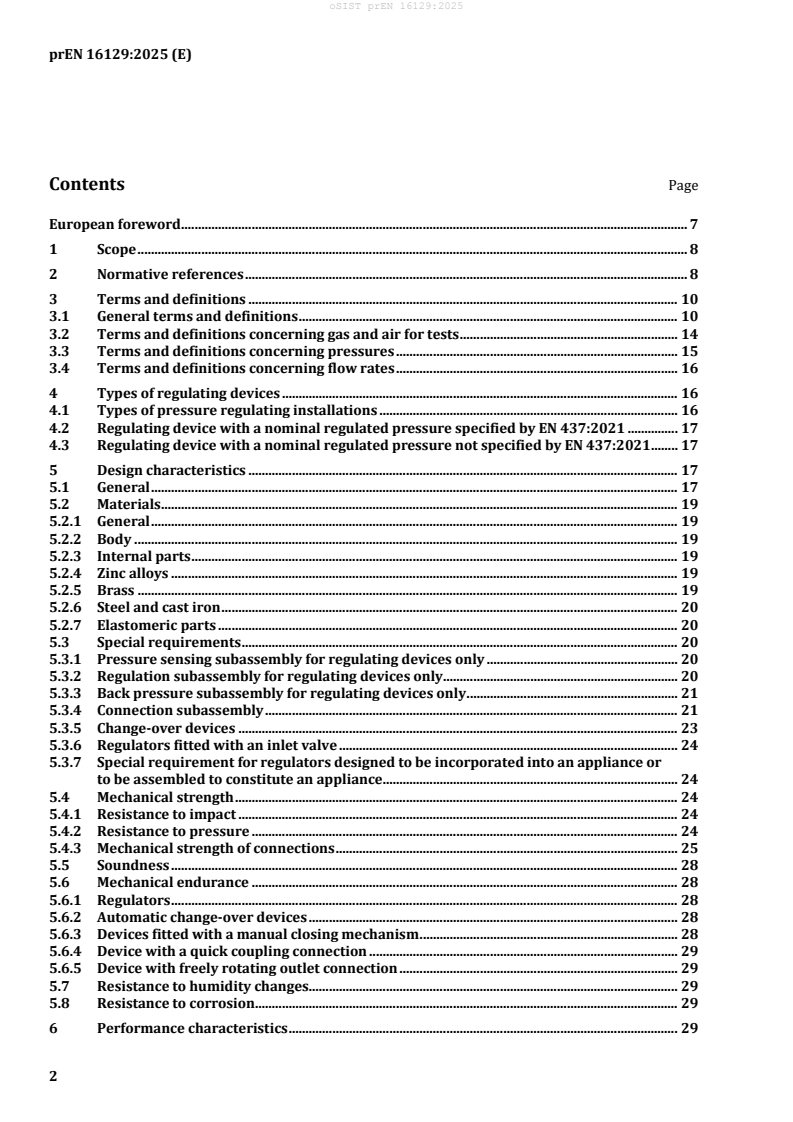
Contents Page
European foreword . 7
1 Scope . 8
2 Normative references . 8
3 Terms and definitions . 10
3.1 General terms and definitions . 10
3.2 Terms and definitions concerning gas and air for tests . 14
3.3 Terms and definitions concerning pressures . 15
3.4 Terms and definitions concerning flow rates . 16
4 Types of regulating devices . 16
4.1 Types of pressure regulating installations . 16
4.2 Regulating device with a nominal regulated pressure specified by EN 437:2021 . 17
4.3 Regulating device with a nominal regulated pressure not specified by EN 437:2021 . 17
5 Design characteristics . 17
5.1 General . 17
5.2 Materials . 19
5.2.1 General . 19
5.2.2 Body . 19
5.2.3 Internal parts . 19
5.2.4 Zinc alloys . 19
5.2.5 Brass . 19
5.2.6 Steel and cast iron . 20
5.2.7 Elastomeric parts . 20
5.3 Special requirements . 20
5.3.1 Pressure sensing subassembly for regulating devices only . 20
5.3.2 Regulation subassembly for regulating devices only . 20
5.3.3 Back pressure subassembly for regulating devices only . 21
5.3.4 Connection subassembly . 21
5.3.5 Change-over devices . 23
5.3.6 Regulators fitted with an inlet valve . 24
5.3.7 Special requirement for regulators designed to be incorporated into an appliance or
to be assembled to constitute an appliance . 24
5.4 Mechanical strength . 24
5.4.1 Resistance to impact . 24
5.4.2 Resistance to pressure . 24
5.4.3 Mechanical strength of connections . 25
5.5 Soundness . 28
5.6 Mechanical endurance . 28
5.6.1 Regulators . 28
5.6.2 Automatic change-over devices . 28
5.6.3 Devices fitted with a manual closing mechanism . 28
5.6.4 Device with a quick coupling connection . 29
5.6.5 Device with freely rotating outlet connection . 29
5.7 Resistance to humidity changes . 29
5.8 Resistance to corrosion . 29
6 Performance characteristics . 29
oSIST prEN 16129:2025
prEN 16129:2025 (E)
6.1 General . 29
6.2 Regulators . 30
6.2.1 Supply and regulated pressures for regulators to be used on installations where the
final pressure is to EN 437:2021 . 30
6.2.2 Supply and regulated pressures for fixed or adjustable regulators to be used on
installations where the final pressure is not to EN 437:2021 . 34
6.2.3 Variable regulators . 35
6.3 Automatic change-over devices . 36
6.3.1 Supply and regulated pressures for automatic change-over devices to be used on
installations where the final pressure is to EN 437:2021 . 36
6.3.2 Supply and regulated pressures for fixed or adjustable automatic change-over
devices to be used on installations where the final pressure is not to EN 437:2021 . 37
6.3.3 Automatic change-over device with integral variable regulator . 38
6.3.4 Change-over pressure . 38
6.4 Adaptors . 38
7 Test methods . 38
7.1 General conditions . 38
7.1.1 Type of test gas . 38
7.1.2 Test conditions . 39
7.1.3 Equivalence formulas . 39
7.1.4 Test samples . 39
7.1.5 Tolerances of measurements . 40
7.2 Verification of design characteristics . 41
7.2.1 Resistance to impact . 41
7.2.2 Resistance to pressure . 41
7.2.3 Mechanical strength of connections . 42
7.2.4 Valve pad retention . 47
7.2.5 Soundness . 47
7.2.6 Mechanical endurance . 48
7.2.7 Resistance to humidity changes . 50
7.2.8 Resistance to corrosion . 50
7.3 Verification of performance characteristics . 51
7.3.1 General . 51
7.3.2 Plotting of the performance curves for regulating devices . 53
7.3.3 Performances of adaptors . 54
7.3.4 Verification of first stage pressure for G.56 connection regulating devices . 55
7.3.5 Soundness of the non-return valve . 55
7.4 Proof test . 55
8 Marking, packaging, instructions . 55
8.1 General . 55
8.2 Marking of the device . 56
8.2.1 Marking . 56
8.2.2 Durability of the marking . 57
8.3 Packaging . 57
8.4 Instructions for installation, use and maintenance . 57
8.4.1 General . 57
8.4.2 Special requirement for regulators designed to be incorporated into an appliance or
to be assembled to constitute an appliance . 58
Annex A (normative) Special requirements for devices fitted with pressure or flow rate
operated safety functions . 59
A.1 Regulating devices fitted with an over-pressure relief valve of a limited flow rate
(PRV) . 59
oSIST prEN 16129:2025
prEN 16129:2025 (E)
A.2 Regulating devices fitted with an over-pressure shut off safety device (OPSO) . 61
A.3 Regulating devices fitted with an under-pressure shut off safety device (UPSO) . 63
A.4 Regulating devices fitted with an excess flow valve (EFV) . 64
A.5 Regulating devices fitted with a regulated outlet pressure limiter . 68
A.6 Two stage pressure limiting regulating device . 70
A.7 Additional diaphragm . 71
A.8 Regulating devices with in-line monitor . 72
Annex B (normative) Special requirements for devices fitted with a thermal shut off system . 73
B.1 Thermal shut off valve . 73
B.2 Thermal spindle on devices for self-closing valve connection . 74
Annex C (normative) Special requirements for devices under extreme temperature
conditions (temperatures down to –30 °C and/or up to +80 °C) . 76
C.1 Scope . 76
C.2 Requirements . 76
C.3 Conditioning . 76
C.4 Marking . 76
C.5 Instructions . 77
Annex D (normative) Regulating devices for gas cylinders to supply appliances installed in
caravans and motor caravans . 78
D.1 Scope . 78
D.2 Mounting and connections . 78
D.3 Pressures and flow rate . 82
D.4 Pressure safety functions . 82
D.5 Automatic change-over system (“kit”) . 82
D.6 Resistance to vibration . 83
D.7 Marking . 83
D.8 Instructions for installation, use and maintenance . 83
Annex E (normative) Complementary test requirements for non-metallic thermoplastic or
thermal setting materials used in the construction of devices . 84
E.1 Scope . 84
E.2 Materials . 84
E.3 Special requirements and tests . 85
E.4 Special conditions for carrying out the tests mentioned in the body of the standard . 87
E.5 Sampling and order of tests . 87
Annex F (normative) Requirements for elastomeric reinforced diaphragms . 88
F.1 Requirements . 88
F.2 Test according to EN 549:2019+A2:2024 . 88
F.3 Additional test . 88
oSIST prEN 16129:2025
prEN 16129:2025 (E)
Annex G (normative) Inlet connections . 89
Annex H (normative) Outlet connections . 102
Annex I (normative) Test method for resistance to corrosion . 119
I.1 Principle . 119
I.2 Reagents . 119
I.3 Apparatus . 120
I.4 Test method . 121
Annex J (informative) Method for measuring leaks . 125
J.1 Scope . 125
J.2 Diagram of the test bench . 125
J.3 Coefficient K . 125
J.4 Measurement of the leak. 126
J.5 Checks . 126
Annex K (normative) Special requirements for low pressure fixed regulators fitted with
two or three outlets for outdoor use . 127
K.1 Scope . 127
K.2 Design characteristics . 127
K.3 Performance characteristics . 127
K.4 Test methods . 127
K.5 Marking . 129
K.6 Instructions for installation, use and maintenance . 129
Annex L (normative) Special requirements for regulators fitted with an inlet valve . 130
L.1 Scope . 130
L.2 General . 130
L.3 Design characteristics . 130
L.4 Performance characteristics: mechanical strength . 130
L.5 Test methods . 130
Annex M (normative) Devices for gas cylinders to supply appliances installed in boats . 131
M.1 Scope . 131
M.2 Mounting and connections . 131
M.3 Pressure and flow rate . 131
M.4 Pressure safety functions . 131
M.5 Vent . 132
M.6 Automatic change-over system (“kit”) . 132
M.7 Materials . 132
M.8 Corrosion . 132
M.9 Resistance to vibration . 133
M.10 Marking . 133
oSIST prEN 16129:2025
prEN 16129:2025 (E)
M.11 Instructions for installation, use and maintenance . 133
Annex N (normative) Alternative possible seal. 134
N.1 Scope . 134
N.2 Dimensions . 134
N.3 Materials . 134
N.4 Markings . 134
Annex O (informative) Flow chart describing situation of regulating devices and adaptors
regarding to PED. 136
Annex P (Informative) Inlet and outlet connections used in the various countries . 138
P.1 Inlet connections . 138
P.2 Outlet connections . 142
Annex ZA (informative) Relationship between this European Standard and the Essential
Requirements of EU Regulation (EU) 2016/426 aimed to be covered (for regulating
devices only) . 145
Annex ZB (informative) Relationship between this European Standard and the Essential
Requirements of EU Directive 2014/68/EU aimed to be covered. 147
Bibliography . 148
oSIST prEN 16129:2025
prEN 16129:2025 (E)
European foreword
This document (prEN 16129:2025) has been prepared by Technical Committee CEN/TC 181 “Appliances
and leisure vehicle installations using liquefied petroleum gas and appliances using natural gas for
outdoor use”, the secretariat of which is held by AFNOR.
This document is currently submitted to the CEN Enquiry.
This document will supersede EN 16129:2013.
This document has been prepared under a standardization request addressed to CEN by the European
Commission. The Standing Committee of the EFTA States subsequently approves these requests for its
Member States.
For the relationship with EU Legislation, see informative Annex ZA or Annex ZB, which is an integral part
of this document.
The main changes compared with EN 16129:2013 are as follows:
— harmonization with pressure equipment directive 2014/68/EU. Annex O describes the situation of
regulating devices and adaptors regarding to PED;
— modification of the wording of both paragraphs 5.3.4.3 (Devices with a quick coupling connection)
and 5.3.4.4 (Devices for fitting to a self-closing valve by means of a thread) in order to distinguish
quick coupling connections from devices for fitting to a self closing valve;
— reconsideration of the G.56 connection specifications with the possibility to both connect and
disconnect in “on” position;
— additional tests regarding to marking durability;
— editorial changes (Definition Butane / Propane / LPG, Performance (FR vs UK versions), marking and
instructions);
— harmonization of pressure definitions and symbols with those given in EN 334:2019+A1:2024;
— dynamic resistance corrosion test;
— lock-up pressure test;
— Annex C;
— Annex M;
— rewording of the Annex ZA according to the Gas Appliance Regulation (EU) 2016/426;
— Annex ZB according to the pressure equipment directive 2014/68/EU.
NOTE Gas pressure regulators according to this document do not have their own source of ignition and
therefore are not within the scope of European Directive 2014/34/EU. Any additional components (e.g. proximity
switch, travel transducer etc.) are expected to be independently considered in the framework of assemblies as per
ATEX Guideline “Guideline on the application of Council directive 94/9/EC of 23rd March 1994 edition June 2009”,
Clauses 3.7.3 and 3.7.4.
oSIST prEN 16129:2025
prEN 16129:2025 (E)
1 Scope
This document specifies the design and operational characteristics, the safety requirements, test methods
and the marking of regulators and automatic change-over devices having a maximum regulated pressure
of 4 bar, with a maximum capacity of 150 kg/h, for use with butane, propane and their mixtures in the
vapour phase.
The maximum supply pressures for devices covered by this standard are 7,5 bar for butane and 16 bar
for propane and LPG.
This document also applies to the safety devices which are included within regulating devices covered by
this document.
This document also includes requirements for:
— adaptors for connecting to self-closing valves;
— integral or auxiliary safety devices.
This document covers devices used in locations where the temperature likely to be reached during use is
between −20 °C and +50 °C
Additional requirements for devices to be used at temperatures down to −30 °C and/or up to +80 °C are
defined in Annex C.
This document gives special requirements for:
— devices intended to be used in caravans and motor caravans (Annex D);
— devices intended to be used in boats (Annex M);
— specific connections which are not defined in other standards (e.g. EN 15202:2019 for cylinder valve
connections).
NOTE Boats considered in this document are recreational crafts covered by European Directive 2013/53/EU.
2 Normative references
The following documents are referred to in the text in such a way that some or all of their content
constitutes requirements of this document. For dated references, only the edition cited applies. For
undated references, the latest edition of the referenced document (including any amendments) applies.
EN 437:2021, Test gases — Test pressures — Appliance categories
EN 549:2019+A2:2024, Rubber materials for seals and diaphragms for gas appliances and gas equipment
EN 624:2011, Specification for dedicated LPG appliances Room sealed LPG space heating equipment for
installation in vehicles and boats
EN 751-1:1996, Sealing materials for metallic threaded joints in contact with 1st, 2nd and 3rd family gases
and hot water — Part 1: Anaerobic jointing compounds
EN 751-2:1996, Sealing materials for metallic threaded joints in contact with 1st, 2nd and 3rd family gases
and hot water — Part 2: Non-hardening jointing compounds
EN 751-3:2022+A1:2023, Sealing materials for metallic threaded joints in contact with 1st, 2nd and 3rd
family gases and hot water — Part 3: Unsintered PTFE tapes and PTFE strings
EN 1563:2018, Founding — Spheroidal graphite cast irons
oSIST prEN 16129:2025
prEN 16129:2025 (E)
EN 1652:1997, Copper and copper alloys — Plate, sheet, strip and circles for general purposes
EN 1774:1997, Zinc and zinc alloys — Alloys for foundry purposes — Ingot and liquid
EN 10226-1:2004, Pipe threads where pressure tight joints are made on the threads — Part 1: Taper
external threads and parallel internal threads — Dimensions, tolerances and designation
EN 10226-2:2005, Pipe threads where pressure tight joints are made on the threads — Part 2: Taper
external threads and taper internal threads — Dimensions, tolerances and designation
EN 12164:2024, Copper and copper alloys — Rod for free machining purposes
EN 12165:2024, Copper and copper alloys — Wrought and unwrought forging stock
EN 12420:2024, Copper and copper alloys — Forgings
EN 12844:1998, Zinc and zinc alloys — Castings — Specifications
EN 15202:2019, LPG equipment and accessories — Essential operational dimensions for LPG cylinder valve
outlet and associated equipment connections
EN 60695-11-10:2013, Fire hazard testing — Part 11-10: Test flames — 50 W horizontal and vertical
flame test methods
EN ISO 75-1:2020, Plastics — Determination of temperature of deflection under load — Part 1: General test
method (ISO 75-1:2020)
EN ISO 75-2:2013, Plastics — Determination of temperature of deflection under load — Part 2: Plastics and
ebonite (ISO 75-2:2013)
EN ISO 75-3:2004, Plastics — Determination of temperature of deflection under load — Part 3: High-
strength thermosetting laminates (ISO 75-3:2004)
EN ISO 178:2019, Plastics — Determination of flexural properties (ISO 178:2019)
EN ISO 180:2023, Plastics — Determination of Izod impact strength (ISO 180:2023)
EN ISO 527-1:2019, Plastics — Determination of tensile properties — Part 1: General principles
(ISO 527-1:2019)
EN ISO 527-2:2012, Plastics — Determination of tensile properties — Part 2: Test conditions for moulding
and extrusion plastics (ISO 527-2:2012)
EN ISO 527-3:2018, Plastics — Determination of tensile properties — Part 3: Test conditions for films and
sheets (ISO 527-3:2018)
EN ISO 527-4:2023, Plastics — Determination of tensile properties — Part 4: Test conditions for isotropic
and orthotropic fibre-reinforced plastic composites (ISO 527-4:2023)
As impacted by EN 1652:1997/AC:2003.
As impacted by EN 60695-11-10:2013/AC:2014.
As impacted by EN ISO 75-3:2004/AC:2006.
oSIST prEN 16129:2025
prEN 16129:2025 (E)
EN ISO 527-5:2021, Plastics — Determination of tensile properties — Part 5: Test conditions for
unidirectional fibre-reinforced plastic composites (ISO 527-5:2021)
EN ISO 4628-3:2024, Paints and varnishes — Evaluation of quantity and size of defects, and of intensity of
uniform changes in appearance — Part 3: Assessment of degree of rusting (ISO 4628-3:2024)
EN ISO 4892-3:2024, Plastics — Methods of exposure to laboratory light sources — Part 3: Fluorescent UV
lamps (ISO 4892-3:2024)
ISO 565:1990, Test sieves — Metal wire cloth, perforated metal plate and electroformed sheet — Nominal
sizes of openings
ISO 7005-1:2011, Pipe flanges — Part 1: Steel flanges for industrial and general service piping systems
ISO 7005-2:1988, Metallic flanges — Part 2: Cast iron flanges
3 Terms and definitions
For the purposes of this document, the following terms and definitions apply.
ISO and IEC maintain terminology databases for use in standardization at the following addresses:
— ISO Online browsing platform: available at https://www.iso.org/obp
— IEC Electropedia: available at https://www.electropedia.org/
3.1 General terms and definitions
3.1.1
regulator
regulating device which maintains a regulated pressure within pre-set limits, for a defined range of
upstream pressure, flow rate and temperature
Note 1 to entry: Figure 1 gives the terminology used in this document. The design shown is only an example.
oSIST prEN 16129:2025
prEN 16129:2025 (E)
Key
1 pressure sensing subassembly (diaphragm and plate)
2 regulation subassembly (seat and valve pad)
3 back pressure subassembly (cover, vent, spring and spring adjustment)
4 mechanical linkage subassembly (levers, linkages)
5 connection subassembly (inlet and outlet connections)
6 body
7 integral filter (if applicable)
Figure 1 — Principal parts of a regulator
3.1.2
automatic change-over device
regulating device which maintains the gas supply continuity by automatically using gas from a “reserve”
cylinder or series of cylinders when the supply pressure from a preselected “service” cylinder or series
of cylinders drops below a defined value
3.1.3
integral two stage automatic change-over device
regulating device combining an automatic change-over device and a regulator
3.1.4
regulating device
regulator or automatic change-over device or combination of both
oSIST prEN 16129:2025
prEN 16129:2025 (E)
3.1.5
monitor
second regulator installed in series with an active regulator, normally upstream, which has the task of
maintaining the controlled variable within allowable limits in the event of its value exceeding
pre-established values
3.1.6
adaptor
device which connects another part of the gas installation (e.g. hose) directly to a self-closing cylinder
valve and can incorporate an “on/off” or other function but not a pressure regulating function
3.1.7
device
regulator, automatic change-over device or adaptor
3.1.8
fixed regulating device
regulating device whose regulated pressure is fixed by construction
3.1.9
adjustable regulating device
regulating device whose regulated pressure can only be modified during commissioning or during
maintenance; it is then fixed
3.1.10
variable regulating device
regulating device whose regulated pressure can be modified during use with simple manipulation
between two fixed limits
3.1.11
automatic change-over device system “kit”
system of several regulators designed and adjusted in such a way as to operate like an automatic
change-over device as in 3.1.2
3.1.12
quick coupling
connection system which allows the fitting of a regulator or adaptor to a cylinder valve without a
threaded connection and without using tools
3.1.13
union connection
threaded connection with a freely rotating nut
Note 1 to entry: A union connection allows the assembly of a device without rotating it.
3.1.14
manual closing mechanism
part of a device used for closing the gas flow which requires an intentional manual action
EXAMPLE A lever or selector
3.1.15
self-closing valve
device fixed on the gas cylinder allowing the automatic shut off of the gas flow, by simple disconnection
of the regulator or adaptor from the cylinder valve
oSIST prEN 16129:2025
prEN 16129:2025 (E)
3.1.16
valve pad
component part of the regulation subassembly which ensures soundness between the part of the
regulator at supply pressure and the part of the regulator at regulated
...