


oSIST prEN 15203:2005
(Main)Energy performance of buildings - Application of calculation of energy use to existing buildings
Energy performance of buildings - Application of calculation of energy use to existing buildings
Energy labelling of buildings requires a method valid for both new and existing buildings, and treating them in an equivalent way.
In new buildings all required information exists to compute energy use, when necessary using conventional occupancy data; but the actual energy use is not available. In existing buildings, actual energy use is known in some cases from energy meters, but often some information, such as U-values of components or actual air change rate is missing. Since energy use for space heating and cooling strongly depends on occupants' behaviour and that different uses are involved, actual energy use cannot be used for energy labelling of the building without correction.
Therefore, a methodology should be developed to get the same results from different sets of data. The work will propose a methodology to assess missing data and to calculate a "standard" energy use for space heating and cooling. This work item also includes a methodology that allows determining the energy effectiveness of possible improvements.
Energieeffizienz von Gebäuden - Bewertung des Energieverbrauchs und Festlegung der Leistungsindikatoren
Diese Norm legt die Energieverwendungszwecke fest, die bei der Festlegung von Leistungsindikatoren der Energieeffizienz neuer und bereits bestehender Gebäude zu berücksichtigen sind und enthält Folgendes:
a) Ein Verfahren zur Berechnung des Zielleistungsindikators, einem Normenergieverwendungszweck, der nicht vom Verhalten der Gebäudenutzer, den tatsächlichen Wetterbedingungen und weiteren tatsächlichen (Umwelt oder Eingangs )Bedingungen abhängig ist. Für die Anwendung dieses Verfahrens stellen die Gebäudebelegung, das Klima und einige weitere Daten, die nicht vom Gebäude selbst abhängig sind, konventionelle Daten dar, die von der bestimmungsgemäßen Nutzung des Gebäudes und der betrachteten Klimazone abhängen.
b) Ein Verfahren zur Bewertung des Funktionsleistungsindikators auf der Grundlage der Bezugsenergie.
c) Eine Verfahrensweise zur Verbesserung des Vertrauens in das Gebäudeberechnungsmodell durch einen Vergleich mit dem tatsächlichen Energieverbrauch.
d) Ein Verfahren zur Bewertung der Energieeffizienz durch mögliche Verbesserungen.
Es ist die Aufgabe der nationalen Körperschaften festzulegen, unter welchen Bedingungen und für welche Gebäudetypen die verschiedenen Leistungsindikatoren gelten.
Performance énergétique des bâtiments - Evaluation de l'énergie utilisée et définition des indices de performance
Energijske lastnosti stavb – Ugotavljanje porabe energije in definicije ocenitev Energetska učinkovitost stavb
General Information
- Status
- Not Published
- Technical Committee
- TOP - Thermal insulation
- Current Stage
- 4020 - Public enquire (PE) (Adopted Project)
- Start Date
- 01-May-2005
- Due Date
- 01-May-2005
- Completion Date
- 01-May-2005



Relations
- Effective Date
- 07-Mar-2023
- Effective Date
- 22-Dec-2008
Overview
oSIST prEN 15203:2005 is a European draft standard developed by the Slovenian Institute for Standardization (SIST) addressing the energy performance of buildings. The standard provides a harmonized methodology for calculating and assessing energy use in both new and existing buildings. This enables fair and consistent energy labelling of buildings, supporting compliance with EU directives on energy performance.
The document ensures that the assessment method works equivalently for buildings with complete design data (as in new buildings) and those where actual usage or some characteristics are missing (more common in existing buildings). It standardizes how to handle missing data and discrepancies between calculated and measured energy use, ensuring reliable building energy ratings.
Key Topics
- Energy Performance Assessment: Clear procedures for evaluating energy use for space heating, cooling, ventilation, hot water, and lighting.
- Types of Ratings:
- Asset Rating: Calculated energy use under standard conditions, considering intrinsic building performance.
- Operational Rating: Based on actual, metered energy consumption, reflecting in-use performance.
- Design Rating: Used at the building design phase, relying on building plans and projections.
- Tailored Rating: Customized calculations using actual occupancy or climate data.
- Management of Missing Data: Provides methodologies to estimate values like U-values or air exchange rates when not available, crucial for existing buildings.
- Standard Input Data: Establishes the use of consistent climatic data, occupancy profiles, and energy carrier conversion factors, standardized at a national or regional level.
- Validation of Models: Emphasizes the comparison and adjustment of calculation models using actual energy consumption to improve accuracy.
- Evaluation of Energy Improvements: Methodology to assess potential energy savings and the effectiveness of retrofit measures.
Applications
- Energy Certification and Labelling: Supports compliance with the EU Energy Performance of Buildings Directive (EPBD) by providing a reproducible, fair system for energy certificates and labels for both new and existing buildings.
- Building Permitting: Used to demonstrate compliance with national energy efficiency requirements when seeking building permits.
- Retrofit Planning: Offers a validated calculation model approach to estimate the impact of renovation or energy efficiency upgrades in existing structures.
- Operational Benchmarking: Enables building managers and owners to compare measured energy performance with calculated standards, helping identify areas for improvement.
- Regulatory and Policy Support: Assists regulators in setting minimum performance standards, monitoring market compliance, and informing incentives or energy policies.
Related Standards
oSIST prEN 15203:2005 is closely linked with several international and European standards for a comprehensive approach to energy performance:
- EN 410: Glass in building - Determination of luminous and solar characteristics
- EN 673: Determination of thermal transmittance (U value)
- EN ISO 13790: Calculation of energy use for space heating
- prEN wi 14: Calculation of energy use for space heating and cooling
- prEN wi 13: Energy requirements for lighting
- EN ISO 7345: Thermal insulation - Physical quantities and definitions
- prEN wi 20 + 21: Ventilation for buildings - Calculation methods for ventilation energy requirements
- prEN wi 22: Methods for energy efficiency improvements via building automation
These referenced standards form an integrated framework for energy performance assessment, ensuring reliability and comparability across the European building sector.
By establishing uniform procedures for both new and existing buildings, oSIST prEN 15203:2005 enhances the credibility of building energy ratings, streamlines compliance, and promotes efficient retrofitting practices. It is an essential resource for professionals engaged in building design, energy management, and policy implementation aiming for a sustainable, energy-efficient built environment.
Get Certified
Connect with accredited certification bodies for this standard

DIBt (Deutsches Institut für Bautechnik)
German Institute for Building Technology.
DIN CERTCO
DIN Group product certification.

Aboma Certification B.V.
Specialized in construction, metal, and transport sectors.
Sponsored listings
Frequently Asked Questions
oSIST prEN 15203:2005 is a draft published by the Slovenian Institute for Standardization (SIST). Its full title is "Energy performance of buildings - Application of calculation of energy use to existing buildings". This standard covers: Energy labelling of buildings requires a method valid for both new and existing buildings, and treating them in an equivalent way. In new buildings all required information exists to compute energy use, when necessary using conventional occupancy data; but the actual energy use is not available. In existing buildings, actual energy use is known in some cases from energy meters, but often some information, such as U-values of components or actual air change rate is missing. Since energy use for space heating and cooling strongly depends on occupants' behaviour and that different uses are involved, actual energy use cannot be used for energy labelling of the building without correction. Therefore, a methodology should be developed to get the same results from different sets of data. The work will propose a methodology to assess missing data and to calculate a "standard" energy use for space heating and cooling. This work item also includes a methodology that allows determining the energy effectiveness of possible improvements.
Energy labelling of buildings requires a method valid for both new and existing buildings, and treating them in an equivalent way. In new buildings all required information exists to compute energy use, when necessary using conventional occupancy data; but the actual energy use is not available. In existing buildings, actual energy use is known in some cases from energy meters, but often some information, such as U-values of components or actual air change rate is missing. Since energy use for space heating and cooling strongly depends on occupants' behaviour and that different uses are involved, actual energy use cannot be used for energy labelling of the building without correction. Therefore, a methodology should be developed to get the same results from different sets of data. The work will propose a methodology to assess missing data and to calculate a "standard" energy use for space heating and cooling. This work item also includes a methodology that allows determining the energy effectiveness of possible improvements.
oSIST prEN 15203:2005 is classified under the following ICS (International Classification for Standards) categories: 91.120.10 - Thermal insulation of buildings. The ICS classification helps identify the subject area and facilitates finding related standards.
oSIST prEN 15203:2005 has the following relationships with other standards: It is inter standard links to SIST EN 15603:2008; is excused to SIST EN 15603:2008. Understanding these relationships helps ensure you are using the most current and applicable version of the standard.
oSIST prEN 15203:2005 is associated with the following European legislation: Standardization Mandates: M/343. When a standard is cited in the Official Journal of the European Union, products manufactured in conformity with it benefit from a presumption of conformity with the essential requirements of the corresponding EU directive or regulation.
oSIST prEN 15203:2005 is available in PDF format for immediate download after purchase. The document can be added to your cart and obtained through the secure checkout process. Digital delivery ensures instant access to the complete standard document.
Standards Content (Sample)
SLOVENSKI oSIST prEN 15203:2005
PREDSTANDARD
maj 2005
Energijske karakteristike stavb – Ugotavljanje porabe energije in definicije
ocenitev
Energy performance of buildings - Assessment of energy use and definition of
ratings
ICS 91.120.10 Referenčna številka
© Standard je založil in izdal Slovenski inštitut za standardizacijo. Razmnoževanje ali kopiranje celote ali delov tega dokumenta ni dovoljeno
EUROPEAN STANDARD
DRAFT
NORME EUROPÉENNE
EUROPÄISCHE NORM
March 2005
ICS
English version
Energy performance of buildings - Assessment of energy use
and definition of ratings
Performance énergétique des bâtiments - Evaluation de Energetische Verhalten von Gebäuden - Evaluierung des
l'énergie utilisée et définition des indices de performance Energieverbrauchs von Gebäuden und Definition der
Leistungsindikatoren
This draft European Standard is submitted to CEN members for enquiry. It has been drawn up by the Technical Committee CEN/TC 89.
If this draft becomes a European Standard, CEN members are bound to comply with the CEN/CENELEC Internal Regulations which
stipulate the conditions for giving this European Standard the status of a national standard without any alteration.
This draft European Standard was established by CEN in three official versions (English, French, German). A version in any other language
made by translation under the responsibility of a CEN member into its own language and notified to the Management Centre has the same
status as the official versions.
CEN members are the national standards bodies of Austria, Belgium, Cyprus, Czech Republic, Denmark, Estonia, Finland, France,
Germany, Greece, Hungary, Iceland, Ireland, Italy, Latvia, Lithuania, Luxembourg, Malta, Netherlands, Norway, Poland, Portugal, Slovakia,
Slovenia, Spain, Sweden, Switzerland and United Kingdom.
Warning : This document is not a European Standard. It is distributed for review and comments. It is subject to change without notice and
shall not be referred to as a European Standard.
EUROPEAN COMMITTEE FOR STANDARDIZATION
COMITÉ EUROPÉEN DE NORMALISATION
EUROPÄISCHES KOMITEE FÜR NORMUNG
Management Centre: rue de Stassart, 36 B-1050 Brussels
© 2005 CEN All rights of exploitation in any form and by any means reserved Ref. No. prEN 15203:2005: E
worldwide for CEN national Members.
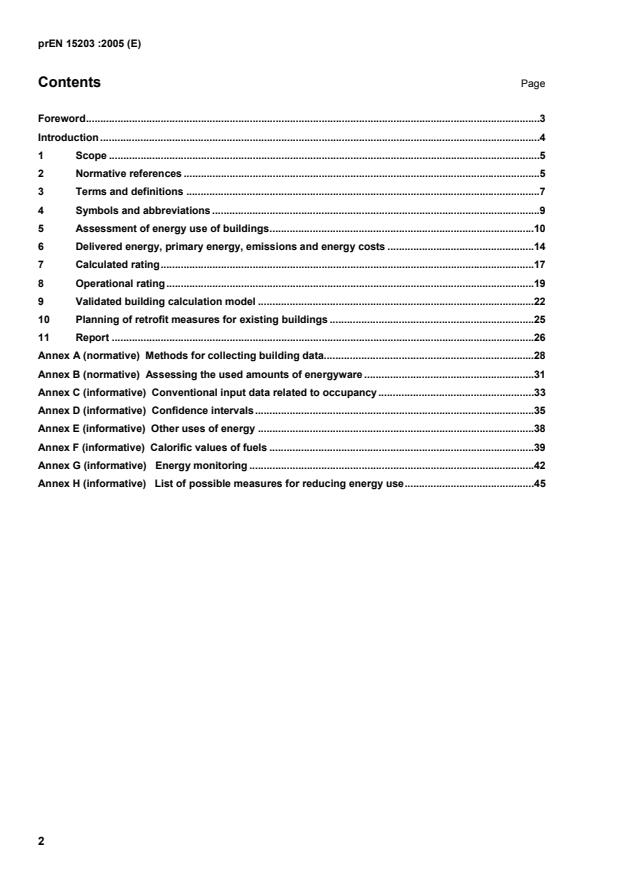
Contents Page
Foreword.3
Introduction .4
1 Scope .5
2 Normative references .5
3 Terms and definitions .7
4 Symbols and abbreviations .9
5 Assessment of energy use of buildings.10
6 Delivered energy, primary energy, emissions and energy costs .14
7 Calculated rating.17
8 Operational rating.19
9 Validated building calculation model .22
10 Planning of retrofit measures for existing buildings .25
11 Report .26
Annex A (normative) Methods for collecting building data.28
Annex B (normative) Assessing the used amounts of energyware .31
Annex C (informative) Conventional input data related to occupancy.33
Annex D (informative) Confidence intervals.35
Annex E (informative) Other uses of energy .38
Annex F (informative) Calorific values of fuels .39
Annex G (informative) Energy monitoring .42
Annex H (informative) List of possible measures for reducing energy use.45
Foreword
This document (prEN 15203:2005) has been prepared by Technical Committee CEN/TC 89 “Thermal
performance of buildings and building components”, the secretariat of which is held by SIS.
This document is currently submitted to the CEN Enquiry.
This document has been prepared under a mandate given to CEN by the European Commission and the
European Free Trade Association, and supports essential requirements of EU Directive(s).
Introduction
Energy assessments of buildings are carried out for various purposes, such as:
a) Judging compliance with building regulations expressed in terms of a limitation on energy use or a related
quantity;
b) Transparency in commercial operations through the certification and/or display of a level of energy
performance (energy certification);
c) Monitoring of the energy efficiency of the building including heating, ventilation and air conditioning
systems
d) Helping in planning retrofit measures, through prediction of energy savings which would result from
various actions.
Energy certification of buildings requires a method that is applicable to both new and existing buildings, and
which treats them in an equivalent way. Therefore, a methodology to obtain equivalent results from different
sets of data is presented in this standard. A methodology to assess missing data and to calculate a "standard"
energy use for space heating and cooling, ventilation, domestic hot water and lighting is provided. This
standard also includes a methodology that allows assessment of the energy effectiveness of possible
improvements.
Two principal types of ratings for buildings are proposed in this standard:
1) The asset rating is obtained by calculation for standardised conditions, but there can be different
ways of assembling the input data – from drawings and design values for new buildings, from
drawings, site surveys and rules derived from building typology for existing buildings, and by
improving on the latter by making use of metered energy.
2) The operational rating is obtained by metering and summing up all delivered energywares.
Because of the differences in the way these two ratings are obtained, they cannot be compared directly.
However, the difference between the two ratings for the same building can be used to assess the cumulative
effects of actual construction, systems and operating conditions versus standard ones and the contribution of
energy uses not included in the asset rating.
1 Scope
This standard defines the uses of energy to be taken into account for setting energy performance ratings for
new and existing buildings, and provides:
a) A method to compute the asset rating, a standard energy use that does not depend on occupant
behaviour, actual weather and other actual (environment or input) conditions. For this, occupancy, climate
and some other data that do not depend on the building itself are conventional ones, depending on the
intended use of the building and on the climatic zone considered.
b) A method to assess the operational rating, based on the delivered energy.
c) A methodology to improve confidence in the building calculation model by comparison with actual energy
consumption.
d) A method to assess the energy effectiveness of possible improvements.
It is up to national bodies to define under which conditions and for which types of buildings the various ratings
apply.
2 Normative references
The following referenced documents are indispensable for the application of this document. For dated
references, only the edition cited applies. For undated references, the latest edition of the referenced
document (including any amendments) applies.
EN 410, Glass in building – Determination of luminous and solar characteristics of glazing
EN 673, Glass in building – Determination of thermal transmittance (U value) – Calculation method
EN 12412-2, Thermal performance of windows, doors and shutters – Determination of thermal transmittance
by hot box method – Part 2: Frames
EN 13187, Thermal performance of buildings – Qualitative detection of thermal irregularities in building
envelopes – Infrared method
prEN wi 1+3, Energy performance of buildings — Methods for expressing energy performance and for energy
certification of buildings
prEN wi 2, Energy performance of buildings — Overall energy use, primary energy and CO emissions
prEN wi 7, Heating systems in buildings – Method for calculation of system energy requirements and system
efficiencies – Part 1: General
prEN wi 8, Heating systems in buildings – Method for calculation of system energy requirements and system
efficiencies – Part 2.1: Space heating emission systems
prEN wi 9, Heating systems in buildings – Method for calculation of system energy requirements and system
efficiencies –
Part 2.2.1: Boilers
Part 2.2.2: Heat pumps
Part 2.2.3: Heating generation – Thermal solar systems
Part 2.2.4: Performance and quality of CHP
Part 2.2.5: Performance and quality of district heating and large volume systems
Part 2.2.6: Performance of other renewables (heat and electricity)
Part 2.2.7: Space heating generation – Biomass combustion systems
prEN wi 10, Heating systems in buildings - Method for calculation of system energy requirements and system
efficiencies – Part 2.3: Space heating distribution systems
prEN wi 11, Heating systems in buildings – Method for calculation of system energy requirements and system
efficiencies – Part 3.1: Domestic hot water systems, including generation efficiency and the tap water
requirements
prEN wi 12, Calculation of room temperatures and of load and energy for buildings with room conditioning
systems
prEN wi 13, Energy performance of buildings – Energy requirements for lighting — Part 1: Lighting energy
estimation
prEN wi 14, Energy performance of buildings – Calculation of energy use for space heating and cooling
prEN wi 17, Thermal performance of buildings – Calculation of energy use for space heating and cooling –
General criteria and validation procedures for detailed calculations
prEN wi 20+21, Ventilation for buildings – Calculation methods for energy requirements due to ventilation
systems in buildings
prEN wi 22, Calculation methods for energy efficiency improvements by the application of integrated building
automation systems
prEN ISO 6946:2005, Building components and building elements – Thermal resistance and thermal
transmittance – Calculation method
EN ISO 7345, Thermal insulation – Physical quantities and definitions
prEN ISO 10077-1:2004, Thermal performance of windows, doors and shutters – Calculation of thermal
transmittance – Part 1: General
EN ISO 10077-2, Thermal performance of windows, doors and shutters – Calculation of thermal transmittance
– Part 2: Numerical method for frames
prEN ISO 10211:2005, Thermal bridges in building construction – Heat flows and surface temperatures –
Detailed calculations
EN ISO 12567 (all parts), Thermal performance of windows and doors – Determination of thermal
transmittance by hot box method
EN ISO 12569, Thermal insulation in buildings – Determination of air change in buildings - Tracer gas dilution
method
EN ISO 13790, Thermal performance of buildings – Calculation of energy use for space heating
prEN ISO 14683:2005, Thermal bridges in building construction – Linear thermal transmittance – Simplified
methods and default values
1)
EN ISO 15927-4 , Hygrothermal performance of buildings – Calculation and presentation of climatic data –
Part 4: Hourly data for assessing the annual energy use for heating and cooling
prEN ISO 15927-6:2004, Hygrothermal performance of buildings – Calculation and presentation of climatic
data – Part 6: Accumulated temperature differences (degree-days)
ISO 9869, Thermal insulation – Building elements – In-situ measurement of thermal resistance and thermal
transmittance
ISO 13600, Technical energy systems – Basic concepts
ISO 13601, Technical energy systems – Structure for analysis – Energyware supply and demand sectors
1) To be published.
3 Terms and definitions
For the purposes of this European Standard, the terms and definitions given in EN ISO 7345 and the following
apply.
3.1
rating
evaluation of the energy performance of a building based on the weighted sum of the calculated or metered
use of energy carriers.
3.2
asset rating
rating based on calculations of the energy used by a building for heating, cooling, ventilation, hot water and
lighting, with standard input data related to internal and external climates and occupancy
NOTE It represents the intrinsic energy potential of a building under standardised conditions of weather and
occupancy This is particularly relevant to certification of standard performance. The asset rating represents a weighted
sum per energyware of the total energy for heating, hot water heating, cooling, ventilation and lighting. This rating
quantifies the calculated energy intensity of the building under standardised conditions for a given set of energy end uses.
3.3
design rating
rating based on calculations using building drawings and design values, calculated for a building at the design
phase
NOTE The design rating is calculated on the basis of building plans, whereas the asset rating is calculated using data
for the building as actually constructed.
3.4
tailored rating
rating based on calculations of the energy used by the building for heating, cooling, ventilation, hot water and
lighting, with actual climate and occupancy data
3.5
operational rating
rating based on measured energy use
NOTE The operational rating is the weighted sum of all energywares used by the building. It is a measure of the in-
use performance of the building. This is particularly relevant to certification of actual performance The operational rating
represents the sum per energyware of the total energy used by the building, as measured by meters or other means
described in Annex B. This rating quantifies the total actual energy use of the building.
3.6
building
inhabited construction as a whole, including its envelope, and heating, ventilation and air conditioning
systems
3.7
new building
building at design stage or under construction or (for operational rating) too recently constructed to have
reliable records of energy use
3.8
existing building
building that is erected, for which actual data necessary to assess the energy use according to this standard
are known or can be measured
3.9
building calculation model
mathematical model of the building used to calculate its energy use
NOTE Most models used in this standard are defined in international standards. Several models may be necessary
to assess the energy use for all purposes.
3.10
validated building calculation model
building calculation model in which one or more parameters are adjusted so that its results do not significantly
differ from the measured reality
3.11
confidence interval
interval that has a high probability (e.g. 95 %) to include the actual value
NOTE Annex D provides ways to assess such intervals.
3.12
reasonably possible
can be achieved at a reasonable cost
3.13
reasonable cost
investment that is accepted by all parties to reach a given purpose
NOTE This cost strongly depends on the purpose of the effort. For example, the cost of a rating could be relatively
large if it is to provide an official certificate to put the building on the market or for displaying the building performance to
the public, but reduced if it is simply for statistical purpose.
3.14
energy carrier
substance or phenomenon that can be used to produce mechanical work or heat or to operate chemical or
physical processes [ISO 13600:1997]
3.15
energyware
tradable commodity used mainly to produce mechanical work or heat, or to operate chemical or physical
processes, and listed in Annex A of ISO 13600. [ISO 13600:1997]
NOTE Energywares form a proper subset of energy carriers. The set of energy carriers is open.
3.16
energyware consumption system
technical energy system consuming energyware and in many cases also other energy carriers and producing
products and services [ISO 13600:1997]
NOTE Buildings are such systems.
3.17
renewable energy
energy from sources that will not be exhausted during the lifetime of mankind, such as solar energy (thermal
and photovoltaic), wind, hydraulic, biomass
NOTE In ISO 13602-1:2002, renewable resource is defined as 'natural resource for which the ratio of the creation of
the natural resource to the output of that resource from nature to the technosphere is equal to or greater than one.
3.18
primary energy
energy that has not been subjected to any conversion or transformation process
NOTE For a building, it is the energy used to produce the energy delivered to the building. It is the delivered energy
divided by the conversion or transformation factor of each form of energy.
3.19
delivered energy
energy supplied to the building from the last market agent
NOTE The boundaries of the building include all internal and external areas associated with the building, where
energy is consumed or produced (see 5.1). The energy produced by the building itself, for example using solar water
heater, photovoltaic systems or co-generation and delivered back to the market is reported separately. Delivered energy is
presented per energyware.
3.19
energy use of a building
total energy per energy carrier delivered to the energy systems for heating, cooling, ventilation, hot water
heating, lighting, appliances, etc.
NOTE Appliances are not explicitly included in the asset rating and in the ‘inter alia’ subset of energy end uses in
2)
Article 2 of the EPBD , but they are in fact included in the total energy use of the building.
3.20
auxiliary energy
energy used by heating, cooling, domestic water, lighting and ventilation systems to transform the delivered
energy into the useful energy
NOTE This includes energy for fans, pumps, pilot flames, electronics, etc., but not the energy that is transformed.
3.21
calorific value
quantity of heat produced by complete combustion, at a constant pressure equal to 101 320 Pa, of a unit
amount of fuel
NOTE The gross calorific value includes the heat recovered when condensing the water vapour resulting from the
combustion of hydrogen. The net calorific value does not take account of this latent heat.
4 Symbols and abbreviations
Table 1 —Symbols and units
Symbol Quantity Unit
A area m²
c
concentration -
C cost €
DD
accumulated temperature differences (degree-days) K d
f factor -
I
solar irradiance J/m²
E energyware amount kg, m³, kWh, MJ, etc.
O
occupancy h, h/d, %
Q quantity of heat or energy J
t
time, time interval d, h, s
&
V airflow rate m³/h, m³/s
Φ heat flow rate, power W
GCV gross calorific value of an energyware MJ/unit, kWh/unit
Celsius temperature °C
θ
) DIRECTIVE 2002/91/EC OF THE EUROPEAN PARLIAMENT AND OF THE COUNCIL of 16 December 2002 on the
energy performance of buildings
NOTE Hours can be used as the unit of time instead of seconds for all quantities involving time (i.e. for time periods
as well as for air change rates), but in that case the unit of energy is Watt-hours [Wh] instead of Joules.
Table 2 — Subscripts
a automation and control m measured
c cooling n net
CO2 related to CO emissions o operational
d Delivered, day p primary
E electricity rc recovered
e external rn renewable
ex exported s system
g Related to gains st standard
h heating t total
i internal v ventilation
i,j,k numbering indices w hot water
L limit Y year, annual
l lighting
5 Assessment of energy use of buildings
5.1 Building boundaries
The boundaries for the energy performance assessment shall be clearly defined for all energy carriers before
the calculation. It includes all inside and outside areas associated with the building, where energy is
consumed or produced.
For insulated buildings, it is defined by the building envelope for heat flows, the main building meters for gas,
electricity, district heating and water, the loading port of the storage facility for liquid and solid energywares,
and the smoke exhaust of chimney and connection to main wastewater duct for losses.
If a part of a building system (e.g.boiler, chiller, cooling tower, etc.) is outside the building envelope, it is
nevertheless considered to be inside the boundaries.
A building may refer to a group of adjacent buildings as a whole or parts thereof that have been designed or
altered to be used separately. If one building in a row of similar buildings are to be assessed, heat flows
through partition walls are neglected in the balance.
If adjacent buildings do not have the same type of use, and hence not the same internal design or actual
temperature, heat flows through partition walls are taken into account in the balance.
NOTE In many cases, buildings in rows have the same use and, for calculation purposes, the internal temperature of
all the buildings can be assumed to be the same, and these partition walls can be taken to be adiabatic. However, if the
external envelope is well insulated and partition walls are not, these heat flows can contribute an appreciable amount of
heat gains and losses.
The way the building envelope is considered to calculate heat flows is defined in prEN wi 14.
5.2 Types of ratings
This standard proposes two principal options for energy rating of buildings, the first being calculated, the
second being based on measurements. These options are the asset rating and the operational rating.
Figure 1 — The operational rating includes all energy uses under actual conditions, while the asset
rating includes only some uses, and for standard conditions
The asset rating is based on calculations of the energy used by the building for heating, cooling, ventilation,
hot water and lighting, with standard input data related to climate and occupancy (see 7.2). This rating
provides an assessment of the energy efficiency of the building under standardised conditions that enables a
comparison to be made between different buildings within climatic main regions and with identical or at least
similar activities.
The operational rating is based on measurement of energy use (see Clause 8). The operational rating
measures the in-use performance of a building, including all deviations between theoretical properties in
calculations and realised properties (air-infiltration, heat transfer, generation efficiency, control, etc.) and is
influenced by the way the building is maintained and operated. It cannot therefore be used to provide
prospective purchasers or tenants with like-for-like comparisons between buildings. It assists those trying to
improve the efficiency of building operation and allows displaying the actual energy performance of a building.
It can also provide useful feedback to the owners, occupiers and designers of new buildings if assessed a few
years after occupation and compared to the calculated asset rating, for the same set of energy end uses.
Only asset rating and operational ratings are used for building energy performance certification.
The design rating is similar to the asset rating, but based on building drawing and design intentions. It can be
used to get a building permit.
The tailored rating is an asset rating, in which either actual climatic data or actual occupancy related data or
both are used instead of standard ones. This can be used to compare two buildings having different climates
or different uses, to compare retrofit scenarios, to optimise energy performance, etc.
The calculation models and input used for the asset rating can be validated against the operational rating,
providing more confidence in the model (see Clause 9). The validated model can then be used to compute a
more accurate asset rating, or to study the effect of retrofit scenarios.
The types of rating are summarised in Table 3. The type of rating (asset rating or operational rating) to be
used for certification of different building types is defined in national regulations.
Table 3 —Types of ratings
Input data
Name Use Climate Building Utility or purpose
Design Standard StandardDrawings Building permit
Calculated Asset Standard Standard Actual Certificate, regulation
Tailored Depending on purpose Actual Optimisation, comparisons, retrofit planning
Measured Operational Actual Actual Actual Certification, regulation
5.3 Input and output
5.3.1 General
This standard needs and provides the following information:
5.3.2 Necessary inputs
5.3.2.1 Inputs for calculated ratings
a) Annual energy use for heating, calculated according to prEN wi 14;
b) Annual energy use for cooling, calculated according to prEN wi 14;
c) Annual energy use for hot water, calculated according to prEN wi 11;
d) Annual energy use for lighting, calculated according to prEN wi 13;
e) Annual energy use for ventilation, calculated according to prEN wi 20;
f) Effect of automation and controls, assessed according to prEN wi 22;
g) Conversion factors from delivered energy to primary energy and CO production, according to prEN wi 2.
5.3.2.2 Inputs for operational rating and calculation model validation
h) Metered energy use for all energywares.
5.3.3 Additional inputs
The following information is normally provided on a national level:
i) Gross calorific value of energywares;
j) Standard data related to occupancy (temperature, humidity, airflow rate, internal gains, hot water use, and
standard energy use for appliances other than heating, cooling, ventilation, hot water and lighting);
k) Standard climatic data.
Figure 2 — Inputs to this standard and outputs from this standard
5.3.4 Provided output
For certification and regulation purposes this standard provides:
l) Asset rating: the calculated energy use of the building under standard conditions;
m) Operational rating, based on metered energy use;
For obtaining building permits this standard provides:
n) Design rating;
For other purposes this standard provides:
o) Validated building calculation model that can be used to assess the effect of measures to be taken for
improving the energy performance, including combinations thereof;
p) Tailored rating.
These outputs are used for expressing the energy performance of the building and establishing energy
performance requirements according to prEN wi 1+3.
6 Delivered energy, primary energy, emissions and energy costs
6.1 Energy uses
The total calculated energy used by the building shall comprise the annual energy use for the following
purposes:
heating;
cooling;
ventilation systems;
hot water;
lighting.
Each energy use includes auxiliary energy and losses of systems.
Energy uses for other purposes (e.g. electrical appliances, cooking, industrial processes) are not included in
the calculated energy use but the total metered energy will normally include these other uses.
6.2 Delivered energy
6.2.1 General
For each of the purposes listed in 6.1, the energy use is calculated for standardised use and climate according
to the standards cited in 6.2.2. The results are allocated to energy carriers for each purpose according to the
scheme in Table 4.
The rows and columns in Table 4 should be adapted to the building concerned. The columns include the
relevant energy carriers. The sub-total row relates to the energy included in the asset rating.
If energy is produced on site, rows and columns are added to the matrix for each energy producing system.
Delivered energy consumed by the systems (e.g. gas for cogeneration) is indicated in the appropriate cell
under "energy consumption", and energy produced by a system is indicated by a negative number in the
appropriate cell under "energy production". Energy produced and consumed on site is indicated by a positive
number in the cell corresponding to the appropriate use. A negative number in the total row means energy
being exported.
Exported amounts of energy carriers (electricity or heat in most cases) are accounted separately, because
different conversion factors may apply to them.
System heat losses that are recovered are, depending on the way they are recovered, either deducted from
the loss of each system or taken into account as gains to calculate energy use for heating and cooling.
NOTE In buildings with co-generation, it is not straightforward to attribute the fuel used to the heat and electricity
produced and the system loss. This splitting should nevertheless be performed as well as reasonably possible.
The calculation for heating and cooling is based on a mathematical calculation model of the building defined in
prEN wi 14. Other more sophisticated calculation models can be used, provided that they provide the annual
energy use for all the purposes mentioned in 6.1 and that they follow the calculation procedures of prEN wi 14
for detailed simulation methods for heating and cooling calculations.
NOTE These procedures include rules for the building boundaries, partitioning into zones, the elements to take into
account in the energy balance, the boundary conditions and physical input, plus reference to the validation procedures
according to prEN wi 17.
Table 4 — Accounting energy uses for asset rating
Energy carrier
Use of energy
Heating
Cooling
Ventilation system
Hot water
Lighting
Sub-total
Prod. solar thermal
Prod. photovoltaic
Prod: cogeneration
Total
Weighting factors
Weighted energy
6.2.2 Energy use for hot water
The energy use for energy carrier i for hot water is calculated by:
Q = Q + Q (1)
w,i nw,i sw,i
where
Q is the annual net use of energy carrier i for hot water, calculated according to prEN wi 11;
nw,i
Q is the annual use energy carrier i for the hot water system, calculated according to prEN wi 11
swc,i
and prEN wi 9.
If there is no hot water circulation, heat flows between the building and the hot and cold water systems are
either neglected, or heat flow from the hot water system to the internal environment and heat flow from the
internal environment to the cold water network shall be both taken into account in the calculation of the energy
use for heating and cooling.
If there is hot water circulation, heat flow between the hot water circulation systems and the building are
accounted as losses of the hot water system. The part lost within the conditioned space is accounted for in the
internal gains to compute energy for heating and cooling.
6.2.3 Energy use for lighting
The annual energy use of energy carrier i for lighting, Q , , is calculated according to prEN wi 13, and the
l i
effects of control according to prEN wi 22. The part of this energy, lighting the conditioned space, is added to
the internal gains to compute energy for heating and cooling.
Oil
Gas
Coal
District heating
District cooling
Wood
Electricity
Carrier n
Solar energy
thermal
Solar photovoltaïc
Electricity from
cogeneration
Heat from
cogeneraration
Weighted energy
6.2.4 Energy use for heating
The annual energy use in energy carrier i for heating, Q , is calculated according to prEN wi 14, taking
nh,i
account of the system's losses and of the effects of controls according to prEN wi 22.
Auxiliary energy used in the heating system (pumps, fans, control systems) shall be also taken into account at
this step if not already accounted for in the energy use of the heating system.
6.2.5 Energy use for cooling
The annual energy use in energy carrier i for cooling, Q is calculated according to prEN wi 14 taking
nc,i,
account of the effects of controls according to prEN wi 22.
Auxiliary energy used in the cooling system (pumps, fans, control systems) shall be also taken into account at
this step if not already accounted for in the energy use of the cooling system.
6.2.6 Energy use for ventilation
The annual energy use for ventilation, Q , is calculated according to prEN wi 20.
vs
6.3 Delivered energy per energy carrier
The delivered energy for each energy carrier is calculated by adding each energy used by that energy carrier.
Q = Q + Q + Q + Q + Q (2)
d,i h,i c,i v,i w,i l,i
where
Q is the annual delivered energy in carrier i.
d,i
The annual on-site production of renewable energy, Q , and the annual quantity of energy exported, Q , are
rn ex
calculated separately (see prEN wi 9, Parts 2.2.3, 2.2.4 and 2.2.6).
For rating the building, the delivered and exported energy per energy carrier are combined using weighting
factors for each energy carrier. Examples are primary energy, emission and cost. Factors may be different for
delivered and exported energy.
NOTE The total delivered energy for the operational rating includes also the energy for uses other than those
mentioned in 6.1. and Equation (4).
6.4 Primary energy
Primary energy is calculated from the delivered and exported energy for each energyware:
Q =()Q × f −(Q × f) (3)
p d,i p,i ex,i pex,i
∑ ∑
where
Q is the delivered energy for energyware i;
d,i
Q is the exported energy for energyware i;
ex,i
f is the primary energy factor for energyware i, f is the primary energy factor for the exported
p,i pex,i
energyware i. These two factors can be the same.
Primary energy factors are calculated according to prEN wi 2.
NOTE Equation (6) is a sum of energywares. Energy carriers that are not energywares are omitted.
6.5 Carbon dioxide emissions
CO emissions are calculated from the delivered energy for each energy carrier:
E =()Q × f −(Q × f ) (4)
CO2 ∑ d,i CO2,i ∑ ex,i CO2ex,i
where
Q is the delivered energy for energy carrier i;
d,i
Q is the exported energy for energy carrier i;
ex,i
f is the CO emission factor for energyware i and f is the primary energy factor for the
CO2,i CO2ex,i
exported energyware i. These two factors can be the same.
CO emission factors are calculated according to prEN wi 2
NOTE Equation (6) is a sum of energywares. Energy carriers that are not energywares are omitted.
6.6 Total energy cost
The delivered energy use for each energyware is first expressed in terms of amounts of energywares:
Q
d,i
E = (5)
i
GCV
i
where
Q is the delivered energy energyware i;
d,i
E is the annual amount of energyware i delivered to the building expressed in units used to
i,
express the cost of the energyware. This unit shall be consistent with the unit of GCV ;
i.
GCV is the gross calorific value of each energyware, expressed in units consistent with the unit of E.
i
NOTE The gross calorific values of several fuels depend on source and quality. Values can be given in national
standards.
The total energy cost is calculated by adding the cost of each delivered energyware and subtracting the
income resulting from energy delivered back to the market:
C = E C − E C (6)
i,d i,d i,ex i,e
∑ ∑
i i
where C is the unit cost of energyware i. The subscript d is for delivered, and ex for exported.
i
7 Calculated rating
7.1 General
The calculated rating shall be based on one of the ways of expressing performance defined in prEN wi 1+3. It
is related to weighted sum of the calculated delivered energywares according to Clause 6, where the
weightings can be related to primary energy, CO emissions or energy costs.
7.2 Asset rating
7.2.1 General
The asset rating is a calculated rating applying to existing buildings, based on standardised use of the building
or the activity areas concerned. It is based on best data available at a reasonable cost, but climate and
occupant-related input data are standard, conventional ones.
The asset rating is calculated according to Clause 6 using input data as defined below.
7.2.2 Climate and occupant-related input data
7.2.2.1 General
Data that are more related to climate or occupants than to building characteristics are standardised for the
calculation of asset rating. These standard input data are defined at the national or the regional level. The
corresponding variables are defined in 7.2.2.2 and 7.2.2.3.
7.2.2.2 Data related to occupancy and use
These data depend of the type of building and its usage. They should be provided on a national basis. These
data shall include at least:
θ internal set-point temperatures as required by prEN wi 14. If this temperature varies (e.g. night set-
i
back), schedules shall also be provided;
.
V air flow rate through the building, including airflows to and from unconditioned spaces. This data can
be normalised to conditioned area or to the number of occupants;
Q internal heat gains coming form occupancy and heat generated by other sources than heating. This
g
data can be normalised to conditioned area or to the number of occupants.
Operation schedules of heating and cooling plant.
Hot water use per person and temperatures of cold and heated water.
Q Electricity use for lighting, calculated using prEN wi 13using either a standard lighting requirement, or
E,l
standard luminaries and standard number of luminaries.
NOTE Annex C provides informative values to be used where no national information is available.
7.2.2.3 Climatic data
The climatic data of an appropriate meteorological station shall be used.
θ monthly average or hourly values of external temperature, depending on then method used
e
in prEN wi 14;
I monthly total solar irradiance for each orientation, in J/m², or hourly values of solar irradiation,
j
in W/m², depending on then method used in prEN wi 14.
EN ISO 15927 specifies the calculation and presentation of meteorological data.
NOTE Methods to compute monthly total solar irradiance for any orientation form data available on an horizontal
plane exist in the literature. These can be used, as well as tables provided at a national level.
7.2.3 Building input data
Actual building data are used to compute the asset rating. These data shall be as close as reasonably
possible to the actual values. Design data can be used where they are valid.
Annex A gives more information on ways to acquire the data.
7.3 Design rating
The design rating is calculated according to 7.2, but it is based on the building drawings and design data. It can
be used to obtain a building permit.
Once the building has been erected, this rating is adapted to actual building data to obtain the asset rating.
NOTE Since the design may change during planning and construction, the design and asset ratings are often not the
same.
7.4 Tailored rating
The tailored rating is a rating calculated according to 7.2 but with actual climate and occupancy data.
8 Operational rating
8.1 Assessment method
The operational rating is the weighted sum of the measured annual amounts of all the energywares used by
the building, where the weights are related to primary energy, CO emissions or energy costs.
Table 5 — Accounting energywares for operational rating
Energy consumption Energy production
Energy carrier
Use of energy
Units
Annual delivered quantity
- exported quantity
Quantity used in building
Weighting factors
Weighted energy use.
(primary, kg CO , etc)
In many cases, all energy delivered to a building is used for that building. In other cases, some of the
delivered energy is surplus to the requirements of the building and is exported either to the grid or to other
buildings. Often it is difficult to identify which energy end use is being served by a specific energyware.
The columns in Table 5 include the relevant energywares and should be adapted to the building concerned:
additional columns can be added as necessary, for example for a wind turbine. The annual delivered row
Oil
Gas
District heating
Coal
Wood
Grid electricity
Energyware n
Solar energy
thermal
Solar photovoltaïc
Electricity from
cogeneration
Heat from
cogeneration
Weighted energy
use
relates to the total delivery of each energyware, as might be measured according to 8.3. The exported energy
carriers might be measured by an export meter or its surrogate.
8.2 Assessment period
8.2.1 General requirements
Energy use for all energywares shall be assessed for the same period.
In principle, the time period is the whole year. If only cooling or heating energy is assessed and metered
separately from other uses, the time periods are the whole cooling or heating seasons.
NOTE For example, the assessment period of energywares used mainly for heating could exclude the summer
months.
It is recommended to take the average over several full years, as long as the building and its use pattern do
not change.
No modifications to the building that may change its energy performance should happen during the
assessment period.
It is recommended that the first one or two years after the building construction are discarded.
NOTE The energy use during the first years is often larger than during the following years for several reasons:
some additional energy is used to dry the building fabric;
the adjustment of control system may not be perfect from the first day of use;
there may be some faults that are corrected during the first year.
It is recommended that the meters are read, or stored quantities are measured, at a time when the
consumption of the energyware concerned is low. In particular, it is recommended the amounts of
energywares used for heating and of energywares used for cooling are assessed separately. The errors
resulting of metering for not exactly 365 days will then be r
...