


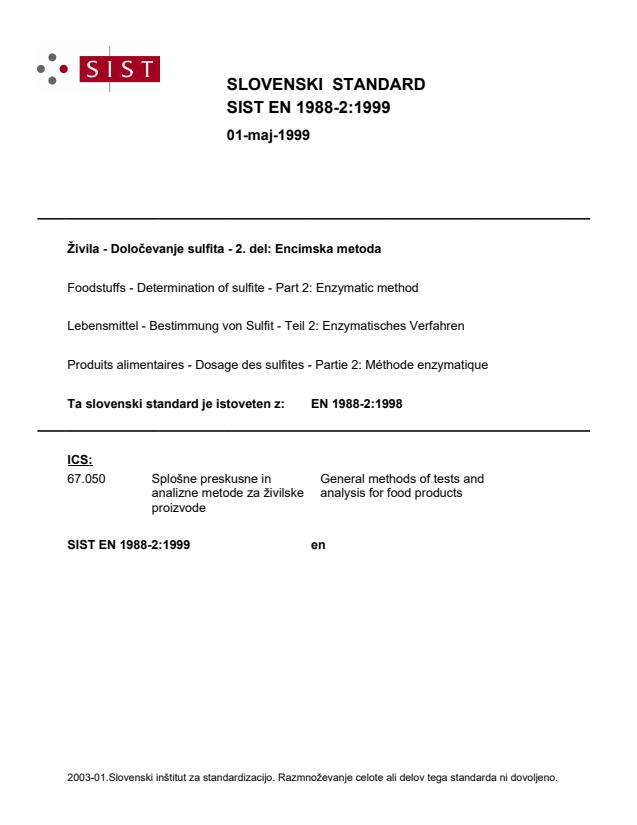
SIST EN 1988-2:1999
(Main)Foodstuffs - Determination of sulfite - Part 2: Enzymatic method
Foodstuffs - Determination of sulfite - Part 2: Enzymatic method
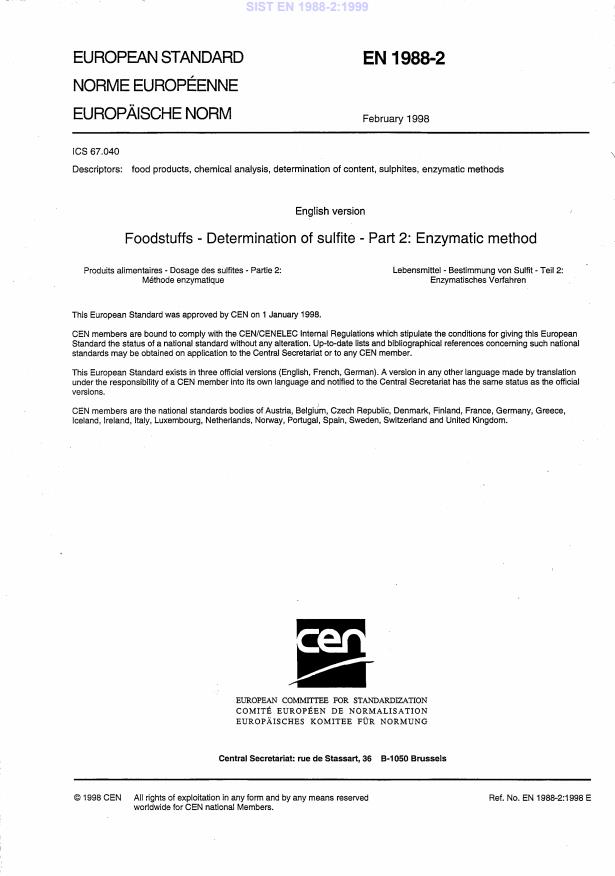
This European Standard specifies an enzymatic method for the determination of the sulfite content, expressed as sulfur dioxide, in foodstuffs. Other sulfur-containing substances such as sulfate, sulfide or thiosulfate do not interfere with the determination. Carbonyl-sulfite complexes react as free sulfites. Isothiocyanates occuring in, e.g. mustard interfere with the determination. The method is not applicable to cabbages, dried garlic, dried onions, ginger, leeks and soy protein.
Lebensmittel - Bestimmung von Sulfit - Teil 2: Enzymatisches Verfahren
Diese Europäische Norm legt ein enzymatisches Verfahren zur Bestimmung von Sulfit (ausgedrückt in Schwefeldioxid) in Lebensmittel fest. Andere schwefelhaltige Substanzen wie Sulfate, Sulfide oder Thiosulfate stören die Bestimmung nicht. Carbonylsulfitkomplexe reagieren wie freies Sulfit. Isothiocyanate, die z.B. in Senf vorkommen, stören die Bestimmung von Sulfit. Das Verfahren ist nicht anwendbar auf Kohl, getrockneten Knoblauch, getrocknete Zwiebeln, Ingwer, Lauch und Sojaproteine.
Produits alimentaires - Dosage des sulfites - Partie 2: Méthode enzymatique
La présente partie de norme spécifie une méthode enzymatique permettant de déterminer la concentration en sulfites, exprimée en dioxyde de soufre, des produits alimentaires. D'autres substances contenant du soufre, tels que des sulfates, des sulfures ou des hyposulfites, n'interfèrent pas dans l'analyse. Les complexes carbonyl-sulfites réagissent comme des sulfites libres. Les isothiocyanates, qui se forment par exemple dans la moutarde, perturbent l'analyse pour le dosage des sulfites. La méthode n'est pas applicable à l'ail séché, aux oignons séchés, au gingembre, aux protéines de soja, aux poireaux.
Živila - Določevanje sulfita - 2. del: Encimska metoda
General Information
- Status
- Published
- Publication Date
- 30-Apr-1999
- Technical Committee
- KŽP - Agricultural food products
- Current Stage
- 6060 - National Implementation/Publication (Adopted Project)
- Start Date
- 01-May-1999
- Due Date
- 01-May-1999
- Completion Date
- 01-May-1999

Relations
- Effective Date
- 28-Jan-2026
Overview
SIST EN 1988-2:1999 is a European standard that defines an enzymatic method for the determination of sulfite content in foodstuffs. The sulfite content is measured and expressed as sulfur dioxide. This standard was developed by the Slovenski inštitut za standardizacijo (SIST) and aligns with EN 1988-2:1998, ensuring harmonization with European food testing protocols. The test is specifically designed to avoid interference from other sulfur-containing compounds such as sulfate, sulfide, and thiosulfate. However, samples containing isothiocyanates (such as mustard) may interfere with results. The method is not suitable for use with certain foods, including cabbages, dried garlic, dried onions, ginger, leeks, and soy protein.
Key Topics
- Enzymatic determination of sulfite: This method utilizes enzymes to specifically and accurately quantify sulfite content in various foods.
- Interferences and limitations:
- Sulfate, sulfide, and thiosulfate do not interfere with the sulfite determination.
- Carbonyl-sulfite complexes are detected as free sulfite.
- Isothiocyanates (found, for example, in mustard) can cause interference.
- The method is not applicable to particular vegetables and dried products (cabbages, dried garlic/onions, ginger, leeks, soy protein).
- Sulfite analysis in foodstuffs: The standard provides a clear and validated approach to analyzing sulfite, a critical preservative and additive in food regulation.
Applications
Implementing SIST EN 1988-2:1999 offers significant benefits for various stakeholders in the food industry:
- Food safety and quality assurance: Ensures reliable determination of sulfites, which are regulated additives in many countries due to allergy risks.
- Regulatory compliance: Helps food manufacturers demonstrate compliance with food labeling and safety standards by providing accurate sulfite content data.
- Laboratory testing protocols: Standardizes analytical procedures across different laboratories, improving consistency of results in food control and research settings.
- Control of allergens and additives: Essential for routine monitoring of sulfite levels in processed foods, beverages, and ingredients, helping to protect sensitive consumers.
- Support for certification and export: Facilitates compliance with both domestic and international food trade requirements for sulfite monitoring.
Related Standards
To achieve comprehensive and harmonized food testing, consider the following related standards:
- SIST EN 1988-1: Foodstuffs - Determination of sulfite - Part 1: Iodometric (titrimetric) method
- ISO 5522: Determination of sulfur dioxide in fruits and vegetables
- ISO 21872 series: Microbiology of food and animal feeding stuffs
- EN 1988 series: General methods of tests and analysis for food products
SIST EN 1988-2:1999 is essential for laboratories, food manufacturers, and regulatory authorities involved in the control and monitoring of food additives. Adopting this enzymatic method ensures accurate, reliable detection of sulfites, supporting food safety and regulatory compliance throughout the food supply chain.
Get Certified
Connect with accredited certification bodies for this standard

BSI Group
BSI (British Standards Institution) is the business standards company that helps organizations make excellence a habit.

Bureau Veritas
Bureau Veritas is a world leader in laboratory testing, inspection and certification services.

DNV
DNV is an independent assurance and risk management provider.
Sponsored listings
Frequently Asked Questions
SIST EN 1988-2:1999 is a standard published by the Slovenian Institute for Standardization (SIST). Its full title is "Foodstuffs - Determination of sulfite - Part 2: Enzymatic method". This standard covers: This European Standard specifies an enzymatic method for the determination of the sulfite content, expressed as sulfur dioxide, in foodstuffs. Other sulfur-containing substances such as sulfate, sulfide or thiosulfate do not interfere with the determination. Carbonyl-sulfite complexes react as free sulfites. Isothiocyanates occuring in, e.g. mustard interfere with the determination. The method is not applicable to cabbages, dried garlic, dried onions, ginger, leeks and soy protein.
This European Standard specifies an enzymatic method for the determination of the sulfite content, expressed as sulfur dioxide, in foodstuffs. Other sulfur-containing substances such as sulfate, sulfide or thiosulfate do not interfere with the determination. Carbonyl-sulfite complexes react as free sulfites. Isothiocyanates occuring in, e.g. mustard interfere with the determination. The method is not applicable to cabbages, dried garlic, dried onions, ginger, leeks and soy protein.
SIST EN 1988-2:1999 is classified under the following ICS (International Classification for Standards) categories: 67.050 - General methods of tests and analysis for food products. The ICS classification helps identify the subject area and facilitates finding related standards.
SIST EN 1988-2:1999 has the following relationships with other standards: It is inter standard links to SIST EN ISO 3696:1998. Understanding these relationships helps ensure you are using the most current and applicable version of the standard.
SIST EN 1988-2:1999 is available in PDF format for immediate download after purchase. The document can be added to your cart and obtained through the secure checkout process. Digital delivery ensures instant access to the complete standard document.
Standards Content (Sample)
2003-01.Slovenski inštitut za standardizacijo. Razmnoževanje celote ali delov tega standarda ni dovoljeno.Lebensmittel - Bestimmung von Sulfit - Teil 2: Enzymatisches VerfahrenProduits alimentaires - Dosage des sulfites - Partie 2: Méthode enzymatiqueFoodstuffs - Determination of sulfite - Part 2: Enzymatic method67.050Splošne preskusne in analizne metode za živilske proizvodeGeneral methods of tests
...