

SIST EN 12603:2004
(Main)Glass in building - Procedures for goodness of fit and confidence intervals for Weibull distributed glass strength data
General Information
- Abstract
This standard describes procedures of evaluation of sample data by means of a two-parameter WEIBULL distribution function.
- Status
- Published
- Publication Date
- 31-Aug-2004
- Technical Committee
- STV - Steklo, svetloba in razsvetljava v gradbeništvu
- Current Stage
- 6060 - National Implementation/Publication (Adopted Project)
- Start Date
- 01-Sep-2004
- Due Date
- 01-Sep-2004
- Completion Date
- 01-Sep-2004


Overview
EN 12603:2002 - "Glass in building - Procedures for goodness of fit and confidence intervals for Weibull distributed glass strength data" (CEN) provides standardized statistical procedures for evaluating glass strength data using a two‑parameter Weibull distribution. The standard covers both uncensored (complete) and censored sample situations, defines point estimators for the Weibull shape (b) and scale (q) parameters, prescribes graphical methods (Weibull diagram) and gives procedures to calculate confidence intervals and to test goodness of fit.
Key topics
- Scope and assumptions: Evaluation assumes data can be represented by a single two‑parameter Weibull function; users must verify this by goodness‑of‑fit testing before applying procedures.
- Sample types: Procedures for both uncensored (complete) and specific censored sampling methods.
- Point estimators: Formulae and tabulated coefficients (kn, kr;n, Cr;n) for estimating shape parameter b̂ and scale parameter q̂ from sample data.
- Goodness of fit: A test (based on sample order statistics and an F‑distribution criterion) to decide whether measured glass strength data follow a single Weibull distribution.
- Weibull diagram and plotting: How to plot ordered sample data and the estimated Weibull line (using log‑scale abscissa and transformed ordinate) for visual assessment.
- Confidence intervals: Methods for computing confidence limits for:
- the shape parameter b,
- the scale parameter q,
- the distribution function G(x) at a given x,
- the quantile x at a given G(x). Relevant tables and asymptotic estimates are provided.
- Informative annexes: Worked examples (uncensored and censored samples) and a Weibull graph to support practical application.
Applications and users
EN 12603:2002 is practical for:
- Structural engineers and façade designers assessing reliability of glass components.
- Glass manufacturers and quality control labs analyzing breakage and strength test results.
- Product certification bodies and safety assessors requiring statistically defensible strength characterisation.
- Researchers working on glass fracture mechanics and reliability modelling.
Typical uses:
- Statistical evaluation of bending strength or failure stress data.
- Determination of characteristic strengths and confidence bounds for design and safety margins.
- Verification that test data fit a Weibull model before extrapolating to target fractiles.
Related standards
- Normative references in EN 12603: ISO 2854:1976 (statistical estimation & tests) and ISO 3534 (statistics vocabulary and symbols).
(EN 12603:2002 was prepared by CEN/TC 129 “Glass in building”.)
For practitioners seeking reproducible, defensible statistical analysis of glass strength, EN 12603:2002 provides the standardized procedures, tables, plotting conventions and example calculations needed to apply Weibull distribution methods in glass testing and design.
Relations
- Effective Date
- 25-Aug-2026
- Effective Date
- 28-Jan-2026
Frequently Asked Questions
SIST EN 12603:2004 is a standard published by the Slovenian Institute for Standardization (SIST). Its full title is "Glass in building - Procedures for goodness of fit and confidence intervals for Weibull distributed glass strength data". This standard covers: This standard describes procedures of evaluation of sample data by means of a two-parameter WEIBULL distribution function.
This standard describes procedures of evaluation of sample data by means of a two-parameter WEIBULL distribution function.
SIST EN 12603:2004 is classified under the following ICS (International Classification for Standards) categories: 81.040.20 - Glass in building. The ICS classification helps identify the subject area and facilitates finding related standards.
SIST EN 12603:2004 has the following relationships with other standards: It is inter standard links to SIST ISO 2854:1996, SIST EN 14762:2006. Understanding these relationships helps ensure you are using the most current and applicable version of the standard.
SIST EN 12603:2004 is associated with the following European legislation: EU Directives/Regulations: 305/2011, 89/106/EEC. When a standard is cited in the Official Journal of the European Union, products manufactured in conformity with it benefit from a presumption of conformity with the essential requirements of the corresponding EU directive or regulation.
SIST EN 12603:2004 is available in PDF format for immediate download after purchase. The document can be added to your cart and obtained through the secure checkout process. Digital delivery ensures instant access to the complete standard document.
Standards Content (Sample)
2003-01.Slovenski inštitut za standardizacijo. Razmnoževanje celote ali delov tega standarda ni dovoljeno.Steklo v stavbah – Postopki ugotavljanja upogibne trdnosti in intervala zaupanja za podatke z Weibullovo porazdelitvijoGlas im Bauwesen - Bestimmung der Biegefestigkeit von Glas - Schätzverfahren und Bestimmung der Vertrauensbereiche für Daten mit Weibull-VerteilungVerre dans la construction - Procédures de validité de l'ajustement et intervalles de confiance des données de résistance du verre au moyen de la loi de WeibullGlass in building - Procedures for goodness of fit and confidence intervals for Weibull distributed glass strength data81.040.20Steklo v gradbeništvuGlass in buildingICS:Ta slovenski standard je istoveten z:EN 12603:2002SIST EN 12603:2004en01-september-2004SIST EN 12603:2004SLOVENSKI
STANDARD
EUROPEAN STANDARDNORME EUROPÉENNEEUROPÄISCHE NORMEN 12603November 2002ICS 81.040.20English versionGlass in building - Procedures for goodness of fit andconfidence intervals for Weibull distributed glass strength dataVerre dans la construction - Procédures de validité del'ajustement et intervalles de confiance des données derésistance du verre au moyen de la loi de WeibullGlas im Bauwesen - Bestimmung der Biegefestigkeit vonGlas - Schätzverfahren und Bestimmung derVertrauensbereiche für Daten mit Weibull-VerteilungThis European Standard was approved by CEN on 7 September 2002.CEN members are bound to comply with the CEN/CENELEC Internal Regulations which stipulate the conditions for giving this EuropeanStandard the status of a national standard without any alteration. Up-to-date lists and bibliographical references concerning such nationalstandards may be obtained on application to the Management Centre or to any CEN member.This European Standard exists in three official versions (English, French, German). A version in any other language made by translationunder the responsibility of a CEN member into its own language and notified to the Management Centre has the same status as the officialversions.CEN members are the national standards bodies of Austria, Belgium, Czech Republic, Denmark, Finland, France, Germany, Greece,Iceland, Ireland, Italy, Luxembourg, Malta, Netherlands, Norway, Portugal, Spain, Sweden, Switzerland and United Kingdom.EUROPEAN COMMITTEE FOR STANDARDIZATIONCOMITÉ EUROPÉEN DE NORMALISATIONEUROPÄISCHES KOMITEE FÜR NORMUNGManagement Centre: rue de Stassart, 36
B-1050 Brussels© 2002 CENAll rights of exploitation in any form and by any means reservedworldwide for CEN national Members.Ref. No. EN 12603:2002 ESIST EN 12603:2004
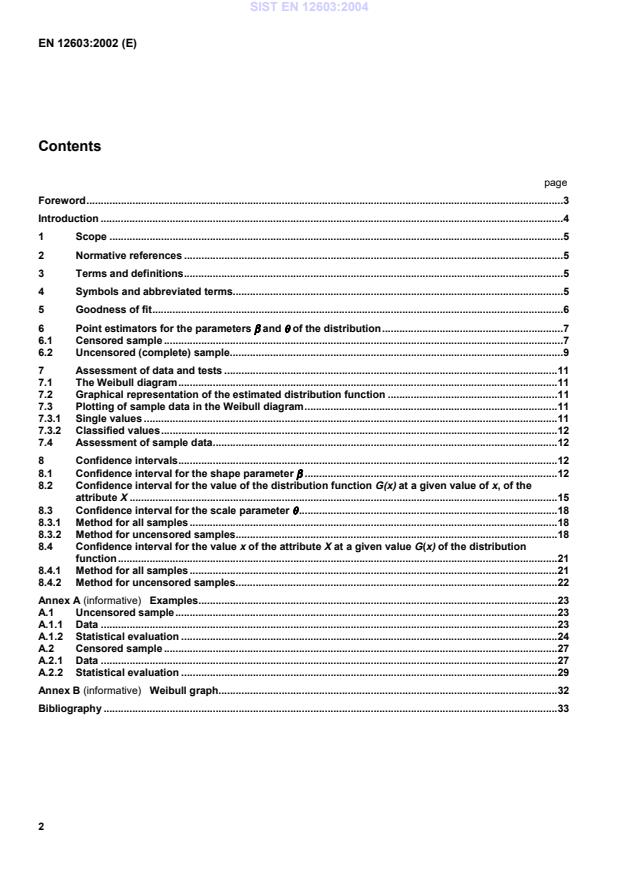
Examples.23A.1Uncensored sample.23A.1.1Data.23A.1.2Statistical evaluation.24A.2Censored sample.27A.2.1Data.27A.2.2Statistical evaluation.29Annex B (informative)
Weibull graph.32Bibliography.33SIST EN 12603:2004
For this reason, the user of the standard has tocheck by a goodness of fit test whether the measured data of a sample can be represented by means of one singleWeibull function.
Only in this case can the hypothesis be accepted and the procedures described in this standard beapplied.The user decides on this question also considering all previous relevant data and the general state of knowledge in thespecial field.
Every extrapolation into ranges of fractiles not confirmed by measured values requires utmost care, themore so the farther the extrapolation exceeds the range of measurements.NOTEThe three-parameter Weibull function is:úúûùêêëé÷øöçèæ---=bq0exp1)(xxxG(1)If xo = 0 is assumed, the two-parameter Weibull function results:úúûùêêëé÷øöçèæ--=bqxxGexp1)((2)which can be written as:bq1)(11lnúûùêëé÷÷øöççèæ-=xGx(3)The calculation can be based either on an uncensored or a censored sample.
There are several methods of censoring.In this standard only the following method of censoring is considered:- given a number r < n of specimens of which attribute values xi were measured.SIST EN 12603:2004
Thesenormative references are cited at the appropriate places in the text, and the publications are listed hereafter. For datedreferences, subsequent amendments to or revisions of any of these publications apply to this European Standard onlywhen incorporated in its amendment or revision.
For undated reference, the latest edition of the publications referred toapplies (including amendments).ISO 2854:1976, Statistical interpretation of data - Techniques of estimation and tests relating to means and variances.ISO 3534, Statistics - Vocabulary and symbols.3 Terms and definitionsFor the purposes of this European Standard, the terms and definitions given in ISO 3534 apply.4 Symbols and abbreviated termsXattribute taken into consideration;x, xi, xrvalues of X;G(x)distribution function of X = percentage of failure;xo, b, qparameters of the three-parameter Weibull function;^identification label for point estimators (e.g. bˆ, qˆ, Gˆ);1-aconfidence level;ivalue used in the goodness of fit test;Lvalue used in the goodness of fit test;nsample size;rnumber of specimens of which attribute values xi were measured;NOTEThe sample is ordered, i.e. x1 £ x2 £ x3 .
£ xrr
£
n;f,f1,f2degrees of freedom;kn,kr;nfactors used in estimating bˆ;SIST EN 12603:2004
As a rule, diagrams should be used with a range of G-values from G = 1 ´ 10-3 = 0,1 % toG = 0,999 = 99,9 %.
The necessary range of x-values depends on the value b of the shape parameter.7.2 Graphical representation of the estimated distribution functionThe point estimators of the shape parameter b and the scale parameter q define a straight line in the Weibull diagram; itis appropriate to define this straight line though the following two points:qˆ=x%21,636321,0)(==xG(14)bq101005,0ˆ´=x%101,0)(==xG(15)This straight line shall be plotted into the diagram.7.3 Plotting of sample data in the Weibull diagram7.3.1 Single valuesMeasurements of a censored or uncensored sample yield r or n values xi, respectively, of the attribute X.
These valuesxi shall be ordered to make up an Ordered Sample.SIST EN 12603:2004
The proportion of x-values summed up in any class considered shall be plotted at theupper limit of that class.7.4 Assessment of sample dataThe straight line plotted according to 7.2 and the points which represent the measured values of the sample,plotted according to 7.3 can be compared visually.Systematic deviations can examined in detail taking into consideration the general knowledge of the basic technicaland scientific facts and the results of previous relevant research.
For instance, if the distribution of the attribute valuescan be approximated by segments of straight lines with different slopes, a mixed Weibull distribution may be assumed.This can be taken as a hint that several basic mechanisms determine the attribute values xi.
Such a detailedexamination is beyond the scope of this standard.8 Confidence intervalsThe equations of the following sub-clauses are valid for the case that the confidence intervals are limited on two sides(subscript z).
Where the confidence intervals are limited only on one side, a/2 shall be replaced by a in the followingequations.The confidence level (1 - a) is to be chosen by the user of this standard.8.1 Confidence interval for the shape parameter bbThe upper limit of the confidence interval for the shape parameter b at the confidence level (1 - a)
...