


SIST EN 302 307-2 V1.3.1:2021
(Main)Digital Video Broadcasting (DVB) - Second generation framing structure, channel coding and modulation systems for Broadcasting, Interactive Services, News Gathering and other broadband satellite applications - Part 2: DVB-S2 Extensions (DVB-S2X)
Digital Video Broadcasting (DVB) - Second generation framing structure, channel coding and modulation systems for Broadcasting, Interactive Services, News Gathering and other broadband satellite applications - Part 2: DVB-S2 Extensions (DVB-S2X)
The present document specifies the optional extensions of the S2 system, identified by the S2X denomination. The
present document also includes amendments to the standard to enable beam hopping operation.
Digitalna videoradiodifuzija (DVB) - Druga generacija strukture okvirov, kodiranja kanalov in modulacijskih sistemov za radiodifuzijo, interaktivne storitve, novinarstvo in druge širokopasovne satelitske aplikacije - 2. del: Priključki DVB-S2 (DVB-S2X)
General Information
- Status
- Published
- Public Enquiry End Date
- 25-Jul-2021
- Publication Date
- 16-Aug-2021
- Technical Committee
- MOC - Mobile Communications
- Current Stage
- 6060 - National Implementation/Publication (Adopted Project)
- Start Date
- 02-Aug-2021
- Due Date
- 07-Oct-2021
- Completion Date
- 17-Aug-2021
Overview
SIST EN 302 307-2 V1.3.1:2021 (DVB-S2X) specifies the optional extensions to the DVB second‑generation satellite standard (S2). Published as the European/ETSI aligned document ETSI EN 302 307-2 V1.3.1 (2021‑07), this standard defines enhanced framing, channel coding and modulation tools for broadband satellite applications - including broadcasting, interactive services, news gathering and other BSS/HTS use cases. The document also includes amendments to enable beam hopping operation.
Key topics and technical requirements
The standard expands the S2 toolbox with advanced physical‑layer and system features. Major technical topics covered include:
Framing and Physical Layer (PL) details
- Enhanced PL framing and signalling, optional super‑framing structures and PL headers.
- Pilot insertion and PL scrambling methods for improved synchronization and robustness.
Channel coding and FEC
- Outer and inner FEC specifications (BCH outer codes and LDPC inner codes are specified for S2X).
- Support for normal, short and medium FECFRAME modes and associated interleaving.
Constellations and bit mapping
- Definitions for a wide range of modulation formats: π/2‑BPSK, QPSK, 8PSK and multiple APSK variants up to high‑order APSK (e.g., 64/128/256APSK mapping).
- Bit mapping rules and VL‑SNR (Very Low SNR) mode provisions.
Advanced features
- Channel bonding for multi‑tuner receivers and multi‑carrier aggregation.
- GSE High Efficiency Mode (GSE‑HEM) for Generic Stream Encapsulation.
- Tools for shortening/puncturing of MODCODs and high‑efficiency header options.
- Amendments to support beam hopping satellite operation.
Signalling, adaptation and ancillary tools
- Mode adaptation, stream adaptation (scrambling, padding), Base‑Band Header insertion and error performance metrics.
- Annexes covering implementation aids (parity accumulators, super‑frame container specification, signalling for reception quality).
Practical applications and who uses it
DVB‑S2X is targeted at stakeholders deploying or manufacturing satellite broadband and broadcast systems:
- Satellite operators and network planners implementing HTS, beam‑hopping or multi‑spot networks.
- Broadcast service providers and news‑gathering organizations requiring efficient, resilient satellite links.
- Equipment vendors and chipset designers building modulators, demodulators, gateways and multi‑tuner receivers.
- System integrators, test labs and standards bodies validating interoperability and compliance.
By enabling higher spectral efficiency, finer granularity of MODCODs and new framing tools, DVB‑S2X supports demanding services such as direct‑to‑home TV, contribution feeds, IP trunking and broadband internet via satellite.
Related standards
- ETSI EN 302 307 series (DVB‑S2 core)
- DVB‑GSE (Generic Stream Encapsulation) and related DVB framing/CAS specifications
Keywords: DVB‑S2X, satellite broadcasting standard, channel coding, modulation, beam hopping, LDPC, BCH, APSK, QPSK, channel bonding, super‑framing.

ETSI EN 302 307-2 V1.3.1 (2021-04) - Digital Video Broadcasting (DVB); Second generation framing structure, channel coding and modulation systems for Broadcasting, Interactive Services, News Gathering and other broadband satellite applications; Part 2: DVB-S2 Extensions (DVB-S2X)
ETSI EN 302 307-2 V1.3.1 (2021-07) - Digital Video Broadcasting (DVB); Second generation framing structure, channel coding and modulation systems for Broadcasting, Interactive Services, News Gathering and other broadband satellite applications; Part 2: DVB-S2 Extensions (DVB-S2X)


Frequently Asked Questions
SIST EN 302 307-2 V1.3.1:2021 is a standard published by the Slovenian Institute for Standardization (SIST). Its full title is "Digital Video Broadcasting (DVB) - Second generation framing structure, channel coding and modulation systems for Broadcasting, Interactive Services, News Gathering and other broadband satellite applications - Part 2: DVB-S2 Extensions (DVB-S2X)". This standard covers: The present document specifies the optional extensions of the S2 system, identified by the S2X denomination. The present document also includes amendments to the standard to enable beam hopping operation.
The present document specifies the optional extensions of the S2 system, identified by the S2X denomination. The present document also includes amendments to the standard to enable beam hopping operation.
SIST EN 302 307-2 V1.3.1:2021 is classified under the following ICS (International Classification for Standards) categories: 33.170 - Television and radio broadcasting. The ICS classification helps identify the subject area and facilitates finding related standards.
SIST EN 302 307-2 V1.3.1:2021 is available in PDF format for immediate download after purchase. The document can be added to your cart and obtained through the secure checkout process. Digital delivery ensures instant access to the complete standard document.
Standards Content (Sample)
Draft ETSI EN 302 307-2 V1.3.1 (2021-04)
EUROPEAN STANDARD
Digital Video Broadcasting (DVB);
Second generation framing structure, channel coding and
modulation systems for Broadcasting,
Interactive Services, News Gathering and
other broadband satellite applications;
Part 2: DVB-S2 Extensions (DVB-S2X)
2 Draft ETSI EN 302 307-2 V1.3.1 (2021-04)
Reference
REN/JTC-DVB-395-2
Keywords
BSS, digital, DVB, modulation, satellite, TV
ETSI
650 Route des Lucioles
F-06921 Sophia Antipolis Cedex - FRANCE
Tel.: +33 4 92 94 42 00 Fax: +33 4 93 65 47 16
Siret N° 348 623 562 00017 - APE 7112B
Association à but non lucratif enregistrée à la
Sous-Préfecture de Grasse (06) N° w061004871
Important notice
The present document can be downloaded from:
http://www.etsi.org/standards-search
The present document may be made available in electronic versions and/or in print. The content of any electronic and/or
print versions of the present document shall not be modified without the prior written authorization of ETSI. In case of any
existing or perceived difference in contents between such versions and/or in print, the prevailing version of an ETSI
deliverable is the one made publicly available in PDF format at www.etsi.org/deliver.
Users of the present document should be aware that the document may be subject to revision or change of status.
Information on the current status of this and other ETSI documents is available at
https://portal.etsi.org/TB/ETSIDeliverableStatus.aspx
If you find errors in the present document, please send your comment to one of the following services:
https://portal.etsi.org/People/CommiteeSupportStaff.aspx
Notice of disclaimer & limitation of liability
The information provided in the present deliverable is directed solely to professionals who have the appropriate degree of
experience to understand and interpret its content in accordance with generally accepted engineering or
other professional standard and applicable regulations.
No recommendation as to products and services or vendors is made or should be implied.
In no event shall ETSI be held liable for loss of profits or any other incidental or consequential damages.
Any software contained in this deliverable is provided "AS IS" with no warranties, express or implied, including but not
limited to, the warranties of merchantability, fitness for a particular purpose and non-infringement of intellectual property
rights and ETSI shall not be held liable in any event for any damages whatsoever (including, without limitation, damages
for loss of profits, business interruption, loss of information, or any other pecuniary loss) arising out of or related to the use
of or inability to use the software.
Copyright Notification
No part may be reproduced or utilized in any form or by any means, electronic or mechanical, including photocopying and
microfilm except as authorized by written permission of ETSI.
The content of the PDF version shall not be modified without the written authorization of ETSI.
The copyright and the foregoing restriction extend to reproduction in all media.
© ETSI 2021.
© European Broadcasting Union 2021.
All rights reserved.
ETSI
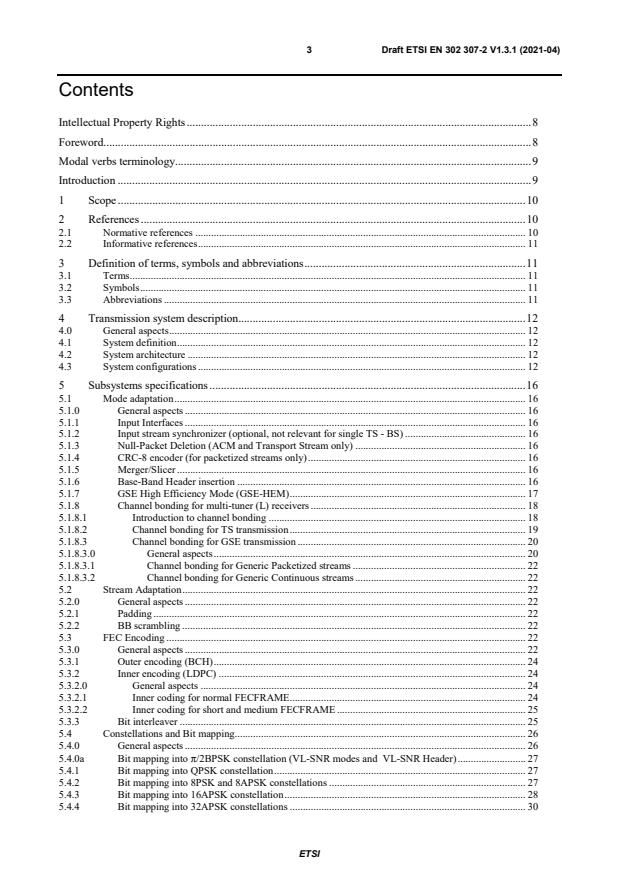
3 Draft ETSI EN 302 307-2 V1.3.1 (2021-04)
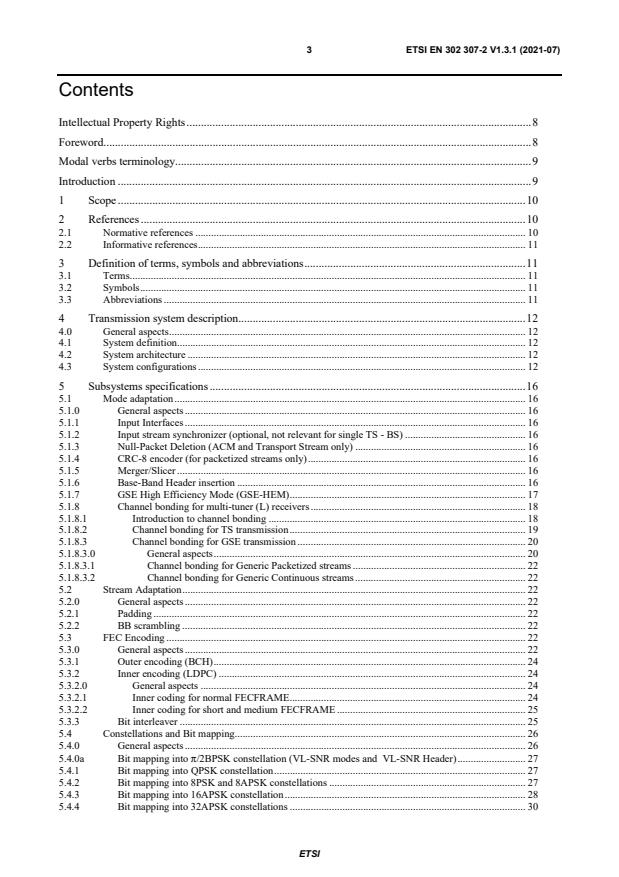
Contents
Intellectual Property Rights . 8
Foreword . 8
Modal verbs terminology . 9
Introduction . 9
1 Scope . 10
2 References . 10
2.1 Normative references . 10
2.2 Informative references . 11
3 Definition of terms, symbols and abbreviations . 11
3.1 Terms . 11
3.2 Symbols . 11
3.3 Abbreviations . 11
4 Transmission system description . 12
4.0 General aspects . 12
4.1 System definition . 12
4.2 System architecture . 12
4.3 System configurations . 12
5 Subsystems specifications . 16
5.1 Mode adaptation . 16
5.1.0 General aspects . 16
5.1.1 Input Interfaces . 16
5.1.2 Input stream synchronizer (optional, not relevant for single TS - BS) . 16
5.1.3 Null-Packet Deletion (ACM and Transport Stream only) . 16
5.1.4 CRC-8 encoder (for packetized streams only) . 16
5.1.5 Merger/Slicer . 16
5.1.6 Base-Band Header insertion . 16
5.1.7 GSE High Efficiency Mode (GSE-HEM) . 17
5.1.8 Channel bonding for multi-tuner (L) receivers . 18
5.1.8.1 Introduction to channel bonding . 18
5.1.8.2 Channel bonding for TS transmission . 19
5.1.8.3 Channel bonding for GSE transmission . 20
5.1.8.3.0 General aspects . 20
5.1.8.3.1 Channel bonding for Generic Packetized streams . 22
5.1.8.3.2 Channel bonding for Generic Continuous streams . 22
5.2 Stream Adaptation . 22
5.2.0 General aspects . 22
5.2.1 Padding . 22
5.2.2 BB scrambling . 22
5.3 FEC Encoding . 22
5.3.0 General aspects . 22
5.3.1 Outer encoding (BCH) . 24
5.3.2 Inner encoding (LDPC) . 24
5.3.2.0 General aspects . 24
5.3.2.1 Inner coding for normal FECFRAME. 24
5.3.2.2 Inner coding for short and medium FECFRAME . 25
5.3.3 Bit interleaver . 25
5.4 Constellations and Bit mapping. 26
5.4.0 General aspects . 26
5.4.0a Bit mapping into π/2BPSK constellation (VL-SNR modes and VL-SNR Header) . 27
5.4.1 Bit mapping into QPSK constellation . 27
5.4.2 Bit mapping into 8PSK and 8APSK constellations . 27
5.4.3 Bit mapping into 16APSK constellation . 28
5.4.4 Bit mapping into 32APSK constellations . 30
ETSI
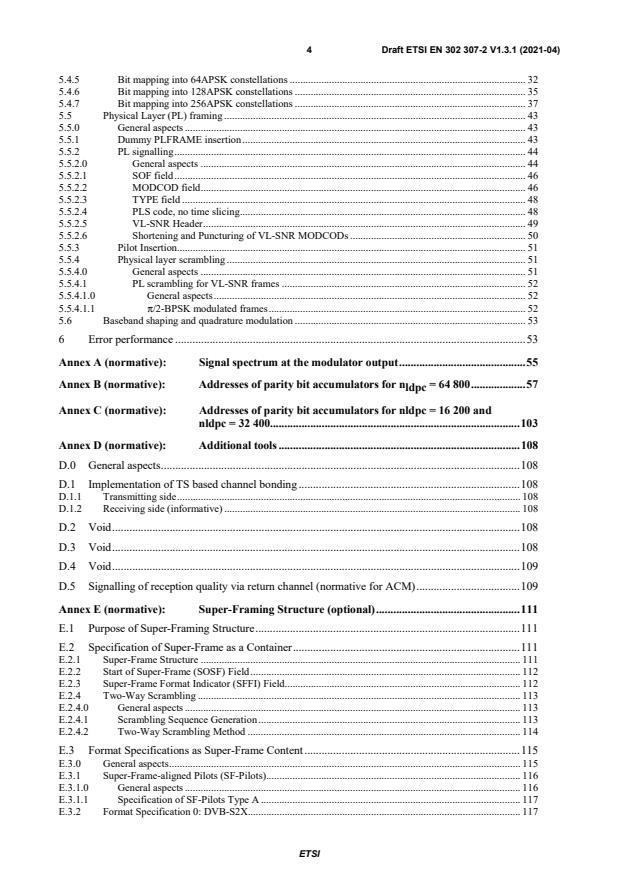
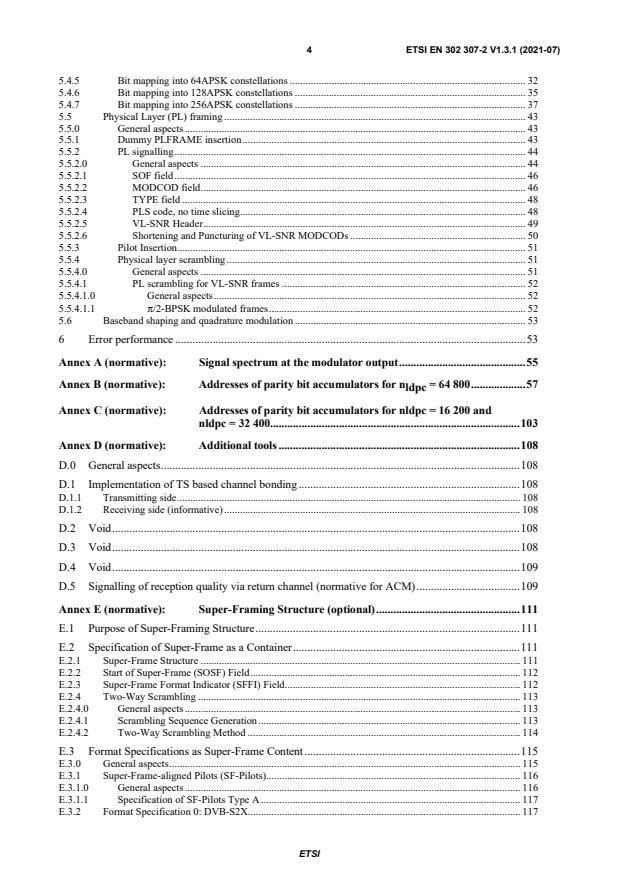
4 Draft ETSI EN 302 307-2 V1.3.1 (2021-04)
5.4.5 Bit mapping into 64APSK constellations . 32
5.4.6 Bit mapping into 128APSK constellations . 35
5.4.7 Bit mapping into 256APSK constellations . 37
5.5 Physical Layer (PL) framing . 43
5.5.0 General aspects . 43
5.5.1 Dummy PLFRAME insertion . 43
5.5.2 PL signalling . 44
5.5.2.0 General aspects . 44
5.5.2.1 SOF field . 46
5.5.2.2 MODCOD field . 46
5.5.2.3 TYPE field . 48
5.5.2.4 PLS code, no time slicing . 48
5.5.2.5 VL-SNR Header . 49
5.5.2.6 Shortening and Puncturing of VL-SNR MODCODs . 50
5.5.3 Pilot Insertion. 51
5.5.4 Physical layer scrambling . 51
5.5.4.0 General aspects . 51
5.5.4.1 PL scrambling for VL-SNR frames . 52
5.5.4.1.0 General aspects . 52
5.5.4.1.1 π/2-BPSK modulated frames . 52
5.6 Baseband shaping and quadrature modulation . 53
6 Error performance . 53
Annex A (normative): Signal spectrum at the modulator output . 55
Annex B (normative): Addresses of parity bit accumulators for n = 64 800 . 57
ldpc
Annex C (normative): Addresses of parity bit accumulators for nldpc = 16 200 and
nldpc = 32 400 . 103
Annex D (normative): Additional tools . 108
D.0 General aspects . 108
D.1 Implementation of TS based channel bonding . 108
D.1.1 Transmitting side . 108
D.1.2 Receiving side (informative) . 108
D.2 Void . 108
D.3 Void . 108
D.4 Void . 109
D.5 Signalling of reception quality via return channel (normative for ACM) . 109
Annex E (normative): Super-Framing Structure (optional) . 111
E.1 Purpose of Super-Framing Structure . 111
E.2 Specification of Super-Frame as a Container . 111
E.2.1 Super-Frame Structure . 111
E.2.2 Start of Super-Frame (SOSF) Field . 112
E.2.3 Super-Frame Format Indicator (SFFI) Field. 112
E.2.4 Two-Way Scrambling . 113
E.2.4.0 General aspects . 113
E.2.4.1 Scrambling Sequence Generation . 113
E.2.4.2 Two-Way Scrambling Method . 114
E.3 Format Specifications as Super-Frame Content . 115
E.3.0 General aspects . 115
E.3.1 Super-Frame-aligned Pilots (SF-Pilots). 116
E.3.1.0 General aspects . 116
E.3.1.1 Specification of SF-Pilots Type A . 117
E.3.2 Format Specification 0: DVB-S2X. 117
ETSI
5 Draft ETSI EN 302 307-2 V1.3.1 (2021-04)
E.3.2.0 General aspects . 117
E.3.2.1 Pilot structure . 118
E.3.2.2 Modified VL-SNR-frame . 118
E.3.3 Format Specification 1: DVB-S2 legacy . 119
E.3.4 Format Specification 2: Bundled PLFRAME (64 800 payload Size) with SF-Pilots . 119
E.3.4.0 General aspects . 119
E.3.4.1 Bundled PLFRAME (64 800 payload) Definition . 120
E.3.4.2 PLHEADER Specification for Bundled PLFRAMEs (64 800 payload) . 121
E.3.4.3 SF-Pilot Structure . 123
E.3.5 Format Specification 3: Bundled PLFRAME (16 200 Payload Size) with SF-Pilots. 124
E.3.5.0 General aspects . 124
E.3.5.1 Bundled PLFRAME Definition . 125
E.3.5.2 PLHEADER Specification for Short Bundled PLFRAME. 126
E.3.5.3 SF-Pilot Structure . 127
E.3.6 Format Specification 4: Flexible Format with VL-SNR PLH tracking . 129
E.3.6.0 General aspects . 129
E.3.6.1 Super-Frame Header (SFH) . 130
E.3.6.2 SFH-Trailer (ST) . 131
E.3.6.3 Physical Layer Header (PLH) . 131
E.3.6.3.0 General aspects . 131
E.3.6.3.1 PLSCODE Definition. 131
E.3.6.3.2 PLH Protection Levels . 132
E.3.6.3.3 Signalling of MOD/COD/SPREAD/SIZE . 133
E.3.6.3.4 Field for TSN . 134
E.3.6.3.5 SOF Sequence . 134
E.3.6.4 PLFRAME structure . 134
E.3.6.5 Pilot structure . 136
E.3.6.5.1 SF-Pilots . 136
E.3.6.5.2 Special VL-SNR Pilots . 136
E.3.6.6 Spreading and Signalling Rules . 136
E.3.6.7 Dummy PL Frame Definition . 137
E.3.6.7.0 General aspects . 137
E.3.6.7.1 Dummy PL frames with deterministic content . 137
E.3.6.7.2 Dummy PL frames with arbitrary content . 138
E.3.7 Format Specification 5: Periodic Beam Hopping Format with VL-SNR and fragmentation Support. 138
E.3.7.0 General aspects . 138
E.3.7.1 Super-Frame Header (SFH) . 140
E.3.7.2 SFH-Trailer (ST) . 141
E.3.7.3 Physical Layer Header (PLH) . 141
E.3.7.3.0 General aspects . 141
E.3.7.3.1 PLSCODE Definition. 141
E.3.7.3.2 PLH Protection Levels . 141
E.3.7.3.3 Signalling of MOD/COD/SPREAD/SIZE and TYPE . 141
E.3.7.3.4 Field for TSN . 142
E.3.7.3.5 SOF Sequence . 142
E.3.7.4 PLFRAME structure . 142
E.3.7.5 Pilot structure . 143
E.3.7.5.1 SF-Pilots . 143
E.3.7.5.2 Special VL-SNR Pilots . 143
E.3.7.6 Spreading and Signalling Rules . 143
E.3.7.7 Dummy PL Frame Definition . 143
E.3.7.8 Postamble Definition . 143
E.3.8 Format Specification 6: Traffic Driven Beam Hopping Format with VL-SNR Support . 144
E.3.8.0 General aspects . 144
E.3.8.1 Super-Frame Header (SFH) . 146
E.3.8.2 Physical Layer Trailer (ST) . 146
E.3.8.3 Physical Layer Header (PLH) . 146
E.3.8.4 PLFRAME structure . 146
E.3.8.5 Pilot structure . 146
E.3.8.5.1 SF-Pilots . 146
E.3.8.5.2 Special VL-SNR Pilots . 146
E.3.8.6 Spreading and Signalling Rules . 147
ETSI
6 Draft ETSI EN 302 307-2 V1.3.1 (2021-04)
E.3.8.7 Dummy PL Frame Definition . 147
E.3.8.8 Postamble Definition . 147
E.3.9 Format Specification 7: Simplified Traffic Driven Beam Hopping Format without VL-SNR Support 147
E.3.9.0 General aspects . 147
E.3.9.1 Superframe Header (SFH) . 148
E.3.9.2 SFH-Trailer (ST) . 148
E.3.9.3 Physical Layer Header (PLH) . 148
E.3.9.3.0 General aspects . 148
E.3.9.3.1 PLSCODE Definition. 148
E.3.9.3.2 PLH Protection Levels . 149
E.3.9.3.3 Signalling of MOD/COD/SPREAD/SIZE and TYPE . 149
E.3.9.3.4 Field for TSN . 149
E.3.9.3.5 SOF Sequence . 149
E.3.9.4 PLFRAME structure . 149
E.3.9.5 SF-Pilot structure . 149
E.3.9.5.1 SF-Pilots . 149
E.3.9.5.2 Special VL-SNR Pilots . 149
E.3.9.6 Spreading and Signalling Rules . 149
E.3.9.7 Dummy PL Frame Definition . 149
E.3.9.8 Postamble Definition . 149
E.3.10 Format Specifications 8 - 15: Reserved . 149
E.4 Signalling of additional reception quality parameters via return channel (normative for
Interference Management at the Gateway). 150
Annex F: For future use . 152
Annex G: For future use . 153
Annex H (informative): Examples of possible use of the System . 154
H.0 General aspects . 154
H.1 Void . 154
H.2 Void . 154
H.3 Void . 154
H.4 Void . 154
H.5 Void . 154
H.6 Void . 154
H.7 Satellite transponder models for simulations . 154
H.8 Phase noise masks for simulations . 156
Annex I (normative): ACM . 158
I.1 ACM Command . 158
I.2 Dummy Synchronization Scheme (optional) . 159
I.2.0 General aspects . 159
I.2.1 Dummy Synchronization Frame structure . 159
I.2.1.0 General aspects . 159
I.2.1.1 PLH* description . 160
I.2.1.2 Known Symbols . 160
I.2.1.3 Known correlation structure . 160
I.2.2 Scrambling . 161
Annex J: For future use . 162
Annex K: For future use . 163
Annex L: For future use . 164
ETSI
7 Draft ETSI EN 302 307-2 V1.3.1 (2021-04)
Annex M (normative): Transmission format for wideband satellite transponders using time-
slicing (optional) . 165
History . 166
ETSI
8 Draft ETSI EN 302 307-2 V1.3.1 (2021-04)
Intellectual Property Rights
Essential patents
IPRs essential or potentially essential to normative deliverables may have been declared to ETSI. The declarations
pertaining to these essential IPRs, if any, are publicly available for ETSI members and non-members, and can be
found in ETSI SR 000 314: "Intellectual Property Rights (IPRs); Essential, or potentially Essential, IPRs notified to
ETSI in respect of ETSI standards", which is available from the ETSI Secretariat. Latest updates are available on the
ETSI Web server (https://ipr.etsi.org/).
Pursuant to the ETSI Directives including the ETSI IPR Policy, no investigation regarding the essentiality of IPRs,
including IPR searches, has been carried out by ETSI. No guarantee can be given as to the existence of other IPRs not
referenced in ETSI SR 000 314 (or the updates on the ETSI Web server) which are, or may be, or may become,
essential to the present document.
Trademarks
The present document may include trademarks and/or tradenames which are asserted and/or registered by their owners.
ETSI claims no ownership of these except for any which are indicated as being the property of ETSI, and conveys no
right to use or reproduce any trademark and/or tradename. Mention of those trademarks in the present document does
not constitute an endorsement by ETSI of products, services or organizations associated with those trademarks.
DECT™, PLUGTESTS™, UMTS™ and the ETSI logo are trademarks of ETSI registered for the benefit of its
Members. 3GPP™ and LTE™ are trademarks of ETSI registered for the benefit of its Members and of the 3GPP
Organizational Partners. oneM2M™ logo is a trademark of ETSI registered for the benefit of its Members and of the ®
oneM2M Partners. GSM and the GSM logo are trademarks registered and owned by the GSM Association.
Foreword
This draft European Standard (EN) has been produced by Joint Technical Committee (JTC) Broadcast of the European
Broadcasting Union (EBU), Comité Européen de Normalisation ELECtrotechnique (CENELEC) and the European
Telecommunications Standards Institute (ETSI), and is now submitted for the combined Public Enquiry and Vote phase
of the ETSI standards EN Approval Procedure.
NOTE: The EBU/ETSI JTC Broadcast was established in 1990 to co-ordinate the drafting of standards in the
specific field of broadcasting and related fields. Since 1995 the JTC Broadcast became a tripartite body
by including in the Memorandum of Understanding also CENELEC, which is responsible for the
standardization of radio and television receivers. The EBU is a professional association of broadcasting
organizations whose work includes the co-ordination of its members' activities in the technical, legal,
programme-making and programme-exchange domains. The EBU has active members in about
60 countries in the European broadcasting area; its headquarters is in Geneva.
European Broadcasting Union
CH-1218 GRAND SACONNEX (Geneva)
Switzerland
Tel: +41 22 717 21 11
Fax: +41 22 717 24 81
The Digital Video Broadcasting Project (DVB) is an industry-led consortium of broadcasters, manufacturers, network
operators, software developers, regulatory bodies, content owners and others committed to designing global standards
for the delivery of digital television and data services. DVB fosters market driven solutions that meet the needs and
economic circumstances of broadcast industry stakeholders and consumers. DVB standards cover all aspects of digital
television from transmission through interfacing, conditional access and interactivity for digital video, audio and data.
The consortium came together in 1993 to provide global standardisation, interoperability and future proof
specifications.
ETSI
9 Draft ETSI EN 302 307-2 V1.3.1 (2021-04)
The present document is part 2 of a multi-part deliverable covering the optional extensions of the DVB-S2 system,
denoted "DVB-S2X", as identified below:
Part 1: "DVB-S2";
Part 2: "DVB-S2 Extensions (DVB-S2X)".
Proposed national transposition dates
Date of latest announcement of this EN (doa): 3 months after ETSI publication
Date of latest publication of new National Standard
or endorsement of this EN (dop/e): 6 months after doa
Date of withdrawal of any conflicting National Standard (dow): 6 months after doa
Modal verbs terminology
In the present document "shall", "shall not", "should", "should not", "may", "need not", "will", "will not", "can" and
"cannot" are to be interpreted as described in clause 3.2 of the ETSI Drafting Rules (Verbal forms for the expression of
provisions).
"must" and "must not" are NOT allowed in ETSI deliverables except when used in direct citation.
Introduction
The optional extensions of the S2 system have been approved in 2014 and are identified by the S2X denomination.
Such extensions are non-backwards-compatible with ETSI EN 302 307 [4], are optional for the implementation of new
receivers under ETSI EN 302 307-1 [3], but are normative for the implementation of receivers under the present
document: mapping of specific S2X building blocks to application areas is specified in Table 1. For every S2X
application area, as defined in Table 1, the configurations for the corresponding S2 application area, as defined in ETSI
EN 302 307-1 [3], Table 1, will be implemented. In case of conflicts the definition of the S2X application area applies.
The present document targets the core application areas of S2 (Digital Video Broadcasting, forward link for interactive
services using ACM, Digital Satellite News Gathering and professional digital links such as video point-to-point or
Internet trunking links), and new application areas requiring very-low carrier-to-noise and carrier-to-interference
operation (VL-SNR).
In particular for DTH, a possible use case is the launch of UHDTV-1 (e.g. 4k) television services in Ku-/Ka-band that
will adopt HEVC encoding. In this context it may be desirable to eventually use fragments of smaller blocks of capacity
on two or three DTH transponders and bond them into one logical stream. This permits to maximize capacity
exploitation by avoiding the presence of spare capacity in individual transponders and/or to take maximum advantage of
statistical multiplexing.
The S2X system offers the ability to operate with very-low carrier-to-noise and carrier-to-interference ratios (SNR
down to -10 dB), to serve markets such as airborne (business jets), maritime, civil aviation internet access, VSAT
terminals at higher frequency ranges or in tropical zones, small portable terminals for journalists and other
professionals. Furthermore, the S2X system provides transmission modes offering significantly higher capacity and
efficiency to serve professional links characterized by very-high carrier-to-noise and carrier-to-interference ratios
conditions.
The present document reuses the S2 system architecture, while adding finer MODCOD steps, sharper roll-off filtering,
technical means for bonding of multiple transponders and additional signalling capacity by means of an optional
periodic super-frame structure, extended PLHEADER signalling schemes and the support of GSE-Lite signals.
The present document maintains the same clause numbering as ETSI EN 302 307-1 [3], in order to facilitate
cross-reference.
ETSI
10 Draft ETSI EN 302 307-2 V1.3.1 (2021-04)
1 Scope
The present document specifies the optional extensions of the S2 system, identified by the S2X denomination. The
present document also includes amendments to the standard to enable beam hopping operation.
2 References
2.1 Normative references
References are either specific (identified by date of publication and/or edition number or version number) or
non-specific. For specific references, only the cited version applies. For non-specific references, the latest version of the
referenced document (including any amendments) applies.
Referenced documents which are not found to be publicly available in the expected location might be found at
https://docbox.etsi.org/Reference/.
NOTE: While any hyperlinks included in this clause were valid at the time of publication, ETSI cannot guarantee
their long term validity.
The following referenced documents are necessary for the application of the present document.
[1] ETSI TS 101 545-1 (V1.1.1): "Digital Video Broadcasting (DVB); Second Generation DVB
Interactive Satellite System (DVB-RCS2); Part 1: Overview and System Level specification".
[2] ETSI TS 102 606-1 (V1.2.1): "Digital Video Broadcasting (DVB); Generic Stream Encapsulation
(GSE); Part 1: Protocol".
[3] ETSI EN 302 307-1: "Digital Video Broadcasting (DVB); Second generation framing structure,
channel coding and modulation systems for Broadcasting, Interactive Services, News Gathering
and other broadband satellite applications; Part 1: DVB-S2".
[4] ETSI EN 302 307 (V1.1.1): "Digital Video Broadcasting (DVB); Second generation framing
structure, channel coding and modulation systems for Broadcasting, Interactive Services, News
Gathering and other broadband satellite applications".
[5] ETSI EN 300 468: "Digital Video Broadcasting (DVB); Specification for Service Information (SI)
in DVB systems".
[6] ETSI TS 102 606-2: "Digital Video Broadcasting (DVB); Generic Stream Encapsulation (GSE);
Part 2
...
EUROPEAN STANDARD
Digital Video Broadcasting (DVB);
Second generation framing structure, channel coding and
modulation systems for Broadcasting,
Interactive Services, News Gathering and
other broadband satellite applications;
Part 2: DVB-S2 Extensions (DVB-S2X)
2 ETSI EN 302 307-2 V1.3.1 (2021-07)
Reference
REN/JTC-DVB-395-2
Keywords
BSS, digital, DVB, modulation, satellite, TV
ETSI
650 Route des Lucioles
F-06921 Sophia Antipolis Cedex - FRANCE
Tel.: +33 4 92 94 42 00 Fax: +33 4 93 65 47 16
Siret N° 348 623 562 00017 - APE 7112B
Association à but non lucratif enregistrée à la
Sous-Préfecture de Grasse (06) N° w061004871
Important notice
The present document can be downloaded from:
http://www.etsi.org/standards-search
The present document may be made available in electronic versions and/or in print. The content of any electronic and/or
print versions of the present document shall not be modified without the prior written authorization of ETSI. In case of any
existing or perceived difference in contents between such versions and/or in print, the prevailing version of an ETSI
deliverable is the one made publicly available in PDF format at www.etsi.org/deliver.
Users of the present document should be aware that the document may be subject to revision or change of status.
Information on the current status of this and other ETSI documents is available at
https://portal.etsi.org/TB/ETSIDeliverableStatus.aspx
If you find errors in the present document, please send your comment to one of the following services:
https://portal.etsi.org/People/CommiteeSupportStaff.aspx
Notice of disclaimer & limitation of liability
The information provided in the present deliverable is directed solely to professionals who have the appropriate degree of
experience to understand and interpret its content in accordance with generally accepted engineering or
other professional standard and applicable regulations.
No recommendation as to products and services or vendors is made or should be implied.
In no event shall ETSI be held liable for loss of profits or any other incidental or consequential damages.
Any software contained in this deliverable is provided "AS IS" with no warranties, express or implied, including but not
limited to, the warranties of merchantability, fitness for a particular purpose and non-infringement of intellectual property
rights and ETSI shall not be held liable in any event for any damages whatsoever (including, without limitation, damages
for loss of profits, business interruption, loss of information, or any other pecuniary loss) arising out of or related to the use
of or inability to use the software.
Copyright Notification
No part may be reproduced or utilized in any form or by any means, electronic or mechanical, including photocopying and
microfilm except as authorized by written permission of ETSI.
The content of the PDF version shall not be modified without the written authorization of ETSI.
The copyright and the foregoing restriction extend to reproduction in all media.
© ETSI 2021.
© European Broadcasting Union 2021.
All rights reserved.
ETSI
3 ETSI EN 302 307-2 V1.3.1 (2021-07)
Contents
Intellectual Property Rights . 8
Foreword . 8
Modal verbs terminology . 9
Introduction . 9
1 Scope . 10
2 References . 10
2.1 Normative references . 10
2.2 Informative references . 11
3 Definition of terms, symbols and abbreviations . 11
3.1 Terms . 11
3.2 Symbols . 11
3.3 Abbreviations . 11
4 Transmission system description . 12
4.0 General aspects . 12
4.1 System definition . 12
4.2 System architecture . 12
4.3 System configurations . 12
5 Subsystems specifications . 16
5.1 Mode adaptation . 16
5.1.0 General aspects . 16
5.1.1 Input Interfaces . 16
5.1.2 Input stream synchronizer (optional, not relevant for single TS - BS) . 16
5.1.3 Null-Packet Deletion (ACM and Transport Stream only) . 16
5.1.4 CRC-8 encoder (for packetized streams only) . 16
5.1.5 Merger/Slicer . 16
5.1.6 Base-Band Header insertion . 16
5.1.7 GSE High Efficiency Mode (GSE-HEM) . 17
5.1.8 Channel bonding for multi-tuner (L) receivers . 18
5.1.8.1 Introduction to channel bonding . 18
5.1.8.2 Channel bonding for TS transmission . 19
5.1.8.3 Channel bonding for GSE transmission . 20
5.1.8.3.0 General aspects . 20
5.1.8.3.1 Channel bonding for Generic Packetized streams . 22
5.1.8.3.2 Channel bonding for Generic Continuous streams . 22
5.2 Stream Adaptation . 22
5.2.0 General aspects . 22
5.2.1 Padding . 22
5.2.2 BB scrambling . 22
5.3 FEC Encoding . 22
5.3.0 General aspects . 22
5.3.1 Outer encoding (BCH) . 24
5.3.2 Inner encoding (LDPC) . 24
5.3.2.0 General aspects . 24
5.3.2.1 Inner coding for normal FECFRAME. 24
5.3.2.2 Inner coding for short and medium FECFRAME . 25
5.3.3 Bit interleaver . 25
5.4 Constellations and Bit mapping. 26
5.4.0 General aspects . 26
5.4.0a Bit mapping into π/2BPSK constellation (VL-SNR modes and VL-SNR Header) . 27
5.4.1 Bit mapping into QPSK constellation . 27
5.4.2 Bit mapping into 8PSK and 8APSK constellations . 27
5.4.3 Bit mapping into 16APSK constellation . 28
5.4.4 Bit mapping into 32APSK constellations . 30
ETSI
4 ETSI EN 302 307-2 V1.3.1 (2021-07)
5.4.5 Bit mapping into 64APSK constellations . 32
5.4.6 Bit mapping into 128APSK constellations . 35
5.4.7 Bit mapping into 256APSK constellations . 37
5.5 Physical Layer (PL) framing . 43
5.5.0 General aspects . 43
5.5.1 Dummy PLFRAME insertion . 43
5.5.2 PL signalling . 44
5.5.2.0 General aspects . 44
5.5.2.1 SOF field . 46
5.5.2.2 MODCOD field . 46
5.5.2.3 TYPE field . 48
5.5.2.4 PLS code, no time slicing . 48
5.5.2.5 VL-SNR Header . 49
5.5.2.6 Shortening and Puncturing of VL-SNR MODCODs . 50
5.5.3 Pilot Insertion. 51
5.5.4 Physical layer scrambling . 51
5.5.4.0 General aspects . 51
5.5.4.1 PL scrambling for VL-SNR frames . 52
5.5.4.1.0 General aspects . 52
5.5.4.1.1 π/2-BPSK modulated frames . 52
5.6 Baseband shaping and quadrature modulation . 53
6 Error performance . 53
Annex A (normative): Signal spectrum at the modulator output . 55
Annex B (normative): Addresses of parity bit accumulators for n = 64 800 . 57
ldpc
Annex C (normative): Addresses of parity bit accumulators for nldpc = 16 200 and
nldpc = 32 400 . 103
Annex D (normative): Additional tools . 108
D.0 General aspects . 108
D.1 Implementation of TS based channel bonding . 108
D.1.1 Transmitting side . 108
D.1.2 Receiving side (informative) . 108
D.2 Void . 108
D.3 Void . 108
D.4 Void . 109
D.5 Signalling of reception quality via return channel (normative for ACM) . 109
Annex E (normative): Super-Framing Structure (optional) . 111
E.1 Purpose of Super-Framing Structure . 111
E.2 Specification of Super-Frame as a Container . 111
E.2.1 Super-Frame Structure . 111
E.2.2 Start of Super-Frame (SOSF) Field . 112
E.2.3 Super-Frame Format Indicator (SFFI) Field. 112
E.2.4 Two-Way Scrambling . 113
E.2.4.0 General aspects . 113
E.2.4.1 Scrambling Sequence Generation . 113
E.2.4.2 Two-Way Scrambling Method . 114
E.3 Format Specifications as Super-Frame Content . 115
E.3.0 General aspects . 115
E.3.1 Super-Frame-aligned Pilots (SF-Pilots). 116
E.3.1.0 General aspects . 116
E.3.1.1 Specification of SF-Pilots Type A . 117
E.3.2 Format Specification 0: DVB-S2X. 117
ETSI
5 ETSI EN 302 307-2 V1.3.1 (2021-07)
E.3.2.0 General aspects . 117
E.3.2.1 Pilot structure . 118
E.3.2.2 Modified VL-SNR-frame . 118
E.3.3 Format Specification 1: DVB-S2 legacy . 119
E.3.4 Format Specification 2: Bundled PLFRAME (64 800 payload Size) with SF-Pilots . 119
E.3.4.0 General aspects . 119
E.3.4.1 Bundled PLFRAME (64 800 payload) Definition . 120
E.3.4.2 PLHEADER Specification for Bundled PLFRAMEs (64 800 payload) . 121
E.3.4.3 SF-Pilot Structure . 123
E.3.5 Format Specification 3: Bundled PLFRAME (16 200 Payload Size) with SF-Pilots. 124
E.3.5.0 General aspects . 124
E.3.5.1 Bundled PLFRAME Definition . 125
E.3.5.2 PLHEADER Specification for Short Bundled PLFRAME. 126
E.3.5.3 SF-Pilot Structure . 127
E.3.6 Format Specification 4: Flexible Format with VL-SNR PLH tracking . 129
E.3.6.0 General aspects . 129
E.3.6.1 Super-Frame Header (SFH) . 130
E.3.6.2 SFH-Trailer (ST) . 131
E.3.6.3 Physical Layer Header (PLH) . 131
E.3.6.3.0 General aspects . 131
E.3.6.3.1 PLSCODE Definition. 131
E.3.6.3.2 PLH Protection Levels . 132
E.3.6.3.3 Signalling of MOD/COD/SPREAD/SIZE . 133
E.3.6.3.4 Field for TSN . 134
E.3.6.3.5 SOF Sequence . 134
E.3.6.4 PLFRAME structure . 134
E.3.6.5 Pilot structure . 136
E.3.6.5.1 SF-Pilots . 136
E.3.6.5.2 Special VL-SNR Pilots . 136
E.3.6.6 Spreading and Signalling Rules . 136
E.3.6.7 Dummy PL Frame Definition . 137
E.3.6.7.0 General aspects . 137
E.3.6.7.1 Dummy PL frames with deterministic content . 137
E.3.6.7.2 Dummy PL frames with arbitrary content . 138
E.3.7 Format Specification 5: Periodic Beam Hopping Format with VL-SNR and fragmentation Support. 138
E.3.7.0 General aspects . 138
E.3.7.1 Super-Frame Header (SFH) . 140
E.3.7.2 SFH-Trailer (ST) . 141
E.3.7.3 Physical Layer Header (PLH) . 141
E.3.7.3.0 General aspects . 141
E.3.7.3.1 PLSCODE Definition. 141
E.3.7.3.2 PLH Protection Levels . 141
E.3.7.3.3 Signalling of MOD/COD/SPREAD/SIZE and TYPE . 141
E.3.7.3.4 Field for TSN . 142
E.3.7.3.5 SOF Sequence . 142
E.3.7.4 PLFRAME structure . 142
E.3.7.5 Pilot structure . 143
E.3.7.5.1 SF-Pilots . 143
E.3.7.5.2 Special VL-SNR Pilots . 143
E.3.7.6 Spreading and Signalling Rules . 143
E.3.7.7 Dummy PL Frame Definition . 143
E.3.7.8 Postamble Definition . 143
E.3.8 Format Specification 6: Traffic Driven Beam Hopping Format with VL-SNR Support . 144
E.3.8.0 General aspects . 144
E.3.8.1 Super-Frame Header (SFH) . 146
E.3.8.2 Physical Layer Trailer (ST) . 146
E.3.8.3 Physical Layer Header (PLH) . 146
E.3.8.4 PLFRAME structure . 146
E.3.8.5 Pilot structure . 146
E.3.8.5.1 SF-Pilots . 146
E.3.8.5.2 Special VL-SNR Pilots . 146
E.3.8.6 Spreading and Signalling Rules . 147
ETSI
6 ETSI EN 302 307-2 V1.3.1 (2021-07)
E.3.8.7 Dummy PL Frame Definition . 147
E.3.8.8 Postamble Definition . 147
E.3.9 Format Specification 7: Simplified Traffic Driven Beam Hopping Format without VL-SNR Support 147
E.3.9.0 General aspects . 147
E.3.9.1 Superframe Header (SFH) . 148
E.3.9.2 SFH-Trailer (ST) . 148
E.3.9.3 Physical Layer Header (PLH) . 148
E.3.9.3.0 General aspects . 148
E.3.9.3.1 PLSCODE Definition. 148
E.3.9.3.2 PLH Protection Levels . 149
E.3.9.3.3 Signalling of MOD/COD/SPREAD/SIZE and TYPE . 149
E.3.9.3.4 Field for TSN . 149
E.3.9.3.5 SOF Sequence . 149
E.3.9.4 PLFRAME structure . 149
E.3.9.5 SF-Pilot structure . 149
E.3.9.5.1 SF-Pilots . 149
E.3.9.5.2 Special VL-SNR Pilots . 149
E.3.9.6 Spreading and Signalling Rules . 149
E.3.9.7 Dummy PL Frame Definition . 149
E.3.9.8 Postamble Definition . 149
E.3.10 Format Specifications 8 - 15: Reserved . 149
E.4 Signalling of additional reception quality parameters via return channel (normative for
Interference Management at the Gateway). 150
Annex F: For future use . 152
Annex G: For future use . 153
Annex H (informative): Examples of possible use of the System . 154
H.0 General aspects . 154
H.1 Void . 154
H.2 Void . 154
H.3 Void . 154
H.4 Void . 154
H.5 Void . 154
H.6 Void . 154
H.7 Satellite transponder models for simulations . 154
H.8 Phase noise masks for simulations . 156
Annex I (normative): ACM . 158
I.1 ACM Command . 158
I.2 Dummy Synchronization Scheme (optional) . 159
I.2.0 General aspects . 159
I.2.1 Dummy Synchronization Frame structure . 159
I.2.1.0 General aspects . 159
I.2.1.1 PLH* description . 160
I.2.1.2 Known Symbols . 160
I.2.1.3 Known correlation structure . 160
I.2.2 Scrambling . 161
Annex J: For future use . 162
Annex K: For future use . 163
Annex L: For future use . 164
ETSI
7 ETSI EN 302 307-2 V1.3.1 (2021-07)
Annex M (normative): Transmission format for wideband satellite transponders using time-
slicing (optional) . 165
History . 166
ETSI
8 ETSI EN 302 307-2 V1.3.1 (2021-07)
Intellectual Property Rights
Essential patents
IPRs essential or potentially essential to normative deliverables may have been declared to ETSI. The declarations
pertaining to these essential IPRs, if any, are publicly available for ETSI members and non-members, and can be
found in ETSI SR 000 314: "Intellectual Property Rights (IPRs); Essential, or potentially Essential, IPRs notified to
ETSI in respect of ETSI standards", which is available from the ETSI Secretariat. Latest updates are available on the
ETSI Web server (https://ipr.etsi.org/).
Pursuant to the ETSI Directives including the ETSI IPR Policy, no investigation regarding the essentiality of IPRs,
including IPR searches, has been carried out by ETSI. No guarantee can be given as to the existence of other IPRs not
referenced in ETSI SR 000 314 (or the updates on the ETSI Web server) which are, or may be, or may become,
essential to the present document.
Trademarks
The present document may include trademarks and/or tradenames which are asserted and/or registered by their owners.
ETSI claims no ownership of these except for any which are indicated as being the property of ETSI, and conveys no
right to use or reproduce any trademark and/or tradename. Mention of those trademarks in the present document does
not constitute an endorsement by ETSI of products, services or organizations associated with those trademarks.
DECT™, PLUGTESTS™, UMTS™ and the ETSI logo are trademarks of ETSI registered for the benefit of its
Members. 3GPP™ and LTE™ are trademarks of ETSI registered for the benefit of its Members and of the 3GPP
Organizational Partners. oneM2M™ logo is a trademark of ETSI registered for the benefit of its Members and of the ®
oneM2M Partners. GSM and the GSM logo are trademarks registered and owned by the GSM Association.
Foreword
This European Standard (EN) has been produced by Joint Technical Committee (JTC) Broadcast of the European
Broadcasting Union (EBU), Comité Européen de Normalisation ELECtrotechnique (CENELEC) and the European
Telecommunications Standards Institute (ETSI).
NOTE: The EBU/ETSI JTC Broadcast was established in 1990 to co-ordinate the drafting of standards in the
specific field of broadcasting and related fields. Since 1995 the JTC Broadcast became a tripartite body
by including in the Memorandum of Understanding also CENELEC, which is responsible for the
standardization of radio and television receivers. The EBU is a professional association of broadcasting
organizations whose work includes the co-ordination of its members' activities in the technical, legal,
programme-making and programme-exchange domains. The EBU has active members in about
60 countries in the European broadcasting area; its headquarters is in Geneva.
European Broadcasting Union
CH-1218 GRAND SACONNEX (Geneva)
Switzerland
Tel: +41 22 717 21 11
Fax: +41 22 717 24 81
The Digital Video Broadcasting Project (DVB) is an industry-led consortium of broadcasters, manufacturers, network
operators, software developers, regulatory bodies, content owners and others committed to designing global standards
for the delivery of digital television and data services. DVB fosters market driven solutions that meet the needs and
economic circumstances of broadcast industry stakeholders and consumers. DVB standards cover all aspects of digital
television from transmission through interfacing, conditional access and interactivity for digital video, audio and data.
The consortium came together in 1993 to provide global standardisation, interoperability and future proof
specifications.
The present document is part 2 of a multi-part deliverable covering the optional extensions of the DVB-S2 system,
denoted "DVB-S2X", as identified below:
Part 1: "DVB-S2";
Part 2: "DVB-S2 Extensions (DVB-S2X)".
ETSI
9 ETSI EN 302 307-2 V1.3.1 (2021-07)
National transposition dates
Date of adoption of this EN: 26 July 2021
Date of latest announcement of this EN (doa): 31 October 2021
Date of latest publication of new National Standard
or endorsement of this EN (dop/e): 30 April 2022
Date of withdrawal of any conflicting National Standard (dow): 30 April 2022
Modal verbs terminology
In the present document "shall", "shall not", "should", "should not", "may", "need not", "will", "will not", "can" and
"cannot" are to be interpreted as described in clause 3.2 of the ETSI Drafting Rules (Verbal forms for the expression of
provisions).
"must" and "must not" are NOT allowed in ETSI deliverables except when used in direct citation.
Introduction
The optional extensions of the S2 system have been approved in 2014 and are identified by the S2X denomination.
Such extensions are non-backwards-compatible with ETSI EN 302 307 [4], are optional for the implementation of new
receivers under ETSI EN 302 307-1 [3], but are normative for the implementation of receivers under the present
document: mapping of specific S2X building blocks to application areas is specified in Table 1. For every S2X
application area, as defined in Table 1, the configurations for the corresponding S2 application area, as defined in ETSI
EN 302 307-1 [3], Table 1, will be implemented. In case of conflicts the definition of the S2X application area applies.
The present document targets the core application areas of S2 (Digital Video Broadcasting, forward link for interactive
services using ACM, Digital Satellite News Gathering and professional digital links such as video point-to-point or
Internet trunking links), and new application areas requiring very-low carrier-to-noise and carrier-to-interference
operation (VL-SNR).
In particular for DTH, a possible use case is the launch of UHDTV-1 (e.g. 4k) television services in Ku-/Ka-band that
will adopt HEVC encoding. In this context it may be desirable to eventually use fragments of smaller blocks of capacity
on two or three DTH transponders and bond them into one logical stream. This permits to maximize capacity
exploitation by avoiding the presence of spare capacity in individual transponders and/or to take maximum advantage of
statistical multiplexing.
The S2X system offers the ability to operate with very-low carrier-to-noise and carrier-to-interference ratios (SNR
down to -10 dB), to serve markets such as airborne (business jets), maritime, civil aviation internet access, VSAT
terminals at higher frequency ranges or in tropical zones, small portable terminals for journalists and other
professionals. Furthermore, the S2X system provides transmission modes offering significantly higher capacity and
efficiency to serve professional links characterized by very-high carrier-to-noise and carrier-to-interference ratios
conditions.
The present document reuses the S2 system architecture, while adding finer MODCOD steps, sharper roll-off filtering,
technical means for bonding of multiple transponders and additional signalling capacity by means of an optional
periodic super-frame structure, extended PLHEADER signalling schemes and the support of GSE-Lite signals.
The present document maintains the same clause numbering as ETSI EN 302 307-1 [3], in order to facilitate
cross-reference.
ETSI
10 ETSI EN 302 307-2 V1.3.1 (2021-07)
1 Scope
The present document specifies the optional extensions of the S2 system, identified by the S2X denomination. The
present document also includes amendments to the standard to enable beam hopping operation.
2 References
2.1 Normative references
References are either specific (identified by date of publication and/or edition number or version number) or
non-specific. For specific references, only the cited version applies. For non-specific references, the latest version of the
referenced document (including any amendments) applies.
Referenced documents which are not found to be publicly available in the expected location might be found at
https://docbox.etsi.org/Reference/.
NOTE: While any hyperlinks included in this clause were valid at the time of publication, ETSI cannot guarantee
their long term validity.
The following referenced documents are necessary for the application of the present document.
[1] ETSI TS 101 545-1 (V1.1.1): "Digital Video Broadcasting (DVB); Second Generation DVB
Interactive Satellite System (DVB-RCS2); Part 1: Overview and System Level specification".
[2] ETSI TS 102 606-1 (V1.2.1): "Digital Video Broadcasting (DVB); Generic Stream Encapsulation
(GSE); Part 1: Protocol".
[3] ETSI EN 302 307-1: "Digital Video Broadcasting (DVB); Second generation framing structure,
channel coding and modulation systems for Broadcasting, Interactive Services, News Gathering
and other broadband satellite applications; Part 1: DVB-S2".
[4] ETSI EN 302 307 (V1.1.1): "Digital Video Broadcasting (DVB); Second generation framing
structure, channel coding and modulation systems for Broadcasting, Interactive Services, News
Gathering and other broadband satellite applications".
[5] ETSI EN 300 468: "Digital Video Broadcasting (DVB); Specification for Service Information (SI)
in DVB systems".
[6] ETSI TS 102 606-2: "Digital Video Broadcasting (DVB); Generic Stream Encapsulation (GSE);
Part 2: Logical Link Control (LLC)".
[7] ETSI ETS 300 801: "Digital Video Broadcasting (DVB); Interaction channel through Public
Switched Telecommunications Network (PSTN)/Integ
...
SLOVENSKI STANDARD
01-september-2021
Digitalna videoradiodifuzija (DVB) - Druga generacija strukture okvirov, kodiranja
kanalov in modulacijskih sistemov za radiodifuzijo, interaktivne storitve,
novinarstvo in druge širokopasovne satelitske aplikacije - 2. del: Priključki DVB-S2
(DVB-S2X)
Digital Video Broadcasting (DVB) - Second generation framing structure, channel coding
and modulation systems for Broadcasting, Interactive Services, News Gathering and
other broadband satellite applications - Part 2: DVB-S2 Extensions (DVB-S2X)
Ta slovenski standard je istoveten z: ETSI EN 302 307-2 V1.3.1 (2021-07)
ICS:
33.170 Televizijska in radijska Television and radio
difuzija broadcasting
2003-01.Slovenski inštitut za standardizacijo. Razmnoževanje celote ali delov tega standarda ni dovoljeno.
EUROPEAN STANDARD
Digital Video Broadcasting (DVB);
Second generation framing structure, channel coding and
modulation systems for Broadcasting,
Interactive Services, News Gathering and
other broadband satellite applications;
Part 2: DVB-S2 Extensions (DVB-S2X)
2 ETSI EN 302 307-2 V1.3.1 (2021-07)
Reference
REN/JTC-DVB-395-2
Keywords
BSS, digital, DVB, modulation, satellite, TV
ETSI
650 Route des Lucioles
F-06921 Sophia Antipolis Cedex - FRANCE
Tel.: +33 4 92 94 42 00 Fax: +33 4 93 65 47 16
Siret N° 348 623 562 00017 - APE 7112B
Association à but non lucratif enregistrée à la
Sous-Préfecture de Grasse (06) N° w061004871
Important notice
The present document can be downloaded from:
http://www.etsi.org/standards-search
The present document may be made available in electronic versions and/or in print. The content of any electronic and/or
print versions of the present document shall not be modified without the prior written authorization of ETSI. In case of any
existing or perceived difference in contents between such versions and/or in print, the prevailing version of an ETSI
deliverable is the one made publicly available in PDF format at www.etsi.org/deliver.
Users of the present document should be aware that the document may be subject to revision or change of status.
Information on the current status of this and other ETSI documents is available at
https://portal.etsi.org/TB/ETSIDeliverableStatus.aspx
If you find errors in the present document, please send your comment to one of the following services:
https://portal.etsi.org/People/CommiteeSupportStaff.aspx
Notice of disclaimer & limitation of liability
The information provided in the present deliverable is directed solely to professionals who have the appropriate degree of
experience to understand and interpret its content in accordance with generally accepted engineering or
other professional standard and applicable regulations.
No recommendation as to products and services or vendors is made or should be implied.
In no event shall ETSI be held liable for loss of profits or any other incidental or consequential damages.
Any software contained in this deliverable is provided "AS IS" with no warranties, express or implied, including but not
limited to, the warranties of merchantability, fitness for a particular purpose and non-infringement of intellectual property
rights and ETSI shall not be held liable in any event for any damages whatsoever (including, without limitation, damages
for loss of profits, business interruption, loss of information, or any other pecuniary loss) arising out of or related to the use
of or inability to use the software.
Copyright Notification
No part may be reproduced or utilized in any form or by any means, electronic or mechanical, including photocopying and
microfilm except as authorized by written permission of ETSI.
The content of the PDF version shall not be modified without the written authorization of ETSI.
The copyright and the foregoing restriction extend to reproduction in all media.
© ETSI 2021.
© European Broadcasting Union 2021.
All rights reserved.
ETSI
3 ETSI EN 302 307-2 V1.3.1 (2021-07)
Contents
Intellectual Property Rights . 8
Foreword . 8
Modal verbs terminology . 9
Introduction . 9
1 Scope . 10
2 References . 10
2.1 Normative references . 10
2.2 Informative references . 11
3 Definition of terms, symbols and abbreviations . 11
3.1 Terms . 11
3.2 Symbols . 11
3.3 Abbreviations . 11
4 Transmission system description . 12
4.0 General aspects . 12
4.1 System definition . 12
4.2 System architecture . 12
4.3 System configurations . 12
5 Subsystems specifications . 16
5.1 Mode adaptation . 16
5.1.0 General aspects . 16
5.1.1 Input Interfaces . 16
5.1.2 Input stream synchronizer (optional, not relevant for single TS - BS) . 16
5.1.3 Null-Packet Deletion (ACM and Transport Stream only) . 16
5.1.4 CRC-8 encoder (for packetized streams only) . 16
5.1.5 Merger/Slicer . 16
5.1.6 Base-Band Header insertion . 16
5.1.7 GSE High Efficiency Mode (GSE-HEM) . 17
5.1.8 Channel bonding for multi-tuner (L) receivers . 18
5.1.8.1 Introduction to channel bonding . 18
5.1.8.2 Channel bonding for TS transmission . 19
5.1.8.3 Channel bonding for GSE transmission . 20
5.1.8.3.0 General aspects . 20
5.1.8.3.1 Channel bonding for Generic Packetized streams . 22
5.1.8.3.2 Channel bonding for Generic Continuous streams . 22
5.2 Stream Adaptation . 22
5.2.0 General aspects . 22
5.2.1 Padding . 22
5.2.2 BB scrambling . 22
5.3 FEC Encoding . 22
5.3.0 General aspects . 22
5.3.1 Outer encoding (BCH) . 24
5.3.2 Inner encoding (LDPC) . 24
5.3.2.0 General aspects . 24
5.3.2.1 Inner coding for normal FECFRAME. 24
5.3.2.2 Inner coding for short and medium FECFRAME . 25
5.3.3 Bit interleaver . 25
5.4 Constellations and Bit mapping. 26
5.4.0 General aspects . 26
5.4.0a Bit mapping into π/2BPSK constellation (VL-SNR modes and VL-SNR Header) . 27
5.4.1 Bit mapping into QPSK constellation . 27
5.4.2 Bit mapping into 8PSK and 8APSK constellations . 27
5.4.3 Bit mapping into 16APSK constellation . 28
5.4.4 Bit mapping into 32APSK constellations . 30
ETSI
4 ETSI EN 302 307-2 V1.3.1 (2021-07)
5.4.5 Bit mapping into 64APSK constellations . 32
5.4.6 Bit mapping into 128APSK constellations . 35
5.4.7 Bit mapping into 256APSK constellations . 37
5.5 Physical Layer (PL) framing . 43
5.5.0 General aspects . 43
5.5.1 Dummy PLFRAME insertion . 43
5.5.2 PL signalling . 44
5.5.2.0 General aspects . 44
5.5.2.1 SOF field . 46
5.5.2.2 MODCOD field . 46
5.5.2.3 TYPE field . 48
5.5.2.4 PLS code, no time slicing . 48
5.5.2.5 VL-SNR Header . 49
5.5.2.6 Shortening and Puncturing of VL-SNR MODCODs . 50
5.5.3 Pilot Insertion. 51
5.5.4 Physical layer scrambling . 51
5.5.4.0 General aspects . 51
5.5.4.1 PL scrambling for VL-SNR frames . 52
5.5.4.1.0 General aspects . 52
5.5.4.1.1 π/2-BPSK modulated frames . 52
5.6 Baseband shaping and quadrature modulation . 53
6 Error performance . 53
Annex A (normative): Signal spectrum at the modulator output . 55
Annex B (normative): Addresses of parity bit accumulators for n = 64 800 . 57
ldpc
Annex C (normative): Addresses of parity bit accumulators for nldpc = 16 200 and
nldpc = 32 400 . 103
Annex D (normative): Additional tools . 108
D.0 General aspects . 108
D.1 Implementation of TS based channel bonding . 108
D.1.1 Transmitting side . 108
D.1.2 Receiving side (informative) . 108
D.2 Void . 108
D.3 Void . 108
D.4 Void . 109
D.5 Signalling of reception quality via return channel (normative for ACM) . 109
Annex E (normative): Super-Framing Structure (optional) . 111
E.1 Purpose of Super-Framing Structure . 111
E.2 Specification of Super-Frame as a Container . 111
E.2.1 Super-Frame Structure . 111
E.2.2 Start of Super-Frame (SOSF) Field . 112
E.2.3 Super-Frame Format Indicator (SFFI) Field. 112
E.2.4 Two-Way Scrambling . 113
E.2.4.0 General aspects . 113
E.2.4.1 Scrambling Sequence Generation . 113
E.2.4.2 Two-Way Scrambling Method . 114
E.3 Format Specifications as Super-Frame Content . 115
E.3.0 General aspects . 115
E.3.1 Super-Frame-aligned Pilots (SF-Pilots). 116
E.3.1.0 General aspects . 116
E.3.1.1 Specification of SF-Pilots Type A . 117
E.3.2 Format Specification 0: DVB-S2X. 117
ETSI
5 ETSI EN 302 307-2 V1.3.1 (2021-07)
E.3.2.0 General aspects . 117
E.3.2.1 Pilot structure . 118
E.3.2.2 Modified VL-SNR-frame . 118
E.3.3 Format Specification 1: DVB-S2 legacy . 119
E.3.4 Format Specification 2: Bundled PLFRAME (64 800 payload Size) with SF-Pilots . 119
E.3.4.0 General aspects . 119
E.3.4.1 Bundled PLFRAME (64 800 payload) Definition . 120
E.3.4.2 PLHEADER Specification for Bundled PLFRAMEs (64 800 payload) . 121
E.3.4.3 SF-Pilot Structure . 123
E.3.5 Format Specification 3: Bundled PLFRAME (16 200 Payload Size) with SF-Pilots. 124
E.3.5.0 General aspects . 124
E.3.5.1 Bundled PLFRAME Definition . 125
E.3.5.2 PLHEADER Specification for Short Bundled PLFRAME. 126
E.3.5.3 SF-Pilot Structure . 127
E.3.6 Format Specification 4: Flexible Format with VL-SNR PLH tracking . 129
E.3.6.0 General aspects . 129
E.3.6.1 Super-Frame Header (SFH) . 130
E.3.6.2 SFH-Trailer (ST) . 131
E.3.6.3 Physical Layer Header (PLH) . 131
E.3.6.3.0 General aspects . 131
E.3.6.3.1 PLSCODE Definition. 131
E.3.6.3.2 PLH Protection Levels . 132
E.3.6.3.3 Signalling of MOD/COD/SPREAD/SIZE . 133
E.3.6.3.4 Field for TSN . 134
E.3.6.3.5 SOF Sequence . 134
E.3.6.4 PLFRAME structure . 134
E.3.6.5 Pilot structure . 136
E.3.6.5.1 SF-Pilots . 136
E.3.6.5.2 Special VL-SNR Pilots . 136
E.3.6.6 Spreading and Signalling Rules . 136
E.3.6.7 Dummy PL Frame Definition . 137
E.3.6.7.0 General aspects . 137
E.3.6.7.1 Dummy PL frames with deterministic content . 137
E.3.6.7.2 Dummy PL frames with arbitrary content . 138
E.3.7 Format Specification 5: Periodic Beam Hopping Format with VL-SNR and fragmentation Support. 138
E.3.7.0 General aspects . 138
E.3.7.1 Super-Frame Header (SFH) . 140
E.3.7.2 SFH-Trailer (ST) . 141
E.3.7.3 Physical Layer Header (PLH) . 141
E.3.7.3.0 General aspects . 141
E.3.7.3.1 PLSCODE Definition. 141
E.3.7.3.2 PLH Protection Levels . 141
E.3.7.3.3 Signalling of MOD/COD/SPREAD/SIZE and TYPE . 141
E.3.7.3.4 Field for TSN . 142
E.3.7.3.5 SOF Sequence . 142
E.3.7.4 PLFRAME structure . 142
E.3.7.5 Pilot structure . 143
E.3.7.5.1 SF-Pilots . 143
E.3.7.5.2 Special VL-SNR Pilots . 143
E.3.7.6 Spreading and Signalling Rules . 143
E.3.7.7 Dummy PL Frame Definition . 143
E.3.7.8 Postamble Definition . 143
E.3.8 Format Specification 6: Traffic Driven Beam Hopping Format with VL-SNR Support . 144
E.3.8.0 General aspects . 144
E.3.8.1 Super-Frame Header (SFH) . 146
E.3.8.2 Physical Layer Trailer (ST) . 146
E.3.8.3 Physical Layer Header (PLH) . 146
E.3.8.4 PLFRAME structure . 146
E.3.8.5 Pilot structure . 146
E.3.8.5.1 SF-Pilots . 146
E.3.8.5.2 Special VL-SNR Pilots . 146
E.3.8.6 Spreading and Signalling Rules . 147
ETSI
6 ETSI EN 302 307-2 V1.3.1 (2021-07)
E.3.8.7 Dummy PL Frame Definition . 147
E.3.8.8 Postamble Definition . 147
E.3.9 Format Specification 7: Simplified Traffic Driven Beam Hopping Format without VL-SNR Support 147
E.3.9.0 General aspects . 147
E.3.9.1 Superframe Header (SFH) . 148
E.3.9.2 SFH-Trailer (ST) . 148
E.3.9.3 Physical Layer Header (PLH) . 148
E.3.9.3.0 General aspects . 148
E.3.9.3.1 PLSCODE Definition. 148
E.3.9.3.2 PLH Protection Levels . 149
E.3.9.3.3 Signalling of MOD/COD/SPREAD/SIZE and TYPE . 149
E.3.9.3.4 Field for TSN . 149
E.3.9.3.5 SOF Sequence . 149
E.3.9.4 PLFRAME structure . 149
E.3.9.5 SF-Pilot structure . 149
E.3.9.5.1 SF-Pilots . 149
E.3.9.5.2 Special VL-SNR Pilots . 149
E.3.9.6 Spreading and Signalling Rules . 149
E.3.9.7 Dummy PL Frame Definition . 149
E.3.9.8 Postamble Definition . 149
E.3.10 Format Specifications 8 - 15: Reserved . 149
E.4 Signalling of additional reception quality parameters via return channel (normative for
Interference Management at the Gateway). 150
Annex F: For future use . 152
Annex G: For future use . 153
Annex H (informative): Examples of possible use of the System . 154
H.0 General aspects . 154
H.1 Void . 154
H.2 Void . 154
H.3 Void . 154
H.4 Void . 154
H.5 Void . 154
H.6 Void . 154
H.7 Satellite transponder models for simulations . 154
H.8 Phase noise masks for simulations . 156
Annex I (normative): ACM . 158
I.1 ACM Command . 158
I.2 Dummy Synchronization Scheme (optional) . 159
I.2.0 General aspects . 159
I.2.1 Dummy Synchronization Frame structure . 159
I.2.1.0 General aspects . 159
I.2.1.1 PLH* description . 160
I.2.1.2 Known Symbols . 160
I.2.1.3 Known correlation structure . 160
I.2.2 Scrambling . 161
Annex J: For future use . 162
Annex K: For future use . 163
Annex L: For future use . 164
ETSI
7 ETSI EN 302 307-2 V1.3.1 (2021-07)
Annex M (normative): Transmission format for wideband satellite transponders using time-
slicing (optional) . 165
History . 166
ETSI
8 ETSI EN 302 307-2 V1.3.1 (2021-07)
Intellectual Property Rights
Essential patents
IPRs essential or potentially essential to normative deliverables may have been declared to ETSI. The declarations
pertaining to these essential IPRs, if any, are publicly available for ETSI members and non-members, and can be
found in ETSI SR 000 314: "Intellectual Property Rights (IPRs); Essential, or potentially Essential, IPRs notified to
ETSI in respect of ETSI standards", which is available from the ETSI Secretariat. Latest updates are available on the
ETSI Web server (https://ipr.etsi.org/).
Pursuant to the ETSI Directives including the ETSI IPR Policy, no investigation regarding the essentiality of IPRs,
including IPR searches, has been carried out by ETSI. No guarantee can be given as to the existence of other IPRs not
referenced in ETSI SR 000 314 (or the updates on the ETSI Web server) which are, or may be, or may become,
essential to the present document.
Trademarks
The present document may include trademarks and/or tradenames which are asserted and/or registered by their owners.
ETSI claims no ownership of these except for any which are indicated as being the property of ETSI, and conveys no
right to use or reproduce any trademark and/or tradename. Mention of those trademarks in the present document does
not constitute an endorsement by ETSI of products, services or organizations associated with those trademarks.
DECT™, PLUGTESTS™, UMTS™ and the ETSI logo are trademarks of ETSI registered for the benefit of its
Members. 3GPP™ and LTE™ are trademarks of ETSI registered for the benefit of its Members and of the 3GPP
Organizational Partners. oneM2M™ logo is a trademark of ETSI registered for the benefit of its Members and of the ®
oneM2M Partners. GSM and the GSM logo are trademarks registered and owned by the GSM Association.
Foreword
This European Standard (EN) has been produced by Joint Technical Committee (JTC) Broadcast of the European
Broadcasting Union (EBU), Comité Européen de Normalisation ELECtrotechnique (CENELEC) and the European
Telecommunications Standards Institute (ETSI).
NOTE: The EBU/ETSI JTC Broadcast was established in 1990 to co-ordinate the drafting of standards in the
specific field of broadcasting and related fields. Since 1995 the JTC Broadcast became a tripartite body
by including in the Memorandum of Understanding also CENELEC, which is responsible for the
standardization of radio and television receivers. The EBU is a professional association of broadcasting
organizations whose work includes the co-ordination of its members' activities in the technical, legal,
programme-making and programme-exchange domains. The EBU has active members in about
60 countries in the European broadcasting area; its headquarters is in Geneva.
European Broadcasting Union
CH-1218 GRAND SACONNEX (Geneva)
Switzerland
Tel: +41 22 717 21 11
Fax: +41 22 717 24 81
The Digital Video Broadcasting Project (DVB) is an industry-led consortium of broadcasters, manufacturers, network
operators, software developers, regulatory bodies, content owners and others committed to designing global standards
for the delivery of digital television and data services. DVB fosters market driven solutions that meet the needs and
economic circumstances of broadcast industry stakeholders and consumers. DVB standards cover all aspects of digital
television from transmission through interfacing, conditional access and interactivity for digital video, audio and data.
The consortium came together in 1993 to provide global standardisation, interoperability and future proof
specifications.
The present document is part 2 of a multi-part deliverable covering the optional extensions of the DVB-S2 system,
denoted "DVB-S2X", as identified below:
Part 1: "DVB-S2";
Part 2: "DVB-S2 Extensions (DVB-S2X)".
ETSI
9 ETSI EN 302 307-2 V1.3.1 (2021-07)
National transposition dates
Date of adoption of this EN: 26 July 2021
Date of latest announcement of this EN (doa): 31 October 2021
Date of latest publication of new National Standard
or endorsement of this EN (dop/e): 30 April 2022
Date of withdrawal of any conflicting National Standard (dow): 30 April 2022
Modal verbs terminology
In the present document "shall", "shall not", "should", "should not", "may", "need not", "will", "will not", "can" and
"cannot" are to be interpreted as described in clause 3.2 of the ETSI Drafting Rules (Verbal forms for the expression of
provisions).
"must" and "must not" are NOT allowed in ETSI deliverables except when used in direct citation.
Introduction
The optional extensions of the S2 system have been approved in 2014 and are identified by the S2X denomination.
Such extensions are non-backwards-compatible with ETSI EN 302 307 [4], are optional for the implementation of new
receivers under ETSI EN 302 307-1 [3], but are normative for the implementation of receivers under the present
document: mapping of specific S2X building blocks to application areas is specified in Table 1. For every S2X
application area, as defined in Table 1, the configurations for the corresponding S2 application area, as defined in ETSI
EN 302 307-1 [3], Table 1, will be implemented. In case of conflicts the definition of the S2X application area applies.
The present document targets the core application areas of S2 (Digital Video Broadcasting, forward link for interactive
services using ACM, Digital Satellite News Gathering and professional digital links such as video point-to-point or
Internet trunking links), and new application areas requiring very-low carrier-to-noise and carrier-to-interference
operation (VL-SNR).
In particular for DTH, a possible use case is the launch of UHDTV-1 (e.g. 4k) television services in Ku-/Ka-band that
will adopt HEVC encoding. In this context it may be desirable to eventually use fragments of smaller blocks of capacity
on two or three DTH transponders and bond them into one logical stream. This permits to maximize capacity
exploitation by avoiding the presence of spare capacity in individual transponders and/or to take maximum advantage of
statistical multiplexing.
The S2X system offers the ability to operate with very-low carrier-to-noise and carrier-to-interference ratios (SNR
down to -10 dB), to serve markets such as airborne (business jets), maritime, civil aviation internet access, VSAT
terminals at higher frequency ranges or in tropical zones, small portable terminals for journalists and other
professionals. Furthermore, the S2X system provides transmission modes offering significantly higher capacity and
efficiency to serve professional links characterized by very-high carrier-to-noise and carrier-to-interference ratios
conditions.
The present document reuses the S2 system architecture, while adding finer MODCOD steps, sharper roll-off filtering,
technical means for bonding of multiple transponders and additional signalling capacity by means of an optional
periodic super-frame structure, extended PLHEADER signalling schemes and the support of GSE-Lite signals.
The present document maintains the same clause numbering as ETSI EN 302 307-1 [3], in order to facilitate
cross-reference.
ETSI
10 ETSI EN 302 307-2 V1.3.1 (2021-07)
1 Scope
The present document specifies the optional extensions of the S2 system, identified by the S2X denomination. The
present document also includes amendments to the standard to enable beam hopping operation.
2 References
2.1 Normative references
References are either specific (identified by date of publication and/or edition number or version number) or
non-specific. For specific references, only the cited version applies. For non-specific references, the latest version of the
referenced document (including any amendments) applies.
Referenced documents which are not found to be publicly available in the expected location might be found at
https://docbox.etsi.org/Reference/.
NOTE: While any hyperlinks included in this clause were valid at the time of publicati
...
Questions, Comments and Discussion
Ask us and Technical Secretary will try to provide an answer. You can facilitate discussion about the standard in here.
Loading comments...