

SIST EN 15152:2019+A1:2024
(Main)Railway applications - Windscreens for trains
General Information
- Abstract
This document specifies the functional requirements for rail vehicle windscreens, including type testing, routine testing, and inspection methods for high speed rail, heavy rail, and urban rail vehicles, including metro and tram applications.
This document is also applicable for tram vehicles.
For on-track machines (OTMs) when in transport mode (self-propelled or hauled) the requirements of this standard are applicable. OTMs in working configuration are outside the scope of this document.
Determination of the size, shape, orientation and position of windscreens is outside the scope of this document. These data form part of the windscreen technical specification.
This document applies to windscreens made of laminated glass, which is the most commonly used material but also to other materials, subject to the performance requirements being satisfied.
This document does not specify requirements for the interfaces between the windscreen and the vehicle. Accordingly this document does not address issues relating to: installation, structural integrity and crashworthiness.
- Status
- Published
- Publication Date
- 18-Mar-2024
- Technical Committee
- IŽNP - Reilway applications
- Current Stage
- 6060 - National Implementation/Publication (Adopted Project)
- Start Date
- 03-Jan-2024
- Due Date
- 09-Mar-2024
- Completion Date
- 19-Mar-2024

Overview
SIST EN 15152:2019+A1:2024 is a comprehensive European Standard developed by CEN for railway vehicle windscreens, addressing the functional requirements for type testing, routine testing, and inspection methods. Applicable to high speed rail, heavy rail, urban rail, metro, and tram vehicles, this standard ensures that windscreens meet strict performance criteria in terms of visual, optical, and mechanical properties. While primarily focused on laminated glass, it can be applied to other materials as long as performance requirements are fulfilled. The standard also covers on-track machines (OTMs) in transport mode, but excludes installation, structural integrity, crashworthiness, and requirements related to windscreen sizing and positioning.
Key Topics
Scope of Application
- High speed, heavy rail, urban rail vehicles (metro and tram)
- On-track machines in transport mode
- Laminated glass and alternative compliant materials
Windscreen Classification and Areas
- Differentiation between driver's windscreens, side windscreens, and passenger windscreens
- Definition of primary, secondary, and peripheral optical areas
- Assignment of vision areas based on driving position (primary for driver, others for passengers)
Testing and Inspection
- Type testing and routine testing: appearance, optical distortion, haze, transmittance, impact, abrasion resistance, bullet resistance (if required), residual visibility, and gravelling
- Visual inspection criteria for appearance defects and optical qualities (such as distortion and haze)
- Heating systems evaluation and resistance to environmental ageing (UV exposure, thermal cycling, and humidity)
Functional Performance
- Impact and spall resistance to protect personnel and maintain structural integrity during routine rail operation
- Optical clarity and chromaticity to ensure safe observation of signals and track conditions
- Heating solutions for visibility in adverse weather
Applications
The requirements of SIST EN 15152:2019+A1:2024 provide an essential framework for the railway industry, with practical applications including:
New Rolling Stock Development
- Ensures that manufacturers design and specify windscreens that deliver reliable visibility and protection according to operational environment (urban, high-speed, etc.)
Maintenance and Replacement
- Assists operators and maintainers in selecting compliant windscreens, performing routine inspections, and validating replacement components through standardized tests
Safety and Regulatory Compliance
- Meets EU Directive 2008/57/EC for interoperability and passenger safety by aligning technical rail standards
- Supports procurement contracts and harmonization across the European railway sector
Urban and Urban-Suburban Services
- Addresses visibility and impact risks specific to metro systems, trams, and other urban rail vehicles
On-Track Machines (OTMs)
- Applies safety-critical windscreen performance standards during OTMs' transport mode
Related Standards
SIST EN 15152:2019+A1:2024 references and aligns with a number of key standards across the rail and glazing sectors:
- EN 1063: Glass in building - Security glazing - Testing and classification of resistance against bullet attack
- EN 45545-2: Railway applications - Fire protection on railway vehicles – Part 2: Requirements for fire behaviour of materials and components
- EN 50155: Railway applications - Rolling stock - Electronic equipment
- EN ISO 4892-3: Plastics – Methods of exposure to laboratory light sources – Part 3: Fluorescent UV lamps
- EN ISO 11664 Series: Colorimetry standards
- EN 16186-1: Railway applications - Driver’s cab - Standard for sightlines and vision areas
This standard supports compliance with essential European railway safety and operational requirements, making it vital for rolling stock manufacturers, operators, maintenance teams, and component suppliers in the rail sector. By following SIST EN 15152:2019+A1:2024, stakeholders can ensure consistent, safe, and high-quality windscreen solutions across all key rail applications.
Relations
- Effective Date
- 01-May-2024
- Effective Date
- 01-Nov-2023
- Effective Date
- 28-Jan-2026
- Effective Date
- 28-Jan-2026
- Referred By
SIST EN 16186-8:2022 - Railway applications - Driver's cab - Part 8: Tram vehicle layout and access - Effective Date
- 28-Jan-2026
- Effective Date
- 28-Jan-2026
- Referred By
SIST EN 16186-1:2015 - Railway applications - Driver's cab - Part 1: Visibility, layout, access - Effective Date
- 28-Jan-2026
- Effective Date
- 28-Jan-2026
- Effective Date
- 28-Jan-2026
Get Certified
Connect with accredited certification bodies for this standard

IRIS Certification (UNIFE)
International Railway Industry Standard certification.

TÜV SÜD Rail GmbH
TÜV SÜD railway certification services.

Bureau Veritas Railway Certification
Railway and transportation certification.
Sponsored listings
Frequently Asked Questions
SIST EN 15152:2019+A1:2024 is a standard published by the Slovenian Institute for Standardization (SIST). Its full title is "Railway applications - Windscreens for trains". This standard covers: This document specifies the functional requirements for rail vehicle windscreens, including type testing, routine testing, and inspection methods for high speed rail, heavy rail, and urban rail vehicles, including metro and tram applications. This document is also applicable for tram vehicles. For on-track machines (OTMs) when in transport mode (self-propelled or hauled) the requirements of this standard are applicable. OTMs in working configuration are outside the scope of this document. Determination of the size, shape, orientation and position of windscreens is outside the scope of this document. These data form part of the windscreen technical specification. This document applies to windscreens made of laminated glass, which is the most commonly used material but also to other materials, subject to the performance requirements being satisfied. This document does not specify requirements for the interfaces between the windscreen and the vehicle. Accordingly this document does not address issues relating to: installation, structural integrity and crashworthiness.
This document specifies the functional requirements for rail vehicle windscreens, including type testing, routine testing, and inspection methods for high speed rail, heavy rail, and urban rail vehicles, including metro and tram applications. This document is also applicable for tram vehicles. For on-track machines (OTMs) when in transport mode (self-propelled or hauled) the requirements of this standard are applicable. OTMs in working configuration are outside the scope of this document. Determination of the size, shape, orientation and position of windscreens is outside the scope of this document. These data form part of the windscreen technical specification. This document applies to windscreens made of laminated glass, which is the most commonly used material but also to other materials, subject to the performance requirements being satisfied. This document does not specify requirements for the interfaces between the windscreen and the vehicle. Accordingly this document does not address issues relating to: installation, structural integrity and crashworthiness.
SIST EN 15152:2019+A1:2024 is classified under the following ICS (International Classification for Standards) categories: 45.060.10 - Tractive stock. The ICS classification helps identify the subject area and facilitates finding related standards.
SIST EN 15152:2019+A1:2024 has the following relationships with other standards: It is inter standard links to SIST EN 15152:2019, SIST EN 15152:2019/kFprA1:2023, SIST EN 14033-1:2011, SIST EN 16186-4:2019, SIST EN 16186-8:2022, SIST EN 17530:2022+A1:2025, SIST EN 16186-1:2015, SIST EN 16186-8:2022+A1:2024, SIST EN 17530:2022. Understanding these relationships helps ensure you are using the most current and applicable version of the standard.
SIST EN 15152:2019+A1:2024 is available in PDF format for immediate download after purchase. The document can be added to your cart and obtained through the secure checkout process. Digital delivery ensures instant access to the complete standard document.
Standards Content (Sample)
SLOVENSKI STANDARD
01-maj-2024
Železniške naprave - Vetrobranska stekla za vlake (vključno z dopolnilom A1)
Railway applications - Windscreens for trains
Bahnanwendungen - Frontscheiben für Schienenfahrzeuge
Applications ferroviaires - Vitres frontales pour véhicules ferroviaires
Ta slovenski standard je istoveten z: EN 15152:2019+A1:2023
ICS:
45.060.10 Vlečna vozila Tractive stock
2003-01.Slovenski inštitut za standardizacijo. Razmnoževanje celote ali delov tega standarda ni dovoljeno.
EN 15152:2019+A1
EUROPEAN STANDARD
NORME EUROPÉENNE
December 2023
EUROPÄISCHE NORM
ICS 45.060.10 Supersedes EN 15152:2019
English Version
Railway applications - Windscreens for trains
Applications ferroviaires - Vitres frontales pour Bahnanwendungen - Frontscheiben für
véhicules ferroviaires Schienenfahrzeuge
This European Standard was approved by CEN on 17 June 2019 and includes Amendment approved by CEN on 27 November
2023.
CEN members are bound to comply with the CEN/CENELEC Internal Regulations which stipulate the conditions for giving this
European Standard the status of a national standard without any alteration. Up-to-date lists and bibliographical references
concerning such national standards may be obtained on application to the CEN-CENELEC Management Centre or to any CEN
member.
This European Standard exists in three official versions (English, French, German). A version in any other language made by
translation under the responsibility of a CEN member into its own language and notified to the CEN-CENELEC Management
Centre has the same status as the official versions.
CEN members are the national standards bodies of Austria, Belgium, Bulgaria, Croatia, Cyprus, Czech Republic, Denmark, Estonia,
Finland, France, Germany, Greece, Hungary, Iceland, Ireland, Italy, Latvia, Lithuania, Luxembourg, Malta, Netherlands, Norway,
Poland, Portugal, Republic of North Macedonia, Romania, Serbia, Slovakia, Slovenia, Spain, Sweden, Switzerland, Türkiye and
United Kingdom.
EUROPEAN COMMITTEE FOR STANDARDIZATION
COMITÉ EUROPÉEN DE NORMALISATION
EUROPÄISCHES KOMITEE FÜR NORMUNG
CEN-CENELEC Management Centre: Rue de la Science 23, B-1040 Brussels
© 2023 CEN All rights of exploitation in any form and by any means reserved Ref. No. EN 15152:2019+A1:2023 E
worldwide for CEN national Members.
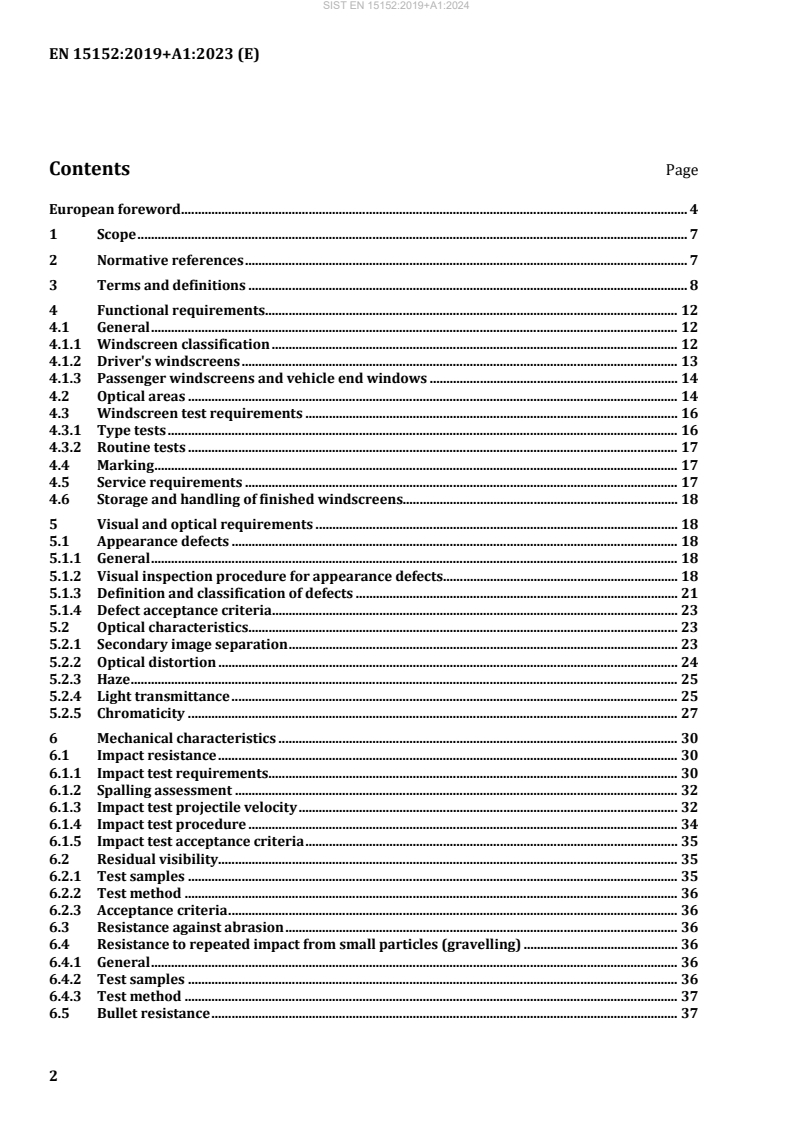
Contents Page
European foreword . 4
1 Scope . 7
2 Normative references . 7
3 Terms and definitions . 8
4 Functional requirements. 12
4.1 General . 12
4.1.1 Windscreen classification . 12
4.1.2 Driver's windscreens . 13
4.1.3 Passenger windscreens and vehicle end windows . 14
4.2 Optical areas . 14
4.3 Windscreen test requirements . 16
4.3.1 Type tests . 16
4.3.2 Routine tests . 17
4.4 Marking . 17
4.5 Service requirements . 17
4.6 Storage and handling of finished windscreens. 18
5 Visual and optical requirements . 18
5.1 Appearance defects . 18
5.1.1 General . 18
5.1.2 Visual inspection procedure for appearance defects. 18
5.1.3 Definition and classification of defects . 21
5.1.4 Defect acceptance criteria . 23
5.2 Optical characteristics . 23
5.2.1 Secondary image separation . 23
5.2.2 Optical distortion . 24
5.2.3 Haze . 25
5.2.4 Light transmittance . 25
5.2.5 Chromaticity . 27
6 Mechanical characteristics . 30
6.1 Impact resistance . 30
6.1.1 Impact test requirements. 30
6.1.2 Spalling assessment . 32
6.1.3 Impact test projectile velocity . 32
6.1.4 Impact test procedure . 34
6.1.5 Impact test acceptance criteria . 35
6.2 Residual visibility. 35
6.2.1 Test samples . 35
6.2.2 Test method . 36
6.2.3 Acceptance criteria . 36
6.3 Resistance against abrasion . 36
6.4 Resistance to repeated impact from small particles (gravelling) . 36
6.4.1 General . 36
6.4.2 Test samples . 36
6.4.3 Test method . 37
6.5 Bullet resistance . 37
7 Performance in service . 38
7.1 Heating system . 38
7.1.1 General . 38
7.1.2 Heating uniformity . 38
7.1.3 Coating based heating systems . 39
7.1.4 Wire based heating systems . 39
7.1.5 Resistance measurement . 39
7.1.6 Voltage withstand test . 39
7.2 Resistance against ageing . 39
7.2.1 General . 39
7.2.2 Accelerated weathering test . 40
7.2.3 Thermal cycling . 40
7.2.4 Humidity test . 41
7.2.5 Windscreen heating test . 42
Annex A (normative) Determination of windscreen angles . 43
A.1 Determination of windscreen plan view angle . 43
A.2 Determination of the rake angle . 46
Annex B (normative) Transmittance calculation for inclined windscreen . 47
Annex C (normative) Windscreen test sample mounting . 50
Annex D (normative) Impact test projectile . 52
Annex E (normative) Gravelling test projectile . 54
Annex F (informative) Test samples . 55
F.1 Test sample properties . 55
F.2 Test sample for optical tests . 55
F.3 !Test sample for mechanical tests" . 55
F.4 Test sample for ageing tests . 55
Annex G (normative) Summary of testing requirements . 56
Annex H (informative) Alternative method for testing resistance to Ultra Violet radiation . 57
H.1 General . 57
H.2 Test method . 57
H.3 Interpretation of results . 57
Annex ZA (informative) Relationship between this European Standard and the Essential
Requirements of EU Directive 2008/57/EC aimed to be covered . 58
Bibliography . 59
European foreword
This document (EN 15152:2019+A1:2023) has been prepared by Technical Committee CEN/TC 256
“Railway applications”, the secretariat of which is held by DIN.
This European Standard shall be given the status of a national standard, either by publication of an
identical text or by endorsement, at the latest by June 2024, and conflicting national standards shall be
withdrawn at the latest by June 2024.
Attention is drawn to the possibility that some of the elements of this document may be the subject of
patent rights. CEN shall not be held responsible for identifying any or all such patent rights.
This document supersedes !EN 15152:2019".
This document includes Amendment 1 approved by CEN on 27 November 2023.
The start and finish of text introduced or altered by amendment is indicated in the text by tags !".
In comparison with the previous edition, the following technical modifications have been made:
Clause/subclause/table/figure Change
Whole document and scope Introduction of urban rail requirements, requirements for
high speed trains and for certain types of OTMs
2 Normative references The normative references have been updated
3 Terms and definitions Creation of new definitions for different types of windscreen
and glazing (e.g lateral windscreens, passenger windscreens,
etc)
3 Terms and definitions !New definitions for hotspots, heavy rail systems and
urban rail systems"
4.1.1 Windscreen classifications New sub clause for the classification of windscreens into
different types: driver's windscreens, lateral windscreen,
passenger windscreen
4.2 Optical areas New definitions of different optical areas based on the types
of windscreens
4.3 Windscreen test requirements All the test requirements as well as test prescriptions have
been moved to the corresponding sub clauses
4.4 Marking Former 4.3.3 has been moved and modified
4.5 Service requirements New sub clause for in service requirements for windscreens
4.6 Storage and handling New sub clause for storage and handling requirements for
windscreens
5 Visual and optical requirements New clause created for visual and optical requirements in
order to separate them from functional requirements
5.1.2 Visual inspection procedure for appearance New sub clause with precise instructions for the inspection of
defects windscreens
5.1.3 Definition and classification of defects New criteria for defining defects and their tolerances
5.1.4 Defect acceptance criteria The notion of negligible, minor and major defects has been
replaced by the number of acceptable defects on a given
Clause/subclause/table/figure Change
surface of the windscreen
5.2 Optical characteristics New sub clause assembling all the optical requirements as
well as the related measurement methods. Different
requirements for urban rail have been introduced
6 Mechanical characteristics New clause assembling all the mechanical requirements for
windscreens. The clause has been editorially rearranged with
regards to the previous version
6.1.1 Impact test requirements Separate new requirements for the testing of high speed
trains. Temperature ranges for the test have been introduced.
The notion of testing at different angles (e.g 90° or at
installation angle) has been introduced
6.1.4 Impact test procedure The test procedure is now described in detail. Notably The
notion of testing at different angles (e.g 90° or at installation
angle) has been introduced
6.2 Residual visibility New requirement and associated test
6.4 Resistance to repeated impact from small Editorial rearrangement of the sub clause and introduction of
particles (gravelling) more precise test methods
6.5 Bullet resistance New requirement and associated test
7 Performance in service New clause assembling several requirements for heating
systems, for the resistance against ageing, the accelerated
weathering test, thermal cycling, etc. All the sub clauses have
been editorial reworked and more precise test methods have
been introduced
Annex A – Determination of windscreen angles New annex introduced to help the user determine the type of
the windscreen (e.g driver's windscreen, lateral windscreen,
etc)
Annex B – Transmittance calculation for inclined New annex explaining the calculation method for light
windscreens transmittance of windscreens at installation angle
Annex C – Windscreen test sample mounting New annex giving precise instructions for the installation of
test samples. The set up applies to impact and gravelling
tests
Annex D – Impact test projectile New, more precise criteria for the impact test projectile,
based on actual examples
Annex E – Gravelling test projectile New annex for the precise description of the gravelling test
projectile
New annex with precise requirements for test samples used
Annex F – Test samples
in different tests throughout the document
Annex G – Summary of testing requirements Editorial rearrangement of the annex in order to take into
account all the changes made to the document
Annex ZA – Relationship between this European New Annex ZA
Standard and the Essential Requirements of EU
Directive 2008/57/EC aimed to be covered
This document has been prepared under a mandate given to CEN by the European Commission and the
European Free Trade Association, and supports essential requirements of EU Directive 2008/57/EC.
For relationship with EU Directive 2008/57/EC, see informative Annex ZA, which is an integral part of
this document.
!Any feedback and questions on this document should be directed to the users’ national standards
body. A complete listing of these bodies can be found on the CEN website."
According to the CEN-CENELEC Internal Regulations, the national standards organisations of the
following countries are bound to implement this European Standard: Austria, Belgium, Bulgaria,
Croatia, Cyprus, Czech Republic, Denmark, Estonia, Finland, France, Germany, Greece, Hungary, Iceland,
Ireland, Italy, Latvia, Lithuania, Luxembourg, Malta, Netherlands, Norway, Poland, Portugal, Republic of
North Macedonia, Romania, Serbia, Slovakia, Slovenia, Spain, Sweden, Switzerland, Türkiye and the
United Kingdom.
1 Scope
!This document specifies the functional requirements for rail vehicle windscreens, including type
testing, routine testing, and inspection methods for high speed rail, heavy rail, and urban rail vehicles,
including metro and tram applications."
This document is also applicable for tram vehicles.
For on-track machines (OTMs) when in transport mode (self-propelled or hauled) the requirements of
this standard are applicable. OTMs in working configuration are outside the scope of this document.
Determination of the size, shape, orientation and position of windscreens is outside the scope of this
document. These data form part of the windscreen technical specification.
This document applies to windscreens made of laminated glass, which is the most commonly used
material but also to other materials, subject to the performance requirements being satisfied.
This document does not specify requirements for the interfaces between the windscreen and the
vehicle. Accordingly this document does not address issues relating to: installation, structural integrity
and crashworthiness.
2 Normative references
The following documents are referred to in the text in such a way that some or all of their content
constitutes requirements of this document. For dated references, only the edition cited applies. For
undated references, the latest edition of the referenced document (including any amendments) applies.
EN 755-2:2016, Aluminium and aluminium alloys - Extruded rod/bar, tube and profiles - Part 2:
Mechanical properties
EN 1063:1999, Glass in building - Security glazing - Testing and classification of resistance against bullet
attack
EN 2155-9, Aerospace series - Test method for transparent materials for aircraft glazing - Part 9 :
Determination of haze
EN 45545-2, Railway applications — Fire protection on railway vehicles – Part 2: Requirements for fire
behaviour of materials and components
EN 50155, Railway applications — Rolling stock — Electronic equipment
EN ISO 4892-3, Plastics - Methods of exposure to laboratory light sources - Part 3: Fluorescent UV lamps
(ISO 4892-3)
EN ISO 11664-1 (CIE S 014-1), Colorimetry — Part 1: CIE standard colorimetric observers (ISO 11664-1)
EN ISO 11664-2 (CIE, S 014-2), Colorimetry — Part 2: CIE standard illuminants (ISO 11664-2)
EN ISO 11664-3 (CIE, S 014-3), Colorimetry — Part 3: CIE tristimulus values (ISO 11664-3)
ISO 48, Rubber, vulcanized or thermoplastic — Determination of hardness (hardness between 10 IRHD
and 100 IRHD)
ISO 3537, Road vehicles — Safety glazing materials — Mechanical tests
ISO 3538:1997, Road vehicles — Safety glazing materials — Test methods for optical properties
ISO 6362-2:2014, Wrought aluminium and aluminium alloys — Extruded rods/bars, tubes and profiles —
Part 2: Mechanical properties
CIE 15:2004, Colorimetry, 3rd Edition
CIE 38:1977, Radiometric and photometric characteristics of materials and their measurement
CIE S 004, Colours of Light Signals
3 Terms and definitions
For the purposes of this document, the following terms and definitions apply.
ISO and IEC maintain terminological databases for use in standardization at the following addresses:
• IEC Electropedia: available at http://www.electropedia.org/
• ISO Online browsing platform: available at http://www.iso.org/obp
Note 1 to entry: Figure 1 shows examples of the different types of windscreen, bodyside windows and external
glazing.
3.1
glazing
glass or equivalent transparent material
3.2
windscreen
glazing in front of a driver or passengers through which the track ahead can be observed
3.2.1
driver's windscreen
windscreen used by a driver in service to observe the track and signals
3.2.2
side windscreen
additional glazing positioned at the side of a windscreen that is predominately positioned transversely
to the running direction
3.2.3
passenger windscreen
windscreen primarily for passenger use in the leading ends of rail vehicles
Can be obtained from: International Commission of Illumination, CIE Central Bureau, Kegelgasse 27, A-1030
Wien.
a) !urban rail" b) heavy rail
Key
1 driver's windscreen (3.2.1)
2 side windscreen (3.2.2)
3 bodyside window
4 external glazing (for example covers for lights, information displays)
Figure 1 — Windscreen, window and glazing definitions
3.3
primary vision area
area of the windscreen through which track and signals are visible from the driving position
Note 1 to entry: Defined as “vision area A” by EN 16186-1.
3.4
secondary vision area
area of the windscreen outside the primary vision area, through which the driver can also look from the
driving position
Note 1 to entry: Defined as “vision area B” by EN 16186-1.
3.5
peripheral area
area of the windscreen outside the secondary vision area
Note 1 to entry: The peripheral area includes any screen-printed areas.
3.6
secondary image separation
angular separation between the primary and the brightest secondary images (due to internal reflection)
of a distant light source or object when viewed through glazing
3.7
ultra-violet radiation
UV
electromagnetic radiation of a wavelength shorter than that of visible light
Note 1 to entry: For the purposes of this document, wavelength is between 200 nm and 380 nm.
3.8
spall
small glass particles which detach from the face of a window pane when it is subjected to impact on the
opposite side
Note 1 to entry: Spalling in this document describes the detachment of spall from the inside face of a
windscreen or window, when the outer face is subjected to impact.
3.9
hot-spot
highly localised area where the temperature deviates significantly from the area surrounding it
!3.10
heavy rail system
conventional rail system intended for intra and inter-regional and/or international transportation
Note 1 to entry: The heavy rail system comprises the heavy rail network, related rolling stock and the
associated operation.
Note 2 to entry: Typically, a heavy rail system has standard or broad gauge tracks and infrastructure which are
designed for an axle load of at least 17 t. The vehicles comply with a structural design category L, P-I, P-II or F-I
according to EN 12663-1:2010+A1:2014 and a crashworthiness design category C-I according to EN 15227:2020.
Note 3 to entry: The heavy rail system is typically intended for passenger and freight transport.
[SOURCE: EN 17343:2020, 3.1.3]
3.11
urban rail system
rail system intended for local, urban and suburban transportation
Note 1 to entry: The urban rail system comprises the urban rail network, related rolling stock and the
associated operation.
Note 2 to entry: The urban rail system covers the transport in urban centres like towns, cities or conurbations
and between such centres and surrounding areas.
Note 3 to entry: The urban rail system is predominantly intended for passenger transport.
[SOURCE: EN 17343:2020, 3.1.4]
3.12
metro system
urban rail system operated by using a command / control system segregated from road traffic or any
other rail system
Note 1 to entry: The metro system comprises the metro network, related rolling stock, and the associated
operation.
Note 2 to entry: Typically, a metro system has tracks and infrastructure, which are designed for an axle load
less than 17 t. The vehicles comply with a structural design category P-III according to EN 12663-1:2010+A1:2014
and a crashworthiness design category C-II according to EN 15227:2020.
Note 3 to entry: The metro system may include underground, elevated or surface sections.
Note 4 to entry: Exceptionally, metro systems may have level crossings and/or share tracks with other rail
systems.
[SOURCE: EN 17343:2020, 3.1.4.1]
3.13
tram system
urban rail system operated on separate infrastructure or infrastructure shared with road traffic, or both
Note 1 to entry: The tram system comprises the tram network, related rolling stock, and the associated
operation.
Note 2 to entry: Typically, a tram system has tracks and infrastructure, which are designed for an axle load less
than 13 t. The vehicles comply with a structural design category P-IV or P-V according to
EN 12663-1:2010+A1:2014 and a crashworthiness design category C-IV according to EN 15227:2020.
Note 3 to entry: Sections of the route may be signal controlled.
Note 4 to entry: A tram network can be linked to other rail networks.
Note 5 to entry: For tram systems having sections segregated from road traffic the term light rail system (LRS)
may be used.
Note 6 to entry: Road traffic includes road users like cars, pedestrians, cyclists, wheelchair users, etc.
[SOURCE: EN 17343:2020, 3.1.4.2]"
3.14
technical specification
document describing specific parameters and/or product requirements as an addition to the
requirements of this standard
3.15
inspector
person with evidence of training, professional knowledge, skill and experience to enable the required
inspection(s) to be performed
3.16
seat reference point
SRP
reference point at the back pan of a new seat design with a horizontal distance of 135 mm and vertical
distance of 98 mm from the H point according to ISO 20176:2011
Note 1 to entry: See Figure 2 of EN 16186-1:2014+A1:2018.
[SOURCE, EN 16186-1:2014+A1:2018, 3.1.6, modified]
4 Functional requirements
4.1 General
4.1.1 Windscreen classification
Windscreens are positioned to allow observation of the track and signals ahead of a vehicle. Additional
side windscreens or windows may be provided to the side of the windscreen or windscreens (see
Figure 2).
Key
1 windscreen
2 side windscreen
3 side windscreen (cab window forward of seat reference point, see 4.1.2)
4 bodyside window
5 driver's seat (or passenger seats, for example in automatic vehicles)
6 seat reference point (SRP)
Θi, Θn plan view angles (for curved windscreens, values vary with position)
X direction of travel
Figure 2 — Windscreens and side windscreens
The classification of rail vehicle glazing (windscreens, side windscreens or bodyside windows) affects
the characteristics required and primarily depends on the orientation relative to the track. For the
determination of a windscreen’s orientation, only the parts of the glazing which if removed would
create an aperture in the structure of the vehicle and expose the occupants of a vehicle to the outside
shall be considered. Glazing that covers lights, information displays or extends over the structure for
aesthetic purposes is therefore excluded.
Except when the requirements for driver’s cabs apply (see 4.1.2), where the projected forward facing
area determined according to Annex A is less than or equal to 0,065 m , the glazing shall be considered
to be a bodyside window and therefore outside the scope of this document.
For windscreens that can be considered to be forward facing (including those which are not required or
intended for direct observation of the track and signals) the maximum and minimum plan view angles,
Θ (See Figure 2), shall be determined according to Annex A.
For driver's windscreens, with a central driving position, the plan view angle, Θ may be assumed to
be = 0°.
The maximum and minimum rake angles Φ shall be determined according to Annex A.
For curved windscreens the method set out in Annex A should be followed for the determination of plan
view and rake angles.
The maximum and minimum installation angles Ψ shall be determined from the maximum and
minimum plan view angles Θ and the maximum and minimum rake angles Φ using the relation
cos(Ψ) = cos(Θ).cos(Φ).
The maximum and minimum windscreen plan view angles, rake angles and installation angles shall
form part of the specification for manufacture and testing.
Where samples are used to determine optical properties, the maximum installation angle shall be used
(see for example 5.2).
Where samples are used to determine mechanical properties such as impact resistance, the minimum
installation angle shall be used (see for example 6.1).
4.1.2 Driver's windscreens
All windows in driver’s cabs that are fully or partially in front of the driver’s seat reference point (SRP),
measured in the longitudinal direction shall be considered as windscreens or side windscreens (see
Figure 2). !Exceptions according to Clause A.1 are acceptable."
Where two, or more, windscreens are fitted (for example two on either side of a cab end gangway) and
only one of which is required to be a driver’s windscreen, the requirements for driver’s windscreens
shall apply to both (or all) windscreens (see Figure 3).
For driver’s windscreens, the plan view angle shall be determined using the points defining the primary
vision area (see 4.2, see Zone A in Figure 4).
Key
1 leading vehicle (alternate cab types shown)
2 intermediate and/or end vehicles
3 driver's windscreen(s)
4 passenger windscreen
5 vehicle end windows
6 driver's cab partition wall
X direction of travel
Figure 3 — Windscreens and body end windows
4.1.3 Passenger windscreens and vehicle end windows
Windscreens or side windscreens that are only provided for observation by passengers shall be
referred to as passenger windscreens (see Figure 3).
NOTE Examples of passenger windscreens could be the leading end windows in fully automatic rail vehicles
or leading end windows in vehicles where the cab only uses part of the width allowing passenger access to the
remainder.
The following may be considered to be equivalent to bodyside windows and therefore outside the scope
of this document:
— forward facing vehicle end windows, located at an intermediate end of a vehicle, if they are shielded
by an adjacent vehicle from the risk of a direct longitudinal impact (see Figure 3);
— forward facing vehicle end windows, for example in body end doors, where people are not present
during operation;
— vehicle end windows that only face to the rear in normal service (see Figure 3).
4.2 Optical areas
A windscreen can be divided into a maximum of three optical areas as shown in Figure 4.
A primary vision area shall be defined for driver’s windscreens. The boundary between secondary and
peripheral areas shall form part of the windscreen technical specification.
For other types of windscreen and glazing in the scope of this document a primary vision area may not
be required and the boundaries between optical areas shall form part of the windscreen technical
specification.
Key
A primary vision area
B secondary vision area
C peripheral area
O assumed eye position
1 driver's sightlines
W, X, Y, Z sightline intersection points
Figure 4 — Windscreen optical areas
The four points W, X, Y and Z, shown on Figure 4, represent the intersections between the windscreen
and the driver’s sightlines. These points are joined by lines as shown in Figure 4 to define the primary
vision area.
The definition of the driver’s sightlines (for the observation of track and signals) is outside of the scope
of this document. Data to define these points shall form part of the windscreen technical specification.
NOTE For heavy rail applications, driver's sightlines are defined in EN 16186-1.
The peripheral area can be deliberately obscured (in whole or in part) e.g. by silk-screen printing for
any of the following reasons:
— elimination of distracting items from the field of vision;
— for windscreens that are bonded into position, to protect the bonded area from the effect of
ultraviolet (UV) radiation;
— aesthetic purposes.
If obscuration is used to protect bonded areas from UV degradation, the obscuration should not permit
more than 0,1 % of incident UV light to reach the bonded area.
4.3 Windscreen test requirements
4.3.1 Type tests
The windscreen design shall be validated by satisfactory completion of the assessments and tests for:
— appearance (see 5.1);
— secondary images (see 5.2.1);
— optical distortion (see 5.2.2);
— haze (see 5.2.3);
— transmittance (see 5.2.4);
— chromaticity (see 5.2.5);
— impact (including spalling) (see 6.1);
— residual visibility (6.2);
— abrasion resistance (see 6.3);
— gravelling (if required by the windscreen technical specification) (see 6.4);
— bullet resistance (if required by the windscreen technical specification) (see 6.5);
— heating (see 7.1);
— ageing (see 7.2).
For a passenger windscreens the following tests are optional:
— secondary images (see 5.2.1);
— haze (see 5.2.3);
— transmittance (see 5.2.4), a minimum transmittance of 40 % may be accepted;
— chromaticity (see 5.2.5).
If a windscreen is fitted with a heating device the following tests shall be repeated with the heating
device in use:
— secondary images (see 5.2.1);
— optical distortion test (see 5.2.2).
When type tests are repeated with the heating device in use:
— the heater shall be operated at its nominal voltage;
— thermal stabilization shall be reached before measurements are undertaken.
This requirement shall not apply to additional start-up heating provided for use on a stationary vehicle
to accelerate the removal of ice or snow.
Testing requirements are summarized in Annex G.
If a windscreen validated in accordance with this document is modified, where it can be shown, for a
given type test, that the required performance is not affected, a new type test may not be required.
4.3.2 Routine tests
Routine testing shall be undertaken during production on all windscreens for the following:
— appearance (see 5.1);
— optical distortion (see 5.2.2);
— heating (see 7.1).
Transmittance (see 5.2.4) and haze (see 5.2.3) shall be tested periodically at a frequency given in the
windscreen technical specification.
4.4 Marking
The windscreen shall be permanently marked. The marking shall be readable and visible from inside
the cab. The minimum height of characters shall be 4 mm.
The marking shall be outside of the primary vision area. If there are no conflicting requirements, it
should be in the upper right hand corner of the windscreen.
As a minimum, the following information shall be included in the marking:
— name or logo of windscreen supplier;
— date of manufacturing (month and the last two numerals of the year or a code by which this
information can be identified);
— unique identification number (part number and serial number);
— nominal voltage and type of current (AC or DC) of the heater (if applicable);
— total power of the heater (if applicable);
— the applicable version of this document, e.g. EN 15152:2019.
4.5 Service requirements
Windscreens shall be designed to withstand normal operational conditions, including induced static
and dynamic loadings and environmental conditions such as temperature and humidity, when installed
in a railway vehicle.
NOTE 1 Typically, reference is made to EN 50125-1 temperature classes T1, T2 or T3.
Requirements for use in a specific environment which are in addition to the requirements set out in this
document shall form part of the windscreen technical specification.
A heating system can be incorporated in a driver’s windscreen for de-icing and de-misting so that the
driver can maintain a clear external view in most weather and operating conditions. If such an integral
heating system is provided it shall satisfy the requirements set out in 7.1.
A heating device is required for driver’s windscreens in vehicles which conform to Directive
2008/57/EC.
If an anti-spall layer is used, it shall satisfy the fire safety requirements set out in EN 45545-2.
Driver’s windscreens, when impacted or cracked, shall have sufficient residual visibility to allow the
train to be moved, subject to operational rules. This requirement shall be deemed to be satisfied by
achieving the residual visibility requirements set out in 6.2.
NOTE 2 For heavy rail vehicles, requirements for cab layout that can affect windscreen design and installation
are set out in EN 16186-1.
NOTE 3 The mechanical strength of the windscreen installation is within the scope of the requirements that are
applicable for equipment attachments set out in EN 12663-1. In case a retaining bracket needs to be installed, a
calculation, to demonstrate the adequacy of the retaining bracket, might be required.
NOTE 4 The windscreen installation is within the scope of the requirements set out in EN 15227. These
requirements are for the prevention of intrusion by the windscreen and maintenance of survival space for the
driver in the event of a collision.
NOTE 5 The windscreen installation is in the scope of the fire safety requirements set out in EN 45545-2.
NOTE 6 For passenger windscreens, an anti-defenestration and containment test can be required by the
windscreen technical specification.
4.6 Storage and handling of finished windscreens
Windscreens should be stored in a well ventilated area, protected from the weather and out of direct
sunlight.
Flat windscreens should be stored on a solid base in a vertical orientation, inclined at a rake angle of
approximately 6 degrees. The windscreens should be continuously supported by brackets along each
edge. The supporting brackets should be covered with soft material to prevent damage.
Storage for curved windscreens should follow the same principles adapted for the specific geometry of
the product.
5 Visual and optical requirements
5.1 Appearance defects
5.1.1 General
Appearance defects (blemishes) are characteristics of one of the following elements of the windscreen
or the processes in its manufacture:
— glazing material(s);
— interlayer(s);
— assembly;
— handling;
— anti-spall layer, if fitted.
To ensure an acceptable quality of vision to the driver, windscreens shall be inspected according to the
procedure set out in 5.1.2. Any defec
...