

ISO/IEC FDIS 20547-4
(Main)Technologies de l'information -- Architecture de référence des mégadonnées
General Information
Standards Content (sample)
DRAFT INTERNATIONAL STANDARD
ISO/IEC DIS 20547-4
ISO/IEC JTC 1/SC 27 Secretariat: DIN
Voting begins on: Voting terminates on:
2019-12-30 2020-03-23
Information technology — Big data reference
architecture —
Part 4:
Security and privacy
Technologies de l'information — Architecture de référence des mégadonnées —
Partie 4: Sécurité et Confidentialité
ICS: 35.020
THIS DOCUMENT IS A DRAFT CIRCULATED
FOR COMMENT AND APPROVAL. IT IS
THEREFORE SUBJECT TO CHANGE AND MAY
NOT BE REFERRED TO AS AN INTERNATIONAL
STANDARD UNTIL PUBLISHED AS SUCH.
IN ADDITION TO THEIR EVALUATION AS
BEING ACCEPTABLE FOR INDUSTRIAL,
This document is circulated as received from the committee secretariat.
TECHNOLOGICAL, COMMERCIAL AND
USER PURPOSES, DRAFT INTERNATIONAL
STANDARDS MAY ON OCCASION HAVE TO
BE CONSIDERED IN THE LIGHT OF THEIR
POTENTIAL TO BECOME STANDARDS TO
WHICH REFERENCE MAY BE MADE IN
Reference number
NATIONAL REGULATIONS.
ISO/IEC DIS 20547-4:2019(E)
RECIPIENTS OF THIS DRAFT ARE INVITED
TO SUBMIT, WITH THEIR COMMENTS,
NOTIFICATION OF ANY RELEVANT PATENT
RIGHTS OF WHICH THEY ARE AWARE AND TO
PROVIDE SUPPORTING DOCUMENTATION. ISO/IEC 2019
---------------------- Page: 1 ----------------------
ISO/IEC DIS 20547-4:2019(E)
COPYRIGHT PROTECTED DOCUMENT
© ISO/IEC 2019
All rights reserved. Unless otherwise specified, or required in the context of its implementation, no part of this publication may
be reproduced or utilized otherwise in any form or by any means, electronic or mechanical, including photocopying, or posting
on the internet or an intranet, without prior written permission. Permission can be requested from either ISO at the address
below or ISO’s member body in the country of the requester.ISO copyright office
CP 401 • Ch. de Blandonnet 8
CH-1214 Vernier, Geneva
Phone: +41 22 749 01 11
Fax: +41 22 749 09 47
Email: copyright@iso.org
Website: www.iso.org
Published in Switzerland
ii © ISO/IEC 2019 – All rights reserved
---------------------- Page: 2 ----------------------
ISO/IEC DIS 20547-4:2019(E)
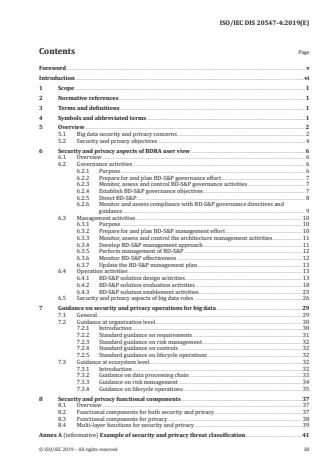
Contents Page
Foreword ..........................................................................................................................................................................................................................................v
Introduction ................................................................................................................................................................................................................................vi
1 Scope ................................................................................................................................................................................................................................. 1
2 Normative references ...................................................................................................................................................................................... 1
3 Terms and definitions ..................................................................................................................................................................................... 1
4 Symbols and abbreviated terms ........................................................................................................................................................... 1
5 Overview ....................................................................................................................................................................................................................... 2
5.1 Big data security and privacy concerns ............................................................................................................................. 2
5.2 Security and privacy objectives ................................................................................................................................................ 4
6 Security and privacy aspects of BDRA user view ................................................................................................................ 6
6.1 Overview ...................................................................................................................................................................................................... 6
6.2 Governance activities ........................................................................................................................................................................ 6
6.2.1 Purpose .................................................................................................................................................................................... 6
6.2.2 Prepare for and plan BD-S&P governance effort .................................................................................. 7
6.2.3 Monitor, assess and control BD-S&P governance activities ........................................................ 7
6.2.4 Establish BD-S&P governance objectives ................................................................................................... 7
6.2.5 Direct BD-S&P..................................................................................................................................................................... 8
6.2.6 Monitor and assess compliance with BD-S&P governance directives andguidance .................................................................................................................................................................................. 9
6.3 Management activities ..................................................................................................................................................................10
6.3.1 Purpose .................................................................................................................................................................................10
6.3.2 Prepare for and plan BD-S&P management effort ...........................................................................10
6.3.3 Monitor, assess and control the architecture management activities .............................11
6.3.4 Develop BD-S&P management approach .................................................................................................11
6.3.5 Perform management of BD-S&P ...................................................................................................................12
6.3.6 Monitor BD-S&P effectiveness ..........................................................................................................................12
6.3.7 Update the BD-S&P management plan ......................................................................................................13
6.4 Operation activities ..........................................................................................................................................................................13
6.4.1 BD-S&P solution design activities ..................................................................................................................13
6.4.2 BD-S&P solution evaluation activities ........................................................................................................18
6.4.3 BD-S&P solution enablement activities .....................................................................................................23
6.5 Security and privacy aspects of big data roles ..........................................................................................................26
7 Guidance on security and privacy operations for big data ....................................................................................29
7.1 General ........................................................................................................................................................................................................29
7.2 Guidance at organization level ...............................................................................................................................................30
7.2.1 Introduction ......................................................................................................................................................................30
7.2.2 Standard guidance on requirements ...........................................................................................................31
7.2.3 Standard guidance on risk management .................................................................................................32
7.2.4 Standard guidance on controls .........................................................................................................................32
7.2.5 Standard guidance on lifecycle operations ............................................................................................32
7.3 Guidance at ecosystem level .....................................................................................................................................................32
7.3.1 Introduction ......................................................................................................................................................................32
7.3.2 Guidance on data processing chain ..............................................................................................................33
7.3.3 Guidance on risk management .........................................................................................................................34
7.3.4 Guidance on lifecycle operations ....................................................................................................................35
8 Security and privacy functional components ......................................................................................................................37
8.1 Overview ...................................................................................................................................................................................................37
8.2 Functional components for both security and privacy......................................................................................37
8.3 Functional components for privacy ...................................................................................................................................38
8.4 Multi-layer functions for security and privacy .........................................................................................................39
Annex A (informative) Example of security and privacy threat classification .......................................................41
© ISO/IEC 2019 – All rights reserved iii---------------------- Page: 3 ----------------------
ISO/IEC DIS 20547-4:2019(E)
Annex B (informative) Example of security and privacy control classification ....................................................42
Annex C (informative) Example of ecosystem and resulting coordination of security and
privacy operations ...........................................................................................................................................................................................45
Annex D (informative) Examples of security and privacy controls per BDRA roles ........................................51
Bibliography .............................................................................................................................................................................................................................56
iv © ISO/IEC 2019 – All rights reserved---------------------- Page: 4 ----------------------
ISO/IEC DIS 20547-4:2019(E)
Foreword
ISO (the International Organization for Standardization) and IEC (the International Electrotechnical
Commission) form the specialized system for worldwide standardization. National bodies that are
members of ISO or IEC participate in the development of International Standards through technical
committees established by the respective organization to deal with particular fields of technical
activity. ISO and IEC technical committees collaborate in fields of mutual interest. Other international
organizations, governmental and non-governmental, in liaison with ISO and IEC, also take part in the
work. In the field of information technology, ISO and IEC have established a joint technical committee,
ISO/IEC JTC 1.The procedures used to develop this document and those intended for its further maintenance are
described in the ISO/IEC Directives, Part 1. In particular the different approval criteria needed for the
different types of ISO documents should be noted. This document was drafted in accordance with the
editorial rules of the ISO/IEC Directives, Part 2 (see www .iso .org/ directives).
Attention is drawn to the possibility that some of the elements of this document may be the subject of
patent rights. ISO shall not be held responsible for identifying any or all such patent rights. Details of
any patent rights identified during the development of the document will be in the Introduction and/or
on the ISO list of patent declarations received (see www .iso .org/ patents).Any trade name used in this document is information given for the convenience of users and does not
constitute an endorsement.For an explanation on the meaning of ISO specific terms and expressions related to conformity assessment,
as well as information about ISO's adherence to the World Trade Organization (WTO) principles in the
Technical Barriers to Trade (TBT) see the following URL: www .iso .org/ iso/ foreword .html.
The committee responsible for this document is Technical Committee ISO/IEC JTC 1, Information
technology, Subcommittee SC 27, Information security, cybersecurity and privacy protection.
A list of all parts in the ISO/IEC 20547 series can be found on the ISO website.© ISO/IEC 2019 – All rights reserved v
---------------------- Page: 5 ----------------------
ISO/IEC DIS 20547-4:2019(E)
Introduction
Big data refers to the massive amount of digital information collected in various forms from different
sources of digital and physical environments. This data is not only generated by traditional means
of information exchange, but also from sensors embedded in physical environments, such as city
surroundings, transportation vehicles, critical infrastructures, etc. The collection and processing of big
data provides additional challenges not inherent in the traditional digital information exchange setting.
This document was developed in response to worldwide demand for a common baseline security and
privacy aspects for big data architectures to facilitate interoperability in big data systems without
compromising privacy, confidentiality, or integrity.The big data paradigm blurs the security boundaries between data collection, storage, and access
– areas traditionally addressed independently – that must now be confronted holistically with a
comprehensive security and privacy foundation, tightly coupled to all architecture components.
Effective standardization of security and privacy is paramount to the development of mutual trust and
cooperation amongst big data stakeholders.Identification of patent holders, if any.
vi © ISO/IEC 2019 – All rights reserved
---------------------- Page: 6 ----------------------
DRAFT INTERNATIONAL STANDARD ISO/IEC DIS 20547-4:2019(E)
Information technology — Big data reference
architecture —
Part 4:
Security and privacy
1 Scope
This document specifies the security and privacy aspects applicable to the Big Data Reference
Architecture (BDRA) including the big data roles, activities, and functional components, and also
provides guidance on security and privacy operations for big data.2 Normative references
The following documents are referred to in the text in such a way that some or all of their content
constitutes requirements of this document. For dated references, only the edition cited applies. For
undated references, the latest edition of the referenced document (including any amendments) applies.
ISO/IEC 20547-3, Information technology — Big data reference architecture — Part 3: Reference
architecture3 Terms and definitions
For the purposes of this document, the terms and definitions given in ISO/IEC 20546 apply.
ISO and IEC maintain terminological databases for use in standardization at the following addresses:
— ISO Online browsing platform: available at http:// www .iso .org/ obp— IEC Electropedia: available at http:// www .electropedia .org/
4 Symbols and abbreviated terms
The following abbreviations apply to this document.
APT Advanced Persistent Threat
BDRA Big Data Reference Architecture
BD-S&P Big Data Security and Privacy
DDoS Distributed Denial of Service
PII Personally Identifiable Information
© ISO/IEC 2019 – All rights reserved 1
---------------------- Page: 7 ----------------------
ISO/IEC DIS 20547-4:2019(E)
5 Overview
5.1 Big data security and privacy concerns
Subclause 5.1 addresses three types of concerns:
— Risks caused by big data characteristics
— Security and privacy challenges from big data
— Ecosystem coordination capabilities needed in the context of big data
Big data has the key data characteristics of volume, velocity, variety and variability, and also the
key data processing characteristics of volatility, veracity and value. These characteristics introduce
additional risks and thus challenges on the security and privacy aspect of big data.
— Volume of data is at risk associated with massive amounts of data in various layers. For example,
multi-tiered, distributed storages and transmission on various networks with different protocols.
— Velocity of data has risks associated with faster flow at which the data is created, stored, analysed
or visualized. Security controls might be a burden on velocity and easily omitted.
— Variety of data brings more complexity from a diversity of sources under control of various actors.
Complexity inevitably leads to vulnerability. An emergent phenomenon introduced by big data
variety is its ability to infer identity from anonymized datasets by correlating with apparently
innocuous public databases.— Variability of data has risks associated with faster changes in data rate, format/structure, semantics,
and/or quality. It might become more difficult to apply security controls on data security and
privacy.— Volatility of data could affect to keep audit trails and make security management difficult.
— Veracity of data brings higher requirements to integrity, consistency and accuracy. Associated risks
could be aggregated and magnified.— Value of data brings more attacks for a variety of purposes and interests.
Big data application boom brings more serious security and privacy issues on data, such as frequent
incidents of data loss and personal data leakage, illegal data transactions underground, which cause
data abuse and Internet fraud, and endanger social stability and national security.
From technology platform perspective, due to the continuous emergence of a variety of big data
technology, new technical architecture and support platform, and big data software, the following
security and privacy capabilities are needed in big data context:— Traditional security controls in big data context are needed.
Massive, multi-sourced, heterogeneous, dynamic and other big data characteristics lead to the
difference of data application security from a closed environment. Big data applications generally
use the open distributed computing and storage architecture with complex underlying support to
provide massive data distributed storage and high-performance computing services. These new
technologies and architectures make the network boundaries of big data applications become
blurred, so that the boundary-based traditional security protection measures are no longer valid.
Meanwhile, under this new situation, the Advanced Persistent threat (APT), Distributed Denial
of Service (DDoS), machine learning-based data mining and privacy discovery, and other attacks
make the traditional defence, detection and other security controls expose serious deficiencies. For
instance, providing secure data management and threat intelligence, providing secure data storage
for big data as well as secure log data generation, transmission, storage, analysis and disposal
becomes very difficult. Additionally novel technical approaches for privacy-preserving, machine
learning, cryptographic mechanisms for data-centric security and access control are necessary.
2 © ISO/IEC 2019 – All rights reserved---------------------- Page: 8 ----------------------
ISO/IEC DIS 20547-4:2019(E)
For more information on the requirements of big data security and privacy, refer the security and
privacy technical considerations in different use cases provided by ISO/IEC TR 20547-2:2018.
— Security and privacy need to be provided for the distributed computation and data store
infrastructure of big data.This requires privacy-preserving and secure distributed computation and information
dissemination. Big data requires scalable and distributed solutions for secure data storage as
well as for audits and investigations for data provenance. Data integrity for streaming influx of
data from various sensors and other end-points has to be provided. Real-time analytics for threat
intelligence require processing of large amounts of security related information such as traffic
streams and log information.— Platform security mechanisms need to be improved in the context of big data security and privacy.
In general, existing big data applications use the big data management platforms and technology,
such as Hadoop-based HBase/Hive, Cassandra/Spark, MongoDB. At the beginning of design, these
platforms and technology are mostly considered to be used in the trusted internal network, with
little consideration of authentication, authorization, key services and security audit. Although some
software are improved, such as adding Kerberos authentication mechanism, the overall security
capability is still relatively weak. Meanwhile, the third party open source components are often
used in big data applications. Due to the lack of rigorous test management and security certification
of these components, the ability to prevent software vulnerabilities and malicious backdoors in big
data applications is insufficient.— Application access control capabilities in big data context are needed.
Because of the variety of data types and the wide range of applications of big data, it is often
used to provide multiple services to users with different identities and purposes from different
organizations or departments. In general, access control is an effective means to achieve controlled
access to data. However, due to a large number of unknown data users and data to be accessed, it
is very difficult to pre-set roles and permissions of data access. Although user’s rights to access
data can be classified in advance, because of the numerous roles, it is difficult to define the control
of each role's actual permissions in a fine-grained way. So, it is difficulty to accurately specify the
range of data for each user to access without deploying newer access control model such as ABAC
(Attribute-Base Access Control). This also causes the issue with the data minimization principle in
ISO/IEC 29100.— Scalable security and privacy mechanisms are needed.
When designing and applying security and privacy mechanisms such key management, identity
and access management, de-identification, etc., in big data environment, not only the security and
privacy functionalities need to be considered, but also scalability of these mechanisms need to be
taken into account in order to support processing of high volume and high velocity of the data.
From data application perspective, due to the big Vs (Volume, Variety, Velocity and Variability)
characteristics of big data, and huge value in big data, the following security and privacy capabilities
are needed in big data context:— Data protection capabilities in big data context are needed.
In the open network society, the huge volume of big data with immeasurable potential value
makes it more favoured and easier to become a significant target of network attacks. In recent
years, information security incidents frequently occur, for example, leakage of email accounts,
social security information and bank card numbers. The distributed system deployment, the open
network environment, the complex data application and the large amount of user accesses, all cause
the big data to face the bigger challenges in the confidentiality, integrity, availability and so on.
© ISO/IEC 2019 – All rights reserved 3---------------------- Page: 9 ----------------------
ISO/IEC DIS 20547-4:2019(E)
— Personal data protection capabilities in big data context are needed.
Due to the large amount of personal data in big data systems, when the security incidents such as
data abuse, internal theft and network attacks occur, the consequences of personal data leakage
will be more serious than ordinary information systems. On the other hand, the advantage of
generating value from the analysis and usage of large amounts of data could be compromised by
the more risk of personal data leakage during the comprehensive analysis of multi-source data
where analysts are easier to explore more personal data through correlation analysis.
— Data authenticity capabilities in big data context are needed.Data in big data systems have a wide range of sources that could be a variety of sensors, active
uploads and public websites. In addition to reliable data sources, there are a large number of
untrusted data sources. Some attackers even deliberately falsify data in an attempt to induce
data analysis results. Therefore, it is very important to verify the authenticity of data and their
sources. However, there are many difficulties in verifying all the data authenticity because of the
performance limitation of data acquisition terminals, the lack of technology, the limited amount of
information, and the variety and complexity of sources.— Data owner’s right protection capabilities in big data context are needed.
During the application of big data, the data could be accessed by a variety of users, flow from one
controller to another, and even be mined to produce new data. Therefore, in the process of data
exchange and sharing, there are the circumstance where the data ownership of a data owner
and the data use right of a data manager are separated, which implies that data could be out of
data owner's control, and brings the risks such as data abuse, vague ownership of data, unclear
responsibilities of data security supervision, so that the rights and interests of data owners could
be seriously damaged.Big data involves ecosystems, or networks of organizations which collaborates to collect, analyse and
share data. The following collaborations are needed in a big data context:— collaboration between stakeholders to ensure that overall ecosystem security and privacy
requirements and individual organization’s security and privacy requirements are consistent;
— collaboration between stakeholders to ensure that the overall ecosystem risk management and the
individual organization’s risk management are consistent; and— collaboration between stakeholders to ensure that the individual organizations ensure a consistent
treatment of the assets to protect.5.2 Security and privacy objectives
Big data applications have security and privacy objectives. Table 1 describes examples of security
objectives. Table 2 describes examples of privacy objectives. Note that Table 2 describes alternative
ways to look at objectives.4 © ISO/IEC 2019 – All rights reserved
---------------------- Page: 10 ----------------------
ISO/IEC DIS 20547-4:2019(E)
Table 1 — Security objectives
Objective Description Examples
Ensures that information is not Protected transmission of collected data,
made available or disclosed to un- protected access with suitable authen-
Confidentiality
authorized individuals, entities, or tication schemes, protected processing
processes. of data, and protected storage.
Security protec-
Protection of integrity during trans-
tion goals
Ensures the accuracy and complete- mission, processing of data, as well as
Integrity
ness of data over its entire life cycle. at storage level using schemes such as
[From ISO/
digital signatures
IEC 27000]
Preventing service disruptions due to
Ensures accessibility and usability power outages, hardware failures, or
Availability
upon demand by an authorized entity denial of service attacks using schemes
such as redundant systems.
Table 2 — Privacy objectives
Objective Description
Providing PII principals with clear, prominent, easily understand-
able, accessible and affordable mechanisms to exercise choice and
Consent and choice
to give consent in relation to the processing of their PII at the time
of collection
Purpose legitimacy and Ensuring that the purpose(s) complies with applicable law and relies
specification on a permissible legal basisLimiting the collection of PII to that which is within the bounds
Collection limitation
of applicable law and strictly necessary for the specified purpose
Data minimization Strictly minimizes the processing of PII
Limiting the use, retention and disclosure (including transfer) of
Use retention and dis-
PII to that which is necessary in order to fulfil specific, explicit and
closure limitation
legitimate purposes
Ensuring that the PII processed is accurate, complete, up-to-date
Accuracy and quality (unless there
...
Questions, Comments and Discussion
Ask us and Technical Secretary will try to provide an answer. You can facilitate discussion about the standard in here.