

ISO/IEC 19086-4:2019
(Main)Cloud computing — Service level agreement (SLA) framework — Part 4: Components of security and of protection of PII
General Information
- Abstract
This document specifies security and protection of personally identifiable information components, SLOs and SQOs for cloud service level agreements (cloud SLA) including requirements and guidance. This document is for the benefit and use of both CSPs and CSCs.
- Status
- Published
- Publication Date
- 28-Jan-2019
- Drafting Committee
- ISO/IEC JTC 1/SC 27/WG 4 - Security controls and services
- Current Stage
- 9092 - International Standard to be revised
- Start Date
- 28-Oct-2024
- Completion Date
- 29-Aug-2026
Buy Documents


ISO/IEC 19086-4:2019 - Cloud computing -- Service level agreement (SLA) framework
ISO/IEC 19086-4:2019 - Cloud computing — Service level agreement (SLA) framework — Part 4: Components of security and of protection of PII/29/2019
Overview
ISO/IEC 19086-4:2019 defines the security and personally identifiable information (PII) protection components for cloud service level agreements (cloud SLA). It specifies security components, PII protection components, and associated Service Level Objectives (SLOs) and Service Quality Objectives (SQOs), together with requirements and guidance for inclusion in cloud SLAs. The standard is intended for use by both cloud service providers (CSPs) and cloud service customers (CSCs) to clarify expectations for security, privacy, and data protection in cloud contracts.
Key topics and technical requirements
ISO/IEC 19086-4 structures security and PII protection into discrete components and provides SLO/SQO guidance for each. Key technical topics include:
Information security components
- Information security policy, organization of information security
- Asset management, access control, cryptography
- Physical/environmental security, operations and communications security
- Systems acquisition, supplier relationships
- Incident management, business continuity, compliance
Protection of PII components
- Consent and choice, purpose legitimacy and specification
- Data minimization, use/retention/disclosure limitation
- Accuracy and quality, openness/transparency/notice
- Individual participation and access, accountability
SLOs and SQOs
- Defines measurable and qualitative objectives for cloud security and PII protection to be embedded in SLAs
- Provides guidance on how CSPs and CSCs can express, measure and agree on security/privacy commitments without prescribing specific technologies or thresholds
Relationship and conformance
- Explains how these components integrate with the broader ISO/IEC 19086 cloud SLA framework and offers conformance guidance for SLA drafting and assessment
Practical applications - who uses this standard
- Cloud service providers (CSPs): to define and publish SLA security/privacy commitments and design controls to meet agreed SLOs/SQOs.
- Cloud service customers (CSCs): to evaluate vendor SLAs, negotiate contractual protections for PII, and align procurement requirements with compliance needs.
- Privacy officers / compliance teams: to map contractual obligations to regulatory requirements and demonstrate accountability.
- Security architects / legal teams / procurement: to translate organizational security/privacy policies into enforceable SLA terms.
Related standards
- ISO/IEC 19086 series (the cloud SLA framework) - use ISO/IEC 19086-4 together with other parts of the framework for a complete approach to cloud SLA definition, metrics and contractual constructs.
ISO/IEC 19086-4 is a practical reference for embedding clear, measurable security and PII protections into cloud SLAs, helping organizations manage risk, compliance and vendor expectations.
Relations
- Effective Date
- 06-Jun-2022
Buy Documents
ISO/IEC 19086-4:2019 - Cloud computing -- Service level agreement (SLA) framework
ISO/IEC 19086-4:2019 - Cloud computing — Service level agreement (SLA) framework — Part 4: Components of security and of protection of PII/29/2019
Get Certified
Connect with accredited certification bodies for this standard

BSI Group
BSI (British Standards Institution) is the business standards company that helps organizations make excellence a habit.

NYCE
Mexican standards and certification body.
Sponsored listings
Frequently Asked Questions
ISO/IEC 19086-4:2019 is a standard published by the International Organization for Standardization (ISO). Its full title is "Cloud computing — Service level agreement (SLA) framework — Part 4: Components of security and of protection of PII". This standard covers: This document specifies security and protection of personally identifiable information components, SLOs and SQOs for cloud service level agreements (cloud SLA) including requirements and guidance. This document is for the benefit and use of both CSPs and CSCs.
This document specifies security and protection of personally identifiable information components, SLOs and SQOs for cloud service level agreements (cloud SLA) including requirements and guidance. This document is for the benefit and use of both CSPs and CSCs.
ISO/IEC 19086-4:2019 is classified under the following ICS (International Classification for Standards) categories: 35.020 - Information technology (IT) in general; 35.210 - Cloud computing. The ICS classification helps identify the subject area and facilitates finding related standards.
ISO/IEC 19086-4:2019 has the following relationships with other standards: It is inter standard links to ISO 14630:2024. Understanding these relationships helps ensure you are using the most current and applicable version of the standard.
ISO/IEC 19086-4:2019 is available in PDF format for immediate download after purchase. The document can be added to your cart and obtained through the secure checkout process. Digital delivery ensures instant access to the complete standard document.
Standards Content (Sample)
INTERNATIONAL ISO/IEC
STANDARD 19086-4
First edition
2019-01
Cloud computing — Service level
agreement (SLA) framework —
Part 4:
Components of security and of
protection of PII
Informatique en nuage — Cadre de travail de l'accord du niveau de
service —
Partie 4: Eléments de sécurité et de protection des PII
Reference number
©
ISO/IEC 2019
© ISO/IEC 2019
All rights reserved. Unless otherwise specified, or required in the context of its implementation, no part of this publication may
be reproduced or utilized otherwise in any form or by any means, electronic or mechanical, including photocopying, or posting
on the internet or an intranet, without prior written permission. Permission can be requested from either ISO at the address
below or ISO’s member body in the country of the requester.
ISO copyright office
CP 401 • Ch. de Blandonnet 8
CH-1214 Vernier, Geneva
Phone: +41 22 749 01 11
Fax: +41 22 749 09 47
Email: copyright@iso.org
Website: www.iso.org
Published in Switzerland
ii © ISO/IEC 2019 – All rights reserved
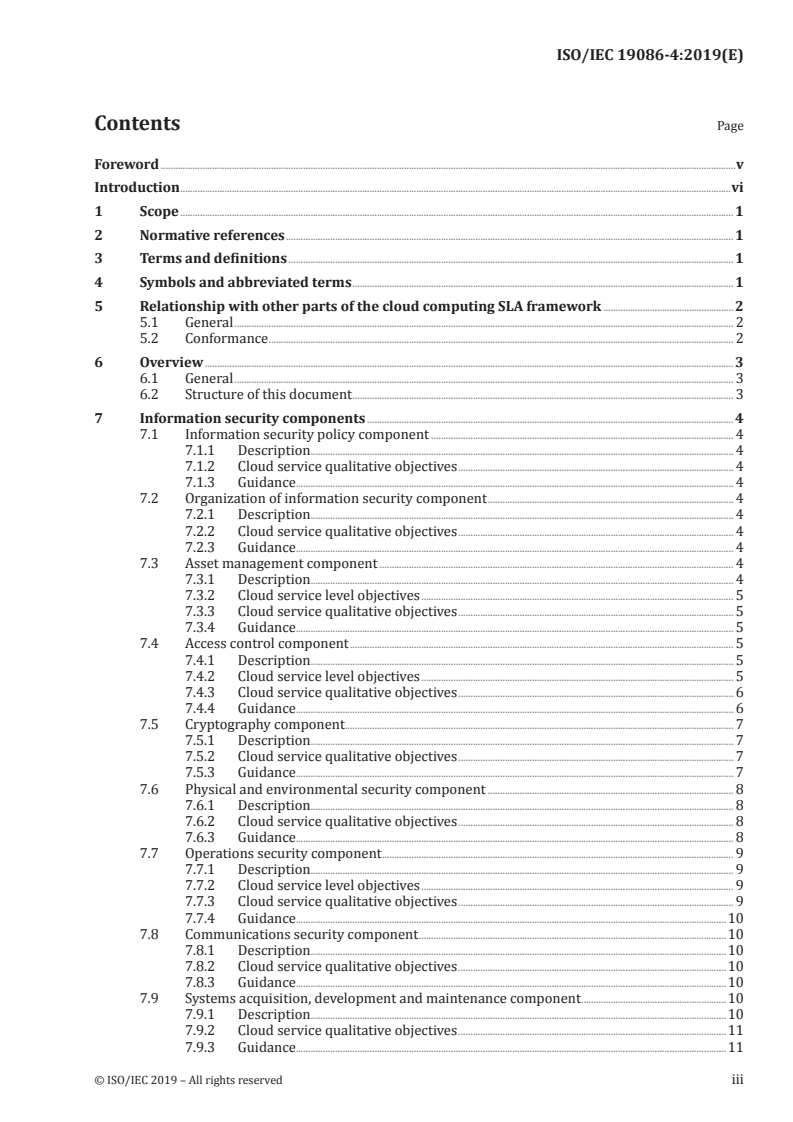
Contents Page
Foreword .v
Introduction .vi
1 Scope . 1
2 Normative references . 1
3 Terms and definitions . 1
4 Symbols and abbreviated terms . 1
5 Relationship with other parts of the cloud computing SLA framework .2
5.1 General . 2
5.2 Conformance . 2
6 Overview . 3
6.1 General . 3
6.2 Structure of this document . 3
7 Information security components . 4
7.1 Information security policy component . 4
7.1.1 Description . . . 4
7.1.2 Cloud service qualitative objectives . 4
7.1.3 Guidance. 4
7.2 Organization of information security component . 4
7.2.1 Description . . . 4
7.2.2 Cloud service qualitative objectives . 4
7.2.3 Guidance. 4
7.3 Asset management component . 4
7.3.1 Description . . . 4
7.3.2 Cloud service level objectives . 5
7.3.3 Cloud service qualitative objectives . 5
7.3.4 Guidance. 5
7.4 Access control component . 5
7.4.1 Description . . . 5
7.4.2 Cloud service level objectives . 5
7.4.3 Cloud service qualitative objectives . 6
7.4.4 Guidance. 6
7.5 Cryptography component . 7
7.5.1 Description . . . 7
7.5.2 Cloud service qualitative objectives . 7
7.5.3 Guidance. 7
7.6 Physical and environmental security component . 8
7.6.1 Description . . . 8
7.6.2 Cloud service qualitative objectives . 8
7.6.3 Guidance. 8
7.7 Operations security component . 9
7.7.1 Description . . . 9
7.7.2 Cloud service level objectives . 9
7.7.3 Cloud service qualitative objectives . 9
7.7.4 Guidance.10
7.8 Communications security component .10
7.8.1 Description . . .10
7.8.2 Cloud service qualitative objectives .10
7.8.3 Guidance.10
7.9 Systems acquisition, development and maintenance component .10
7.9.1 Description . . .10
7.9.2 Cloud service qualitative objectives .11
7.9.3 Guidance.11
© ISO/IEC 2019 – All rights reserved iii
7.10 Supplier relationships component .11
7.10.1 Description . . .11
7.10.2 Cloud service qualitative objectives .11
7.10.3 Guidance.12
7.11 Information security incident management component .12
7.11.1 Description . . .12
7.11.2 Cloud service level objectives .12
7.11.3 Cloud service qualitative objectives .12
7.11.4 Guidance.12
7.12 Business continuity management component .12
7.12.1 Description . . .12
7.12.2 Cloud service qualitative objectives .12
7.12.3 Guidance.13
7.13 Compliance component .13
7.13.1 Description . . .13
7.13.2 Cloud service qualitative objectives .13
7.13.3 Guidance.13
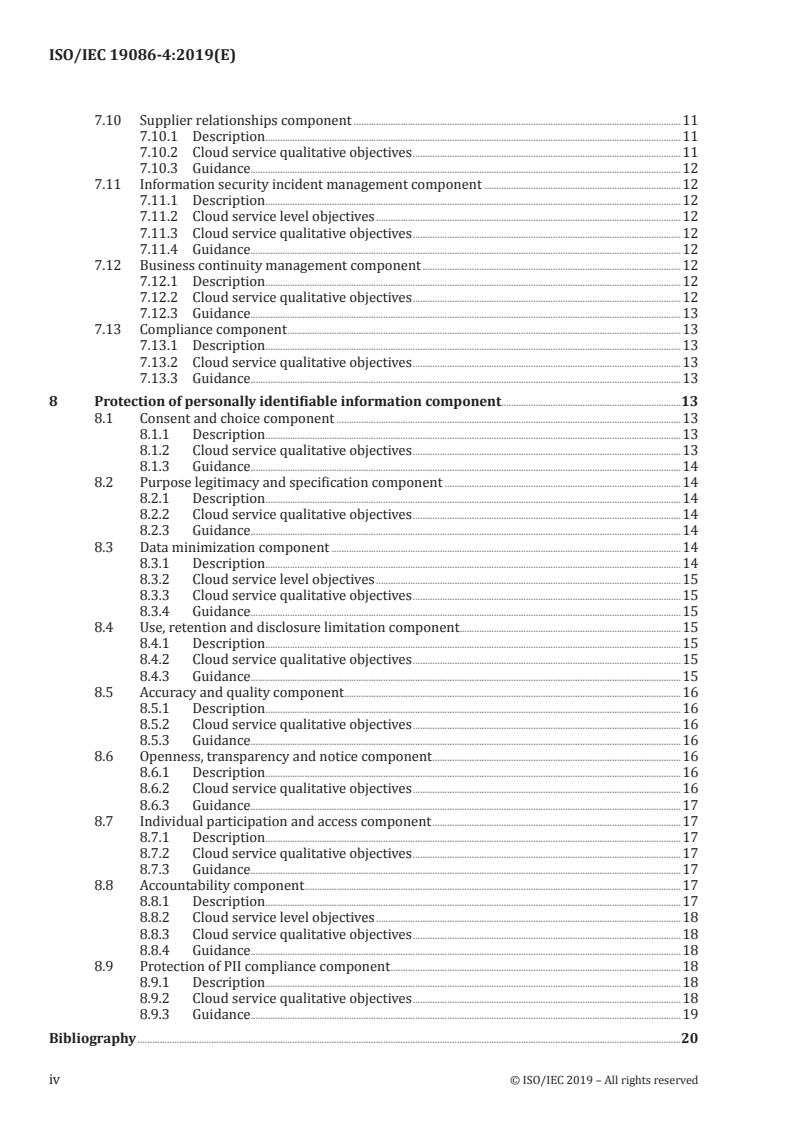
8 Protection of personally identifiable information component.13
8.1 Consent and choice component .13
8.1.1 Description . . .13
8.1.2 Cloud service qualitative objectives .13
8.1.3 Guidance.14
8.2 Purpose legitimacy and specification component .14
8.2.1 Description . . .14
8.2.2 Cloud service qualitative objectives .14
8.2.3 Guidance.14
8.3 Data minimization component .14
8.3.1 Description . . .14
8.3.2 Cloud service level objectives .15
8.3.3 Cloud service qualitative objectives .15
8.3.4 Guidance.15
8.4 Use, retention and disclosure limitation component.15
8.4.1 Description . . .15
8.4.2 Cloud service qualitative objectives .15
8.4.3 Guidance.15
8.5 Accuracy and quality component.16
8.5.1 Description . . .16
8.5.2 Cloud service qualitative objectives .16
8.5.3 Guidance.16
8.6 Openness, transparency and notice component .16
8.6.1 Description . . .16
8.6.2 Cloud service qualitative objectives .16
8.6.3 Guidance.17
8.7 Individual participation and access component .17
8.7.1 Description . . .17
8.7.2 Cloud service qualitative objectives .17
8.7.3 Guidance.17
8.8 Accountability component .17
8.8.1 Description . . .17
8.8.2 Cloud service level objectives .18
8.8.3 Cloud service qualitative objectives .18
8.8.4 Guidance.18
8.9 Protection of PII compliance component .18
8.9.1 Description . . .18
8.9.2 Cloud service qualitative objectives .18
8.9.3 Guidance.19
Bibliography .20
iv © ISO/IEC 2019 – All rights reserved
Foreword
ISO (the International Organization for Standardization) and IEC (the International Electrotechnical
Commission) form the specialized system for worldwide standardization. National bodies that
are members of ISO or IEC participate in the development of International Standards through
technical committees established by the respective organization to deal with particular fields of
technical activity. ISO and IEC technical committees collaborate in fields of mutual interest. Other
international organizations, governmental and non-governmental, in liaison with ISO and IEC, also
take part in the work.
The procedures used to develop this document and those intended for its further maintenance are
described in the ISO/IEC Directives, Part 1. In particular, the different approval criteria needed for
the different types of document should be noted. This document was drafted in accordance with the
editorial rules of the ISO/IEC Directives, Part 2 (see www .iso .org/directives).
Attention is drawn to the possibility that some of the elements of this document may be the subject
of patent rights. ISO and IEC shall not be held responsible for identifying any or all such patent
rights. Details of any patent rights identified during the development of the document will be in the
Introduction and/or on the ISO list of patent declarations received (see www .iso .org/patents) or the IEC
list of patent declarations received (see http: //patents .iec .ch).
Any trade name used in this document is information given for the convenience of users and does not
constitute an endorsement.
For an explanation of the voluntary nature of standards, the meaning of ISO specific terms and
expressions related to conformity assessment, as well as information about ISO's adherence to the
World Trade Organization (WTO) principles in the Technical Barriers to Trade (TBT) see www .iso
.org/iso/foreword .html.
This document was prepared by Joint Technical Committee ISO/IEC JTC 1, Information technology,
Subcommittee SC 27, IT Security techniques.
A list of all parts in the ISO/IEC 19086 series can be found in the ISO website.
Any feedback or questions on this document should be directed to the user’s national standards body. A
complete listing of these bodies can be found at www .iso .org/members .html.
© ISO/IEC 2019 – All rights reserved v
Introduction
This document can be used by any organization or individual involved in the creation, modification
or understanding of a cloud service level agreement which conforms to ISO/IEC 19086 (all parts).
The cloud SLA accounts for the key characteristics of a cloud service and aims to facilitate a common
understanding between cloud service providers (CSPs) and cloud service customers (CSCs).
This document builds on the foundational concepts and definitions described by ISO/IEC 19086-1.
Figure 1 — Relationship of parts of ISO/IEC 19086 (all parts) and other cloud computing
standards
Figure 1 presents an overview of the content of the ISO/IEC 19086 series and the relationships between
the parts of ISO/IEC 19086 and other key International Standards relating to cloud computing.
vi © ISO/IEC 2019 – All rights reserved
INTERNATIONAL STANDARD ISO/IEC 19086-4:2019(E)
Cloud computing — Service level agreement (SLA)
framework —
Part 4:
Components of security and of protection of PII
1 Scope
This document specifies security and protection of personally identifiable information components,
SLOs and SQOs for cloud service level agreements (cloud SLA) including requirements and guidance.
This document is for the benefit and use of both CSPs and CSCs.
2 Normative references
The following documents are referred to in the text in such a way that some or all of their content
constitutes requirements of this document. For dated references, only the edition cited applies. For
undated references, the latest edition of the referenced document (including any amendments) applies.
ISO/IEC 17788, Information technology — Cloud computing — Overview and vocabulary
ISO/IEC 19086-1, Information technology — Cloud computing—Service level agreement (SLA)
framework — Part 1: Overview and concepts
ISO/IEC 27017, Information technology — Security techniques — Code of practice for information security
controls based on ISO/IEC 27002 for cloud services
ISO/IEC 27018, Information technology — Security techniques — Code of practice for protection of
personally identifiable information (PII) in public clouds acting as PII processors
ISO/IEC 29100, Information technology — Security techniques — Privacy framework
3 Terms and definitions
For the purposes of this document, the terms and definitions given in ISO/IEC 17788, ISO/IEC 19086-1,
ISO/IEC 27017, ISO/IEC 27018, ISO/IEC 29100 apply.
ISO and IEC maintain terminological databases for use in standardization at the following addresses:
— ISO Online browsing platform: available at https: //www .iso .org/obp
— IEC Electropedia: available at http: //www .electropedia .org/
4 Symbols and abbreviated terms
CSC cloud service customer
CSP cloud service provider
CSA cloud service agreement
Cloud SLA Cloud service level agreement
© ISO/IEC 2019 – All rights reserved 1
PII personally identifiable information
SLA service level agreement
SLO cloud service level objective
SQO cloud service qualitative objective
VPN virtual private network
5 Relationship with other parts of the cloud computing SLA framework
5.1 General
ISO/IEC 19086-1 provides an overview, foundational concepts, and definitions for the cloud SLA
framework. In particular, it defines the following fundamental concepts of the cloud SLA framework:
— Cloud Service Agreement (CSA);
— Cloud Service Level Agreement (Cloud SLA);
— Cloud Service Level Objectives (SLO);
— Cloud Service Qualitative Objectives (SQO).
ISO/IEC 19086-1 also describes the content areas and components that consist of a list of SLOs and SQOs.
ISO/IEC 19086-2 provides a metric model to be used for specifying metrics used for cloud SLAs.
ISO/IEC 19086-3 provides the core conformance requirements derived from the SLOs and SQOs defined
in ISO/IEC 19086-1.
This document builds on the foundational concepts and definitions described by ISO/IEC 19086-1 to
address security and protection of PII components.
ISO/IEC 19086 (all parts) is intended to facilitate a common understanding between CSCs and CSPs.
Cloud service agreements and their associated cloud SLAs vary between CSPs, and in some cases
different CSCs can negotiate different contract terms with the same CSP for a particular cloud service.
This document aims to assist CSCs when they compare cloud services from different CSPs, with respect
to material that covers security and protection of personally identifiable information. This document
should be used in conjunction with ISO/IEC 19086-1 for a full understanding of a cloud SLA.
5.2 Conformance
ISO/IEC 19086-3:2017, Clause 5 describes conformance for a cloud SLA in the context of ISO/IEC 19086-1.
This document follows the same principle regarding a conforming cloud SLA. In each of the components
identified in this document in the areas of security (Clause 7) and protection of PII (Clause 8), there are
one or more SLOs or SQOs. When using one of the components from Clauses 7 or 8, a conforming cloud
SLA is not required to use the SLOs or SQOs described in those components. A conforming cloud SLA
should use SLOs and SQOs from this document, when appropriate. Regardless of whether an SLO or SQO
is used, a CSP shall not redefine any term in such a way that it contradicts the terms and definitions in
ISO/IEC 19086-1 or in this document.
ISO/IEC 19086-2 defines a model for specifying metrics for cloud service level agreements (SLAs).
Conforming cloud SLAs should use the model in ISO/IEC 19086-2 when specifying metrics for SLOs.
A conforming cloud SLA may use a subset of the components described in this document (Clauses 7
and 8) and it may include components outside the scope of this document. However, a conforming
cloud SLA shall adhere to the definition of the terms, components or content areas, as stated in this
document and in ISO/IEC 19086-1, and the requirements as stated in this document. Where a cloud
2 © ISO/IEC 2019 – All rights reserved
SLA contains a specific component or content area, it shall adhere to all the requirements specified for
that component or content area. Conformance to this document does not require implementation of any
specific technology.
6 Overview
6.1 General
This document builds on foundational cloud SLA concepts covered in general in ISO/IEC 19086-1. A
description of each security or protection of PII component is provided with applicable SLOs and SQOs.
As explained in ISO/IEC 19086-1, a CSP can offer more than one SLO, SQO or both.
The specific components and the conformance requirements for SLOs and SQOs in the area of security
and protection of PII are detailed in this document. The security components (7.1 to 7.13) follow
the structure of ISO/IEC 27002 and the cloud-specific information security controls defined in ISO/
IEC 27017. The protection of PII components (8.1 to 8.9) follow the structure of ISO/IEC 29100 and the
cloud-specific PII related controls defined in ISO/IEC 27018.
Using the definitions of SLO and SQO stated in ISO/IEC 19086-1 and the metric model described in ISO/
IEC 19086-2, CSPs are able to specify their SLOs and SQOs. A CSC can then express its requirements for
the covered services using the same SLOs and SQOs as the CSP. This allows the CSC to directly compare
its requirements to determine which CSP’s capabilities best meet the CSC’s requirements. Further
guidance on evaluating SQOs and SLOs, and accepting cloud SLAs, is provided in ISO/IEC 19086-
1:2016, 7.3.
6.2 Structure of this document
The order of the clauses in this document does not imply their importance or priority. Each component
for security and protection of PII should be considered according to cloud service categories, cloud
capabilities types and cloud deployment models (see ISO/IEC 17788).
Components are structured as follows:
1) Description: describes the specific component. Description of the core conformance requirements
and the guidance on those core requirements for each specific component.
2) List of SLOs and SQOs: describes the relevant SLOs and SQOs.
The definition of an SLO is provided in ISO/IEC 19086-1 as follows: “commitment a cloud service
provider makes for a specific, quantitative characteristic of a cloud service, where the value follows
the interval scale or ratio scale”.
The definition of an SQO is provided in ISO/IEC 19086-1 as follows: “commitment a cloud service
provider makes for a specific, qualitative characteristic of a cloud service, where the value follows
the nominal scale or ordinal scale”. Description of the core conformance requirements and the
guidance on those core requirements for each specific component.
3) Guidance: provides more detailed information to support the implementation of the SLO or SQO. It
is possible that the guidance is not entirely suitable or sufficient in all situations and does not fulfil
the CSP’s specific SLO or SQO requirements.
© ISO/IEC 2019 – All rights reserved 3
7 Information security components
7.1 Information security policy component
7.1.1 Description
Information security policies describe the policy and/or the process for securing the provision,
operation and maintenance of the covered services.
An information security policy component shall specify the information security policy that applies to
the covered services.
7.1.2 Cloud service qualitative objectives
Information security policy
A statement that describes the CSP’s policies and processes for securing the covered services.
An information security policy SQO shall describe the information security policy that relates to the
covered services.
7.1.3 Guidance
Information about information security policies can be found in ISO/IEC 27002 and ISO/IEC 27017.
NOTE ISO/IEC 27017:2015, 5.1.1 describes what the information security policy should encompass.
7.2 Organization of information security component
7.2.1 Description
The organization of information security component describes the separation of roles and
responsibilities between the CSP and the CSC.
An organization of information security component shall specify roles and responsibilities in relation
to the covered services.
7.2.2 Cloud service qualitative objectives
Allocation of roles and responsibilities
A statement of the separation of the roles and responsibilities between the CSP and the CSC.
An allocation of roles and responsibilities SQO shall provide a statement of the allocation of roles and
responsibilities between the CSC and the CSP for the covered services.
7.2.3 Guidance
Information about the organization of information security component can be found in ISO/IEC 27002
and ISO/IEC 27017.
7.3 Asset management component
7.3.1 Description
The asset management component deals with identifying the assets covered and defining the
responsibilities regarding those assets, in terms of the CSC or the CSP. Assets can include hardware,
software and/or data, in terms of the CSC or the CSP.
4 © ISO/IEC 2019 – All rights reserved
An asset management component shall specify the assets and responsibilities relating to those assets in
relation to the covered services.
7.3.2 Cloud service level objectives
Asset data update frequency
The maximum interval between refreshes of the asset database.
An asset data update frequency SLO shall specify the maximum interval between refreshes of the asset
database.
7.3.3 Cloud service qualitative objectives
Asset and responsibility inventory
A list of the assets or categories of assets and the responsibilities, in terms of the CSC or the CSP,
regarding those assets or categories of assets relating to the covered services.
An asset and responsibility SQO shall provide a list of the assets and the responsibilities regarding
those assets for the covered services.
7.3.4 Guidance
Additional information about categories of data types, expressed as a taxonomy, that can be used to
describe those assets can be found in ISO/IEC 19944.
Additional information about asset management can be found in ISO/IEC 27017:2015, Clause 8.
7.4 Access control component
7.4.1 Description
The access control component deals with the access controls in place for the covered services, including
the service access, administration access and business access as described in ISO/IEC 17789.
An access control component shall specify the access controls relating to the covered services.
7.4.2 Cloud service level objectives
7.4.2.1 Maximum time required to revoke user access
The maximum time required to revoke user access to the covered services.
A maximum time required to revoke user access SLO shall provide the maximum time to revoke access
to the covered services.
7.4.2.2 Time required to revoke user access at a specified commitment level
The time required to revoke user access to the covered services for at least the specified fraction of all
such requests. For example, 95 % of user revocation requested is completed within two hours.
A time required to revoke user access at a specified commitment level SLO shall provide a specified
lower bound on the percentile of user revocation requests that shall be completed within the specified
upper bound on elapsed time.
© ISO/IEC 2019 – All rights reserved 5
7.4.3 Cloud service qualitative objectives
7.4.3.1 User registration and de-registration
A statement describing the process used for registering and de-registering cloud service users for the
covered services.
A user registration and de-registration SQO shall specify the process used for registering and de-
registering cloud service users for the covered services.
7.4.3.2 Review access patterns
A statement describing the capabilities to support review of access patterns and to proactively identify
and mitigate potential threats.
A review access patterns SQO shall provide a statement describing the capabilities for review of access
patterns and to identify and mitigate potential threats for the covered services.
7.4.3.3 Authentication mechanism
A description of the available authentication mechanisms supported by the CSP on the covered services.
A description of the available authentication mechanisms for both users and administrators supported
by the CSP on its covered services.
An authentication mechanism SQO shall provide a description of the available authentication
mechanisms for the covered services.
7.4.3.4 Third-party authentication support
A description of what third-party authentication mechanisms are supported by the CSP.
A third-party authentication support SQO shall provide a description of the available third-party
authentication mechanisms for the covered services.
7.4.3.5 Strong authentication support
A description of any strong authentication mechanisms which can be used to control CSC’s access to
covered services. This includes for example multi-factor authentication.
A strong authentication support SQO shall provide a description of the available strong authentication
mechanisms for the covered services.
7.4.3.6 Anonymous and pseudonymous authentication support
A description of available mechanisms for anonymous and pseudonymous authentication support
provided for the covered services.
An anonymous and pseudonymous authentication support SQO shall provide a description of the
available mechanisms for anonymous and pseudonymous authentication support for the covered
services.
7.4.4 Guidance
Access control guidance for cloud computing is given in ISO/IEC 27017 and ISO/IEC 27002.
Additional information about access control can be found in ISO/IEC 27002.
6 © ISO/IEC 2019 – All rights reserved
7.5 Cryptography component
7.5.1 Description
A description of cryptographic controls that the CSP offers to the CSC for the covered services. The
controls are given for the three states of data in motion, data at rest and data during execution.
Cryptography is described in ISO/IEC 27002.
A cryptography component shall specify the cryptographic controls relating to the covered services.
The specification shall include an identifier for the protocols and algorithms used, as well as a definition
of their cryptographic strength such that controls become comparable for the CSC.
7.5.2 Cloud service qualitative objectives
7.5.2.1 Cryptographic controls for data in motion
A description of the cryptographic controls available for data in motion associated with the covered
services.
NOTE These controls provide for securing data with respect to confidentiality and integrity, while being
transferred within a covered service, between covered services, and between the CSC and the covered services.
A cryptographic controls for data in motion SQO shall describe the cryptographic controls for the
protection of data in motion.
7.5.2.2 Cryptographic controls for data at rest
A description of the cryptographic controls available for data at rest associated with the covered
services.
NOTE These controls provide for securing data with respect to confidentiality and integrity, while being
stored in the covered services.
A cryptographic controls for data at rest SQO shall describe the cryptographic controls available for the
protection of data at rest.
7.5.2.3 Cryptographic controls for data during execution
A description of the cryptographic controls available for data during execution associated with the
covered services.
NOTE These controls provide for securing data with respect to confidentiality and integrity, while being
processed in the covered services.
A cryptographic controls for data during execution SQO shall describe the cryptographic controls
available for the protection of data during execution.
7.5.2.4 Key management policy
A statement describing the key management policy for the covered services which can include any
mechanisms in place to isolate customer controlled keys from the CSP.
A key management policy SQO shall provide a description of the key management policy for the covered
services.
7.5.3 Guidance
Cryptographic controls are described in ISO/IEC 27002.
© ISO/IEC 2019 – All rights reserved 7
ISO/IEC 27040 provides definitions for data in motion and data at rest.
7.6 Physical and environmental security component
7.6.1 Description
The physical and environmental security component describes the security processes and controls
provided by the CSP to protect the physical facilities used to provide the covered services from loss of
data, connectivity and availability of necessary infrastructure and IT equipment. These processes and
controls should protect the physical facilities from theft, fire, flood, earthquake, intentional destruction,
unintentional damage, mechanical equipment failure and power failures.
Physical facilities include the building shell, infrastructure equipment such as cooling, power
distribution, security and fire protection systems along with IT equipment such as servers, storage
and network equipment. Physical facilities also include any locations, such as operations centres for
monitoring the covered services that can process CSC data, derived data and CSP data.
A physical and environmental security component shall specify the physical security controls relating
to the covered services.
7.6.2 Cloud service qualitative objectives
7.6.2.1 Data centre monitoring
A statement describing the monitoring done on data centres used for the covered services. This is
covered in ISO/IEC 19086-1:2016, 9.4.
A data centre monitoring SQO shall describe the monitoring of the data centres used for the covered
services.
7.6.2.2 Secure disposal and re-use of equipment
A description of processes for the secure disposal and re-use of equipment.
A secure disposal and re-use of equipment SQO shall describe the processes for secure disposal and re-
use of equipment related to the covered services.
The secure disposal and re-use of equipment process shall ensure that data is deleted from storage
devices, and state how devices no longer in use are disposed of. ISO/IEC 19086-1:2016, 10.12.8 covers
the cloud SLA data deletion component.
7.6.2.3 Facilities authorization
A statement describing the policy and process for granting access to the facilities used to provide the
covered services.
A facilities authorization SQO shall describe the policy and process for granting access to the facilities
used for the covered services.
7.6.3 Guidance
Information on physical and environmental security can be found in ISO/IEC 27002.
Information on techniques for data deletion from storage devices can be found in ISO/IEC 27040.
8 © ISO/IEC 2019 – All rights reserved
7.7 Operations security component
7.7.1 Description
An operations security component specifies processes that secure the covered services during the
operation of the covere
...
INTERNATIONAL ISO/IEC
STANDARD 19086-4
First edition
2019-01
Cloud computing — Service level
agreement (SLA) framework —
Part 4:
Components of security and of
protection of PII
Informatique en nuage — Cadre de travail de l'accord du niveau de
service —
Partie 4: Eléments de sécurité et de protection des PII
Reference number
©
ISO/IEC 2019
© ISO/IEC 2019
All rights reserved. Unless otherwise specified, or required in the context of its implementation, no part of this publication may
be reproduced or utilized otherwise in any form or by any means, electronic or mechanical, including photocopying, or posting
on the internet or an intranet, without prior written permission. Permission can be requested from either ISO at the address
below or ISO’s member body in the country of the requester.
ISO copyright office
CP 401 • Ch. de Blandonnet 8
CH-1214 Vernier, Geneva
Phone: +41 22 749 01 11
Fax: +41 22 749 09 47
Email: copyright@iso.org
Website: www.iso.org
Published in Switzerland
ii © ISO/IEC 2019 – All rights reserved
Contents Page
Foreword .v
Introduction .vi
1 Scope . 1
2 Normative references . 1
3 Terms and definitions . 1
4 Symbols and abbreviated terms . 1
5 Relationship with other parts of the cloud computing SLA framework .2
5.1 General . 2
5.2 Conformance . 2
6 Overview . 3
6.1 General . 3
6.2 Structure of this document . 3
7 Information security components . 4
7.1 Information security policy component . 4
7.1.1 Description . . . 4
7.1.2 Cloud service qualitative objectives . 4
7.1.3 Guidance. 4
7.2 Organization of information security component . 4
7.2.1 Description . . . 4
7.2.2 Cloud service qualitative objectives . 4
7.2.3 Guidance. 4
7.3 Asset management component . 4
7.3.1 Description . . . 4
7.3.2 Cloud service level objectives . 5
7.3.3 Cloud service qualitative objectives . 5
7.3.4 Guidance. 5
7.4 Access control component . 5
7.4.1 Description . . . 5
7.4.2 Cloud service level objectives . 5
7.4.3 Cloud service qualitative objectives . 6
7.4.4 Guidance. 6
7.5 Cryptography component . 7
7.5.1 Description . . . 7
7.5.2 Cloud service qualitative objectives . 7
7.5.3 Guidance. 7
7.6 Physical and environmental security component . 8
7.6.1 Description . . . 8
7.6.2 Cloud service qualitative objectives . 8
7.6.3 Guidance. 8
7.7 Operations security component . 9
7.7.1 Description . . . 9
7.7.2 Cloud service level objectives . 9
7.7.3 Cloud service qualitative objectives . 9
7.7.4 Guidance.10
7.8 Communications security component .10
7.8.1 Description . . .10
7.8.2 Cloud service qualitative objectives .10
7.8.3 Guidance.10
7.9 Systems acquisition, development and maintenance component .10
7.9.1 Description . . .10
7.9.2 Cloud service qualitative objectives .11
7.9.3 Guidance.11
© ISO/IEC 2019 – All rights reserved iii
7.10 Supplier relationships component .11
7.10.1 Description . . .11
7.10.2 Cloud service qualitative objectives .11
7.10.3 Guidance.12
7.11 Information security incident management component .12
7.11.1 Description . . .12
7.11.2 Cloud service level objectives .12
7.11.3 Cloud service qualitative objectives .12
7.11.4 Guidance.12
7.12 Business continuity management component .12
7.12.1 Description . . .12
7.12.2 Cloud service qualitative objectives .12
7.12.3 Guidance.13
7.13 Compliance component .13
7.13.1 Description . . .13
7.13.2 Cloud service qualitative objectives .13
7.13.3 Guidance.13
8 Protection of personally identifiable information component.13
8.1 Consent and choice component .13
8.1.1 Description . . .13
8.1.2 Cloud service qualitative objectives .13
8.1.3 Guidance.14
8.2 Purpose legitimacy and specification component .14
8.2.1 Description . . .14
8.2.2 Cloud service qualitative objectives .14
8.2.3 Guidance.14
8.3 Data minimization component .14
8.3.1 Description . . .14
8.3.2 Cloud service level objectives .15
8.3.3 Cloud service qualitative objectives .15
8.3.4 Guidance.15
8.4 Use, retention and disclosure limitation component.15
8.4.1 Description . . .15
8.4.2 Cloud service qualitative objectives .15
8.4.3 Guidance.15
8.5 Accuracy and quality component.16
8.5.1 Description . . .16
8.5.2 Cloud service qualitative objectives .16
8.5.3 Guidance.16
8.6 Openness, transparency and notice component .16
8.6.1 Description . . .16
8.6.2 Cloud service qualitative objectives .16
8.6.3 Guidance.17
8.7 Individual participation and access component .17
8.7.1 Description . . .17
8.7.2 Cloud service qualitative objectives .17
8.7.3 Guidance.17
8.8 Accountability component .17
8.8.1 Description . . .17
8.8.2 Cloud service level objectives .18
8.8.3 Cloud service qualitative objectives .18
8.8.4 Guidance.18
8.9 Protection of PII compliance component .18
8.9.1 Description . . .18
8.9.2 Cloud service qualitative objectives .18
8.9.3 Guidance.19
Bibliography .20
iv © ISO/IEC 2019 – All rights reserved
Foreword
ISO (the International Organization for Standardization) and IEC (the International Electrotechnical
Commission) form the specialized system for worldwide standardization. National bodies that
are members of ISO or IEC participate in the development of International Standards through
technical committees established by the respective organization to deal with particular fields of
technical activity. ISO and IEC technical committees collaborate in fields of mutual interest. Other
international organizations, governmental and non-governmental, in liaison with ISO and IEC, also
take part in the work.
The procedures used to develop this document and those intended for its further maintenance are
described in the ISO/IEC Directives, Part 1. In particular, the different approval criteria needed for
the different types of document should be noted. This document was drafted in accordance with the
editorial rules of the ISO/IEC Directives, Part 2 (see www .iso .org/directives).
Attention is drawn to the possibility that some of the elements of this document may be the subject
of patent rights. ISO and IEC shall not be held responsible for identifying any or all such patent
rights. Details of any patent rights identified during the development of the document will be in the
Introduction and/or on the ISO list of patent declarations received (see www .iso .org/patents) or the IEC
list of patent declarations received (see http: //patents .iec .ch).
Any trade name used in this document is information given for the convenience of users and does not
constitute an endorsement.
For an explanation of the voluntary nature of standards, the meaning of ISO specific terms and
expressions related to conformity assessment, as well as information about ISO's adherence to the
World Trade Organization (WTO) principles in the Technical Barriers to Trade (TBT) see www .iso
.org/iso/foreword .html.
This document was prepared by Joint Technical Committee ISO/IEC JTC 1, Information technology,
Subcommittee SC 27, IT Security techniques.
A list of all parts in the ISO/IEC 19086 series can be found in the ISO website.
Any feedback or questions on this document should be directed to the user’s national standards body. A
complete listing of these bodies can be found at www .iso .org/members .html.
© ISO/IEC 2019 – All rights reserved v
Introduction
This document can be used by any organization or individual involved in the creation, modification
or understanding of a cloud service level agreement which conforms to ISO/IEC 19086 (all parts).
The cloud SLA accounts for the key characteristics of a cloud service and aims to facilitate a common
understanding between cloud service providers (CSPs) and cloud service customers (CSCs).
This document builds on the foundational concepts and definitions described by ISO/IEC 19086-1.
Figure 1 — Relationship of parts of ISO/IEC 19086 (all parts) and other cloud computing
standards
Figure 1 presents an overview of the content of the ISO/IEC 19086 series and the relationships between
the parts of ISO/IEC 19086 and other key International Standards relating to cloud computing.
vi © ISO/IEC 2019 – All rights reserved
INTERNATIONAL STANDARD ISO/IEC 19086-4:2019(E)
Cloud computing — Service level agreement (SLA)
framework —
Part 4:
Components of security and of protection of PII
1 Scope
This document specifies security and protection of personally identifiable information components,
SLOs and SQOs for cloud service level agreements (cloud SLA) including requirements and guidance.
This document is for the benefit and use of both CSPs and CSCs.
2 Normative references
The following documents are referred to in the text in such a way that some or all of their content
constitutes requirements of this document. For dated references, only the edition cited applies. For
undated references, the latest edition of the referenced document (including any amendments) applies.
ISO/IEC 17788, Information technology — Cloud computing — Overview and vocabulary
ISO/IEC 19086-1, Information technology — Cloud computing—Service level agreement (SLA)
framework — Part 1: Overview and concepts
ISO/IEC 27017, Information technology — Security techniques — Code of practice for information security
controls based on ISO/IEC 27002 for cloud services
ISO/IEC 27018, Information technology — Security techniques — Code of practice for protection of
personally identifiable information (PII) in public clouds acting as PII processors
ISO/IEC 29100, Information technology — Security techniques — Privacy framework
3 Terms and definitions
For the purposes of this document, the terms and definitions given in ISO/IEC 17788, ISO/IEC 19086-1,
ISO/IEC 27017, ISO/IEC 27018, ISO/IEC 29100 apply.
ISO and IEC maintain terminological databases for use in standardization at the following addresses:
— ISO Online browsing platform: available at https: //www .iso .org/obp
— IEC Electropedia: available at http: //www .electropedia .org/
4 Symbols and abbreviated terms
CSC cloud service customer
CSP cloud service provider
CSA cloud service agreement
Cloud SLA Cloud service level agreement
© ISO/IEC 2019 – All rights reserved 1
PII personally identifiable information
SLA service level agreement
SLO cloud service level objective
SQO cloud service qualitative objective
VPN virtual private network
5 Relationship with other parts of the cloud computing SLA framework
5.1 General
ISO/IEC 19086-1 provides an overview, foundational concepts, and definitions for the cloud SLA
framework. In particular, it defines the following fundamental concepts of the cloud SLA framework:
— Cloud Service Agreement (CSA);
— Cloud Service Level Agreement (Cloud SLA);
— Cloud Service Level Objectives (SLO);
— Cloud Service Qualitative Objectives (SQO).
ISO/IEC 19086-1 also describes the content areas and components that consist of a list of SLOs and SQOs.
ISO/IEC 19086-2 provides a metric model to be used for specifying metrics used for cloud SLAs.
ISO/IEC 19086-3 provides the core conformance requirements derived from the SLOs and SQOs defined
in ISO/IEC 19086-1.
This document builds on the foundational concepts and definitions described by ISO/IEC 19086-1 to
address security and protection of PII components.
ISO/IEC 19086 (all parts) is intended to facilitate a common understanding between CSCs and CSPs.
Cloud service agreements and their associated cloud SLAs vary between CSPs, and in some cases
different CSCs can negotiate different contract terms with the same CSP for a particular cloud service.
This document aims to assist CSCs when they compare cloud services from different CSPs, with respect
to material that covers security and protection of personally identifiable information. This document
should be used in conjunction with ISO/IEC 19086-1 for a full understanding of a cloud SLA.
5.2 Conformance
ISO/IEC 19086-3:2017, Clause 5 describes conformance for a cloud SLA in the context of ISO/IEC 19086-1.
This document follows the same principle regarding a conforming cloud SLA. In each of the components
identified in this document in the areas of security (Clause 7) and protection of PII (Clause 8), there are
one or more SLOs or SQOs. When using one of the components from Clauses 7 or 8, a conforming cloud
SLA is not required to use the SLOs or SQOs described in those components. A conforming cloud SLA
should use SLOs and SQOs from this document, when appropriate. Regardless of whether an SLO or SQO
is used, a CSP shall not redefine any term in such a way that it contradicts the terms and definitions in
ISO/IEC 19086-1 or in this document.
ISO/IEC 19086-2 defines a model for specifying metrics for cloud service level agreements (SLAs).
Conforming cloud SLAs should use the model in ISO/IEC 19086-2 when specifying metrics for SLOs.
A conforming cloud SLA may use a subset of the components described in this document (Clauses 7
and 8) and it may include components outside the scope of this document. However, a conforming
cloud SLA shall adhere to the definition of the terms, components or content areas, as stated in this
document and in ISO/IEC 19086-1, and the requirements as stated in this document. Where a cloud
2 © ISO/IEC 2019 – All rights reserved
SLA contains a specific component or content area, it shall adhere to all the requirements specified for
that component or content area. Conformance to this document does not require implementation of any
specific technology.
6 Overview
6.1 General
This document builds on foundational cloud SLA concepts covered in general in ISO/IEC 19086-1. A
description of each security or protection of PII component is provided with applicable SLOs and SQOs.
As explained in ISO/IEC 19086-1, a CSP can offer more than one SLO, SQO or both.
The specific components and the conformance requirements for SLOs and SQOs in the area of security
and protection of PII are detailed in this document. The security components (7.1 to 7.13) follow
the structure of ISO/IEC 27002 and the cloud-specific information security controls defined in ISO/
IEC 27017. The protection of PII components (8.1 to 8.9) follow the structure of ISO/IEC 29100 and the
cloud-specific PII related controls defined in ISO/IEC 27018.
Using the definitions of SLO and SQO stated in ISO/IEC 19086-1 and the metric model described in ISO/
IEC 19086-2, CSPs are able to specify their SLOs and SQOs. A CSC can then express its requirements for
the covered services using the same SLOs and SQOs as the CSP. This allows the CSC to directly compare
its requirements to determine which CSP’s capabilities best meet the CSC’s requirements. Further
guidance on evaluating SQOs and SLOs, and accepting cloud SLAs, is provided in ISO/IEC 19086-
1:2016, 7.3.
6.2 Structure of this document
The order of the clauses in this document does not imply their importance or priority. Each component
for security and protection of PII should be considered according to cloud service categories, cloud
capabilities types and cloud deployment models (see ISO/IEC 17788).
Components are structured as follows:
1) Description: describes the specific component. Description of the core conformance requirements
and the guidance on those core requirements for each specific component.
2) List of SLOs and SQOs: describes the relevant SLOs and SQOs.
The definition of an SLO is provided in ISO/IEC 19086-1 as follows: “commitment a cloud service
provider makes for a specific, quantitative characteristic of a cloud service, where the value follows
the interval scale or ratio scale”.
The definition of an SQO is provided in ISO/IEC 19086-1 as follows: “commitment a cloud service
provider makes for a specific, qualitative characteristic of a cloud service, where the value follows
the nominal scale or ordinal scale”. Description of the core conformance requirements and the
guidance on those core requirements for each specific component.
3) Guidance: provides more detailed information to support the implementation of the SLO or SQO. It
is possible that the guidance is not entirely suitable or sufficient in all situations and does not fulfil
the CSP’s specific SLO or SQO requirements.
© ISO/IEC 2019 – All rights reserved 3
7 Information security components
7.1 Information security policy component
7.1.1 Description
Information security policies describe the policy and/or the process for securing the provision,
operation and maintenance of the covered services.
An information security policy component shall specify the information security policy that applies to
the covered services.
7.1.2 Cloud service qualitative objectives
Information security policy
A statement that describes the CSP’s policies and processes for securing the covered services.
An information security policy SQO shall describe the information security policy that relates to the
covered services.
7.1.3 Guidance
Information about information security policies can be found in ISO/IEC 27002 and ISO/IEC 27017.
NOTE ISO/IEC 27017:2015, 5.1.1 describes what the information security policy should encompass.
7.2 Organization of information security component
7.2.1 Description
The organization of information security component describes the separation of roles and
responsibilities between the CSP and the CSC.
An organization of information security component shall specify roles and responsibilities in relation
to the covered services.
7.2.2 Cloud service qualitative objectives
Allocation of roles and responsibilities
A statement of the separation of the roles and responsibilities between the CSP and the CSC.
An allocation of roles and responsibilities SQO shall provide a statement of the allocation of roles and
responsibilities between the CSC and the CSP for the covered services.
7.2.3 Guidance
Information about the organization of information security component can be found in ISO/IEC 27002
and ISO/IEC 27017.
7.3 Asset management component
7.3.1 Description
The asset management component deals with identifying the assets covered and defining the
responsibilities regarding those assets, in terms of the CSC or the CSP. Assets can include hardware,
software and/or data, in terms of the CSC or the CSP.
4 © ISO/IEC 2019 – All rights reserved
An asset management component shall specify the assets and responsibilities relating to those assets in
relation to the covered services.
7.3.2 Cloud service level objectives
Asset data update frequency
The maximum interval between refreshes of the asset database.
An asset data update frequency SLO shall specify the maximum interval between refreshes of the asset
database.
7.3.3 Cloud service qualitative objectives
Asset and responsibility inventory
A list of the assets or categories of assets and the responsibilities, in terms of the CSC or the CSP,
regarding those assets or categories of assets relating to the covered services.
An asset and responsibility SQO shall provide a list of the assets and the responsibilities regarding
those assets for the covered services.
7.3.4 Guidance
Additional information about categories of data types, expressed as a taxonomy, that can be used to
describe those assets can be found in ISO/IEC 19944.
Additional information about asset management can be found in ISO/IEC 27017:2015, Clause 8.
7.4 Access control component
7.4.1 Description
The access control component deals with the access controls in place for the covered services, including
the service access, administration access and business access as described in ISO/IEC 17789.
An access control component shall specify the access controls relating to the covered services.
7.4.2 Cloud service level objectives
7.4.2.1 Maximum time required to revoke user access
The maximum time required to revoke user access to the covered services.
A maximum time required to revoke user access SLO shall provide the maximum time to revoke access
to the covered services.
7.4.2.2 Time required to revoke user access at a specified commitment level
The time required to revoke user access to the covered services for at least the specified fraction of all
such requests. For example, 95 % of user revocation requested is completed within two hours.
A time required to revoke user access at a specified commitment level SLO shall provide a specified
lower bound on the percentile of user revocation requests that shall be completed within the specified
upper bound on elapsed time.
© ISO/IEC 2019 – All rights reserved 5
7.4.3 Cloud service qualitative objectives
7.4.3.1 User registration and de-registration
A statement describing the process used for registering and de-registering cloud service users for the
covered services.
A user registration and de-registration SQO shall specify the process used for registering and de-
registering cloud service users for the covered services.
7.4.3.2 Review access patterns
A statement describing the capabilities to support review of access patterns and to proactively identify
and mitigate potential threats.
A review access patterns SQO shall provide a statement describing the capabilities for review of access
patterns and to identify and mitigate potential threats for the covered services.
7.4.3.3 Authentication mechanism
A description of the available authentication mechanisms supported by the CSP on the covered services.
A description of the available authentication mechanisms for both users and administrators supported
by the CSP on its covered services.
An authentication mechanism SQO shall provide a description of the available authentication
mechanisms for the covered services.
7.4.3.4 Third-party authentication support
A description of what third-party authentication mechanisms are supported by the CSP.
A third-party authentication support SQO shall provide a description of the available third-party
authentication mechanisms for the covered services.
7.4.3.5 Strong authentication support
A description of any strong authentication mechanisms which can be used to control CSC’s access to
covered services. This includes for example multi-factor authentication.
A strong authentication support SQO shall provide a description of the available strong authentication
mechanisms for the covered services.
7.4.3.6 Anonymous and pseudonymous authentication support
A description of available mechanisms for anonymous and pseudonymous authentication support
provided for the covered services.
An anonymous and pseudonymous authentication support SQO shall provide a description of the
available mechanisms for anonymous and pseudonymous authentication support for the covered
services.
7.4.4 Guidance
Access control guidance for cloud computing is given in ISO/IEC 27017 and ISO/IEC 27002.
Additional information about access control can be found in ISO/IEC 27002.
6 © ISO/IEC 2019 – All rights reserved
7.5 Cryptography component
7.5.1 Description
A description of cryptographic controls that the CSP offers to the CSC for the covered services. The
controls are given for the three states of data in motion, data at rest and data during execution.
Cryptography is described in ISO/IEC 27002.
A cryptography component shall specify the cryptographic controls relating to the covered services.
The specification shall include an identifier for the protocols and algorithms used, as well as a definition
of their cryptographic strength such that controls become comparable for the CSC.
7.5.2 Cloud service qualitative objectives
7.5.2.1 Cryptographic controls for data in motion
A description of the cryptographic controls available for data in motion associated with the covered
services.
NOTE These controls provide for securing data with respect to confidentiality and integrity, while being
transferred within a covered service, between covered services, and between the CSC and the covered services.
A cryptographic controls for data in motion SQO shall describe the cryptographic controls for the
protection of data in motion.
7.5.2.2 Cryptographic controls for data at rest
A description of the cryptographic controls available for data at rest associated with the covered
services.
NOTE These controls provide for securing data with respect to confidentiality and integrity, while being
stored in the covered services.
A cryptographic controls for data at rest SQO shall describe the cryptographic controls available for the
protection of data at rest.
7.5.2.3 Cryptographic controls for data during execution
A description of the cryptographic controls available for data during execution associated with the
covered services.
NOTE These controls provide for securing data with respect to confidentiality and integrity, while being
processed in the covered services.
A cryptographic controls for data during execution SQO shall describe the cryptographic controls
available for the protection of data during execution.
7.5.2.4 Key management policy
A statement describing the key management policy for the covered services which can include any
mechanisms in place to isolate customer controlled keys from the CSP.
A key management policy SQO shall provide a description of the key management policy for the covered
services.
7.5.3 Guidance
Cryptographic controls are described in ISO/IEC 27002.
© ISO/IEC 2019 – All rights reserved 7
ISO/IEC 27040 provides definitions for data in motion and data at rest.
7.6 Physical and environmental security component
7.6.1 Description
The physical and environmental security component describes the security processes and controls
provided by the CSP to protect the physical facilities used to provide the covered services from loss of
data, connectivity and availability of necessary infrastructure and IT equipment. These processes and
controls should protect the physical facilities from theft, fire, flood, earthquake, intentional destruction,
unintentional damage, mechanical equipment failure and power failures.
Physical facilities include the building shell, infrastructure equipment such as cooling, power
distribution, security and fire protection systems along with IT equipment such as servers, storage
and network equipment. Physical facilities also include any locations, such as operations centres for
monitoring the covered services that can process CSC data, derived data and CSP data.
A physical and environmental security component shall specify the physical security controls relating
to the covered services.
7.6.2 Cloud service qualitative objectives
7.6.2.1 Data centre monitoring
A statement describing the monitoring done on data centres used for the covered services. This is
covered in ISO/IEC 19086-1:2016, 9.4.
A data centre monitoring SQO shall describe the monitoring of the data centres used for the covered
services.
7.6.2.2 Secure disposal and re-use of equipment
A description of processes for the secure disposal and re-use of equipment.
A secure disposal and re-use of equipment SQO shall describe the processes for secure disposal and re-
use of equipment related to the covered services.
The secure disposal and re-use of equipment process shall ensure that data is deleted from storage
devices, and state how devices no longer in use are disposed of. ISO/IEC 19086-1:2016, 10.12.8 covers
the cloud SLA data deletion component.
7.6.2.3 Facilities authorization
A statement describing the policy and process for granting access to the facilities used to provide the
covered services.
A facilities authorization SQO shall describe the policy and process for granting access to the facilities
used for the covered services.
7.6.3 Guidance
Information on physical and environmental security can be found in ISO/IEC 27002.
Information on techniques for data deletion from storage devices can be found in ISO/IEC 27040.
8 © ISO/IEC 2019 – All rights reserved
7.7 Operations security component
7.7.1 Description
An operations security component specifies processes that secure the covered services during the
operation of the covere
...