


ASTM A996/A996M-16
(Specification)Standard Specification for Rail-Steel and Axle-Steel Deformed Bars for Concrete Reinforcement
Standard Specification for Rail-Steel and Axle-Steel Deformed Bars for Concrete Reinforcement
ABSTRACT
This specification covers rail-steel and axle-steel deformed bars for concrete reinforcement. The standard sizes and dimensions of deformed bars and their number designation are presented. The carbon determination, deformation requirements and deformation measurement are provided. The material shall conform to the requirements prescribed by the specification. The yield point or yield strength shall be determined by either drop of the beam or halt in the gage of the testing machine, or by extension under load using an autographic diagram method. For all bar sizes a tension test, a bend test and a set of dimensional property tests including bar weight and spacing, height, and gap of deformations shall be made from each lot of 10 tons.
SCOPE
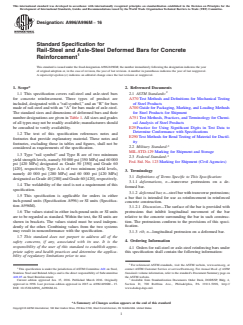
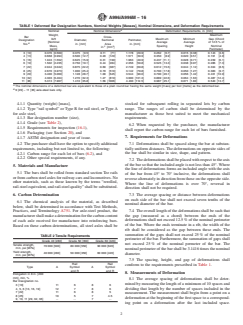
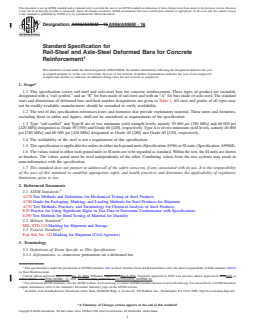
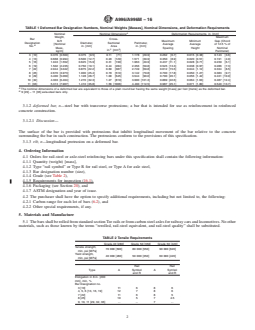
1.1 This specification covers rail-steel and axle-steel bars for concrete reinforcement. Three types of product are included, designated with a “rail symbol,” and an “R” for bars made of rail-steel and with an “A” for bars made of axle-steel. The standard sizes and dimensions of deformed bars and their number designations are given in Table 1. All sizes and grades of all types may not be readily available; manufacturers should be consulted to verify availability. (A) The nominal dimensions of a deformed bar are equivalent to those of a plain round bar having the same weight [mass] per foot [metre] as the deformed bar.(B) 9 [29] – 11 [36] axle-steel bars only.
1.2 The text of this specification references notes and footnotes that provide explanatory material. These notes and footnotes, excluding those in tables and figures, shall not be considered as requirements of the specification.
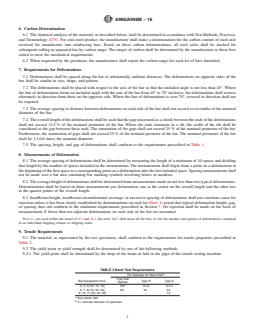
1.3 Type “rail symbol” and Type R are of two minimum yield strength levels, namely 50 000 psi [350 MPa] and 60 000 psi [420 MPa] designated as Grade 50 [350] and Grade 60 [420], respectively. Type A is of two minimum yield levels, namely 40 000 psi [280 MPa] and 60 000 psi [420 MPa] designated as Grade 40 [280] and Grade 60 [420], respectively.
1.4 The weldability of the steel is not a requirement of this specification.
1.5 This specification is applicable for orders in either inch-pound units (Specification A996) or SI units (Specification A996M).
1.6 The values stated in either inch-pound units or SI units are to be regarded as standard. Within the text, the SI units are shown in brackets. The values stated must be used independently of the other. Combining values from the two systems may result in nonconformance with the specification.
1.7 This standard does not purport to address all of the safety concerns, if any, associated with its use. It is the responsibility of the user of this standard to establish appropriate safety and health practices and determine the applicability of regulatory limitations prior to use.
General Information
- Status
- Published
- Publication Date
- 14-Jan-2016
- Technical Committee
- A01 - Steel, Stainless Steel and Related Alloys
- Drafting Committee
- A01.05 - Steel Reinforcement
Relations
- Effective Date
- 01-Mar-2024
- Effective Date
- 01-Nov-2019
- Effective Date
- 01-Jul-2019
- Refers
ASTM A370-17a - Standard Test Methods and Definitions for Mechanical Testing of Steel Products - Effective Date
- 15-Nov-2017
- Effective Date
- 01-Jan-2017
- Effective Date
- 01-Nov-2015
- Effective Date
- 01-Nov-2014
- Effective Date
- 15-May-2014
- Effective Date
- 01-Mar-2014
- Effective Date
- 15-Nov-2013
- Effective Date
- 01-Apr-2013
- Refers
ASTM A370-12a - Standard Test Methods and Definitions for Mechanical Testing of Steel Products - Effective Date
- 15-Oct-2012
- Effective Date
- 15-Mar-2012
- Refers
ASTM A370-11a - Standard Test Methods and Definitions for Mechanical Testing of Steel Products - Effective Date
- 15-Nov-2011
- Effective Date
- 15-Jun-2010
Overview
ASTM A996/A996M-16: Standard Specification for Rail-Steel and Axle-Steel Deformed Bars for Concrete Reinforcement is a key ASTM International standard that specifies requirements for deformed steel bars manufactured from rail-steel and axle-steel, designed for use as concrete reinforcement. The standard covers product types, bar sizes, minimum physical properties, manufacturing criteria, and key testing methods to ensure material quality and compliance. These deformed bars are critical components in reinforced concrete construction, contributing to structural strength and stability.
Key Topics
Types of Steel and Grades
- Three product types: Rail-symbol bars, Type R (rail-steel), and Type A (axle-steel).
- Minimum yield strength levels:
- Rail-symbol and Type R: 50,000 psi (Grade 50) and 60,000 psi (Grade 60)
- Type A: 40,000 psi (Grade 40) and 60,000 psi (Grade 60)
Size Designations
- Standard bar sizes and dimensions are provided, with nominal measurements equivalent to plain round bars of equivalent weight.
Physical and Mechanical Properties
- Includes requirements for:
- Carbon content determination for axle-steel bars
- Deformation geometry (spacing, height, gap)
- Yield strength and tensile strength (as per rigorous testing protocols)
- Elongation and bending performance
- Includes requirements for:
Testing and Inspection
- Mandatory tests per lot of 10 tons:
- Tension test
- Bend test
- Dimensional property tests (weight, deformation attributes)
- Retest protocols in place for certain criteria
- Inspections are agreed upon between purchaser and manufacturer
- Mandatory tests per lot of 10 tons:
Marking and Identification
- Bars must bear identifying marks: mill symbol, size designation, steel type, and grade indicator for Grade 60.
- Packaging and marking follow ASTM and, if required, military or federal standards.
Units of Measure
- The standard supports both inch-pound and SI units; values must not be mixed in application.
Applications
ASTM A996/A996M-16 deformed steel bars are widely used in the construction industry for reinforcing concrete structures. Their major applications include:
- Building Construction
- Reinforced concrete beams, columns, and structural frameworks
- Infrastructure Projects
- Bridges, highways, tunnels, and transportation facilities
- Industrial Facilities
- Foundations and slabs for heavy-duty applications
- Civil Engineering Projects
- Retaining walls, water treatment plants, and marine structures
The use of rail-steel and axle-steel deformed bars enhances the durability and load-bearing capacity of concrete. These bars, with specified deformation patterns, ensure effective bonding with concrete, minimizing slippage and improving safety under load.
Related Standards
For further guidance and complementary protocols, the following related ASTM and federal standards are referenced within ASTM A996/A996M-16:
- ASTM A370: Test Methods and Definitions for Mechanical Testing of Steel Products
- ASTM A700: Guide for Packaging, Marking, and Loading Methods for Steel Products for Shipment
- ASTM A751: Test Methods, Practices, and Terminology for Chemical Analysis of Steel Products
- ASTM E29: Practice for Using Significant Digits in Test Data
- ASTM E290: Test Methods for Bend Testing of Material for Ductility
- MIL-STD-129: Marking for Shipment and Storage (Military requirements)
- Fed. Std. No. 123: Marking for Shipment for Civil Agencies
ASTM A996/A996M-16 provides a consistent foundation for specifying, producing, and verifying the quality of rail-steel and axle-steel deformed bars, supporting the design and construction of safe, reliable reinforced concrete structures. For optimal outcomes, it is essential to consult the latest version of the standard and related documents.
Buy Documents
ASTM A996/A996M-16 - Standard Specification for Rail-Steel and Axle-Steel Deformed Bars for Concrete Reinforcement
REDLINE ASTM A996/A996M-16 - Standard Specification for Rail-Steel and Axle-Steel Deformed Bars for Concrete Reinforcement
Get Certified
Connect with accredited certification bodies for this standard

Element Materials Technology
Materials testing and product certification.

Inštitut za kovinske materiale in tehnologije
Institute of Metals and Technology. Materials testing, metallurgical analysis, NDT.
Sponsored listings
Frequently Asked Questions
ASTM A996/A996M-16 is a technical specification published by ASTM International. Its full title is "Standard Specification for Rail-Steel and Axle-Steel Deformed Bars for Concrete Reinforcement". This standard covers: ABSTRACT This specification covers rail-steel and axle-steel deformed bars for concrete reinforcement. The standard sizes and dimensions of deformed bars and their number designation are presented. The carbon determination, deformation requirements and deformation measurement are provided. The material shall conform to the requirements prescribed by the specification. The yield point or yield strength shall be determined by either drop of the beam or halt in the gage of the testing machine, or by extension under load using an autographic diagram method. For all bar sizes a tension test, a bend test and a set of dimensional property tests including bar weight and spacing, height, and gap of deformations shall be made from each lot of 10 tons. SCOPE 1.1 This specification covers rail-steel and axle-steel bars for concrete reinforcement. Three types of product are included, designated with a “rail symbol,” and an “R” for bars made of rail-steel and with an “A” for bars made of axle-steel. The standard sizes and dimensions of deformed bars and their number designations are given in Table 1. All sizes and grades of all types may not be readily available; manufacturers should be consulted to verify availability. (A) The nominal dimensions of a deformed bar are equivalent to those of a plain round bar having the same weight [mass] per foot [metre] as the deformed bar.(B) 9 [29] – 11 [36] axle-steel bars only. 1.2 The text of this specification references notes and footnotes that provide explanatory material. These notes and footnotes, excluding those in tables and figures, shall not be considered as requirements of the specification. 1.3 Type “rail symbol” and Type R are of two minimum yield strength levels, namely 50 000 psi [350 MPa] and 60 000 psi [420 MPa] designated as Grade 50 [350] and Grade 60 [420], respectively. Type A is of two minimum yield levels, namely 40 000 psi [280 MPa] and 60 000 psi [420 MPa] designated as Grade 40 [280] and Grade 60 [420], respectively. 1.4 The weldability of the steel is not a requirement of this specification. 1.5 This specification is applicable for orders in either inch-pound units (Specification A996) or SI units (Specification A996M). 1.6 The values stated in either inch-pound units or SI units are to be regarded as standard. Within the text, the SI units are shown in brackets. The values stated must be used independently of the other. Combining values from the two systems may result in nonconformance with the specification. 1.7 This standard does not purport to address all of the safety concerns, if any, associated with its use. It is the responsibility of the user of this standard to establish appropriate safety and health practices and determine the applicability of regulatory limitations prior to use.
ABSTRACT This specification covers rail-steel and axle-steel deformed bars for concrete reinforcement. The standard sizes and dimensions of deformed bars and their number designation are presented. The carbon determination, deformation requirements and deformation measurement are provided. The material shall conform to the requirements prescribed by the specification. The yield point or yield strength shall be determined by either drop of the beam or halt in the gage of the testing machine, or by extension under load using an autographic diagram method. For all bar sizes a tension test, a bend test and a set of dimensional property tests including bar weight and spacing, height, and gap of deformations shall be made from each lot of 10 tons. SCOPE 1.1 This specification covers rail-steel and axle-steel bars for concrete reinforcement. Three types of product are included, designated with a “rail symbol,” and an “R” for bars made of rail-steel and with an “A” for bars made of axle-steel. The standard sizes and dimensions of deformed bars and their number designations are given in Table 1. All sizes and grades of all types may not be readily available; manufacturers should be consulted to verify availability. (A) The nominal dimensions of a deformed bar are equivalent to those of a plain round bar having the same weight [mass] per foot [metre] as the deformed bar.(B) 9 [29] – 11 [36] axle-steel bars only. 1.2 The text of this specification references notes and footnotes that provide explanatory material. These notes and footnotes, excluding those in tables and figures, shall not be considered as requirements of the specification. 1.3 Type “rail symbol” and Type R are of two minimum yield strength levels, namely 50 000 psi [350 MPa] and 60 000 psi [420 MPa] designated as Grade 50 [350] and Grade 60 [420], respectively. Type A is of two minimum yield levels, namely 40 000 psi [280 MPa] and 60 000 psi [420 MPa] designated as Grade 40 [280] and Grade 60 [420], respectively. 1.4 The weldability of the steel is not a requirement of this specification. 1.5 This specification is applicable for orders in either inch-pound units (Specification A996) or SI units (Specification A996M). 1.6 The values stated in either inch-pound units or SI units are to be regarded as standard. Within the text, the SI units are shown in brackets. The values stated must be used independently of the other. Combining values from the two systems may result in nonconformance with the specification. 1.7 This standard does not purport to address all of the safety concerns, if any, associated with its use. It is the responsibility of the user of this standard to establish appropriate safety and health practices and determine the applicability of regulatory limitations prior to use.
ASTM A996/A996M-16 is classified under the following ICS (International Classification for Standards) categories: 77.140.15 - Steels for reinforcement of concrete. The ICS classification helps identify the subject area and facilitates finding related standards.
ASTM A996/A996M-16 has the following relationships with other standards: It is inter standard links to ASTM A370-24, ASTM A700-14(2019), ASTM A370-19, ASTM A370-17a, ASTM A370-17, ASTM A370-15, ASTM A700-14, ASTM A370-14, ASTM A751-14, ASTM A370-13, ASTM E290-13, ASTM A370-12a, ASTM A370-12, ASTM A370-11a, ASTM A370-10. Understanding these relationships helps ensure you are using the most current and applicable version of the standard.
ASTM A996/A996M-16 is available in PDF format for immediate download after purchase. The document can be added to your cart and obtained through the secure checkout process. Digital delivery ensures instant access to the complete standard document.
Standards Content (Sample)
This international standard was developed in accordance with internationally recognized principles on standardization established in the Decision on Principles for the
Development of International Standards, Guides and Recommendations issued by the World Trade Organization Technical Barriers to Trade (TBT) Committee.
Designation:A996/A996M −16
Standard Specification for
Rail-Steel and Axle-Steel Deformed Bars for Concrete
Reinforcement
This standard is issued under the fixed designationA996/A996M; the number immediately following the designation indicates the year
of original adoption or, in the case of revision, the year of last revision. A number in parentheses indicates the year of last reapproval.
A superscript epsilon (´) indicates an editorial change since the last revision or reapproval.
1. Scope* 2. Referenced Documents
1.1 This specification covers rail-steel and axle-steel bars 2.1 ASTM Standards:
for concrete reinforcement. Three types of product are A370 Test Methods and Definitions for Mechanical Testing
included, designated with a “rail symbol,” and an “R” for bars of Steel Products
made of rail-steel and with an “A” for bars made of axle-steel. A700 Guide for Packaging, Marking, and Loading Methods
The standard sizes and dimensions of deformed bars and their for Steel Products for Shipment
number designations are given in Table 1.All sizes and grades A751 Test Methods, Practices, and Terminology for Chemi-
of all types may not be readily available; manufacturers should cal Analysis of Steel Products
be consulted to verify availability. E29 Practice for Using Significant Digits in Test Data to
Determine Conformance with Specifications
1.2 The text of this specification references notes and
E290 Test Methods for Bend Testing of Material for Ductil-
footnotes that provide explanatory material. These notes and
ity
footnotes, excluding those in tables and figures, shall not be
2.2 Military Standard:
considered as requirements of the specification.
MIL-STD-129 Marking for Shipment and Storage
1.3 Type “rail symbol” and Type R are of two minimum
2.3 Federal Standard:
yield strength levels, namely 50 000 psi [350 MPa] and 60 000
Fed. Std. No. 123 Marking for Shipment (Civil Agencies)
psi [420 MPa] designated as Grade 50 [350] and Grade 60
[420], respectively. Type A is of two minimum yield levels,
3. Terminology
namely 40 000 psi [280 MPa] and 60 000 psi [420 MPa]
3.1 Definitions of Terms Specific to This Specification:
designated as Grade 40 [280] and Grade 60 [420], respectively.
3.1.1 deformations, n—transverse protrusions on a de-
1.4 The weldability of the steel is not a requirement of this
formed bar.
specification.
3.1.2 deformed bar, n—steelbarwithtransverseprotrusions;
1.5 This specification is applicable for orders in either
a bar that is intended for use as reinforcement in reinforced
inch-pound units (Specification A996) or SI units (Specifica-
concrete construction.
tion A996M).
3.1.2.1 Discussion—The surface of the bar is provided with
1.6 The values stated in either inch-pound units or SI units protrusions that inhibit longitudinal movement of the bar
relative to the concrete surrounding the bar in such construc-
are to be regarded as standard. Within the text, the SI units are
shown in brackets. The values stated must be used indepen- tion. The protrusions conform to the provisions of this speci-
fication.
dently of the other. Combining values from the two systems
may result in nonconformance with the specification.
3.1.3 rib, n—longitudinal protrusion on a deformed bar.
1.7 This standard does not purport to address all of the
4. Ordering Information
safety concerns, if any, associated with its use. It is the
responsibility of the user of this standard to establish appro-
4.1 Orders for rail-steel or axle-steel reinforcing bars under
priate safety and health practices and determine the applica-
this specification shall contain the following information:
bility of regulatory limitations prior to use.
For referenced ASTM standards, visit the ASTM website, www.astm.org, or
This specification is under the jurisdiction of ASTM Committee A01 on Steel, contact ASTM Customer Service at service@astm.org. For Annual Book of ASTM
Stainless Steel and Related Alloys and is the direct responsibility of Subcommittee Standards volume information, refer to the standard’s Document Summary page on
A01.05 on Steel Reinforcement. the ASTM website.
Current edition approved Jan. 15, 2016. Published March 2016. Originally Available from Standardization Documents Order Desk, DODSSP, Bldg. 4,
approved in 1998. Last previous edition approved in 2015 as A996/A996M – 15. Section D, 700 Robbins Ave., Philadelphia, PA 19111-5098, http://
DOI: 10.1520/A0996_A0996M-16. www.dodssp.daps.mil.
*A Summary of Changes section appears at the end of this standard
Copyright © ASTM International, 100 Barr Harbor Drive, PO Box C700, West Conshohocken, PA 19428-2959. United States
A996/A996M−16
TABLE 1 Deformed Bar Designation Numbers, Nominal Weights [Masses], Nominal Dimensions, and Deformation Requirements
A
Nominal Nominal Dimensions Deformation Requirements, in. [mm]
Weight, Maximum
Bar Cross-
lb/ft Maximum Minimum Gap (Chord
Designation Diameter, Sectional Perimeter,
[Nominal Average Average of 12.5 % of
B
No. in. [mm] Area in. [mm]
Mass, Spacing Height Nominal
2 2
in. [mm ]
kg/m] Perimeter)
3 [10] 0.376 [0.560] 0.375 [9.5] 0.11 [71] 1.178 [29.9] 0.262 [6.7] 0.015 [0.38] 0.143 [3.6]
4 [13] 0.668 [0.994] 0.500 [12.7] 0.20 [129] 1.571 [39.9] 0.350 [8.9] 0.020 [0.51] 0.191 [4.9]
5 [16] 1.043 [1.552] 0.625 [15.9] 0.31 [199] 1.963 [49.9] 0.437 [11.1] 0.028 [0.71] 0.239 [6.1]
6 [19] 1.502 [2.235] 0.750 [19.1] 0.44 [284] 2.356 [59.8] 0.525 [13.3] 0.038 [0.97] 0.286 [7.3]
7 [22] 2.044 [3.042] 0.875 [22.2] 0.60 [387] 2.749 [69.8] 0.612 [15.5] 0.044 [1.12] 0.334 [8.5]
8 [25] 2.670 [3.973] 1.000 [25.4] 0.79 [510] 3.142 [79.8] 0.700 [17.8] 0.050 [1.27] 0.383 [9.7]
9 [29] 3.400 [5.060] 1.128 [28.7] 1.00 [645] 3.544 [90.0] 0.790 [20.1] 0.056 [1.42] 0.431 [10.9]
10 [32] 4.303 [6.404] 1.270 [32.3] 1.27 [819] 3.990 [101.3] 0.889 [22.6] 0.064 [1.63] 0.487 [12.4]
11 [36] 5.313 [7.907] 1.410 [35.8] 1.56 [1006] 4.430 [112.5] 0.987 [25.1] 0.071 [1.80] 0.540 [13.7]
A
The nominal dimensions of a deformed bar are equivalent to those of a plain round bar having the same weight [mass] per foot [metre] as the deformed bar.
B
9 [29] – 11 [36] axle-steel bars only.
4.1.1 Quantity (weight) [mass], stocked for subsequent rolling in separated lots by carbon
4.1.2 Type “rail symbol” or Type R for rail steel, or TypeA range. The ranges of carbon shall be determined by the
for axle steel, manufacturer as those best suited to meet the mechanical
4.1.3 Bar designation number (size), requirements.
4.1.4 Grade (see Table 2),
6.2 When requested by the purchaser, the manufacturer
4.1.5 Requirements for inspection (16.1),
shall report the carbon range for each lot of bars furnished.
4.1.6 Packaging (see Section 20), and
7. Requirements for Deformations
4.1.7 ASTM designation and year of issue.
4.2 Thepurchasershallhavetheoptiontospecifyadditional 7.1 Deformations shall be spaced along the bar at substan-
tially uniform distances.The deformations on opposite sides of
requirements, including but not limited to, the following:
4.2.1 Carbon range for each lot of bars (6.2), and the bar shall be similar in size, shape, and pattern.
4.2.2 Other special requirements, if any.
7.2 Thedeformationsshallbeplacedwithrespecttotheaxis
of the bar so that the included angle is not less than 45°.Where
5. Materials and Manufacture
the line of deformations forms an included angle with the axis
5.1 The bars shall be rolled from standard section Tee rails
of the bar from 45° to 70° inclusive, the deformations shall
orfromcarbonsteelaxlesforrailwaycarsandlocomotives.No
reverse alternately in direction from those on the opposite side.
other materials, such as those known by the terms “rerolled,
Where the line of deformations is over 70°, reversal in
rail-steel equivalent, and rail-steel quality” shall be substituted.
direction shall not be required.
7.3 The average spacing or distance between deformations
6. Carbon Determination
on each side of the bar shall not exceed seven tenths of the
6.1 The chemical analysis of the material, as described
nominal diameter of the bar.
below, shall be determined in accordance with Test Methods,
7.4 The overall length of the deformations shall be such that
Practices, and Terminology A751. For axle-steel product, the
the gap (measured as a chord) between the ends of the
manufacturershallmakeadeterminationforthecarboncontent
deformations shall not exceed 12.5 % of the nominal perimeter
of each axle received for manufacture into reinforcing bars.
of the bar. Where the ends terminate in a rib, the width of the
Based on these carbon determinations, all steel axles shall be
rib shall be considered as the gap between these ends. The
summation of the gaps shall not exceed 25 % of the nominal
TABLE 2 Tensile Requirements
perimeter of the bar. Furthermore, the summation of gaps shall
Grade 40 [280] Grade 50 [350] Grade 60 [420]
not exceed 25 % of the nominal permeter of the bar. The
Tensile strength,
70 000 [500] 80 000 [550] 90 000 [620]
min, psi [MPa]
nominal perimeter of the bar shall be 3.1416 times the nominal
Yield strength,
40 000 [280] 50 000 [350] 60 000 [420]
diameter.
min, psi [MPa]
7.5 The spacing, height, and gap of deformations shall
Rail Rail
conform to the requirements prescribed in Table 1.
Type A Symbol A Symbol
and R and R
8. Measurements of Deformation
Elongation in 8 in. [200
mm],min,%
8.1 The average spacing of deformations shall be deter-
Bar Designation no.
mined by measuring the length of a minimum of 10 spaces and
3 [10] 11 6 8 6
4, 5, 6 [13, 16, 19] 12 7 8 6 dividing that length by the number of spaces included in the
7 [22] 11 6 8 5
measurement. The measurement shall begin from a point on a
8 [25] 10 5 7 4.5
deformation at the beginning of the first space to a correspond-
9, 10, 11 [29, 32, 36] . . 7 .
ing point on a deformation after the last included space.
A996/A996M−16
Spacing measurements shall not be made over a bar area 10.2.3 Close wrapping of the specimen around a pin during
containing bar marking symbols involving letters or numbers. the bending operation.
8.2 The average height of deformations shall be determined
10.3 It shall be permissible to use other methods of bend
from measurements made on not less than two typical defor- testing described in Test Methods E290, such as placing a
mations. Determinations shall be based on three measurements
specimen across two round bearings free to rotate and applying
per deformation, one at the center on the overall length and the the bending force with a fixed rounded-tip mandrel conforming
other two at the quarter points of the overall length. to the specified bend radius, allowing the bar to pass through
with sufficient clearance. When failures occur under other
8.3 Insufficient height, insufficient circumferential
methods of bend testing, retest shall be permitted under the
coverage, or excessive spacing of deformations shall not
bend test method prescribed in 10.2.
constitute cause for rejection unless it has been clearly estab-
lishedbydeterminationsoneachlot(Note1)testedthattypical
11. Permissible Variation in Weight [Mass]
deformation height, gap, or spacing does not conform to the
minimum requirements prescribed in Section 7. No rejection
11.1 Deformed reinforcing bars shall be evaluated on the
shall be made on the basis of measurements if fewer than ten
basis of nominal weight [mass]. The weight [mass] determined
adjacent deformations on each side of the bar are measured.
using the
...
This document is not an ASTM standard and is intended only to provide the user of an ASTM standard an indication of what changes have been made to the previous version. Because
it may not be technically possible to adequately depict all changes accurately, ASTM recommends that users consult prior editions as appropriate. In all cases only the current version
of the standard as published by ASTM is to be considered the official document.
Designation: A996/A996M − 15 A996/A996M − 16
Standard Specification for
Rail-Steel and Axle-Steel Deformed Bars for Concrete
Reinforcement
This standard is issued under the fixed designation A996/A996M; the number immediately following the designation indicates the year
of original adoption or, in the case of revision, the year of last revision. A number in parentheses indicates the year of last reapproval.
A superscript epsilon (´) indicates an editorial change since the last revision or reapproval.
1. Scope*
1.1 This specification covers rail-steel and axle-steel bars for concrete reinforcement. Three types of product are included,
designated with a “rail symbol,” and an “R” for bars made of rail-steel and with an “A” for bars made of axle-steel. The standard
sizes and dimensions of deformed bars and their number designations are given in Table 1. All sizes and grades of all types may
not be readily available; manufacturers should be consulted to verify availability.
1.2 The text of this specification references notes and footnotes that provide explanatory material. These notes and footnotes,
excluding those in tables and figures, shall not be considered as requirements of the specification.
1.3 Type “rail symbol” and Type R are of two minimum yield strength levels, namely 50 000 psi [350 MPa] and 60 000 psi
[420 MPa] designated as Grade 50 [350] and Grade 60 [420], respectively. Type A is of two minimum yield levels, namely 40 000
psi [280 MPa] and 60 000 psi [420 MPa] designated as Grade 40 [280] and Grade 60 [420], respectively.
1.4 The weldability of the steel is not a requirement of this specification.
1.5 This specification is applicable for orders in either inch-pound units (Specification A996) or SI units (Specification A996M).
1.6 The values stated in either inch-pound units or SI units are to be regarded as standard. Within the text, the SI units are shown
in brackets. The values stated must be used independently of the other. Combining values from the two systems may result in
nonconformance with the specification.
1.7 This standard does not purport to address all of the safety concerns, if any, associated with its use. It is the responsibility
of the user of this standard to establish appropriate safety and health practices and determine the applicability of regulatory
limitations prior to use.
2. Referenced Documents
2.1 ASTM Standards:
A370 Test Methods and Definitions for Mechanical Testing of Steel Products
A700 Guide for Packaging, Marking, and Loading Methods for Steel Products for Shipment
A751 Test Methods, Practices, and Terminology for Chemical Analysis of Steel Products
E29 Practice for Using Significant Digits in Test Data to Determine Conformance with Specifications
E290 Test Methods for Bend Testing of Material for Ductility
2.2 Military Standard:
MIL-STD-129 Marking for Shipment and Storage
2.3 Federal Standard:
Fed. Std. No. 123 Marking for Shipment (Civil Agencies)
3. Terminology
3.1 Definitions of Terms Specific to This Specification:
3.1.1 deformations, n—transverse protrusions on a deformed bar.
This specification is under the jurisdiction of ASTM Committee A01 on Steel, Stainless Steel and Related Alloys and is the direct responsibility of Subcommittee A01.05
on Steel Reinforcement.
Current edition approved July 1, 2015Jan. 15, 2016. Published August 2015March 2016. Originally approved in 1998. Last previous edition approved in 20142015 as
A996/A996M – 14a.A996/A996M – 15. DOI: 10.1520/A0996_A0996M-15.10.1520/A0996_A0996M-16.
For referenced ASTM standards, visit the ASTM website, www.astm.org, or contact ASTM Customer Service at service@astm.org. For Annual Book of ASTM Standards
volume information, refer to the standard’s Document Summary page on the ASTM website.
Available from Standardization Documents Order Desk, DODSSP, Bldg. 4, Section D, 700 Robbins Ave., Philadelphia, PA 19111-5098, http://www.dodssp.daps.mil.
*A Summary of Changes section appears at the end of this standard
Copyright © ASTM International, 100 Barr Harbor Drive, PO Box C700, West Conshohocken, PA 19428-2959. United States
A996/A996M − 16
TABLE 1 Deformed Bar Designation Numbers, Nominal Weights [Masses], Nominal Dimensions, and Deformation Requirements
A
Nominal Nominal Dimensions Deformation Requirements, in. [mm]
Weight,
Maximum
Bar Cross-
lb/ft Maximum Minimum Gap (Chord
Designation Diameter, Sectional Perimeter,
[Nominal Average Average of 12.5 % of
B
No. in. [mm] Area in. [mm]
Mass, Spacing Height Nominal
2 2
in. [mm ]
kg/m] Perimeter)
3 [10] 0.376 [0.560] 0.375 [9.5] 0.11 [71] 1.178 [29.9] 0.262 [6.7] 0.015 [0.38] 0.143 [3.6]
4 [13] 0.668 [0.994] 0.500 [12.7] 0.20 [129] 1.571 [39.9] 0.350 [8.9] 0.020 [0.51] 0.191 [4.9]
5 [16] 1.043 [1.552] 0.625 [15.9] 0.31 [199] 1.963 [49.9] 0.437 [11.1] 0.028 [0.71] 0.239 [6.1]
6 [19] 1.502 [2.235] 0.750 [19.1] 0.44 [284] 2.356 [59.8] 0.525 [13.3] 0.038 [0.97] 0.286 [7.3]
7 [22] 2.044 [3.042] 0.875 [22.2] 0.60 [387] 2.749 [69.8] 0.612 [15.5] 0.044 [1.12] 0.334 [8.5]
8 [25] 2.670 [3.973] 1.000 [25.4] 0.79 [510] 3.142 [79.8] 0.700 [17.8] 0.050 [1.27] 0.383 [9.7]
9 [29] 3.400 [5.060] 1.128 [28.7] 1.00 [645] 3.544 [90.0] 0.790 [20.1] 0.056 [1.42] 0.431 [10.9]
10 [32] 4.303 [6.404] 1.270 [32.3] 1.27 [819] 3.990 [101.3] 0.889 [22.6] 0.064 [1.63] 0.487 [12.4]
11 [36] 5.313 [7.907] 1.410 [35.8] 1.56 [1006] 4.430 [112.5] 0.987 [25.1] 0.071 [1.80] 0.540 [13.7]
A
The nominal dimensions of a deformed bar are equivalent to those of a plain round bar having the same weight [mass] per foot [metre] as the deformed bar.
B
9 [29] – 11 [36] axle-steel bars only.
3.1.2 deformed bar, n—steel bar with transverse protrusions; a bar that is intended for use as reinforcement in reinforced
concrete construction.
3.1.2.1 Discussion—
The surface of the bar is provided with protrusions that inhibit longitudinal movement of the bar relative to the concrete
surrounding the bar in such construction. The protrusions conform to the provisions of this specification.
3.1.3 rib, n—longitudinal protrusion on a deformed bar.
4. Ordering Information
4.1 Orders for rail-steel or axle-steel reinforcing bars under this specification shall contain the following information:
4.1.1 Quantity (weight) [mass],
4.1.2 Type “rail symbol” or Type R for rail steel, or Type A for axle steel,
4.1.3 Bar designation number (size),
4.1.4 Grade (see Table 2),
4.1.5 Requirements for inspection (16.1),
4.1.6 Packaging (see Section 20), and
4.1.7 ASTM designation and year of issue.
4.2 The purchaser shall have the option to specify additional requirements, including but not limited to, the following:
4.2.1 Carbon range for each lot of bars (6.2), and
4.2.2 Other special requirements, if any.
5. Materials and Manufacture
5.1 The bars shall be rolled from standard section Tee rails or from carbon steel axles for railway cars and locomotives. No other
materials, such as those known by the terms “rerolled, rail-steel equivalent, and rail-steel quality” shall be substituted.
TABLE 2 Tensile Requirements
Grade 40 [280] Grade 50 [350] Grade 60 [420]
Tensile strength,
70 000 [500] 80 000 [550] 90 000 [620]
min, psi [MPa]
Yield strength,
40 000 [280] 50 000 [350] 60 000 [420]
min, psi [MPa]
Rail Rail
Type A Symbol A Symbol
and R and R
Elongation in 8 in. [200
mm], min, %
Bar Designation no.
3 [10] 11 6 8 6
4, 5, 6 [13, 16, 19] 12 7 8 6
7 [22] 11 6 8 5
8 [25] 10 5 7 4.5
9, 10, 11 [29, 32, 36] . . 7 .
A996/A996M − 16
6. Carbon Determination
6.1 The chemical analysis of the material, as described below, shall be determined in accordance with Test Methods, Practices,
and Terminology A751. For axle-steel product, the manufacturer shall make a determination for the carbon content of each axle
received for manufacture into reinforcing bars. Based on these carbon determinations, all steel axles shall be stocked for
subsequent rolling in separated lots by carbon range. The ranges of carbon shall be determined by the manufacturer as those best
suited to meet the mechanical requirements.
6.2 When requested by the purchaser, the manufacturer shall report the carbon range for each lot of bars furnished.
7. Requirements for Deformations
7.1 Deformations shall be spaced along the bar at substantially uniform distances. The deformations on opposite sides of the
bar shall be similar in size, shape, and pattern.
7.2 The deformations shall be placed with respect to the axis of the bar so that the included angle is not less than 45°. Where
the line of deformations forms an included angle with the axis of the bar from 45° to 70° inclusive, the deformations shall reverse
alternately in direction from those on the opposite side. Where the line of deformations is over 70°, reversal in direction shall not
be required.
7.3 The average spacing or distance between deformations on each side of the bar shall not exceed seven tenths of the nominal
diameter of the bar.
7.4 The overall length of the deformations shall be such that the gap (measured as a chord) between the ends of the deformations
shall not exceed 12.5 % of the nominal perimeter of the bar. Where the ends terminate in a rib, the width of the rib shall be
considered as the gap between these ends. The summation of the gaps shall not exceed 25 % of the nominal perimeter of the bar.
Furthermore, the summation of gaps shall not exceed 25 % of the nominal permeter of the bar. The nominal perimeter of the bar
shall be 3.1416 times the nominal diameter.
7.5 The spacing, height, and gap of deformations shall conform to the requirements prescribed in Table 1.
8. Measurements of Deformation
8.1 The average spacing of deformations shall be determined by measuring the length of a minimum of 10 spaces and dividing
that length by the number of spaces included in the measurement. The measurement shall begin from a point on a deformation at
the beginning of the first space to a corresponding point on a deformation after the last included space. Spacing measurements shall
not be made over a bar area containing bar marking symbols involving letters or numbers.
8.2 The average height of deformations shall be determined from measurements made on not less than two typical deformations.
Determinations shall be based on three measurements per deformation, one at the center on the overall length and the other two
at the quarter points of the overall length.
8.3 Insufficient height, insufficient circumferential coverage, or excessive spacing of deformations shall not constitute cause for
rejection unless it has been clearly established by determinations on each lot (Note 1) tested that typical deformation height, gap,
or spacing does not conform to the minimum requirements prescribed in Section 7. No rejection shall be made on the basis of
measurements if fewer than ten adjacent deformations on each side of the bar are measured.
NOTE 1—As used within the intent of 8.3 and 14.1, the term “lot” shall mean all the bars of one bar number and pattern of deformations contained
in an individual shipping release or shipping order.
9. Tensile Requirements
9.1 The material, as represented by the test specimens, shall conform to the requirements for tensile properties prescribed in
Table 2.
9.2 The yield point or yield strength shall be determined by one of the following methods.
9.2.1 The yield point shall be determined by the drop of the beam or halt in the gage of the tensile testing machine.
TABLE 3 Bend Test Requirements
A
Pin Diameter for Bend Test
Type Rail
Bar Designation Nos. Type R Type A
Symbol
B
1 1
3, 4, 5 [10, 13, 16] 6d 3 ⁄2d 3 ⁄2d
6, 7, 8 [19, 22, 25] 6d 5d 5d
9, 10, 11 [29, 32, 36] . . 7d
A
Test bends 180°.
B
d = nominal diameter of specimen.
A996/A996M − 16
9.2.2 Where the steel tested does not have a well-defined yield point, the yield strength shall be determined by the offset method
(0.2 % offset), as described in Test Methods and Definitions A370.
9.3 The percentage of elongation shall be as prescribed in Table 2.
10. Bending Requirements
10.1 The bend test specimen shall withstand being bent around a pin without cracking on the outside radius of the bent portion.
The requirements for degree of bending and sizes of pins are prescribed in Table 3.
10.2 The bend test shall be made on specimen
...
Questions, Comments and Discussion
Ask us and Technical Secretary will try to provide an answer. You can facilitate discussion about the standard in here.
Loading comments...