

ASTM A881/A881M-23
(Specification)Standard Specification for Steel Wire, Indented, Low-Relaxation for Prestressed Concrete
General Information
- Abstract
ABSTRACT
This specification covers uncoated, deformed, stress-relieved, and low-relaxation wire for use as prestressed tendons in concrete railroad ties. Deformed wires with nominal diameters shall be supplied in coils and shall conform to specified values of breaking strength requirements. The relaxation losses of normal stress-relieved and low-relaxation stress-relieved wires should not exceed the specified limits. The two acceptable types of deformed wire shall have specific dimensions of deformations, where the depth of indent shall be the average depth of six or more random indents measured at maximum depth. The material shall be tested on and shall conform to specified values of the following mechanical properties: breaking strength, load at 1% extension, elongation, bending, and relaxation.
SCOPE
1.1 This specification covers indented, low-relaxation steel wire for use in prestressed concrete.
1.2 The text of this specification contains notes or footnotes, or both, that provide explanatory material. Such notes and footnotes do not contain any mandatory information.
1.3 This specification is applicable for orders in either inch-pound units (as Specification A881) or in SI units (as Specification A881M).
1.4 The values stated in either inch-pound units or SI units are to be regarded separately as standard. Within the text, the SI units are shown in brackets. The values stated in each system may not be exact equivalents; therefore, each system shall be used independently of the other. Combining values from the two systems may result in non-conformance with the specification.
1.5 This international standard was developed in accordance with internationally recognized principles on standardization established in the Decision on Principles for the Development of International Standards, Guides and Recommendations issued by the World Trade Organization Technical Barriers to Trade (TBT) Committee.
- Status
- Published
- Publication Date
- 31-Aug-2023
- Technical Committee
- A01 - Steel, Stainless Steel and Related Alloys
- Drafting Committee
- A01.05 - Steel Reinforcement
Buy Documents
ASTM A881/A881M-23 - Standard Specification for Steel Wire, Indented, Low-Relaxation for Prestressed Concrete
REDLINE ASTM A881/A881M-23 - Standard Specification for Steel Wire, Indented, Low-Relaxation for Prestressed Concrete
Overview
ASTM A881/A881M-23 is the standard specification for indented, low-relaxation steel wire intended for use in prestressed concrete applications, with a primary focus on concrete railroad ties. Developed by ASTM International, this specification addresses the requirements for uncoated, deformed, stress-relieved steel wire used as prestressed tendons. The standard outlines essential mechanical properties, dimensional tolerances, and testing protocols to ensure optimal performance in structural concrete components.
This specification applies to orders in both inch-pound (A881) and SI (A881M) units. Its guidelines are designed in accordance with internationally recognized standardization principles, making it a crucial reference for manufacturers, suppliers, and quality control professionals in the construction and precast concrete industries.
Key Topics
Material Requirements
- Covers indented, cold-drawn, low-relaxation carbon steel wire.
- Accepts all commercially approved steelmaking processes.
Mechanical Properties
- Specifies minimum tensile strength and load at 1% extension.
- Stipulates minimum elongation and bend test performance.
Relaxation Limits
- Ensures relaxation loss does not exceed 3.5% at 80% of minimum tensile strength after 1000 hours, or 2.5% at 70% load after 1000 hours.
Indentation Geometry
- Defines the depth, sidewall angle, and pitch of indentations for effective prestress transfer.
- Allows two acceptable types of indented wire geometry.
Dimensional Tolerances
- Strict limits on nominal diameter and out-of-round variation to maintain consistency and structural performance.
Workmanship and Surface Quality
- Finished wire must be free from kinks, tight curls, twists, or sharp bends.
- Prohibits oiling or greasing, requiring clean, residue-free surfaces.
Testing and Inspection
- Includes guidelines for sampling, routine testing, and quality assurance.
- Enables outside inspection as specified by the purchaser.
Applications
ASTM A881/A881M-23 wire is vital in structural applications where prestressed concrete is required, offering high performance, reliability, and longevity. Key uses include:
- Concrete Railroad Ties: Provides superior bonding and stress transfer, enhancing durability under heavy load cycles.
- Prestressed Concrete Beams and Slabs: Delivers consistent mechanical properties, supporting large-span construction and reducing the risk of cracks.
- Precast Concrete Components: Ensures strong, reliable connections in bridges, parking structures, and other critical infrastructure.
- Specialty Construction: Applicable in civil engineering projects that require controlled relaxation and high-tensile steel reinforcement.
The specification ensures that indented, low-relaxation wire contributes to the structural integrity, service life, and cost-effectiveness of prestressed concrete products.
Related Standards
For comprehensive adherence to industry best practices, consider these associated ASTM and government standards:
- ASTM A370: Test Methods and Definitions for Mechanical Testing of Steel Products
- ASTM A421/A421M: Specification for Stress-Relieved Steel Wire for Prestressed Concrete
- ASTM A700: Guide for Packaging, Marking, and Loading Methods for Steel Products for Shipment
- ASTM A1096/A1096M: Test Method for Evaluating Bond of Individual Steel Wire, Indented or Plain, for Concrete Reinforcement
- MIL-STD-129: Marking for Shipment and Storage (U.S. Military Standard)
- Fed. Std. No. 123: Marking for Shipment (U.S. Federal Standard for Civil Agencies)
These documents provide additional information and testing methods that complement the requirements of ASTM A881/A881M-23, supporting robust quality control and compliance throughout the supply chain.
Keywords: indented steel wire, low-relaxation wire, prestressed concrete, ASTM A881, steel reinforcement, concrete railroad ties, quality control, tensile properties, mechanical testing, structural applications
Relations
- Effective Date
- 01-Mar-2024
- Effective Date
- 01-Nov-2019
- Effective Date
- 01-Jul-2019
- Refers
ASTM A370-17a - Standard Test Methods and Definitions for Mechanical Testing of Steel Products - Effective Date
- 15-Nov-2017
- Effective Date
- 01-Jan-2017
- Effective Date
- 01-Nov-2015
- Effective Date
- 01-Nov-2014
- Effective Date
- 15-May-2014
- Effective Date
- 15-Nov-2013
- Refers
ASTM A370-12a - Standard Test Methods and Definitions for Mechanical Testing of Steel Products - Effective Date
- 15-Oct-2012
- Effective Date
- 15-Mar-2012
- Refers
ASTM A370-11a - Standard Test Methods and Definitions for Mechanical Testing of Steel Products - Effective Date
- 15-Nov-2011
- Effective Date
- 01-Nov-2010
- Effective Date
- 15-Jun-2010
- Refers
ASTM A370-09a - Standard Test Methods and Definitions for Mechanical Testing of Steel Products - Effective Date
- 01-Jun-2009
Buy Documents
ASTM A881/A881M-23 - Standard Specification for Steel Wire, Indented, Low-Relaxation for Prestressed Concrete
REDLINE ASTM A881/A881M-23 - Standard Specification for Steel Wire, Indented, Low-Relaxation for Prestressed Concrete
Get Certified
Connect with accredited certification bodies for this standard

Element Materials Technology
Materials testing and product certification.

Inštitut za kovinske materiale in tehnologije
Institute of Metals and Technology. Materials testing, metallurgical analysis, NDT.
Sponsored listings
Frequently Asked Questions
ASTM A881/A881M-23 is a technical specification published by ASTM International. Its full title is "Standard Specification for Steel Wire, Indented, Low-Relaxation for Prestressed Concrete". This standard covers: ABSTRACT This specification covers uncoated, deformed, stress-relieved, and low-relaxation wire for use as prestressed tendons in concrete railroad ties. Deformed wires with nominal diameters shall be supplied in coils and shall conform to specified values of breaking strength requirements. The relaxation losses of normal stress-relieved and low-relaxation stress-relieved wires should not exceed the specified limits. The two acceptable types of deformed wire shall have specific dimensions of deformations, where the depth of indent shall be the average depth of six or more random indents measured at maximum depth. The material shall be tested on and shall conform to specified values of the following mechanical properties: breaking strength, load at 1% extension, elongation, bending, and relaxation. SCOPE 1.1 This specification covers indented, low-relaxation steel wire for use in prestressed concrete. 1.2 The text of this specification contains notes or footnotes, or both, that provide explanatory material. Such notes and footnotes do not contain any mandatory information. 1.3 This specification is applicable for orders in either inch-pound units (as Specification A881) or in SI units (as Specification A881M). 1.4 The values stated in either inch-pound units or SI units are to be regarded separately as standard. Within the text, the SI units are shown in brackets. The values stated in each system may not be exact equivalents; therefore, each system shall be used independently of the other. Combining values from the two systems may result in non-conformance with the specification. 1.5 This international standard was developed in accordance with internationally recognized principles on standardization established in the Decision on Principles for the Development of International Standards, Guides and Recommendations issued by the World Trade Organization Technical Barriers to Trade (TBT) Committee.
ABSTRACT This specification covers uncoated, deformed, stress-relieved, and low-relaxation wire for use as prestressed tendons in concrete railroad ties. Deformed wires with nominal diameters shall be supplied in coils and shall conform to specified values of breaking strength requirements. The relaxation losses of normal stress-relieved and low-relaxation stress-relieved wires should not exceed the specified limits. The two acceptable types of deformed wire shall have specific dimensions of deformations, where the depth of indent shall be the average depth of six or more random indents measured at maximum depth. The material shall be tested on and shall conform to specified values of the following mechanical properties: breaking strength, load at 1% extension, elongation, bending, and relaxation. SCOPE 1.1 This specification covers indented, low-relaxation steel wire for use in prestressed concrete. 1.2 The text of this specification contains notes or footnotes, or both, that provide explanatory material. Such notes and footnotes do not contain any mandatory information. 1.3 This specification is applicable for orders in either inch-pound units (as Specification A881) or in SI units (as Specification A881M). 1.4 The values stated in either inch-pound units or SI units are to be regarded separately as standard. Within the text, the SI units are shown in brackets. The values stated in each system may not be exact equivalents; therefore, each system shall be used independently of the other. Combining values from the two systems may result in non-conformance with the specification. 1.5 This international standard was developed in accordance with internationally recognized principles on standardization established in the Decision on Principles for the Development of International Standards, Guides and Recommendations issued by the World Trade Organization Technical Barriers to Trade (TBT) Committee.
ASTM A881/A881M-23 is classified under the following ICS (International Classification for Standards) categories: 77.140.15 - Steels for reinforcement of concrete. The ICS classification helps identify the subject area and facilitates finding related standards.
ASTM A881/A881M-23 has the following relationships with other standards: It is inter standard links to ASTM A370-24, ASTM A700-14(2019), ASTM A370-19, ASTM A370-17a, ASTM A370-17, ASTM A370-15, ASTM A700-14, ASTM A370-14, ASTM A370-13, ASTM A370-12a, ASTM A370-12, ASTM A370-11a, ASTM A421/A421M-10, ASTM A370-10, ASTM A370-09a. Understanding these relationships helps ensure you are using the most current and applicable version of the standard.
ASTM A881/A881M-23 is available in PDF format for immediate download after purchase. The document can be added to your cart and obtained through the secure checkout process. Digital delivery ensures instant access to the complete standard document.
Standards Content (Sample)
This international standard was developed in accordance with internationally recognized principles on standardization established in the Decision on Principles for the
Development of International Standards, Guides and Recommendations issued by the World Trade Organization Technical Barriers to Trade (TBT) Committee.
Designation: A881/A881M − 23
Standard Specification for
Steel Wire, Indented, Low-Relaxation for Prestressed
Concrete
This standard is issued under the fixed designation A881/A881M; the number immediately following the designation indicates the year
of original adoption or, in the case of revision, the year of last revision. A number in parentheses indicates the year of last reapproval.
A superscript epsilon (´) indicates an editorial change since the last revision or reapproval.
1. Scope* A1096/A1096M Test Method for Evaluating Bond of Indi-
vidual Steel Wire, Indented or Plain, for Concrete Rein-
1.1 This specification covers indented, low-relaxation steel
forcement
wire for use in prestressed concrete.
2.2 U.S. Military Standard:
1.2 The text of this specification contains notes or footnotes,
MIL-STD-129 Marking for Shipment and Storage
or both, that provide explanatory material. Such notes and
2.3 U.S. Federal Standard:
footnotes do not contain any mandatory information.
Fed. Std. No. 123 Marking for Shipment (Civil Agencies)
1.3 This specification is applicable for orders in either
3. Terminology
inch-pound units (as Specification A881) or in SI units (as
Specification A881M). 3.1 Definitions of Terms Specific to This Specification:
3.1.1 indented steel wire, n—indented, cold-drawn, low-
1.4 The values stated in either inch-pound units or SI units
relaxation wire, the wire surface having indentations that
are to be regarded separately as standard. Within the text, the
reduce longitudinal movement of the wire while also providing
SI units are shown in brackets. The values stated in each
consistent prestress transfer length.
system may not be exact equivalents; therefore, each system
3.1.2 lot, n—all of the coils, packs, or spools of wire of the
shall be used independently of the other. Combining values
same nominal wire diameter contained in an individual ship-
from the two systems may result in non-conformance with the
ping release or shipping order.
specification.
3.1.3 low-relaxation wire, n—straightened wire that re-
1.5 This international standard was developed in accor-
ceives a suitable continuous thermo-mechanical treatment as
dance with internationally recognized principles on standard-
the last operation to produce the properties listed.
ization established in the Decision on Principles for the
Development of International Standards, Guides and Recom-
4. Ordering Information
mendations issued by the World Trade Organization Technical
Barriers to Trade (TBT) Committee. 4.1 Orders for indented low-relaxation steel wire for pre-
stressed concrete shall include the following necessary infor-
2. Referenced Documents
mation:
4.1.1 Quantity (weight [mass]),
2.1 ASTM Standards:
4.1.2 Required minimum tensile strength (6.2),
A370 Test Methods and Definitions for Mechanical Testing
4.1.3 Nominal diameter (6.1),
of Steel Products
4.1.4 Packaging, and
A421/A421M Specification for Stress-Relieved Steel Wire
4.1.5 ASTM designation and year of issue.
for Prestressed Concrete
A700 Guide for Packaging, Marking, and Loading Methods
4.2 The purchaser shall have the option to specify additional
for Steel Products for Shipment
requirements, including but not limited to, the following:
4.2.1 Indentation geometry (7.2, 7.3),
4.2.2 Indentation sidewall angle (7.3, 7.4),
This specification is under the jurisdiction of ASTM Committee A01 on Steel,
4.2.3 Welding of rod prior to cold drawing permissible
Stainless Steel and Related Alloys and is the direct responsibility of Subcommittee
(9.3),
A01.05 on Steel Reinforcement.
4.2.4 Outside inspection (11.1),
Current edition approved Sept. 1, 2023. Published September 2023. Originally
approved in 1990. Last previous edition approved in 2016 as A881/A881M – 16a. 4.2.5 Special packaging (14.1, 14.2), and
DOI: 10.1520/A0881_A0881M-23.
For referenced ASTM standards, visit the ASTM website, www.astm.org, or
contact ASTM Customer Service at service@astm.org. For Annual Book of ASTM Available from Standardization Documents Order Desk, DODSSP, Bldg. 4,
Standards volume information, refer to the standard’s Document Summary page on Section D, 700 Robbins Ave., Philadelphia, PA 19111-5098, http://
the ASTM website. dodssp.daps.dla.mil.
*A Summary of Changes section appears at the end of this standard
Copyright © ASTM International, 100 Barr Harbor Drive, PO Box C700, West Conshohocken, PA 19428-2959. United States
A881/A881M − 23
4.2.6 Other special requirements, if any. of Specification A421/A421M. The relaxation losses are not to
exceed 3.5 % after 1000 h when tested at an initial load of
5. Materials and Manufacture
80 % of minimum tensile strength, or 2.5 % after 1000 h when
tested at an initial load of 70 % of minimum tensile strength.
5.1 The steel shall be made by any commercially accepted
steelmaking process.
7. Requirements for Indentations
5.2 The base metal shall be carbon steel of such quality that
when drawn to wire, indented, and then thermo-mechanically 7.1 Indentations—Indentations shall be in three lines spaced
treated, shall have the properties and characteristics prescribed
uniformly around the wire with one line of indentations
in this specification. inclined in the opposite direction to the other two. The
indentations shall be placed in respect to the axis of the wire so
6. Mechanical Property Requirements
that the included angle is not less than 45°, as shown in Fig. 2.
Pitch and shape shall be consistent, with not more than 10 %
6.1 General—Indented wire shall be supplied in coils,
being malformed in any 2 ft [600 mm] length of wire, judged
packs, or spools to the specified mechanical properties in Table
visually. Criteria for what constitutes a malformed indentation
1. It shall be permissible to furnish diameters of wire not
shall be mutually agreed upon between manufacturer and
specifically itemized in this specification, provided that the
purchaser as required.
strength is defined and they conform otherwise to the require-
ments of this specification.
7.2 Type—Two acceptable types of indented wire are shown
6.2 Tensile Strength—The minimum tensile strength of the in Fig. 2(a) and (b), with dimensions in Table 2.
indented wire shall conform to the requirements of Table 1.
7.3 Options—Other types of indented wire are permitted by
Other values of tensile strength and nominal diameters can be
agreement, provided the wire is comparable with the accepted
specified if shown by test that the strength exceeds that
types in mechanical properties and bond with concrete.
specified. The tension test shall be made in accordance with
7.4 Indentation Sidewall Angle—The manufacturer and pur-
Test Methods A370.
chaser shall agree upon minimum and maximum indentation
6.3 Load at 1 % Extension—The load at 1 % extension shall
sidewall angles (as shown in Fig. 2). The manufacturer shall
be at least 90 % of the minimum specified tensile strength
demonstrate process controls to meet mutually agreed upon
when tested in accordance with Test Methods A370.
requirements.
6.4 Elongation—The percent elongation after fracture on a
7.4.1 Indentation sidewall angle shall be measured along the
10 in. [250 mm] gauge length shall be 3.0 % minimum.
centerline axis of the wire through the center of indentation.
Leading and trailing sidewall angles shall be calculated using
6.5 Bend Test—A 90° bend test (see Fig. 1) around a pin six
measured horizontal distances and indentation depths.
times the nominal diameter of the wire shall be performed once
7.4.2 Depth of indentation shall be the average depth of six
per coil/pack/spool for each row of indentations, with the
or more random indentations measured at maximum depth.
centerline of the row of indentations located at the outside of
the bend. The wire shall be bent at a uniform rate, with the
NOTE 1—Shallow indentation sidewall angles can impart excessive
duration of test to be between 10 s and 30 s. The bend location radial forces into the concrete. Similarly, angles that are too steep can
reduce transfer length to the point of creating excessive bond demand on
along the axis of the wire specimen shall be random and three
the concrete. Depth of indentation, concrete properties at release of
locations shall be tested along the specimen, for a total of nine
prestress, and wire surface condition are other factors to take into
bends per test. Each bend shall be inspected after testing to
consideration when determining min/max allowable indentation sidewall
ensure no cracking or fracturing that is visible to a person with
angles. Test Method A1096/A1096M was developed to allow for evalu-
normal or corrected vision has occurred. ation of the bond of single prestressing wire and could be utilized.
6.6
...
This document is not an ASTM standard and is intended only to provide the user of an ASTM standard an indication of what changes have been made to the previous version. Because
it may not be technically possible to adequately depict all changes accurately, ASTM recommends that users consult prior editions as appropriate. In all cases only the current version
of the standard as published by ASTM is to be considered the official document.
Designation: A881/A881M − 16a A881/A881M − 23
Standard Specification for
Steel Wire, Indented, Low-Relaxation for Prestressed
Concrete
This standard is issued under the fixed designation A881/A881M; the number immediately following the designation indicates the year
of original adoption or, in the case of revision, the year of last revision. A number in parentheses indicates the year of last reapproval.
A superscript epsilon (´) indicates an editorial change since the last revision or reapproval.
1. Scope*
1.1 This specification covers indented, low-relaxation steel wire for use in prestressed concrete.
1.2 The text of this specification contains notes or footnotes, or both, that provide explanatory material. Such notes and footnotes
do not contain any mandatory information.
1.3 This specification is applicable for orders in either inch-pound units (as Specification A881) or in SI units (as Specification
A881M).
1.4 The values stated in either inch-pound units or SI units are to be regarded separately as standard. Within the text, the SI units
are shown in brackets. The values stated in each system may not be exact equivalents; therefore, each system shall be used
independently of the other. Combining values from the two systems may result in non-conformance with the specification.
1.5 This international standard was developed in accordance with internationally recognized principles on standardization
established in the Decision on Principles for the Development of International Standards, Guides and Recommendations issued
by the World Trade Organization Technical Barriers to Trade (TBT) Committee.
2. Referenced Documents
2.1 ASTM Standards:
A370 Test Methods and Definitions for Mechanical Testing of Steel Products
A421/A421M Specification for Stress-Relieved Steel Wire for Prestressed Concrete
A700 Guide for Packaging, Marking, and Loading Methods for Steel Products for Shipment
A1096/A1096M Test Method for Evaluating Bond of Individual Steel Wire, Indented or Plain, for Concrete Reinforcement
2.2 U.S. Military Standard:
MIL-STD-129 Marking for Shipment and Storage
2.3 U.S. Federal Standard:
Fed. Std. No. 123 Marking for Shipment (Civil Agencies)
This specification is under the jurisdiction of ASTM Committee A01 on Steel, Stainless Steel and Related Alloys and is the direct responsibility of Subcommittee A01.05
on Steel Reinforcement.
Current edition approved Dec. 1, 2016Sept. 1, 2023. Published January 2017September 2023. Originally approved in 1990. Last previous edition approved in 2016 as
A881/A881M – 16.A881/A881M – 16a. DOI: 10.1520/A0881_A0881M-16A.10.1520/A0881_A0881M-23.
For referenced ASTM standards, visit the ASTM website, www.astm.org, or contact ASTM Customer Service at service@astm.org. For Annual Book of ASTM Standards
volume information, refer to the standard’s Document Summary page on the ASTM website.
Available from Standardization Documents Order Desk, DODSSP, Bldg. 4, Section D, 700 Robbins Ave., Philadelphia, PA 19111-5098, http://dodssp.daps.dla.mil.
*A Summary of Changes section appears at the end of this standard
Copyright © ASTM International, 100 Barr Harbor Drive, PO Box C700, West Conshohocken, PA 19428-2959. United States
A881/A881M − 23
3. Terminology
3.1 Definitions of Terms Specific to This Specification:
3.1.1 indented steel wire, n—indented, cold-drawn, low-relaxation wire, the wire surface having indentations that reduce
longitudinal movement of the wire while also providing consistent prestress transfer length.
3.1.2 lot, n—all of the coils, packs, or spools of wire of the same nominal wire diameter contained in an individual shipping release
or shipping order.
3.1.3 low-relaxation wire, n—straightened wire that receives a suitable continuous thermo-mechanical treatment as the last
operation to produce the properties listed.
4. Ordering Information
4.1 Orders for indented low-relaxation steel wire for prestressed concrete shall include the following necessary information:
4.1.1 Quantity (weight [mass]),
4.1.2 Required minimum tensile strength (6.2),
4.1.3 Nominal diameter (6.1),
4.1.4 Packaging, and
4.1.5 ASTM designation and year of issue.
4.2 The purchaser shall have the option to specify additional requirements, including but not limited to, the following:
4.2.1 Indentation geometry (7.2, 7.3),
4.2.2 Indentation sidewall angle (7.3, 7.4),
4.2.3 Welding of rod prior to cold drawing permissible (9.3),
4.2.4 Outside inspection (11.1),
4.2.5 Special packaging (14.1, 14.2), and
4.2.6 Other special requirements, if any.
5. Materials and Manufacture
5.1 The steel shall be made by any commercially accepted steelmaking process.
5.2 The base metal shall be carbon steel of such quality that when drawn to wire, indented, and then thermo-mechanically treated,
shall have the properties and characteristics prescribed in this specification.
6. Mechanical Property Requirements
6.1 General—Indented wire shall be supplied in coils, packs, or spools to the specified mechanical properties in Table 1. It shall
be permissible to furnish diameters of wire not specifically itemized in this specification, provided that the strength is defined and
they conform otherwise to the requirements of this specification.
6.2 Tensile Strength—The minimum tensile strength of the indented wire shall conform to the requirements of Table 1. Other
values of tensile strength and nominal diameters can be specified if shown by test that the strength exceeds that specified. The
tension test shall be made in accordance with Test Methods A370.
A881/A881M − 23
TABLE 1 Tensile Strength Requirements
Nominal Weight
Nominal Tensile Nominal
[Mass], lb/1000 ft
A
Diameter Strength Area
[g/m]
2 2
in. [mm] lbf [kN] in. [mm ]
0.198 [5.03] 7230 [32.2] 0.0308 [19.86] 104.8 [155.9]
0.198 [5.03] 7700 [34.3] 0.0308 [19.86] 104.8 [155.9]
0.2094 [5.32] 9000 [39.1] 0.0344 [22.23] 117.1 [174.5]
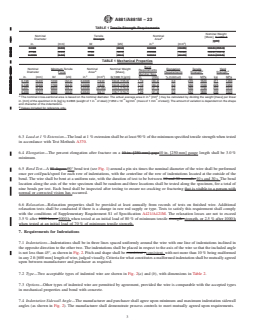
TABLE 1 Mechanical Properties
Bend
Nominal Minimum Tensile Nominal Nominal Weight Elongation Tensile Yield
Requirements
A B B
Diameter Force Area [Mass], Requirements Strength Strength
Mandrel Size,
2 2
in. [mm] lbf [kN] in. [mm ] lb/1000 ft [g/m] in. [mm] % minimum ksi MPa ksi MPa
0.198 [5.03] 7230 [32.2] 0.0308 [19.9] 104.8 [155.9] 1.19 [30.2] 3.0 235 1620 211 1460
0.198 [5.03] 7700 [34.3] 0.0308 [19.9] 104.8 [155.9] 1.19 [30.2] 3.0 250 1720 225 1550
0.207 [5.25] 8800 [39.1] 0.0336 [21.65] 114.3 [170.3] 1.24 [31.5] 3.0 260 1790 234 1610
0.209 [5.31] 9000 [40.0] 0.0343 [22.1] 116.7 [173.7] 1.25 [31.9] 3.0 262 1800 236 1620
A 2 2
The nominal cross-sectional area is based on the nominal diameter. The actual average area in in. [mm ] may be calculated by dividing the weight [mass] per linear
3 –6 3 3
in. [mm] of the specimen in lb [kg] by 0.2836 (weight of 1 in. of steel) [7.850 × 10 kg/mm (mass of 1 mm of steel)]. The amount of variation is dependent on the shape
and character of the indentations.
B
Values included for reference only.
6.3 Load at 1 % Extension—The load at 1 % extension shall be at least 90 % of the minimum specified tensile strength when tested
in accordance with Test Methods A370.
6.4 Elongation—The percent elongation after fracture on a 10-in. [250-mm] gage10 in. [250 mm] gauge length shall be 3.0 %
minimum.
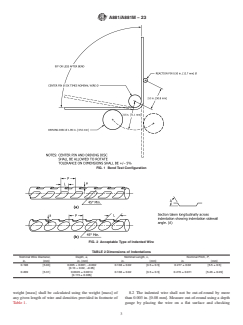
6.5 Bend Test—A 90 degree 90° bend test (see Fig. 1) around a pin six times the nominal diameter of the wire shall be performed
once per coil/pack/spool for each row of indentations, with the centerline of the row of indentations located at the outside of the
bend. The wire shall be bent at a uniform rate, with the duration of test to be between 10 and 30 seconds. 10 s and 30 s. The bend
location along the axis of the wire specimen shall be random and three locations shall be tested along the specimen, for a total of
nine bends per test. Each bend shall be inspected after testing to ensure no cracking or fracturing that is visible to a person with
normal or corrected vision has occurred.
6.6 Relaxation—Relaxation properties shall be provided at least annually from records of tests on finished wire. Additional
relaxation tests shall be conducted if there is a change in raw rod supply or type. Tests to satisfy this requirement shall comply
with the conditions of Supplementary Requirement S1 of Specification A421/A421M. The relaxation losses are not to exceed
3.5 % after 1000 hours 1000 h when tested at an initial load of 80 % of minimum tensile strength. strength, or 2.5 % after 1000 h
when tested at an initial load of 70 % of minimum tensile strength.
7. Requirements for Indentations
7.1 Indentations—Indentations shall be in three lines spaced uniformly around the wire with one line of indentations inclined in
the opposite direction to the other two. The indentations shall be placed in respect to the axis of the wire so that the included angle
is not less than 45°, as shown in Fig. 2. Pitch and shape shall be consistent , consistent, with not more than 10 % being malformed
in any 2 ft [600 mm] length of wire, judged visually. Criteria for what constitutes a malformed indentation shall be mutually agreed
upon between manufacturer and purchaser as required.
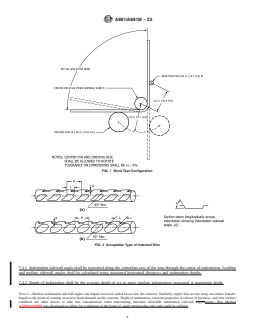
7.2 Type—Two acceptable types of indented wire are shown in Fig. 2(a) and (b), with dimensions in Table 2.
7.3 Options—Other types of indented wire are permitted by agreement, provided the wire is comparable with the accepted types
in mechanical properties and bond with concrete.
7.4 Indentation Sidewall Angle—The manufacturer and purchaser shall agree upon minimum and maximum indentation sidewall
angles (as shown in Fig. 2). The manufacturer shall demonstrate process controls to meet mutually agreed upon requirements.
----------------
...