

prEN IEC 60730-2-22:2026
(Main)Automatic electrical controls - Part 2-22: Particular requirements for thermal motor protectors
General Information
- Abstract
- Status
- Not Published
- Publication Date
- 25-Oct-2027
- Technical Committee
- CLC/TC 72 - Automatic controls for household use
- Current Stage
- 4060 - Enquiry results established and sent to TC, SR, BTTF - Enquiry
- Start Date
- 26-Jun-2026
- Completion Date
- 26-Jun-2026

Overview
prEN IEC 60730-2-22:2026 is an international standard developed by the International Electrotechnical Commission (IEC) and CENELEC (CLC) addressing the particular requirements for automatic electrical controls, specifically thermal motor protectors. These devices are integral to the safety and longevity of electric motors used in a wide variety of appliances and equipment. The standard is intended for application to thermal protectors either integrated into motors or used with sealed (hermetic and semi-hermetic) motor-compressors, ensuring a consistent approach to safety performance and evaluation.
Key Topics
- Definitions and Scope: The standard clarifies what constitutes a thermal motor protector, its purpose, and its operational characteristics. It covers both in-winding (integrated) and off-winding (incorporated) designs.
- Operational Safety: prEN IEC 60730-2-22 outlines requirements for protecting against electric shock, providing adequate earthing, and tests for electric strength and insulation resistance.
- Construction and Endurance: The document specifies mechanical, electrical, and thermal endurance requirements to evaluate long-term reliability. For in-winding protectors, testing is linked to IEC 60335-2-34.
- Environmental Resistance: Requirements address suitability under various environmental conditions, including protection against heat, fire, corrosion, and humidity.
- Testing and Classification: The standard identifies classification (Type 2 and Type 3 actions), test methodologies, and technical data needed for evaluation. Unique criteria are specified for mounting within sealed motor-compressor enclosures.
Applications
Thermal motor protectors covered by this standard play a vital role in:
- Household Appliances: Ensuring the safe function of electric motors within washing machines, refrigerators, air conditioners, and other white goods.
- Commercial and Light Industrial Equipment: Equipment used by laymen in shops, small-scale manufacturing, or agricultural settings benefits from standardized motor protection to avoid overheating and failure.
- Motor-Compressors: Used extensively in HVAC systems and refrigeration, both hermetic and semi-hermetic motor-compressors require integrated protection to meet international safety requirements.
By complying with prEN IEC 60730-2-22:2026, designers and manufacturers can guarantee a high level of motor safety, product reliability, and regulatory compliance, reducing the risk of fire or mechanical failure due to motor overheating.
Related Standards
- IEC 60730-1: General requirements for automatic electrical controls, forming the foundation upon which Part 2-22 builds.
- IEC 60335-2-34: Specific safety requirements for sealed (hermetic and semi-hermetic type) motor-compressors.
- IEC 60269-3: Supplementary requirements for low-voltage fuses in household and similar applications.
- IEC 60730-2-9: Requirements for thermal protectors with integral heating elements.
- National Differences: Annexes in prEN IEC 60730-2-22 highlight regional variations for countries including Canada, USA, and Japan, ensuring global applicability.
Practical Value
Adhering to prEN IEC 60730-2-22:2026 ensures:
- Consistent Safety Benchmarks: Harmonized testing and construction criteria improve trust in product safety.
- Market Access: Compliance demonstrates conformity to international and regional requirements, facilitating global trade.
- Product Differentiation: Manufacturers can leverage compliance as a competitive advantage in markets requiring certified safety standards.
- Risk Mitigation: By establishing defined performance and endurance expectations, the likelihood of field failures and liability is reduced.
By aligning with this standard, stakeholders support safer use of electrical appliances and equipment equipped with automatic thermal motor protectors.
Relations
- Effective Date
- 24-Feb-2026
Frequently Asked Questions
prEN IEC 60730-2-22:2026 is a draft published by CLC. Its full title is "Automatic electrical controls - Part 2-22: Particular requirements for thermal motor protectors". This standard covers: Automatic electrical controls - Part 2-22: Particular requirements for thermal motor protectors
Automatic electrical controls - Part 2-22: Particular requirements for thermal motor protectors
prEN IEC 60730-2-22:2026 is classified under the following ICS (International Classification for Standards) categories: 97.120 - Automatic controls for household use. The ICS classification helps identify the subject area and facilitates finding related standards.
prEN IEC 60730-2-22:2026 has the following relationships with other standards: It is inter standard links to EN IEC 60730-2-22:2020. Understanding these relationships helps ensure you are using the most current and applicable version of the standard.
prEN IEC 60730-2-22:2026 is available in PDF format for immediate download after purchase. The document can be added to your cart and obtained through the secure checkout process. Digital delivery ensures instant access to the complete standard document.
Standards Content (Sample)
SLOVENSKI STANDARD
01-junij-2026
Avtomatske električne krmilne naprave - 2-22. del: Posebne zahteve za naprave za
toplotno zaščito motorjev
Automatic electrical controls - Part 2-22: Particular requirements for thermal motor
protectors
Automatische elektrische Regel- und Steuergeräte - Teil 2-22: Besondere
Anforderungen an thermisch wirkende Motorschutzeinrichtungen
Dispositifs de commande électrique automatiques - Partie 2-22: Exigences particulières
pour les protecteurs thermiques
Ta slovenski standard je istoveten z: prEN IEC 60730-2-22:2026
ICS:
97.120 Avtomatske krmilne naprave Automatic controls for
za dom household use
2003-01.Slovenski inštitut za standardizacijo. Razmnoževanje celote ali delov tega standarda ni dovoljeno.
72/1532/CDV
COMMITTEE DRAFT FOR VOTE (CDV)
PROJECT NUMBER:
IEC 60730-2-22 ED2
DATE OF CIRCULATION: CLOSING DATE FOR VOTING:
2026-04-03 2026-06-26
SUPERSEDES DOCUMENTS:
72/1529/RR
IEC TC 72 : AUTOMATIC ELECTRICAL CONTROLS
SECRETARIAT: SECRETARY:
United States of America Ms Grace Roh
OF INTEREST TO THE FOLLOWING COMMITTEES: HORIZONTAL FUNCTION(S):
ASPECTS CONCERNED:
SUBMITTED FOR CENELEC PARALLEL VOTING NOT SUBMITTED FOR CENELEC PARALLEL VOTING
This document is still under study and subject to change. It should not be used for reference purposes.
Recipients of this document are invited to submit, with their comments, notification of any relevant patent rights of
which they are aware and to provide supporting documentation.
Recipients of this document are invited to submit, with their comments, notification of any relevant “In Some Countries”
clauses to be included should this proposal proceed. Recipients are reminded that the CDV stage is the final stage for
submitting ISC clauses. (SEE AC/22/2007 OR NEW GUIDANCE DOC).
TITLE:
Automatic electrical controls - Part 2-22: Particular requirements for thermal motor protectors
PROPOSED STABILITY DATE: 2029
NOTE FROM TC/SC OFFICERS:
This Part 2 standard has been editorially formatted to the 6th edition of the Part 1 standard. Some of these
editorial changes may result in technical changes.
The last edition (1.0) of this Part 2 of the standard was based on IEC 60730-1 Edition 4 without
amendments.
The foreword of IEC 60730-1 Edition 6 only outlines the changes that have been made from Edition 5.2 to
the new edition.
Therefore, read this Part 2 standard with the newest edition of IEC 60730-1 Edition 6.
this electronic file, to make a copy and to print out the content for the sole purpose of preparing National Committee
positions. You may not copy or "mirror" the file or printed version of the document, o r any part of it, for any other
purpose without permission in writing from IEC.
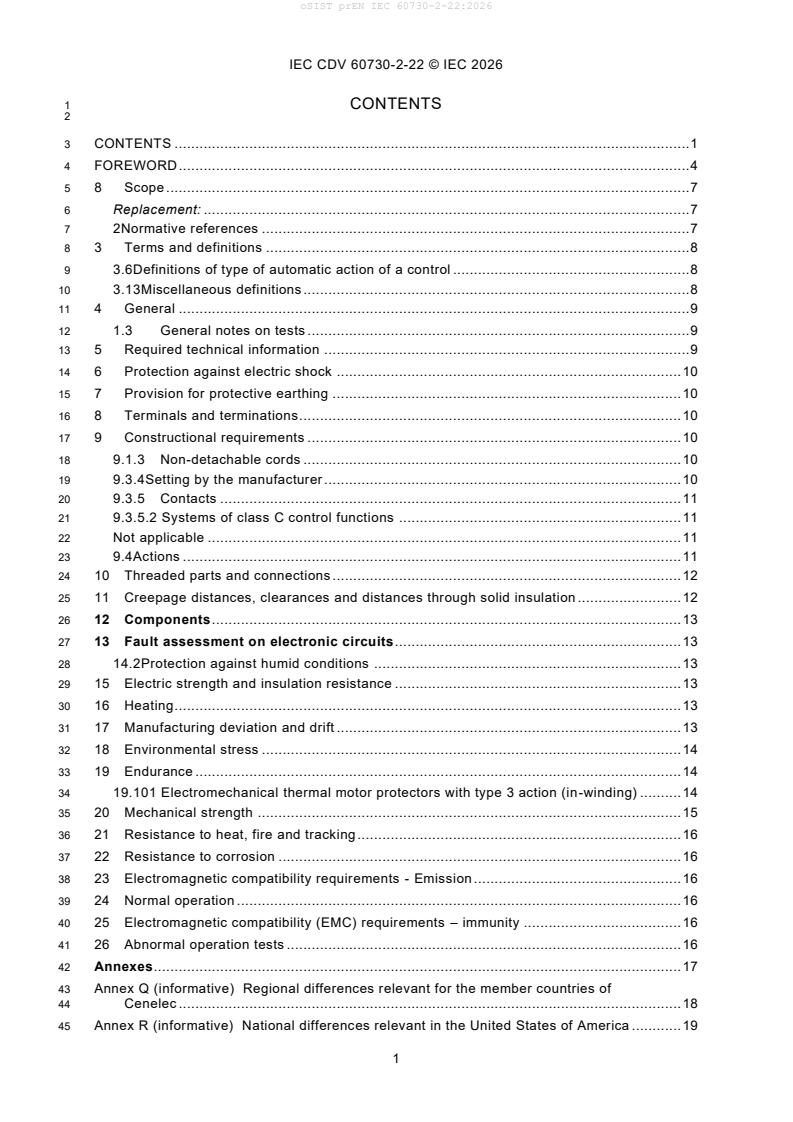
IEC CDV 60730-2-22 © IEC 2026
1 CONTENTS
3 CONTENTS . 1
4 FOREWORD . 4
5 8 Scope . 7
6 Replacement: . 7
7 2Normative references . 7
8 3 Terms and definitions . 8
9 3.6Definitions of type of automatic action of a control . 8
10 3.13Miscellaneous definitions . 8
11 4 General . 9
12 1.3 General notes on tests . 9
13 5 Required technical information . 9
14 6 Protection against electric shock . 10
15 7 Provision for protective earthing . 10
16 8 Terminals and terminations . 10
17 9 Constructional requirements . 10
18 9.1.3 Non-detachable cords . 10
19 9.3.4Setting by the manufacturer . 10
20 9.3.5 Contacts . 11
21 9.3.5.2 Systems of class C control functions . 11
22 Not applicable . 11
23 9.4Actions . 11
24 10 Threaded parts and connections . 12
25 11 Creepage distances, clearances and distances through solid insulation . 12
26 12 Components . 13
27 13 Fault assessment on electronic circuits . 13
28 14.2Protection against humid conditions . 13
29 15 Electric strength and insulation resistance . 13
30 16 Heating . 13
31 17 Manufacturing deviation and drift . 13
32 18 Environmental stress . 14
33 19 Endurance . 14
34 19.101 Electromechanical thermal motor protectors with type 3 action (in-winding) . 14
35 20 Mechanical strength . 15
36 21 Resistance to heat, fire and tracking . 16
37 22 Resistance to corrosion . 16
38 23 Electromagnetic compatibility requirements - Emission . 16
39 24 Normal operation . 16
40 25 Electromagnetic compatibility (EMC) requirements – immunity . 16
41 26 Abnormal operation tests . 16
42 Annexes . 17
43 Annex Q (informative) Regional differences relevant for the member countries of
44 Cenelec . 18
45 Annex R (informative) National differences relevant in the United States of America . 19
IEC CDV 60730-2-22 © IEC 2026
46 R.2 Normative references . 19
47 Annex S (informative) National differences relevant in Japan . 20
48 S.2 Normative references . 20
49 Annex T (informative) National differences relevant in Canada . 21
50 T.2 Normative references . 21
51 Annex AA (normative) Endurance test for thermal motor protectors as components,
52 i.e. not installed on a motor . 22
53 AA.1Purpose. 22
54 AA.2Endurance test of automatic action at accelerated rate . 22
55 AA.2.1Electrical conditions for tests . 22
56 AA.2.2Thermal conditions for the tests . 22
57 AA.2.3Manual and mechanical conditions for the test . 22
58 AA.2.4Test of automatic action at accelerated rate . 23
59 AA.2.5Evaluation of test results . 23
60 Annex BB (informative) Testing of the combination of motor and thermal motor
61 protectors (not applicable to sealed motor-compressors) . 24
62 BB.1Purpose. 24
63 BB.4General notes on tests . 24
64 BB.4.2Samples required . 24
65 BB.4.3.2.6Replacement: . 24
66 BB.6Classification . 24
67 BB.6.201 According to opening temperature tolerance of the thermal motor
68 protector . 25
69 BB.6.202 According to limited short-circuit capability in terms of current, voltage,
70 fuse size and special fuse requirements, if applicable . 25
71 BB.7Information . 25
72 BB.15Manufacturing deviation and drift . 25
73 BB.17Endurance . 25
74 BB.17.201Endurance test on combination of motor and thermal motor protector . 25
75 BB.17.202Electrical conditions for the tests . 25
76 BB.17.203Thermal conditions for the tests . 25
77 BB.17.204Manual and mechanical conditions for the tests . 26
78 BB.17.205.1Running overload protection . 26
79 BB.17.205.2Locked rotor protection (temperature) . 28
80 BB.17.205.3Electric strength test . 29
81 BB.17.205.4Locked rotor endurance . 29
82 Annex CC (informative) Additional information on the application of motor protectors
83 in pollution degree 1, 2 and 3 . 31
84 CC.1General . 31
85 CC.2Guidance on the mounting method versus pollution degree (see Annex N) . 31
86 Bibliography . 32
87 Figure T.101 – Limited short circuit test scheme . 23
89 Table 1 . 10
90 Table R.101 – Limited short-circuit capacity (applicable in Canada) . 19
91 Table T.101 - Limited short-circuit capacity (applicable in USA)………………………23
92 Table BB.101 – Additional required information and methods of providing information . 29
IEC CDV 60730-2-22 © IEC 2026
93 Table BB.201 – Maximum allowable temperatures on running loads . 30
94 Table BB.202 – Maximum continuous running overload current permitted by thermal
95 protector as percentage of nominal full load motor current . 30
96 Table BB.203 – Maximum allowable temperatures for locked rotor conditions . 31
97 Table CC.1 . 34
IEC CDV 60730-2-22 © IEC 2026
99 INTERNATIONAL ELECTROTECHNICAL COMMISSION
100 ____________
102 AUTOMATIC ELECTRICAL CONTROLS–
104 Part 2-22: Particular requirements for thermal motor protectors
106 FOREWORD
107 1) The International Electrotechnical Commission (IEC) is a worldwide organization for standardization comprising
108 all national electrotechnical committees (IEC National Committees). The object of IEC is to promote international
109 co-operation on all questions concerning standardization in the electrical and electronic fields. To this end and
110 in addition to other activities, IEC publishes International Standards, Technical Specifications, Technical Reports,
111 Publicly Available Specifications (PAS) and Guides (hereafter referred to as “IEC Publication(s)”). Their
112 preparation is entrusted to technical committees; any IEC National Committee interested in the subject dealt with
113 may participate in this preparatory work. International, governmental and non-governmental organizations liaising
114 with the IEC also participate in this preparation. IEC collaborates closely with the International Organization for
115 Standardization (ISO) in accordance with conditions determined by agreement between the two organizations.
116 2) The formal decisions or agreements of IEC on technical matters express, as nearly as possible, an international
117 consensus of opinion on the relevant subjects since each technical committee has representation from all
118 interested IEC National Committees.
119 3) IEC Publications have the form of recommendations for international use and are accepted by IEC National
120 Committees in that sense. While all reasonable efforts are made to ensure that the technical content of IEC
121 Publications is accurate, IEC cannot be held responsible for the way in which they are used or for any
122 misinterpretation by any end user.
123 4) In order to promote international uniformity, IEC National Committees undertake to apply IEC Publications
124 transparently to the maximum extent possible in their national and regional publications. Any divergence between
125 any IEC Publication and the corresponding national or regional publication shall be clearly indicated in the latter.
126 5) IEC itself does not provide any attestation of conformity. Independent certification bodies provide conformity
127 assessment services and, in some areas, access to IEC marks of conformity. IEC is not responsible for any
128 services carried out by independent certification bodies.
129 6) All users should ensure that they have the latest edition of this publication.
130 7) No liability shall attach to IEC or its directors, employees, servants or agents including individual experts and
131 members of its technical committees and IEC National Committees for any personal injury, property damage or
132 other damage of any nature whatsoever, whether direct or indirect, or for costs (including legal fees) and
133 expenses arising out of the publication, use of, or reliance upon, this IEC Publication or any other IEC
134 Publications.
135 8) Attention is drawn to the Normative references cited in this publication. Use of the referenced publications is
136 indispensable for the correct application of this publication.
137 9) Attention is drawn to the possibility that some of the elements of this IEC Publication may be the subject of patent
138 rights. IEC shall not be held responsible for identifying any or all such patent rights.
139 International Standard IEC 60730-22 has been prepared by IEC technical committee 72:
140 Automatic electrical controls.
141 The text of this standard is based on the following documents:
FDIS Report on voting
72/XXX/FDIS 72/XXX/RVD
143 Full information on the voting for the approval of this standard can be found in the report on
144 voting indicated in the above table.
145 This publication has been drafted in accordance with the ISO/IEC Directives, Part 2.
146 This Part 2-22 is intended to be used in conjunction with IEC 60730-1. This second edition
147 cancels and replaces the first edition published in 2014. This edition was established on the
148 basis of the sixth edition (2022) of IEC 60730-1. Consideration may be given to future editions
149 of, or amendments to, IEC 60730-1.
IEC CDV 60730-2-22 © IEC 2026
150 This Part 2-22 supplements or modifies the corresponding clauses in IEC 60730-1 so as to
151 convert that publication into the IEC standard: Safety requirements for automatic electrical
152 thermal motor protectors.
153 Where this Part 2-22 states "addition", "modification", or "replacement", the relevant
154 requirement, test specification or explanatory matter in Part 1 should be adapted accordingly.
155 Where no change is necessary, this Part 2-22 indicates that the relevant clause or subclause
156 applies.
157 In the development of a fully international standard, it has been necessary to take into
158 consideration the differing requirements resulting from practical experience in various parts of
159 the world and to recognize the variation in national electrical systems and wiring rules.
160 The ”in some countries” clauses have been moved to the Regional National Differences in
161 Annex Q to Annex T. In this publication:
162 1) The following print types are used:
163 – Requirements proper: in roman type;
164 – Test specifications: in italic type;
165 – Explanatory matter; in small roman type;
166 – Words defined in Clause 2: bold.
167 2) Subclauses, notes, tables and figures which are additional to those in part 1 are numbered
168 starting from 101, additional annexes are lettered AA, BB, etc.
169 A list of all parts of the IEC 60730 series, under the general title Automatic electrical controls
170 can be found on the IEC website.
IEC CDV 60730-2-22 © IEC 2026
172 The committee has decided that the contents of this publication will remain unchanged until the
173 stability date indicated on the IEC web site under "http://webstore.iec.ch" in the data related to
174 the specific publication. At this date, the publication will be
175 • reconfirmed,
176 • withdrawn,
177 • replaced by a revised edition, or
178 • amended.
IEC CDV 60730-2-22 © IEC 2026
180 AUTOMATIC ELECTRICAL CONTROLS
182 Part 2-22: Particular requirements for thermal motor protectors
184 8 Scope
185 Replacement:
186 This document applies to the inherent safety and evaluation of thermal motor protectors
187 intended to be integrated or incorporated in:
188 - motors used in equipment but not limited to the scope of IEC 60335-1 and its Part 2’s.
189 - sealed (hermetic and semi-hermetic type) motor-compressors.
190 NOTE Throughout this standard, the word “equipment” means “appliance and equipment”.
191 Thermal motor protectors that are off winding (not integrated with the motor winding) to the
192 motor are covered under the scope of this document and may be considered incorporated
193 controls with respect to the requirements of this standard. Thermal protectors with integral
194 heating elements (resistors, thermistors and the like) are considered voltage maintained
195 thermal cutouts and are covered under IEC 60730-2-9.
196 Requirements concerning the testing of the combination of sealed (hermetic and semi-hermetic
197 type) motor-compressors and thermal motor protectors are given in IEC 60335-2-34.
198 This document applies to thermal motor protectors:
199 • using NTC or PTC thermistors, requirements for which are contained in Annex J.
200 • responsive to the operating values, operating times, and operating sequences,
201 where such are associated with equipment safety, and to the testing of thermal motor
202 protectors used in or on equipment as well as in sealed (hermetic and semi-hermetic
203 type) motor-compressors.
204 • not intended for normal household use, but which nevertheless may be used by the
205 public, such as in equipment intended to be used by laymen in shops, in light industry
206 and on farms, are within the scope of this standard.
207 This document does not apply to:
208 • thermal motor protectors designed exclusively for industrial applications unless no
209 relevant safety standard exists.
210 • other means of motor protection.
211 • a manual device for opening the circuit.
212 2 Normative references
213 Addition:
214 IEC 60269-3, Low-voltage fuses – Part 3: Supplementary requirements for fuses for use by
215 unskilled persons (fuses mainly for household and similar applications) – Examples of
216 standardized systems of fuses A to F
IEC CDV 60730-2-22 © IEC 2026
217 IEC 60335-2-34:2012, Household and similar electrical appliances – Safety – Part 2-34:
218 Particular requirements for motor-compressors
219 3 Terms and definitions
220 This clause of Part 1 is applicable except as follows:
221 3.2 Definition of types of control according to purpose
222 3.2.101
223 motor protector
224 automatic control that is specifically intended to protect the windings of an electric motor from
225 overheating.
226 3.2.102
227 thermal motor protector
228 automatic control, built-in or on a motor, that is specifically intended to protect the motor
229 against overheating due to running overload and failure to start
230 Note 1 to entry: The control carries motor current and is sensitive to motor temperature and current.
231 Note 2 to entry: The control is capable of being reset (either manually or automatically) when its temperature falls
232 to the reset value.
233 3.6 Definitions of type of automatic action of a control
234 Modified:
235 3.6.2
236 Type 2 action
237 automatic action for which the manufacturing deviation and the drift of its operating value,
238 operating time or operating sequence have been declared and tested under this document
239 Note 1 to entry: Type 2 action applies to off winding, incorporated thermal motor protectors.
241 Additional definition:
242 3.6.101
243 type 3 action
244 automatic action for which reliability of the operating characteristics can only be evaluated in
245 terms of measurements made on the protected motor or motor compressor
246 Note 1 to entry: Type 3 action applies to in-winding, integrated thermal motor protectors.
248 3.13 Miscellaneous definitions
249 Additional definition:
250 3.13.101
251 sealed motor-compressor
252 mechanical compressor (of a hermetic or semi-hermetic type) consisting of a compressor and
253 a motor, both of which are enclosed in the same sealed housing with no external shaft seals,
254 the motor operating in a refrigerant atmosphere
255 Note 1 to entry: The enclosure may be permanently sealed by welding or brazing (hermetic compressor) or may be
256 sealed by one or more gasketed joints (semi-hermetic compressor).
IEC CDV 60730-2-22 © IEC 2026
257 4 General
258 This clause of Part 1 is applicable except for the following.
259 1.3 General notes on tests
260 This clause of Part 1 is applicable except as follows:
261 4.3.4 Instructions for test
262 4.3.4.1 According to submission
263 4.3.4.1.1 and 4.3.4.1.2 Not applicable.
265 5 Required technical information
266 This clause of Part 1 is applicable except as follows:
267 Table 1 – Required technical information and methods of providing these information
Information Clause or subclause Method
3.6.2, X
20 Number of automatic cycles (A) for each automatic action.
19.8.4, 19.102, Annex
Preferred values are: 300 000 cycles; 200 000 cycles; 100 000 cycles;
AA
1)
30 000 cycles; 20 000 cycles; 10 000 cycles; 6 000 cycles; 3 000 cycles ;
1) 2) 2)4) 3)
1 000 cycles ; 300 cycles ; 30 cycles ; 1 cycle .
1)
Not applicable to thermostats or to other fast cycling actions.
2)
Applicable only to manual reset.
3)
Applicable only to actions which require the replacement of a part after
each operation.
4)
Can only be reset during manufacturer servicing.
NOTE For controls having more than one automatic action, a different value can be declared
for each.
3.4.3 X
22 Micro disconnection provided by each circuit (Type 3.B)
24 Method of mounting control 9.6 X
33 Type 2 action or Type 3 action 3.6, 3.6.101 D or E
34 Additional features of type 2 action or type 3 actions 9.4,9.4.11, 9.4.101 D or E
b
3.6, 9.4.101 X
37 Reset characteristics for cut-out action
c
9.4.101 D
102 Features of automatic actions
103 Maximum pressure for controls located within the sealed compressor 20.1.3.101.1 D
d
enclosure
104 In-winding, Integrated thermal motor protector (type 3 action) 3.6.101, 9.4.101, 17,
19.101
105 off-winding, incorporated thermal motor protector (type 2 action) 3.6.2, 17, 19.102,
Annex AA
IEC CDV 60730-2-22 © IEC 2026
a
The unique type reference shall be such that, when it is quoted in full, the manufacturer of the control can
supply a replacement which will be fully interchangeable with the original electrically, mechanically,
dimensionally and functionally.
It may comprise a series type reference with other marking, such as voltage rating or an ambient temperature
marking, which together provide a unique type reference.
b
Manufacturers may declare a lower ambient temperature than that specified in 9.4.102.
c
Thermal motor protectors are classified as Type 3.B.H
d
The test pressure depends on the intended refrigerant and the location of the protector inside the compressor
(high side or low side). Values can be taken from 22.7 of IEC 60335-2-34:2024.
268 6 Protection against electric shock
269 This clause of Part 1 is applicable.
270 7 Provision for protective earthing
271 This clause of Part 1 is applicable.
272 8 Terminals and terminations
273 This clause of Part 1 is applicable except as follows:
274 8.1 Terminals and termination for external copper conductors
275 Not applicable.
276 9 Constructional requirements
277 This clause of Part 1 is applicable except as follows:
278 9.1.3 Non-detachable cords
279 Not applicable.
281 9.2 Protection against electric shock
282 9.2.4 Flexible cord sheaths
283 Not applicable
285 9.3 Actuation and operation
286 9.3.1 Full disconnection
287 Not applicable
289 9.3.4 Setting by the manufacturer
290 Addition:
291 NOTE Sealing compounds, lock nuts and the like are deemed adequate for this purpose.
IEC CDV 60730-2-22 © IEC 2026
293 9.3.5 Contacts
294 9.3.5.2 Systems of class C control functions
295 Not applicable
297 9.3.9 Pull-cord actuated control
298 Not applicable
300 9.4 Actions
301 9.4.1 Combined actions
302 Not applicable
303 9.4.4 Type 1.A or 2.A action (Full disconnection on operation)
304 Not applicable
305 9.4.6 Type 1.C or 2.C action (Micro-interruption on operation)
306 Not applicable
307 9.4.13 Type 1.K or 2.K action (for sensing actions, no increase in the operating value as the result
308 of a breakage in the sensing element, or in parts connecting the sensing element to the switch
309 head)
310 Not applicable
311 9.4.14 Type 1.L or 2.L action (an action that does not require any external auxiliary energy source
312 of electrical supply for its intended operation)
313 Not applicable
314 Additional subclauses:
315 9.4.101 Thermal motor protectors are further classified according to the following
316 constructional or operational features:
317 – non-self-resetting (Type 3.B.H)
318 9.4.101.1 A Type 3.B.H action shall operate to provide the electric strength requirements
319 specified for micro-disconnection.
320 Compliance is checked by the tests of Clause 15 and the relevant requirements of Clause 11.
321 9.4.102 A Type 3.B.H action shall be so designed that the contacts cannot be prevented from
322 opening and may automatically reset to the closed position if the reset means is held in the
323 reset position. With the reset means in its normally free position, the control shall not reset
324 automatically at any test ambient temperature above –5 °C.
325 Compliance is checked by inspection and, where necessary, by test, with no force applied to
326 the actuating member.
327 9.5 Openings in enclosures
328 Not applicable
IEC CDV 60730-2-22 © IEC 2026
329 9.6 Mounting of controls
330 9.6.3 Mounting of independently mounted controls
332 Not applicable
334 9.7 Attachment of cords
335 Not applicable
336 9.8 Size of cords-non-detachable
337 Not Applicable.
338 9.9 Inlet openings
339 Not applicable
340 9.10 Equipment inlets and socket-outlets.
341 Not applicable.
343 9.11 Requirements during mounting, use, maintenance and servicing
344 9.11.6 Pull-cords
345 Not applicable.
347 9.12 Controls using software
348 Not applicable
350 9.13 Protective controls and components of protective control systems
351 9.13.2 Pressure limiting devices
352 Not applicable
354 9.13.4 Batteries
356 Not applicable
358 9.13.5 Smart enabled controls
360 Not applicable
362 10 Threaded parts and connections
364 This clause of Part 1 is applicable.
365 11 Creepage distances, clearances and distances through solid insulation
366 This clause of Part 1 is applicable.
IEC CDV 60730-2-22 © IEC 2026
367 12 Components
369 This clause of Part 1 is applicable.
371 13 Fault assessment on electronic circuits
373 This clause of part 1 is applicable
375 14 Moisture and dust resistance
377 This clause of Part 1 is applicable except for the following:
379 14.1 Protection against ingress of water and dust
381 Not applicable
383 14.2 Protection against humid conditions
384 Add the following text after 14.2.2:
385 NOTE 1 In Canada and the USA, see Annex T and R respectively.
386 NOTE 2 In Japan, See Annex S
388 14.3 Touch current test for in-line cord controls and free-standing controls
390 Not applicable
392 15 Electric strength and insulation resistance
393 This clause of Part 1 is applicable except as follows:
394 15.1 Insulation resistance
395 Not applicable
396 15.2 Electric strength
397 Add the following text after table 16 of 15.2.1:
398 NOTE The suitability of the test in Clause 15 can depend upon the method of mounting the thermal motor protector
399 in the equipment.
400 If the results of the tests in Clause 15 are not likely to be representative of the results obtained when the thermal
401 motor protector is mounted in the equipment, then these tests would normally be carried out in the equipment.
403 15.3 Additional tests for in-line cord and free-standing controls
404 Not applicable
405 16 Heating
406 This clause of Part 1 is applicable.
407 17 Manufacturing deviation and drift
408 This clause of Part 1 is applicable.
IEC CDV 60730-2-22 © IEC 2026
409 18 Environmental stress
410 This clause of Part 1 is applicable.
411 19 Endurance
412 This clause of Part 1 is replaced as follows:
413 19.1 General requirements
414 19.1.1 Objectives of the test
415 The endurance test is intended:
416 a) To evaluate the robustness of the switching contacts and associated parts that are either
417 integrated in the thermal motor protector or separately controlled.
418 b) To ensure inherent and functional safety as applicable, as well as normal operation of the
419 thermal motor protector.
420 c) For electromechanical thermal motor protector with type 2 action.
421 d) For electronic thermal motor protector that have moving parts.
422 19.1.2 A thermal motor protector shall withstand the mechanical, electrical and thermal stresses
423 that occur in normal use.
424 19.1.3 Electronic thermal motor protector
425 Electronic thermal motor protectors are not subjected to an endurance test but to a thermal cycling
426 test under the conditions described in H.19.1.3.3.
427 19.1.3.3 Thermal cycling test, see H.19.1.3.3
428 19.1.4 Electromechanical thermal motor protector with type 2 action
429 Electromechanical thermal motor protectors with type 2 actions shall operate such that any
430 operating value, operating time or operating sequence does not change by an amount greater than the
431 declared drift, see H.17
432 19.101 Electromechanical thermal motor protectors with type 3 action (in-winding)
434 Endurance requirements for thermal motor protectors used in motor-compressors with type
435 3 action are represented by the abnormal test of 19.101 to 19.105 inclusive, in IEC 60335-2-
436 34:2024.
438 19.102 Electromechanical thermal motor protectors with type 2 action (off winding)
440 Annex AA contains requirements for the endurance test on the thermal motor protector as a
441 component, i.e. not installed in a motor.
443 19.103 Limited short-circuit capability
444 See Annex R & T.
IEC CDV 60730-2-22 © IEC 2026
445 20 Mechanical strength
446 This clause of Part 1 is applicable except as follows:
447 20.1.3 Additional subclause:
448 20.1.3.101 Thermal motor protectors for motor compressor only located within the sealed
449 motor compressor enclosure shall be so designed and constructed to withstand the pressures
450 developed under operating conditions.
451 20.1.3.101.1 Compliance is checked by exposing two samples of the thermal protector to an
452 external pressure value declared in Table 1, item 103 without:
453 – collapsing, bending, warping or distorting the protective device housing as determined by
454 visual examination;
455 – short-circuiting the housing to internal current-carrying parts of the protective device; and
456 – affecting electrical continuity between terminals of the protective device.
457 20.1.3.101.2 Alternatively, at the request of the manufacturer, the tests of 20.1.3.101.1 may
458 be conducted at a pressure equal to 60 % of the test pressure specified in 20.1.3.101.1 provided
459 that the protector complies with the requirements of the calibration check test of 20.1.3.101.4
460 and with the following.
461 In addition, the test as determined by visual examination shall not cause structural damage
462 which would decrease the required electrical creepage distance and clearance.
463 20.1.3.101.3 The pressure test medium is to be any non-hazardous liquid, such as water. The
464 test samples are to be placed in a container filled with the test medium to exclude air. The
465 container is to be connected to a hydraulic system whose pressure is to be increased gradually
466 to the required test pressure, which is then maintained for 1 min.
467 20.1.3.101.4 A calibration test is performed by measuring the operating and reset
468 temperatures of the thermal motor protector before and after the pressure test of
469 20.1.3.101.2. The difference in measured temperature shall be within 5 K or 5 %, whichever is
470 greater, of the temperature measured prior to the pressure test.
471 The test is performed by mounting the test samples in an air oven, having forced air circulation
472 at a velocity of at least 0,5 m/s and designed to nullify the effects of radiation. Temperatures
473 are to be measured by thermocouples attached to an adjacent protector device or located in air
474 adjacent to the protector device under test. Indication of operating and reset is to be obtained
475 by a low-energy continuity-indicating circuit whose current does not influence operation of the
476 device. The operating and reset temperatures are to be the average of two trials.
477 Prior to cut-out or cut-in temperature calibration, uniform temperatures of all parts of the thermal
478 protector are to be maintained at approximately 11 K below the operating temperature and 11
479 K above the reset temperature until conditions of equilibrium have been established. The
480 temperature is then to be increased or decreased as required at a rate not greater than 0,5
481 K/min until the protector opens or closes.
482 NOTE 1 Alternate calibration test equipment is subject to agreement between test house and manufacturer.
483 NOTE 2 A higher test pressure is subject to agreement between test house and manufacturer.
484 20.1.4 to 20.9 Not applicable.
IEC CDV 60730-2-22 © IEC 2026
485 21 Resistance to heat, fire and tracking
486 This clause of Part 1 is applicable except for the following:.
487 21.3 Independently mounting, free-standing controls
488 Not applicable
489 22 Resistance to corrosion
490 This clause of Part 1 is applicable.
491 NOTE 101 Annex CC provides additional information on the application of motor protectors in pollution degree
492 1, 2 and 3 situations.
493 23 Electromagnetic compatibility requirements - Emission
494 This clause of Part 1 is applicable.
495 24 Normal operation
496 This clause of Part 1 is applicable.
497 Addition:
498 No test is required for component parts within a hermetically sealed enclosure.
499 25 Electromagnetic compatibility (EMC) requirements – immunity
500 This clause of Part 1 is applicable.
501 26 Abnormal operation tests
502 This clause of Part 1 is not applicable.
IEC CDV 60730-2-22 © IEC 2026
504 Annexes
505 The annexes of Part 1 are applicable except as follows:
IEC CDV 60730-2-22 © IEC 2026
507 Annex Q
508 (informative)
510 Regional differences relevant for the member countries of Cenelec
511 This annex of Part 1 is applicable except as follows:
512 Replacement:
514 NOTE This annex is informative in this document, but in EN IEC 60730-2-22, this annex is normative. Refer to EN
515 IEC 60730-2-22 for regional differences in member countries of Cenelec.
517 Q.2 Normative references
519 Replacement:
521 Refer to EN IEC 60730-2-22 for specific requirements in the member countries of Cenelec.
IEC CDV 60730-2-22 © IEC 2026
523 Annex R
524 (informative)
526 National differences relevant in the United States of America
527 This annex of Part 1 is applicable except as follows:
528 Replacement:
529 NOTE This annex is informative in this document, but in UL 60730-2-22, this annex is normative. Refer to UL
530 60730-2-22 National differences for US specific requirements.
531 R.2 Normative references
532 Replacement:
533 Refer to UL 60730-2-22 for specific requirements in the United States
IEC CDV 60730-2-22 © IEC 2026
535 Annex S
536 (informative)
538 National differences relevant in Japan
539 This annex of Part 1 is applicable except as follows:
541 Replacement
542 NOTE This annex is informative in this document, but in JIS C 9730-2-2 and JIS C 9730-2-4, this annex is normative.
543 Refer to JIS C 9730-2-2 and JIS C 9730-2-4 for Japanese specific requirements.
544 S.2 Normative references
545 Refer to JIS C 9730-2-2 and JIS C 9730-2-4 for Japanese specific requirements.
IEC CDV 60730-2-22 © IEC 2026
547 Annex T
548 (informative)
550 National differences relevant in Canada
551 This annex of the Part 1 is applicable except as follows:
552 Replacement:
553 NOTE This annex is informative in this document, but in CSA C22.2 No 60730-2-22, this annex is normative. Refer
554 to CSA C22.2 No 60730-2-22, National differences for Canada specific requirements.
555 T.2 Normative references
556 Refer to CSA C22.2 No 60730-2-22 for specific requirements in Canada.
IEC CDV 60730-2-22 © IEC 2026
557 Annex AA
558 (normative)
560 Endurance test for thermal motor protectors
561 as components, i.e. not installed on a motor
562 AA.1 Purpose
563 The purpose of Annex AA is to provide the user of thermal motor protectors a means for pre-
564 selecting thermal motor protectors. The results of this test do not provide assurance that
565 devices passing the test will also pass the final motor test. Also, devices failing this test may
566 still pass the final motor test.
567 The test of Annex AA cannot, therefore, be used as a basis for certification of a motor protector
568 or motor/motor protector combination. It does not replace the locked rotor test in IEC 60335-
569 2-34.
...