

ASTM D6200-21
(Test Method)Standard Test Method for Determination of Cooling Characteristics of Quench Oils by Cooling Curve Analysis
General Information
- Abstract
SIGNIFICANCE AND USE
5.1 This test method provides a cooling time versus temperature pathway which is directly proportional to physical properties such as the hardness obtainable upon quenching of a metal. The results obtained by this test may be used as a guide in heat treating oil selection or comparison of quench severities of different heat treating oils, new or used.
SCOPE
1.1 This test method describes the equipment and the procedure for evaluation of a quenching oil's quenching characteristics by cooling rate determination.
1.2 This test is designed to evaluate quenching oils in a non-agitated system. There is no correlation between these test results and the results obtained in agitated systems.
1.3 The values in SI units are to be regarded as the standard.
1.3.1 Exception—The values in parentheses are provided for information only.
1.4 This standard does not purport to address all of the safety concerns, if any, associated with its use. It is the responsibility of the user of this standard to establish appropriate safety, health, and environmental practices and determine the applicability of regulatory limitations prior to use.
1.5 This international standard was developed in accordance with internationally recognized principles on standardization established in the Decision on Principles for the Development of International Standards, Guides and Recommendations issued by the World Trade Organization Technical Barriers to Trade (TBT) Committee.
- Status
- Published
- Publication Date
- 30-Nov-2021
- Technical Committee
- D02 - Petroleum Products, Liquid Fuels, and Lubricants
- Drafting Committee
- D02.L0.06 - Non-Lubricating Process Fluids
Buy Documents
ASTM D6200-21 - Standard Test Method for Determination of Cooling Characteristics of Quench Oils by Cooling Curve Analysis
REDLINE ASTM D6200-21 - Standard Test Method for Determination of Cooling Characteristics of Quench Oils by Cooling Curve Analysis
Overview
ASTM D6200-21: Standard Test Method for Determination of Cooling Characteristics of Quench Oils by Cooling Curve Analysis establishes a method to evaluate the cooling properties of quenching oils in non-agitated systems through cooling curve analysis. Used extensively in heat treatment operations, quench oils directly influence metallurgical outcomes such as surface hardness and structural integrity. This standard outlines precise equipment and procedures for determining and comparing the cooling time versus temperature profile of quench oils, which is critical for selecting appropriate heat treating oils and optimizing process results.
Key Topics
Cooling Curve Analysis
The standard explains how to measure the temperature decrease over time as a heated metal probe is quenched in oil, creating a cooling curve. This curve forms the basis for understanding how effectively an oil can extract heat and thus its “quench severity.”Test Apparatus and Calibration
Detailed requirements are provided for the furnace, probe assembly, data acquisition systems, and sample containers. Calibration with reference fluids ensures test consistency and repeatability.Suitability and Scope
The method is exclusively applicable to non-agitated systems. There is no correlation between these results and quenching in agitated systems. All measurements are standardized in SI units.Interferences and Precautions
Water content in quench oil can significantly impact results, making pre-test verification of oil moisture content essential for accuracy.Interpretation and Reporting
Results include time-to-temperature values, maximum cooling rates, and graphical representations. These parameters are used for comparison between oils, with duplicate testing recommended for verification.
Applications
ASTM D6200-21 plays a vital role in various industrial segments where heat treatment is essential, such as:
Metal Hardening and Heat Treatment
By providing a pathway to gauge potential hardness and structural changes, this standard helps professionals select or compare quenching oils based on their cooling performance-thereby optimizing metallurgical properties and minimizing distortion or cracking risks.Routine Quality Control
Manufacturers and laboratories utilize this standard to monitor changes in quench oil performance due to oxidation, contamination, or additive degradation, ensuring consistent process quality over time.Comparative Evaluation of New and Used Oils
This test enables direct comparison of quench severities for different oils, supporting both selection of new oils and assessment of oils already in service.Troubleshooting and Process Optimization
Deviations in cooling curves can signify potential problems in heat treatment lines, facilitating targeted corrective actions.
Related Standards
Several other standards and reference materials are relevant for organizations implementing ASTM D6200-21, including:
- ASTM D4175 - Terminology Relating to Petroleum Products, Liquid Fuels, and Lubricants
- ASTM E220 - Test Method for Calibration of Thermocouples by Comparison Techniques
- ASTM E230 - Specification for Temperature-EMF Tables for Standardized Thermocouples
- JIS K 2242 - Japanese Industrial Standard for Heat Treating Oil
- SAE AMS 5665 - Specification for Nickel Alloy (material for test probes)
- ASTM D1744 (Withdrawn) - Test Method for Determination of Water in Liquid Petroleum Products
Practical Value
Adoption of ASTM D6200-21 ensures rigorous, consistent testing of quench oils, supporting process reliability and product performance in critical heat treating operations. By using the outlined cooling curve analysis, organizations can make data-driven decisions for oil selection, maintenance, and process improvements, ultimately optimizing metallurgical outcomes and extending the service life of heat treating fluids.
Relations
- Refers
ASTM D4175-23a - Standard Terminology Relating to Petroleum Products, Liquid Fuels, and Lubricants - Effective Date
- 15-Dec-2023
- Refers
ASTM D4175-23e1 - Standard Terminology Relating to Petroleum Products, Liquid Fuels, and Lubricants - Effective Date
- 01-Jul-2023
- Effective Date
- 01-Dec-2013
- Effective Date
- 01-Nov-2013
- Refers
ASTM E220-07a - Standard Test Method for Calibration of Thermocouples By Comparison Techniques - Effective Date
- 01-Nov-2007
- Effective Date
- 01-May-2007
- Refers
ASTM E220-07e1 - Standard Test Method for Calibration of Thermocouples By Comparison Techniques - Effective Date
- 01-May-2007
- Effective Date
- 23-Sep-2003
- Effective Date
- 10-May-2002
- Effective Date
- 10-Jun-1998
- Effective Date
- 10-Nov-1996
- Effective Date
- 01-Jan-1992
Buy Documents
ASTM D6200-21 - Standard Test Method for Determination of Cooling Characteristics of Quench Oils by Cooling Curve Analysis
REDLINE ASTM D6200-21 - Standard Test Method for Determination of Cooling Characteristics of Quench Oils by Cooling Curve Analysis
Get Certified
Connect with accredited certification bodies for this standard

Element Materials Technology
Materials testing and product certification.

ABS Group Brazil
ABS Group certification services in Brazil.

ABS Quality Evaluations Inc.
American Bureau of Shipping quality certification.
Sponsored listings
Frequently Asked Questions
ASTM D6200-21 is a standard published by ASTM International. Its full title is "Standard Test Method for Determination of Cooling Characteristics of Quench Oils by Cooling Curve Analysis". This standard covers: SIGNIFICANCE AND USE 5.1 This test method provides a cooling time versus temperature pathway which is directly proportional to physical properties such as the hardness obtainable upon quenching of a metal. The results obtained by this test may be used as a guide in heat treating oil selection or comparison of quench severities of different heat treating oils, new or used. SCOPE 1.1 This test method describes the equipment and the procedure for evaluation of a quenching oil's quenching characteristics by cooling rate determination. 1.2 This test is designed to evaluate quenching oils in a non-agitated system. There is no correlation between these test results and the results obtained in agitated systems. 1.3 The values in SI units are to be regarded as the standard. 1.3.1 Exception—The values in parentheses are provided for information only. 1.4 This standard does not purport to address all of the safety concerns, if any, associated with its use. It is the responsibility of the user of this standard to establish appropriate safety, health, and environmental practices and determine the applicability of regulatory limitations prior to use. 1.5 This international standard was developed in accordance with internationally recognized principles on standardization established in the Decision on Principles for the Development of International Standards, Guides and Recommendations issued by the World Trade Organization Technical Barriers to Trade (TBT) Committee.
SIGNIFICANCE AND USE 5.1 This test method provides a cooling time versus temperature pathway which is directly proportional to physical properties such as the hardness obtainable upon quenching of a metal. The results obtained by this test may be used as a guide in heat treating oil selection or comparison of quench severities of different heat treating oils, new or used. SCOPE 1.1 This test method describes the equipment and the procedure for evaluation of a quenching oil's quenching characteristics by cooling rate determination. 1.2 This test is designed to evaluate quenching oils in a non-agitated system. There is no correlation between these test results and the results obtained in agitated systems. 1.3 The values in SI units are to be regarded as the standard. 1.3.1 Exception—The values in parentheses are provided for information only. 1.4 This standard does not purport to address all of the safety concerns, if any, associated with its use. It is the responsibility of the user of this standard to establish appropriate safety, health, and environmental practices and determine the applicability of regulatory limitations prior to use. 1.5 This international standard was developed in accordance with internationally recognized principles on standardization established in the Decision on Principles for the Development of International Standards, Guides and Recommendations issued by the World Trade Organization Technical Barriers to Trade (TBT) Committee.
ASTM D6200-21 is classified under the following ICS (International Classification for Standards) categories: 75.080 - Petroleum products in general. The ICS classification helps identify the subject area and facilitates finding related standards.
ASTM D6200-21 has the following relationships with other standards: It is inter standard links to ASTM D4175-23a, ASTM D4175-23e1, ASTM D1744-13, ASTM E220-13, ASTM E220-07a, ASTM E220-07, ASTM E220-07e1, ASTM E230-03, ASTM E220-02, ASTM E230-98, ASTM E220-86(1996)e1, ASTM D1744-92. Understanding these relationships helps ensure you are using the most current and applicable version of the standard.
ASTM D6200-21 is available in PDF format for immediate download after purchase. The document can be added to your cart and obtained through the secure checkout process. Digital delivery ensures instant access to the complete standard document.
Standards Content (Sample)
This international standard was developed in accordance with internationally recognized principles on standardization established in the Decision on Principles for the
Development of International Standards, Guides and Recommendations issued by the World Trade Organization Technical Barriers to Trade (TBT) Committee.
Designation: D6200 − 21
Standard Test Method for
Determination of Cooling Characteristics of Quench Oils by
Cooling Curve Analysis
This standard is issued under the fixed designation D6200; the number immediately following the designation indicates the year of
original adoption or, in the case of revision, the year of last revision. A number in parentheses indicates the year of last reapproval. A
superscript epsilon (´) indicates an editorial change since the last revision or reapproval.
1. Scope* Comparison Techniques
E230 Specification for Temperature-Electromotive Force
1.1 This test method describes the equipment and the
(emf) Tables for Standardized Thermocouples
procedure for evaluation of a quenching oil’s quenching
2.2 SAE Standards:
characteristics by cooling rate determination.
AMS 5665 NickelAlloy Corrosion and Heat Resistant Bars,
1.2 This test is designed to evaluate quenching oils in a
Forgings and Rings
non-agitated system. There is no correlation between these test
2.3 Japanese Industrial Standards (JIS):
results and the results obtained in agitated systems.
JIS K 2242 - 1980 Heat Treating Oil
1.3 The values in SI units are to be regarded as the standard.
JIS K 6753 - 1977 Di-2-ethylhexyl Phthalate
1.3.1 Exception—Thevaluesinparenthesesareprovidedfor
information only. 3. Terminology
1.4 This standard does not purport to address all of the 3.1 Definitions of Terms Specific to This Standard:
safety concerns, if any, associated with its use. It is the 3.1.1 For definitions of terms used in this guide, refer to
responsibility of the user of this standard to establish appro- Terminology D4175.
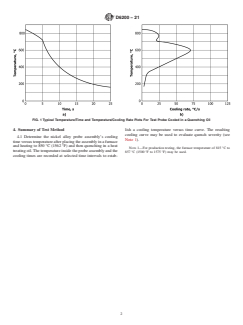
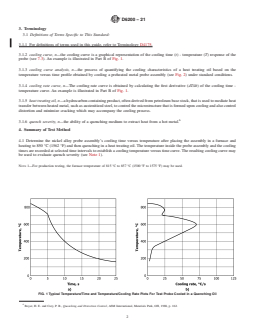
priate safety, health, and environmental practices and deter- 3.1.2 cooling curve, n—the cooling curve is a graphical
mine the applicability of regulatory limitations prior to use. representation of the cooling time (t) - temperature (T) re-
1.5 This international standard was developed in accor- sponse of the probe (see 7.3).An example is illustrated in Part
dance with internationally recognized principles on standard- Bof Fig. 1.
ization established in the Decision on Principles for the
3.1.3 cooling curve analysis, n—the process of quantifying
Development of International Standards, Guides and Recom-
the cooling characteristics of a heat treating oil based on the
mendations issued by the World Trade Organization Technical
temperature versus time profile obtained by cooling a pre-
Barriers to Trade (TBT) Committee.
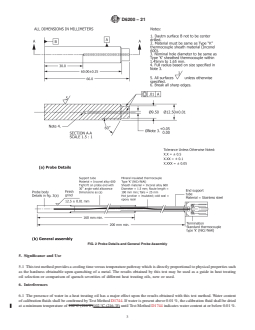
heated metal probe assembly (see Fig. 2) under standard
conditions.
2. Referenced Documents
3.1.4 cooling rate curve, n—The cooling rate curve is
2.1 ASTM Standards:
obtained by calculating the first derivative (dT/dt)ofthe
D1744 Test Method for Determination of Water in Liquid
cooling time - temperature curve. An example is illustrated in
Petroleum Products by Karl Fischer Reagent (Withdrawn
Part B of Fig. 1.
2016)
3.1.5 heat treating oil, n—a hydrocarbon containing
D4175 Terminology Relating to Petroleum Products, Liquid
product, often derived from petroleum base stock, that is used
Fuels, and Lubricants
to mediate heat transfer between heated metal, such as austen-
E220 Test Method for Calibration of Thermocouples By
itized steel, to control the microstructure that is formed upon
cooling and also control distortion and minimize cracking
1 which may accompany the cooling process.
This test method is under the jurisdiction of ASTM Committee D02 on
Petroleum Products, Liquid Fuels, and Lubricants and is the direct responsibility of
3.1.6 quench severity, n—the ability of a quenching medium
Subcommittee D02.L0.06 on Non-Lubricating Process Fluids.
to extract heat from a hot metal.
Current edition approved Dec. 1, 2021. Published January 2022. Originally
approved in 1997. Last previous edition approved in 2017 as D6200 – 01 (2017).
DOI: 10.1520/D6200-21.
2 4
For referenced ASTM standards, visit the ASTM website, www.astm.org, or Available from Society of Automotive Engineers (SAE), 400 Commonwealth
contact ASTM Customer Service at service@astm.org. For Annual Book of ASTM Dr., Warrendale, PA 15096-0001, http://www.sae.org.
Standards volume information, refer to the standard’s Document Summary page on Available from Japanese Standards Organization (JSA), 4-1-24 Akasaka
the ASTM website. Minato-Ku, Tokyo, 107-8440, Japan, http://www.jsa.or.ja.
3 6
The last approved version of this historical standard is referenced on Boyer, H. E. and Cary, P. R., Quenching and Distortion Control, ASM
www.astm.org. International, Materials Park, OH, 1988, p. 162.
*A Summary of Changes section appears at the end of this standard
Copyright © ASTM International, 100 Barr Harbor Drive, PO Box C700, West Conshohocken, PA 19428-2959. United States
D6200 − 21
FIG. 1 Typical Temperature/Time and Temperature/Cooling Rate Plots For Test Probe Cooled in a Quenching Oil
4. Summary of Test Method lish a cooling temperature versus time curve. The resulting
cooling curve may be used to evaluate quench severity (see
4.1 Determine the nickel alloy probe assembly’s cooling
Note 1).
time versus temperature after placing the assembly in a furnace
and heating to 850 °C (1562 °F) and then quenching in a heat
NOTE 1—For production testing, the furnace temperature of 815 °C to
treating oil.The temperature inside the probe assembly and the
857 °C (1500 °F to 1575 °F) may be used.
cooling times are recorded at selected time intervals to estab-
D6200 − 21
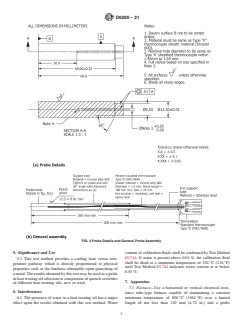
FIG. 2 Probe Details and General Probe Assembly
5. Significance and Use content of calibration fluids shall be confirmed byTest Method
D1744. If water is present above 0.01 %, the calibration fluid
5.1 This test method provides a cooling time versus tem-
shall be dried at a minimum temperature of 102 °C (216 °F)
perature pathway which is directly proportional to physical
until Test Method D1744 indicates water content at or below
properties such as the hardness obtainable upon quenching of
0.01 %.
ametal.Theresultsobtainedbythistestmaybeusedasaguide
inheattreatingoilselectionorcomparisonofquenchseverities
7. Apparatus
of different heat treating oils, new or used.
7.1 Furnace—Use a horizontal or vertical electrical resis-
6. Interferences
tance tube-type furnace capable of maintaining a constant
6.1 The presence of water in a heat treating oil has a major minimum temperature of 850 °C (1562 °F) over a heated
effect upon the results obtained with this test method. Water length of not less than 120 mm (4.72 in.) and a probe
D6200 − 21
positioned in the center of the heating chamber. The furnace 8. Reagents and Materials
shall be capable of maintaining the probe’s temperature within
8.1 Reference Quenching Fluid—A reference quenching
62.5 °C (4.5 °F) over the specimen length. The furnace, that
fluid shall be used for initial and regular system calibration.
is, the radiant tube heating media, shall be used with ambient
The primary reference fluid, as described in the Wolfson
atmosphere.
Engineering Group Specification , exhibits the following cool-
ing characteristics:
7.2 Measurement System—The temperature-time measure-
Time to cool to 600 °C (1112 °F) 12 s to 14 s
ment system shall be a computer based data acquisition system
Time to cool to 400 °C (752 °F) 19 s to 21 s
capable of providing a permanent record of the cooling
Time to cool to 200 °C (392 °F) 50 s to 55 s
characteristics of each oil sample tested, producing a record of
Cooling rate, max 47 °C to 53 °C ⁄s (85 °F to
95 °F ⁄s)
variationinthetestprobeassemblyoftemperaturewithrespect
Temperature of the maximum cooling rate 490 °C to 530 °C (914 °F to
to time, and cooling rate with respect to temperature.
986 °F)
Cooling rate at 300 °C (572 °F) 6 °C to 8 °C ⁄s (10.8 °F to
7.3 Probe—The probe shall be cylindrical, having a diam-
14.4 °F ⁄s)
eter of 12.5 mm 6 0.01 mm (0.492 in. 6 0.0004 in.) and a
8.1.1 These characteristics are based on quenching a
length of 60 mm 6 0.25 mm (2.362 in. 6 0.01 in.) with a
2000 mL 6 50 mLvolume of the primary reference fluid in the
1.45 mm to 1.65 mm (0.057 in. to 0.065 in.) sheathed Type K
sample container described in 7.5 according to the procedure
thermocouple in its geometric center. The probe shall be made
outlined in Section 13.
of a nickel alloy 600 (UNS N06600) purchased to SAE
8.1.2 A secondary reference fluid, such as JIS Standards
Specification AMS 5665 which has a nominal composition of
K 2242 and K 6753, may be used, provided that sufficient
76.0 % Ni, 15.5 % Cr, 8.0 % Fe, .08 % C, and .25 % max Cu.
statistical cooling curve testing has been conducted so that
The probe shall be attached to a support tube with a minimum
results are traceable to the six cooling characteristics of the
length of 200 mm (7.874 in.). The thermocouple sheathing and
primary reference fluid.
the support tube shall be the same material as the probe (see
8.1.3 The reference fluids shall be stored in a sealed
Note 2). See Fig. 2 for recommended manufacturing details.
container when not in use and shall be replaced after 200
quenches or two years, whichever is sooner.
NOTE 2—Care must be taken that the probe specimen is not damaged as
surface irregularities will influence the results of the test. 8.2 Cleaning Solvent—A hydrocarbon solvent that will
evaporate at room temperature, leaving no residue
7.4 Transfer Mechanism—One of the following shall be
(Warning—Flammable. Harmful if inhaled.).
used to transfer the heated probe from the furnace to the test
8.3 Polishing Paper, 600 grit Emery.
fluid.
7.4.1 Automated Transfer Mechanism—The transfer from
8.4 Cloth, lintless and absorbent.
the furnace to the oil shall be completed within 3.0 s. Immerse
9. Cleaning and Conditioning
the probe in the center, 0 mm to 5 mm (0 in. to 0.197 in.), of
the heat treating oil container to a depth where there is 50 mm
9.1 Cleaning Used Probes—Wipeprobewithalintlesscloth
6 2 mm (1.97 in. 6 0.08 in.) of fluid above and below the
or absorbent paper after removal from the oil and prior to
probe when quenched. A mechanical stop shall be used for
returning to the furnace. (Warning—The probe shall always
reproducibility of probe placement.
be considered hot, as temperature below visual hot tempera-
tures can still cause injury to the skin (Warning—Do not use
7.4.2 Manual Transfer—If manual transfer is used, the
cleaning solvent near the furnace opening especially with
sample container shall be equipped with a fixture to ensure
automated transfer mechanisms.).) A cleaning solvent may be
correctplacementinthecenteroftheheattreatingoilcontainer
used, but care should be taken that the probe is below 50 °C
and to the depth defined in 7.4.1. A timer shall be used to
(122 °F).
ensure a maximum transfer time of 3.0 s.
9.2 Conditioning New Probes—Condition the probe prior to
7.5 Sample Container—A container, preferably a damage-
its initial use with any quenchant by carrying out a minimum
resistant, tall form vessel having an internal diameter of
of six trial quenches, or a greater number if required to achieve
115 mm 6 5 mm (4.528 in. 6 0.197 in.) shall be selected to
consistency, using a general purpose hydrocarbon oil. Consis-
provide 50 mL (1.97 in.) of fluid above and below the probe
tencyshallmeanthelasttwotestsshallhavemaximumcooling
when quenched. It is recommended that 2000 mL 6 50 mL of
rates within 62 % in temperature and cooling rate. Clean the
oil be used. The resulting cooling curve will be dependent on
probe assembly between quenches as specified in 9.1. Quench
the temperature rise during the quench and on the total fluid
the probe in the reference quenching fluid and check according
volume. Therefore, the cooling curve analysis shall be per-
to 12.3. If the probe does not meet the requirements of 12.3,
formed with the same volume of fluid.
recondition according to 9.3 and then recalibrate again accord-
7.6 Oil Temperature Measurement—Anytemperaturedetec- ing to 12.3. Do not use probes that do not meet these
tion device may be used that is capable of measuring oil requirements.
temperature to within
...
This document is not an ASTM standard and is intended only to provide the user of an ASTM standard an indication of what changes have been made to the previous version. Because
it may not be technically possible to adequately depict all changes accurately, ASTM recommends that users consult prior editions as appropriate. In all cases only the current version
of the standard as published by ASTM is to be considered the official document.
Designation: D6200 − 01 (Reapproved 2017) D6200 − 21
Standard Test Method for
Determination of Cooling Characteristics of Quench Oils by
Cooling Curve Analysis
This standard is issued under the fixed designation D6200; the number immediately following the designation indicates the year of
original adoption or, in the case of revision, the year of last revision. A number in parentheses indicates the year of last reapproval. A
superscript epsilon (´) indicates an editorial change since the last revision or reapproval.
1. Scope Scope*
1.1 This test method describes the equipment and the procedure for evaluation of a quenching oil’s quenching characteristics by
cooling rate determination.
1.2 This test is designed to evaluate quenching oils in a non-agitated system. There is no correlation between these test results and
the results obtained in agitated systems.
1.3 The values in SI units are to be regarded as the standard.
1.3.1 Exception—The values in parentheses are provided for information only.
1.4 This standard does not purport to address all of the safety concerns, if any, associated with its use. It is the responsibility
of the user of this standard to establish appropriate safety, health, and environmental practices and determine the applicability of
regulatory limitations prior to use.
1.5 This international standard was developed in accordance with internationally recognized principles on standardization
established in the Decision on Principles for the Development of International Standards, Guides and Recommendations issued
by the World Trade Organization Technical Barriers to Trade (TBT) Committee.
2. Referenced Documents
2.1 ASTM Standards:
D1744 Test Method for Determination of Water in Liquid Petroleum Products by Karl Fischer Reagent (Withdrawn 2016)
D4175 Terminology Relating to Petroleum Products, Liquid Fuels, and Lubricants
E220 Test Method for Calibration of Thermocouples By Comparison Techniques
E230 Specification for Temperature-Electromotive Force (emf) Tables for Standardized Thermocouples
2.2 SAE Standards:
AMS 5665 Nickel Alloy Corrosion and Heat Resistant Bars, Forgings and Rings
2.3 Japanese Industrial Standards (JIS):
JIS K 2242 - 1980 Heat Treating Oil
JIS K 6753 - 1977 Di-2-ethylhexyl Phthalate
This test method is under the jurisdiction of ASTM Committee D02 on Petroleum Products, Liquid Fuels, and Lubricants and is the direct responsibility of Subcommittee
D02.L0.06 on Non-Lubricating Process Fluids.
Current edition approved Oct. 1, 2017Dec. 1, 2021. Published November 2017January 2022. Originally approved in 1997. Last previous edition approved in 20122017
as D6200–01(2012).D6200 – 01 (2017). DOI: 10.1520/D6200-01R17.10.1520/D6200-21.
For referenced ASTM standards, visit the ASTM website, www.astm.org, or contact ASTM Customer Service at service@astm.org. For Annual Book of ASTM Standards
volume information, refer to the standard’s Document Summary page on the ASTM website.
The last approved version of this historical standard is referenced on www.astm.org.
Available from Society of Automotive Engineers (SAE), 400 Commonwealth Dr., Warrendale, PA 15096-0001, http://www.sae.org.
Available from Japanese Standards Organization (JSA), 4-1-24 Akasaka Minato-Ku, Tokyo, 107-8440, Japan, http://www.jsa.or.ja.
*A Summary of Changes section appears at the end of this standard
Copyright © ASTM International, 100 Barr Harbor Drive, PO Box C700, West Conshohocken, PA 19428-2959. United States
D6200 − 21
3. Terminology
3.1 Definitions of Terms Specific to This Standard:
3.1.1 For definitions of terms used in this guide, refer to Terminology D4175.
3.1.2 cooling curve, n—the cooling curve is a graphical representation of the cooling time (t) - temperature (T) response of the
probe (see 7.3). An example is illustrated in Part B of Fig. 1.
3.1.3 cooling curve analysis, n—the process of quantifying the cooling characteristics of a heat treating oil based on the
temperature versus time profile obtained by cooling a preheated metal probe assembly (see Fig. 2) under standard conditions.
3.1.4 cooling rate curve, n—The cooling rate curve is obtained by calculating the first derivative (dT/dt) of the cooling time -
temperature curve. An example is illustrated in Part B of Fig. 1.
3.1.5 heat treating oil, n—a hydrocarbon containing product, often derived from petroleum base stock, that is used to mediate heat
transfer between heated metal, such as austenitized steel, to control the microstructure that is formed upon cooling and also control
distortion and minimize cracking which may accompany the cooling process.
3.1.6 quench severity, n—the ability of a quenching medium to extract heat from a hot metal.
4. Summary of Test Method
4.1 Determine the nickel alloy probe assembly’s cooling time versus temperature after placing the assembly in a furnace and
heating to 850 °C (1562 °F) and then quenching in a heat treating oil. The temperature inside the probe assembly and the cooling
times are recorded at selected time intervals to establish a cooling temperature versus time curve. The resulting cooling curve may
be used to evaluate quench severity (see Note 1).
NOTE 1—For production testing, the furnace temperature of 815 °C to 857 °C (1500 °F to 1575 °F) may be used.
FIG. 1 Typical Temperature/Time and Temperature/Cooling Rate Plots For Test Probe Cooled in a Quenching Oil
Boyer, H. E. and Cary, P. R., Quenching and Distortion Control, ASM International, Materials Park, OH, 1988, p. 162.
D6200 − 21
FIG. 2 Probe Details and General Probe Assembly
5. Significance and Use
5.1 This test method provides a cooling time versus temperature pathway which is directly proportional to physical properties such
as the hardness obtainable upon quenching of a metal. The results obtained by this test may be used as a guide in heat treating
oil selection or comparison of quench severities of different heat treating oils, new or used.
6. Interferences
6.1 The presence of water in a heat treating oil has a major effect upon the results obtained with this test method. Water content
of calibration fluids shall be confirmed by Test Method D1744. If water is present above 0.01 %, the calibration fluid shall be dried
at a minimum temperature of 102°C (216°F)102 °C (216 °F) until Test Method D1744 indicates water content at or below 0.01 %.
D6200 − 21
7. Apparatus
7.1 Furnace—Use a horizontal or vertical electrical resistance tube-type furnace capable of maintaining a constant minimum
temperature of 850 °C (1562 °F) over a heated length of not less than 120 mm (4.72 in.) and a probe positioned in the center of
the heating chamber. The furnace shall be capable of maintaining the probe’s temperature within 62.5 °C (4.5 °F) over the
specimen length. The furnace, that is, the radiant tube heating media, shall be used with ambient atmosphere.
7.2 Measurement System—The temperature-time measurement system shall be a computer based data acquisition system capable
of providing a permanent record of the cooling characteristics of each oil sample tested, producing a record of variation in the test
probe assembly of temperature with respect to time, and cooling rate with respect to temperature.
7.3 Probe—The probe shall be cylindrical, having a diameter of 12.5 mm 6 0.01 mm (0.492 in. 6 0.0004 in.) and a length of
60 mm 6 0.25 mm (2.362 in. 6 0.01 in.) with a 1.45 mm to 1.65 mm (0.057 in. to 0.065 in.) sheathed Type K thermocouple in
its geometric center. The probe shall be made of a nickel alloy 600 (UNS N06600) purchased to SAE Specification AMS 5665
which has a nominal composition of 76.0 % Ni, 15.5 % Cr, 8.0 % Fe, .08 % C, and .25 % max Cu. The probe shall be attached
to a support tube with a minimum length of 200 mm (7.874 in.). The thermocouple sheathing and the support tube shall be the same
material as the probe (see Note 2). See Fig. 2 for recommended manufacturing details.
NOTE 2—Care must be taken that the probe specimen is not damaged as surface irregularities will influence the results of the test.
7.4 Transfer Mechanism—One of the following shall be used to transfer the heated probe from the furnace to the test fluid.
7.4.1 Automated Transfer Mechanism—The transfer from the furnace to the oil shall be completed within 3.0 s. Immerse the probe
in the center, 0 mm to 5 mm (0 in. to 0.197 in.), of the heat treating oil container to a depth where there is 50 mm 6 2 mm (1.97 in.
6 0.08 in.) of fluid above and below the probe when quenched. A mechanical stop shall be used for reproducibility of probe
placement.
7.4.2 Manual Transfer—If manual transfer is used, the sample container shall be equipped with a fixture to ensure correct
placement in the center of the heat treating oil container and to the depth defined in 7.4.1. A timer shall be used to ensure a
maximum transfer time of 3.0 s.
7.5 Sample Container—A container, preferably a damage-resistant, tall form vessel having an internal diameter of 115 mm 6
5 mm (4.528 in. 6 0.197 in.) shall be selected to provide 50 mL (1.97 in.) of fluid above and below the probe when quenched. It
is recommended that 2000 mL 6 50 mL of oil be used. The resulting cooling curve will be dependent on the temperature rise
during the quench and on the total fluid volume. Therefore, the cooling curve analysis shall be performed with the same volume
of fluid.
7.6 Oil Temperature Measurement—Any temperature detection device may be used that is capable of measuring oil temperature
to within 61 °C (1.8 °F) during drying.
7.7 Timer—Graduated in seconds and minutes, and may be part of a computer clock.
8. Reagents and Materials
8.1 Reference Quenching Fluid—A reference quenching fluid shall be used for initial and regular system calibration. The primary
reference fluid, as described in the Wolfson Engineering Group Specification , exhibits the following cooling characteristics:
Available from Wolfson Heat Treatment Centre, Aston University, Aston Triangle, Birmingham B4 7ET, England.
D6200 − 21
Time to cool to 600 °C (1112 °F) 12 s to 14 s
Time to cool to 400 °C (752 °F) 19 s to 21 s
Time to cool to 200 °C (392 °F) 50 s to 55 s
Cooling rate, max 47 °C to 53 °C ⁄s (85 °F to
95 °F ⁄s)
Temperature of the maximum cooling rate 490 °C to 530 °C (914 °F to
986 °F)
Cooling rate at 300 °C (572 °F) 6 °C to 8 °C ⁄s (10.8 °F to
14.4 °F ⁄s)
8.1.1 These characteristics are based on quenching a 2000 mL 6 50 mL volume of the primary reference fluid in the sample
container described in 7.5 according to the procedure outlined in Section 13.
8.1.2 A secondary reference fluid, such as JIS Standards K 2242 and K 6753, may be used, provided that sufficient statistical
cooling curve testing has been conducted so that results are traceable to the six cooling characteristics of the primary reference
fluid.
8.1.3 The reference fluids shall be stored in a sealed container when not in use and shall be replaced after 200 quenches or two
years, whichever is sooner.
8.2 Cleaning Solvent—A hydrocarbon solvent that will evaporate at room temperature, leaving no residue (Warning—
Flammable. Harmful if inhaled.).
8.3 Polishing Paper, 600 grit Emery.
8.4 Cloth, lintless and absorbent.
9. Cleaning and Conditioning
9.1 Cleaning Used Probes—Wipe probe with a lintless cloth or absorbent paper after removal from the oil and prior to returning
to the furnace. (Warning—The probe shall always be considered hot, as temperature below visual hot temperatures can still cause
injury to the skin (Warning—Do not use cleaning solvent near the furnace opening especially with automated transfer
mechanisms.).) A cleaning solvent may be used, but care should be taken that the probe is below 50 °C (122 °F).
9.2 Conditioning New Probes—Condition the probe prior to its initial use with any quenchant by carrying out a minimum of six
trial quenches, or a greater number if required to achieve consistency, using a general purpose hydrocarbon oil. Consistency shall
mean the last two tests shall have maximum cooling rates within 62 % in temperature and cooling rate. Clean the prob
...