

ASTM E2707-22
(Test Method)Standard Test Method for Determining Fire Penetration of Exterior Wall Assemblies Using a Direct Flame Impingement Exposure
General Information
- Abstract
SIGNIFICANCE AND USE
5.1 The test method described herein measures the ability of the exterior wall covering material or system to resist fire penetration from the exterior to the unexposed side of the wall assembly under the specified conditions of exposure.
5.2 Representative joints and other characteristics of an assembly shall be included in a test specimen when these details are representative of the construction of the end-use product(s).
5.3 This test method is applicable to end-use product(s) not having an ideally planar external surface.
5.4 The overall performance of the test specimen is visually documented by full-color photographic records. Video recording of the complete fire test is an acceptable alternative to the photographic record. Infrared photography of the unexposed side of the test wall can be used to identify areas of increasing temperatures or persisting hot spots.
5.5 In this procedure, the specimens are subjected to a specific set of laboratory fire test exposure conditions. If different test conditions are substituted or the anticipated end-use conditions are changed, it is not known whether it is possible by use of this test to predict changes in the performance characteristics measured. Therefore, the results are strictly valid only for the fire test exposure conditions described in this procedure.
SCOPE
1.1 This fire-test-response standard prescribes a method to assess the fire performance of a vertically oriented specimen exposed to direct flame impingement in a simulated external fire exposure potentially encountered in a ‘Wildland Urban Interface’ scenario. This test method provides data suitable for comparing the performance of materials, which are used as the exposed surfaces of exterior walls in construction applications.
Note 1: This test method closely follows the test procedure of California Office of State Marshal (SFM) Method 12-7A-1.2
1.2 This test method measures the ability of the wall system to resist fire penetration from the exterior into the wall cavity or unexposed side of the test assembly under the conditions of exposure.
1.3 This test method provides data suitable for comparing the performance of vertically oriented materials, products or assemblies in exterior construction applications. The test specimen shall be tested in thicknesses and configurations representative of actual end product or system uses.
1.4 Limitations of the test method are listed in Section 5.5.
1.5 The system of units to be used in referee decisions is the SI system of units; see IEEE/ASTM SI-10 for further details. The units given in parentheses are for information only.
1.6 This standard is used to measure and describe the response of materials, products, or assemblies to heat and flame under controlled conditions, but does not by itself incorporate all factors required for fire hazard or fire risk assessment of the materials, products, or assemblies under actual fire conditions.
1.7 This standard does not purport to address all of the safety concerns, if any, associated with its use. It is the responsibility of the user of this standard to establish appropriate safety, health, and environmental practices and determine the applicability of regulatory limitations prior to use.
1.8 Fire testing is inherently hazardous. Adequate safeguards for personnel and property shall be employed in conducting these tests.
1.9 This international standard was developed in accordance with internationally recognized principles on standardization established in the Decision on Principles for the Development of International Standards, Guides and Recommendations issued by the World Trade Organization Technical Barriers to Trade (TBT) Committee.
- Status
- Published
- Publication Date
- 31-Mar-2022
- Technical Committee
- E05 - Fire Standards
- Drafting Committee
- E05.14 - External Fire Exposures
Buy Documents
ASTM E2707-22 - Standard Test Method for Determining Fire Penetration of Exterior Wall Assemblies Using a Direct Flame Impingement Exposure
REDLINE ASTM E2707-22 - Standard Test Method for Determining Fire Penetration of Exterior Wall Assemblies Using a Direct Flame Impingement Exposure
Overview
ASTM E2707-22 is a standard test method established by ASTM International for determining the fire penetration resistance of exterior wall assemblies when exposed to direct flame impingement. This method is designed to evaluate how well exterior wall systems, including their joints and coverings, resist fire from the exterior-particularly in scenarios representative of wildland-urban interface (WUI) fires. The procedure provides valuable data for comparing materials and assemblies used in building exteriors, ensuring that construction choices are informed by robust fire performance benchmarks.
Key Topics
- Fire Penetration Resistance: The standard assesses a wall assembly’s ability to prevent fire from breaching from the exterior side to the unexposed (interior) side under controlled direct flame exposure.
- Test Simulation: The method simulates external fire exposure situations, such as those found in WUI zones, where wildfires pose significant risks to structures.
- Representative Construction: Test specimens include all relevant joints and construction details typical of end-use products, accommodating non-planar and various material configurations.
- Performance Documentation: Results are documented through photography or video recording. Infrared imaging is recommended for detecting temperature rises and persistent hot spots on the unexposed wall side.
- Controlled Laboratory Conditions: The procedure specifies strict laboratory fire exposure parameters, making results valid only for the described conditions.
- Safety Precautions: The method addresses the inherent hazards involved in fire testing and emphasizes the need for appropriate safety and environmental measures.
Applications
ASTM E2707-22 is primarily valuable for:
- Product Comparison: Provides a basis for comparing the fire resistance performance of different exterior wall coverings, sidings, sheathing materials, and assembly configurations.
- Building Code Compliance: Helps demonstrate compliance with fire safety requirements for exterior wall materials in regions susceptible to wildfire or urban fire exposures.
- Research and Development: Supports the development of new fire-resistant building products and assemblies by offering a repeatable method to verify fire penetration resistance.
- Regulatory Approval: Supplies reliable test results for product listing and acceptance by authorities having jurisdiction, particularly when code compliance for exterior wildfire exposure is required.
- Quality Assurance: Enables manufacturers and testing laboratories to validate wall assemblies for use in environments where exterior fire exposure is a concern.
Related Standards
ASTM E2707-22 references and aligns with several important industry and international standards to ensure broad applicability and relevance:
- ASTM D2898 - Accelerated Weathering of Fire-Retardant-Treated Wood for Fire Testing
- ASTM D4442 / D4444 - Direct Moisture Content Measurement and Calibration of Moisture Meters
- ASTM D6662 / D7032 - Performance Ratings for Plastic Lumber and Wood-Plastic Composites
- ASTM E176 - Terminology of Fire Standards
- ASTM E1354, E1474, E1740, E2102, E2257, E2886 - A suite of test methods addressing heat release, ignition, and fire resistance for various building components
- IEEE/ASTM SI-10 - Use of the International System of Units (SI)
- ISO 13943 - Fire Safety Vocabulary
Practical Value
Adhering to ASTM E2707-22 delivers assurance that exterior wall systems are evaluated using a recognized, standardized methodology for fire penetration resistance. This not only aids in fire safety design and code compliance, but also enhances the credibility of product manufacturers and testing laboratories. The method’s adaptability to varying wall constructions, including non-planar surfaces and various joint types, ensures comprehensive applicability in modern construction scenarios where exterior wildfire or urban fire exposures are a concern.
Keywords: ASTM E2707-22, fire penetration, exterior wall assembly, direct flame impingement, fire resistance, wildland urban interface, fire test method, exterior cladding, siding, building code compliance, fire safety standard.
Relations
- Effective Date
- 01-Jan-2024
- Effective Date
- 01-Mar-2020
- Effective Date
- 01-Jan-2020
- Effective Date
- 01-Jan-2020
- Effective Date
- 15-Dec-2018
- Effective Date
- 01-Jul-2018
- Effective Date
- 01-Mar-2018
- Effective Date
- 01-Feb-2017
- Effective Date
- 15-Nov-2016
- Effective Date
- 01-May-2016
- Refers
ASTM E2257-16 - Standard Test Method for Room Fire Test of Wall and Ceiling Materials and Assemblies - Effective Date
- 01-Feb-2016
- Effective Date
- 01-Feb-2016
- Effective Date
- 01-Dec-2015
- Effective Date
- 01-Oct-2015
- Effective Date
- 01-Aug-2015
Buy Documents
ASTM E2707-22 - Standard Test Method for Determining Fire Penetration of Exterior Wall Assemblies Using a Direct Flame Impingement Exposure
REDLINE ASTM E2707-22 - Standard Test Method for Determining Fire Penetration of Exterior Wall Assemblies Using a Direct Flame Impingement Exposure
Get Certified
Connect with accredited certification bodies for this standard

DIBt (Deutsches Institut für Bautechnik)
German Institute for Building Technology.
DIN CERTCO
DIN Group product certification.

Kiwa BDA Testing
Building and construction product certification.
Sponsored listings
Frequently Asked Questions
ASTM E2707-22 is a standard published by ASTM International. Its full title is "Standard Test Method for Determining Fire Penetration of Exterior Wall Assemblies Using a Direct Flame Impingement Exposure". This standard covers: SIGNIFICANCE AND USE 5.1 The test method described herein measures the ability of the exterior wall covering material or system to resist fire penetration from the exterior to the unexposed side of the wall assembly under the specified conditions of exposure. 5.2 Representative joints and other characteristics of an assembly shall be included in a test specimen when these details are representative of the construction of the end-use product(s). 5.3 This test method is applicable to end-use product(s) not having an ideally planar external surface. 5.4 The overall performance of the test specimen is visually documented by full-color photographic records. Video recording of the complete fire test is an acceptable alternative to the photographic record. Infrared photography of the unexposed side of the test wall can be used to identify areas of increasing temperatures or persisting hot spots. 5.5 In this procedure, the specimens are subjected to a specific set of laboratory fire test exposure conditions. If different test conditions are substituted or the anticipated end-use conditions are changed, it is not known whether it is possible by use of this test to predict changes in the performance characteristics measured. Therefore, the results are strictly valid only for the fire test exposure conditions described in this procedure. SCOPE 1.1 This fire-test-response standard prescribes a method to assess the fire performance of a vertically oriented specimen exposed to direct flame impingement in a simulated external fire exposure potentially encountered in a ‘Wildland Urban Interface’ scenario. This test method provides data suitable for comparing the performance of materials, which are used as the exposed surfaces of exterior walls in construction applications. Note 1: This test method closely follows the test procedure of California Office of State Marshal (SFM) Method 12-7A-1.2 1.2 This test method measures the ability of the wall system to resist fire penetration from the exterior into the wall cavity or unexposed side of the test assembly under the conditions of exposure. 1.3 This test method provides data suitable for comparing the performance of vertically oriented materials, products or assemblies in exterior construction applications. The test specimen shall be tested in thicknesses and configurations representative of actual end product or system uses. 1.4 Limitations of the test method are listed in Section 5.5. 1.5 The system of units to be used in referee decisions is the SI system of units; see IEEE/ASTM SI-10 for further details. The units given in parentheses are for information only. 1.6 This standard is used to measure and describe the response of materials, products, or assemblies to heat and flame under controlled conditions, but does not by itself incorporate all factors required for fire hazard or fire risk assessment of the materials, products, or assemblies under actual fire conditions. 1.7 This standard does not purport to address all of the safety concerns, if any, associated with its use. It is the responsibility of the user of this standard to establish appropriate safety, health, and environmental practices and determine the applicability of regulatory limitations prior to use. 1.8 Fire testing is inherently hazardous. Adequate safeguards for personnel and property shall be employed in conducting these tests. 1.9 This international standard was developed in accordance with internationally recognized principles on standardization established in the Decision on Principles for the Development of International Standards, Guides and Recommendations issued by the World Trade Organization Technical Barriers to Trade (TBT) Committee.
SIGNIFICANCE AND USE 5.1 The test method described herein measures the ability of the exterior wall covering material or system to resist fire penetration from the exterior to the unexposed side of the wall assembly under the specified conditions of exposure. 5.2 Representative joints and other characteristics of an assembly shall be included in a test specimen when these details are representative of the construction of the end-use product(s). 5.3 This test method is applicable to end-use product(s) not having an ideally planar external surface. 5.4 The overall performance of the test specimen is visually documented by full-color photographic records. Video recording of the complete fire test is an acceptable alternative to the photographic record. Infrared photography of the unexposed side of the test wall can be used to identify areas of increasing temperatures or persisting hot spots. 5.5 In this procedure, the specimens are subjected to a specific set of laboratory fire test exposure conditions. If different test conditions are substituted or the anticipated end-use conditions are changed, it is not known whether it is possible by use of this test to predict changes in the performance characteristics measured. Therefore, the results are strictly valid only for the fire test exposure conditions described in this procedure. SCOPE 1.1 This fire-test-response standard prescribes a method to assess the fire performance of a vertically oriented specimen exposed to direct flame impingement in a simulated external fire exposure potentially encountered in a ‘Wildland Urban Interface’ scenario. This test method provides data suitable for comparing the performance of materials, which are used as the exposed surfaces of exterior walls in construction applications. Note 1: This test method closely follows the test procedure of California Office of State Marshal (SFM) Method 12-7A-1.2 1.2 This test method measures the ability of the wall system to resist fire penetration from the exterior into the wall cavity or unexposed side of the test assembly under the conditions of exposure. 1.3 This test method provides data suitable for comparing the performance of vertically oriented materials, products or assemblies in exterior construction applications. The test specimen shall be tested in thicknesses and configurations representative of actual end product or system uses. 1.4 Limitations of the test method are listed in Section 5.5. 1.5 The system of units to be used in referee decisions is the SI system of units; see IEEE/ASTM SI-10 for further details. The units given in parentheses are for information only. 1.6 This standard is used to measure and describe the response of materials, products, or assemblies to heat and flame under controlled conditions, but does not by itself incorporate all factors required for fire hazard or fire risk assessment of the materials, products, or assemblies under actual fire conditions. 1.7 This standard does not purport to address all of the safety concerns, if any, associated with its use. It is the responsibility of the user of this standard to establish appropriate safety, health, and environmental practices and determine the applicability of regulatory limitations prior to use. 1.8 Fire testing is inherently hazardous. Adequate safeguards for personnel and property shall be employed in conducting these tests. 1.9 This international standard was developed in accordance with internationally recognized principles on standardization established in the Decision on Principles for the Development of International Standards, Guides and Recommendations issued by the World Trade Organization Technical Barriers to Trade (TBT) Committee.
ASTM E2707-22 is classified under the following ICS (International Classification for Standards) categories: 13.220.50 - Fire-resistance of building materials and elements; 91.060.10 - Walls. Partitions. Facades. The ICS classification helps identify the subject area and facilitates finding related standards.
ASTM E2707-22 has the following relationships with other standards: It is inter standard links to ASTM E176-24, ASTM D4442-20, ASTM E1474-20, ASTM E1740-20, ASTM E176-18a, ASTM D4444-13(2018), ASTM E176-18, ASTM D2898-10(2017), ASTM D4442-16, ASTM E1354-16a, ASTM E2257-16, ASTM E1354-16, ASTM D7032-15, ASTM E2102-15, ASTM E1354-15a. Understanding these relationships helps ensure you are using the most current and applicable version of the standard.
ASTM E2707-22 is available in PDF format for immediate download after purchase. The document can be added to your cart and obtained through the secure checkout process. Digital delivery ensures instant access to the complete standard document.
Standards Content (Sample)
This international standard was developed in accordance with internationally recognized principles on standardization established in the Decision on Principles for the
Development of International Standards, Guides and Recommendations issued by the World Trade Organization Technical Barriers to Trade (TBT) Committee.
Designation: E2707 − 22 An American National Standard
Standard Test Method for
Determining Fire Penetration of Exterior Wall Assemblies
Using a Direct Flame Impingement Exposure
This standard is issued under the fixed designation E2707; the number immediately following the designation indicates the year of
original adoption or, in the case of revision, the year of last revision. A number in parentheses indicates the year of last reapproval. A
superscript epsilon (´) indicates an editorial change since the last revision or reapproval.
1. Scope* priate safety, health, and environmental practices and deter-
mine the applicability of regulatory limitations prior to use.
1.1 This fire-test-response standard prescribes a method to
1.8 Fire testing is inherently hazardous. Adequate safe-
assess the fire performance of a vertically oriented specimen
guards for personnel and property shall be employed in
exposed to direct flame impingement in a simulated external
conducting these tests.
fire exposure potentially encountered in a ‘Wildland Urban
1.9 This international standard was developed in accor-
Interface’scenario. This test method provides data suitable for
dance with internationally recognized principles on standard-
comparing the performance of materials, which are used as the
ization established in the Decision on Principles for the
exposed surfaces of exterior walls in construction applications.
Development of International Standards, Guides and Recom-
NOTE 1—This test method closely follows the test procedure of
mendations issued by the World Trade Organization Technical
California Office of State Marshal (SFM) Method 12-7A-1.
Barriers to Trade (TBT) Committee.
1.2 This test method measures the ability of the wall system
to resist fire penetration from the exterior into the wall cavity
2. Referenced Documents
or unexposed side of the test assembly under the conditions of
2.1 ASTM Standards:
exposure.
D2898 Practice for Accelerated Weathering of Fire-
1.3 This test method provides data suitable for comparing
Retardant-Treated Wood for Fire Testing
the performance of vertically oriented materials, products or
D4442 Test Methods for Direct Moisture Content Measure-
assemblies in exterior construction applications.The test speci-
ment of Wood and Wood-Based Materials
men shall be tested in thicknesses and configurations represen-
D4444 Test Method for Laboratory Standardization and
tative of actual end product or system uses.
Calibration of Hand-Held Moisture Meters
1.4 Limitations of the test method are listed in Section 5.5. D6662 Specification for Polyolefin-Based Plastic Lumber
Decking Boards
1.5 The system of units to be used in referee decisions is the
D7032 Specification for Establishing Performance Ratings
SI system of units; see IEEE/ASTM SI-10 for further details.
for Wood-Plastic Composite and Plastic Lumber Deck
The units given in parentheses are for information only.
Boards, Stair Treads, Guards, and Handrails
1.6 This standard is used to measure and describe the
E176 Terminology of Fire Standards
responseofmaterials,products,orassembliestoheatandflame
E1354 Test Method for Heat and Visible Smoke Release
under controlled conditions, but does not by itself incorporate
Rates for Materials and Products Using an Oxygen Con-
all factors required for fire hazard or fire risk assessment of the
sumption Calorimeter
materials, products, or assemblies under actual fire conditions.
E1474 Test Method for Determining the Heat Release Rate
1.7 This standard does not purport to address all of the
of Upholstered Furniture and Mattress Components or
safety concerns, if any, associated with its use. It is the Composites Using a Bench Scale Oxygen Consumption
responsibility of the user of this standard to establish appro-
Calorimeter
E1740 Test Method for Determining the Heat Release Rate
and Other Fire-Test-Response Characteristics of Wall
1 Covering or Ceiling Covering Composites Using a Cone
This test method is under the jurisdiction of ASTM Committee E05 on Fire
Standards and is the direct responsibility of Subcommittee E05.14 on External Fire Calorimeter
Exposures.
Current edition approved April 1, 2022. Published May 2022. Originally
approved in 2009. Last previous edition approved in 2015 as E2707–15. DOI:
10.1520/E2707-22. For referenced ASTM standards, visit the ASTM website, www.astm.org, or
2019 California Building Code, Chapter 7A[SFM], Materials and Construction contact ASTM Customer Service at service@astm.org. For Annual Book of ASTM
Methods for Exterior Wildfire Exposure, Exterior Wall Siding and Sheathing, SFM Standards volume information, refer to the standard’s Document Summary page on
Standard 12-7A-1. the ASTM website.
*A Summary of Changes section appears at the end of this standard
Copyright © ASTM International, 100 Barr Harbor Drive, PO Box C700, West Conshohocken, PA 19428-2959. United States
E2707 − 22
E2102 Test Method for Measurement of Mass Loss and 5. Significance and Use
Ignitability for Screening Purposes Using a Conical Ra-
5.1 The test method described herein measures the ability of
diant Heater
the exterior wall covering material or system to resist fire
E2257 Test Method for Room Fire Test of Wall and Ceiling
penetration from the exterior to the unexposed side of the wall
Materials and Assemblies
assembly under the specified conditions of exposure.
E2886 Test Method for Evaluating the Ability of Exterior
5.2 Representative joints and other characteristics of an
Vents to Resist the Entry of Embers and Direct Flame
assembly shall be included in a test specimen when these
Impingement
details are representative of the construction of the end-use
IEEE/ASTM SI-10 American National Standard for Use of
product(s).
theInternationalSystemofUnits(SI):TheModernMetric
System
5.3 This test method is applicable to end-use product(s) not
having an ideally planar external surface.
2.2 ISO Standards:
ISO 13943 Fire Safety—Vocabulary
5.4 The overall performance of the test specimen is visually
documented by full-color photographic records. Video record-
3. Terminology
ing of the complete fire test is an acceptable alternative to the
photographic record. Infrared photography of the unexposed
3.1 Definitions—For definitions of terms used in this
standard, see Terminology E176 and ISO 13943. In case of side of the test wall can be used to identify areas of increasing
temperatures or persisting hot spots.
conflict, the definitions given in Terminology E176 shall
prevail.
5.5 In this procedure, the specimens are subjected to a
3.2 Definitions of Terms Specific to This Standard:
specific set of laboratory fire test exposure conditions. If
3.2.1 orientation, n—theverticalplaneinwhichtheexposed
different test conditions are substituted or the anticipated
face of the test specimen is located during testing.
end-use conditions are changed, it is not known whether it is
3.2.2 siding (cladding), n—any material that constitutes the
possible by use of this test to predict changes in the perfor-
exposed exterior covering of an exterior wall and such material
mance characteristics measured. Therefore, the results are
is applied over sheathing or directly attached to the wall
strictly valid only for the fire test exposure conditions de-
system.
scribed in this procedure.
3.2.3 sheathing, n—the material placed on an exterior wall
6. Safety Precautions
beneath cladding or siding and directly attached to the wall
system used over the wall framework and is attached directly
6.1 The test procedures involve high temperatures and
to the wall framing members. Materials called sheathing that
combustion processes.Therefore, the potential exists for burns,
are not placed beneath cladding or siding shall be classified as
ignition of extraneous objects or clothing, and for inhalation of
cladding or siding.
combustion products.
3.2.4 sustained flaming, n—flame on or over the surface of
a test specimen that lasts longer than a period of 4 s.
7. Apparatus
7.1 Unless otherwise noted, dimensions in the following
4. Summary of Test Method
descriptions, shall be followed with a tolerance of 613 mm
4.1 This test method provides for the direct flame exposure
(0.5 in.).
of a wall specimen to a flame source centered at the base of a
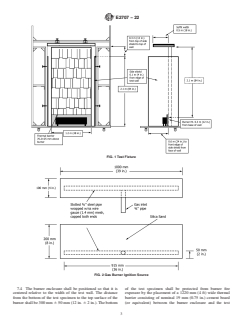
7.2 Wall Assembly Holding Fixture—The test specimen
1220 mm by 2440 mm (4 ft by 8 ft) test assembly.
support assembly shown in Fig. 1 is designed to permit rapid
4.2 This test method employs a gas burner to produce a
installation and removal of wall assemblies, and to prevent
diffusion flame in contact with the test wall assembly.
edge penetration of fire at the margins of the wall assembly. It
includes a sturdy frame assembly to hold the specimen and a
4.3 The gas burner produces a prescribed net rate of heat
simulated soffit that is non-combustible. The frame assembly
outputof150kW(8535BTU/min)foraperiodof10min,after
permits a 1220 mm by 2440 mm (4 ft by 8 ft) prefabricated
which the flame exposure is terminated.
wall section to be inserted from the rear and to seal in such a
4.4 The test method measures the ability of the wall system
way that protects the edges from fire. Side shields are situated
toresistfirepenetrationfromtheexteriortotheunexposedside
near the vertical edges and to within 304 mm (12 in.) of the top
of the test assembly under the conditions of exposure. Obser-
of the test wall assembly as shown in Fig. 1 to aid in
vations are made for the appearance of sustained flaming or
minimizing extraneous drafts to the surface of the assembly.
glow on the unexposed side or sustained glowing on the
7.3 Burner Details—The ignition source for the test shall be
unexposed side, or both, at the end of a 60 min observation
a gas diffusion burner with a nominal 100 mm wide by 1000
period.
mm long (4 in. wide by 39 in. long) porous top surface of a
refractory material, as shown in Fig. 2. With the exception of
top surface dimensions, the essential configuration of the
Available from International Organization for Standardization (ISO), 1, ch. de
burner is comparable to the burner design described in Test
la Voie-Creuse, Case postale 56, CH-1211, Geneva 20, Switzerland, http://
www.iso.ch. Method E2257.
E2707 − 22
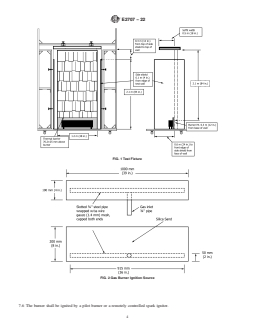
FIG. 1 Test Fixture
FIG. 2 Gas Burner Ignition Source
7.4 The burner enclosure shall be positioned so that it is of the test specimen shall be protected from burner fire
centered relative to the width of the test wall. The distance exposure by the placement of a 1220 mm (4 ft) wide thermal
from the bottom of the test specimen to the top surface of the barrier consisting of nominal 19 mm (0.75 in.) cement board
burner shall be 300 mm 6 50 mm (12 in. 6 2 in.). The bottom (or equivalent) between the burner enclosure and the test
E2707 − 22
specimen. The burner enclosure shall be in contact with the instructions. The sheathing shall have one vertical seam on a
protective barrier. The thermal barrier shall be positioned so selected stud witha3mm (0.125 in.) gap. The type, thickness,
thatthetopedgeextends76mm 625mm(3in. 61in.)above and installation method of any sheathing shall be included in
the top edge of the burner, and fastened to the base of the wall the report.
in such a manner to prevent obstruction of the burner flame
8.6 Protect the vertical and horizontal edges of the test
caused by distortion away from the surface of the wall. Any
specimen with 12 mm ceramic wool blanket (or equivalent) to
gaps between the top edge of the thermal barrier and the test
eliminate the gap between the holder and the test specimen and
wall surface shall be filled with ceramic wool, or equivalent,
prevent unwanted edge effects caused by heat transfer to the
prior to the test.
edges of the test specimen through the sample holder.
7.5 Naturalgas,methaneorpropaneshallbesuppliedtothe
8.7 Replicates—Three matched test specimen assemblies
burner through a metered control system.The gas supply to the
shall be tested.
burner shall produce a net heat output of 150 kW 68kW
8.8 Accelerated Aging/Weathering and Pre-test Condition-
(8535 Btu/min 6 454 Btu/min) throughout the flame exposure.
ing of Test Material:
7.6 The burner shall be ignited by a pilot burner or a
8.8.1 Whenitisanticipatedthataregulatoryorotheragency
remotely controlled spark igniter.
will require pre-test accelerated aging/weathering of the
7.7 Moisture Meter—Moisture meters used to determine the samples, the manufacturer shall have the option to conduct
suchweathering.Weatheringshallbeconductedasspecifiedby
moisture content of wood products for compliance with 8.8.4.2
shall be calibrated as described in Test Method D4444. the regulatory agency or applicable methods as specified for
the product.The process shall evaluate the potential for the fire
test response characteristics as measured in this test method to
8. Test Specimen
deteriorate due to accelerated aging/weathering of the wall
8.1 Test specimen’s dimensions shall be 1220 mm (4 ft)
material. Details of the weathering method used, or reference
wide by 2440 mm (8 ft) high. The test specimen shall be
to a standard test method, shall be included in the report (see
representative of the end-use wall assembly except as specified
Appendix X2).
in 8.3 and 8.4. The test specimen shall be mounted in the steel
8.8.2 Pieces of any hygroscopic materials from the same
frame holding fixture assembly as shown in Fig. 1.
stock from which the test assembly was constructed shall be
8.2 The test specimen shall incorporate joint detail(s) rep-
tacked to the assembly during construction in such a manner
resentative of actual installation.
that they are easily removed.These pieces shall be conditioned
with the completed assemblies.
8.3 For wall assemblies without internal cavity spaces, the
8.8.3 The completed test assemblies are to be stored indoors
entire wall assembly shall constitute the test specimen to be
attemperaturesnotlowerthan16°C(60°F)norhigherthan32
tested. The wall assembly shall be constructed in accordance
°C (90 °F) for the period of time necessary to cure the
with manufacturer’s specifications or building code
assembly components. Test assemblies are to be stored so that
requirements, or both, where applicable. Other components of
each will be surrounded by freely circulating air.
the wall assembly, such as building felt and sheathing, are
8.8.4 Just before the test assembly is tested, the pieces of
employed to conform to the manufacturer’s specifications or
hygroscopic materials prepared in 8.8.2 shall be tested for
building codes, or both.
moisture content.
8.4 For wall assemblies with internal cavity spaces, the
8.8.4.1 Make the moisture determination on two samples
materials on what would be considered the interior (unex-
from each piece and report the average. For lumber and other
posed) side of the wall assembly shall be omitted from the test
wood-based materials, use Test Methods D4442.Alternatively,
specimen. Materials such as insulation normally installed
the moisture content for lumber and other wood-based mate-
withinthecavityspaceshallbeomittedfromthetestspecimen.
rials is permitted to be measured using a moisture meter
The wall assembly used as the test specimen shall include the
complying with 7.7. For other hygroscopic materials, use test
structural support elements and any sheathing, weather barrier
methods appropriate for those materials.
and cladding attached to the exterior surface of the structural
8.8.4.2 For lumber used in the construction of the support-
support elements.
ing wall structure, the moisture content shall not be more than
8.5 For wall assemblies composed of layered materials,
12 %. For wood sheathing, the moisture content shall not
such as sheathing, siding (cladding) and underlayment, the
exceed8%.Forotherhygroscopicmaterials,themoistureshall
installation of such layered materials shall be in accordance
be within ranges specified by the manufacturer before the
with manufacturer’s instructions, or in the absence of such
assemblyisconstructed.Thesespecifiedrangesshallbetypical
instructions, applicable building code requirements. In the
for exposure at 77 °F 6 9 °F (25 °C 6 5 °C) and 55 6 10 %
absence of manufacturer’s specifications, the wall assembly
relative humidity.
shall include the following minimum components: nominal 2
9. Calibration
by 4 studs spaced 410 mm (16 in.) on center, and the desired
exterior siding material. If sheathing is used, tests shall be run 9.1 Burner Calibration:
on typical ⁄16 in. oriented strandboard (OSB) of Exposure 1 9.1.1 The gas supply to the burner shall be the same as used
rating.Wherespecifiedbythemanufacturer,sheathingmaterial for testing. The gas shall be metered and kept constant
and installation shall be in accordance with the manufacturer’s throughout the calibration test.
E2707 − 22
9.1.2 Place the gas burner in the configuration to be used for 10.4.4 Perform photographic or video documentation, or
testing and obtain a heat release rate v
...
This document is not an ASTM standard and is intended only to provide the user of an ASTM standard an indication of what changes have been made to the previous version. Because
it may not be technically possible to adequately depict all changes accurately, ASTM recommends that users consult prior editions as appropriate. In all cases only the current version
of the standard as published by ASTM is to be considered the official document.
Designation: E2707 − 15 E2707 − 22 An American National Standard
Standard Test Method for
Determining Fire Penetration of Exterior Wall Assemblies
Using a Direct Flame Impingement Exposure
This standard is issued under the fixed designation E2707; the number immediately following the designation indicates the year of
original adoption or, in the case of revision, the year of last revision. A number in parentheses indicates the year of last reapproval. A
superscript epsilon (´) indicates an editorial change since the last revision or reapproval.
1. Scope Scope*
1.1 This fire-test-response standard prescribes a method to assess the fire performance of a vertically oriented specimen exposed
to direct flame impingement in a simulated external fire exposure potentially encountered in a ‘Wildland Urban Interface’ scenario.
This test method provides data suitable for comparing the performance of materials, which are used as the exposed surfaces of
exterior walls in construction applications.
NOTE 1—This test method closely follows the test procedure of California Office of State Marshal (SFM) Method 12-7A-1.
1.2 This test method measures the ability of the wall system to resist fire penetration from the exterior into the wall cavity or
unexposed side of the test assembly under the conditions of exposure.
1.3 This test method provides data suitable for comparing the performance of vertically oriented materials, products or assemblies
in exterior construction applications. The test specimen shall be tested in thicknesses and configurations representative of actual
end product or system uses.
1.4 Limitations of the test method are listed in Section 5.5.
1.5 The system of units to be used in referee decisions is the SI system of units; see IEEE/ASTM SI-10 for further details. The
units given in parentheses are for information only.
1.6 This standard is used to measure and describe the response of materials, products, or assemblies to heat and flame under
controlled conditions, but does not by itself incorporate all factors required for fire hazard or fire risk assessment of the materials,
products, or assemblies under actual fire conditions.
1.7 This standard does not purport to address all of the safety concerns, if any, associated with its use. It is the responsibility
of the user of this standard to establish appropriate safety safety, health, and healthenvironmental practices and determine the
applicability of regulatory limitations prior to use.
1.8 Fire testing is inherently hazardous. Adequate safeguards for personnel and property shall be employed in conducting these
tests.
This test method is under the jurisdiction of ASTM Committee E05 on Fire Standards and is the direct responsibility of Subcommittee E05.14 on External Fire Exposures.
Current edition approved Oct. 1, 2015April 1, 2022. Published November 2015May 2022. Originally approved in 2009. Last previous edition approved in 20142015 as
E2707–14.–15. DOI: 10.1520/E2707-15.10.1520/E2707-22.
20072019 California Building Code, Chapter 7A [SFM], Materials and Construction Methods for Exterior Wildfire Exposure, Exterior Wall Siding and Sheathing, SFM
Standard 12-7A-1.
*A Summary of Changes section appears at the end of this standard
Copyright © ASTM International, 100 Barr Harbor Drive, PO Box C700, West Conshohocken, PA 19428-2959. United States
E2707 − 22
1.9 This international standard was developed in accordance with internationally recognized principles on standardization
established in the Decision on Principles for the Development of International Standards, Guides and Recommendations issued
by the World Trade Organization Technical Barriers to Trade (TBT) Committee.
2. Referenced Documents
2.1 ASTM Standards:
D2898 Practice for Accelerated Weathering of Fire-Retardant-Treated Wood for Fire Testing
D4442 Test Methods for Direct Moisture Content Measurement of Wood and Wood-Based Materials
D4444 Test Method for Laboratory Standardization and Calibration of Hand-Held Moisture Meters
D6662 Specification for Polyolefin-Based Plastic Lumber Decking Boards
D7032 Specification for Establishing Performance Ratings for Wood-Plastic Composite and Plastic Lumber Deck Boards, Stair
Treads, Guards, and Handrails
E176 Terminology of Fire Standards
E1354 Test Method for Heat and Visible Smoke Release Rates for Materials and Products Using an Oxygen Consumption
Calorimeter
E1474 Test Method for Determining the Heat Release Rate of Upholstered Furniture and Mattress Components or Composites
Using a Bench Scale Oxygen Consumption Calorimeter
E1740 Test Method for Determining the Heat Release Rate and Other Fire-Test-Response Characteristics of Wall Covering or
Ceiling Covering Composites Using a Cone Calorimeter
E2102 Test Method for Measurement of Mass Loss and Ignitability for Screening Purposes Using a Conical Radiant Heater
E2257 Test Method for Room Fire Test of Wall and Ceiling Materials and Assemblies
E2886 Test Method for Evaluating the Ability of Exterior Vents to Resist the Entry of Embers and Direct Flame Impingement
IEEE/ASTM SI-10 American National Standard for Use of the International System of Units (SI): The Modern Metric System
2.2 ISO Standards:
ISO 13943 Fire Safety—Vocabulary
3. Terminology
3.1 Definitions—For definitions of terms used in this standard, see Terminology E176 and ISO 13943. In case of conflict, the
definitions given in Terminology E176 shall prevail.
3.2 Definitions of Terms Specific to This Standard:
3.2.1 orientation, n—the vertical plane in which the exposed face of the test specimen is located during testing.
3.2.2 siding (cladding), n—any material that constitutes the exposed exterior covering of an exterior wall and such material is
applied over sheathing or directly attached to the wall system.
3.2.3 sheathing, n—the material placed on an exterior wall beneath cladding or siding and directly attached to the wall system used
over the wall framework and is attached directly to the wall framing members. Materials called sheathing that are not placed
beneath cladding or siding shall be classified as cladding or siding.
3.2.4 sustained flaming, n—flame on or over the surface of a test specimen that lasts longer than a period of 4 s.
4. Summary of Test Method
4.1 This test method provides for the direct flame exposure of a wall specimen to a flame source centered at the base of a 1220
mm by 2440 mm (4 ft by 8 ft) test assembly.
4.2 This test method employs a gas burner to produce a diffusion flame in contact with the test wall assembly.
4.3 The gas burner produces a prescribed net rate of heat output of 150 kW (8535 BTU/min) for a period of 10 min, after which
the flame exposure is terminated.
For referenced ASTM standards, visit the ASTM website, www.astm.org, or contact ASTM Customer Service at service@astm.org. For Annual Book of ASTM Standards
volume information, refer to the standard’s Document Summary page on the ASTM website.
Available from International Organization for Standardization (ISO), 1, ch. de la Voie-Creuse, Case postale 56, CH-1211, Geneva 20, Switzerland, http://www.iso.ch.
E2707 − 22
4.4 The test method measures the ability of the wall system to resist fire penetration from the exterior to the unexposed side of
the test assembly under the conditions of exposure. Observations are made for the appearance of sustained flaming or glow on the
unexposed side or sustained glowing on the unexposed side, or both, at the end of a 60 min observation period.
5. Significance and Use
5.1 The test method described herein measures the ability of the exterior wall covering material or system to resist fire penetration
from the exterior to the unexposed side of the wall assembly under the specified conditions of exposure.
5.2 Representative joints and other characteristics of an assembly shall be included in a test specimen when these details are
representative of the construction of the end-use product(s).
5.3 This test method is applicable to end-use product(s) not having an ideally planar external surface.
5.4 The overall performance of the test specimen is visually documented by full-color photographic records. Video tapingrecord-
ing of the complete fire test is an acceptable alternative to the photographic record. The use of infrared Infrared photography of
the unexposed side of the test wall can be used to reveal developmentidentify areas of increasing temperatures or persisting hot
spots.
5.5 In this procedure, the specimens are subjected to a specific set of laboratory fire test exposure conditions. If different test
conditions are substituted or the anticipated end-use conditions are changed, it is not known whether it is possible by use of this
test to predict changes in the performance characteristics measured. Therefore, the results are strictly valid only for the fire test
exposure conditions described in this procedure.
6. Safety Precautions
6.1 The test procedures involve high temperatures and combustion processes. Therefore, the potential exists for burns, ignition of
extraneous objects or clothing, and for inhalation of combustion products.
7. Apparatus
7.1 Unless otherwise noted, dimensions in the following descriptions, shall be followed with a tolerance of 613 mm (0.5 in.).
7.2 Wall Assembly Holding Fixture—The test specimen support assembly shown in Fig. 1 is designed to permit rapid installation
and removal of wall assemblies, and to prevent edge penetration of fire at the margins of the wall assembly. It includes a sturdy
frame assembly to hold the specimen and a simulated soffit that is non-combustible. The frame assembly permits a 1220 mm by
2440 mm (4 ft by 8 ft) prefabricated wall section to be inserted from the rear and to seal in such a way that protects the edges from
fire. Side shields are situated near the vertical edges and to within 304 mm (12 in.) of the top of the test wall assembly as shown
in Fig. 1 to aid in minimizing extraneous drafts to the surface of the assembly.
7.3 Burner Details—The ignition source for the test shall be a gas diffusion burner with a nominal 100 mm wide by 1000 mm
long (4 in. wide by 39 in. long) porous top surface of a refractory material, as shown in Fig. 2. With the exception of top surface
dimensions, the essential configuration of the burner is comparable to the burner design described in Test Method E2257.
7.4 The burner enclosure shall be positioned so that it is centered relative to the width of the test wall. The distance from the
bottom of the test specimen to the top surface of the burner shall be 300 mm 6 50 mm (12 in. 6 2 in.). The bottom of the test
specimen shall be protected from burner fire exposure by the placement of a 1220 mm (4 ft) wide thermal barrier consisting of
nominal 19 mm (0.75 in.) cement board (or equivalent) between the burner enclosure and the test specimen. The burner enclosure
shall be in contact with the protective barrier. The thermal barrier shall be positioned so that the top edge extends 76 mm 6 25
mm (3 in. 6 1 in.) above the top edge of the burner, and fastened to the base of the wall in such a manner to prevent obstruction
of the burner flame caused by distortion away from the surface of the wall. Any gaps between the top edge of the thermal barrier
and the test wall surface shall be filled with ceramic wool, or equivalent, prior to the test.
7.5 Natural gas, methane or propane shall be supplied to the burner through a metered control system. The gas supply to the
burner shall produce a net heat output of 150 kW 6 8 kW (8535 Btu/min 6 454 Btu/min) throughout the flame exposure.
E2707 − 22
FIG. 1 Test Fixture
FIG. 2 Gas Burner Ignition Source
7.6 The burner shall be ignited by a pilot burner or a remotely controlled spark igniter.
E2707 − 22
7.7 Moisture Meter—Moisture meters used to determine the moisture content of wood products for compliance with 8.8.4.2 shall
be calibrated as described in Test Method D4444.
8. Test Specimen
8.1 Test specimen’s dimensions shall be 1220 mm (4 ft) wide by 2440 mm (8 ft) high. The test specimen shall be representative
of the end-use wall assembly except as specified in 8.3 and 8.4. The test specimen shall be mounted in the steel frame holding
fixture assembly as shown in Fig. 1.
8.2 The test specimen shall incorporate joint detail(s) representative of actual installation.
8.3 For wall assemblies without internal cavity spaces, the entire wall assembly shall constitute the test specimen to be tested. The
wall assembly shall be constructed in accordance with manufacturer’s specifications or building code requirements, or both, where
applicable. Other components of the wall assembly, such as building felt and sheathing, are employed to conform to the
manufacturer’s specifications or building codes, or both.
8.4 For wall assemblies with internal cavity spaces, the materials on what would be considered the interior (unexposed) side of
the wall assembly shall be omitted from the test specimen. Materials such as insulation normally installed within the cavity space
shall be omitted from the test specimen. The wall assembly used as the test specimen shall include the structural support elements
and any sheathing, weather barrier and cladding attached to the exterior surface of the structural support elements.
8.5 For wall assemblies composed of layered materials, such as sheathing, siding (cladding) and underlayment, the installation of
such layered materials shall be in accordance with manufacturer’s instructions, or in the absence of such instructions, applicable
building code requirements. In the absence of manufacturer’s specifications, the wall assembly shall include the following
minimum components: nominal 2 by 4 studs spaced 410 mm (16 in.) on center, and the desired exterior siding material. If sheathing
is used, tests shall be run on typical 7/16 ⁄16 in. oriented strandboard (OSB) of Exposure 1 rating. Where specified by the
manufacturer, sheathing material and installation shall be in accordance with the manufacturer’s instructions. The sheathing shall
have one vertical seam on a selected stud with a 3 mm (0.125 in.) gap. The type, thickness, and installation method of any sheathing
shall be included in the report.
8.6 Protect the vertical and horizontal edges of the test specimen with 12-mm 12 mm ceramic wool blanket (or equivalent) to
eliminate the gap between the holder and the test specimen and prevent unwanted edge effects caused by heat transfer to the edges
of the test specimen through the sample holder.
8.7 Replicates—Three matched test specimen assemblies shall be tested.
8.8 Accelerated Aging/Weathering and Pre-test Conditioning of Test Material:
8.8.1 When it is anticipated that a regulatory or other agency will require pre-test accelerated aging/weathering of the samples,
the manufacturer shall have the option to conduct such weathering. Weathering shall be conducted as specified by the regulatory
agency or applicable methods as specified for the product. The process shall evaluate the potential for the fire test response
characteristics as measured in this test method to deteriorate due to accelerated aging/weathering of the wall material. Details of
the weathering method used, or reference to a standard test method, shall be included in the report (see Appendix X2).
8.8.2 Pieces of any hygroscopic materials from the same stock from which the test assembly was constructed shall be tacked to
the assembly during construction in such a manner that they are easily removed. These pieces shall be conditioned with the
completed assemblies.
8.8.3 The completed test assemblies are to be stored indoors at temperatures not lower than 16°C (60°F) 16 °C (60 °F) nor higher
than 32°C (90°F) 32 °C (90 °F) for the period of time necessary to cure the assembly components. Test assemblies are to be stored
so that each will be surrounded by freely circulating air.
8.8.4 Just before the test assembly is tested, the pieces of hygroscopic materials prepared in 8.8.2 shall be tested for moisture
content.
E2707 − 22
8.8.4.1 Make the moisture determination on two samples from each piece and report the average. For lumber and other
wood-based materials, use Test Methods D4442. Alternatively, the moisture content for lumber and other wood-based materials
is permitted to be measured using a moisture meter complying with 7.7. For other hygroscopic materials, use test methods
appropriate for those materials.
8.8.4.2 For lumber used in the construction of the supporting wall structure, the moisture content shall not be more than 12 %.
For wood sheathing, the moisture content shall not exceed 8 %. For other hygroscopic materials, the moisture shall be within
ranges specified by the manufacturer before the assembly is constructed. These specified ranges shall be typical for exposure at
77 °F 6 9°F 9 °F (25 °C 6 5°C) 5 °C) and 55 6 10 % relative humidity.
9. Calibration
9.1 Burner Calibration:
9.1.1 The gas supply to the burner shall be the same as used for testing. The gas shall be metered and kept constant throughout
the calibration test.
9.1.2 Place the gas burner in the configuration to be used for testing and obtain a heat release rate value of 150 kW.
9.1.3 Take measurements at least once every 6 s and start 1 min prior to ignition of the burner. Determine the average heat output
over a period of at least 1 min by the oxygen consumption method, or calculate the heat output from the gas mass flow and the
net heat of combustion.
9.1.4 Perform calibration prior to each day of testing.
10. Procedure
10.1 The ambient temperature in the test room shall be above 15°C (60°F) 15 °C (60 °F) and the relative humidity shall be less
than 75 %. The test room shall be draft-protected and equipped with an exhaust hood system for removal of products of combustion
during testing.
10.2 The horizontal air flow, measured at a horizontal distance of 0.5m (20 in.) from the edge of the wall assembly, shall not
exceed 0.5 m/s (1.64 ft/s).
10.3 Prior to testing, and without the test specimen in place, position the frame assembly under the exhaust hood and set the gas
burner for the prescribed level of output.
10.4 Once the burner output is verified, position the specimen holder assembly at the desired test location under the collection
h
...