

ASTM C1795-17(2024)
(Test Method)Standard Test Methods for High-Temperature Characterization of Gypsum Boards and Panels
General Information
- Abstract
SCOPE
1.1 These test methods describe three bench top test methods for measuring the thermophysical responses of gypsum boards and panels when exposed to high temperatures. The test methods are:
1.1.1 High-temperature Core Cohesion—This test method evaluates the ability of the test specimen to withstand a specified mechanical strain while exposed to elevated temperature.
1.1.2 High-temperature Shrinkage—This test method evaluates dimensional changes in the test specimen when exposed to elevated temperatures.
1.1.3 High-temperature Thermal Insulation—This test method evaluates the rate of heat transfer through the thickness of the test specimen by measuring the length of time required to heat the center of the test specimen over a specified temperature rise when exposed to prescribed furnace conditions.
1.2 The test methods appear in the following order:
Test Method
Section
High-temperature Core Cohesion
4
High-temperature Shrinkage
5
High-temperature Thermal Insulation
6
1.3 Units—The values stated in either inch-pound units or SI units (given in parenthesis) are to be regarded separately as standard. The values stated in each system may not be exact equivalents; therefore, each system shall be used independently of the other. Combining values from the two systems may result in non-conformance with the standard.
1.4 While these tests are useful for evaluating fire properties of gypsum boards and panels, they are not suitable for predicting the Test Methods E119 fire resistance performance of a specific gypsum protected assembly that has not previously been tested in accordance with Test Methods E119 and correlated to these tests.2
1.5 This standard is used to measure and describe the response of materials, products, or assemblies to heat and flame under controlled conditions, but does not by itself incorporate all factors required for fire hazard or fire risk assessment of the materials, products, or assemblies under actual fire conditions.
1.6 This standard does not purport to address all of the safety concerns, if any, associated with its use. It is the responsibility of the user of this standard to establish appropriate safety, health, and environmental practices and determine the applicability of regulatory limitations prior to use.
1.7 This international standard was developed in accordance with internationally recognized principles on standardization established in the Decision on Principles for the Development of International Standards, Guides and Recommendations issued by the World Trade Organization Technical Barriers to Trade (TBT) Committee.
- Status
- Published
- Publication Date
- 31-Mar-2024
- Technical Committee
- C11 - Gypsum and Related Building Materials and Systems
- Drafting Committee
- C11.01 - Specifications and Test Methods for Gypsum Products
Overview
ASTM C1795-17(2024), “Standard Test Methods for High-Temperature Characterization of Gypsum Boards and Panels,” provides a comprehensive set of laboratory test methods for evaluating the thermophysical responses of gypsum panels when exposed to elevated temperatures. Developed by ASTM International, this standard is intended for use in research, quality assurance, and comparative product performance evaluations. It is specifically designed to assess three key properties: high-temperature core cohesion, shrinkage, and thermal insulation of gypsum boards and panels.
Key Topics
High-Temperature Core Cohesion
This test method determines the ability of a gypsum panel specimen to retain mechanical integrity while subjected to mechanical strain at elevated temperature. A shear force is applied to a cantilevered specimen using a suspended weight, and the specimen is then exposed to controlled burner flames. The test measures the specimen’s resistance to breaking or deflecting under these combined stresses.High-Temperature Shrinkage
This method evaluates dimensional stability by exposing disk-shaped specimens to controlled high temperatures in a furnace and measuring the change in diameter after heating. Results provide insight into the potential for dimensional change or cracking in gypsum panels during fire exposure.High-Temperature Thermal Insulation
This test assesses the panel’s capacity to resist heat transfer when subjected to furnace conditions. Using a thermocouple embedded in a sandwich of disks, the time for the center to heat from 104°F to 392°F (40°C to 200°C) is measured. The result, reported as the Thermal Insulation (TI) Index, is a comparative indicator of how well a gypsum panel insulates against heat.
Applications
ASTM C1795-17(2024) is widely applicable in the construction materials industry, especially for manufacturers, researchers, and quality control laboratories involved with:
- Performance Comparison: Comparing thermophysical behavior of different gypsum board formulations or product lines.
- Product Development: Guiding improvements or innovations in fire-resistant building materials.
- Quality Assurance: Verifying that products manufactured meet required performance benchmarks for high-temperature exposure.
- Research: Providing standardized data for technical literature or regulatory submissions.
- Benchmark Testing: Supporting fire performance studies, though the results do not replace comprehensive fire resistance tests such as ASTM E119.
It is important to note that while these test methods are useful for evaluation, they alone do not predict or guarantee specific fire resistance ratings in end-use assemblies.
Related Standards
Several other international and ASTM standards are commonly referenced in conjunction with ASTM C1795-17(2024):
ASTM E119 – Test Methods for Fire Tests of Building Construction and Materials
The primary standard for fire resistance testing of complete assemblies; direct correlation to C1795 test results cannot be assumed unless assemblies are previously tested in accordance with E119.ASTM C11 – Terminology Relating to Gypsum and Related Building Materials and Systems
Provides essential definitions used in interpreting results from C1795.ASTM E631 – Terminology of Building Constructions
Offers additional terminology relevant to building materials.EN 520 – Gypsum Plasterboards – Definitions, Requirements and Test Methods
European reference for similar gypsum board test methods.
Practical Value
By following the bench-scale methods detailed in ASTM C1795-17(2024), organizations can efficiently and consistently measure high-temperature performance characteristics of gypsum boards and panels. This standard supports objective comparison, troubleshooting, and development of gypsum products intended for use in fire-rated assemblies, helping ensure both product reliability and regulatory compliance.
Keywords: high-temperature testing, gypsum board, thermal insulation, fire performance, ASTM C1795, core cohesion, shrinkage, building materials, standard test methods.
Relations
- Effective Date
- 01-Apr-2024
Get Certified
Connect with accredited certification bodies for this standard

DIBt (Deutsches Institut für Bautechnik)
German Institute for Building Technology.
DIN CERTCO
DIN Group product certification.

Kiwa BDA Testing
Building and construction product certification.
Sponsored listings
Frequently Asked Questions
ASTM C1795-17(2024) is a standard published by ASTM International. Its full title is "Standard Test Methods for High-Temperature Characterization of Gypsum Boards and Panels". This standard covers: SCOPE 1.1 These test methods describe three bench top test methods for measuring the thermophysical responses of gypsum boards and panels when exposed to high temperatures. The test methods are: 1.1.1 High-temperature Core Cohesion—This test method evaluates the ability of the test specimen to withstand a specified mechanical strain while exposed to elevated temperature. 1.1.2 High-temperature Shrinkage—This test method evaluates dimensional changes in the test specimen when exposed to elevated temperatures. 1.1.3 High-temperature Thermal Insulation—This test method evaluates the rate of heat transfer through the thickness of the test specimen by measuring the length of time required to heat the center of the test specimen over a specified temperature rise when exposed to prescribed furnace conditions. 1.2 The test methods appear in the following order: Test Method Section High-temperature Core Cohesion 4 High-temperature Shrinkage 5 High-temperature Thermal Insulation 6 1.3 Units—The values stated in either inch-pound units or SI units (given in parenthesis) are to be regarded separately as standard. The values stated in each system may not be exact equivalents; therefore, each system shall be used independently of the other. Combining values from the two systems may result in non-conformance with the standard. 1.4 While these tests are useful for evaluating fire properties of gypsum boards and panels, they are not suitable for predicting the Test Methods E119 fire resistance performance of a specific gypsum protected assembly that has not previously been tested in accordance with Test Methods E119 and correlated to these tests.2 1.5 This standard is used to measure and describe the response of materials, products, or assemblies to heat and flame under controlled conditions, but does not by itself incorporate all factors required for fire hazard or fire risk assessment of the materials, products, or assemblies under actual fire conditions. 1.6 This standard does not purport to address all of the safety concerns, if any, associated with its use. It is the responsibility of the user of this standard to establish appropriate safety, health, and environmental practices and determine the applicability of regulatory limitations prior to use. 1.7 This international standard was developed in accordance with internationally recognized principles on standardization established in the Decision on Principles for the Development of International Standards, Guides and Recommendations issued by the World Trade Organization Technical Barriers to Trade (TBT) Committee.
SCOPE 1.1 These test methods describe three bench top test methods for measuring the thermophysical responses of gypsum boards and panels when exposed to high temperatures. The test methods are: 1.1.1 High-temperature Core Cohesion—This test method evaluates the ability of the test specimen to withstand a specified mechanical strain while exposed to elevated temperature. 1.1.2 High-temperature Shrinkage—This test method evaluates dimensional changes in the test specimen when exposed to elevated temperatures. 1.1.3 High-temperature Thermal Insulation—This test method evaluates the rate of heat transfer through the thickness of the test specimen by measuring the length of time required to heat the center of the test specimen over a specified temperature rise when exposed to prescribed furnace conditions. 1.2 The test methods appear in the following order: Test Method Section High-temperature Core Cohesion 4 High-temperature Shrinkage 5 High-temperature Thermal Insulation 6 1.3 Units—The values stated in either inch-pound units or SI units (given in parenthesis) are to be regarded separately as standard. The values stated in each system may not be exact equivalents; therefore, each system shall be used independently of the other. Combining values from the two systems may result in non-conformance with the standard. 1.4 While these tests are useful for evaluating fire properties of gypsum boards and panels, they are not suitable for predicting the Test Methods E119 fire resistance performance of a specific gypsum protected assembly that has not previously been tested in accordance with Test Methods E119 and correlated to these tests.2 1.5 This standard is used to measure and describe the response of materials, products, or assemblies to heat and flame under controlled conditions, but does not by itself incorporate all factors required for fire hazard or fire risk assessment of the materials, products, or assemblies under actual fire conditions. 1.6 This standard does not purport to address all of the safety concerns, if any, associated with its use. It is the responsibility of the user of this standard to establish appropriate safety, health, and environmental practices and determine the applicability of regulatory limitations prior to use. 1.7 This international standard was developed in accordance with internationally recognized principles on standardization established in the Decision on Principles for the Development of International Standards, Guides and Recommendations issued by the World Trade Organization Technical Barriers to Trade (TBT) Committee.
ASTM C1795-17(2024) is classified under the following ICS (International Classification for Standards) categories: 13.220.50 - Fire-resistance of building materials and elements; 91.060.10 - Walls. Partitions. Facades. The ICS classification helps identify the subject area and facilitates finding related standards.
ASTM C1795-17(2024) has the following relationships with other standards: It is inter standard links to ASTM C1795-17. Understanding these relationships helps ensure you are using the most current and applicable version of the standard.
ASTM C1795-17(2024) is available in PDF format for immediate download after purchase. The document can be added to your cart and obtained through the secure checkout process. Digital delivery ensures instant access to the complete standard document.
Standards Content (Sample)
This international standard was developed in accordance with internationally recognized principles on standardization established in the Decision on Principles for the
Development of International Standards, Guides and Recommendations issued by the World Trade Organization Technical Barriers to Trade (TBT) Committee.
Designation: C1795 − 17 (Reapproved 2024)
Standard Test Methods for
High-Temperature Characterization of Gypsum Boards and
Panels
This standard is issued under the fixed designation C1795; the number immediately following the designation indicates the year of
original adoption or, in the case of revision, the year of last revision. A number in parentheses indicates the year of last reapproval. A
superscript epsilon (´) indicates an editorial change since the last revision or reapproval.
1. Scope ously been tested in accordance with Test Methods E119 and
correlated to these tests.
1.1 These test methods describe three bench top test meth-
1.5 This standard is used to measure and describe the
ods for measuring the thermophysical responses of gypsum
response of materials, products, or assemblies to heat and
boards and panels when exposed to high temperatures. The test
flame under controlled conditions, but does not by itself
methods are:
incorporate all factors required for fire hazard or fire risk
1.1.1 High-temperature Core Cohesion—This test method
assessment of the materials, products, or assemblies under
evaluates the ability of the test specimen to withstand a
actual fire conditions.
specified mechanical strain while exposed to elevated tempera-
1.6 This standard does not purport to address all of the
ture.
safety concerns, if any, associated with its use. It is the
1.1.2 High-temperature Shrinkage—This test method evalu-
responsibility of the user of this standard to establish appro-
ates dimensional changes in the test specimen when exposed to
priate safety, health, and environmental practices and deter-
elevated temperatures.
mine the applicability of regulatory limitations prior to use.
1.1.3 High-temperature Thermal Insulation—This test
1.7 This international standard was developed in accor-
method evaluates the rate of heat transfer through the thickness
dance with internationally recognized principles on standard-
of the test specimen by measuring the length of time required
ization established in the Decision on Principles for the
to heat the center of the test specimen over a specified
Development of International Standards, Guides and Recom-
temperature rise when exposed to prescribed furnace condi-
mendations issued by the World Trade Organization Technical
tions.
Barriers to Trade (TBT) Committee.
1.2 The test methods appear in the following order:
2. Referenced Documents
Test Method Section
2.1 ASTM Standards:
High-temperature Core Cohesion 4
C11 Terminology Relating to Gypsum and Related Building
High-temperature Shrinkage 5
Materials and Systems
High-temperature Thermal Insulation 6
E119 Test Methods for Fire Tests of Building Construction
1.3 Units—The values stated in either inch-pound units or
and Materials
SI units (given in parenthesis) are to be regarded separately as
E631 Terminology of Building Constructions
standard. The values stated in each system may not be exact
2.2 Other Standards:
equivalents; therefore, each system shall be used independently
EN 520 Gypsum Plasterboards—Definitions, Requirements
of the other. Combining values from the two systems may
and Test Methods
result in non-conformance with the standard.
1.4 While these tests are useful for evaluating fire properties
3. Terminology
of gypsum boards and panels, they are not suitable for
3.1 General—Refer to Terminologies C11 and E631 for
predicting the Test Methods E119 fire resistance performance
standard terminology on gypsum and related building
of a specific gypsum protected assembly that has not previ-
materials, systems and building construction.
3.2 Definitions of Terms Specific to This Standard:
This test method is under the jurisdiction of ASTM Committee C11 on Gypsum
and Related Building Materials and Systems and is the direct responsibility of
Subcommittee C11.01 on Specifications and Test Methods for Gypsum Products. Shipp, P. H., and Yu, Q., “Thermophysical Characterization of Type X Special
Current edition approved April 1, 2024. Published April 2024. Originally Fire Resistant Gypsum Board,” Proceedings of the Fire and Materials 2011
approved in 2005. Last previous edition approved in 2017 as C1795 – 17. DOI: Conference, San Francisco, Jan. 1, 2011 – Feb. 2, 2011, Interscience Communica-
10.1520/C1795-17R24. tions Ltd., London, UK, pp. 417-426.
Copyright © ASTM International, 100 Barr Harbor Drive, PO Box C700, West Conshohocken, PA 19428-2959. United States
C1795 − 17 (2024)
3.2.1 Thermal Insulation Index (TI), n—a single value index has a mounting hole drilled in it near the outer extremity and
that denotes the rate of heating at the center of the Thermal is of sufficient length that the hook or wire by which the
Insulation Test specimen as determined by the elapsed time to loading weight is suspended from the strap does not contact the
the nearest minute for the temperature to rise from 104 °F to specimen.
392 °F (40 °C to 200 °C). 4.3.3 Loading Weight—A weight fitted with a hook or wire
for hanging it from the free end of the specimen by means of
4. High-temperature Core Cohesion
the hanger strap. The loading weight may be configured as a
cup or disk to receive weighted shot or slotted disks to adjust
4.1 Summary of Test Method—The high-temperature core
the weight for different test specimen thicknesses. The total
cohesion of gypsum panel products is evaluated by applying a
weight of the entire loading device (hanger strap, loading
shear force and bending moment to a cantilevered test speci-
weight, suspension wire or hook) shall correspond to the
men by hanging a weight from the free end of the specimen.
nominal thickness of the sample in accordance with Eq 1,
The specimen is exposed to heating from two burner flames at
rounded to the nearest integer multiple of 25, and shown in
a specified distance and location from its fixed end. The
Table 1:
exposure of the specimen to the burner flame results in the
calcination of the specimen, which weakens the core matrix
and results in deflection of the loaded, cantilevered specimen.
When a specified deflection occurs, the specimen is examined
t
for breakage. This test is derived from an earlier version of the
W 5 10.6 (1)
S D
0.50
high-temperature core cohesion test found in EN 520.
Where:
4.2 Significance and Use—This test method provides a
W = total weight of loading device, oz., and
procedure for evaluating the high temperature strain capacity
t = nominal board thickness, in.
of gypsum panel products.
4.3 Apparatus:
TABLE 1 Required Loading Device Weight for Each Board
4.3.1 Specimen Mounting Device—A fixture capable of
Thickness
rigidly supporting the specimen and weight in the horizontal
Nominal Board Thickness Weight of Loading Device
plane. The specimen is clamped or otherwise held rigidly at ⁄2 in. (12.7 mm) 10.6 oz ± 0.4 oz (300 g ± 10 g)
⁄8 in. (15.9 mm) 13.2 oz ± 0.4 oz (375 g ± 10 g)
one end in a cantilevered horizontal position. The mounting
⁄4 in. (19.1 mm) 15.9 oz ± 0.4 oz (450 g ± 10 g)
fixture shall provide sufficient clearance of the end weight
fixture above the horizontal base to allow for the full prescribed
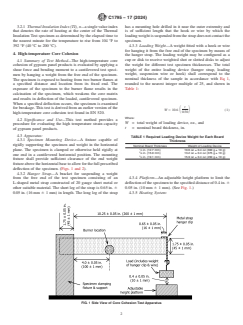
deflection of the specimen. (Figs. 1 and 2).
4.3.2 Hanger Strap—A bracket for suspending a weight
from the free end of the test specimen consisting of an 4.3.4 Platform—An adjustable height platform to limit the
L-shaped metal strap constructed of 20 gauge sheet metal or deflection of the specimen to the specified distance of 0.4 in. 6
other suitable material. The short leg of the strap is 0.65 in. 6 0.05 in. (10 mm 6 1 mm). (See Fig. 1.)
0.05 in. (16 mm 6 1 mm) in length. The long leg of the strap 4.3.5 Heating System:
FIG. 1 Side View of Core Cohesion Test Apparatus
C1795 − 17 (2024)
FIG. 2 Top View of Core Cohesion Test Apparatus
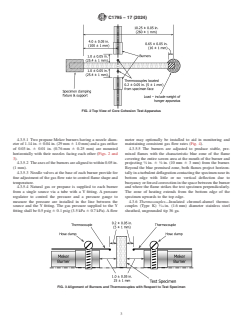
4.3.5.1 Two propane Meker burners having a nozzle diam- meter may optionally be installed to aid in monitoring and
eter of 1.14 in. 6 0.04 in. (29 mm 6 1.0 mm) and a gas orifice maintaining consistent gas flow rates (Fig. 4).
of 0.03 in. 6 0.01 in. (0.76 mm 6 0.25 mm) are mounted 4.3.5.5 The burners are adjusted to produce stable, pre-
horizontally with their nozzles facing each other (Figs. 2 and mixed flames with the characteristic blue zone of the flame
3). covering the entire screen area at the mouth of the burner and
3 1
4.3.5.2 The axes of the burners are aligned to within 0.05 in. projecting ⁄8 in. 6 ⁄8 in. (10 mm 6 3 mm) from the burner.
(1 mm). Beyond the blue premixed zone, both flames project horizon-
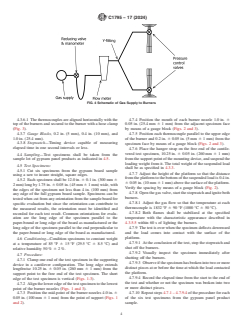
4.3.5.3 Needle valves at the base of each burner provide for tally in a turbulent deflagration contacting the specimen near its
fine adjustment of the gas flow rate to control flame shape and bottom edge with little or no vertical deflection due to
temperature. buoyancy or forced convection in the space between the burner
4.3.5.4 Natural gas or propane is supplied to each burner and where the flame strikes the test specimen perpendicularly.
from a single source via a tube with a Y fitting. A pressure The zone of heating extends from the bottom edge of the
regulator to control the pressure and a pressure gauge to specimen upwards to the top edge.
measure the pressure are installed in the line between the 4.3.6 Thermocouples—Insulated chromel-alumel thermo-
source and the Y fitting. The gas pressure supplied to the Y couples (Type K) ⁄16 in. (1.6 mm) diameter stainless steel
fitting shall be 0.5 psig 6 0.1 psig (3.5 kPa 6 0.7 kPa). A flow sheathed, ungrounded tip 36 ga.
FIG. 3 Alignment of Burners and Thermocouples with Respect to Test Specimen
C1795 − 17 (2024)
FIG. 4 Schematic of Gas Supply to Burners
4.3.6.1 The thermocouples are aligned horizontally with the 4.7.4 Position the mouth of each burner nozzle 1.0 in. 6
top of the burners and secured to the burner with a hose clamp 0.05 in. (25.4 mm 6 1 mm) from the adjacent specimen face
(Fig. 3). by means of a gauge block (Figs. 2 and 3).
4.3.7 Gauge Blocks, 0.2 in. (5 mm), 0.4 in. (10 mm), and
4.7.5 Position each thermocouple parallel to the upper edge
1.0 in. (25.4 mm).
of the burner and 0.2 in. 6 0.05 in. (5 mm 6 1 mm) from the
4.3.8 Stopwatch—Timing device capable of measuring
specimen face by means of a gauge block (Figs. 2 and 3).
elapsed time in one second intervals or less.
4.7.6 Place the hanger strap on the free end of the cantile-
vered test specimen, 10.25 in. 6 0.05 in. (260 mm 6 1 mm)
4.4 Sampling—Test specimens shall be taken from the
from the support point of the mounting device, and suspend the
sample lot of gypsum panel products as indicated in 4.5.
loading weight from it. The total weight of the suspended load
4.5 Test Specimens:
shall be as specified in 4.3.3.
4.5.1 Cut six specimens from the gypsum board sample
4.7.7 Adjust the height of the platform so that the distance
using a saw to insure straight, square edges.
from the platform to the bottom of the suspended load is 0.4 in.
4.5.2 Each specimen shall be 12.0 in. 6 0.1 in. (300 mm 6
6 0.05 in. (10 mm 6 1 mm) above the surface of the platform.
2 mm) long by 1.75 in. 6 0.05 in. (45 mm 6 1 mm) wide, with
Verify the spacing by means of a gauge block (Fig. 2).
the edges of the specimen not less than 4 in. (100 mm) from
4.7.8 Open the gas valve, start the stopwatch and ignite both
any edge of the full gypsum board sample. Specimens can be
burners.
tested when cut from any orientation from the sample board for
4.7.8.1 Adjust the gas flow so that the temperature at each
specific evaluation but since the orientation can contribute to
thermocouple is 1832 °F 6 90 °F (1000 °C 6 50 °C).
the measured results, the orientation must be identified and
4.7.8.2 Both flames shall be stabilized at the specified
recorded for each test result. Common orientations for evalu-
ation are the long edge of the specimen parallel to the temperature with the characteristic appearance described in
4.3.5.5 within 60 s of lighting the burners.
paper-bound or long edge of the board as manufactured or the
long edge of the specimen parallel to the end perpendicular to
4.7.9 The test is over when the specimen deflects downward
the paper-bound or long edge of the board as manufactured.
and the load comes into contact with the surface of the
platform.
4.6 Conditioning—Condition specimens to constant weight
4.7.9.1 At the conclusion of the test, stop the stopwatch and
at a temperature of 85 °F 6 15 °F (29.5 °C 6 8.5 °C) and
shut off the burners.
relative humidity 50 % 6 2 %.
4.7.9.2 Visually inspect the specimen immediately after
4.7 Procedure:
shutting off the burners.
4.7.1 Clamp one end of the test specimen in the supporting
4.7.9.3 Observe if the specimen has broken into two or more
device in a cantilever configuration. The long edge extends
distinct pieces at or before the time at which the load contacted
lengthwise 10.25 in. 6 0.05 in. (260 mm 6 1 mm) from the
the platform.
support point to the free end of the test specimen. The short
4.7.9.4 Record the elapsed time from the start to the end of
edge of the test specimen is vertical (Figs. 1-3).
the test and whether or not the specimen was broken into two
4.7.2 Align the lower edge of the test specimen to the lowest
or more distinct pieces.
point of the burner nozzles (Figs. 1 and 3).
4.7.3 Position the mid-point of the burner nozzles 4.0 in. 6 4.7.10 Repeat steps 4.7.1 – 4.7.9.4 of the procedure for each
0.05 in. (100 mm 6 1 mm) from the point of support (Figs. 1 of the six test specimens from the gypsum panel product
and 2). sample.
C1795 − 17 (2024)
5.3.4 Hearth Plate—Ceramic tray, made of vitreous alumi-
nosilicate fiber insulation or equivalent refractory material to
support test specimen loads.
5.3.5 Digital Electronic or Dial Caliper—Diameter measur-
ing device, 0 in. to 6 in. (0 mm to 152 mm) range, 0.001 in.
(0.025 mm) graduation.
5.3.6 Specimen Pedestals—Six pedestals, nominal ⁄4 in.
(6.35 mm) high and fabricated from stainless steel tubing, 2 in.
(51 mm) diameter × 0.047 in. (1.2 mm) wall thickness (Fig. 5).
5.4 Furnace Set-up Procedure:
5.4.1 Furnace Settings—Preset the furnace as shown in
Table 2.
TABLE 2 Heating Profile
Test heating profile furnace temperature settings:
FIG. 5 Specimen Pedestal
Stage 1: 0–35 min: ramp up from room temperature to 1565 °F
(850 °C)
Stage 2: 35–60 min: maintain furnace temperature at 1565 °F
(850 °C)
4.8 Report—Report the number of specimens that remained
Stage 3: Shut off furnace and allow furnace to cool below 1120 °F
intact, the number of specimens that broke into two or more
(600 °C) before opening furnace door to remove
distinct pieces, and the time to reach 0.4 in. (10 mm) deflection
specimens.
for each specimen.
4.9 Precision and Bias—No information is presented about
either the precision or bias of this test method for measuring
high-temperature core cohesion since the test result is qualita-
NOTE 1—Heat up and cool down periods at the start and end of the test
tive. are to avoid thermal shock to the test specimens that can cause physical
damage.
5. High-temperature Shrinkage Test
5.4.2 The temperature of the furnace shall be recorded
during the test and subsequent cooling period. Do not open the
5.1 Summary of Test Method—This test method evaluates
furnace door at elevated temperatures to avoid thermal shock
high-temperature shrinkage of gypsum panel products by
damage to the furnace and specimens.
exposing specimen disks to prescribed temperature conditions
5.4.3 Allow the furnace to return to room temperature
in a muffle furnace and measuring the change in diameter
before starting the next test.
before and after heating exposure.
5.5 Sampling—Test specimens shall be taken from the
5.2 Significance and Use—This test method evaluates the
high-temperature shrinkage of gypsum panel products and is sample lot of gypsum panel products as indicated in 5.6.
useful for estimating their behavior when exposed to fire.
5.6 Test Specimens:
5.3 Apparatus: 5.6.1 Each specimen shall be cut not less than 4 in.
(100 mm) from any edge of the f
...