

ISO/DIS 11515
(Main)Gas cylinders -- Refillable composite reinforced tubes of water capacity between 450 L and 3000 L -- Design, construction and testing
Gas cylinders -- Refillable composite reinforced tubes of water capacity between 450 L and 3000 L -- Design, construction and testing
Bouteilles à gaz -- Tubes composites renforcés rechargeables d'une capacité de 450 L à 3000 L -- Conception, construction et essais
General Information
RELATIONS
Standards Content (sample)
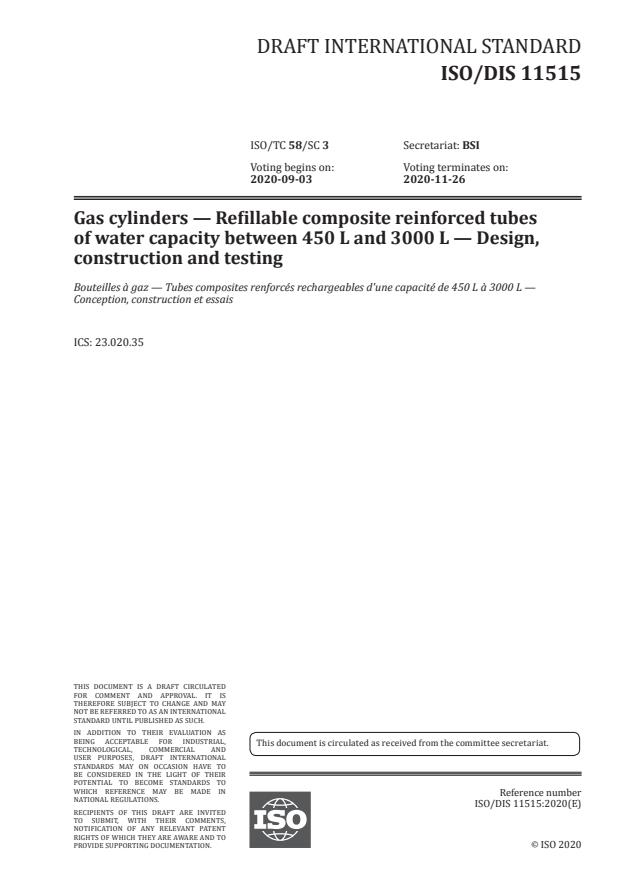
DRAFT INTERNATIONAL STANDARD
ISO/DIS 11515
ISO/TC 58/SC 3 Secretariat: BSI
Voting begins on: Voting terminates on:
2020-09-03 2020-11-26
Gas cylinders — Refillable composite reinforced tubes
of water capacity between 450 L and 3000 L — Design,
construction and testing
Bouteilles à gaz — Tubes composites renforcés rechargeables d'une capacité de 450 L à 3000 L —
Conception, construction et essaisICS: 23.020.35
THIS DOCUMENT IS A DRAFT CIRCULATED
FOR COMMENT AND APPROVAL. IT IS
THEREFORE SUBJECT TO CHANGE AND MAY
NOT BE REFERRED TO AS AN INTERNATIONAL
STANDARD UNTIL PUBLISHED AS SUCH.
IN ADDITION TO THEIR EVALUATION AS
BEING ACCEPTABLE FOR INDUSTRIAL,
This document is circulated as received from the committee secretariat.
TECHNOLOGICAL, COMMERCIAL AND
USER PURPOSES, DRAFT INTERNATIONAL
STANDARDS MAY ON OCCASION HAVE TO
BE CONSIDERED IN THE LIGHT OF THEIR
POTENTIAL TO BECOME STANDARDS TO
WHICH REFERENCE MAY BE MADE IN
Reference number
NATIONAL REGULATIONS.
ISO/DIS 11515:2020(E)
RECIPIENTS OF THIS DRAFT ARE INVITED
TO SUBMIT, WITH THEIR COMMENTS,
NOTIFICATION OF ANY RELEVANT PATENT
RIGHTS OF WHICH THEY ARE AWARE AND TO
PROVIDE SUPPORTING DOCUMENTATION. ISO 2020
---------------------- Page: 1 ----------------------
ISO/DIS 11515:2020(E)
COPYRIGHT PROTECTED DOCUMENT
© ISO 2020
All rights reserved. Unless otherwise specified, or required in the context of its implementation, no part of this publication may
be reproduced or utilized otherwise in any form or by any means, electronic or mechanical, including photocopying, or posting
on the internet or an intranet, without prior written permission. Permission can be requested from either ISO at the address
below or ISO’s member body in the country of the requester.ISO copyright office
CP 401 • Ch. de Blandonnet 8
CH-1214 Vernier, Geneva
Phone: +41 22 749 01 11
Email: copyright@iso.org
Website: www.iso.org
Published in Switzerland
ii © ISO 2020 – All rights reserved
---------------------- Page: 2 ----------------------
ISO/DIS 11515:2020(E)
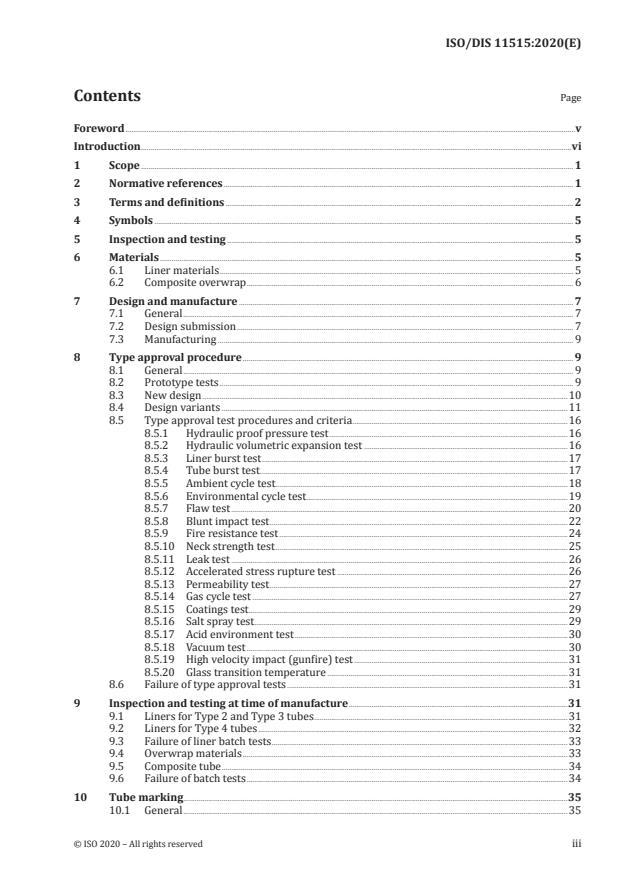
Contents Page
Foreword ..........................................................................................................................................................................................................................................v
Introduction ................................................................................................................................................................................................................................vi
1 Scope ................................................................................................................................................................................................................................. 1
2 Normative references ...................................................................................................................................................................................... 1
3 Terms and definitions ..................................................................................................................................................................................... 2
4 Symbols .......................................................................................................................................................................................................................... 5
5 Inspection and testing .................................................................................................................................................................................... 5
6 Materials ....................................................................................................................................................................................................................... 5
6.1 Liner materials ........................................................................................................................................................................................ 5
6.2 Composite overwrap .......................................................................................................................................................................... 6
7 Design and manufacture .............................................................................................................................................................................. 7
7.1 General ........................................................................................................................................................................................................... 7
7.2 Design submission ............................................................................................................................................................................... 7
7.3 Manufacturing ......................................................................................................................................................................................... 9
8 Type approval procedure ............................................................................................................................................................................ 9
8.1 General ........................................................................................................................................................................................................... 9
8.2 Prototype tests ........................................................................................................................................................................................ 9
8.3 New design ..............................................................................................................................................................................................10
8.4 Design variants ....................................................................................................................................................................................11
8.5 Type approval test procedures and criteria ................................................................................................................16
8.5.1 Hydraulic proof pressure test ............................................................................................................................16
8.5.2 Hydraulic volumetric expansion test ..........................................................................................................16
8.5.3 Liner burst test ...............................................................................................................................................................17
8.5.4 Tube burst test ................................................................................................................................................................17
8.5.5 Ambient cycle test ........................................................................................................................................................18
8.5.6 Environmental cycle test........................................................................................................................................19
8.5.7 Flaw test ...............................................................................................................................................................................20
8.5.8 Blunt impact test ...........................................................................................................................................................22
8.5.9 Fire resistance test ......................................................................................................................................................24
8.5.10 Neck strength test ........................................................................................................................................................25
8.5.11 Leak test ...............................................................................................................................................................................26
8.5.12 Accelerated stress rupture test ........................................................................................................................26
8.5.13 Permeability test ...........................................................................................................................................................27
8.5.14 Gas cycle test ....................................................................................................................................................................27
8.5.15 Coatings test......................................................................................................................................................................29
8.5.16 Salt spray test ...................................................................... .............................................................................................29
8.5.17 Acid environment test ..............................................................................................................................................30
8.5.18 Vacuum test .......................................................................................................................................................................30
8.5.19 High velocity impact (gunfire) test ...............................................................................................................31
8.5.20 Glass transition temperature .............................................................................................................................31
8.6 Failure of type approval tests ..................................................................................................................................................31
9 Inspection and testing at time of manufacture ..................................................................................................................31
9.1 Liners for Type 2 and Type 3 tubes ....................................................................................................................................31
9.2 Liners for Type 4 tubes .................................................................................................................................................................32
9.3 Failure of liner batch tests ..........................................................................................................................................................33
9.4 Overwrap materials .........................................................................................................................................................................33
9.5 Composite tube ....................................................................................................................................................................................34
9.6 Failure of batch tests .......................................................................................................................................................................34
10 Tube marking ........................................................................................................................................................................................................35
10.1 General ........................................................................................................................................................................................................35
© ISO 2020 – All rights reserved iii---------------------- Page: 3 ----------------------
ISO/DIS 11515:2020(E)
10.2 Additional marking ..........................................................................................................................................................................35
Annex A (informative) Examples of design approval certificate ..........................................................................................36
Annex B (informative) Specimen test reports ..........................................................................................................................................37
Annex C (normative) Ultrasonic inspection for seamless steel liners and metal tubing ............................39
Annex D (Informative) Guidance for calculating permeation rates when using trace gases ..................44
Bibliography .............................................................................................................................................................................................................................45
iv © ISO 2020 – All rights reserved---------------------- Page: 4 ----------------------
ISO/DIS 11515:2020(E)
Foreword
ISO (the International Organization for Standardization) is a worldwide federation of national standards
bodies (ISO member bodies). The work of preparing International Standards is normally carried out
through ISO technical committees. Each member body interested in a subject for which a technical
committee has been established has the right to be represented on that committee. International
organizations, governmental and non-governmental, in liaison with ISO, also take part in the work.
ISO collaborates closely with the International Electrotechnical Commission (IEC) on all matters of
electrotechnical standardization.The procedures used to develop this document and those intended for its further maintenance are
described in the ISO/IEC Directives, Part 1. In particular the different approval criteria needed for the
different types of ISO documents should be noted. This document was drafted in accordance with the
editorial rules of the ISO/IEC Directives, Part 2. www .iso .org/ directivesAttention is drawn to the possibility that some of the elements of this document may be the subject of
patent rights. ISO shall not be held responsible for identifying any or all such patent rights. Details of
any patent rights identified during the development of the document will be in the Introduction and/or
on the ISO list of patent declarations received. www .iso .org/ patentsAny trade name used in this document is information given for the convenience of users and does not
constitute an endorsement.The committee responsible for this document is ISO/TC 58, Gas cylinders, Subcommittee SC 3,
Cylinder design.© ISO 2020 – All rights reserved v
---------------------- Page: 5 ----------------------
ISO/DIS 11515:2020(E)
Introduction
The purpose of ISO 11515 is to provide a specification for the design, manufacture, inspection and
testing of composite tubes for worldwide usage. The objective is to balance design and economic
efficiency against international acceptance and universal utility.ISO 11515 aims to eliminate the concern about climate, duplicate inspection and restrictions currently
existing because of lack of definitive International Standards and should not be construed as reflecting
on the suitability of the practice of any nation or region.ISO 11515 addresses the general requirements on design, construction and initial inspection and
testing of pressure receptacles of the United Nations Recommendations on the Transport of Dangerous
Goods Model Regulations.Annexes A and B of ISO 11515 are for information only.
vi © ISO 2020 – All rights reserved
---------------------- Page: 6 ----------------------
DRAFT INTERNATIONAL STANDARD ISO/DIS 11515:2020(E)
Gas cylinders — Refillable composite reinforced tubes
of water capacity between 450 L and 3000 L — Design,
construction and testing
1 Scope
This document specifies minimum requirements for the materials, design, construction and
performance testing for:— type 2 hoop wrapped composite tubes
— type 3 fully wrapped composite tubes
— type 4 fully wrapped composite tubes
— with water capacities between 450 l and 3 000 l for storage and conveyance of compressed or
liquefied gases with test pressures up to and including 1600 bar and a design life of at least 15 years.
The expected service temperatures are between −40 °C and +65 °C.Type 4 tubes manufactured and tested to this document are not intended to contain toxic, oxidizing or
corrosive gases.This document is limited to tubes with composite reinforcement of carbon fibre or aramid fibre or glass
fibre (or a mixture thereof) in a matrix.Composite tubes can be used alone or in batteries to equip trailers or skids (ISO modules) or multiple
element gas containers (MEGC) for the transportation and distribution of gases. This document does
not include consideration of any additional stresses that can occur during service or transport, (e.g.
torsional / bending stresses). However, it is important that the stresses associated with mounting the
tube are considered by the assembly manufacturer and the tube manufacturer.2 Normative references
The following documents, in whole or in part, are normatively referenced in this document and are
indispensable for its application. For dated references, only the edition cited applies. For undated
references, the latest edition of the referenced document (including any amendments) applies.
ISO 306, Plastics — Thermoplastic materials — Determination of Vicat softening temperature (VST)
ISO 527-1, Plastics — Determination of tensile properties — Part 1: General principles
ISO 527-2, Plastics — Determination of tensile properties — Part 2: Test conditions for moulding and
extrusion plasticsISO 3341, Textile glass — Yarns — Determination of breaking force and breaking elongation
ISO 4624, Paints and varnishes — Pull-off test for adhesionISO 6506-1, Metallic materials — Brinell hardness test — Part 1: Test method
ISO 6508-1, Metallic materials — Rockwell hardness test — Part 1: Test method
ISO 6892-1, Metallic materials — Tensile testing — Part 1: Method of test at room temperature
ISO 7225, Gas cylinders — Precautionary labels© ISO 2020 – All rights reserved 1
---------------------- Page: 7 ----------------------
ISO/DIS 11515:2020(E)
ISO 7866, Gas cylinders — Refillable seamless aluminium alloy gas cylinders — Design, construction
and testingISO 9227:2012, Corrosion tests in artificial atmospheres — Salt spray tests
ISO 9712, Non-destructive testing — Qualification and certification of NDT personnel
ISO 9809-1, Gas cylinders — Design, construction and testing of refillable seamless steel gas cylinders and
tubes — Part 1: Quenched and tempered steel cylinders and tubes with tensile strength less than 1 100 MPa
ISO 9809-2, Gas cylinders — Design, construction and testing of refillable seamless steel gas cylinders and
tubes — Part 2: Quenched and tempered steel cylinders and tubes with tensile strength greater than or
equal to 1 100 MPaISO 9809-3, Gas cylinders — Design, construction and testing of refillable seamless steel gas cylinders and
tubes — Part 3: Normalized steel cylinders and tubesISO 10286, Gas cylinders - Terminology
ISO 10618, Carbon fibre — Determination of tensile properties of resin-impregnated yarn
ISO 11114-1, Gas cylinders — Compatibility of cylinder and valve materials with gas contents — Part 1:
Metallic materialsISO 11114-2, Gas cylinders — Compatibility of cylinder and valve materials with gas contents — Part 2:
Non-metallic materialsISO 11120, Gas cylinders — Refillable seamless steel tubes of water capacity between 150 l and 3000 l —
Design, construction and testingISO 13341, Gas cylinders — Fitting of valves to gas cylinders
ISO 13769, Gas cylinders — Stamp marking
ISO 14130, Fibre-reinforced plastic composites — Determination of apparent interlaminar shear strength
by short-beam methodASTM D 522-93a, Standard Test Methods for Mandrel Bend Test of Attached Organic Coatings
ASTM D1308, Standard Test Method for Effect of Household Chemicals on Clear and Pigmented Organic
FinishesASTM D2794, Standard Test Method for Resistance of Organic Coatings to the Effects of Rapid Deformation
(Impact)ASTM D3170, Standard Test Method for Chipping Resistance of Coatings
ASTM D7269, Standard Test Methods for Tensile Testing of Aramid Yarns
ASTM E1356–08,Standard Test Method for Assignment of the Glass Transition Temperatures by Differential
Scanning Calorimetry3 Terms and definitions
For the purposes of this document, the terms and definitions in ISO 10286 and the following apply.
ISO and IEC maintain terminological databases for use in standardization at the following addresses:
— IEC Electropedia: available at http:// www .electropedia .org/— ISO Online browsing platform: available at https:// www .iso .org/ obp
2 © ISO 2020 – All rights reserved
---------------------- Page: 8 ----------------------
ISO/DIS 11515:2020(E)
3.1
aramid fibre
continuous filaments of aramid laid up in tow form, used for reinforcement
3.2
autofrettage
pressure application procedure which strains the metal liner past its yield point sufficient to cause
permanent plastic deformation, and results in the liner having compressive stresses and the fibres
having tensile stresses when at zero internal gauge pressure3.3
batch
collective term for a set of homogeneous items or material
Note 1 to entry: The number of items in a batch can vary according to the context in which the term is used.
3.4batch of load sharing liners
quantity of liners of the same nominal diameter, length, thickness and design, made successively from
the same material cast (heat) and processed in the same heat treatment equipment (i.e. a continuous
furnace process or a single furnace charge) using the same heat treatment parameters
3.5batch of non-metallic liners
quantity of non-metallic liners of the same nominal diameter, length, thickness and design, made
successively and subjected to the same continuous manufacturing process3.6
batch of metal bosses
quantity of metal bosses of the same nominal diameter, length, thickness and design, made successively
from the same material cast (heat) and processed in the same heat treatment equipment using the same
heat treatment parameters3.7
batch of finished tubes
production quantity of up to 200 finished tubes successively produced (plus finished tubes required for
destructive testing), of the same nominal diameter, length, thickness and designNote 1 to entry: The batch of finished tubes can contain different batches of liners, fibres and matrix materials.
3.8burst pressure
highest pressure reached in a tube or liner during a burst test
3.9
carbon fibre
continuous filaments of carbon laid up in tow form, used for reinforcement
3.10
composite overwrap
combination of fibres and matrix used to reinforce the tube, including any barrier or protective layers
that are a permanent part of the design3.11
dedicated gas service
service in which a tube is to be used only with specified gas or gases
3.12
equivalent fibre
fibre from the same material family and similar properties to a fibre used in a previously prototype
tested tube© ISO 2020 – All rights reserved 3
---------------------- Page: 9 ----------------------
ISO/DIS 11515:2020(E)
3.13
equivalent liner
liner manufactured from the same nominal raw materials, using the same process of manufacture and
having the same physical structure and the same nominal physical properties (within ± 5 %) of the
approved liner design3.14
equivalent matrix
resin matrix from the same chemical family and similar properties to the resin matrix used in a
previously prototype tested cylinder3.15
exterior coating
layers of material applied to the tube as protection or for cosmetic purposes
Note 1 to entry: The coating can be transparent or opaque.
3.16
glass fibre
continuous filaments of glass laid up in tow form, used for reinforcement
3.17
leak
escape of gas at a rate greater than 5×10 mbar.l/s through a defect rather than permeation
3.18liner
inner portion of the composite tube, whose purpose is both to contain the gas and transmit the gas
pressure to the fibres3.19
load sharing liner
liner that has a burst pressure greater than or equal to 5 % of the nominal burst pressure of the finished
composite tube3.20
non-load-sharing liner
liner that provides no load sharing for the finished composite tube
3.21
matrix
material that is used to bind and hold the fibres in place
3.22
minimum design burst pressure
minimum burst pressure specified by the manufacturer and that shall be achieved during a burst test
3.23representative composite tube
a shorter tube with the same nominal diameter, and manufactured using the same materials and
manufacturing technique, and using a representative wrapping pattern (same number of strands and
same number of layers) so as to represent an equivalent stress compared to a full scale prototype
3.24tube
transportable pressure receptacle of a water capacity exceeding 150 litres
3.25
tubing
hollow cylindrical body of metal or other material, used for conveying or containing liquids or gases
4 © ISO 2020 – All rights reserved---------------------- Page: 10 ----------------------
ISO/DIS 11515:2020(E)
3.26
type 2 tube
hoop wrapped tube with a load sharing metal liner and composite reinforcement on the cylindrical
portion only3.27
type 3 tube
fully wrapped tube with a load sharing metal liner and composite reinforcement on both cylindrical
portion and dome ends3.28
type 4 tube
fully wrapped tube with a non-metallic, non-load-sharing liner and composite reinforcement on both
cylindrical portion and dome ends3.29
glass transition temperature Tg
the temperature where a polymer substrate changes from a rigid glassy material to a soft (not melted)
material, and is usually measured in terms of the stiffness, or modulus4 Symbols
p Burst pressure of finished tube bar
p Test pressure bar
p Maximum developed pressure at 65 °C bar
max
p Working pressure bar
5 Inspection and testing
ISO 11515 is intended to be used under a variety of national regulatory regimes but has been written
so that it is suitable for use with the conformity assessment system of the UN Model Regulations for the
Transportation of Dangerous Goods. Attention is drawn to requirements in specified relevant national
regulations of the country (countries) where the tubes are intended to be used that might override the
requirements given in this document. To ensure that the tubes conform to this document, they shall
be subject to inspection and testing in accordance with Clauses 6, 7, 8 and 9 by an inspection body
(hereafter referred to as “the inspector”) authorized to do so.Tests and examinations performed to demonstrate compliance with this document shall be conducted
using instruments calibrated before being put into service and thereafter according to an established
programme.6 Materials
6.1 Liner materials
6.1.1 Load sharing liner materials shall conform in all relevant respects to the appropriate International
Standards:a) seamless steel liners: ISO 9809-1, ISO 9809-2, ISO 9809-3 or ISO 11120 as appropriate;
b) seamless aluminium alloy liners: ISO 7866.© ISO 2020 – All rights reserved 5
---------------------- Page: 11 ----------------------
ISO/DIS 11515:2020(E)
Relevant sections are those covering materials, thermal treatments, neck design, construction and
workmanship, mechanical tests. Design requirements are excluded since these are specified by the
manufacturer for the design of the composite tube (see 7.2.2).6.1.1.1 The composite tube manufacturer shall verify that each new batch of materials has the
specified properties and qualities, and shall maintain records so that the cast of material and the heat
treatment batch (where applicable) used for the manufacture of each tube can be identified. A certificate
of conformance from the liner material manufacturer is considered acceptable for the purposes of
verification.6.1.1.2 The liner shall be manufactured from a metal or alloy suitable for the gas to be contained in
accordance with ISO 11114-1.6.1.1.3 When a neck ring is provided, it shall be of a material compatible with that of the tube, and
shall be securely attached by a method appropriate to the liner material.6.1.1.4 Non-load-sharing liner materials shall conform in all relevant respects to the appropriate
standards, as follows:a) The liner (including metal boss) shall be manufactured from a material suitable for the gas to be
contained in accordance with ISO 11114-1 and ISO 11114-2 or demonstrated and documented by
suitable testing.b) Metal bosses attached to a non-metallic liner shall fulfil the type approval testing requirements of
this document.c) The tensile yield strength and ultimate elongation of plastic liner material shall be determined at
−50 °C in accordance with ISO 527-2.The test results shall demonstrate the ductile properties of
the plastic liner material at temperatures of −50 °C or lower by meeting the values specified by the
manufacturer.d) Polymeric materials from finished liners shall be tested in accordance with a method described in
ISO 306. The softening temperature shall be at least 100 °C.6.2 Composite overwrap
6.2.1 The overwrap filament materials shall be carbon fibre or aramid fibre or glass fibre (or any
mixture thereof).NOTE Glass fibre reinforced composite tubes can be susceptible to chemical attack and degradation after
being in contact with aggressive acids (e.g. battery acid).6.2.2 The resin matrix shall be a polymer suited to the application, environment and intended life of the
product, e.g. epoxy or modified epoxy with amine or anhydride curing agent, vinyl esters and polyesters.
6.2.3 The supplier of the filament material and the resin matrix system componen...
Questions, Comments and Discussion
Ask us and Technical Secretary will try to provide an answer. You can facilitate discussion about the standard in here.