

ISO 11119-2:2020
(Main)Gas cylinders — Design, construction and testing of refillable composite gas cylinders and tubes — Part 2: Fully wrapped fibre reinforced composite gas cylinders and tubes up to 450 l with load-sharing metal liners
General Information
- Abstract
This document specifies minimum requirements for the material, design, construction and workmanship, manufacturing processes, examination and testing at time of manufacture for: — type 3 fully wrapped cylinders or tubes with a load-sharing metal liner and composite reinforcement on both the cylindrical portion and the dome ends; — water capacities up to 450 l; — storage and conveyance of compressed or liquefied gases; — cylinders and tubes with composite reinforcement of carbon fibre, aramid fibre or glass fibre (or a mixture thereof) within a matrix; — a minimum design life of 15 years. This document does not address the design, fitting, and performance of removable protective sleeves. This document does not apply to cylinders with welded liners. NOTE 1 References to cylinders in this document include composite tubes if appropriate. NOTE 2 ISO 11439 applies to cylinders intended for use as fuel containers on natural gas vehicles and ISO 11623 covers periodic inspection and re-testing of composite cylinders.
- Status
- Published
- Publication Date
- 22-Nov-2020
- Technical Committee
- ISO/TC 58/SC 3 - Cylinder design
- Drafting Committee
- ISO/TC 58/SC 3/WG 27 - Composite cylinders
- Current Stage
- 9092 - International Standard to be revised
- Start Date
- 10-Jun-2025
- Completion Date
- 29-Aug-2026
Buy Documents


ISO 11119-2:2020 - Gas cylinders -- Design, construction and testing of refillable composite gas cylinders and tubes
ISO 11119-2:2020 - Gas cylinders — Design, construction and testing of refillable composite gas cylinders and tubes — Part 2: Fully wrapped fibre reinforced composite gas cylinders and tubes up to 450 l with load-sharing metal liners/23/2020
Overview - ISO 11119-2:2020 (Fully wrapped composite gas cylinders)
ISO 11119-2:2020 specifies minimum requirements for the design, construction and testing of refillable, fully wrapped fibre‑reinforced composite gas cylinders and tubes (Type 3) with load‑sharing metal liners, for water capacities up to 450 L. The standard covers composite reinforcement using carbon fibre, aramid fibre or glass fibre (or mixtures) within a matrix, and requires a minimum design life of 15 years. It excludes cylinders with welded liners and does not address removable protective sleeves.
Keywords: ISO 11119-2:2020, composite gas cylinders, fully wrapped, load‑sharing metal liners, carbon fibre, aramid, glass fibre, refillable cylinders, up to 450 L
Key topics and technical requirements
The standard provides detailed technical requirements and test procedures, including:
- Materials: requirements for metal liners and composite overwrap materials (carbon, aramid, glass fibre).
- Design and manufacture: design submission, minimum fibre stress ratios, manufacturing controls and workmanship.
- Type approval and prototype testing: procedures for type approval, new designs and design variants.
- Type approval tests (examples included in the standard):
- Proof pressure and hydraulic volumetric expansion tests
- Liner burst and cylinder burst tests
- Ambient and environmental cycle tests
- Flaw detection tests, drop/impact and high‑velocity (gunfire) tests
- Fire resistance, salt‑water immersion and torque tests
- Environmentally assisted stress rupture, resin shear strength and glass transition temperature checks
- Batch inspection and testing: liner, overwrap and finished cylinder batch checks and failure handling.
- Marking and documentation: mandatory markings and type approval records.
The document is written to support international acceptance and to be compatible with the UN Model Regulations for transport of dangerous goods.
Practical applications and who uses this standard
ISO 11119-2 is used by:
- Manufacturers and designers of composite pressure vessels to meet international safety and quality benchmarks.
- Test laboratories and certification bodies performing type approval and batch testing.
- Regulatory authorities and inspection agencies responsible for transport and storage safety of compressed or liquefied gases.
- OEMs and end users specifying durable, lightweight gas storage for industrial, medical, diving, and specialty gas applications.
- Supply chain partners selecting materials (carbon/aramid/glass) and validating design lifetimes (minimum 15 years).
Benefits include consistent safety criteria, harmonized test methods, and clearer acceptance for cross‑border transport and use.
Related standards
- ISO 11119 series (other parts for composite cylinders)
- ISO 11439 (cylinders for natural gas vehicles)
- ISO 11623 (periodic inspection and re‑testing of composite cylinders)
- ISO 10286 (terminology) and other referenced material/test standards listed in ISO 11119-2:2020
For manufacturers and engineers specifying composite gas cylinders, ISO 11119-2:2020 is a primary reference for design, testing and certification of fully wrapped, load‑sharing liner cylinders up to 450 L.
Relations
- Effective Date
- 25-Aug-2026
- Effective Date
- 25-Aug-2026
- Effective Date
- 25-Aug-2026
- Effective Date
- 11-Mar-2026
- Consolidated By
ISO 10286:2025 - Gas cylinders — Vocabulary - Effective Date
- 06-Jun-2022
- Effective Date
- 30-Jul-2022
- Effective Date
- 12-May-2018
- Effective Date
- 12-May-2018
Buy Documents
ISO 11119-2:2020 - Gas cylinders -- Design, construction and testing of refillable composite gas cylinders and tubes
ISO 11119-2:2020 - Gas cylinders — Design, construction and testing of refillable composite gas cylinders and tubes — Part 2: Fully wrapped fibre reinforced composite gas cylinders and tubes up to 450 l with load-sharing metal liners/23/2020
Get Certified
Connect with accredited certification bodies for this standard

Institut za varilstvo d.o.o. (Welding Institute)
Slovenia's leading welding institute since 1952. ISO 3834, EN 1090, pressure equipment certification, NDT personnel, welder qualification. Only IIW Au
Sponsored listings
Frequently Asked Questions
ISO 11119-2:2020 is a standard published by the International Organization for Standardization (ISO). Its full title is "Gas cylinders — Design, construction and testing of refillable composite gas cylinders and tubes — Part 2: Fully wrapped fibre reinforced composite gas cylinders and tubes up to 450 l with load-sharing metal liners". This standard covers: This document specifies minimum requirements for the material, design, construction and workmanship, manufacturing processes, examination and testing at time of manufacture for: — type 3 fully wrapped cylinders or tubes with a load-sharing metal liner and composite reinforcement on both the cylindrical portion and the dome ends; — water capacities up to 450 l; — storage and conveyance of compressed or liquefied gases; — cylinders and tubes with composite reinforcement of carbon fibre, aramid fibre or glass fibre (or a mixture thereof) within a matrix; — a minimum design life of 15 years. This document does not address the design, fitting, and performance of removable protective sleeves. This document does not apply to cylinders with welded liners. NOTE 1 References to cylinders in this document include composite tubes if appropriate. NOTE 2 ISO 11439 applies to cylinders intended for use as fuel containers on natural gas vehicles and ISO 11623 covers periodic inspection and re-testing of composite cylinders.
This document specifies minimum requirements for the material, design, construction and workmanship, manufacturing processes, examination and testing at time of manufacture for: — type 3 fully wrapped cylinders or tubes with a load-sharing metal liner and composite reinforcement on both the cylindrical portion and the dome ends; — water capacities up to 450 l; — storage and conveyance of compressed or liquefied gases; — cylinders and tubes with composite reinforcement of carbon fibre, aramid fibre or glass fibre (or a mixture thereof) within a matrix; — a minimum design life of 15 years. This document does not address the design, fitting, and performance of removable protective sleeves. This document does not apply to cylinders with welded liners. NOTE 1 References to cylinders in this document include composite tubes if appropriate. NOTE 2 ISO 11439 applies to cylinders intended for use as fuel containers on natural gas vehicles and ISO 11623 covers periodic inspection and re-testing of composite cylinders.
ISO 11119-2:2020 is classified under the following ICS (International Classification for Standards) categories: 23.020.35 - Gas cylinders. The ICS classification helps identify the subject area and facilitates finding related standards.
ISO 11119-2:2020 has the following relationships with other standards: It is inter standard links to EN ISO 11623:2023, EN ISO 13341:2025, EN ISO 22734-1:2025, EN ISO 16923:2026, ISO 10286:2025, ISO 11119-2:2020/Amd 1:2023, ISO 11119-2:2012/Amd 1:2014, ISO 11119-2:2012. Understanding these relationships helps ensure you are using the most current and applicable version of the standard.
ISO 11119-2:2020 is available in PDF format for immediate download after purchase. The document can be added to your cart and obtained through the secure checkout process. Digital delivery ensures instant access to the complete standard document.
Standards Content (Sample)
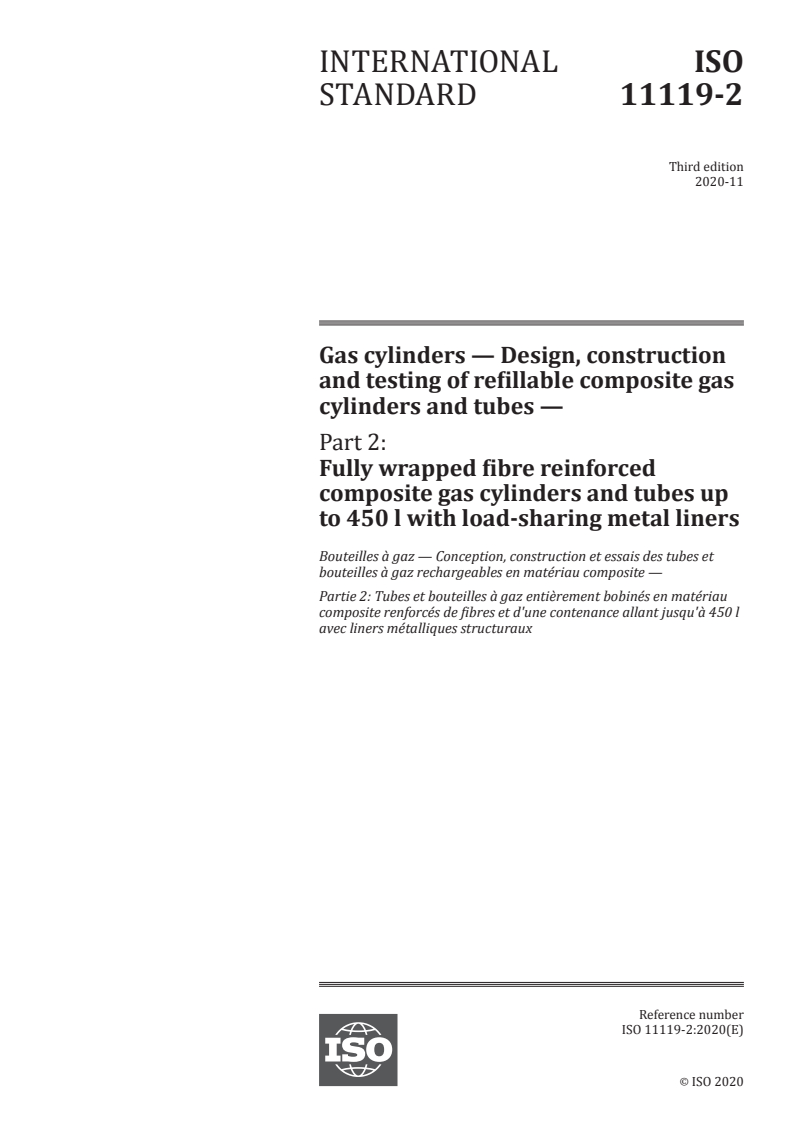
INTERNATIONAL ISO
STANDARD 11119-2
Third edition
2020-11
Gas cylinders — Design, construction
and testing of refillable composite gas
cylinders and tubes —
Part 2:
Fully wrapped fibre reinforced
composite gas cylinders and tubes up
to 450 l with load-sharing metal liners
Bouteilles à gaz — Conception, construction et essais des tubes et
bouteilles à gaz rechargeables en matériau composite —
Partie 2: Tubes et bouteilles à gaz entièrement bobinés en matériau
composite renforcés de fibres et d'une contenance allant jusqu'à 450 l
avec liners métalliques structuraux
Reference number
©
ISO 2020
© ISO 2020
All rights reserved. Unless otherwise specified, or required in the context of its implementation, no part of this publication may
be reproduced or utilized otherwise in any form or by any means, electronic or mechanical, including photocopying, or posting
on the internet or an intranet, without prior written permission. Permission can be requested from either ISO at the address
below or ISO’s member body in the country of the requester.
ISO copyright office
CP 401 • Ch. de Blandonnet 8
CH-1214 Vernier, Geneva
Phone: +41 22 749 01 11
Email: copyright@iso.org
Website: www.iso.org
Published in Switzerland
ii © ISO 2020 – All rights reserved
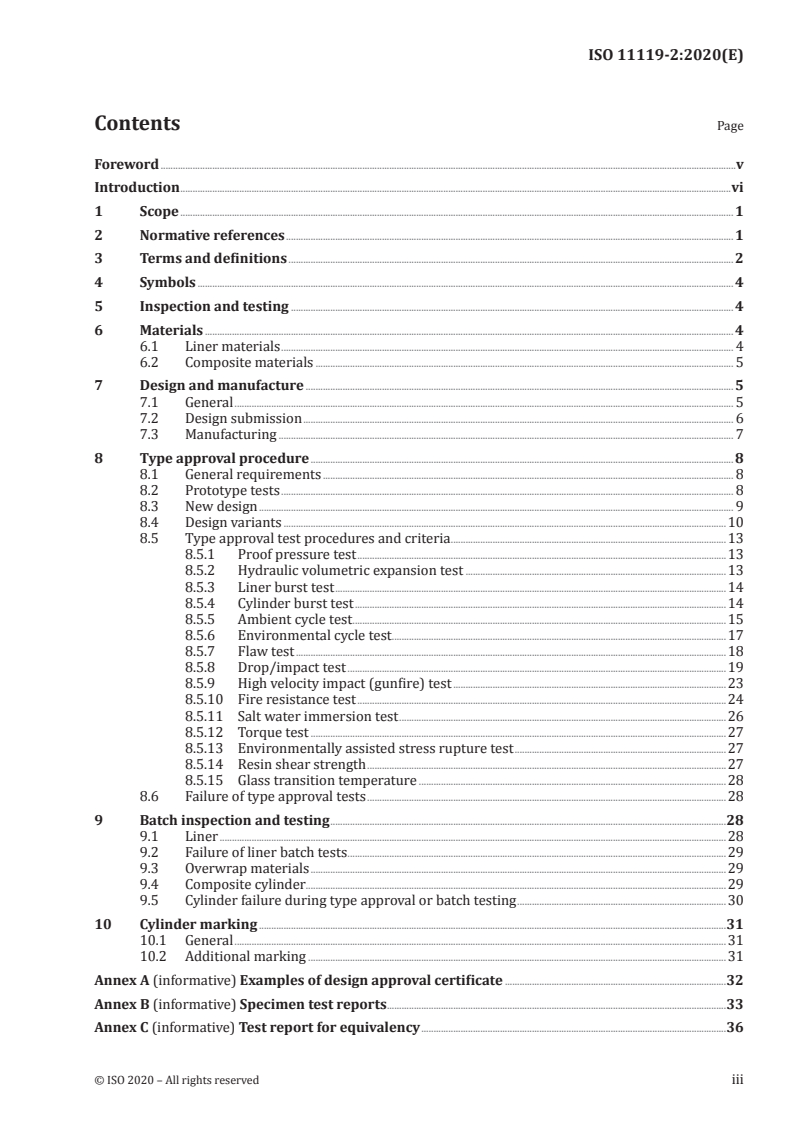
Contents Page
Foreword .v
Introduction .vi
1 Scope . 1
2 Normative references . 1
3 Terms and definitions . 2
4 Symbols . 4
5 Inspection and testing . 4
6 Materials . 4
6.1 Liner materials . 4
6.2 Composite materials . 5
7 Design and manufacture . 5
7.1 General . 5
7.2 Design submission . 6
7.3 Manufacturing . 7
8 Type approval procedure . 8
8.1 General requirements . 8
8.2 Prototype tests . 8
8.3 New design . 9
8.4 Design variants .10
8.5 Type approval test procedures and criteria .13
8.5.1 Proof pressure test .13
8.5.2 Hydraulic volumetric expansion test .13
8.5.3 Liner burst test .14
8.5.4 Cylinder burst test .14
8.5.5 Ambient cycle test .15
8.5.6 Environmental cycle test.17
8.5.7 Flaw test .18
8.5.8 Drop/impact test .19
8.5.9 High velocity impact (gunfire) test .23
8.5.10 Fire resistance test .24
8.5.11 Salt water immersion test .26
8.5.12 Torque test .27
8.5.13 Environmentally assisted stress rupture test .27
8.5.14 Resin shear strength .27
8.5.15 Glass transition temperature .28
8.6 Failure of type approval tests .28
9 Batch inspection and testing .28
9.1 Liner .28
9.2 Failure of liner batch tests .29
9.3 Overwrap materials .29
9.4 Composite cylinder.29
9.5 Cylinder failure during type approval or batch testing .30
10 Cylinder marking .31
10.1 General .31
10.2 Additional marking .31
Annex A (informative) Examples of design approval certificate .32
Annex B (informative) Specimen test reports .33
Annex C (informative) Test report for equivalency .36
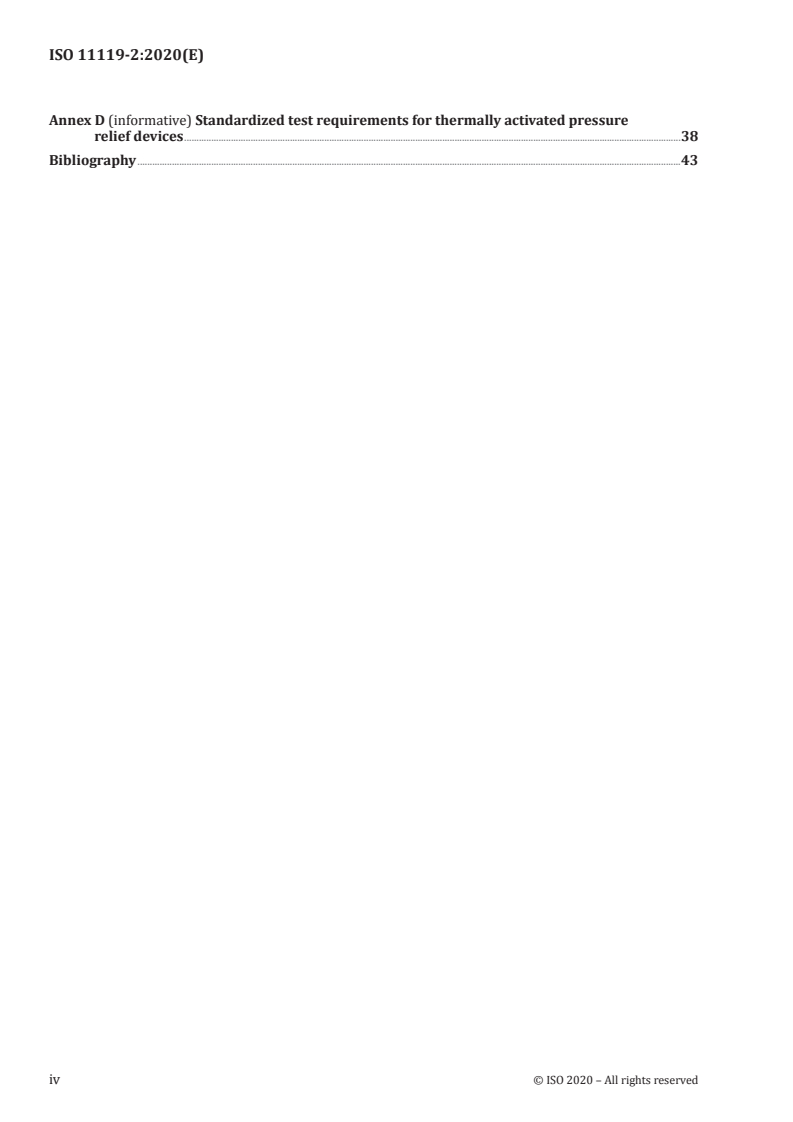
Annex D (informative) Standardized test requirements for thermally activated pressure
relief devices .38
Bibliography .43
iv © ISO 2020 – All rights reserved
Foreword
ISO (the International Organization for Standardization) is a worldwide federation of national standards
bodies (ISO member bodies). The work of preparing International Standards is normally carried out
through ISO technical committees. Each member body interested in a subject for which a technical
committee has been established has the right to be represented on that committee. International
organizations, governmental and non-governmental, in liaison with ISO, also take part in the work.
ISO collaborates closely with the International Electrotechnical Commission (IEC) on all matters of
electrotechnical standardization.
The procedures used to develop this document and those intended for its further maintenance are
described in the ISO/IEC Directives, Part 1. In particular, the different approval criteria needed for the
different types of ISO documents should be noted. This document was drafted in accordance with the
editorial rules of the ISO/IEC Directives, Part 2 (see www .iso .org/ directives).
Attention is drawn to the possibility that some of the elements of this document may be the subject of
patent rights. ISO shall not be held responsible for identifying any or all such patent rights. Details of
any patent rights identified during the development of the document will be in the Introduction and/or
on the ISO list of patent declarations received (see www .iso .org/ patents).
Any trade name used in this document is information given for the convenience of users and does not
constitute an endorsement.
For an explanation of the voluntary nature of standards, the meaning of ISO specific terms and
expressions related to conformity assessment, as well as information about ISO's adherence to the
World Trade Organization (WTO) principles in the Technical Barriers to Trade (TBT) see www .iso .org/
iso/ foreword .html.
This document was prepared by Technical Committee ISO/TC 58, Gas cylinders, Subcommittee SC 3,
Cylinder design.
Any feedback or questions on this document should be directed to the user’s national standards body. A
complete listing of these bodies can be found at www .iso .org/ members .html.
This third edition cancels and replaces the second edition (ISO 11119-2:2012), which has been
technically revised. It also incorporates the Amendment ISO 11119-2:2012/Amd.1:2014.
The main changes compared to the previous edition are as follows:
— References updated.
— 7.1.3 Minimum fibre stress ratios added.
— 8.5.8 Drop Test. Addition of new alternative test for cylinders up to and including 50 l water capacity
with dedicated compressed gas service. Addition of alternative impact test for tubes 150 l and above.
— 8.5.10 Fire resistance test. Changes to the procedure to make the test more consistent. Adding a
criteria for tubes above 150 l to be tested for 5 min.
— 8.5.12 Torque Test is now only required for taper threads.
A list of all parts in the ISO 11119 series can be found on the ISO website.
Introduction
The purpose of this document is to provide a specification for the design, manufacture, inspection and
testing of cylinders for worldwide usage. The objective is to balance design and economic efficiency
against international acceptance and universal utility.
This document aims to eliminate the concern about climate, duplicate inspection and restrictions
currently existing because of lack of definitive International Standards and is not to be construed as
reflecting on the suitability of the practice of any nation or region.
[1]
This document has been written so that it is suitable to be referenced in the UN Model Regulations .
This document addresses the general requirements on design, construction and initial inspection and
testing of pressure receptacles of the Recommendations on the transport of dangerous goods: Model
[15]
regulations developed by the United Nations .
vi © ISO 2020 – All rights reserved
INTERNATIONAL STANDARD ISO 11119-2:2020(E)
Gas cylinders — Design, construction and testing of
refillable composite gas cylinders and tubes —
Part 2:
Fully wrapped fibre reinforced composite gas cylinders
and tubes up to 450 l with load-sharing metal liners
1 Scope
This document specifies minimum requirements for the material, design, construction and
workmanship, manufacturing processes, examination and testing at time of manufacture for:
— type 3 fully wrapped cylinders or tubes with a load-sharing metal liner and composite reinforcement
on both the cylindrical portion and the dome ends;
— water capacities up to 450 l;
— storage and conveyance of compressed or liquefied gases;
— cylinders and tubes with composite reinforcement of carbon fibre, aramid fibre or glass fibre (or a
mixture thereof) within a matrix;
— a minimum design life of 15 years.
This document does not address the design, fitting, and performance of removable protective sleeves.
This document does not apply to cylinders with welded liners.
NOTE 1 References to cylinders in this document include composite tubes if appropriate.
NOTE 2 ISO 11439 applies to cylinders intended for use as fuel containers on natural gas vehicles and
ISO 11623 covers periodic inspection and re-testing of composite cylinders.
2 Normative references
The following documents are referred to in the text in such a way that some or all of their content
constitutes requirements of this document. For dated references, only the edition cited applies. For
undated references, the latest edition of the referenced document (including any amendments) applies.
ISO 3341, Textile glass — Yarns — Determination of breaking force and breaking elongation
ISO 6506-1, Metallic materials — Brinell hardness test — Part 1: Test method
ISO 6508-1, Metallic materials — Rockwell hardness test — Part 1: Test method
ISO 7225, Gas cylinders — Precautionary labels
ISO 7866, Gas cylinders — Refillable seamless aluminium alloy gas cylinders — Design, construction
and testing
ISO 9809-1, Gas cylinders — Design, construction and testing of refillable seamless steel gas cylinders and
tubes — Part 1: Quenched and tempered steel cylinders and tubes with tensile strength less than 1 100 MPa
ISO 9809-2, Gas cylinders — Design, construction and testing of refillable seamless steel gas cylinders and
tubes — Part 2: Quenched and tempered steel cylinders and tubes with tensile strength greater than or
equal to 1 100 MPa
ISO 9809-3, Gas cylinders — Design, construction and testing of refillable seamless steel gas cylinders and
tubes — Part 3: Normalized steel cylinders and tubes
ISO 9809-4, Gas cylinders — Refillable seamless steel gas cylinders — Design, construction and testing —
Part 4: Stainless steel cylinders with an Rm value of less than 1 100 MPa
ISO 10286, Gas cylinders — Terminology
ISO 10618, Carbon fibre — Determination of tensile properties of resin-impregnated yarn
ISO 11114-1, Gas cylinders — Compatibility of cylinder and valve materials with gas contents — Part 1:
Metallic materials
ISO 11114-4, Transportable gas cylinders — Compatibility of cylinder and valve materials with gas
contents — Part 4: Test methods for selecting steels resistant to hydrogen embrittlement
ISO 13341, Gas cylinders — Fitting of valves to gas cylinders
ISO 13769, Gas cylinders — Stamp marking
ISO 14130, Fibre-reinforced plastic composites — Determination of apparent interlaminar shear strength
by short-beam method
ASTM D7269, Standard test methods for tensile testing of aramid yarns
ASTM E1356–08, Standard Test Method for Assignment of the Glass Transition Temperatures by Differential
Scanning Calorimetry
3 Terms and definitions
For the purposes of this document, the terms and definitions in ISO 10286 and the following apply.
ISO and IEC maintain terminological databases for use in standardization at the following addresses:
— ISO Online browsing platform: available at https:// www .iso .org/ obp
— IEC Electropedia: available at http:// www .electropedia .org/
3.1
aramid fibre
continuous filaments of aramid laid up in tow form
3.2
autofrettage
pressure application procedure which strains the metal liner past its yield point sufficient to cause
permanent plastic deformation, and results in the liner having compressive stresses and the fibres
having tensile stresses when at zero internal gauge pressure
3.3
batch
set of homogeneous items or material
Note 1 to entry: The number of items in a batch can vary according to the context in which the term is used.
2 © ISO 2020 – All rights reserved
3.4
batch of liners
production quantity of up to 200 finished liners successively produced (plus units required for
destructive testing) of the same nominal diameter, length, thickness and design, from the same material
cast and heat treated to the same conditions of temperature and time
3.5
batch of finished cylinders
production quantity of up to 200 finished cylinders successively produced by the same manufacturing
process plus finished cylinders required for destructive testing, of the same nominal diameter, length,
thickness and design
3.6
burst pressure
highest pressure reached in a cylinder during a burst test
3.7
carbon fibre
continuous filaments of carbon laid up in tow form
3.8
composite overwrap
combination of fibres and matrix
3.9
dedicated gas service
service in which a cylinder is to be used only with a specified gas or gases
3.10
equivalent fibre
fibre from the same material family and similar properties to a fibre used in a previously prototype
tested cylinder
3.11
equivalent liner
liner of the same alloy family, and that has certified properties and performance so as to be a directly
comparable to a liner used in an already approved cylinder
3.12
equivalent matrix
resin matrix from the same chemical family and similar properties to the resin matrix used in a
previously prototype tested cylinder
3.14
glass fibre
continuous filaments of glass laid up in tow form
3.15
liner
inner portion of the composite cylinder, comprising a metallic vessel, whose purpose is both to contain
the gas and transmit the gas pressure to the fibres
3.16
matrix
material used to bind and hold the fibres in place
3.17
load-sharing liner
liner which has a burst pressure greater than or equal to 5 % of the nominal burst pressure of the
finished composite cylinder
3.18
thermoplastic
plastics capable of being repeatedly softened by increase of temperature and hardened by decrease of
temperature
3.19
thermosetting
plastics that, when cured by the application of heat or chemical means, harden permanently into a
substantially infusible and insoluble product
3.20
working pressure
p
w
settled pressure, in bar, of a compressed gas at a reference temperature of 15 °C in a full gas cylinder
3.21
nominal outside diameter
diameter of the cylinder specified by the manufacturer for the type approval including tolerances
(e.g. ±1 %)
3.22
glass transition temperature
Tg
the temperature where a polymer substrate changes from a rigid glassy material to a soft (not melted)
material, and is usually measured in terms of the stiffness, or modulus.
4 Symbols
p burst pressure of finished liner bar
bl
p burst pressure of finished cylinder bar
b
p test pressure bar
h
p maximum developed pressure at 65 °C bar
max
5 Inspection and testing
To ensure that the cylinders conform to this document, they shall be subject to inspection and testing in
accordance with Clauses 6, 7, 8, and 9 by an inspection body (hereafter referred to as “the inspector”)
authorized to do so. Example forms of certificates that can be used are shown in Annexes A and B.
Equipment used for measurement, testing, and examination during production shall be maintained and
calibrated within a documented quality management system.
6 Materials
6.1 Liner materials
6.1.1 The liner materials shall conform in all relevant respects to the appropriate standard:
a) seamless steel liners: ISO 9809-1, ISO 9809-2 or ISO 9809-3, as appropriate;
b) seamless stainless steel liners: ISO 9809-4;
c) seamless aluminium alloy liners: ISO 7866.
4 © ISO 2020 – All rights reserved
Relevant clauses are those covering materials, thermal treatments, neck design, construction and
workmanship, and mechanical tests. This excludes the design requirements since these are specified by
the manufacturer for the design of the composite cylinder (see 7.2.2).
6.1.2 The materials used shall be of uniform and consistent quality. The composite cylinder
manufacturer shall verify that each new batch of materials has the correct properties and is of satisfactory
quality. They shall also maintain records so that the cast of material and the heat treatment batch (where
applicable) used for the manufacture of each cylinder can be identified.
6.1.3 The liner shall be manufactured from a metal or alloy suitable for the gas to be contained in
accordance with ISO 11114-1. For compatibility with hydrogen see ISO 11114-4.
6.1.4 When a neck ring is provided, it shall be of a material compatible with that of the cylinder, and
shall be securely attached by a method appropriate to the liner material.
6.2 Composite materials
6.2.1 The overwrap materials shall be carbon fibre or aramid fibre or glass fibre or any mixture thereof.
6.2.2 The matrix shall be a polymer suited to the application, environment, and intended life of the
product.
6.2.3 The supplier of the filament material and the matrix system component materials shall provide
sufficient documentation for the composite cylinder manufacturer to be able to identify fully the batch of
materials used in the manufacture of each cylinder.
6.2.4 The materials used shall be of uniform and consistent quality. The composite cylinder
manufacturer shall verify that each new batch of materials has the correct properties and is of satisfactory
quality, and maintain records from which the batch of materials used for the manufacture of each cylinder
can be identified. A certificate of conformity from the material manufacturer is considered acceptable for
the purposes of verification.
6.2.5 Batches of materials shall be identified and documented.
7 Design and manufacture
7.1 General
7.1.1 A type 3 fully-wrapped composite gas cylinder with load-sharing liner shall comprise:
a) an internal metal liner, which carries part of the longitudinal and circumferential load;
b) a composite overwrap formed by layers of continuous fibres in a matrix;
c) an optional external protection system.
Where necessary, care shall be taken to ensure that there is no adverse reaction between the liner and
the reinforcing fibre by the application of a suitable protective coating to the liner prior to the wrapping
process.
7.1.2 Cylinders shall be designed with one or two openings along the central axis only. Threads shall
extend completely through the neck or have sufficient threads to allow full engagement of the valve.
The cylinder can also include additional parts (e.g. neck rings, bases).
7.1.3 The cylinders shall be designed for high reliability under sustained load and cyclic loading.
Therefore, it is necessary to take account of the properties of the individual composite fibres and to
establish their respective minimum fibre stress ratios.
The fibre stress ratio is defined as the fibre stress at calculated design minimum burst pressure divided
by the fibre stress at 2/3 test pressure.
The minimum fibre stress ratios shall be as follows:
— for glass: 3,6;
— for aramid: 3,1;
— for carbon: 2,4.
The strength of the individual types of fibres used in hybrid construction may be verified by testing of
containers reinforced with a single type of fibre. In a hybrid construction, the applicable stress ratio
requirements shall be met in one of the two following ways:
a) if load sharing between the various fibre reinforcing materials is considered a fundamental part of
the design, each fibre shall meet the stated stress ratio requirements.
b) if load sharing between fibres is not considered as a fundamental part of the design, then one of the
reinforcing fibres shall be capable of meeting the stress ratio requirements even if all other fibre
reinforcing materials are removed.
7.1.4 Examples of certificates are shown in Annexes A and B.
7.2 Design submission
7.2.1 The design submission for each new design of cylinder shall include a detailed drawing, along
with documentation of the design including manufacturing and inspection particulars as detailed in
7.2.2, 7.2.3, and 7.2.4.
7.2.2 Documentation for the liner shall include (but not be limited to):
a) material, including limits of chemical analysis;
b) dimensions, minimum thickness, straightness, and out-of-roundness, with tolerances;
c) process and specification of manufacture;
d) heat treatment, temperatures, duration, and tolerances;
e) inspection procedures (minimum requirements);
f) material properties including minimum mechanical properties and hardness ranges, where
applicable;
g) minimum design burst pressure;
h) dimensional details of valve threads and any other permanent features.
7.2.3 Documentation for the composite overwrap shall include (but not be limited to):
a) fibre material, specification, and mechanical properties requirements;
b) minimum composite thickness;
c) thermosetting matrix: specifications (including resin, curing agent and accelerator), and resin bath
temperature where applicable;
6 © ISO 2020 – All rights reserved
d) thermoplastic matrix system: main component materials, specifications and process temperatures;
e) overwrap construction including the number of strands used, number of layers, layer orientation,
and tensioning of the fibre at wrapping (where applicable);
f) curing process, temperatures, duration, and tolerances, where applicable.
7.2.4 Documentation for the composite cylinder shall include (but not be limited to):
a) nominal water capacity, in litres, under ambient conditions;
b) dimensions with tolerances
c) list of intended contents, if intended for dedicated gas service;
d) test pressure, p ;
h
e) working pressure, p (if applicable), that shall not exceed 0,67 × p ;
w h
f) maximum developed pressure at 65 °C for specific dedicated gas(es), p ;
max
g) minimum design burst pressure;
h) design life in years, although cylinders with a test pressure of less than 60 bar shall have a non-
limited design life;
i) autofrettage pressure and approximate duration (where applicable);
j) nominal mass of the finished composite cylinder, including tolerances;
k) details of components which are permanently attached and form part of the qualified design (neck
rings, protective boots, etc.).
7.3 Manufacturing
7.3.1 The liner shall be manufactured in accordance with the manufacturer's design (see 7.2.2) and the
International Standard for the relevant metallic material (as listed in 6.1.1).
7.3.2 The composite cylinder shall be fabricated from a load-sharing liner fully overwrapped with
layers of continuous fibres in a matrix applied under a controlled tension to develop the design composite
thickness specified in 7.2.3.
Liners can be stripped and re-wound provided that the overwrap has not been cured. The liner shall
not be overwrapped if it has been damaged or scored by the stripping process.
7.3.3 After wrapping is completed the composite shall be cured (if appropriate) using a controlled
temperature profile as specified in 7.2.3. The maximum temperature shall be such that the mechanical
properties of the liner material are not adversely affected.
7.3.4 If cylinders are subjected to an autofrettage operation, the autofrettage pressure and duration
shall be as specified in 7.2.4. The manufacturer shall demonstrate the effectiveness of the autofrettage by
appropriate measurement technique(s) acceptable to the inspector.
7.3.5 If cylinders are subjected to a prestressing or fibre tensioning during wrapping in order to
actively change the final stresses in the finished cylinder, the level of stress shall be as specified in the
documentation in 7.2.4 and levels of stress of tensioning shall be recorded or monitored.
8 Type approval procedure
8.1 General requirements
Each new cylinder design shall be submitted by the manufacturer to the inspector. The type approval
tests detailed in 8.2 shall be performed, under the supervision of the inspector, on each new cylinder
design or design variant.
8.2 Prototype tests
8.2.1 A minimum of 30 cylinders of the new design shall be made available for prototype testing.
Upon successful completion of all prototype tests, the remaining untested cylinders from the prototype
qualification batch can be used for service.
8.2.2 If, for special applications, the total number of cylinders required is less than 30, sufficient
cylinders shall be made to complete the prototype tests required, in addition to the production quantity.
In this case, the approval validity is limited to this batch only.
For a limited design change (design variant), in accordance with Table 1, a reduced number of cylinders
shall be selected by the inspector.
8.2.3 The batch of liners, prior to being wrapped, shall conform to the design requirements and shall
be inspected and tested in accordance with 9.1.
8.2.4 The composite material(s), prior to the cylinders being wrapped, shall conform to the design
requirements and shall be tested in accordance with 9.3.
8.2.5 Tests for a new cylinder design shall be supervised by an inspector and shall consist of:
a) hydraulic proof pressure test, in accordance with 8.5.1 or, hydraulic volumetric expansion test, in
accordance with 8.5.2;
b) liner burst test, in accordance with 8.5.3;
c) cylinder burst test, in accordance with 8.5.4;
d) ambient temperature cycle test, in accordance with 8.5.5;
e) environmental cycle test, in accordance with 8.5.6;
f) flaw test, in accordance with 8.5.7;
g) drop/impact test, in accordance with 8.5.8;
h) high velocity impact (gunfire) test, in accordance with 8.5.9;
8.2.6 Tests that are optional depending upon the design and intended use of the cylinder are:
a) fire resistance test, in accordance with 8.5.10;
b) salt water immersion test, in accordance with 8.5.11 (mandatory for underwater uses);
c) environmentally assisted stress rupture test, in accordance with 8.5.13 (mandatory for cylinders
with load sharing glass or aramid fibre;
d torque test, in accordance with 8.5.12.
8 © ISO 2020 – All rights reserved
8.2.7 For approval of a design variant as specified in 8.4, it is only necessary to carry out the tests as
stated in Table 1 under supervision of the inspector. A cylinder approval by a reduced series of tests
shall not be used as a basis for a second design variant approval with a reduced set of tests (i.e. multiple
changes from an approved design are not permitted), although individual test results can be used as
applicable (see 8.4.2).
8.2.8 Tests can be combined such that one cylinder can be used for more than one test. For example,
the cylinder burst test in the drop/impact test (8.5.8) can be used to satisfy the requirement of the burst
test (8.5.4).
8.2.9 If the results of the above prototype tests are satisfactory, the inspector shall issue a type approval
certificate, a typical example of which is given in Annex A.
8.2.10 After completion of the tests, the cylinders shall be destroyed or made incapable of holding
pressure.
8.3 New design
8.3.1 This clause specifies when a composite cylinder is a new design for the purposes of this
document. Subclause 8.4 specifies when a composite cylinder is a design variant.
8.3.2 A new cylinder design requires full type approval testing. A cylinder shall be considered to be of
a new design compared with an existing approved design if:
a) It is manufactured in a different factory. A relocation of a factory does not require a new cylinder
design approval provided all equipment and procedures remain the same as for the original design
approval.
b) It is manufactured by a process that is significantly different from the process used in the design
type approval. A significant change is regarded as a change that would have a measurable change in
the performance of the liner and/or finished cylinder. The inspector shall determine when a change
in process or design or manufacture is significantly different from the original qualified design.
c) The nominal outside diameter has changed more than 50 % from the qualified design.
d) A fibre of the same specification classification and mechanical properties, but with a different
linear density shall not be considered a new fibre type. Changes in the wrapping pattern shall be
considered to be a design variant [see 8.4.1 g)].
e) The cylinder is manufactured with a new fibre type. A fibre shall be considered to be of a new fibre
type when:
1) the fibre is of a different classification (e.g. glass, aramid or carbon);
2) the fibre is produced from a different precursor [e.g. polyacrylonitrile (PAN) or pitch for
carbon];
3) the fibre is not equivalent [see 8.4.1 i)] to the fibre in the original design
f) The matrix materials (i.e. resin, curing agent, accelerator) are different and not chemically
equivalent to the original design (e.g. a change from an epoxy to a polyester).
g) The test pressure has increased more than 60 % from the qualified design.
8.3.3 A cylinder shall also be considered to be of a new design compared with an existing approved
design if the liner method of manufacture or design has changed to a significant extent.
EXAMPLE 1 It is manufactured in a different factory. A relocation of a factory does not require a new cylinder
design approval provided all equipment and procedures remain the same as for the original design approval.
EXAMPLE 2 It is manufactured from a material of different composition or composition limits from that used
in the original type tests.
EXAMPLE 3 The material properties are outside the original design limits.
8.4 Design variants
8.4.1 For cylinders similar to an approved design, a reduced type approval testing programme is
required as specified in Table 1. A cylinder shall be considered to be a design variant if changes are
limited to the following:
a) The nominal length of the cylinder has changed by more than 5 %.
b) The nominal outside diameter has changed by 50 % or less.
c) The autofrettage pressure has changed by more than 5 % or 10 bar, whichever is the lower.
d) There is a change in the design test pressure up to and including 60 %.
NOTE Where a cylinder is to be used and marked for a lower test pressure than that for which design
approval has been given, it is not deemed to be of a new design or design variant.
e) The base profile and/or base thickness of the liner has changed relative to the cylinder diameter
and minimum wall thickness and outside the tolerances provided in the design submission.
f) The minimum wall thickness of the liner has changed by more than 5 %.
g) There have been changes to the composite thickness outside the tolerances provided in the design
submission.
h) When equivalent matrix materials are used.
Epoxy, vinyl ester, and polyester systems are not chemically equivalent to each other, but two epoxy-
based systems would be considered chemically equivalent as long as the minimum requirements
of interlaminar shear testing are achieved and has a glass transition temperature Tg equal to or
higher than the system being replaced. When equivalent overwrapping fibres are used.
i) When equivalent overwrapping fibres are used.
Equivalent fibres are manufactured from the same nominal raw materials, using the same process
of manufacture and having the same physical structure and the same nominal physical properties,
and where the average tensile strength and modulus is within ±5 % of the fibre properties in an
approved cylinder design. Carbon fibres made from the same precursor can be equivalent. Aramid,
carbon and glass fibres are not equivalent.
Where a new equivalent fibre has been prototype tested for an existing design, then all the
manufacturer’s existing prototype tested designs are regarded as prototype tested with the new
fibre without the need for any additional prototype testing.
j) When an equivalent liner is used:
1) equivalent liners are manufactured from the same nominal raw materials, using the same
process of manufacture and having the same physical structure and where the average tensile
strength and modulus is within ±5 % of the approved cylinder design;
2) the equivalent liner material shall be subjected to the material tests specified in 9.1.3 and the
liner burst test specified in 8.5.3 and in both cases shall meet the minimum requirements
specified in 7.2.2;
10 © ISO 2020 – All rights reserved
3) where a new equivalent liner has been prototype tested for an existing design, then all the
manufacturer’s existing prototype tested designs are regarded as prototype tested with the
new liner without the need for any additional prototype testing.
k) When the cylinder thread has changed:
When a cylinder design has only a different thread compared to an approved design, only the
torque test, in accordance with 8.5.12, shall be performed.
8.4.2 A cylinder approval by a reduced series of tests (a “design variant”) shall not be used as a basis
for a second design variant approval with a reduced set of tests (i.e. multiple changes from an approved
design are not permitted). If a test has been conducted on a design variant (A) that falls within the testing
requirements for a second variant (B), then the result for (A) can be applied to the new design variant
(B) test programme. However, design variant (A) cannot be used as the reference for determining the
testing required for any new design variant.
8.4.3 Where a design variant involves more than one parameter change all the tests required by those
parameter changes shall be performed once only.
8.4.4 The inspector shall determine the level of reduced testing if not defined in Table 1, but a fully
approved design shall always be used as a reference for the new design variant (i.e. new design variants
shall not be approved by reference only to a previous design variant).
8.4.5 Annex C is an example of a certificate that can be used to document the testing of liner materials
and/or composite materials to prove equivalency with approved materials from a previous type approval
12 © ISO 2020 – All rights reserved
Table 1 — Type approval tests
Design variant changes
New Nominal diam-
Nominal length Test pressure
Equiv- Liner Liner Equiv- Equiv- Au-
Test No. Test des- eter
Composite
alent thickness base alent alent. to-fret-
ign
thickness
>5 % >20 % >20 %
liner change form fibre matrix tage
>50 % ≤20 % ≤20 %
≤50 % ≤50 % ≤60 %
9.1 Liner material test x x x
8.5.14 Resin shear test x x
9.3 Overwrap material
x x x
tests
8.5.1 Proof test or Hy- x
draulic volumetric x x x x x x x x x x x x
8.5.2
expansion test
8.5.3 Liner burst x x x x x x x
8.5.4 Hydraulic burst x x x x x x x x x x x x x x
8.5.5 Ambient cycle x x x x x x x x x x x x x x
8.5.6 Environmental cycle x x
b
8.5.7 Flaw x x x
b b
8.5.8 Drop/impact x x x x x x x
c b b
8.5.9 High velocity impact x x x x x
a b
8.5.10 Fire resistance x x x x x
a
8.5.11 Salt water x x
d
8.5.12 Torque test x
a b
8.5.13 Stress rupture test x x x x x
8.5.15 Glass transition
x x
temp
a
Optional test required according to the design and intended use of the cylinder.
b
Conducted with a liner or composite thickness decrease only.
c
Test to be conducted for reduction in diameter only.
d
When a cylinder design has only a different thread compared to an approved design only the torque test, in accordance with 8.5.12 shall be performed.
8.5 Type approval test procedures and criteria
8.5.1 Proof pressure test
8.5.1.1 Procedure
When carrying out the pressure test, a suitable fluid shall be used as the test medium. This can include
liquids such as water or oil and gases such as air or nitrogen). This test requires that the pressure in
the cylinder be increased gradually and regularly until the test pressure, p , is reached. For cylinders
h
up to 150 l
...
INTERNATIONAL ISO
STANDARD 11119-2
Third edition
2020-11
Gas cylinders — Design, construction
and testing of refillable composite gas
cylinders and tubes —
Part 2:
Fully wrapped fibre reinforced
composite gas cylinders and tubes up
to 450 l with load-sharing metal liners
Bouteilles à gaz — Conception, construction et essais des tubes et
bouteilles à gaz rechargeables en matériau composite —
Partie 2: Tubes et bouteilles à gaz entièrement bobinés en matériau
composite renforcés de fibres et d'une contenance allant jusqu'à 450 l
avec liners métalliques structuraux
Reference number
©
ISO 2020
© ISO 2020
All rights reserved. Unless otherwise specified, or required in the context of its implementation, no part of this publication may
be reproduced or utilized otherwise in any form or by any means, electronic or mechanical, including photocopying, or posting
on the internet or an intranet, without prior written permission. Permission can be requested from either ISO at the address
below or ISO’s member body in the country of the requester.
ISO copyright office
CP 401 • Ch. de Blandonnet 8
CH-1214 Vernier, Geneva
Phone: +41 22 749 01 11
Email: copyright@iso.org
Website: www.iso.org
Published in Switzerland
ii © ISO 2020 – All rights reserved
Contents Page
Foreword .v
Introduction .vi
1 Scope . 1
2 Normative references . 1
3 Terms and definitions . 2
4 Symbols . 4
5 Inspection and testing . 4
6 Materials . 4
6.1 Liner materials . 4
6.2 Composite materials . 5
7 Design and manufacture . 5
7.1 General . 5
7.2 Design submission . 6
7.3 Manufacturing . 7
8 Type approval procedure . 8
8.1 General requirements . 8
8.2 Prototype tests . 8
8.3 New design . 9
8.4 Design variants .10
8.5 Type approval test procedures and criteria .13
8.5.1 Proof pressure test .13
8.5.2 Hydraulic volumetric expansion test .13
8.5.3 Liner burst test .14
8.5.4 Cylinder burst test .14
8.5.5 Ambient cycle test .15
8.5.6 Environmental cycle test.17
8.5.7 Flaw test .18
8.5.8 Drop/impact test .19
8.5.9 High velocity impact (gunfire) test .23
8.5.10 Fire resistance test .24
8.5.11 Salt water immersion test .26
8.5.12 Torque test .27
8.5.13 Environmentally assisted stress rupture test .27
8.5.14 Resin shear strength .27
8.5.15 Glass transition temperature .28
8.6 Failure of type approval tests .28
9 Batch inspection and testing .28
9.1 Liner .28
9.2 Failure of liner batch tests .29
9.3 Overwrap materials .29
9.4 Composite cylinder.29
9.5 Cylinder failure during type approval or batch testing .30
10 Cylinder marking .31
10.1 General .31
10.2 Additional marking .31
Annex A (informative) Examples of design approval certificate .32
Annex B (informative) Specimen test reports .33
Annex C (informative) Test report for equivalency .36
Annex D (informative) Standardized test requirements for thermally activated pressure
relief devices .38
Bibliography .43
iv © ISO 2020 – All rights reserved
Foreword
ISO (the International Organization for Standardization) is a worldwide federation of national standards
bodies (ISO member bodies). The work of preparing International Standards is normally carried out
through ISO technical committees. Each member body interested in a subject for which a technical
committee has been established has the right to be represented on that committee. International
organizations, governmental and non-governmental, in liaison with ISO, also take part in the work.
ISO collaborates closely with the International Electrotechnical Commission (IEC) on all matters of
electrotechnical standardization.
The procedures used to develop this document and those intended for its further maintenance are
described in the ISO/IEC Directives, Part 1. In particular, the different approval criteria needed for the
different types of ISO documents should be noted. This document was drafted in accordance with the
editorial rules of the ISO/IEC Directives, Part 2 (see www .iso .org/ directives).
Attention is drawn to the possibility that some of the elements of this document may be the subject of
patent rights. ISO shall not be held responsible for identifying any or all such patent rights. Details of
any patent rights identified during the development of the document will be in the Introduction and/or
on the ISO list of patent declarations received (see www .iso .org/ patents).
Any trade name used in this document is information given for the convenience of users and does not
constitute an endorsement.
For an explanation of the voluntary nature of standards, the meaning of ISO specific terms and
expressions related to conformity assessment, as well as information about ISO's adherence to the
World Trade Organization (WTO) principles in the Technical Barriers to Trade (TBT) see www .iso .org/
iso/ foreword .html.
This document was prepared by Technical Committee ISO/TC 58, Gas cylinders, Subcommittee SC 3,
Cylinder design.
Any feedback or questions on this document should be directed to the user’s national standards body. A
complete listing of these bodies can be found at www .iso .org/ members .html.
This third edition cancels and replaces the second edition (ISO 11119-2:2012), which has been
technically revised. It also incorporates the Amendment ISO 11119-2:2012/Amd.1:2014.
The main changes compared to the previous edition are as follows:
— References updated.
— 7.1.3 Minimum fibre stress ratios added.
— 8.5.8 Drop Test. Addition of new alternative test for cylinders up to and including 50 l water capacity
with dedicated compressed gas service. Addition of alternative impact test for tubes 150 l and above.
— 8.5.10 Fire resistance test. Changes to the procedure to make the test more consistent. Adding a
criteria for tubes above 150 l to be tested for 5 min.
— 8.5.12 Torque Test is now only required for taper threads.
A list of all parts in the ISO 11119 series can be found on the ISO website.
Introduction
The purpose of this document is to provide a specification for the design, manufacture, inspection and
testing of cylinders for worldwide usage. The objective is to balance design and economic efficiency
against international acceptance and universal utility.
This document aims to eliminate the concern about climate, duplicate inspection and restrictions
currently existing because of lack of definitive International Standards and is not to be construed as
reflecting on the suitability of the practice of any nation or region.
[1]
This document has been written so that it is suitable to be referenced in the UN Model Regulations .
This document addresses the general requirements on design, construction and initial inspection and
testing of pressure receptacles of the Recommendations on the transport of dangerous goods: Model
[15]
regulations developed by the United Nations .
vi © ISO 2020 – All rights reserved
INTERNATIONAL STANDARD ISO 11119-2:2020(E)
Gas cylinders — Design, construction and testing of
refillable composite gas cylinders and tubes —
Part 2:
Fully wrapped fibre reinforced composite gas cylinders
and tubes up to 450 l with load-sharing metal liners
1 Scope
This document specifies minimum requirements for the material, design, construction and
workmanship, manufacturing processes, examination and testing at time of manufacture for:
— type 3 fully wrapped cylinders or tubes with a load-sharing metal liner and composite reinforcement
on both the cylindrical portion and the dome ends;
— water capacities up to 450 l;
— storage and conveyance of compressed or liquefied gases;
— cylinders and tubes with composite reinforcement of carbon fibre, aramid fibre or glass fibre (or a
mixture thereof) within a matrix;
— a minimum design life of 15 years.
This document does not address the design, fitting, and performance of removable protective sleeves.
This document does not apply to cylinders with welded liners.
NOTE 1 References to cylinders in this document include composite tubes if appropriate.
NOTE 2 ISO 11439 applies to cylinders intended for use as fuel containers on natural gas vehicles and
ISO 11623 covers periodic inspection and re-testing of composite cylinders.
2 Normative references
The following documents are referred to in the text in such a way that some or all of their content
constitutes requirements of this document. For dated references, only the edition cited applies. For
undated references, the latest edition of the referenced document (including any amendments) applies.
ISO 3341, Textile glass — Yarns — Determination of breaking force and breaking elongation
ISO 6506-1, Metallic materials — Brinell hardness test — Part 1: Test method
ISO 6508-1, Metallic materials — Rockwell hardness test — Part 1: Test method
ISO 7225, Gas cylinders — Precautionary labels
ISO 7866, Gas cylinders — Refillable seamless aluminium alloy gas cylinders — Design, construction
and testing
ISO 9809-1, Gas cylinders — Design, construction and testing of refillable seamless steel gas cylinders and
tubes — Part 1: Quenched and tempered steel cylinders and tubes with tensile strength less than 1 100 MPa
ISO 9809-2, Gas cylinders — Design, construction and testing of refillable seamless steel gas cylinders and
tubes — Part 2: Quenched and tempered steel cylinders and tubes with tensile strength greater than or
equal to 1 100 MPa
ISO 9809-3, Gas cylinders — Design, construction and testing of refillable seamless steel gas cylinders and
tubes — Part 3: Normalized steel cylinders and tubes
ISO 9809-4, Gas cylinders — Refillable seamless steel gas cylinders — Design, construction and testing —
Part 4: Stainless steel cylinders with an Rm value of less than 1 100 MPa
ISO 10286, Gas cylinders — Terminology
ISO 10618, Carbon fibre — Determination of tensile properties of resin-impregnated yarn
ISO 11114-1, Gas cylinders — Compatibility of cylinder and valve materials with gas contents — Part 1:
Metallic materials
ISO 11114-4, Transportable gas cylinders — Compatibility of cylinder and valve materials with gas
contents — Part 4: Test methods for selecting steels resistant to hydrogen embrittlement
ISO 13341, Gas cylinders — Fitting of valves to gas cylinders
ISO 13769, Gas cylinders — Stamp marking
ISO 14130, Fibre-reinforced plastic composites — Determination of apparent interlaminar shear strength
by short-beam method
ASTM D7269, Standard test methods for tensile testing of aramid yarns
ASTM E1356–08, Standard Test Method for Assignment of the Glass Transition Temperatures by Differential
Scanning Calorimetry
3 Terms and definitions
For the purposes of this document, the terms and definitions in ISO 10286 and the following apply.
ISO and IEC maintain terminological databases for use in standardization at the following addresses:
— ISO Online browsing platform: available at https:// www .iso .org/ obp
— IEC Electropedia: available at http:// www .electropedia .org/
3.1
aramid fibre
continuous filaments of aramid laid up in tow form
3.2
autofrettage
pressure application procedure which strains the metal liner past its yield point sufficient to cause
permanent plastic deformation, and results in the liner having compressive stresses and the fibres
having tensile stresses when at zero internal gauge pressure
3.3
batch
set of homogeneous items or material
Note 1 to entry: The number of items in a batch can vary according to the context in which the term is used.
2 © ISO 2020 – All rights reserved
3.4
batch of liners
production quantity of up to 200 finished liners successively produced (plus units required for
destructive testing) of the same nominal diameter, length, thickness and design, from the same material
cast and heat treated to the same conditions of temperature and time
3.5
batch of finished cylinders
production quantity of up to 200 finished cylinders successively produced by the same manufacturing
process plus finished cylinders required for destructive testing, of the same nominal diameter, length,
thickness and design
3.6
burst pressure
highest pressure reached in a cylinder during a burst test
3.7
carbon fibre
continuous filaments of carbon laid up in tow form
3.8
composite overwrap
combination of fibres and matrix
3.9
dedicated gas service
service in which a cylinder is to be used only with a specified gas or gases
3.10
equivalent fibre
fibre from the same material family and similar properties to a fibre used in a previously prototype
tested cylinder
3.11
equivalent liner
liner of the same alloy family, and that has certified properties and performance so as to be a directly
comparable to a liner used in an already approved cylinder
3.12
equivalent matrix
resin matrix from the same chemical family and similar properties to the resin matrix used in a
previously prototype tested cylinder
3.14
glass fibre
continuous filaments of glass laid up in tow form
3.15
liner
inner portion of the composite cylinder, comprising a metallic vessel, whose purpose is both to contain
the gas and transmit the gas pressure to the fibres
3.16
matrix
material used to bind and hold the fibres in place
3.17
load-sharing liner
liner which has a burst pressure greater than or equal to 5 % of the nominal burst pressure of the
finished composite cylinder
3.18
thermoplastic
plastics capable of being repeatedly softened by increase of temperature and hardened by decrease of
temperature
3.19
thermosetting
plastics that, when cured by the application of heat or chemical means, harden permanently into a
substantially infusible and insoluble product
3.20
working pressure
p
w
settled pressure, in bar, of a compressed gas at a reference temperature of 15 °C in a full gas cylinder
3.21
nominal outside diameter
diameter of the cylinder specified by the manufacturer for the type approval including tolerances
(e.g. ±1 %)
3.22
glass transition temperature
Tg
the temperature where a polymer substrate changes from a rigid glassy material to a soft (not melted)
material, and is usually measured in terms of the stiffness, or modulus.
4 Symbols
p burst pressure of finished liner bar
bl
p burst pressure of finished cylinder bar
b
p test pressure bar
h
p maximum developed pressure at 65 °C bar
max
5 Inspection and testing
To ensure that the cylinders conform to this document, they shall be subject to inspection and testing in
accordance with Clauses 6, 7, 8, and 9 by an inspection body (hereafter referred to as “the inspector”)
authorized to do so. Example forms of certificates that can be used are shown in Annexes A and B.
Equipment used for measurement, testing, and examination during production shall be maintained and
calibrated within a documented quality management system.
6 Materials
6.1 Liner materials
6.1.1 The liner materials shall conform in all relevant respects to the appropriate standard:
a) seamless steel liners: ISO 9809-1, ISO 9809-2 or ISO 9809-3, as appropriate;
b) seamless stainless steel liners: ISO 9809-4;
c) seamless aluminium alloy liners: ISO 7866.
4 © ISO 2020 – All rights reserved
Relevant clauses are those covering materials, thermal treatments, neck design, construction and
workmanship, and mechanical tests. This excludes the design requirements since these are specified by
the manufacturer for the design of the composite cylinder (see 7.2.2).
6.1.2 The materials used shall be of uniform and consistent quality. The composite cylinder
manufacturer shall verify that each new batch of materials has the correct properties and is of satisfactory
quality. They shall also maintain records so that the cast of material and the heat treatment batch (where
applicable) used for the manufacture of each cylinder can be identified.
6.1.3 The liner shall be manufactured from a metal or alloy suitable for the gas to be contained in
accordance with ISO 11114-1. For compatibility with hydrogen see ISO 11114-4.
6.1.4 When a neck ring is provided, it shall be of a material compatible with that of the cylinder, and
shall be securely attached by a method appropriate to the liner material.
6.2 Composite materials
6.2.1 The overwrap materials shall be carbon fibre or aramid fibre or glass fibre or any mixture thereof.
6.2.2 The matrix shall be a polymer suited to the application, environment, and intended life of the
product.
6.2.3 The supplier of the filament material and the matrix system component materials shall provide
sufficient documentation for the composite cylinder manufacturer to be able to identify fully the batch of
materials used in the manufacture of each cylinder.
6.2.4 The materials used shall be of uniform and consistent quality. The composite cylinder
manufacturer shall verify that each new batch of materials has the correct properties and is of satisfactory
quality, and maintain records from which the batch of materials used for the manufacture of each cylinder
can be identified. A certificate of conformity from the material manufacturer is considered acceptable for
the purposes of verification.
6.2.5 Batches of materials shall be identified and documented.
7 Design and manufacture
7.1 General
7.1.1 A type 3 fully-wrapped composite gas cylinder with load-sharing liner shall comprise:
a) an internal metal liner, which carries part of the longitudinal and circumferential load;
b) a composite overwrap formed by layers of continuous fibres in a matrix;
c) an optional external protection system.
Where necessary, care shall be taken to ensure that there is no adverse reaction between the liner and
the reinforcing fibre by the application of a suitable protective coating to the liner prior to the wrapping
process.
7.1.2 Cylinders shall be designed with one or two openings along the central axis only. Threads shall
extend completely through the neck or have sufficient threads to allow full engagement of the valve.
The cylinder can also include additional parts (e.g. neck rings, bases).
7.1.3 The cylinders shall be designed for high reliability under sustained load and cyclic loading.
Therefore, it is necessary to take account of the properties of the individual composite fibres and to
establish their respective minimum fibre stress ratios.
The fibre stress ratio is defined as the fibre stress at calculated design minimum burst pressure divided
by the fibre stress at 2/3 test pressure.
The minimum fibre stress ratios shall be as follows:
— for glass: 3,6;
— for aramid: 3,1;
— for carbon: 2,4.
The strength of the individual types of fibres used in hybrid construction may be verified by testing of
containers reinforced with a single type of fibre. In a hybrid construction, the applicable stress ratio
requirements shall be met in one of the two following ways:
a) if load sharing between the various fibre reinforcing materials is considered a fundamental part of
the design, each fibre shall meet the stated stress ratio requirements.
b) if load sharing between fibres is not considered as a fundamental part of the design, then one of the
reinforcing fibres shall be capable of meeting the stress ratio requirements even if all other fibre
reinforcing materials are removed.
7.1.4 Examples of certificates are shown in Annexes A and B.
7.2 Design submission
7.2.1 The design submission for each new design of cylinder shall include a detailed drawing, along
with documentation of the design including manufacturing and inspection particulars as detailed in
7.2.2, 7.2.3, and 7.2.4.
7.2.2 Documentation for the liner shall include (but not be limited to):
a) material, including limits of chemical analysis;
b) dimensions, minimum thickness, straightness, and out-of-roundness, with tolerances;
c) process and specification of manufacture;
d) heat treatment, temperatures, duration, and tolerances;
e) inspection procedures (minimum requirements);
f) material properties including minimum mechanical properties and hardness ranges, where
applicable;
g) minimum design burst pressure;
h) dimensional details of valve threads and any other permanent features.
7.2.3 Documentation for the composite overwrap shall include (but not be limited to):
a) fibre material, specification, and mechanical properties requirements;
b) minimum composite thickness;
c) thermosetting matrix: specifications (including resin, curing agent and accelerator), and resin bath
temperature where applicable;
6 © ISO 2020 – All rights reserved
d) thermoplastic matrix system: main component materials, specifications and process temperatures;
e) overwrap construction including the number of strands used, number of layers, layer orientation,
and tensioning of the fibre at wrapping (where applicable);
f) curing process, temperatures, duration, and tolerances, where applicable.
7.2.4 Documentation for the composite cylinder shall include (but not be limited to):
a) nominal water capacity, in litres, under ambient conditions;
b) dimensions with tolerances
c) list of intended contents, if intended for dedicated gas service;
d) test pressure, p ;
h
e) working pressure, p (if applicable), that shall not exceed 0,67 × p ;
w h
f) maximum developed pressure at 65 °C for specific dedicated gas(es), p ;
max
g) minimum design burst pressure;
h) design life in years, although cylinders with a test pressure of less than 60 bar shall have a non-
limited design life;
i) autofrettage pressure and approximate duration (where applicable);
j) nominal mass of the finished composite cylinder, including tolerances;
k) details of components which are permanently attached and form part of the qualified design (neck
rings, protective boots, etc.).
7.3 Manufacturing
7.3.1 The liner shall be manufactured in accordance with the manufacturer's design (see 7.2.2) and the
International Standard for the relevant metallic material (as listed in 6.1.1).
7.3.2 The composite cylinder shall be fabricated from a load-sharing liner fully overwrapped with
layers of continuous fibres in a matrix applied under a controlled tension to develop the design composite
thickness specified in 7.2.3.
Liners can be stripped and re-wound provided that the overwrap has not been cured. The liner shall
not be overwrapped if it has been damaged or scored by the stripping process.
7.3.3 After wrapping is completed the composite shall be cured (if appropriate) using a controlled
temperature profile as specified in 7.2.3. The maximum temperature shall be such that the mechanical
properties of the liner material are not adversely affected.
7.3.4 If cylinders are subjected to an autofrettage operation, the autofrettage pressure and duration
shall be as specified in 7.2.4. The manufacturer shall demonstrate the effectiveness of the autofrettage by
appropriate measurement technique(s) acceptable to the inspector.
7.3.5 If cylinders are subjected to a prestressing or fibre tensioning during wrapping in order to
actively change the final stresses in the finished cylinder, the level of stress shall be as specified in the
documentation in 7.2.4 and levels of stress of tensioning shall be recorded or monitored.
8 Type approval procedure
8.1 General requirements
Each new cylinder design shall be submitted by the manufacturer to the inspector. The type approval
tests detailed in 8.2 shall be performed, under the supervision of the inspector, on each new cylinder
design or design variant.
8.2 Prototype tests
8.2.1 A minimum of 30 cylinders of the new design shall be made available for prototype testing.
Upon successful completion of all prototype tests, the remaining untested cylinders from the prototype
qualification batch can be used for service.
8.2.2 If, for special applications, the total number of cylinders required is less than 30, sufficient
cylinders shall be made to complete the prototype tests required, in addition to the production quantity.
In this case, the approval validity is limited to this batch only.
For a limited design change (design variant), in accordance with Table 1, a reduced number of cylinders
shall be selected by the inspector.
8.2.3 The batch of liners, prior to being wrapped, shall conform to the design requirements and shall
be inspected and tested in accordance with 9.1.
8.2.4 The composite material(s), prior to the cylinders being wrapped, shall conform to the design
requirements and shall be tested in accordance with 9.3.
8.2.5 Tests for a new cylinder design shall be supervised by an inspector and shall consist of:
a) hydraulic proof pressure test, in accordance with 8.5.1 or, hydraulic volumetric expansion test, in
accordance with 8.5.2;
b) liner burst test, in accordance with 8.5.3;
c) cylinder burst test, in accordance with 8.5.4;
d) ambient temperature cycle test, in accordance with 8.5.5;
e) environmental cycle test, in accordance with 8.5.6;
f) flaw test, in accordance with 8.5.7;
g) drop/impact test, in accordance with 8.5.8;
h) high velocity impact (gunfire) test, in accordance with 8.5.9;
8.2.6 Tests that are optional depending upon the design and intended use of the cylinder are:
a) fire resistance test, in accordance with 8.5.10;
b) salt water immersion test, in accordance with 8.5.11 (mandatory for underwater uses);
c) environmentally assisted stress rupture test, in accordance with 8.5.13 (mandatory for cylinders
with load sharing glass or aramid fibre;
d torque test, in accordance with 8.5.12.
8 © ISO 2020 – All rights reserved
8.2.7 For approval of a design variant as specified in 8.4, it is only necessary to carry out the tests as
stated in Table 1 under supervision of the inspector. A cylinder approval by a reduced series of tests
shall not be used as a basis for a second design variant approval with a reduced set of tests (i.e. multiple
changes from an approved design are not permitted), although individual test results can be used as
applicable (see 8.4.2).
8.2.8 Tests can be combined such that one cylinder can be used for more than one test. For example,
the cylinder burst test in the drop/impact test (8.5.8) can be used to satisfy the requirement of the burst
test (8.5.4).
8.2.9 If the results of the above prototype tests are satisfactory, the inspector shall issue a type approval
certificate, a typical example of which is given in Annex A.
8.2.10 After completion of the tests, the cylinders shall be destroyed or made incapable of holding
pressure.
8.3 New design
8.3.1 This clause specifies when a composite cylinder is a new design for the purposes of this
document. Subclause 8.4 specifies when a composite cylinder is a design variant.
8.3.2 A new cylinder design requires full type approval testing. A cylinder shall be considered to be of
a new design compared with an existing approved design if:
a) It is manufactured in a different factory. A relocation of a factory does not require a new cylinder
design approval provided all equipment and procedures remain the same as for the original design
approval.
b) It is manufactured by a process that is significantly different from the process used in the design
type approval. A significant change is regarded as a change that would have a measurable change in
the performance of the liner and/or finished cylinder. The inspector shall determine when a change
in process or design or manufacture is significantly different from the original qualified design.
c) The nominal outside diameter has changed more than 50 % from the qualified design.
d) A fibre of the same specification classification and mechanical properties, but with a different
linear density shall not be considered a new fibre type. Changes in the wrapping pattern shall be
considered to be a design variant [see 8.4.1 g)].
e) The cylinder is manufactured with a new fibre type. A fibre shall be considered to be of a new fibre
type when:
1) the fibre is of a different classification (e.g. glass, aramid or carbon);
2) the fibre is produced from a different precursor [e.g. polyacrylonitrile (PAN) or pitch for
carbon];
3) the fibre is not equivalent [see 8.4.1 i)] to the fibre in the original design
f) The matrix materials (i.e. resin, curing agent, accelerator) are different and not chemically
equivalent to the original design (e.g. a change from an epoxy to a polyester).
g) The test pressure has increased more than 60 % from the qualified design.
8.3.3 A cylinder shall also be considered to be of a new design compared with an existing approved
design if the liner method of manufacture or design has changed to a significant extent.
EXAMPLE 1 It is manufactured in a different factory. A relocation of a factory does not require a new cylinder
design approval provided all equipment and procedures remain the same as for the original design approval.
EXAMPLE 2 It is manufactured from a material of different composition or composition limits from that used
in the original type tests.
EXAMPLE 3 The material properties are outside the original design limits.
8.4 Design variants
8.4.1 For cylinders similar to an approved design, a reduced type approval testing programme is
required as specified in Table 1. A cylinder shall be considered to be a design variant if changes are
limited to the following:
a) The nominal length of the cylinder has changed by more than 5 %.
b) The nominal outside diameter has changed by 50 % or less.
c) The autofrettage pressure has changed by more than 5 % or 10 bar, whichever is the lower.
d) There is a change in the design test pressure up to and including 60 %.
NOTE Where a cylinder is to be used and marked for a lower test pressure than that for which design
approval has been given, it is not deemed to be of a new design or design variant.
e) The base profile and/or base thickness of the liner has changed relative to the cylinder diameter
and minimum wall thickness and outside the tolerances provided in the design submission.
f) The minimum wall thickness of the liner has changed by more than 5 %.
g) There have been changes to the composite thickness outside the tolerances provided in the design
submission.
h) When equivalent matrix materials are used.
Epoxy, vinyl ester, and polyester systems are not chemically equivalent to each other, but two epoxy-
based systems would be considered chemically equivalent as long as the minimum requirements
of interlaminar shear testing are achieved and has a glass transition temperature Tg equal to or
higher than the system being replaced. When equivalent overwrapping fibres are used.
i) When equivalent overwrapping fibres are used.
Equivalent fibres are manufactured from the same nominal raw materials, using the same process
of manufacture and having the same physical structure and the same nominal physical properties,
and where the average tensile strength and modulus is within ±5 % of the fibre properties in an
approved cylinder design. Carbon fibres made from the same precursor can be equivalent. Aramid,
carbon and glass fibres are not equivalent.
Where a new equivalent fibre has been prototype tested for an existing design, then all the
manufacturer’s existing prototype tested designs are regarded as prototype tested with the new
fibre without the need for any additional prototype testing.
j) When an equivalent liner is used:
1) equivalent liners are manufactured from the same nominal raw materials, using the same
process of manufacture and having the same physical structure and where the average tensile
strength and modulus is within ±5 % of the approved cylinder design;
2) the equivalent liner material shall be subjected to the material tests specified in 9.1.3 and the
liner burst test specified in 8.5.3 and in both cases shall meet the minimum requirements
specified in 7.2.2;
10 © ISO 2020 – All rights reserved
3) where a new equivalent liner has been prototype tested for an existing design, then all the
manufacturer’s existing prototype tested designs are regarded as prototype tested with the
new liner without the need for any additional prototype testing.
k) When the cylinder thread has changed:
When a cylinder design has only a different thread compared to an approved design, only the
torque test, in accordance with 8.5.12, shall be performed.
8.4.2 A cylinder approval by a reduced series of tests (a “design variant”) shall not be used as a basis
for a second design variant approval with a reduced set of tests (i.e. multiple changes from an approved
design are not permitted). If a test has been conducted on a design variant (A) that falls within the testing
requirements for a second variant (B), then the result for (A) can be applied to the new design variant
(B) test programme. However, design variant (A) cannot be used as the reference for determining the
testing required for any new design variant.
8.4.3 Where a design variant involves more than one parameter change all the tests required by those
parameter changes shall be performed once only.
8.4.4 The inspector shall determine the level of reduced testing if not defined in Table 1, but a fully
approved design shall always be used as a reference for the new design variant (i.e. new design variants
shall not be approved by reference only to a previous design variant).
8.4.5 Annex C is an example of a certificate that can be used to document the testing of liner materials
and/or composite materials to prove equivalency with approved materials from a previous type approval
12 © ISO 2020 – All rights reserved
Table 1 — Type approval tests
Design variant changes
New Nominal diam-
Nominal length Test pressure
Equiv- Liner Liner Equiv- Equiv- Au-
Test No. Test des- eter
Composite
alent thickness base alent alent. to-fret-
ign
thickness
>5 % >20 % >20 %
liner change form fibre matrix tage
>50 % ≤20 % ≤20 %
≤50 % ≤50 % ≤60 %
9.1 Liner material test x x x
8.5.14 Resin shear test x x
9.3 Overwrap material
x x x
tests
8.5.1 Proof test or Hy- x
draulic volumetric x x x x x x x x x x x x
8.5.2
expansion test
8.5.3 Liner burst x x x x x x x
8.5.4 Hydraulic burst x x x x x x x x x x x x x x
8.5.5 Ambient cycle x x x x x x x x x x x x x x
8.5.6 Environmental cycle x x
b
8.5.7 Flaw x x x
b b
8.5.8 Drop/impact x x x x x x x
c b b
8.5.9 High velocity impact x x x x x
a b
8.5.10 Fire resistance x x x x x
a
8.5.11 Salt water x x
d
8.5.12 Torque test x
a b
8.5.13 Stress rupture test x x x x x
8.5.15 Glass transition
x x
temp
a
Optional test required according to the design and intended use of the cylinder.
b
Conducted with a liner or composite thickness decrease only.
c
Test to be conducted for reduction in diameter only.
d
When a cylinder design has only a different thread compared to an approved design only the torque test, in accordance with 8.5.12 shall be performed.
8.5 Type approval test procedures and criteria
8.5.1 Proof pressure test
8.5.1.1 Procedure
When carrying out the pressure test, a suitable fluid shall be used as the test medium. This can include
liquids such as water or oil and gases such as air or nitrogen). This test requires that the pressure in
the cylinder be increased gradually and regularly until the test pressure, p , is reached. For cylinders
h
up to 150 l
...