


SIST EN IEC 62087-7:2019
(Main)Audio, video and related equipment - Methods of measurement for power consumption - Part 7: Computer Monitors (IEC 62087-7:2018)
Audio, video and related equipment - Methods of measurement for power consumption - Part 7: Computer Monitors (IEC 62087-7:2018)
This part of IEC 62087 specifies the determination of the power consumption of computer monitors including, but is not limited to, those with CRT, LCD, PDP or OLED technologies.
Computer monitors that include touch screen functionality are included in the scope of this document. This document is limited to computer monitors that are powered from a main power source other than a battery. Computer monitors that are powered from a battery source are not covered by this document. However mains-powered computer monitors may include any number of auxiliary batteries.
Computer monitors connected by digital inputs such as DisplayPort, HDMI, DVI, or by analogue VGA input, are considered in this document. This document does not apply to network- and wirelessly connected computer monitors.
A computer monitor is a display device that does not include a TV tuner and is intended to be used to display the video signals from a computer. These video signals are produced from software programs that are operating within the computer and can consist of static and moving images. As such, test procedures using static patterns, dynamic video and web-based video are specified.
The test methods specified in this document can be applied to computer monitors of any size, however, this document is not applicable to specialized monitors associated with medical equipment, publishing and other professional, commercial or industrial uses.
The various modes of operation that are relevant for measuring power consumption are also defined.
The measuring conditions in this document represent the normal use of the equipment and can differ from specific conditions, for example as specified in safety standards.
Audio-, Video- und verwandte Geräte - Messverfahren für die Leistungsaufnahme - Teil 7: Rechnerbildschirmgeräte (IEC 62087-7:2018)
Appareils audio, vidéo et matériel connexe – Méthodes de mesure de la consommation d’énergie - Partie 7 : Écrans d’ordinateur (IEC 62087-7:2018)
L'IEC 62087-7:2018 spécifie la détermination de la consommation de puissance des moniteurs d'ordinateurs, et notamment de ceux qui utilisent les technologies CRT, LCD, PDP ou OLED. Les moniteurs d'ordinateurs qui disposent d'une fonctionnalité d'écran tactile sont inclus dans le domaine d'application du présent document. Le présent document ne traite que des moniteurs d'ordinateurs alimentés en électricité par une source d'énergie principale autre qu'une batterie. Les moniteurs d'ordinateurs alimentés par batterie ne sont pas couverts par le présent document. Les moniteurs d'ordinateurs alimentés sur secteur peuvent toutefois comprendre un certain nombre de batteries auxiliaires.
Les moniteurs d'ordinateurs connectés par le biais d'entrées numériques de type DisplayPort, HDMI ou DVI, par exemple, ou au moyen d'une entrée VGA analogique, sont traités dans le présent document. Le présent document ne s'applique pas aux moniteurs d'ordinateurs connectés en réseau et sans fil.
Un moniteur d'ordinateur est un dispositif d'affichage qui ne comporte pas de récepteur TV et qui est destiné à être utilisé pour afficher les signaux vidéo à partir d'un ordinateur. Ces signaux vidéo sont produits par des logiciels informatiques exécutés sur l'ordinateur et peuvent être constitués d'images fixes et mobiles. A ce titre, les procédures d'essai qui utilisent des modèles statiques, la vidéo dynamique et la vidéo sur le Web sont spécifiées.
Les méthodes d'essai spécifiées dans le présent document peuvent être appliquées à tous les moniteurs d'ordinateurs, quelle que soit leur taille. En revanche, le présent document ne s'applique pas aux moniteurs spéciaux liés au matériel médical, à l'édition et à d'autres utilisations professionnelles, commerciales ou industrielles.
Les différents modes de fonctionnement adaptés au mesurage de la consommation de puissance sont également définis.
Les conditions de mesure du présent document sont représentatives de l'usage normal du matériel et peuvent différer des conditions particulières, comme celles spécifiées dans les normes de sécurité.
Avdio, video in pripadajoča oprema - Metode za merjenje porabe energije - 7. del: Računalniški zasloni (IEC 62087-7:2018)
Ta del standarda IEC 62087 določa način ugotavljanja porabe energije računalniških monitorjev, med drugim monitorjev s tehnologijami CRT, LCD, PDP ali OLED, vendar ne omejeno nanje. Računalniški monitorji s funkcijo zaslona na dotik so vključeni na področje uporabe tega dokumenta. Ta dokument je omejen na računalniške monitorje, ki se napajajo iz glavnega vira energije, ki ni baterija. Dokument ne zajema računalniških monitorjev, ki se napajajo iz baterij. Vendar lahko računalniški monitorji, ki se napajajo iz električnega omrežja, vsebujejo poljubno število pomožnih baterij.
V tem dokumentu so upoštevani računalniški monitorji, povezani z digitalnimi vhodi, kot so DisplayPort, HDMI, DVI ali analogni vhod VGA. Ta dokument se ne uporablja za omrežne in brezžično povezane računalniške monitorje.
Računalniški monitor je prikazovalna naprava, ki ne vsebuje TV-kartice in je namenjena za prikaz video signalov iz računalnika. Te video signale ustvarijo aplikacije programske opreme, ki delujejo v računalniku, signali pa so lahko sestavljeni iz statičnih in premikajočih se slik. Tako so preskusni postopki določeni z uporabo statičnih vzorcev, dinamičnega videa in spletnega videa.
Preskusne metode, določene v tem dokumentu, je mogoče uporabiti za računalniške monitorje poljubne velikosti, vendar dokument se ne uporablja za specializirane monitorje, povezane z medicinsko opremo ali založništvom, in za druge profesionalne, komercialne ali industrijske namene.
Opredeljeni so tudi načini delovanja, ki so pomembni za merjenje porabe energije.
Merilni pogoji iz tega dokumenta se navezujejo na običajno uporabo opreme in se lahko razlikujejo od posebnih pogojev, kot so npr. določeni v varnostnih standardih.
General Information
- Status
- Published
- Publication Date
- 02-Sep-2019
- Technical Committee
- AVM - Audio, video and multimedia systems and equipment
- Current Stage
- 6060 - National Implementation/Publication (Adopted Project)
- Start Date
- 21-Feb-2019
- Due Date
- 28-Apr-2019
- Completion Date
- 03-Sep-2019
Overview
EN IEC 62087-7:2019 (IEC 62087-7:2018) specifies repeatable methods for measuring the power consumption of computer monitors. It covers mains‑powered monitors using CRT, LCD, PDP or OLED technologies, including units with touch‑screen functionality and digital/analogue inputs (DisplayPort, HDMI, DVI, VGA). The standard defines measurement conditions, operating modes (on, partial on, standby, off), and test patterns (static, dynamic video, web‑based video) to represent normal use. It excludes battery‑only devices, network/wireless connected monitors and specialised medical, publishing or industrial displays.
Key topics and requirements
- Scope & definitions: What constitutes a computer monitor (no TV tuner; displays signals from a computer) and which devices are excluded.
- Operating modes: Clear definitions for on‑mode, partial on, standby‑active/standby‑passive, off mode, and auto power down behavior.
- Measurement conditions:
- Power supply specifications (mains voltage/frequency).
- Environmental and ambient light conditions to control luminance.
- Required measuring equipment: power measuring instrument, luminance meter, illuminance meter.
- Signal generation and test content: Use of static patterns, dynamic video and web‑based video to reflect real‑world usage.
- Automatic Brightness Control (ABC): Methods to characterise and, when necessary, disable ABC for consistent results.
- Procedure & stabilization: Order of activities, cooldown and stabilization periods, and measurement sequences to ensure reproducibility.
- Partial measurements: Procedures for determining power factor, partial‑on and low‑power active states.
Applications and who uses this standard
EN IEC 62087-7:2019 is used by:
- Manufacturers and design engineers to measure and optimize monitor power consumption and to validate power management features (e.g., auto‑power‑down, ABC).
- Test laboratories and certification bodies for repeatable, auditable energy measurements.
- Regulators, energy‑efficiency programs and procurement teams for compliance, energy labeling and eco‑specifications.
- R&D teams assessing the impact of display technologies (LCD, OLED, etc.) and input interfaces on real‑world power use.
Practical benefits include consistent, comparable power data across products, support for energy‑efficient product design, and objective verification for energy labeling and procurement.
Related standards
- IEC 62087‑1 / EN 62087‑1 - General methods for audio/video power measurement
- IEC 62087‑2 / EN 62087‑2 - Signals and media
- IEC 62301 (mod) / EN 50564 - Measurement of standby power
Keywords: EN IEC 62087-7:2019, computer monitors power consumption, measurement methods, automatic brightness control, on‑mode, standby, luminance measurement, HDMI, DisplayPort, energy efficiency.



Frequently Asked Questions
SIST EN IEC 62087-7:2019 is a standard published by the Slovenian Institute for Standardization (SIST). Its full title is "Audio, video and related equipment - Methods of measurement for power consumption - Part 7: Computer Monitors (IEC 62087-7:2018)". This standard covers: This part of IEC 62087 specifies the determination of the power consumption of computer monitors including, but is not limited to, those with CRT, LCD, PDP or OLED technologies. Computer monitors that include touch screen functionality are included in the scope of this document. This document is limited to computer monitors that are powered from a main power source other than a battery. Computer monitors that are powered from a battery source are not covered by this document. However mains-powered computer monitors may include any number of auxiliary batteries. Computer monitors connected by digital inputs such as DisplayPort, HDMI, DVI, or by analogue VGA input, are considered in this document. This document does not apply to network- and wirelessly connected computer monitors. A computer monitor is a display device that does not include a TV tuner and is intended to be used to display the video signals from a computer. These video signals are produced from software programs that are operating within the computer and can consist of static and moving images. As such, test procedures using static patterns, dynamic video and web-based video are specified. The test methods specified in this document can be applied to computer monitors of any size, however, this document is not applicable to specialized monitors associated with medical equipment, publishing and other professional, commercial or industrial uses. The various modes of operation that are relevant for measuring power consumption are also defined. The measuring conditions in this document represent the normal use of the equipment and can differ from specific conditions, for example as specified in safety standards.
This part of IEC 62087 specifies the determination of the power consumption of computer monitors including, but is not limited to, those with CRT, LCD, PDP or OLED technologies. Computer monitors that include touch screen functionality are included in the scope of this document. This document is limited to computer monitors that are powered from a main power source other than a battery. Computer monitors that are powered from a battery source are not covered by this document. However mains-powered computer monitors may include any number of auxiliary batteries. Computer monitors connected by digital inputs such as DisplayPort, HDMI, DVI, or by analogue VGA input, are considered in this document. This document does not apply to network- and wirelessly connected computer monitors. A computer monitor is a display device that does not include a TV tuner and is intended to be used to display the video signals from a computer. These video signals are produced from software programs that are operating within the computer and can consist of static and moving images. As such, test procedures using static patterns, dynamic video and web-based video are specified. The test methods specified in this document can be applied to computer monitors of any size, however, this document is not applicable to specialized monitors associated with medical equipment, publishing and other professional, commercial or industrial uses. The various modes of operation that are relevant for measuring power consumption are also defined. The measuring conditions in this document represent the normal use of the equipment and can differ from specific conditions, for example as specified in safety standards.
SIST EN IEC 62087-7:2019 is classified under the following ICS (International Classification for Standards) categories: 17.220.20 - Measurement of electrical and magnetic quantities; 33.160.01 - Audio, video and audiovisual systems in general. The ICS classification helps identify the subject area and facilitates finding related standards.
SIST EN IEC 62087-7:2019 is available in PDF format for immediate download after purchase. The document can be added to your cart and obtained through the secure checkout process. Digital delivery ensures instant access to the complete standard document.
Standards Content (Sample)
SLOVENSKI STANDARD
01-oktober-2019
Avdio, video in pripadajoča oprema - Metode za merjenje porabe energije - 7. del:
Računalniški zasloni (IEC 62087-7:2018)
Audio, video and related equipment - Methods of measurement for power consumption -
Part 7: Computer Monitors (IEC 62087-7:2018)
Audio-, Video- und verwandte Geräte - Messverfahren für die Leistungsaufnahme - Teil
7: Rechnerbildschirmgeräte (IEC 62087-7:2018)
Appareils audio, vidéo et matériel connexe – Méthodes de mesure de la consommation
d’énergie - Partie 7 : Écrans d’ordinateur (IEC 62087-7:2018)
Ta slovenski standard je istoveten z: EN IEC 62087-7:2019
ICS:
17.220.20 Merjenje električnih in Measurement of electrical
magnetnih veličin and magnetic quantities
33.160.01 Avdio, video in avdiovizualni Audio, video and audiovisual
sistemi na splošno systems in general
2003-01.Slovenski inštitut za standardizacijo. Razmnoževanje celote ali delov tega standarda ni dovoljeno.
EUROPEAN STANDARD EN IEC 62087-7
NORME EUROPÉENNE
EUROPÄISCHE NORM
February 2019
ICS 33.160.10
English Version
Audio, video, and related equipment - Methods of measurement
for power consumption Part 7: Computer monitors
(IEC 62087-7:2018)
Appareils audio, vidéo et matériel connexe – Méthodes de Audio-, Video- und verwandte Geräte - Messverfahren für
mesure de la consommation d’énergie - Partie 7 : Écrans die Leistungsaufnahme - Teil 7: Rechnerbildschirmgeräte
d’ordinateur (IEC 62087-7:2018)
(IEC 62087-7:2018)
This European Standard was approved by CENELEC on 2019-01-10. CENELEC members are bound to comply with the CEN/CENELEC
Internal Regulations which stipulate the conditions for giving this European Standard the status of a national standard without any alteration.
Up-to-date lists and bibliographical references concerning such national standards may be obtained on application to the CEN-CENELEC
Management Centre or to any CENELEC member.
This European Standard exists in three official versions (English, French, German). A version in any other language made by translation
under the responsibility of a CENELEC member into its own language and notified to the CEN-CENELEC Management Centre has the
same status as the official versions.
CENELEC members are the national electrotechnical committees of Austria, Belgium, Bulgaria, Croatia, Cyprus, the Czech Republic,
Denmark, Estonia, Finland, Former Yugoslav Republic of Macedonia, France, Germany, Greece, Hungary, Iceland, Ireland, Italy, Latvia,
Lithuania, Luxembourg, Malta, the Netherlands, Norway, Poland, Portugal, Romania, Serbia, Slovakia, Slovenia, Spain, Sweden,
Switzerland, Turkey and the United Kingdom.
European Committee for Electrotechnical Standardization
Comité Européen de Normalisation Electrotechnique
Europäisches Komitee für Elektrotechnische Normung
CEN-CENELEC Management Centre: Rue de la Science 23, B-1040 Brussels
© 2019 CENELEC All rights of exploitation in any form and by any means reserved worldwide for CENELEC Members.
Ref. No. EN IEC 62087-7:2019 E
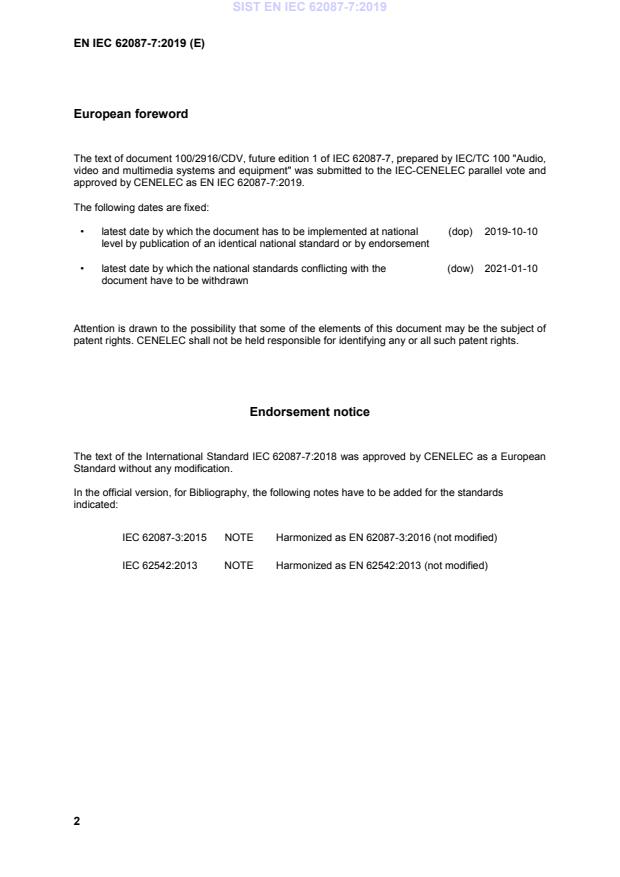
European foreword
The text of document 100/2916/CDV, future edition 1 of IEC 62087-7, prepared by IEC/TC 100 "Audio,
video and multimedia systems and equipment" was submitted to the IEC-CENELEC parallel vote and
approved by CENELEC as EN IEC 62087-7:2019.
The following dates are fixed:
• latest date by which the document has to be implemented at national (dop) 2019-10-10
level by publication of an identical national standard or by endorsement
• latest date by which the national standards conflicting with the (dow) 2021-01-10
document have to be withdrawn
Attention is drawn to the possibility that some of the elements of this document may be the subject of
patent rights. CENELEC shall not be held responsible for identifying any or all such patent rights.
Endorsement notice
The text of the International Standard IEC 62087-7:2018 was approved by CENELEC as a European
Standard without any modification.
In the official version, for Bibliography, the following notes have to be added for the standards
indicated:
IEC 62087-3:2015 NOTE Harmonized as EN 62087-3:2016 (not modified)
IEC 62542:2013 NOTE Harmonized as EN 62542:2013 (not modified)
Annex ZA
(normative)
Normative references to international publications
with their corresponding European publications
The following documents are referred to in the text in such a way that some or all of their content
constitutes requirements of this document. For dated references, only the edition cited applies. For
undated references, the latest edition of the referenced document (including any amendments)
applies.
NOTE 1 Where an International Publication has been modified by common modifications, indicated by (mod), the relevant
EN/HD applies.
NOTE 2 Up-to-date information on the latest versions of the European Standards listed in this annex is available here:
www.cenelec.eu.
Publication Year Title EN/HD Year
IEC 62087-1 - Audio, video, and related equipment - EN 62087-1 2016
Determination of power consumption - Part 1:
General
IEC 62087-2 - Audio, video, and related equipment - EN 62087-2 2016
Determination of power consumption - Part 2:
Signals and media
IEC 62301, mod - Household electrical appliances - Measurement of EN 50564 2011
standby power
IEC 62087-7 ®
Edition 1.0 2018-12
INTERNATIONAL
STANDARD
Audio, video, and related equipment – Methods of measurement for power
consumption
Part 7: Computer monitors
INTERNATIONAL
ELECTROTECHNICAL
COMMISSION
ICS 33.160.10 ISBN 978-2-8322-6329-7
– 2 – IEC 62087-7:2018 © IEC 2018
CONTENTS
FOREWORD . 4
INTRODUCTION . 6
1 Scope . 7
2 Normative references . 7
3 Terms, definitions and abbreviated terms . 8
3.1 Terms and definitions . 8
3.2 Abbreviated terms . 8
4 Specification of operating modes and functions . 8
4.1 General . 8
4.2 Auto power down function . 9
5 Measurement conditions . 10
5.1 General . 10
5.2 Power supply . 10
5.3 Environmental conditions . 10
5.4 Ambient light conditions . 10
5.5 Measuring equipment . 10
5.5.1 Power measuring instrument . 10
5.5.2 Luminance measuring device . 10
5.5.3 Illuminance measuring instrument . 10
5.6 Signal generation . 10
5.6.1 Equipment . 10
5.6.2 Interfaces . 10
5.6.3 Accuracy . 10
5.7 Light source for specific illuminance levels . 11
5.8 Light source for disabling the ABC feature . 11
5.9 Picture controls . 11
5.9.1 Manufacturer's settings . 11
5.9.2 Static test pattern settings . 11
6 Procedure . 12
6.1 Order of activities. 12
6.2 Preparation . 13
6.2.1 Measuring plan . 13
6.2.2 Power supply voltage and frequency . 14
6.2.3 Input terminals . 14
6.2.4 Video signal, on-mode power consumption procedure . 14
6.2.5 Video format . 14
6.2.6 Automatic brightness control capabilities . 14
6.2.7 Automatic brightness control levels . 15
6.3 Initial activities . 15
6.3.1 Order of initial activities . 15
6.3.2 Cool down . 16
6.3.3 Installation . 16
6.3.4 Application of input signals . 16
6.3.5 Luminance measuring device setup . 16
6.3.6 Light source setup . 16
6.3.7 Power . 17
IEC 62087-7:2018 © IEC 2018 – 3 –
6.3.8 Computer monitor settings . 17
6.4 Determination of power consumption, on mode . 18
6.4.1 Order of activities . 18
6.4.2 Stabilization . 18
6.4.3 Computer monitors without automatic brightness control enabled by
default . 18
6.4.4 Computer monitors with automatic brightness control enabled by default . 19
6.4.5 Power measurement . 20
6.5 Determination of power factor . 21
6.6 Determination of power consumption, partial on mode . 21
6.6.1 General . 21
6.6.2 Order of activities . 21
6.6.3 AV inputs . 21
6.6.4 Standby-passive . 21
6.6.5 Standby-active, low . 22
6.7 Determination of power consumption, off mode . 22
6.7.1 Connections and networking . 22
6.7.2 Availability . 22
6.7.3 Measurement . 22
Bibliography . 23
Figure 1 – Recommended order of activities . 13
Figure 2 – Order of initial activities. 15
Figure 3 – Light source configuration . 17
Figure 4 – Order of activities for determining power consumption, on mode . 19
Figure 5 – Order of activities for determining the power consumption, partial on mode . 21
Table 1 – Operating modes and functions . 9
Table 2 – Luminance levels for specified MP resolutions . 12
– 4 – IEC 62087-7:2018 © IEC 2018
INTERNATIONAL ELECTROTECHNICAL COMMISSION
____________
AUDIO, VIDEO, AND RELATED EQUIPMENT –
METHODS OF MEASUREMENT FOR POWER CONSUMPTION
Part 7: Computer monitors
FOREWORD
1) The International Electrotechnical Commission (IEC) is a worldwide organization for standardization comprising
all national electrotechnical committees (IEC National Committees). The object of IEC is to promote
international co-operation on all questions concerning standardization in the electrical and electronic fields. To
this end and in addition to other activities, IEC publishes International Standards, Technical Specifications,
Technical Reports, Publicly Available Specifications (PAS) and Guides (hereafter referred to as “IEC
Publication(s)”). Their preparation is entrusted to technical committees; any IEC National Committee interested
in the subject dealt with may participate in this preparatory work. International, governmental and non-
governmental organizations liaising with the IEC also participate in this preparation. IEC collaborates closely
with the International Organization for Standardization (ISO) in accordance with conditions determined by
agreement between the two organizations.
2) The formal decisions or agreements of IEC on technical matters express, as nearly as possible, an international
consensus of opinion on the relevant subjects since each technical committee has representation from all
interested IEC National Committees.
3) IEC Publications have the form of recommendations for international use and are accepted by IEC National
Committees in that sense. While all reasonable efforts are made to ensure that the technical content of IEC
Publications is accurate, IEC cannot be held responsible for the way in which they are used or for any
misinterpretation by any end user.
4) In order to promote international uniformity, IEC National Committees undertake to apply IEC Publications
transparently to the maximum extent possible in their national and regional publications. Any divergence
between any IEC Publication and the corresponding national or regional publication shall be clearly indicated in
the latter.
5) IEC itself does not provide any attestation of conformity. Independent certification bodies provide conformity
assessment services and, in some areas, access to IEC marks of conformity. IEC is not responsible for any
services carried out by independent certification bodies.
6) All users should ensure that they have the latest edition of this publication.
7) No liability shall attach to IEC or its directors, employees, servants or agents including individual experts and
members of its technical committees and IEC National Committees for any personal injury, property damage or
other damage of any nature whatsoever, whether direct or indirect, or for costs (including legal fees) and
expenses arising out of the publication, use of, or reliance upon, this IEC Publication or any other IEC
Publications.
8) Attention is drawn to the Normative references cited in this publication. Use of the referenced publications is
indispensable for the correct application of this publication.
9) Attention is drawn to the possibility that some of the elements of this IEC Publication may be the subject of
patent rights. IEC shall not be held responsible for identifying any or all such patent rights.
International Standard IEC 62087-7 has been prepared by technical area 12: AV Energy 14
efficiency and smart grid applications of IEC technical committee 100: Audio, video and
multimedia systems and equipment.
The text of this International Standard is based on the following documents:
CDV Report on voting
100/2916/CDV 100/2988/RVC
Full information on the voting for the approval of this International Standard can be found in
the report on voting indicated in the above table.
This document has been drafted in accordance with the ISO/IEC Directives, Part 2.
IEC 62087-7:2018 © IEC 2018 – 5 –
A list of all parts in the IEC 62087 series, published under the general title Audio, video and
related equipment, can be found on the IEC website.
The committee has decided that the contents of this document will remain unchanged until the
stability date indicated on the IEC website under "http://webstore.iec.ch" in the data related to
the specific document. At this date, the document will be
• reconfirmed,
• withdrawn,
• replaced by a revised edition, or
• amended.
A bilingual version of this publication may be issued at a later date.
– 6 – IEC 62087-7:2018 © IEC 2018
INTRODUCTION
This part of IEC 62087 specifies methods of measurement for the power consumption of
computer monitors for use with computers. The test method includes power measurement
using static patterns and both the broadcast and web-based dynamic test loops.
The test method also includes testing with the automatic brightness control (ABC) function
where it is incorporated into a computer monitor.
The test method has also been made consistent with the test method for televisions in
IEC 62087-3.
IEC 62087-7:2018 © IEC 2018 – 7 –
AUDIO, VIDEO, AND RELATED EQUIPMENT –
METHODS OF MEASUREMENT FOR POWER CONSUMPTION
Part 7: Computer monitors
1 Scope
This part of IEC 62087 specifies the determination of the power consumption of computer
monitors including, but is not limited to, those with CRT, LCD, PDP or OLED technologies.
Computer monitors that include touch screen functionality are included in the scope of this
document. This document is limited to computer monitors that are powered from a main power
source other than a battery. Computer monitors that are powered from a battery source are
not covered by this document. However mains-powered computer monitors may include any
number of auxiliary batteries.
Computer monitors connected by digital inputs such as DisplayPort, HDMI, DVI, or by
analogue VGA input, are considered in this document. This document does not apply to
network- and wirelessly connected computer monitors.
A computer monitor is a display device that does not include a TV tuner and is intended to be
used to display the video signals from a computer. These video signals are produced from
software programs that are operating within the computer and can consist of static and
moving images. As such, test procedures using static patterns, dynamic video and web-based
video are specified.
The test methods specified in this document can be applied to computer monitors of any size,
however, this document is not applicable to specialized monitors associated with medical
equipment, publishing and other professional, commercial or industrial uses.
The various modes of operation that are relevant for measuring power consumption are also
defined.
The measuring conditions in this document represent the normal use of the equipment and
can differ from specific conditions, for example as specified in safety standards.
2 Normative references
The following documents are referred to in the text in such a way that some or all of their
content constitutes requirements of this document. For dated references, only the edition
cited applies. For undated references, the latest edition of the referenced document (including
any amendments) applies.
IEC 62087-1, Audio, video, and related equipment – Determination of power consumption –
Part 1: General
IEC 62087-2, Audio, video, and related equipment – Determination of power consumption –
Part 2: Signals and media
IEC 62301, Household electrical appliances – Measurement of standby power
– 8 – IEC 62087-7:2018 © IEC 2018
3 Terms, definitions and abbreviated terms
3.1 Terms and definitions
For the purposes of this document, the terms and definitions given in IEC 62087-1 and the
following apply.
ISO and IEC maintain terminological databases for use in standardization at the following
addresses:
• IEC Electropedia: available at http://www.electropedia.org/
• ISO Online browsing platform: available at http://www.iso.org/obp
3.1.1
ND filter
neutral density filter
optical device that reduces the light intensity in the visible wavelength region
3.1.2
computer monitor
product for the display of data, visual and video signals from a computer
3.1.3
default picture setting
picture setting as set by the manufacturer for computer monitors
3.1.4
special functions
functions that are related to, but not required for, the basic operation of the device
Note 1 to entry: Examples of special functions include, but are not limited to, special sound processing, power
saving functions (e.g. automatic brightness control), cameras, motion sensors and microphones.
3.2 Abbreviated terms
AV audio-visual
ABC automatic brightness control
CRT cathode ray tube
DVI Digital Visual Interface
LCD liquid crystal display
LMD luminance measuring device
ND neutral density
OLED organic light-emitting diode
PDP plasma display panel
SCR silicon controlled rectifier
UUT unit under test
VGA Video Graphics Array
4 Specification of operating modes and functions
4.1 General
Table 1 contains the operating modes and functions for computer monitors.
IEC 62087-7:2018 © IEC 2018 – 9 –
4.2 Auto power down function
An auto power down feature may be implemented on a computer monitor to power down into
a standby mode after a predetermined time and possibly predetermined conditions. Such a
feature should be referred to as "auto power down".
Table 1 – Operating modes and functions
Power Mode Sub-mode Function(s) Description
0 W Disconnected Disconnected Disconnect from The equipment is
power source disconnected from all
external power sources.
Off Off Off The equipment is connected
≥0 W
to an external power source
and provides no functions
that depend on a power
source. The equipment
cannot be switched into any
other mode with the remote
control unit, or an external or
internal signal. Note that
some power may be
consumed if an EMC filter or
other components exist on
the source side of the power
switch.
> 0 W Partial On- Standby-passive The equipment is connected
– Wake on
to an external power source
• remote control
and does not provide its
• internal signa
primary functions. The
equipment can be switched
into another mode with the
remote control unit or an
internal signal, but not with
an external signal
Standby-active, low The equipment is connected
– Wake on
to an external power source
• remote control
and does not provide its
• internal signal
primary functions.
• external signal
The equipment can be
switched into another mode
with the remote control unit,
an internal signal, or an
external signal.
Standby-active, high The equipment is connected
– Wake on
to an external power source
• remote control
and does not provide its
• internal signal
primary functions.
• external signal
The equipment can be
switched into another mode
– Data
with the remote control unit,
communications
an internal signal, or an
external signal. Additionally,
the equipment is exchanging/
receiving data with/from an
external source.
On Operation The computer monitor is
Operation
connected to an external
power source and provides
pictures and, if possible,
sound.
– 10 – IEC 62087-7:2018 © IEC 2018
5 Measurement conditions
5.1 General
Clause 5 specifies requirements that are independent of the equipment to be evaluated. When
setting up a test laboratory, these requirements shall be taken into account.
The requirements in Clause 5 apply to the procedures specified in Clause 6.
5.2 Power supply
Defined in IEC 62087-1:2015, 5.1.1.
5.3 Environmental conditions
Defined in IEC 62087-1:2015, 5.1.2.
5.4 Ambient light conditions
For determining on-mode power consumption for computer monitors with ABC enabled,
≤ 1 lux shall be confirmed at the surface of the ABC sensor assembly with the light sources
(5.7, 5.8) off and the UUT in the off or disconnected mode.
For determining the peak luminance ratio with a non-contact LMD, ≤ 5 lux shall be confirmed
at the nominal centre of the display area of the UUT in the off or disconnected mode. This
requirement applies whether or not a light source (5.8) is applied to disable the ABC feature.
A dark room and/or shroud may be necessary in order to achieve the required ambient light
conditions.
5.5 Measuring equipmen
...
Questions, Comments and Discussion
Ask us and Technical Secretary will try to provide an answer. You can facilitate discussion about the standard in here.
Loading comments...