

SIST EN IEC 63474:2026
(Main)Electrical and electronic household and office equipment - Measurement of networked standby power of edge equipment
- Abstract
This document specifies methods of measurement of electrical power in networked standby mode and the reporting of the results for edge equipment.
The measurement of power and energy use in non-active mode, other than networked standby mode, is covered by IEC 62301 [1], including the input voltage range.
This document applies to edge equipment that is powered by:
– low voltage mains AC power (LV ≤ 1 000 V AC), or
– an external power supply that provides low voltage (LV ≤ 1 000 V) or extra low voltage (ELV ≤ 50 V) AC or DC power, or
– a separate source of extra low voltage DC power (ELV ≤ 50 V DC), or
– an internal main battery.
Conditions that are outside the scope of this document are as follows:
– active modes (primary function),
– other non-active modes (which are either covered by IEC 62301 [1] or by specific product group standards),
– conditions where main batteries are being charged other than in maintenance mode,
– disconnected condition of the equipment.
This document applies to the following product groups where a networked standby mode is present:
– edge equipment with a network reactivation function, such as household appliances, information technology equipment, audio, video and multimedia systems and equipment,
– digital radio receivers with an emergency warning function,
– gas burning equipment with electrical components.
NOTE 1 The measurements of power, energy use and performance of products during their intended use (when performing their primary functions) are generally specified in product standards and are not covered by this document.
NOTE 2 Networked standby mode for lighting equipment and the measurement of power is specified in IEC 63103 [4].
NOTE 3 Interconnecting equipment (equipment that provides network infrastructure and function) is outside the scope of this document. Measurement of electrical power in networked standby mode for interconnecting equipment is the subject of ETSI standard EN 303 423 [5].
This document also provides a method to test power management and to test whether it is possible to deactivate wireless network connection(s).
NOTE 4 Edge equipment can also include auxiliary batteries.
This group EE publication is primarily intended to be used as an EE standard for the products mentioned in the scope, but is also intended to be used by TCs in the preparation of publications for products which are included in the boundary mentioned in the scope of this document.
- Status
- Published
- Public Enquiry End Date
- 20-Jul-2025
- Publication Date
- 07-Sep-2026
- Technical Committee
- AVM - Audio, video and multimedia systems and equipment
- Current Stage
- 6060 - National Implementation/Publication (Adopted Project)
- Start Date
- 04-Aug-2026
- Due Date
- 09-Oct-2026
- Completion Date
- 08-Sep-2026

SIST EN IEC 63474:2026 is a CENELEC European Standard, identical to IEC 63474:2026. It specifies how to measure electrical power in networked standby mode for edge equipment used in household and office applications, and how to report the results. It is written for manufacturers, test laboratories, certification bodies, and product standard writers who need a repeatable way to assess equipment that can wake from a network trigger.
What does SIST EN IEC 63474:2026 specify?
SIST EN IEC 63474:2026 specifies methods for measuring electrical power in networked standby mode and reporting the results for edge equipment. It also covers the test setup, the information the manufacturer must provide, and the report content needed to make the result repeatable and comparable.
The scope covers edge equipment powered by low voltage mains AC, an external power supply, separate extra low voltage DC, or an internal main battery. It excludes active mode, other non-active modes covered by IEC 62301 or product-specific standards, battery charging other than maintenance mode, and the disconnected condition.
Clause 1 sets the scope, Clause 2 lists the normative references, Clauses 3 to 7 cover definitions, test information, measurement conditions, measurements, and reporting. The document is organized with Annexes A to I plus Annex ZA, which links the normative references to European publications.
| Annex | What it covers |
|---|---|
| Annex A | Conceptual framework for power modes and functions |
| Annex B | Normative test conditions for connection types and distances |
| Annex C | Equipment classification and examples |
| Annex D | Examples of network technologies and network configurations |
| Annex E | Information relevant to users and other interested parties |
| Annex F | Example template for required test information |
| Annex G | Example test report template |
| Annex H | Recommended equipment-under-test preparation flowchart |
| Annex I | Factors affecting wireless networked standby measurements |
What are the key requirements of SIST EN IEC 63474:2026?
SIST EN IEC 63474:2026 focuses on three practical tasks: collect the right product information, set up the networked standby test correctly, and record the result in a way that can be checked later. The most important requirements are in Clauses 4 to 7 and Annex B.
What information must the manufacturer provide?
Clause 4 requires the manufacturer to identify, for each physical and associated logical reactivation network port, the default time before power management moves the equipment into networked standby mode, the trigger used to reactivate it, and the technical details of the port. This matters because the test lab needs to know which port to test, which trigger to use, and what performance level the equipment supports.
Clause 4 also requires information on any features that must be enabled for networked standby, the communication protocol used, the radio frequency range of wireless logical reactivation network ports, and how wireless connections are activated or deactivated. If the equipment does not provide power management or a similar function, the manufacturer must explain why that would be inappropriate for the intended use.
How is the test configured?
Clause 5 says the general measurement conditions of IEC 62301 apply, and each declared logical network port using the same physical port shall be tested. If several physical ports share the same specification, one representative port may be used, but the test equipment must support the maximum protocol performance that the product can use.
Clause 5.5 requires the test network to be local and controlled, with external connections only when they are needed for remote activation. This reduces outside influence, which matters because a networked standby result should reflect the product, not the test environment.
Annex B gives the connection types and test conditions, including cable lengths or distances for cases such as LAN Ethernet, Wi-Fi, PLC, Bluetooth, HDMI, and USB or serial connections. In practice, this keeps cable length, spacing, and connected-device conditions consistent from one test to another.
How are the measurements performed?
Clause 6 first requires wireless connections and, where relevant, radio receivers for emergency warning and alert function (EWF) to be managed and verified as deactivated when needed. That check matters because the equipment must not stay active on a wireless link that the test is supposed to disable.
Clause 6.4 measures the time for automatic transition into networked standby mode and then verifies that the product can be reactivated through the tested network port. If the declared reactivation trigger does not wake the product, the equipment is not treated as being in networked standby mode.
Clause 6.5 and Clause 6.7 split battery-powered products into different test paths. Depending on whether the battery can be removed and whether the charging circuitry has a power supply function, the product may be tested with the battery removed, fully charged on mains power, or by a battery-discharge method that measures energy in watt hours and divides it by the discharge time to obtain power.
What must the test report show?
Clause 7 requires the report to identify the laboratory, the product, the network configuration, the timing of automatic transition, the standby power measurements, and the success of reactivation and wireless deactivation checks. For battery-operated products, it also requires discharge time and energy use.
That report detail matters because networked standby results can change with port type, trigger type, access point settings, cable length, and battery state. Annex G gives an example report template to help keep those details together.
What terms does SIST EN IEC 63474:2026 define?
- Edge equipment - networked equipment that interacts with a network or other products, but whose primary function is not passing network traffic to provide a network.
- Networked standby mode - a standby mode in which edge equipment can switch to a different mode through a network reactivation function.
- Network port - the wired or wireless physical interface used for the network connection on the product.
- Reactivation network port - a network port through which the product can receive a remote reactivation trigger.
- Remote reactivation trigger - an externally initiated signal received via a network connection that brings the product into a different mode with additional functions.
- Power management - an automatic control mechanism that reaches a certain power demand within a preset timeframe or under other conditions while keeping a predetermined level of functionality.
- Equipment under test (EUT) - the product being tested using the methods in this document.
- Power supply function - for a battery powered product, the ability of the charging circuitry or power supply to directly power some or all functions without drawing power from the battery.
Who uses SIST EN IEC 63474:2026?
SIST EN IEC 63474:2026 is used by manufacturers, test laboratories, and certification bodies that need to measure networked standby power in a repeatable way. It is also relevant to quality managers and buyers who need evidence that a product’s standby behavior has been tested using a recognized method.
The document covers household appliances, information technology equipment, audio, video and multimedia systems and equipment, digital radio receivers with EWF, and gas burning equipment with electrical components. It is also intended for technical committees preparing related product standards.
What changed in SIST EN IEC 63474:2026 from the previous edition?
SIST EN IEC 63474:2026 supersedes EN IEC 63474:2023 and all of its amendments and corrigenda, if any. The foreword states that this second edition is a technical revision.
The stated technical changes are that the scope and measurement method were extended to battery operated products, and the terms and definitions and measurement conditions were updated and aligned with IEC 62301:2026 and this edition of IEC 63474.
Which standards are used with SIST EN IEC 63474:2026?
SIST EN IEC 63474:2026 normatively references IEC 62104 and IEC 62301. IEC 62301 provides the general standby-power measurement basis used throughout this document, including the common measurement conditions, instruments, and reporting approach. IEC 62104 provides characteristics of DAB receivers, which matter when the emergency warning and alert function of a digital radio receiver is involved.
The bibliography also points to IEC 63103 for lighting equipment, EN 303 423 for interconnecting equipment, and the IEC 62680 series for USB terminology. Annex ZA maps the normative references to their corresponding European publications.
What does the SIST EN IEC 63474:2026 document contain?
SIST EN IEC 63474:2026 contains a conceptual framework for functions and modes in Annex A, including a diagram of reactivation functions. It also contains tables that classify networked equipment, show example technologies and configurations, and define test conditions for different connection types.
The document includes a recommended equipment-under-test preparation flowchart in Annex H, a test-information template in Annex F, and a test report template in Annex G. Annex I summarizes factors that influence wireless networked standby measurements, such as the access point, the device that sends the trigger, network congestion, and software behavior.
Relations
- Effective Date
- 04-Aug-2026
- Effective Date
- 04-Aug-2026
- Effective Date
- 04-Aug-2026
- Effective Date
- 04-Aug-2026
- Effective Date
- 16-Jun-2026
- Effective Date
- 06-Jun-2023
Get Certified
Connect with accredited certification bodies for this standard

BSI Group
BSI (British Standards Institution) is the business standards company that helps organizations make excellence a habit.

NYCE
Mexican standards and certification body.

ANCE
Mexican certification and testing association.
Sponsored listings
Frequently Asked Questions
SIST EN IEC 63474:2026 is a standard published by the Slovenian Institute for Standardization (SIST). Its full title is "Electrical and electronic household and office equipment - Measurement of networked standby power of edge equipment". This standard covers: This document specifies methods of measurement of electrical power in networked standby mode and the reporting of the results for edge equipment. The measurement of power and energy use in non-active mode, other than networked standby mode, is covered by IEC 62301 [1], including the input voltage range. This document applies to edge equipment that is powered by: – low voltage mains AC power (LV ≤ 1 000 V AC), or – an external power supply that provides low voltage (LV ≤ 1 000 V) or extra low voltage (ELV ≤ 50 V) AC or DC power, or – a separate source of extra low voltage DC power (ELV ≤ 50 V DC), or – an internal main battery. Conditions that are outside the scope of this document are as follows: – active modes (primary function), – other non-active modes (which are either covered by IEC 62301 [1] or by specific product group standards), – conditions where main batteries are being charged other than in maintenance mode, – disconnected condition of the equipment. This document applies to the following product groups where a networked standby mode is present: – edge equipment with a network reactivation function, such as household appliances, information technology equipment, audio, video and multimedia systems and equipment, – digital radio receivers with an emergency warning function, – gas burning equipment with electrical components. NOTE 1 The measurements of power, energy use and performance of products during their intended use (when performing their primary functions) are generally specified in product standards and are not covered by this document. NOTE 2 Networked standby mode for lighting equipment and the measurement of power is specified in IEC 63103 [4]. NOTE 3 Interconnecting equipment (equipment that provides network infrastructure and function) is outside the scope of this document. Measurement of electrical power in networked standby mode for interconnecting equipment is the subject of ETSI standard EN 303 423 [5]. This document also provides a method to test power management and to test whether it is possible to deactivate wireless network connection(s). NOTE 4 Edge equipment can also include auxiliary batteries. This group EE publication is primarily intended to be used as an EE standard for the products mentioned in the scope, but is also intended to be used by TCs in the preparation of publications for products which are included in the boundary mentioned in the scope of this document.
This document specifies methods of measurement of electrical power in networked standby mode and the reporting of the results for edge equipment. The measurement of power and energy use in non-active mode, other than networked standby mode, is covered by IEC 62301 [1], including the input voltage range. This document applies to edge equipment that is powered by: – low voltage mains AC power (LV ≤ 1 000 V AC), or – an external power supply that provides low voltage (LV ≤ 1 000 V) or extra low voltage (ELV ≤ 50 V) AC or DC power, or – a separate source of extra low voltage DC power (ELV ≤ 50 V DC), or – an internal main battery. Conditions that are outside the scope of this document are as follows: – active modes (primary function), – other non-active modes (which are either covered by IEC 62301 [1] or by specific product group standards), – conditions where main batteries are being charged other than in maintenance mode, – disconnected condition of the equipment. This document applies to the following product groups where a networked standby mode is present: – edge equipment with a network reactivation function, such as household appliances, information technology equipment, audio, video and multimedia systems and equipment, – digital radio receivers with an emergency warning function, – gas burning equipment with electrical components. NOTE 1 The measurements of power, energy use and performance of products during their intended use (when performing their primary functions) are generally specified in product standards and are not covered by this document. NOTE 2 Networked standby mode for lighting equipment and the measurement of power is specified in IEC 63103 [4]. NOTE 3 Interconnecting equipment (equipment that provides network infrastructure and function) is outside the scope of this document. Measurement of electrical power in networked standby mode for interconnecting equipment is the subject of ETSI standard EN 303 423 [5]. This document also provides a method to test power management and to test whether it is possible to deactivate wireless network connection(s). NOTE 4 Edge equipment can also include auxiliary batteries. This group EE publication is primarily intended to be used as an EE standard for the products mentioned in the scope, but is also intended to be used by TCs in the preparation of publications for products which are included in the boundary mentioned in the scope of this document.
SIST EN IEC 63474:2026 is classified under the following ICS (International Classification for Standards) categories: 17.220.20 - Measurement of electrical and magnetic quantities; 33.160.01 - Audio, video and audiovisual systems in general; 35.020 - Information technology (IT) in general; 97.030 - Domestic electrical appliances in general. The ICS classification helps identify the subject area and facilitates finding related standards.
SIST EN IEC 63474:2026 has the following relationships with other standards: It is inter standard links to SIST EN IEC 60436:2025, SIST EN IEC 60350-2:2025, SIST EN IEC 60350-1:2023/A1:2025, SIST EN IEC 60350-1:2023, SIST EN IEC 62301:2026, SIST EN IEC 63474:2024. Understanding these relationships helps ensure you are using the most current and applicable version of the standard.
SIST EN IEC 63474:2026 is associated with the following European legislation: EU Directives/Regulations: 2023/826/EU. When a standard is cited in the Official Journal of the European Union, products manufactured in conformity with it benefit from a presumption of conformity with the essential requirements of the corresponding EU directive or regulation.
SIST EN IEC 63474:2026 is available in PDF format for immediate download after purchase. The document can be added to your cart and obtained through the secure checkout process. Digital delivery ensures instant access to the complete standard document.
Standards Content (Sample)
SLOVENSKI STANDARD
01-oktober-2026
Električna in elektronska gospodinjska in pisarniška oprema - Merjenje porabe
električne energije v stanju omrežne pripravljenosti na robu omrežja
Electrical and electronic household and office equipment - Measurement of networked
standby power of edge equipment
Elektrische und elektronische Haushalts- und Bürogeräte – Messung der
Leistungsaufnahme im vernetzten Bereitschaftsbetrieb von Geräten am Netzwerkrand
Appareils électriques et électroniques pour application domestique et équipement de
bureau - Mesurage d'énergie en veille avec maintien de la connexion au réseau des
équipements de périphérie
Ta slovenski standard je istoveten z: EN IEC 63474:2026
ICS:
17.220.20 Merjenje električnih in Measurement of electrical
magnetnih veličin and magnetic quantities
33.160.01 Avdio, video in avdiovizualni Audio, video and audiovisual
sistemi na splošno systems in general
35.020 Informacijska tehnika in Information technology (IT) in
tehnologija na splošno general
97.030 Električni aparati za dom na Domestic electrical
splošno appliances in general
2003-01.Slovenski inštitut za standardizacijo. Razmnoževanje celote ali delov tega standarda ni dovoljeno.
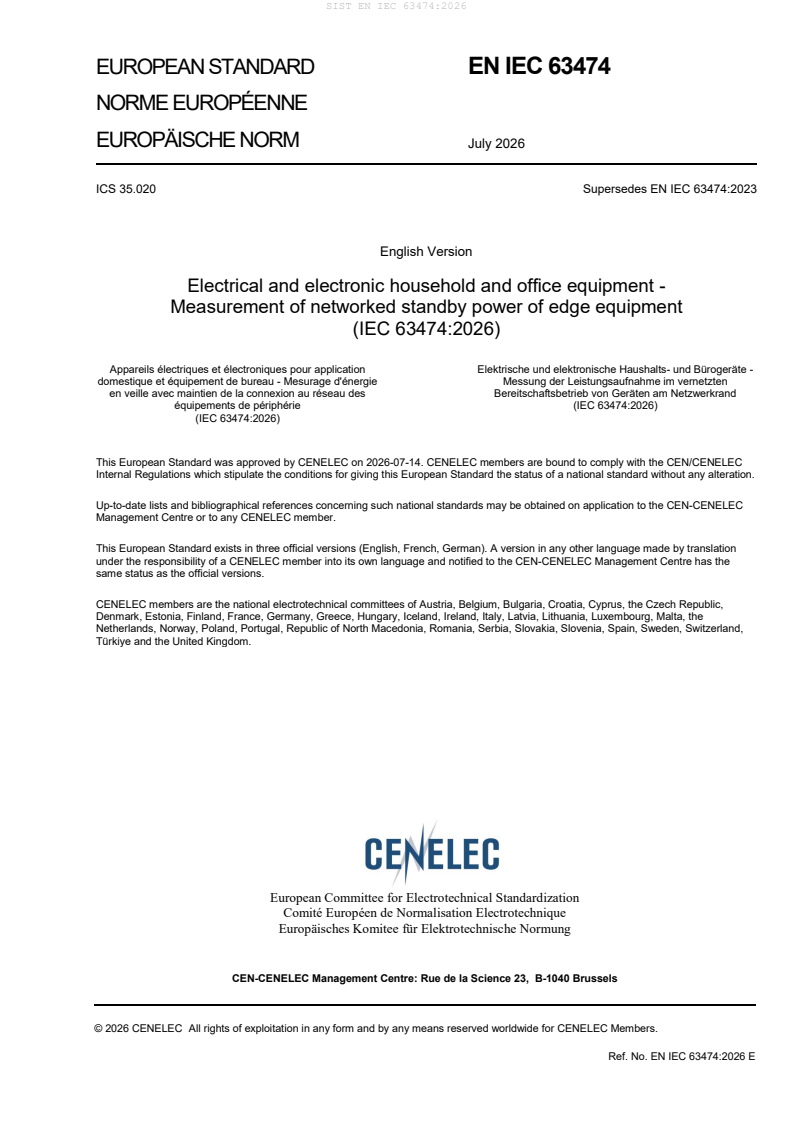
EUROPEAN STANDARD EN IEC 63474
NORME EUROPÉENNE
EUROPÄISCHE NORM July 2026
ICS 35.020 Supersedes EN IEC 63474:2023
English Version
Electrical and electronic household and office equipment -
Measurement of networked standby power of edge equipment
(IEC 63474:2026)
Appareils électriques et électroniques pour application Elektrische und elektronische Haushalts- und Bürogeräte -
domestique et équipement de bureau - Mesurage d'énergie Messung der Leistungsaufnahme im vernetzten
en veille avec maintien de la connexion au réseau des Bereitschaftsbetrieb von Geräten am Netzwerkrand
équipements de périphérie (IEC 63474:2026)
(IEC 63474:2026)
This European Standard was approved by CENELEC on 2026-07-14. CENELEC members are bound to comply with the CEN/CENELEC
Internal Regulations which stipulate the conditions for giving this European Standard the status of a national standard without any alteration.
Up-to-date lists and bibliographical references concerning such national standards may be obtained on application to the CEN-CENELEC
Management Centre or to any CENELEC member.
This European Standard exists in three official versions (English, French, German). A version in any other language made by translation
under the responsibility of a CENELEC member into its own language and notified to the CEN-CENELEC Management Centre has the
same status as the official versions.
CENELEC members are the national electrotechnical committees of Austria, Belgium, Bulgaria, Croatia, Cyprus, the Czech Republic,
Denmark, Estonia, Finland, France, Germany, Greece, Hungary, Iceland, Ireland, Italy, Latvia, Lithuania, Luxembourg, Malta, the
Netherlands, Norway, Poland, Portugal, Republic of North Macedonia, Romania, Serbia, Slovakia, Slovenia, Spain, Sweden, Switzerland,
Türkiye and the United Kingdom.
European Committee for Electrotechnical Standardization
Comité Européen de Normalisation Electrotechnique
Europäisches Komitee für Elektrotechnische Normung
CEN-CENELEC Management Centre: Rue de la Science 23, B-1040 Brussels
© 2026 CENELEC All rights of exploitation in any form and by any means reserved worldwide for CENELEC Members.
Ref. No. EN IEC 63474:2026 E
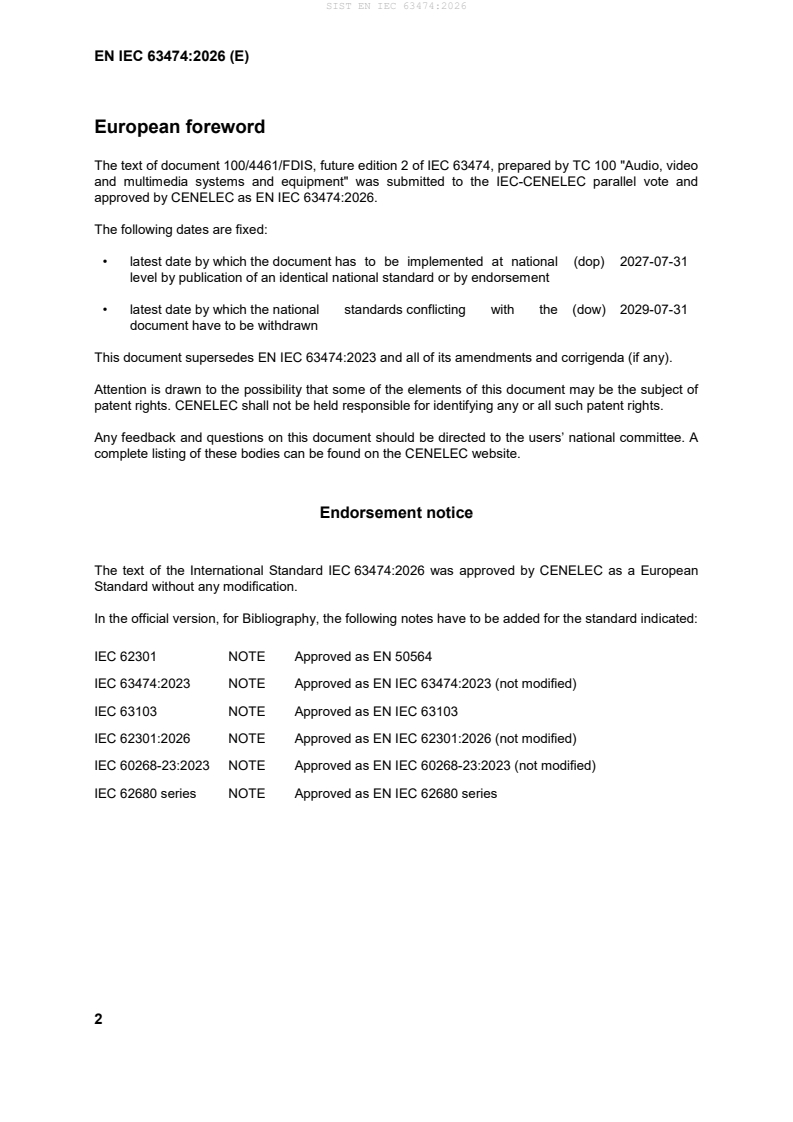
European foreword
The text of document 100/4461/FDIS, future edition 2 of IEC 63474, prepared by TC 100 "Audio, video
and multimedia systems and equipment" was submitted to the IEC-CENELEC parallel vote and
approved by CENELEC as EN IEC 63474:2026.
The following dates are fixed:
• latest date by which the document has to be implemented at national (dop) 2027-07-31
level by publication of an identical national standard or by endorsement
• latest date by which the national standards conflicting with the (dow) 2029-07-31
document have to be withdrawn
This document supersedes EN IEC 63474:2023 and all of its amendments and corrigenda (if any).
Attention is drawn to the possibility that some of the elements of this document may be the subject of
patent rights. CENELEC shall not be held responsible for identifying any or all such patent rights.
Any feedback and questions on this document should be directed to the users’ national committee. A
complete listing of these bodies can be found on the CENELEC website.
Endorsement notice
The text of the International Standard IEC 63474:2026 was approved by CENELEC as a European
Standard without any modification.
In the official version, for Bibliography, the following notes have to be added for the standard indicated:
IEC 62301 NOTE Approved as EN 50564
IEC 63474:2023 NOTE Approved as EN IEC 63474:2023 (not modified)
IEC 63103 NOTE Approved as EN IEC 63103
IEC 62301:2026 NOTE Approved as EN IEC 62301:2026 (not modified)
IEC 60268-23:2023 NOTE Approved as EN IEC 60268-23:2023 (not modified)
IEC 62680 series NOTE Approved as EN IEC 62680 series
Annex ZA
(normative)
Normative references to international publications
with their corresponding European publications
The following documents are referred to in the text in such a way that some or all of their content
constitutes requirements of this document. For dated references, only the edition cited applies. For
undated references, the latest edition of the referenced document (including any amendments)
applies.
NOTE 1 Where an International Publication has been modified by common modifications, indicated by (mod),
the relevant EN/HD applies.
NOTE 2 Up-to-date information on the latest versions of the European Standards listed in this annex is available
here: www.cencenelec.eu.
Publication Year Title EN/HD Year
IEC 62104 - Characteristics of DAB receivers - -
IEC 62301 - Measurement of standby power for EN IEC 62301 -
appliances and equipment
IEC 63474 ®
Edition 2.0 2026-06
INTERNATIONAL
STANDARD
HORIZONTAL PUBLICATION
GROUP ENERGY EFFICIENCY PUBLICATION
Electrical and electronic household and office equipment - Measurement of
networked standby power of edge equipment
ICS 35.020 ISBN 978-2-8327-1245-0
IEC 63474:2026-06(en)
IEC 63474:2026 © IEC 2026
CONTENTS
FOREWORD . 3
INTRODUCTION . 5
1 Scope . 6
2 Normative references . 6
3 Terms, definitions and abbreviated terms . 7
3.1 Terms and definitions. 7
3.1.1 Function related terms and definitions . 7
3.1.2 Mode related terms and definitions . 10
3.1.3 Network related terms and definitions . 12
3.1.4 Other terms and definitions . 13
3.2 Abbreviated terms . 14
4 Information required for testing purposes . 15
4.1 Information about reactivation network ports . 15
4.2 Power management function - Periods and conditions . 15
4.3 Activation and deactivation of wireless network connections . 15
5 Measurement conditions . 15
5.1 Common requirements . 15
5.2 Test room . 16
5.3 Power supply . 16
5.4 Power measuring instruments . 16
5.5 Configuration of network ports . 16
5.6 Power measurement uncertainty . 17
6 Measurements . 17
6.1 Overview . 17
6.2 Management of wireless networks and radio receivers . 18
6.2.1 General . 18
6.2.2 Wireless network connection management . 18
6.2.3 Radio receiver management . 19
6.3 Preparation of the EUT and general testing aspects . 19
6.4 Power management . 19
6.5 Measurement procedure . 20
6.6 Network port configuration . 20
6.6.1 Configuration for measurement of power in networked standby mode
using individual network ports . 20
6.6.2 Configuration for measurement of power in networked standby mode
with all network ports connected . 21
6.6.3 Configuration for measurement of power in networked standby mode
with all network ports disconnected . 21
6.7 Methods for measuring power . 21
6.7.1 Measurement of power in networked standby mode when connected to
mains power . 21
6.7.2 Measurement of power in networked standby mode when powered by
battery only . 21
7 Test report . 22
7.1 Test and laboratory details . 22
7.2 Details of equipment under test. 22
7.3 Test parameters and network configuration . 23
IEC 63474:2026 © IEC 2026
7.4 Measured and documented data . 23
Annex A (informative) Power modes and functions - Conceptual framework . 25
Annex B (normative) Test conditions - Connection types and test conditions . 26
Annex C (informative) Additional considerations for equipment classification and
examples . 27
Annex D (informative) Examples of network technologies and network configurations . 29
Annex E (informative) Information pertinent to the user or other interested parties . 30
E.1 Information available online . 30
E.2 Information available in the instructions for use . 30
Annex F (informative) Example of required information for testing template . 31
Annex G (informative) Example of a test report template . 33
Annex H (informative) Recommended EUT preparation flowchart . 36
Annex I (informative) Factors affecting wireless networked standby mode
measurement. 37
I.1 General . 37
I.2 Connection between remote reactivation trigger device and EUT . 37
I.3 Wireless access point / Router / Bridge . 37
I.4 Device sending the remote reactivation trigger . 38
I.5 Software influence . 38
Bibliography . 39
Figure 1 – Testing overview . 18
Figure A.1 – Category of functions and operating conditions of products in respect to
functions provided (modes) . 25
Figure A.2 – Concept diagram of reactivation function and related terms . 25
Figure H.1 – Recommended EUT preparation flowchart . 36
Table B.1 – Test conditions by type of connection . 26
Table C.1 – Classification of networked equipment . 27
Table C.2 – Examples of equipment definition and its classification . 28
Table D.1 – Examples of technologies considered for networked standby mode . 29
Table F.1 – Specific information required for testing networked edge equipment . 31
Table F.2 – Specific information required for testing network reactivation using network
ports . 31
Table F.3 – Additional information required for testing network reactivation using
network ports . 32
Table G.1 – Example of a test report template . 33
IEC 63474:2026 © IEC 2026
INTERNATIONAL ELECTROTECHNICAL COMMISSION
____________
Electrical and electronic household and office equipment – Measurement
of networked standby power of edge equipment
FOREWORD
1) The International Electrotechnical Commission (IEC) is a worldwide organization for
standardization comprising all national electrotechnical committees (IEC National Committees).
The object of IEC is to promote international co-operation on all questions concerning
standardization in the electrical and electronic fields. To this end and in addition to other
activities, IEC publishes International Standards, Technical Specifications, Technical Reports,
Publicly Available Specifications (PAS) and Guides (hereafter referred to as "IEC
Publication(s)"). Their preparation is entrusted to technical committees; any IEC National
Committee interested in the subject dealt with may participate in this preparatory work.
International, governmental and non-governmental organizations liaising with the IEC also
participate in this preparation. IEC collaborates closely with the International Organization for
Standardization (ISO) in accordance with conditions determined by agreement between the two
organizations.
2) The formal decisions or agreements of IEC on technical matters express, as nearly as
possible, an international consensus of opinion on the relevant subjects since each technical
committee has representation from all interested IEC National Committees.
3) IEC Publications have the form of recommendations for international use and are accepted
by IEC National Committees in that sense. While all reasonable efforts are made to ensure that
the technical content of IEC Publications is accurate, IEC cannot be held responsible for the
way in which they are used or for any misinterpretation by any end user.
4) In order to promote international uniformity, IEC National Committees undertake to apply IEC
Publications transparently to the maximum extent possible in their national and regional
publications. Any divergence between any IEC Publication and the corresponding national or
regional publication shall be clearly indicated in the latter.
5) IEC itself does not provide any attestation of conformity. Independent certification bodies
provide conformity assessment services and, in some areas, access to IEC marks of conformity.
IEC is not responsible for any services carried out by independent certification bodies.
6) All users should ensure that they have the latest edition of this publication.
7) No liability shall attach to IEC or its directors, employees, servants or agents including
individual experts and members of its technical committees and IEC National Committees for
any personal injury, property damage or other damage of any nature whatsoever, whether direct
or indirect, or for costs (including legal fees) and expenses arising out of the publication, use
of, or reliance upon, this IEC Publication or any other IEC Publications.
8) Attention is drawn to the Normative references cited in this publication. Use of the referenced
publications is indispensable for the correct application of this publication.
9) IEC draws attention to the possibility that the implementation of this document may involve
the use of (a) patent(s). IEC takes no position concerning the evidence, validity or applicability
of any claimed patent rights in respect thereof. As of the date of publication of this document,
IEC had not received notice of (a) patent(s), which may be required to implement this document.
However, implementers are cautioned that this may not represent the latest information, which
may be obtained from the patent database available at https://patents.iec.ch. IEC shall not be
held responsible for identifying any or all such patent rights.
IEC 63474:2026 © IEC 2026
IEC 63474 has been prepared by IEC technical committee 100: Audio, video and multimedia
systems and equipment and IEC technical committee 59: Performance of household and similar
electrical appliances. It is an International Standard.
It has the status of a group energy efficiency publication in accordance with IEC Guide 118.
This second edition cancels and replaces the first edition published in 2023. This edition
constitutes a technical revision.
This edition includes the following significant technical changes with respect to the previous
edition:
a) the scope and the measurement method were extended to battery operated products;
b) terms and definitions, and measurement conditions have been updated and aligned for both
IEC 62301 (ED3) and this document, IEC 63474 (ED2).
The text of this International Standard is based on the following documents:
Draft Report on voting
100/4461/FDIS 100/4481/RVD
Full information on the voting for its approval can be found in the report on voting indicated in
the above table.
The language used for the development of this International Standard is English.
This document was drafted in accordance with ISO/IEC Directives, Part 2, and developed in
accordance with ISO/IEC Directives, Part 1 and ISO/IEC Directives, IEC Supplement, available
at www.iec.ch/members_experts/refdocs. The main document types developed by IEC are
described in greater detail at www.iec.ch/standardsdev/publications.
The committee has decided that the contents of this document will remain unchanged until the
stability date indicated on the IEC website under webstore.iec.ch in the data related to the
specific document. At this date, the document will be
– reconfirmed,
– withdrawn, or
– revised.
IEC 63474:2026 © IEC 2026
INTRODUCTION
The methods specified in this document are intended to define requirements for the
measurement of power used by equipment having one or more wired or wireless network port(s)
in those modes that are able to resume a function by way of a remotely initiated trigger or
reactivation trigger from a network connection (networked standby mode).
For the measurement of power used in non-active mode other than networked standby mode,,
reference is made to IEC 62301 [1].
This document also provides a method to test power management and to test whether it is
possible to deactivate wireless network connection(s).
IEC 63474:2023 [2] (ED1) was based on EN 50643:2018 [3]. It was submitted to the National
Committees for voting under the Fast Track Procedure.
IEC 63474:2026 © IEC 2026
1 Scope
This document specifies methods of measurement of electrical power in networked standby
mode and the reporting of the results for edge equipment.
The measurement of power and energy use in non-active mode, other than networked standby
mode, is covered by IEC 62301 [1], including the input voltage range.
This document applies to edge equipment that is powered by:
– low voltage mains AC power (LV ≤ 1 000 V AC), or
– an external power supply that provides low voltage (LV ≤ 1 000 V) or extra low voltage (ELV
≤ 50 V) AC or DC power, or
– a separate source of extra low voltage DC power (ELV ≤ 50 V DC), or
– an internal main battery.
Conditions that are outside the scope of this document are as follows:
– active modes (primary function),
– other non-active modes (which are either covered by IEC 62301 [1] or by specific product
group standards),
– conditions where main batteries are being charged other than in maintenance mode,
– disconnected condition of the equipment.
This document applies to the following product groups where a networked standby mode is
present:
– edge equipment with a network reactivation function, such as household appliances,
information technology equipment, audio, video and multimedia systems and equipment,
– digital radio receivers with an emergency warning function,
– gas burning equipment with electrical components.
NOTE 1 The measurements of power, energy use and performance of products during their intended use (when
performing their primary functions) are generally specified in product standards and are not covered by this
document.
NOTE 2 Networked standby mode for lighting equipment and the measurement of power is specified in
IEC 63103 [4].
NOTE 3 Interconnecting equipment (equipment that provides network infrastructure and function) is outside the
scope of this document. Measurement of electrical power in networked standby mode for interconnecting equipment
is the subject of ETSI standard EN 303 423 [5].
This document also provides a method to test power management and to test whether it is
possible to deactivate wireless network connection(s).
NOTE 4 Edge equipment can also include auxiliary batteries.
This group EE publication is primarily intended to be used as an EE standard for the products
mentioned in the scope, but is also intended to be used by TCs in the preparation of publications
for products which are included in the boundary mentioned in the scope of this document.
2 Normative references
The following documents are referred to in the text in such a way that some or all of their content
constitutes requirements of this document. For dated references, only the edition cited applies.
For undated references, the latest edition of the referenced document (including any
amendments) applies.
IEC 63474:2026 © IEC 2026
IEC 62104, Characteristics of DAB receivers
IEC 62301, Household electrical appliances - Measurement of standby power
3 Terms, definitions and abbreviated terms
3.1 Terms and definitions
For the purposes of this document, the terms and definitions given in IEC 62301 as well as the
following apply.
NOTE Annex A shows the conceptual framework of power modes and functions.
ISO and IEC maintain terminological databases for use in standardization at the following
addresses:
– ISO Online browsing platform: available at https://www.iso.org/obp
– IEC Electropedia: available at http://www.electropedia.org/
3.1.1 Function related terms and definitions
3.1.1.1
function
predetermined operation undertaken by a product
Note 1 to entry: Functions can be controlled by an interaction of the user, of other technical systems, and of the
system itself, from measurable inputs from the environment and/or time.
Note 2 to entry: A function can be classified as primary function (3.1.1.2), secondary function (3.1.1.3) or tertiary
function (3.1.1.4), which are broad categories. The specific categorization of a function can be determined for each
type of equipment.
3.1.1.2
primary function
function (3.1.1.1) providing a main intended purpose
EXAMPLE Cleaning of clothes by a washing machine, displaying of video or providing sound by a television.
Note 1 to entry: Products can have more than one primary function.
Note 2 to entry: Figure A.1 provides a structured overview as an aid to understanding functional relationships and
energy use applicable in electrotechnical products. Additional terms and definitions to fulfil the particular needs of
product sectors should be defined within the structure of the concepts shown in Figure A.1.
[SOURCE: IEC 60050-904:2014 [6], 904-03-02, modified - Subject field added, the word ‘main’
added to the definition, Example and new Note 1 to entry added, existing Note 1 to entry
becomes Note 2 to entry, reference to Table 1 replaced by reference to Figure A.1 in Note 2 to
entry, and the table is omitted from this term entry.]
3.1.1.3
secondary function
function (3.1.1.1) that enables, supplements or enhances a primary function
(3.1.1.2)
EXAMPLE 1 Secondary functions can include status information functions, network (3.1.3.1) integrity functions,
reactivation functions, or sensor-based functions.
EXAMPLE 2 Timer informing of the remaining time for completion of the washing program or the delay start function
(3.1.1.1) of a washing machine.
Note 1 to entry: Figure A.1 provides a structured overview as an aid to understanding functional relationships and
energy use applicable in electrotechnical products. Additional terms and definitions to fulfil the particular needs of
product sectors should be defined within the structure of the concepts shown in Figure A.1.
IEC 63474:2026 © IEC 2026
[SOURCE: IEC 60050-904:2014 [6], 904-03-03, modified - Subject field added, Examples
added, in Note 1 to entry 'Table 1' replaced by 'Figure A.1', and the table is omitted from this
term entry.]
3.1.1.4
tertiary function
function (3.1.1.1) other than a primary or a secondary function (3.1.1.3)
EXAMPLE 1 An electromagnetic compatibility (EMC) filter, if present, can provide its function (3.1.1.1) in non-active
mode (3.1.2.3) and active mode (3.1.2.2).
EXAMPLE 2 Event and failure data recorder in a washing machine for service and design improvement purposes.
Note 1 to entry: Primary functions, secondary functions and tertiary functions are not distinguished by whether they
are necessary or non-necessary.
Note 2 to entry: Figure A.1 provides a structured overview as an aid to understanding functional relationships and
energy use applicable in electrotechnical products. Additional terms and definitions to fulfil the particular needs of
product sectors should be defined within the structure of the concepts shown in Figure A.1.
[SOURCE: IEC 60050-904:2014 [6], 904-03-04, modified - Subject field added, in Example 1
'off mode, partial on mode and on mode' replaced by 'non-active mode and active mode',
Example 2 was amended, new 'Note 1 to entry' and 'Note 2 to entry' added. Note 1 to entry
renumbered Note 3 to entry and reference to 'Table 1' replaced by reference to 'Figure A.1' and
the table is deleted from the term entry.]
3.1.1.5
status information function
function (3.1.1.1) by which the product provides usage-orientated information
EXAMPLE 1 Date, time, timer information, or past or future operation.
EXAMPLE 2 A reactivation function (3.1.1.7) indicated using a simple optical indicator (e.g. a light-emitting diode
(LED)).
Note 1 to entry: Displayed content that relates to the primary function (3.1.1.2) of a display, e.g. displaying moving
images, is not status information. The primary display of a product can provide status information in active mode
(3.1.2.2) .
Note 2 to entry: Figure A.1 provides a structured overview as an aid to understanding functional relationships and
energy use applicable in electrotechnical products. Additional terms and definitions to fulfil the particular needs of
product sectors should be defined within the structure of the concepts shown in Figure A.1.
[SOURCE: IEC 60050-904:2014 [6], 904-03-07, modified - Subject field added, in the definition,
the wording 'equipment provides simple use-oriented' replaced by 'product provides usage-
oriented', original 'Note 1 to entry' was changed to 'EXAMPLE', new 'Note 1 to entry' added, in
Note 2 to entry the reference to 'Table 1' replaced by reference to 'Figure A.1' and the table is
deleted from the term entry.]
3.1.1.6
network integrity function
function (3.1.1.1) to maintain a network (3.1.3.1) communication path external
to the product
Note 1 to entry: The communication can be via wired or wireless interfaces.
Note 2 to entry: In order to communicate, it is necessary for the product to have at least one network port (3.1.3.5)
activated.
Note 3 to entry: Figure A.1 provides a structured overview as an aid to understanding functional relationships and
energy use applicable in electrotechnical products. Additional terms and definitions to fulfil the particular needs of
product sectors should be defined within the structure of the concepts shown in Figure A.1.
IEC 63474:2026 © IEC 2026
[SOURCE: IEC 60050-904:2014 [6], 904-03-08, modified - Subject field added, in the definition
and notes, 'equipment' replaced by 'product' and the word 'network' added, original 'Note 3 to
entry' deleted, in Note 3 to entry the reference to 'Table 1' is replaced by a reference to 'Figure
A.1' and the table is deleted from the term entry.]
3.1.1.7
reactivation function
function (3.1.1.1) allowing a product to be switched into a different mode
(3.1.2.1) with additional functions via an internal signal, manually using a control on the product,
with a remote control unit, or via an externally initiated signal
EXAMPLE 1 A timer could provide the internal signal leading to reactivation.
EXAMPLE 2 The reactivation function may be indicated using a simple optical device (e.g. a light-emitting diode
(LED)).
Note 1 to entry: The mode (3.1.2.1) after reactivation can be an active mode (3.1.2.2) .
Note 2 to entry: Figure A.1 provides a structured overview as an aid to understanding functional relationships and
energy use applicable in electrotechnical products. Additional terms and definitions to fulfil the particular needs of
product sectors should be defined within the structure of the concepts shown in Figure A.1. Figure A.2 provides a
concept diagram.
[SOURCE: IEC 60050-904:2014 [6], 904-03-06, modified - Subject field added, definition
extended to cover both internal reactivation function and 'network reactivation function', original
Note 1 to entry reformatted as Example 2, new Note 1 to entry added, original Note 2 to entry
deleted, in Note 2 to entry the reference to 'Table 1' is replaced by a reference to 'Figure A.1',
the table is deleted from the term entry, and the sentence 'Figure A.2 provides a concept
diagram' added.]
3.1.1.8
internal reactivation function
reactivation function (3.1.1.7) where the product is switched into a different mode
(3.1.2.1) via an internal signal, with its remote control unit, or manually using a control on the
product
Note 1 to entry: Figure A.1 provides a structured overview as an aid to understanding functional relationships and
energy use applicable in electrotechnical products. Additional terms and definitions to fulfil the particular needs of
product sectors should be defined within the structure of the concepts shown in Figure A.1. Figure A.2 provides a
concept diagram.
3.1.1.9
network reactivation function
reactivation function (3.1.1.7) where the product is switched into a different mode
(3.1.2.1) via an external signal through a network (3.1.3.1)
Note 1 to entry: Figure A.1 provides a structured overview as an aid to understanding functional relationships and
energy use applicable in electrotechnical products. Additional terms and definitions to fulfil the particular needs of
product sectors should be defined within the structure of the concepts shown in Figure A.1. Figure A.2 provides a
concept diagram.
3.1.1.10
sensor-based function
function (3.1.1.1) using a sensor to monitor a certain condition, internally or
externally to the product
3.1.1.11
protective function
function (3.1.1.1) that operates to prevent harm to persons or damage to property
EXAMPLE Protective functions can operate in different modes, for instance:
– a back-siphonage device fitted to a dishwasher can operate in any non-active (3.1.2.3) modes,
– a flood protection device fitted to a washing machine can operate in any non-active (3.1.2.3) modes,
IEC 63474:2026 © IEC 2026
– a no-movement deactivation switch fitted to an iron can operate in an active mode (3.1.2.2) , and
– a touch control for a cooking hob requires a minimum of two activation steps (switch on and set level) to
commence heating for the primary function (3.1.1.2) to prevent accidental operation.
Note 1 to entry: Figure A.1 provides a structured overview as an aid to understanding functional relationships and
energy use applicable in electrotechnical products. Additional terms and definitions to fulfil the particular needs of
product sectors should be defined within the structure of the concepts shown in Figure A.1.
[SOURCE: IEC 60050-904:2014 [6], 904-03-05, modified - The wording 'after the occurrence of
a failure in the equipment so as' has been deleted from the definition. Mode names updated in
Note 1 to entry. Note 2 to entry updated.]
3.1.1.12
emergency warning and alert function
EWF
automatic receiver switching and emergency reactivation by alarm
announcement broadcast signal
3.1.1.13
power management
power management function
automatic control mechanism that achieves within a preset timeframe, or other conditions, a
certain power demand consistent with a pre-determined level of functionality
[SOURCE: IEC 60050-904:2014 [6], 904-03-01, modified - In the definition, the wording 'the
smallest input power' has been replaced by 'within a preset timeframe, or other conditions, a
certain power demand' and Note 1 to entry has been omitted.]
3.1.1.14
power supply function
ability of the charging circuitry or power supply to directly power
some or all of the functions of the battery powered product without drawing power from the
battery
Note 1 to entry: This can include main batteries charging or main batteries removed.
Note 2 to entry: Chargers with a power supply function do not show the typical recharging pattern of chargers
without a power supply function as the batteries are not permanently discharged by internal processes, display
information and networked standby (3.1.2.5) energy use. This energy use can be supplied exclusively from the power
supply unit or also proportionally from the battery and the power supply unit.
3.1.2 Mode related terms and definitions
3.1.2.1
mode
condition that has any combination of functions
Note 1 to entry: A mode with one or no functions can be a valid combination.
Note 2 to entry: Any transition of a product to a different mode, either through user intervention or automatically
initiated, is not part of either mode.
Note 3 to entry: A mode can have functions with variable power draw.
Note 4 to entry: Figure A.1 provides a structured overview as an aid to understanding functional relationships and
energy use applicable in electrotechnical products. Additional terms and definitions to fulfil the particular needs of
product sectors should be defined within the structure of the concepts shown in Figure A.1.
3.1.2.2
active mode
on mode
mode (3.1.2.1) in which the product is connected to a power source and provides at least one
primary function (3.1.1.2)
IEC 63474:2026 © IEC 2026
Note 1 to entry: The terms "on", "in-use", and "operation" also describe this mode (3.1.2.1) .
Note 2 to entry: This includes conditions during which the equipment can promptly provide a primary function
(3.1.1.2) but is not doing so, such as:
– when content on a media playing device is paused,
– when noise cancelling is active but no audio is playing.
Note 3 to entry: Figure A.1 provides a structured overview as an aid to understanding functional relationships and
energy use applicable in electrotechnical products. Additional terms and definitions to fulfil the particular needs of
product sectors should be defined within the structure of the concepts shown in Figure A.1.
3.1.2.3
non-active mode
non-active
mode (3.1.2.1) in which the product is connected to a power source and provides no primary
function (3.1.1.2)
Note 1 to entry: This can include modes such as off mode (3.1.2.6), standby mode (3.1.2.4) and networked standby
mode (3.1.2.5), as applicable. Product groups can have product specific non-active (3.1.2.3) modes which can be
identified and named as appropriate.
Note 2 to entry: Figure A.1 provides a structured overview as an aid to understanding functional relationships and
energy use applicable in electrotechnical products. Additional terms and definitions to fulfil the particular needs of
product sectors should be defined within the structure of the concepts shown in Figure A.1.
3.1.2.4
standby mode
standby
non-active mode (3.1.2.3) providing at least one secondary function (3.1.1.3)
Note 1 to entry: Figure A.1 provides a structured overview as an aid to understanding functional relationships and
energy use applicable in electrotechnical products. Additional terms and definitions to fulfil the particular needs of
product sectors should be defined within the structure of the concepts shown in Figure A.1.
3.1.2.5
networked standby mode
networked standby
standby mode (3.1.2.4) in which the edge equipment (3.1.3.3) is able to switch into a different
mode (3.1.2.1) via a network reactivation function (3.1.1.9)
Note 1 to entry: Figure A.1 provides a structured overview as an aid to understanding functional relationships and
energy use applicable in electrotechnical products. Additional terms and definitions to fulfil the particular needs of
product sectors should be defined within the structure of the concepts shown in Figure A.1.
3.1.2.6
off mode
off
non-active mode (3.1.2.3) in which the product is providing no secondary function (3.1.1.3)
Note 1 to entry: Figure A.1 provides a structured overview as an aid to understanding functional relationships and
energy use applicable in electrotechnical products. Additional terms and definitions to fulfil the particular needs of
product sectors should be defined within the structure of the concepts shown in Figure A.1.
3.1.2.7
maintenance mode
mode (3.1.2.1) of a charging circuitry that maintains a battery at a pre-set charge limit
while the battery remains connected to the charging circuitry
Note 1 to entry: Some products can periodically charge the battery while connected to mains power and run some
functions from the battery between these charging cycles. This is still considered to be maintenance mode. Not all
products have a maintenance mode.
Note 2 to entry: Maintenance mode can include the display of information or status and networked standby mode
(3.1.2.5) when connected to a network (3.1.3.1). This mode (3.1.2.1) is focusing on the state of the main battery
(3.1.4.4) and is independent from other functions present.
IEC 63474:2026 © IEC 2026
3.1.3 Network related terms and definitions
3.1.3.1
network
communication infrastructure with a topology of links, an architecture, including the physical
components, organisational principles, communication procedures and formats (protocols)
EXAMPLE A network can include connections that use layers in the open systems interconnection (OSI) model ®
such as Wi-Fi (IEEE 802.11 [7]) and wired networks (IEEE 802.3 [8]) as well as other types of two way digital data
® ®
links that possibly do not use all OSI layers or IP addresses such as HDMI (CEC), Bluetooth , USB and DVI. A
network does not normally include any form of one way communication (for example from an infrared remote control)
or broadcast signal (the exception being the emergency warning and alert function (3.1.1.12)).
3.1.3.2
networked equipment
equipment that can connect to a network (3.1.3.1) and has one or more network ports (3.1.3.5)
3.1.3.3
edge equipment
networked equipment (3.1.3.2) that can interact with a network (3.1.3.1) or other products and
that does not have, as its primary function (3.1.1.2), the passing of network (3.1.3.1) traffic to
provide a network (3.1.3.1)
Note 1 to entry: Examples of edge equipment are given in Annex C.
Note 2 to entry: Some edge equipment can provide some network (3.1.3.1) functions found in interconnecting
equipment (3.1.3.4) in addition to their primary function (3.1.1.2).
3.1.3.4
interconnecting equipment
high network availability equipment
networked equipment (3.1.3.2) that has, as its primary function (3.1.1.2), the passing of network
(3.1.3.1) traffic to provide a network (3.1.3.1)
Note 1 to entry: Examples of interconnecting equipment are given
...