


ASTM B697-88(2016)
(Guide)Standard Guide for Selection of Sampling Plans for Inspection of Electrodeposited Metallic and Inorganic Coatings
Standard Guide for Selection of Sampling Plans for Inspection of Electrodeposited Metallic and Inorganic Coatings
ABSTRACT
This guide covers the standard method for selecting sampling plans to be used in the inspection of electrodeposited metallic and inorganic coatings on products for the purpose of deciding whether submitted lots comply with the specifications applicable to the coatings. The characteristics of the sampling plan are expressed in terms of the Acceptable Quality Level (AQL), Limiting Quality Level (LQL), Average Outgoing Quality (AOQ), and Average Outgoing Quality Limit (AOQL). General procedures and criteria for the construction and selection of the type of sampling plan, selection of a specific plan, selection of the inspection lot, sampling and inspection of samples, and the disposition of lots are discussed fully.
SCOPE
1.1 This guide gives guidance in the selection of sampling plans to be used in the inspection of electrodeposited and related coatings on products for the purpose of deciding whether submitted lots of coated products comply with the specifications applicable to the coatings. This supplements Test Method B602 by giving more information on sampling inspection and by providing additional sampling plans for the user who finds the limited choice of plans in Test Method B602 to be inadequate.
1.2 When using a sampling plan, a relatively small part of the articles in an inspection lot is selected and inspected. Based on the results, a decision is made that the inspection lot either does or does not satisfactorily conform to the specification.
1.3 This guide also contains several sampling plans. The plans are attribute plans, that is, in the application of the plans each inspected article is classified as either conforming or nonconforming to each of the coating requirements. The number of nonconforming articles is compared to a maximum allowable number. The plans are simple and relatively few. Additional plans and more complex plans that cover more situations are given in the Refs (1-7) at the end of this guide and in MIL-STD-105.
1.4 Acceptance sampling plans are used:
1.4.1 When the cost of inspection is high and the consequences of accepting a nonconforming article are not serious.
1.4.2 When 100 % inspection is fatiguing and boring and, therefore, likely to result in errors. In these cases a sampling plan may provide greater protection than 100 % inspection.
1.4.3 When inspection requires a destructive test. Here, sampling inspection must be used.
1.5 Another general type of acceptance sampling plan that is not covered in these guidelines is the variables plan in which measured values of characteristics are analyzed by statistical procedures. Such plans, when applicable, can reduce inspection cost and increase quality protection. Information on variables plans is given in Test Method B762, MIL-STD-414, ANSI/ASQC Z1.9-1979, and Refs (1-2).
General Information
Buy Standard
Standards Content (Sample)
NOTICE: This standard has either been superseded and replaced by a new version or withdrawn.
Contact ASTM International (www.astm.org) for the latest information
Designation: B697 − 88 (Reapproved 2016)
Standard Guide for
Selection of Sampling Plans for Inspection of
Electrodeposited Metallic and Inorganic Coatings
This standard is issued under the fixed designation B697; the number immediately following the designation indicates the year of
original adoption or, in the case of revision, the year of last revision. A number in parentheses indicates the year of last reapproval. A
superscript epsilon (´) indicates an editorial change since the last revision or reapproval.
1. Scope procedures. Such plans, when applicable, can reduce inspec-
tion cost and increase quality protection. Information on
1.1 This guide gives guidance in the selection of sampling
variables plans is given in Test Method B762, MIL-STD-414,
plans to be used in the inspection of electrodeposited and
ANSI/ASQC Z1.9-1979, and Refs (1-2).
related coatings on products for the purpose of deciding
whether submitted lots of coated products comply with the
2. Referenced Documents
specificationsapplicabletothecoatings.ThissupplementsTest
2.1 ASTM Standards:
Method B602 by giving more information on sampling inspec-
B602 Test Method for Attribute Sampling of Metallic and
tion and by providing additional sampling plans for the user
Inorganic Coatings
who finds the limited choice of plans in Test Method B602 to
B762 Test Method of Variables Sampling of Metallic and
be inadequate.
Inorganic Coatings
1.2 When using a sampling plan, a relatively small part of
2.2 ANSI Standard:
thearticlesinaninspectionlotisselectedandinspected.Based
ANSI/ASQC Z1.9-1979 Sampling Procedures and Tables
on the results, a decision is made that the inspection lot either
for Inspection by Variables for Percent Nonconformance
does or does not satisfactorily conform to the specification.
2.3 Military Standards:
1.3 This guide also contains several sampling plans. The
MIL-STD-105 Sampling Procedures and Tables for Inspec-
plans are attribute plans, that is, in the application of the plans
tion by Attributes
each inspected article is classified as either conforming or
MIL-STD-414 Sampling Procedures and Tables for Inspec-
nonconforming to each of the coating requirements. The
tion by Variables for Percent Defective
number of nonconforming articles is compared to a maximum
allowable number. The plans are simple and relatively few.
3. General
Additional plans and more complex plans that cover more
3.1 Procedure—The use of acceptance sampling consists of
situations are given in the Refs (1-7) at the end of this guide
a series of decisions and actions. These are listed in order
and in MIL-STD-105.
below and are discussed in this standard.
1.4 Acceptance sampling plans are used:
3.1.1 Select characteristics to be inspected,
1.4.1 When the cost of inspection is high and the conse-
3.1.2 Select type of sampling plan,
quences of accepting a nonconforming article are not serious.
3.1.3 Select quality level,
1.4.2 When 100 % inspection is fatiguing and boring and,
3.1.4 Define inspection lot,
therefore, likely to result in errors. In these cases a sampling
3.1.5 Select sample,
plan may provide greater protection than 100 % inspection.
3.1.6 Inspect sample,
1.4.3 When inspection requires a destructive test. Here,
3.1.7 Classify inspection lot, and
sampling inspection must be used.
3.1.8 Dispose of inspection lot.
1.5 Anothergeneraltypeofacceptancesamplingplanthatis
3.2 The need for acceptance sampling arises when a deci-
not covered in these guidelines is the variables plan in which
sion must be made about what to do with a quantity of articles.
measured values of characteristics are analyzed by statistical
For referenced ASTM standards, visit the ASTM website, www.astm.org, or
contact ASTM Customer Service at service@astm.org. For Annual Book of ASTM
This guide is under the jurisdiction of ASTM Committee B08 on Metallic and Standards volume information, refer to the standard’s Document Summary page on
Inorganic Coatings and is the direct responsibility of Subcommittee B08.10 on Test the ASTM website.
Methods. Available fromAmerican National Standards Institute (ANSI), 25 W. 43rd St.,
Current edition approved Nov. 1, 2016. Published November 2016. Originally 4th Floor, New York, NY 10036, http://www.ansi.org.
approved in 1981. Last previous edition approved in 2010 as B697 – 88 (2010). Available from Standardization Documents Order Desk, DODSSP, Bldg. 4,
DOI: 10.1520/B0697-88R16. Section D, 700 Robbins Ave., Philadelphia, PA 19111-5098.
Copyright © ASTM International, 100 Barr Harbor Drive, PO Box C700, West Conshohocken, PA 19428-2959. United States
B697 − 88 (2016)
This quantity (called the inspection lot in this guide) may be a 3.7 Because acceptance sampling plans permit the accep-
shipment from a supplier, may be articles that are ready for a tance of inspection lots that contain nonconforming articles,
subsequent manufacturing operation, or may be articles ready basic to the selection of a sampling plan is a decision about the
for shipment to a customer. percentage of nonconforming articles that is acceptable. If the
function of the article is so important that no nonconformers
3.3 When acceptance sampling is done, several of the
can be tolerated, acceptance sampling cannot be used. In these
articlesintheinspectionlotareselectedatrandom(seeSection
cases, every article must be inspected, and, to guard against
7). These articles constitute the sample. Each article in the
error, may have to be inspected twice.
sample is inspected for conformance to the requirements
3.8 The protection that an attributes sampling plan provides
placed on it. If an article meets a requirement, it is classified as
conforming. If not, it is classified as nonconforming. If the against accepting an undesirable number of nonconforming
articles is determined by the size of the sample and by the
number of nonconforming articles in the sample is no more
than a predetermined number (called the acceptance number), acceptance number. The protection provided by a plan is
usually expressed in the form of an operating characteristic
the inspection lot is accepted. If it exceeds the acceptance
(OC) curve.
number, the inspection lot is rejected. Fig. 1 is the OC curve for the plan that calls for a
sampleof55articlesandanacceptancenumberoftwo.Plotted
3.4 The disposition of rejected inspection lots is beyond the
alongthehorizontalaxisisthequalitylevelofaninspectionlot
scope of this guide because, depending on the circumstances,
expressed as the percentage of the articles in the lot that are
lots may be returned to the supplier, kept and used, put to a
nonconforming (Note 1).The vertical axis is the probability, as
different use, scrapped, reworked, or dealt with in some other
apercentage,thataninspectionlotwillbeacceptedbytheplan
way. An exception is rectifying inspection (3.11) in which
(Note 4). Inspection lots with zero percent nonconforming
rejected lots are screened and used.
articles will be accepted 100 % of the time (Note 2). As the
3.5 Because the decision about the disposition of an inspec-
percentage of nonconforming articles in the inspection lot
tion lot is based on the inspection of a sample, and because
increases, the probability of acceptance decreases. For
there is a chance that a sample will not be representative of an
example,asshowninFig.1,aninspectionlotcontaining1.5 %
inspection lot, some inspection lots that have the desired
nonconforming articles has a 95 % chance of being accepted,
quality level (Note 1) will be rejected and some inspection lots
while one containing 9.6 % nonconforming articles has only a
that do not have the desired quality level will be accepted.
10 % chance of being accepted.
Thereareonlytwosituationsinwhichtheresultsofacceptance
NOTE4—TheverticalaxisoftheOCcurvecanhavetwomeanings.One
samplingaretotallypredictable(Note2).Oneiswhenthereare
is the probability that a particular inspection lot will be accepted. The
no nonconforming articles in the inspection lot. There, of
other meaning is the percentage of a series of lots of a given quality level
course,willbenononconformingarticlesinthesampleandthe
that will be accepted. The latter meaning is the one that is strictly correct
mathematically. The former meaning is also correct, as long as the
decision to accept the lot will always be made. The other
inspection lot is at least ten times bigger than the sample.
situation is when no article in the inspection lot conforms. All
of the articles in the sample will be nonconforming and the 3.9 The characteristics of a sampling plan are often ex-
pressed in terms of the Acceptable Quality Level (AQL) and
decision to reject the lot will always be made (Note 3).
theLimitingQualityLevel(LQL).TheAQListhequalitylevel
NOTE 1—In this guide the term “quality level” means the percentage of
that will result in the acceptance of a high percentage of
nonconforming articles in an inspection lot or it means the average
incoming inspection lots; usually it is the quality level that will
percentage of nonconforming articles in a series of inspection lots
received from a single source. Terms such as high quality, increased result in the acceptance of 95 % of the incoming inspection
quality, and better quality mean a relatively smaller percentage of
lots. In Fig. 1, theAQL is 1.5 %. The LQL is the quality level
nonconforming articles, while terms such as low quality, decreased
quality, and poorer quality mean a relatively larger percentage of
nonconforming articles.
NOTE 2—In this discussion and elsewhere in this guide, it is assumed
that no errors are made.
NOTE 3—To be strictly correct, lots that contain no more nonconform-
ing articles than the acceptance number will always be accepted, and lots
that contain fewer conforming articles than the sample size minus the
acceptance number will always be rejected.
3.6 The discussion in 3.5 leads to two important points: (1)
acceptance sampling plans will permit the acceptance of
inspection lots that contain nonconforming articles, and (2)in
a series of inspection lots, each containing the same percentage
of nonconforming articles, some will be accepted and some
will be rejected, and the percentage of nonconforming articles
in the accepted inspection lots will be the same as in the
rejected lots. In other words, acceptance sampling does not, by
itself, result in higher quality. Rectifying inspection (3.11) will
result in higher average quality in the product leaving inspec-
FIG. 1 Operating Characteristic Curve for Single Sample, Attri-
tion. butes Sampling Plan, Sample Size = 55, Acceptance Number = 2
B697 − 88 (2016)
thatwillresultintherejectionofahighpercentageofincoming small. For example, if the incoming lots are of AQL quality,
inspection lots; usually it is the quality level that will result in 1.5 %, theAOQ is 1.4 %.At lower incoming quality levels the
the rejection of 90 % of the incoming inspection lots. In Fig. 1 relative improvement is greater; for example, at an incoming
the LQL is 9.6 %. In this standard, AQL and LQL are defined quality level of 3 %, the AOQ is 2.3 %.
as the quality levels that will be accepted 95 and rejected 90 %
NOTE 5—The AOQs and AOQLs in this guide are calculated on the
of the time, respectively.
basis that when rejected lots are screened the nonconforming articles
found are replaced with conforming articles. If the discarded nonconform-
3.10 Another characteristic of sampling plans that is used in
ing articles are not replaced, a practice that is frequently done, theAOQs
this standard is the 50/50 point. This is the quality level that
andAOQLs will be somewhat different from those in this guide. Chapter
will result in the acceptance of half of the incoming inspection
16 of Ref (4) discusses this point.
lots. In Fig. 1 the 50/50 point is 4.8 %.
3.11.3 Use of rectifying inspection will assure that with a
3.11 Rectifying Inspection:
continuous series of inspection lots the average quality level of
3.11.1 As stated in 3.4, one of the options when an inspec-
all the accepted articles, considered as a whole, will not be
tion lot is rejected is screening of the lot. In this procedure,
worse than the AOQL of the sampling plan used. However,
called rectifying inspection, all of the articles in a rejected lot
rectifying inspection can significantly increase inspection costs
are inspected and the nonconforming ones are removed and
since every rejected inspection lot is 100 % inspected. The
replacedwithconformingarticles.Thenow100 %-conforming
lower the quality of incoming lots, the more of them that will
inspection lot is accepted and is passed along with the
berejectedandthen100 %inspected.Fig.3showshow,forthe
inspection lots that were accepted on the basis of acceptance
sampling plan of Fig. 1 and lots of 550, the average number of
sampling. The addition of these 100 %-conforming inspection
articles inspected per inspection lot increases as the quality
lotsimprovestheaveragequalitylevelofalltheinspectionlots
levels of incoming lots decrease. In lots containing up to about
takentogether.Theamountthequalitylevelisimprovedcanbe
1.5 % nonconforming articles the increase in inspection is
calculated if the average quality level of incoming inspection
moderate. Beyond that point the average amount of inspection
lots is known. The calculations reveal that if the incoming
increases rapidly. At an incoming quality level of 2.1 % the
quality level is high, few inspection lots will be rejected and
amount of inspection is doubled. And with incoming quality
screened and so the average quality of the outgoing lots will be
levels of 15 % virtually every inspection lot is 100 % in-
only slightly improved over the incoming. If the quality level
spected.
of the incoming inspection lots is low, many of the inspection
3.11.4 Because the cost of inspection using rectifying in-
lots will be rejected and screened. The addition of this large
spection plans is so greatly influenced by the quality level of
number of 100 %-conforming lots will result in a high outgo-
incoming inspection lots, past information of that level is
ing quality level. At intermediate incoming quality levels, the
necessary before choosing an AOQL. The AOQL plans in
outgoing quality will be poorer than these two extremes, and
Table1givetherangeofincomingqualitylevelforwhicheach
there will be a particular incoming quality level for which the
plan is recommended. The cost of the inspection is also
outgoing level will be the poorest.
determined by the size of the inspection lot and by the size of
3.11.2 When rectifying inspection is used the average qual-
the sample. If rectifying inspection is to be used on a large
ity level of a series of outgoing lots is called the Average
...
This document is not an ASTM standard and is intended only to provide the user of an ASTM standard an indication of what changes have been made to the previous version. Because
it may not be technically possible to adequately depict all changes accurately, ASTM recommends that users consult prior editions as appropriate. In all cases only the current version
of the standard as published by ASTM is to be considered the official document.
Designation: B697 − 88 (Reapproved 2010) B697 − 88 (Reapproved 2016)
Standard Guide for
Selection of Sampling Plans for Inspection of
Electrodeposited Metallic and Inorganic Coatings
This standard is issued under the fixed designation B697; the number immediately following the designation indicates the year of
original adoption or, in the case of revision, the year of last revision. A number in parentheses indicates the year of last reapproval. A
superscript epsilon (´) indicates an editorial change since the last revision or reapproval.
1. Scope
1.1 This guide gives guidance in the selection of sampling plans to be used in the inspection of electrodeposited and related
coatings on products for the purpose of deciding whether submitted lots of coated products comply with the specifications
applicable to the coatings. This supplements Test Method B602 by giving more information on sampling inspection and by
providing additional sampling plans for the user who finds the limited choice of plans in Test Method B602 to be inadequate.
1.2 When using a sampling plan, a relatively small part of the articles in an inspection lot is selected and inspected. Based on
the results, a decision is made that the inspection lot either does or does not satisfactorily conform to the specification.
1.3 This guide also contains several sampling plans. The plans are attribute plans, that is, in the application of the plans each
inspected article is classified as either conforming or nonconforming to each of the coating requirements. The number of
nonconforming articles is compared to a maximum allowable number. The plans are simple and relatively few. Additional plans
and more complex plans that cover more situations are given in the Refs (1-7) at the end of this guide and in MIL-STD-105.
1.4 Acceptance sampling plans are used:
1.4.1 When the cost of inspection is high and the consequences of accepting a nonconforming article are not serious.
1.4.2 When 100 % inspection is fatiguing and boring and, therefore, likely to result in errors. In these cases a sampling plan
may provide greater protection than 100 % inspection.
1.4.3 When inspection requires a destructive test. Here, sampling inspection must be used.
1.5 Another general type of acceptance sampling plan that is not covered in these guidelines is the variables plan in which
measured values of characteristics are analyzed by statistical procedures. Such plans, when applicable, can reduce inspection cost
and increase quality protection. Information on variables plans is given in Test Method B762, MIL-STD-414, ANSI/ASQC
Z1.9-1979, and Refs (1-2).
2. Referenced Documents
2.1 ASTM Standards:
B602 Test Method for Attribute Sampling of Metallic and Inorganic Coatings
B762 Test Method of Variables Sampling of Metallic and Inorganic Coatings
2.2 ANSI Standard:
ANSI/ASQC Z1.9-1979 Sampling Procedures and Tables for Inspection by Variables for Percent Nonconformance
2.3 Military Standards:
MIL-STD-105 Sampling Procedures and Tables for Inspection by Attributes
MIL-STD-414 Sampling Procedures and Tables for Inspection by Variables for Percent Defective
3. General
3.1 Procedure—The use of acceptance sampling consists of a series of decisions and actions. These are listed in order below
and are discussed in this standard.
This guide is under the jurisdiction of ASTM Committee B08 on Metallic and Inorganic Coatings and is the direct responsibility of Subcommittee B08.10 on Test
Methods.
Current edition approved April 1, 2010Nov. 1, 2016. Published June 2010November 2016. Originally approved in 1981. Last previous edition approved in 20052010 as
B697 – 88 (2005).(2010). DOI: 10.1520/B0697-88R10.10.1520/B0697-88R16.
For referenced ASTM standards, visit the ASTM website, www.astm.org, or contact ASTM Customer Service at service@astm.org. For Annual Book of ASTM Standards
volume information, refer to the standard’s Document Summary page on the ASTM website.
Available from American National Standards Institute (ANSI), 25 W. 43rd St., 4th Floor, New York, NY 10036, http://www.ansi.org.
Available from Standardization Documents Order Desk, DODSSP, Bldg. 4, Section D, 700 Robbins Ave., Philadelphia, PA 19111-5098.
Copyright © ASTM International, 100 Barr Harbor Drive, PO Box C700, West Conshohocken, PA 19428-2959. United States
B697 − 88 (2016)
3.1.1 Select characteristics to be inspected,
3.1.2 Select type of sampling plan,
3.1.3 Select quality level,
3.1.4 Define inspection lot,
3.1.5 Select sample,
3.1.6 Inspect sample,
3.1.7 Classify inspection lot, and
3.1.8 Dispose of inspection lot.
3.2 The need for acceptance sampling arises when a decision must be made about what to do with a quantity of articles. This
quantity (called the inspection lot in this guide) may be a shipment from a supplier, may be articles that are ready for a subsequent
manufacturing operation, or may be articles ready for shipment to a customer.
3.3 When acceptance sampling is done, several of the articles in the inspection lot are selected at random (see Section 7). These
articles constitute the sample. Each article in the sample is inspected for conformance to the requirements placed on it. If an article
meets a requirement, it is classified as conforming. If not, it is classified as nonconforming. If the number of nonconforming articles
in the sample is no more than a predetermined number (called the acceptance number), the inspection lot is accepted. If it exceeds
the acceptance number, the inspection lot is rejected.
3.4 The disposition of rejected inspection lots is beyond the scope of this guide because, depending on the circumstances, lots
may be returned to the supplier, kept and used, put to a different use, scrapped, reworked, or dealt with in some other way. An
exception is rectifying inspection (3.11) in which rejected lots are screened and used.
3.5 Because the decision about the disposition of an inspection lot is based on the inspection of a sample, and because there
is a chance that a sample will not be representative of an inspection lot, some inspection lots that have the desired quality level
(Note 1) will be rejected and some inspection lots that do not have the desired quality level will be accepted. There are only two
situations in which the results of acceptance sampling are totally predictable (Note 2). One is when there are no nonconforming
articles in the inspection lot. There, of course, will be no nonconforming articles in the sample and the decision to accept the lot
will always be made. The other situation is when no article in the inspection lot conforms. All of the articles in the sample will
be nonconforming and the decision to reject the lot will always be made (Note 3).
NOTE 1—In this guide the term “quality level” means the percentage of nonconforming articles in an inspection lot or it means the average percentage
of nonconforming articles in a series of inspection lots received from a single source. Terms such as high quality, increased quality, and better quality
mean a relatively smaller percentage of nonconforming articles, while terms such as low quality, decreased quality, and poorer quality mean a relatively
larger percentage of nonconforming articles.
NOTE 2—In this discussion and elsewhere in this guide, it is assumed that no errors are made.
NOTE 3—To be strictly correct, lots that contain no more nonconforming articles than the acceptance number will always be accepted, and lots that
contain fewer conforming articles than the sample size minus the acceptance number will always be rejected.
3.6 The discussion in 3.5 leads to two important points: (1) acceptance sampling plans will permit the acceptance of inspection
lots that contain nonconforming articles, and (2) in a series of inspection lots, each containing the same percentage of
nonconforming articles, some will be accepted and some will be rejected, and the percentage of nonconforming articles in the
accepted inspection lots will be the same as in the rejected lots. In other words, acceptance sampling does not, by itself, result in
higher quality. Rectifying inspection (3.11) will result in higher average quality in the product leaving inspection.
3.7 Because acceptance sampling plans permit the acceptance of inspection lots that contain nonconforming articles, basic to
the selection of a sampling plan is a decision about the percentage of nonconforming articles that is acceptable. If the function of
the article is so important that no nonconformers can be tolerated, acceptance sampling cannot be used. In these cases, every article
must be inspected, and, to guard against error, may have to be inspected twice.
3.8 The protection that an attributes sampling plan provides against accepting an undesirable number of nonconforming articles
is determined by the size of the sample and by the acceptance number. The protection provided by a plan is usually expressed in
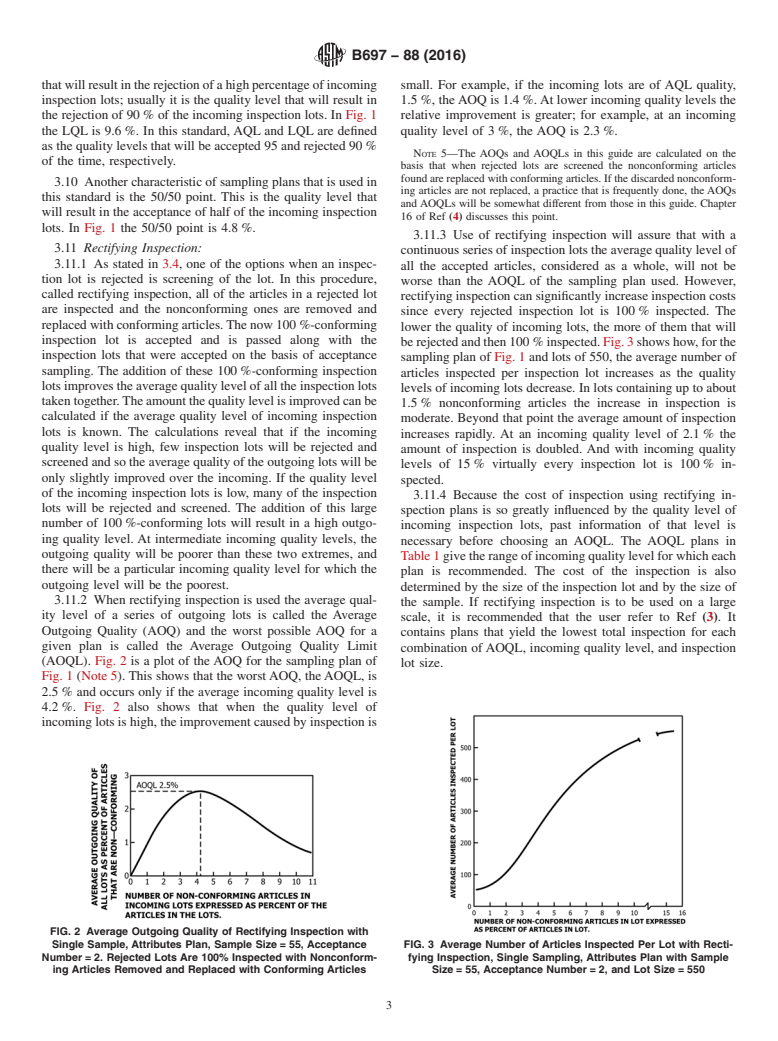
the form of an operating characteristic (OC) curve. Fig. 1 is the OC curve for the plan that calls for a sample of 55 articles and
an acceptance number of two. Plotted along the horizontal axis is the quality level of an inspection lot expressed as the percentage
of the articles in the lot that are nonconforming (Note 1). The vertical axis is the probability, as a percentage, that an inspection
lot will be accepted by the plan (Note 4). Inspection lots with zero percent nonconforming articles will be accepted 100 % of the
time (Note 2). As the percentage of nonconforming articles in the inspection lot increases, the probability of acceptance decreases.
For example, as shown in Fig. 1, an inspection lot containing 1.5 % nonconforming articles has a 95 % chance of being accepted,
while one containing 9.6 % nonconforming articles has only a 10 % chance of being accepted.
NOTE 4—The vertical axis of the OC curve can have two meanings. One is the probability that a particular inspection lot will be accepted. The other
meaning is the percentage of a series of lots of a given quality level that will be accepted. The latter meaning is the one that is strictly correct
mathematically. The former meaning is also correct, as long as the inspection lot is at least ten times bigger than the sample.
3.9 The characteristics of a sampling plan are often expressed in terms of the Acceptable Quality Level (AQL) and the Limiting
Quality Level (LQL). The AQL is the quality level that will result in the acceptance of a high percentage of incoming inspection
B697 − 88 (2016)
FIG. 1 Operating Characteristic Curve for Single Sample, Attributes Sampling Plan, Sample Size = 55, Acceptance Number = 2
lots; usually it is the quality level that will result in the acceptance of 95 % of the incoming inspection lots. In Fig. 1, the AQL
is 1.5 %. The LQL is the quality level that will result in the rejection of a high percentage of incoming inspection lots; usually it
is the quality level that will result in the rejection of 90 % of the incoming inspection lots. In Fig. 1 the LQL is 9.6 %. In this
standard, AQL and LQL are defined as the quality levels that will be accepted 95 and rejected 90 % of the time, respectively.
3.10 Another characteristic of sampling plans that is used in this standard is the 50/50 point. This is the quality level that will
result in the acceptance of half of the incoming inspection lots. In Fig. 1 the 50/50 point is 4.8 %.
3.11 Rectifying Inspection:
3.11.1 As stated in 3.4, one of the options when an inspection lot is rejected is screening of the lot. In this procedure, called
rectifying inspection, all of the articles in a rejected lot are inspected and the nonconforming ones are removed and replaced with
conforming articles. The now 100 %-conforming inspection lot is accepted and is passed along with the inspection lots that were
accepted on the basis of acceptance sampling. The addition of these 100 %-conforming inspection lots improves the average
quality level of all the inspection lots taken together. The amount the quality level is improved can be calculated if the average
quality level of incoming inspection lots is known. The calculations reveal that if the incoming quality level is high, few inspection
lots will be rejected and screened and so the average quality of the outgoing lots will be only slightly improved over the incoming.
If the quality level of the incoming inspection lots is low, many of the inspection lots will be rejected and screened. The addition
of this large number of 100 %-conforming lots will result in a high outgoing quality level. At intermediate incoming quality levels,
the outgoing quality will be poorer than these two extremes, and there will be a particular incoming quality level for which the
outgoing level will be the poorest.
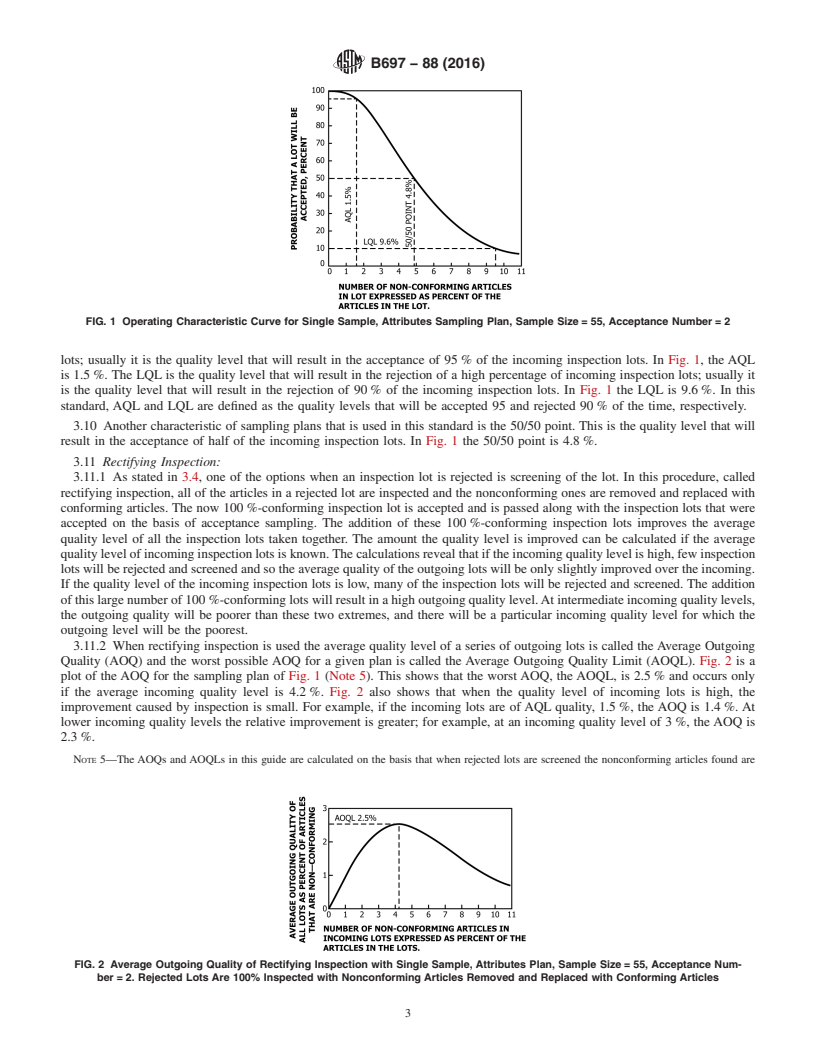
3.11.2 When rectifying inspection is used the average quality level of a series of outgoing lots is called the Average Outgoing
Quality (AOQ) and the worst possible AOQ for a given plan is called the Average Outgoing Quality Limit (AOQL). Fig. 2 is a
plot of the AOQ for the sampling plan of Fig. 1 (Note 5). This shows that the worst AOQ, the AOQL, is 2.5 % and occurs only
if the average incoming quality level is 4.2 %. Fig. 2 also shows that when the quality level of incoming lots is high, the
improvement caused by inspection is small. For example, if the incoming lots are of AQL quality, 1.5 %, the AOQ is 1.4 %. At
lower incoming quality levels the relative improvement is greater; for example, at an incoming quality level of 3 %, the AOQ is
2.3 %.
NOTE 5—The AOQs and AOQLs in this guide are calculated on the basis that when rejected lots are screened the nonconforming articles found are
FIG. 2 Average Outgoing Quality of Rectifying Inspection with Single Sample, Attributes Plan, Sample Size = 55, Acceptance Num-
ber = 2. Rejected Lots Are 100% Inspected with Nonconforming Articles Removed and Replaced with Conforming Articles
B697 − 88 (2016)
replaced with conforming articles. If the discarded nonconforming articles are not replaced, a practice that is frequently done, the AOQs and AOQLs will
be somewhat different from those in this guide. Chapter 16 of Ref (4) discusses this point.
3.11.3 Use of rectifying inspection will assure that with a continuous series of inspection lots the average quality level of all
the accepted articles, considered as a whole, will not be worse than the AOQL of the
...
Questions, Comments and Discussion
Ask us and Technical Secretary will try to provide an answer. You can facilitate discussion about the standard in here.