


ASTM E2609-08(2022)
(Test Method)Standard Test Method for Odor or Flavor Transfer or Both from Rigid Polymeric Packaging
Standard Test Method for Odor or Flavor Transfer or Both from Rigid Polymeric Packaging
SIGNIFICANCE AND USE
5.1 This test method is designed for use by a trained sensory panel experienced in using an intensity scale or rank ordering and familiar with the descriptive terminology and references associated with the packaging materials. Data analysis and interpretation should be conducted by a trained and experienced sensory professional. See Refs (3, 4) for discussions on panelist screening and training.
5.2 This test method should be considered as a screening technique for suppliers and end-users to use in assessing the odor or flavor impact or both of rigid packaging. The application of this test method will result in a PPS or rank data. The determination for suitability of a package for a particular end-use should be based on a set of predetermined criteria including the PPS or rank score. Information obtained from the transfer tests can also be used to evaluate the origin of any transferred tastes or odors.
SCOPE
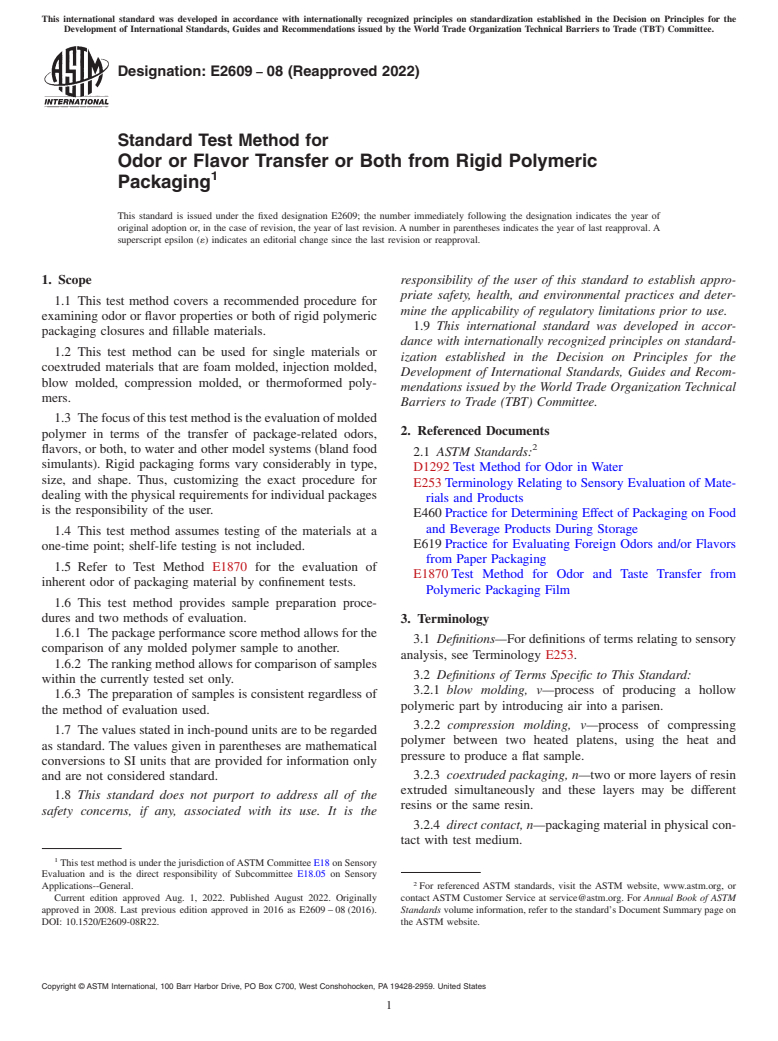
1.1 This test method covers a recommended procedure for examining odor or flavor properties or both of rigid polymeric packaging closures and fillable materials.
1.2 This test method can be used for single materials or coextruded materials that are foam molded, injection molded, blow molded, compression molded, or thermoformed polymers.
1.3 The focus of this test method is the evaluation of molded polymer in terms of the transfer of package-related odors, flavors, or both, to water and other model systems (bland food simulants). Rigid packaging forms vary considerably in type, size, and shape. Thus, customizing the exact procedure for dealing with the physical requirements for individual packages is the responsibility of the user.
1.4 This test method assumes testing of the materials at a one-time point; shelf-life testing is not included.
1.5 Refer to Test Method E1870 for the evaluation of inherent odor of packaging material by confinement tests.
1.6 This test method provides sample preparation procedures and two methods of evaluation.
1.6.1 The package performance score method allows for the comparison of any molded polymer sample to another.
1.6.2 The ranking method allows for comparison of samples within the currently tested set only.
1.6.3 The preparation of samples is consistent regardless of the method of evaluation used.
1.7 The values stated in inch-pound units are to be regarded as standard. The values given in parentheses are mathematical conversions to SI units that are provided for information only and are not considered standard.
1.8 This standard does not purport to address all of the safety concerns, if any, associated with its use. It is the responsibility of the user of this standard to establish appropriate safety, health, and environmental practices and determine the applicability of regulatory limitations prior to use.
1.9 This international standard was developed in accordance with internationally recognized principles on standardization established in the Decision on Principles for the Development of International Standards, Guides and Recommendations issued by the World Trade Organization Technical Barriers to Trade (TBT) Committee.
General Information
Standards Content (Sample)
This international standard was developed in accordance with internationally recognized principles on standardization established in the Decision on Principles for the
Development of International Standards, Guides and Recommendations issued by the World Trade Organization Technical Barriers to Trade (TBT) Committee.
Designation: E2609 − 08 (Reapproved 2022)
Standard Test Method for
Odor or Flavor Transfer or Both from Rigid Polymeric
1
Packaging
This standard is issued under the fixed designation E2609; the number immediately following the designation indicates the year of
original adoption or, in the case of revision, the year of last revision. A number in parentheses indicates the year of last reapproval. A
superscript epsilon (´) indicates an editorial change since the last revision or reapproval.
1. Scope responsibility of the user of this standard to establish appro-
priate safety, health, and environmental practices and deter-
1.1 This test method covers a recommended procedure for
mine the applicability of regulatory limitations prior to use.
examining odor or flavor properties or both of rigid polymeric
1.9 This international standard was developed in accor-
packaging closures and fillable materials.
dance with internationally recognized principles on standard-
1.2 This test method can be used for single materials or
ization established in the Decision on Principles for the
coextruded materials that are foam molded, injection molded,
Development of International Standards, Guides and Recom-
blow molded, compression molded, or thermoformed poly-
mendations issued by the World Trade Organization Technical
mers.
Barriers to Trade (TBT) Committee.
1.3 Thefocusofthistestmethodistheevaluationofmolded
2. Referenced Documents
polymer in terms of the transfer of package-related odors,
2
flavors, or both, to water and other model systems (bland food
2.1 ASTM Standards:
simulants). Rigid packaging forms vary considerably in type,
D1292 Test Method for Odor in Water
size, and shape. Thus, customizing the exact procedure for
E253 Terminology Relating to Sensory Evaluation of Mate-
dealing with the physical requirements for individual packages
rials and Products
is the responsibility of the user.
E460 Practice for Determining Effect of Packaging on Food
and Beverage Products During Storage
1.4 This test method assumes testing of the materials at a
E619 Practice for Evaluating Foreign Odors and/or Flavors
one-time point; shelf-life testing is not included.
from Paper Packaging
1.5 Refer to Test Method E1870 for the evaluation of
E1870 Test Method for Odor and Taste Transfer from
inherent odor of packaging material by confinement tests.
Polymeric Packaging Film
1.6 This test method provides sample preparation proce-
dures and two methods of evaluation.
3. Terminology
1.6.1 The package performance score method allows for the
3.1 Definitions—For definitions of terms relating to sensory
comparison of any molded polymer sample to another.
analysis, see Terminology E253.
1.6.2 Therankingmethodallowsforcomparisonofsamples
3.2 Definitions of Terms Specific to This Standard:
within the currently tested set only.
3.2.1 blow molding, v—process of producing a hollow
1.6.3 The preparation of samples is consistent regardless of
polymeric part by introducing air into a parisen.
the method of evaluation used.
3.2.2 compression molding, v—process of compressing
1.7 The values stated in inch-pound units are to be regarded
polymer between two heated platens, using the heat and
as standard. The values given in parentheses are mathematical
pressure to produce a flat sample.
conversions to SI units that are provided for information only
3.2.3 coextruded packaging, n—two or more layers of resin
and are not considered standard.
extruded simultaneously and these layers may be different
1.8 This standard does not purport to address all of the
resins or the same resin.
safety concerns, if any, associated with its use. It is the
3.2.4 direct contact, n—packaging material in physical con-
tact with test medium.
1
This test method is under the jurisdiction ofASTM Committee E18 on Sensory
Evaluation and is the direct responsibility of Subcommittee E18.05 on Sensory
2
Applications--General. For referenced ASTM standards, visit the ASTM website, www.astm.org, or
Current edition approved Aug. 1, 2022. Published August 2022. Originally contact ASTM Customer Service at service@astm.org. For Annual Book of ASTM
approved in 2008. Last previous edition approved in 2016 as E2609 – 08 (2016). Standards volume information, refer to the standard’s Document Summary page on
DOI: 10.1520/E2609-08R22. the ASTM website.
Copyright © ASTM International, 100 Barr Harbor Drive, PO Box C700, West Conshohocken, PA 19428-2959. United States
1
---------------------- Page: 1 ----------------------
E2609 − 08 (2022)
3.2.5 foam molding, v—process of producing rigid forms by 4.7 For the rating approach, a sample is given an intensity
expanding foam in a closed mold using steam
...
Questions, Comments and Discussion
Ask us and Technical Secretary will try to provide an answer. You can facilitate discussion about the standard in here.