


ASTM B904-00(2014)
(Specification)Standard Specification for Autocatalytic Nickel over Autocatalytic Copper for Electromagnetic Interference Shielding
Standard Specification for Autocatalytic Nickel over Autocatalytic Copper for Electromagnetic Interference Shielding
ABSTRACT
This specification covers the requirements for multilayer coatings of autocatalytic nickel-phosphorus over autocatalytic copper intended for electromagnetic interference or electrostatic discharge shielding to parts fabricated from either polymeric or metallic substrates or parts. Coatings are classified into four types based on thickness and testing requirements, and into two grades based on alloy composition, specifically phosphorus. Surfaces shall be prepared by cleaning it of surface contaminants, conditioning, and activation; identifying of base material suitability; and mechanical roughening. Coatings shouldl be inspected for process qualification, appearance, blisters, unplated areas, adhesion, electrical continuity, and DC resistance. Coatings should also be tested for thickness, which may be performed either by Coulometric, X-ray, or Beta backscatter methods. The requirements for process qualification shall include coating composition, electrical integrity, adhesion, thermal shock resistance, thermal cycling, and shielding effectiveness.
SCOPE
This specification presents the requirements for multilayer coatings of autocatalytic nickel-phosphorus over autocatalytic copper on metallic and polymeric substrates. The coating system is intended to provide electromagnetic interference (EMI) protection properties or electrostatic discharge (ESD) protection to parts fabricated from either polymeric or metallic materials.
General Information
Buy Standard



Standards Content (Sample)
NOTICE: This standard has either been superseded and replaced by a new version or withdrawn.
Contact ASTM International (www.astm.org) for the latest information
Designation:B904 −00 (Reapproved 2014)
Standard Specification for
Autocatalytic Nickel over Autocatalytic Copper for
Electromagnetic Interference Shielding
This standard is issued under the fixed designation B904; the number immediately following the designation indicates the year of
original adoption or, in the case of revision, the year of last revision. A number in parentheses indicates the year of last reapproval. A
superscript epsilon (´) indicates an editorial change since the last revision or reapproval.
1. Scope B553 Test Method for Thermal Cycling of Electroplated
This specification presents the requirements for multilayer Plastics (Withdrawn 1991)
coatings of autocatalytic nickel-phosphorus over autocata- B554 Practice for Measurement of Thickness of Metallic
lytic copper on metallic and polymeric substrates. The coat- Coatings on Nonmetallic Substrates (Withdrawn 1987)
ing system is intended to provide electromagnetic interfer- B567 Test Method for Measurement of Coating Thickness
ence (EMI) protection properties or electrostatic discharge by the Beta Backscatter Method
(ESD) protection to parts fabricated from either polymeric or B568 Test Method for Measurement of Coating Thickness
metallic materials. by X-Ray Spectrometry
B602 Test Method for Attribute Sampling of Metallic and
2. Referenced Documents
Inorganic Coatings
B697 Guide for Selection of Sampling Plans for Inspection
2.1 ASTM Standards:
of Electrodeposited Metallic and Inorganic Coatings
A919 Terminology Relating to Heat Treatment of Metals
B727 Practice for Preparation of Plastics Materials for Elec-
(Withdrawn 1999)
troplating
B183 Practice for Preparation of Low-Carbon Steel for
B733 Specification for Autocatalytic (Electroless) Nickel-
Electroplating
Phosphorus Coatings on Metal
B242 Guide for Preparation of High-Carbon Steel for Elec-
D3330/D3330M TestMethodforPeelAdhesionofPressure-
troplating
Sensitive Tape
B252 Guide for Preparation of Zinc Alloy Die Castings for
D3359 Test Methods for Measuring Adhesion by Tape Test
Electroplating and Conversion Coatings
D4935 Test Method for Measuring the Electromagnetic
B253 Guide for Preparation of Aluminum Alloys for Elec-
Shielding Effectiveness of Planar Materials
troplating
B320 Practice for Preparation of Iron Castings for Electro-
2.2 Military Standard:
plating MIL-STD-461 Electromagnetic Emission and Susceptibility
B322 Guide for Cleaning Metals Prior to Electroplating
Requirements for the Control of Electromagnetic Interfer-
B374 Terminology Relating to Electroplating ence
B504 Test Method for Measurement of Thickness of Metal-
lic Coatings by the Coulometric Method
3. Terminology
B532 Specification for Appearance of Electroplated Plastic
3.1 Definitions—Many of the terms used in this specifica-
Surfaces
tion can be found in Terminologies A919 or B374.
B533 Test Method for Peel Strength of Metal Electroplated
3.2 Definitions of Terms Specific to This Standard:
Plastics
3.2.1 significant surfaces, n—these surfaces are classified as
primary, secondary, nonsignificant, and coating-free surfaces.
This specification is under the jurisdiction of ASTM Committee B08 on
3.2.1.1 coating-free areas, adj—areas specified on part
Metallic and Inorganic Coatings and is the direct responsibility of Subcommittee
drawings or suitably marked samples.
B08.03 on Engineering Coatings.
Current edition approved Nov. 1, 2014. Published November 2014. Originally
3.2.1.2 nonsignificant surfaces, adj—all holes, recesses, and
approvedin2000.Lastpreviouseditionapprovedin2009asB904 – 00(2009).DOI:
other areas where a controlled deposit cannot be obtained
10.1520/B0904-00R14.
under normal coating conditions and that cannot be touched
For referenced ASTM standards, visit the ASTM website, www.astm.org, or
contact ASTM Customer Service at service@astm.org. For Annual Book of ASTM
Standards volume information, refer to the standard’s Document Summary page on
the ASTM website.
3 4
The last approved version of this historical standard is referenced on AvailablefromStandardizationDocumentsOrderDesk,Bldg.4SectionD,700
www.astm.org. Robbins Ave. Philadelphia, PA 19111–5094, Attn: NPODS.
Copyright © ASTM International, 100 Barr Harbor Drive, PO Box C700, West Conshohocken, PA 19428-2959. United States
B904−00 (2014)
with a 20-mm diameter ball shall be considered nonsignificant 4.3.4 Grade 2 coatings have a phosphorus content between
surfacesunlessotherwisespecifiedonpartdrawingsorsuitably 6 and 11 %.
marked samples.
NOTE 3—The adhesion and resistance to blistering are improved on
3.2.1.3 primary significant surface, adj—all mating surfaces some polymeric substrates by an initial flash deposit of autocatalytic
nickel.
and those other surfaces specified on part drawings or suitably
marked samples.
5. Ordering Information
3.2.1.4 secondary significant surfaces, adj—all surfaces,
5.1 To avoid misunderstanding between contractual parties,
other than primary significant surfaces, that can be touched
purchase orders or contracts for autocatalytic nickel over
with a 20-mm diameter ball shall be considered secondary
autocatalytic copper coatings under this specification should
significantsurfacesunlessotherwisespecifiedonpartdrawings
include the designation, issue date, and the following informa-
or suitably marked samples.
tion:
5.1.1 Type of substrate.
4. Classification
5.1.1.1 Metallic substrates should state the composition and
4.1 This classification system provides for the following:
metallurgical condition. Assemblies of dissimilar materials
4.1.1 Types of coating based on thickness and testing
should be identified.
requirements, and
5.1.1.2 Polymeric substrates should state the polymer type
4.1.2 Grades of coating based on alloy composition.
and should be of a plating grade.
4.2 Coating Type:
5.1.2 Classification of the deposit by type and grade.
4.2.1 The coating type indicates the type of application and
5.1.3 Primary significant surfaces and coating-free surfaces
tests to be used in determining the acceptance of the coating.
must be indicated on drawings.
4.2.2 Coating Type Definitions:
5.1.4 Any special requirements.
4.2.2.1 Type 1—Coatings intended to shield devices for
5.1.5 Testmethodsforcoatingadhesion,thickness,porosity.
FCC/VDE Class B service.
5.1.6 Sampling program.
4.2.2.2 Type 2—Coatings intended to shield devices for
FCC/VDE Class B service in harsh environments. 6. Surface Preparation
4.2.2.3 Type 3—Coatings intended to shield devices for
6.1 Surface Contamination—Surfaces of polymeric parts
MIL-STD-461 requirements.
must be free of all mold release agents, dirt, oil, grease, and
4.2.2.4 Type 4—Coatings intended to shield devices for
contamination detrimental to the final finish. Surfaces of
FCC/VDE Class A requirements.
metallic parts must be free of all scale, oxidation, and contami-
4.2.3 The description of Types 1, 2, 3, and 4 is summarized
nation detrimental to the final finish. A clean surface is
in Table 1.
essential to the adhesion and electrical conductivity require-
ments of the subsequent coated part.
4.3 Coating Grade:
4.3.1 The coating grade is based upon phosphorus content.
6.2 Cleaning, Conditioning, and Activating—Any adequate
method of cleaning, conditioning, and activating is acceptable
NOTE 1—The coating grade indicates the relative contact impedance
and the relative corrosion resistance of the nickel-phosphorus coating and provided the coated parts meet the inspection requirements and
tests to be used in determining the acceptance of the coating
are free of distortion. Examples of adequate methods of
cleaning can be found in 10.2.
4.3.2 Coating Grade Definitions:
6.2.1 Base Material Suitability—Thepartstobecoatedshall
4.3.3 Grade 1 coatings have a phosphorus content between
be inspected by the coater prior to any processing to determine
3 and 5 %.
their suitability for coating. Unsuitable parts shall be returned
NOTE 2—Low phosphorus coatings exhibit low electrical contact
to the fabricator or molder.
impedance. High phosphorus contents exhibit somewhat higher contact
impedance, however, the coating is more corrosion resistant.
6.3 Mechanical Roughening—Mechanical roughening of
polymersurfaces,topromoteadhesion,mayonlybeusedwhen
specified on the part drawing.
TABLE 1 Autocatalytic Nickel-Phosphorus Over Autocatalytic
Copper Coating Descriptions Summary
7. In-Process Storage and Handling
Type Thickness Shielding Application
Autocatalytic Autocatalytic Effectiveness 7.1 Following cleaning, conditioning, and activating, all
Copper Nickel- (Typical) in
parts shall be immediately coated with copper and then
Phosphorus accordance with
nickel-phosphorus to the thickness specified in Table 1. The
Test Method
D4935 parts processing cycle shall be a continuous operation without
1 1 µm min 0.25 µm min 80-100 dB FCC/VDE
any interruption.
Class B
2 1 µm min 1.5 µm min 80-100 dB Harsh Envi-
7.2 Handling—The parts shall be suitably racked so as to
ronment
prevent gas entrapment and to avoid physical handling of the
3 2.5 µm min 0.25 µm min 90-110 dB MIL-STD-
primary significant surfaces.
461B
4 Optional/Not re- 1.0 µm min 50-70 dB FCC/VDE
7.3 Drying—Following coating, the parts may be dried with
quired Class A
warm air currents. Drying temperature shall not exceed the
B904−00 (2014)
heat distortion temperature of the substrate. Wetting agents (2) X-Ray Method—This nondestructive method is suitable
may be used to enhance water shedding provided they do not forthemeasurementofindividuallayersintherangeof0.25to
interfere with subsequent paint adhesion. 65 µm and shall be the referee method.
(3) Beta Backscatter Method—This nondestructive method
7.4 St
...
This document is not an ASTM standard and is intended only to provide the user of an ASTM standard an indication of what changes have been made to the previous version. Because
it may not be technically possible to adequately depict all changes accurately, ASTM recommends that users consult prior editions as appropriate. In all cases only the current version
of the standard as published by ASTM is to be considered the official document.
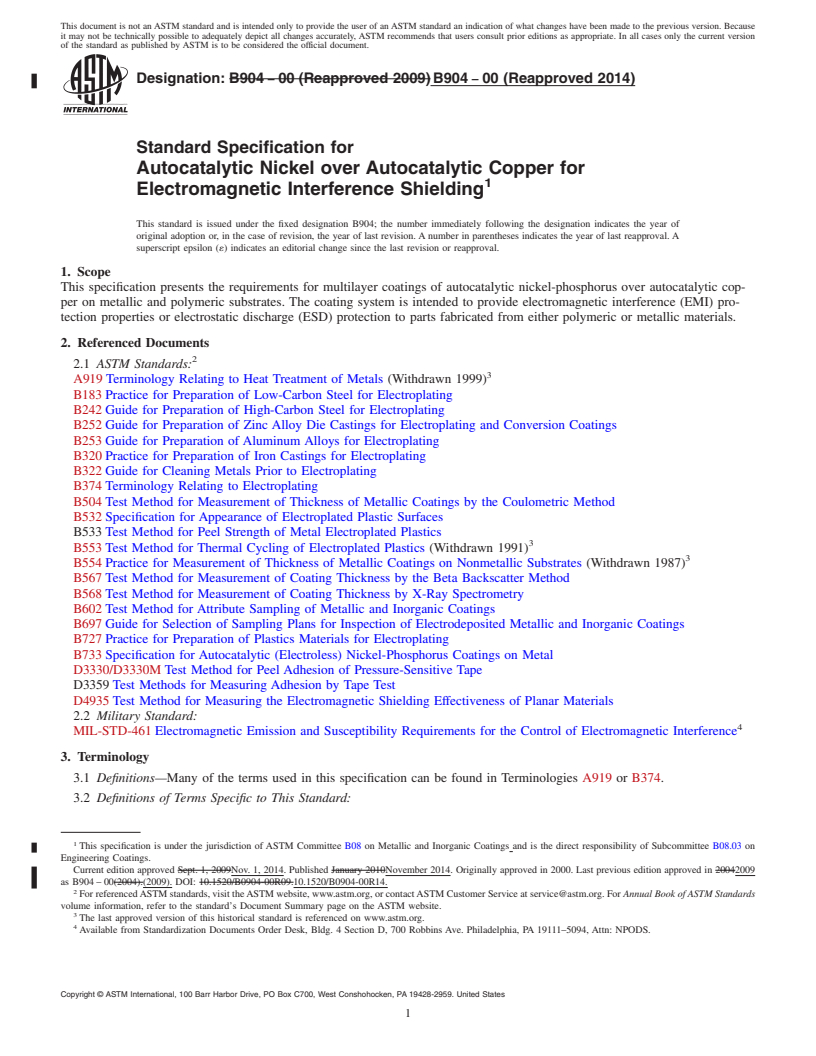
Designation: B904 − 00 (Reapproved 2009) B904 − 00 (Reapproved 2014)
Standard Specification for
Autocatalytic Nickel over Autocatalytic Copper for
Electromagnetic Interference Shielding
This standard is issued under the fixed designation B904; the number immediately following the designation indicates the year of
original adoption or, in the case of revision, the year of last revision. A number in parentheses indicates the year of last reapproval. A
superscript epsilon (´) indicates an editorial change since the last revision or reapproval.
1. Scope
This specification presents the requirements for multilayer coatings of autocatalytic nickel-phosphorus over autocatalytic cop-
per on metallic and polymeric substrates. The coating system is intended to provide electromagnetic interference (EMI) pro-
tection properties or electrostatic discharge (ESD) protection to parts fabricated from either polymeric or metallic materials.
2. Referenced Documents
2.1 ASTM Standards:
A919 Terminology Relating to Heat Treatment of Metals (Withdrawn 1999)
B183 Practice for Preparation of Low-Carbon Steel for Electroplating
B242 Guide for Preparation of High-Carbon Steel for Electroplating
B252 Guide for Preparation of Zinc Alloy Die Castings for Electroplating and Conversion Coatings
B253 Guide for Preparation of Aluminum Alloys for Electroplating
B320 Practice for Preparation of Iron Castings for Electroplating
B322 Guide for Cleaning Metals Prior to Electroplating
B374 Terminology Relating to Electroplating
B504 Test Method for Measurement of Thickness of Metallic Coatings by the Coulometric Method
B532 Specification for Appearance of Electroplated Plastic Surfaces
B533 Test Method for Peel Strength of Metal Electroplated Plastics
B553 Test Method for Thermal Cycling of Electroplated Plastics (Withdrawn 1991)
B554 Practice for Measurement of Thickness of Metallic Coatings on Nonmetallic Substrates (Withdrawn 1987)
B567 Test Method for Measurement of Coating Thickness by the Beta Backscatter Method
B568 Test Method for Measurement of Coating Thickness by X-Ray Spectrometry
B602 Test Method for Attribute Sampling of Metallic and Inorganic Coatings
B697 Guide for Selection of Sampling Plans for Inspection of Electrodeposited Metallic and Inorganic Coatings
B727 Practice for Preparation of Plastics Materials for Electroplating
B733 Specification for Autocatalytic (Electroless) Nickel-Phosphorus Coatings on Metal
D3330/D3330M Test Method for Peel Adhesion of Pressure-Sensitive Tape
D3359 Test Methods for Measuring Adhesion by Tape Test
D4935 Test Method for Measuring the Electromagnetic Shielding Effectiveness of Planar Materials
2.2 Military Standard:
MIL-STD-461 Electromagnetic Emission and Susceptibility Requirements for the Control of Electromagnetic Interference
3. Terminology
3.1 Definitions—Many of the terms used in this specification can be found in Terminologies A919 or B374.
3.2 Definitions of Terms Specific to This Standard:
This specification is under the jurisdiction of ASTM Committee B08 on Metallic and Inorganic Coatings and is the direct responsibility of Subcommittee B08.03 on
Engineering Coatings.
Current edition approved Sept. 1, 2009Nov. 1, 2014. Published January 2010November 2014. Originally approved in 2000. Last previous edition approved in 20042009
as B904 – 00(2004).(2009). DOI: 10.1520/B0904-00R09.10.1520/B0904-00R14.
For referenced ASTM standards, visit the ASTM website, www.astm.org, or contact ASTM Customer Service at service@astm.org. For Annual Book of ASTM Standards
volume information, refer to the standard’s Document Summary page on the ASTM website.
The last approved version of this historical standard is referenced on www.astm.org.
Available from Standardization Documents Order Desk, Bldg. 4 Section D, 700 Robbins Ave. Philadelphia, PA 19111–5094, Attn: NPODS.
Copyright © ASTM International, 100 Barr Harbor Drive, PO Box C700, West Conshohocken, PA 19428-2959. United States
B904 − 00 (2014)
3.2.1 significant surfaces, n—these surfaces are classified as primary, secondary, nonsignificant, and coating-free surfaces.
3.2.1.1 coating-free areas, adj—areas specified on part drawings or suitably marked samples.
3.2.1.2 nonsignificant surfaces, adj—all holes, recesses, and other areas where a controlled deposit cannot be obtained under
normal coating conditions and that cannot be touched with a 20-mm diameter ball shall be considered nonsignificant surfaces
unless otherwise specified on part drawings or suitably marked samples.
3.2.1.3 primary significant surface, adj—all mating surfaces and those other surfaces specified on part drawings or suitably
marked samples.
3.2.1.4 secondary significant surfaces, adj—all surfaces, other than primary significant surfaces, that can be touched with a
20-mm diameter ball shall be considered secondary significant surfaces unless otherwise specified on part drawings or suitably
marked samples.
4. Classification
4.1 This classification system provides for the following:
4.1.1 Types of coating based on thickness and testing requirements, and
4.1.2 Grades of coating based on alloy composition.
4.2 Coating Type:
4.2.1 The coating type indicates the type of application and tests to be used in determining the acceptance of the coating.
4.2.2 Coating Type Definitions:
4.2.2.1 Type 1—Coatings intended to shield devices for FCC/VDE Class B service.
4.2.2.2 Type 2—Coatings intended to shield devices for FCC/VDE Class B service in harsh environments.
4.2.2.3 Type 3—Coatings intended to shield devices for MIL-STD-461 requirements.
4.2.2.4 Type 4—Coatings intended to shield devices for FCC/VDE Class A requirements.
4.2.3 The description of Types 1, 2, 3, and 4 is summarized in Table 1.
4.3 Coating Grade:
4.3.1 The coating grade is based upon phosphorus content.
NOTE 1—The coating grade indicates the relative contact impedance and the relative corrosion resistance of the nickel-phosphorus coating and tests
to be used in determining the acceptance of the coating
4.3.2 Coating Grade Definitions:
4.3.3 Grade 1 coatings have a phosphorus content between 3 and 5 %.
NOTE 2—Low phosphorus coatings exhibit low electrical contact impedance. High phosphorus contents exhibit somewhat higher contact impedance,
however, the coating is more corrosion resistant.
4.3.4 Grade 2 coatings have a phosphorus content between 6 and 11 %.
NOTE 3—The adhesion and resistance to blistering are improved on some polymeric substrates by an initial flash deposit of autocatalytic nickel.
5. Ordering Information
5.1 To avoid misunderstanding between contractual parties, purchase orders or contracts for autocatalytic nickel over
autocatalytic copper coatings under this specification should include the designation, issue date, and the following information:
5.1.1 Type of substrate.
5.1.1.1 Metallic substrates should state the composition and metallurgical condition. Assemblies of dissimilar materials should
be identified.
5.1.1.2 Polymeric substrates should state the polymer type and should be of a plating grade.
TABLE 1 Autocatalytic Nickel-Phosphorus Over Autocatalytic
Copper Coating Descriptions Summary
Type Thickness Shielding Application
Effectiveness
Autocatalytic Autocatalytic
Copper Nickel- (Typical) in
Phosphorus accordance with
Test Method
D4935
1 1 μm min 0.25 μm min 80-100 dB FCC/VDE
Class B
2 1 μm min 1.5 μm min 80-100 dB Harsh Envi-
ronment
3 2.5 μm min 0.25 μm min 90-110 dB MIL-STD-
461B
4 Optional/Not re- 1.0 μm min 50-70 dB FCC/VDE
quired Class A
B904 − 00 (2014)
5.1.2 Classification of the deposit by type and grade.
5.1.3 Primary significant surfaces and coating-free surfaces must be indicated on drawings.
5.1.4 Any special requirements.
5.1.5 Test methods for coating adhesion, thickness, porosity.
5.1.6 Sampling program.
6. Surface Preparation
6.1 Surface Contamination—Surfaces of polymeric parts must be free of all mold release agents, dirt, oil, grease, and
contamination detrimental to the final finish. Surfaces of metallic parts must be free of all scale, oxidation, and contamination
detrimental to the final finish. A clean surface is essential to the adhesion and electrical conductivity requirements of the subsequent
coated part.
6.2 Cleaning, Conditioning, and Activating—Any adequate method of cleaning, conditioning, and activating is acceptable
provided the coated parts meet the inspection requirements and are free of distortion. Examples of adequate methods of cleaning
can be found in 10.2.
6.2.1 Base Material Suitability—The parts to be coated shall be inspected by the coater prior to any processing to determine
their suitability for coating. Unsuitable parts shall be returned to the fabricator or molder.
6.3 Mechanical Roughening—Mechanical roughening of polymer surfaces, to promote adhesion, may only be used when
specified on the part drawing.
7. In-Process Storage and Handling
7.1 Following cleaning, conditioning, and activating, all parts shall be immediately coated with copper and then nickel-
phosphorus to the thickness specified in Table 1. The parts processing cycle shall be a continuous operation without any
interruption.
7.2 Handling—The parts shall be suitably racked so as to prevent gas entrapment and to avoid physical handling of the primary
significant surfaces.
7.3 Drying—Following coating, the parts may be dried with warm air currents. Drying temperature shall not exceed the heat
distortion temperature of the substrate. Wetting agents may be used to enhance water shedding provided they do not interfere with
subsequent paint adhesion.
7.4 Storage—Following drying, all parts shall be stored in a clean dry area,
...
Questions, Comments and Discussion
Ask us and Technical Secretary will try to provide an answer. You can facilitate discussion about the standard in here.