


ASTM D6380/D6380M-03(2018)
(Specification)Standard Specification for Asphalt Roll Roofing (Organic Felt)
Standard Specification for Asphalt Roll Roofing (Organic Felt)
ABSTRACT
This specification covers three classes and three types of asphalt roll roofing in sheet form, in widths agreed upon between the purchaser and the producer/supplier, and composed of asphalt-saturated organic felt coated on both sides with asphalt. Class M and WS rolls are surfaced on the weather (exposed) side with mineral granules, except for any selvage. Class S rolls are surfaced with powdered talc, mica, or other fine mineral matter to prevent sticking. Type classifications (Types II, III, and IV) are grouped based on minimum net mass per unit area of roofing. Roofing shall adhere to physical property requirements such as breaking strength, water permeance and vapor transmission, width, selvage, area, and moisture.
SCOPE
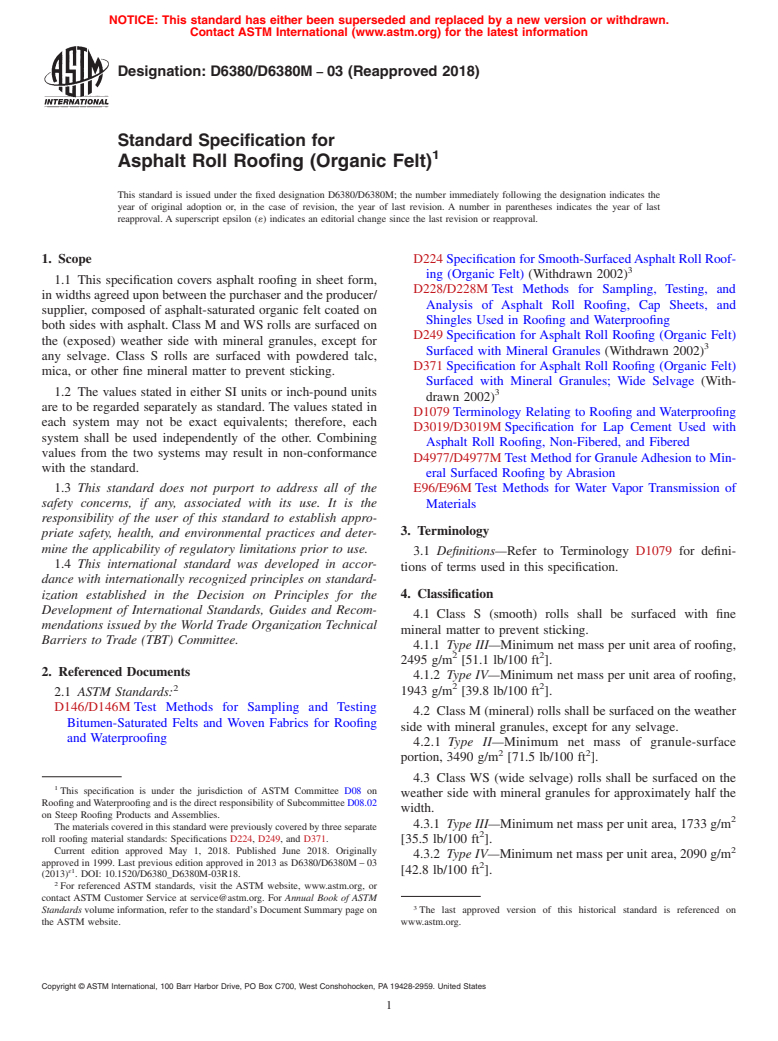
1.1 This specification covers asphalt roofing in sheet form, in widths agreed upon between the purchaser and the producer/supplier, composed of asphalt-saturated organic felt coated on both sides with asphalt. Class M and WS rolls are surfaced on the (exposed) weather side with mineral granules, except for any selvage. Class S rolls are surfaced with powdered talc, mica, or other fine mineral matter to prevent sticking.
1.2 The values stated in either SI units or inch-pound units are to be regarded separately as standard. The values stated in each system may not be exact equivalents; therefore, each system shall be used independently of the other. Combining values from the two systems may result in non-conformance with the standard.
1.3 This standard does not purport to address all of the safety concerns, if any, associated with its use. It is the responsibility of the user of this standard to establish appropriate safety, health, and environmental practices and determine the applicability of regulatory limitations prior to use.
1.4 This international standard was developed in accordance with internationally recognized principles on standardization established in the Decision on Principles for the Development of International Standards, Guides and Recommendations issued by the World Trade Organization Technical Barriers to Trade (TBT) Committee.
General Information
Buy Standard
Standards Content (Sample)
NOTICE: This standard has either been superseded and replaced by a new version or withdrawn.
Contact ASTM International (www.astm.org) for the latest information
Designation:D6380/D6380M −03 (Reapproved 2018)
Standard Specification for
Asphalt Roll Roofing (Organic Felt)
This standard is issued under the fixed designation D6380/D6380M; the number immediately following the designation indicates the
year of original adoption or, in the case of revision, the year of last revision. A number in parentheses indicates the year of last
reapproval. A superscript epsilon (´) indicates an editorial change since the last revision or reapproval.
1. Scope D224 Specification for Smooth-SurfacedAsphalt Roll Roof-
ing (Organic Felt) (Withdrawn 2002)
1.1 This specification covers asphalt roofing in sheet form,
D228/D228M Test Methods for Sampling, Testing, and
in widths agreed upon between the purchaser and the producer/
Analysis of Asphalt Roll Roofing, Cap Sheets, and
supplier, composed of asphalt-saturated organic felt coated on
Shingles Used in Roofing and Waterproofing
both sides with asphalt. Class M and WS rolls are surfaced on
D249 Specification for Asphalt Roll Roofing (Organic Felt)
the (exposed) weather side with mineral granules, except for
Surfaced with Mineral Granules (Withdrawn 2002)
any selvage. Class S rolls are surfaced with powdered talc,
D371 Specification for Asphalt Roll Roofing (Organic Felt)
mica, or other fine mineral matter to prevent sticking.
Surfaced with Mineral Granules; Wide Selvage (With-
1.2 The values stated in either SI units or inch-pound units
drawn 2002)
are to be regarded separately as standard. The values stated in
D1079 Terminology Relating to Roofing and Waterproofing
each system may not be exact equivalents; therefore, each
D3019/D3019M Specification for Lap Cement Used with
system shall be used independently of the other. Combining
Asphalt Roll Roofing, Non-Fibered, and Fibered
values from the two systems may result in non-conformance
D4977/D4977M Test Method for GranuleAdhesion to Min-
with the standard.
eral Surfaced Roofing by Abrasion
1.3 This standard does not purport to address all of the E96/E96M Test Methods for Water Vapor Transmission of
safety concerns, if any, associated with its use. It is the
Materials
responsibility of the user of this standard to establish appro-
3. Terminology
priate safety, health, and environmental practices and deter-
mine the applicability of regulatory limitations prior to use.
3.1 Definitions—Refer to Terminology D1079 for defini-
1.4 This international standard was developed in accor-
tions of terms used in this specification.
dance with internationally recognized principles on standard-
4. Classification
ization established in the Decision on Principles for the
Development of International Standards, Guides and Recom-
4.1 Class S (smooth) rolls shall be surfaced with fine
mendations issued by the World Trade Organization Technical
mineral matter to prevent sticking.
Barriers to Trade (TBT) Committee.
4.1.1 Type III—Minimum net mass per unit area of roofing,
2 2
2495 g/m [51.1 lb/100 ft ].
2. Referenced Documents
4.1.2 Type IV—Minimum net mass per unit area of roofing,
2 2
1943 g/m [39.8 lb/100 ft ].
2.1 ASTM Standards:
D146/D146M Test Methods for Sampling and Testing
4.2 Class M (mineral) rolls shall be surfaced on the weather
Bitumen-Saturated Felts and Woven Fabrics for Roofing
side with mineral granules, except for any selvage.
and Waterproofing
4.2.1 Type II—Minimum net mass of granule-surface
2 2
portion, 3490 g/m [71.5 lb/100 ft ].
4.3 Class WS (wide selvage) rolls shall be surfaced on the
This specification is under the jurisdiction of ASTM Committee D08 on
weather side with mineral granules for approximately half the
Roofing and Waterproofing and is the direct responsibility of Subcommittee D08.02
width.
on Steep Roofing Products and Assemblies.
4.3.1 Type III—Minimum net mass per unit area, 1733 g/m
The materials covered in this standard were previously covered by three separate
roll roofing material standards: Specifications D224, D249, and D371.
[35.5 lb/100 ft ].
Current edition approved May 1, 2018. Published June 2018. Originally 2
4.3.2 Type IV—Minimum net mass per unit area, 2090 g/m
approved in 1999. Last previous edition approved in 2013 as D6380/D6380M – 03
ɛ1 [42.8 lb/100 ft ].
(2013) . DOI: 10.1520/D6380_D6380M-03R18.
For referenced ASTM standards, visit the ASTM website, www.astm.org, or
contact ASTM Customer Service at service@astm.org. For Annual Book of ASTM
Standards volume information, refer to the standard’s Document Summary page on The last approved version of this historical standard is referenced on
the ASTM website. www.astm.org.
Copyright © ASTM International, 100 Barr Harbor Drive, PO Box C700, West Conshohocken, PA 19428-2959. United States
D6380/D6380M−03 (2018)
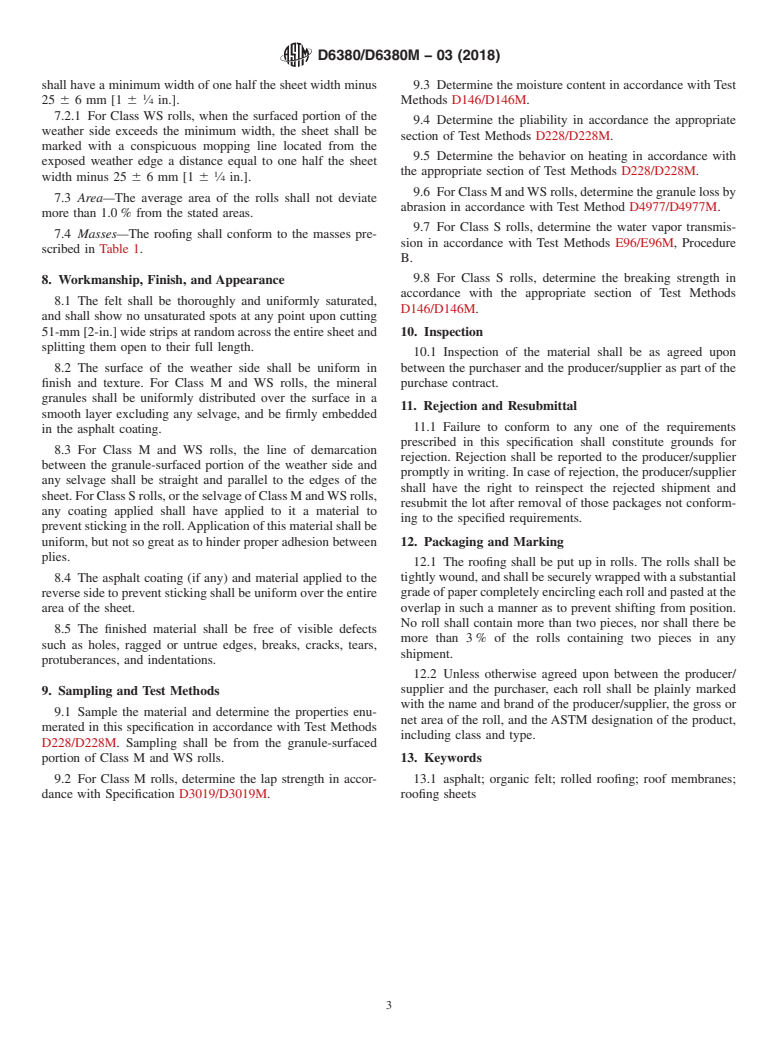
5. Materials and Manufacture 6.4 Pliability at 25°C [77°F]—At least eight strips out of
ten from the granule-surfaced portion of the sheet shall not
5.1 In the process of manufacture, a single thickness of dry
crackwhentestedinaccordancewiththeappropriatesectionof
organic felt shall first be saturated with asphalt. A coating
Test Methods D228/D228M. The samples shall be tested using
asphalt, compounded with or without a fine mineral stabilizer
a mandrel with a radius of 12.7 mm [ ⁄2 in.] for Class S roofing
insoluble in water, shall be applied to one or both sides of the
and 19 mm [ ⁄4 in.] radius for Class M and WS roll roofing.
sheet. Class S rolls shall be surfaced on one side with a suitable
material to prevent sticking in the roll. Class M and WS rolls
6.5 Behavior on Heating to 80°C [176°F] for 2 h—There
shall be covered on the weather side with mineral granules,
shall be no more than 1.5 % volatile loss; and there shall be no
except for any selvage; the reverse side shall be covered with
flowing, sagging, blistering, or absorption of the asphalt
a suitable material to prevent sticking in the roll.
coating; and any granular surfacing shall not slide more than 2
mm [ ⁄16 in.] when tested in accordance with the appropriate
5.2 The felt shall be roofing felt primarily composed of
section of Test Methods D228/D228M.
organic fibers. The surface of the felt shall be uniformly and
relatively smooth. Upon splitting or tearing on the bias, the felt
7. Dimensions, Mass, and Permissible Variations
shall appear reasonably free of lumps or particles of foreign
substances.
7.1 Width—The material shall be put up in rolls and shall be
914 mm [36 in.] wide, 60.7 %. Other widths agreed upon
6. Physical Properties
between the purchaser and the producer/supplier shall not be
6.1 Class S rolls shall conform to the breaking strength and
prohibited.
water permeance requirements prescribed in Table 1.
7.2 Selvage—Class M rolls are available without a selvage,
6.2 Upon being unrolled, the finished product shall not
with a 51 6 6-mm [2 6 ⁄4-in.] selvage, or with a 102 6 6-mm
crack at ambient temperatures above 10°C [50°F] nor be so
[4 6 ⁄4-in.] selvage. For Class WS rolls, the coated and
sticky at any temperature below 60°C [140°F] as to cause
granule-surfaced portion of the weather side shall have a
tearing or material damage.
uniform, minimum width of 432 6 6 mm [17 6 ⁄4 in.] for the
6.3 Class M rolls with a 102-mm [4-in.] wide selvage shall standard 914-mm [36-in.] wide sheet, or as agreed upon
meet the lap strength requirements with Type II or Type III between the purchaser and the producer/supplier. For other
cement specified in Specification D3019/D3019M. Class WS roll widths, the coated and granule-surfaced portion
TABLE 1 Specifications for Asphalt Roll Roofing
Class
...
This document is not an ASTM standard and is intended only to provide the user of an ASTM standard an indication of what changes have been made to the previous version. Because
it may not be technically possible to adequately depict all changes accurately, ASTM recommends that users consult prior editions as appropriate. In all cases only the current version
of the standard as published by ASTM is to be considered the official document.
´1
Designation: D6380/D6380M − 03 (Reapproved 2013) D6380/D6380M − 03 (Reapproved
2018)
Standard Specification for
Asphalt Roll Roofing (Organic Felt)
This standard is issued under the fixed designation D6380/D6380M; the number immediately following the designation indicates the
year of original adoption or, in the case of revision, the year of last revision. A number in parentheses indicates the year of last
reapproval. A superscript epsilon (´) indicates an editorial change since the last revision or reapproval.
ε NOTE—Units information was editorially corrected in November 2013.
1. Scope
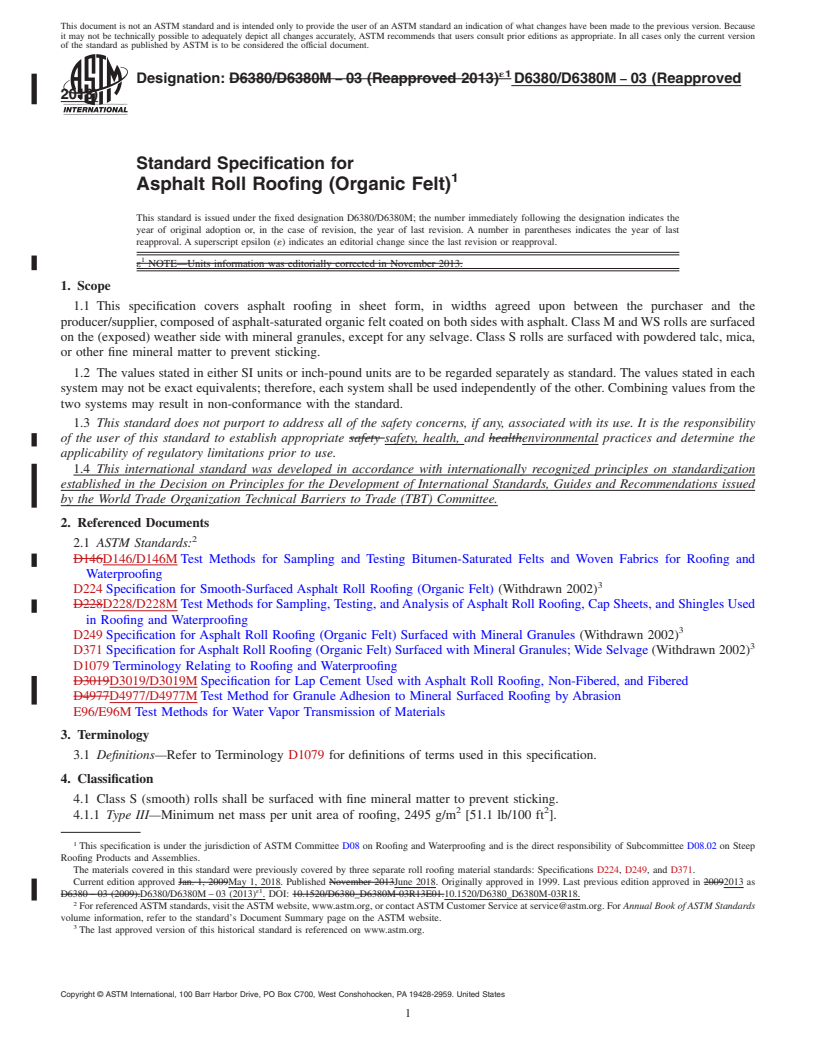
1.1 This specification covers asphalt roofing in sheet form, in widths agreed upon between the purchaser and the
producer/supplier, composed of asphalt-saturated organic felt coated on both sides with asphalt. Class M and WS rolls are surfaced
on the (exposed) weather side with mineral granules, except for any selvage. Class S rolls are surfaced with powdered talc, mica,
or other fine mineral matter to prevent sticking.
1.2 The values stated in either SI units or inch-pound units are to be regarded separately as standard. The values stated in each
system may not be exact equivalents; therefore, each system shall be used independently of the other. Combining values from the
two systems may result in non-conformance with the standard.
1.3 This standard does not purport to address all of the safety concerns, if any, associated with its use. It is the responsibility
of the user of this standard to establish appropriate safety safety, health, and healthenvironmental practices and determine the
applicability of regulatory limitations prior to use.
1.4 This international standard was developed in accordance with internationally recognized principles on standardization
established in the Decision on Principles for the Development of International Standards, Guides and Recommendations issued
by the World Trade Organization Technical Barriers to Trade (TBT) Committee.
2. Referenced Documents
2.1 ASTM Standards:
D146D146/D146M Test Methods for Sampling and Testing Bitumen-Saturated Felts and Woven Fabrics for Roofing and
Waterproofing
D224 Specification for Smooth-Surfaced Asphalt Roll Roofing (Organic Felt) (Withdrawn 2002)
D228D228/D228M Test Methods for Sampling, Testing, and Analysis of Asphalt Roll Roofing, Cap Sheets, and Shingles Used
in Roofing and Waterproofing
D249 Specification for Asphalt Roll Roofing (Organic Felt) Surfaced with Mineral Granules (Withdrawn 2002)
D371 Specification for Asphalt Roll Roofing (Organic Felt) Surfaced with Mineral Granules; Wide Selvage (Withdrawn 2002)
D1079 Terminology Relating to Roofing and Waterproofing
D3019D3019/D3019M Specification for Lap Cement Used with Asphalt Roll Roofing, Non-Fibered, and Fibered
D4977D4977/D4977M Test Method for Granule Adhesion to Mineral Surfaced Roofing by Abrasion
E96/E96M Test Methods for Water Vapor Transmission of Materials
3. Terminology
3.1 Definitions—Refer to Terminology D1079 for definitions of terms used in this specification.
4. Classification
4.1 Class S (smooth) rolls shall be surfaced with fine mineral matter to prevent sticking.
2 2
4.1.1 Type III—Minimum net mass per unit area of roofing, 2495 g/m [51.1 lb/100 ft ].
This specification is under the jurisdiction of ASTM Committee D08 on Roofing and Waterproofing and is the direct responsibility of Subcommittee D08.02 on Steep
Roofing Products and Assemblies.
The materials covered in this standard were previously covered by three separate roll roofing material standards: Specifications D224, D249, and D371.
Current edition approved Jan. 1, 2009May 1, 2018. Published November 2013June 2018. Originally approved in 1999. Last previous edition approved in 20092013 as
ɛ1
D6380 – 03 (2009).D6380/D6380M – 03 (2013) . DOI: 10.1520/D6380_D6380M-03R13E01.10.1520/D6380_D6380M-03R18.
For referenced ASTM standards, visit the ASTM website, www.astm.org, or contact ASTM Customer Service at service@astm.org. For Annual Book of ASTM Standards
volume information, refer to the standard’s Document Summary page on the ASTM website.
The last approved version of this historical standard is referenced on www.astm.org.
Copyright © ASTM International, 100 Barr Harbor Drive, PO Box C700, West Conshohocken, PA 19428-2959. United States
D6380/D6380M − 03 (2018)
2 2
4.1.2 Type IV—Minimum net mass per unit area of roofing, 1943 g/m [39.8 lb/100 ft ].
4.2 Class M (mineral) rolls shall be surfaced on the weather side with mineral granules, except for any selvage.
2 2
4.2.1 Type II—Minimum net mass of granule-surface portion, 3490 g/m [71.5 lb/100 ft ].
4.3 Class WS (wide selvage) rolls shall be surfaced on the weather side with mineral granules for approximately half the width.
2 2
4.3.1 Type III—Minimum net mass per unit area, 1733 g/m [35.5 lb/100 ft ].
2 2
4.3.2 Type IV—Minimum net mass per unit area, 2090 g/m [42.8 lb/100 ft ].
5. Materials and Manufacture
5.1 In the process of manufacture, a single thickness of dry organic felt shall first be saturated with asphalt. A coating asphalt,
compounded with or without a fine mineral stabilizer insoluble in water, shall be applied to one or both sides of the sheet. Class
S rolls shall be surfaced on one side with a suitable material to prevent sticking in the roll. Class M and WS rolls shall be covered
on the weather side with mineral granules, except for any selvage; the reverse side shall be covered with a suitable material to
prevent sticking in the roll.
5.2 The felt shall be roofing felt primarily composed of organic fibers. The surface of the felt shall be uniformly and relatively
smooth. Upon splitting or tearing on the bias, the felt shall appear reasonably free of lumps or particles of foreign substances.
6. Physical Properties
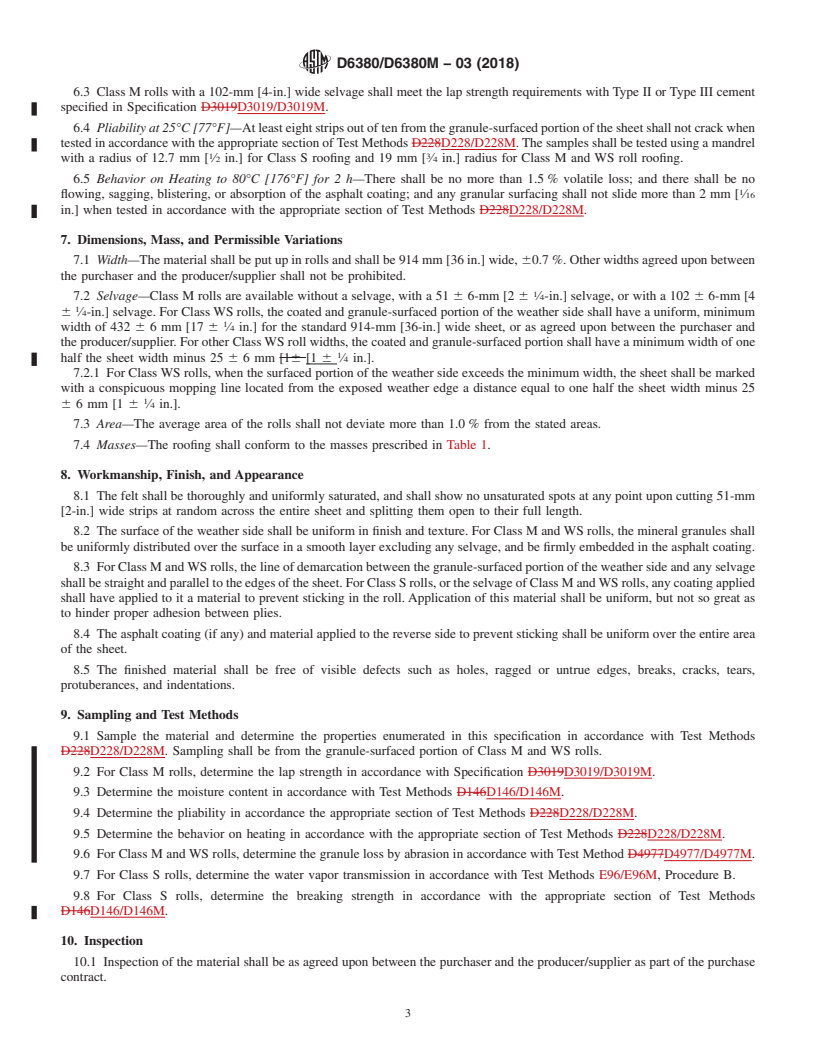
6.1 Class S rolls shall conform to the breaking strength and water permeance requirements prescribed in Table 1.
6.2 Upon being unrolled, the finished product shall not crack at ambient temperatures above 10°C [50°F] nor be so sticky at
any temperature below 60°C [140°F] as to cause tearing or material damage.
TABLE 1 Specifications for Asphalt Roll Roofing
Class S S M WS WS
Type III IV II III IV
Minimum net mass per unit area (of granule- 2495 [51.1] 1943 [39.8] 3490 [71.5] 1733 [35.5] 2090 [42.8]
surfaced portion for Classes M, and WS),
2 2
g/m [lb ⁄100 ft ]
Minimum net mass per standard roll,
average kg [lb]:
no selvage N/A N/A 36.5 [80.3] N/A N/A
2-in. selvage N/A N/A 35.6 [78.3] N/A N/A
4-in. selvage N/A N/A 36.5 [80.2] N/A N/A
wide selvage N/A N/A N/A 19.1 (42.0) 22.0 [48.5]
wide selvage N/A N/A N/A 19.1 [42.0] 22.0 [48.5]
Minimum mass of desaturated, moisture-free felt, 440 (9.0) 250 [5.2] 440 [9.0] 322 [6.6] 440 [9.0]
2 2
g/m [lb ⁄100 ft ]
Minimum mass of desaturated, moisture-free felt, 440 [9.0] 250 [5.2] 440 [9.0] 322 [6.6] 440 [9.0]
2 2
g/m [lb ⁄100 ft ]
Minimum mass of asphalt saturant, soluble in 150 120 150 140 150
1,1,1-trichloroethane, based on the mass
A
of desaturated, moisture free felt, %
Minimum mass of coating, surfacing (talc, both 879 [18.0] 879 [18.0] N/A N/A N/A
2 2
sides) and mineral stabilizer, g/m [lb/100 ft ]
Maximum mass of mineral matter passing a 60 60 60 60 60
212-μm [No. 70] sieve, based on mass of
the coating and surfacing (talc, both sides), %
Maximum % moisture at time of manufacture 3 3 3 3 3
Minimum mass of weather side coating and mineral N/A N/A 903 [18.5] 903 [18.5] 903 [18.5]
stabilizer (excluding surfacing; talc and/or [1582[32.4]] [1582]32.4]] [1582[32.4]]
2 2 2
granules), g/m [lb ⁄100 ft ], [maximum g/m
[lb/100ft ]]
Minimum mass of weather side coating and mineral N/A N/A 903 [18.5] 903 [18.5] 903 [18.5]
stabilizer (excluding surfacing; talc and/or [1582[32.4]] [1582[32.4]]
...
Questions, Comments and Discussion
Ask us and Technical Secretary will try to provide an answer. You can facilitate discussion about the standard in here.