


ASTM E1054-08(2013)
(Test Method)Standard Test Methods for Evaluation of Inactivators of Antimicrobial Agents
Standard Test Methods for Evaluation of Inactivators of Antimicrobial Agents
SIGNIFICANCE AND USE
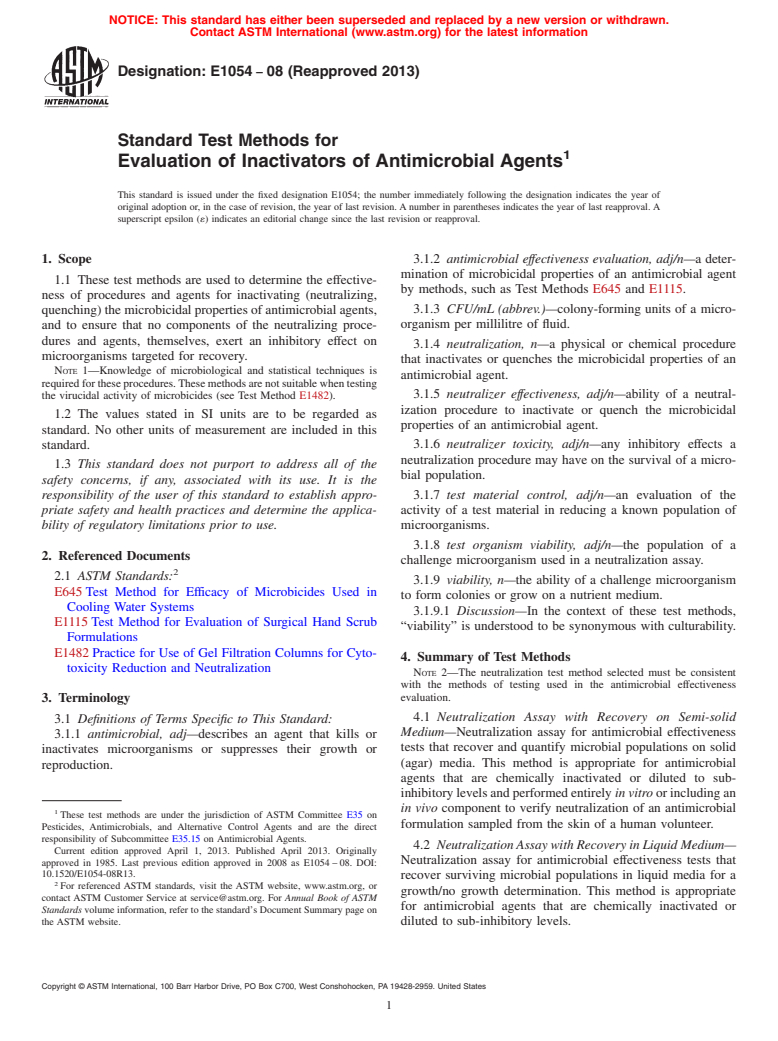
5.1 The effectiveness of antimicrobial agents incorporated into disinfectants, sanitizers, and antiseptics is measured by their ability to kill microorganisms within a specified contact time. Hence, accurate determination of antimicrobial effectiveness requires complete and immediate inactivation (neutralization) of the antimicrobial agent. Inefficient or incomplete neutralization will permit killing or inactivation of microorganisms to continue beyond the experimental exposure time, resulting in an overestimation of antimicrobial activity.
5.2 The neutralization methods commonly used in antimicrobial effectiveness evaluations are chemical inactivation, dilution, and filtration. All critical parameters of an antimicrobial effectiveness evaluation—for example, media, equipment, microorganism(s), and temperature of solutions—must be duplicated when evaluating a neutralization procedure to be used.
5.3 The neutralization evaluation must include at least three replications (five replications in Section 9) so that a statistical analysis of the recovery data can be performed. The number of replicates used in the evaluation depends on the statistical significance required for the expected results, the variability encountered in the data, and the relative effectiveness of the neutralization procedure.
5.4 A limitation of these evaluation procedures is that they use microorganisms that have not been exposed to an antimicrobial agent. Under experimental conditions, cells exposed to neutralization procedures are likely to be damaged to different degrees by the antimicrobial agent. Sublethal injury may be a factor in recovery, and the role of the neutralization procedure in recovery of injured organisms should be examined. This method is not intended to assess injured organism recovery.Note 3—Ideally, all microorganisms used in the antimicrobial effectiveness evaluation should be tested in the neutralization assay. However, representative organisms may be selected for ...
SCOPE
1.1 These test methods are used to determine the effectiveness of procedures and agents for inactivating (neutralizing, quenching) the microbicidal properties of antimicrobial agents, and to ensure that no components of the neutralizing procedures and agents, themselves, exert an inhibitory effect on microorganisms targeted for recovery.Note 1—Knowledge of microbiological and statistical techniques is required for these procedures. These methods are not suitable when testing the virucidal activity of microbicides (see Test Method E1482).
1.2 The values stated in SI units are to be regarded as standard. No other units of measurement are included in this standard.
1.3 This standard does not purport to address all of the safety concerns, if any, associated with its use. It is the responsibility of the user of this standard to establish appropriate safety and health practices and determine the applicability of regulatory limitations prior to use.
General Information
Standards Content (Sample)
NOTICE: This standard has either been superseded and replaced by a new version or withdrawn.
Contact ASTM International (www.astm.org) for the latest information
Designation: E1054 − 08 (Reapproved 2013)
Standard Test Methods for
Evaluation of Inactivators of Antimicrobial Agents
This standard is issued under the fixed designation E1054; the number immediately following the designation indicates the year of
original adoption or, in the case of revision, the year of last revision. A number in parentheses indicates the year of last reapproval. A
superscript epsilon (´) indicates an editorial change since the last revision or reapproval.
1. Scope 3.1.2 antimicrobial effectiveness evaluation, adj/n—a deter-
mination of microbicidal properties of an antimicrobial agent
1.1 These test methods are used to determine the effective-
by methods, such as Test Methods E645 and E1115.
ness of procedures and agents for inactivating (neutralizing,
quenching)themicrobicidalpropertiesofantimicrobialagents, 3.1.3 CFU/mL (abbrev.)—colony-forming units of a micro-
organism per millilitre of fluid.
and to ensure that no components of the neutralizing proce-
dures and agents, themselves, exert an inhibitory effect on
3.1.4 neutralization, n—a physical or chemical procedure
microorganisms targeted for recovery.
that inactivates or quenches the microbicidal properties of an
NOTE 1—Knowledge of microbiological and statistical techniques is
antimicrobial agent.
requiredfortheseprocedures.Thesemethodsarenotsuitablewhentesting
the virucidal activity of microbicides (see Test Method E1482). 3.1.5 neutralizer effectiveness, adj/n—ability of a neutral-
ization procedure to inactivate or quench the microbicidal
1.2 The values stated in SI units are to be regarded as
properties of an antimicrobial agent.
standard. No other units of measurement are included in this
3.1.6 neutralizer toxicity, adj/n—any inhibitory effects a
standard.
neutralization procedure may have on the survival of a micro-
1.3 This standard does not purport to address all of the
bial population.
safety concerns, if any, associated with its use. It is the
responsibility of the user of this standard to establish appro- 3.1.7 test material control, adj/n—an evaluation of the
priate safety and health practices and determine the applica- activity of a test material in reducing a known population of
bility of regulatory limitations prior to use. microorganisms.
3.1.8 test organism viability, adj/n—the population of a
2. Referenced Documents
challenge microorganism used in a neutralization assay.
2.1 ASTM Standards:
3.1.9 viability, n—the ability of a challenge microorganism
E645 Test Method for Efficacy of Microbicides Used in
to form colonies or grow on a nutrient medium.
Cooling Water Systems
3.1.9.1 Discussion—In the context of these test methods,
E1115 Test Method for Evaluation of Surgical Hand Scrub
“viability” is understood to be synonymous with culturability.
Formulations
E1482 Practice for Use of Gel Filtration Columns for Cyto-
4. Summary of Test Methods
toxicity Reduction and Neutralization
NOTE 2—The neutralization test method selected must be consistent
with the methods of testing used in the antimicrobial effectiveness
evaluation.
3. Terminology
4.1 Neutralization Assay with Recovery on Semi-solid
3.1 Definitions of Terms Specific to This Standard:
Medium—Neutralization assay for antimicrobial effectiveness
3.1.1 antimicrobial, adj—describes an agent that kills or
tests that recover and quantify microbial populations on solid
inactivates microorganisms or suppresses their growth or
(agar) media. This method is appropriate for antimicrobial
reproduction.
agents that are chemically inactivated or diluted to sub-
inhibitorylevelsandperformedentirely in vitroorincludingan
in vivo component to verify neutralization of an antimicrobial
These test methods are under the jurisdiction of ASTM Committee E35 on
formulation sampled from the skin of a human volunteer.
Pesticides, Antimicrobials, and Alternative Control Agents and are the direct
responsibility of Subcommittee E35.15 on Antimicrobial Agents.
4.2 NeutralizationAssay with Recovery in Liquid Medium—
Current edition approved April 1, 2013. Published April 2013. Originally
Neutralization assay for antimicrobial effectiveness tests that
approved in 1985. Last previous edition approved in 2008 as E1054 – 08. DOI:
10.1520/E1054-08R13.
recover surviving microbial populations in liquid media for a
For referenced ASTM standards, visit the ASTM website, www.astm.org, or
growth/no growth determination. This method is appropriate
contact ASTM Customer Service at service@astm.org. For Annual Book of ASTM
for antimicrobial agents that are chemically inactivated or
Standards volume information, refer to the standard’s Document Summary page on
the ASTM website. diluted to sub-inhibitory levels.
Copyright © ASTM International, 100 Barr Harbor Drive, PO Box C700, West Conshohocken, PA 19428-2959. United States
E1054 − 08 (2013)
4.3 Neutralization Assay with Recovery by Membrane 6.3 Incubator—Any incubator capable of maintaining an
Filtration—Neutralizationassayforantimicrobialeffectiveness appropriate temperature for growth of the test microorganism
tests that recover and quantify microbial populations by using may be used.
membrane filtration. This method is appropriate for antimicro-
6.4 Sterilizer—Any steam sterilizer capable of producing
bial agents that cannot be chemically inactivated or diluted to
the conditions of sterilization.
sub-inhibitory levels, as well as for those that can be.
6.5 Timer (stopwatch)—One that displays hours, minutes,
and seconds.
5. Significance and Use
6.6 Vortex Mixer or equivalent.
5.1 The effectiveness of antimicrobial agents incorporated
6.7 Membrane Filter Units—Any sterilizable unit that per-
into disinfectants, sanitizers, and antiseptics is measured by
mits filtration of microorganisms for enumeration. The mem-
their ability to kill microorganisms within a specified contact
brane filter unit must be chemically compatible with the
time. Hence, accurate determination of antimicrobial effective-
antimicrobial agent and appropriate to efficient recovery of the
ness requires complete and immediate inactivation (neutraliza-
test microorganisms.
tion) of the antimicrobial agent. Inefficient or incomplete
neutralizationwillpermitkillingorinactivationofmicroorgan-
7. Reagents and Materials
isms to continue beyond the experimental exposure time,
7.1 Phosphate Buffered Saline Dilution Water—PBS (see
resulting in an overestimation of antimicrobial activity.
Test Method E645).
5.2 The neutralization methods commonly used in antimi-
7.1.1 Phosphate Buffer Solution, Stock—Dissolve 34.0 g of
crobial effectiveness evaluations are chemical inactivation,
potassium dihydrogen phosphate (KH PO ) in 500 mL of
2 4
dilution, and filtration.All critical parameters of an antimicro-
water.Adjust pH to 7.2 6 0.2 with 0.1 N NaOH or 0.1 N HCl
bial effectiveness evaluation—for example, media, equipment,
and bring to 1000 mL with deionized water.
microorganism(s), and temperature of solutions—must be
7.1.2 Phosphate Buffer Saline Dilution Water—Add 1.25
duplicated when evaluating a neutralization procedure to be
mL of stock phosphate buffer solution and 8.75 g of NaCl to a
used.
volumetric flask, fill with deionized water to the 1000 mL
5.3 The neutralization evaluation must include at least three mark, and mix. Final pH should be adjusted to 7.2 6 0.2, if
replications (five replications in Section 9) so that a statistical necessary. Sterilize by filtration or autoclave.
analysis of the recovery data can be performed.The number of
7.2 Because the types of materials and reagents required for
replicates used in the evaluation depends on the statistical
various antimicrobial effectiveness evaluations are so diverse,
significance required for the expected results, the variability
it is impractical to list them in this method. The specific
encountered in the data, and the relative effectiveness of the
materials and reagents to be used in the antimicrobial effec-
neutralization procedure.
tiveness evaluation, however, should be tested in the neutral-
ization assay to confirm that the antimicrobial agent is being
5.4 A limitation of these evaluation procedures is that they
neutralized in a particular evaluation.
use microorganisms that have not been exposed to an antimi-
crobial agent. Under experimental conditions, cells exposed to
7.3 Table 1 provides a list of materials employed by
neutralization procedures are likely to be damaged to different
researchers to inactivate the microbicidal properties of various
degrees by the antimicrobial agent. Sublethal injury may be a
antimicrobial agents. This list is provided as a guide for
factor in recovery, and the role of the neutralization procedure
selecting neutralizers and is not exhaustive. A neutralization
in recovery of injured organisms should be examined. This
assay must be performed to determine a selected neutralizer’s
method is not intended to assess injured organism recovery.
effectiveness.
NOTE 3—Ideally, all microorganisms used in the antimicrobial effec-
tiveness evaluation should be tested in the neutralization assay. However, 8. Neutralization Assay with Recovery on Semi-solid
representative organisms may be selected for testing, as judged appropri-
Medium (Fig. 1)
atebytheinvestigator.Theinvestigatoriscautionedthatfailuretoidentify
8.1 The number of replicates necessary in the evaluation
neutralizer efficacy and toxicity for all microorganisms could result in
exaggerated microbial reductions in an antimicrobial effectiveness evalu-
dependsonthestatisticalsignificancerequiredfortheexpected
ation.Also, for a study testing multiple antimicrobial formulations, and in
results, the variability encountered in the data, and the relative
which samples will contain multiple species of microorganisms (for
effectiveness of the neutralization procedure. At least three
example, skin flora) that are exposed to the formulations, a single
replicates are required for these procedures.
procedure and/or combination of agents suitable for neutralizing the
antimicrobial activities of the multiple formulations must be used for
8.2 All tests must be performed in a timely manner so that
testing.
significant proliferation of the test organism does not occur.
8.3 Test A—Neutralization Effectiveness:
6. Apparatus
8.3.1 Inoculate the neutralizer with a volume of the chal-
6.1 Standard bacteriological devices and equipment should
lenge microbial suspension to result in a suspension that
be used for performance of the neutralization assay.
contains 30 to 100 CFU/mL of the microorganism.
6.2 Colony Counter—Any of several types may be used; for
NOTE 4—The challenge inoculum should be prepared in the same
example, Quebec colony counters and similar devices, or
manner to be used in the antimicrobial effectiveness evaluation. The
automated, computerized plater/counter systems. volume of the challenge inoculum should be kept to a minimum so that it
E1054 − 08 (2013)
A
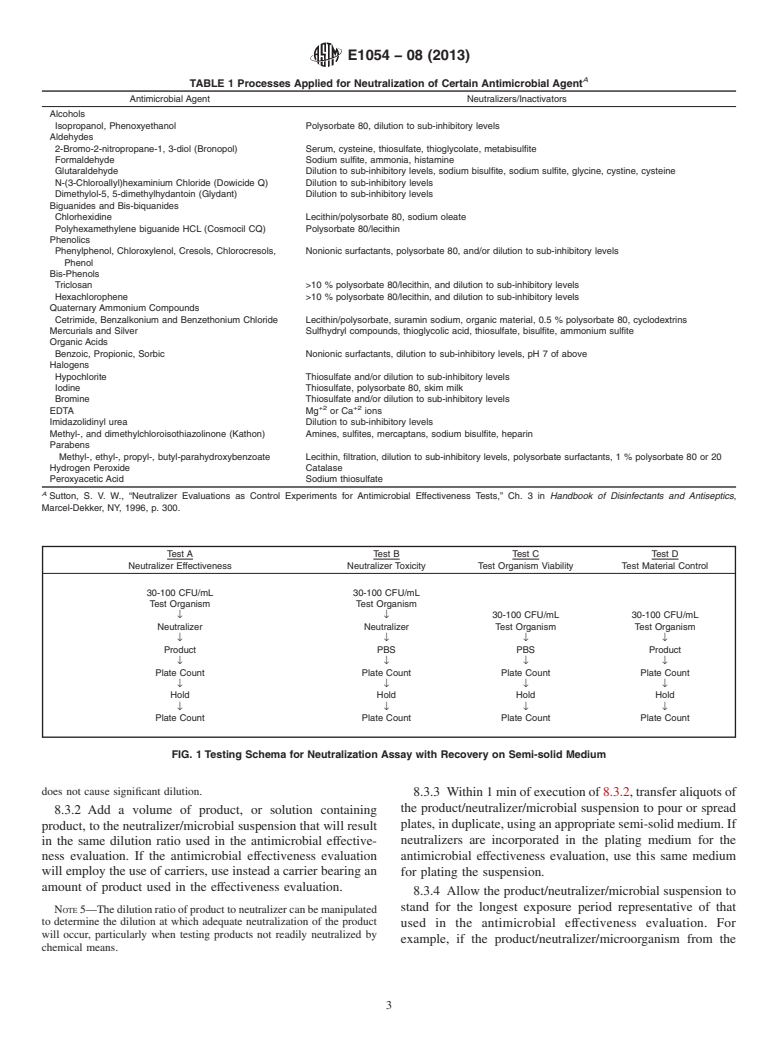
TABLE 1 Processes Applied for Neutralization of Certain Antimicrobial Agent
Antimicrobial Agent Neutralizers/Inactivators
Alcohols
Isopropanol, Phenoxyethanol Polysorbate 80, dilution to sub-inhibitory levels
Aldehydes
2-Bromo-2-nitropropane-1, 3-diol (Bronopol) Serum, cysteine, thiosulfate, thioglycolate, metabisulfite
Formaldehyde Sodium sulfite, ammonia, histamine
Glutaraldehyde Dilution to sub-inhibitory levels, sodium bisulfite, sodium sulfite, glycine, cystine, cysteine
N-(3-Chloroallyl)hexaminium Chloride (Dowicide Q) Dilution to sub-inhibitory levels
Dimethylol-5, 5-dimethylhydantoin (Glydant) Dilution to sub-inhibitory levels
Biguanides and Bis-biquanides
Chlorhexidine Lecithin/polysorbate 80, sodium oleate
Polyhexamethylene biguanide HCL (Cosmocil CQ) Polysorbate 80/lecithin
Phenolics
Phenylphenol, Chloroxylenol, Cresols, Chlorocresols, Nonionic surfactants, polysorbate 80, and/or dilution to sub-inhibitory levels
Phenol
Bis-Phenols
Triclosan >10 % polysorbate 80/lecithin, and dilution to sub-inhibitory levels
Hexachlorophene >10 % polysorbate 80/lecithin, and dilution to sub-inhibitory levels
Quaternary Ammonium Compounds
Cetrimide, Benzalkonium and Benzethonium Chloride Lecithin/polysorbate, suramin sodium, organic material, 0.5 % polysorbate 80, cyclodextrins
Mercurials and Silver Sulfhydryl compounds, thioglycolic acid, thiosulfate, bisulfite, ammonium sulfite
Organic Acids
Benzoic, Propionic, Sorbic Nonionic surfactants, dilution to sub-inhibitory levels, pH 7 of above
Halogens
Hypochlorite Thiosulfate and/or dilution to sub-inhibitory levels
Iodine Thiosulfate, polysorbate 80, skim milk
Bromine Thiosulfate and/or dilution to sub-inhibitory levels
+2 +2
EDTA Mg or Ca ions
Imidazolidinyl urea Dilution to sub-inhibitory levels
Methyl-, and dimethylchloroisothiazolinone (Kathon) Amines, sulfites, mercaptans, sodium bisulfite, heparin
Parabens
Methyl-, ethyl-, propyl-, butyl-parahydroxybenzoate Lecithin, filtration, dilution to sub-inhibitory levels, polysorbate surfactants, 1 % polysorbate 80 or 20
Hydrogen Peroxide Catalase
Peroxyacetic Acid Sodium thiosulfate
A
Sutton, S. V. W., “Neutralizer Evaluations as Control Experiments for Antimicrobial Effectiveness Tests,” Ch. 3 in Handbook of Disinfectants and Antiseptics,
Marcel-Dekker, NY, 1996, p. 300.
Test A Test B Test C Test D
Neutralizer Effectiveness Neutralizer Toxicity Test Organism Viability Test Material Control
30-100 CFU/mL 30-100 CFU/mL
Test Organism Test Organism
↓↓ 30-100 CFU/mL 30-100 CFU/mL
Neutralizer Neutralizer Test Organism Test Organism
↓ ↓↓↓
Product PBS PBS Product
↓ ↓↓↓
Plate Count Plate Count Plate Count Plate Count
↓ ↓↓↓
Hold Hold Hold Hold
↓ ↓↓↓
Plate Count Plate Count Plate Count Plate Count
FIG. 1 Testing Schema for Neutralization Assay with Recovery on Semi-solid Medium
does not cause significant dilution.
8.3.3 Within1minofexecutionof8.3.2,transferaliquotsof
the product/neutralizer/microbial suspension to pour or spread
8.3.2 Add a volume of product, or solution containing
plates,induplicate,usinganappropriatesemi-solidmedium.If
product, to the neutralizer/microbial suspension that will result
neutralizers are incorporated in the plating medium for the
in the same dilution ratio used in the antimicrobial effective-
ness evaluation. If the antimicrobial effectiveness evaluation antimicrobial effectiveness evaluation, use this same medium
will employ the use of carriers, use instead a carrier bearing an for plating the suspension.
amount of product used in the effectiveness evaluation.
8.3.4 Allow the product/neutralizer/microbial suspension to
stand for the longest exposure period representative of that
NOTE5—Thedilutionratioofproducttoneutralizercanbemanipulated
to determine the dilution at which adequate neutralization of the product
used in the antimicrobia
...
Questions, Comments and Discussion
Ask us and Technical Secretary will try to provide an answer. You can facilitate discussion about the standard in here.