


ASTM D3943-10(2015)
(Test Method)Standard Test Method for Total Molybdenum in Fresh Alumina-Base Catalysts
Standard Test Method for Total Molybdenum in Fresh Alumina-Base Catalysts
SIGNIFICANCE AND USE
4.1 This test method sets forth a procedure by which catalyst samples can be compared either on an interlaboratory or intralaboratory basis. It is anticipated that catalyst producers and users will find this method of value.
SCOPE
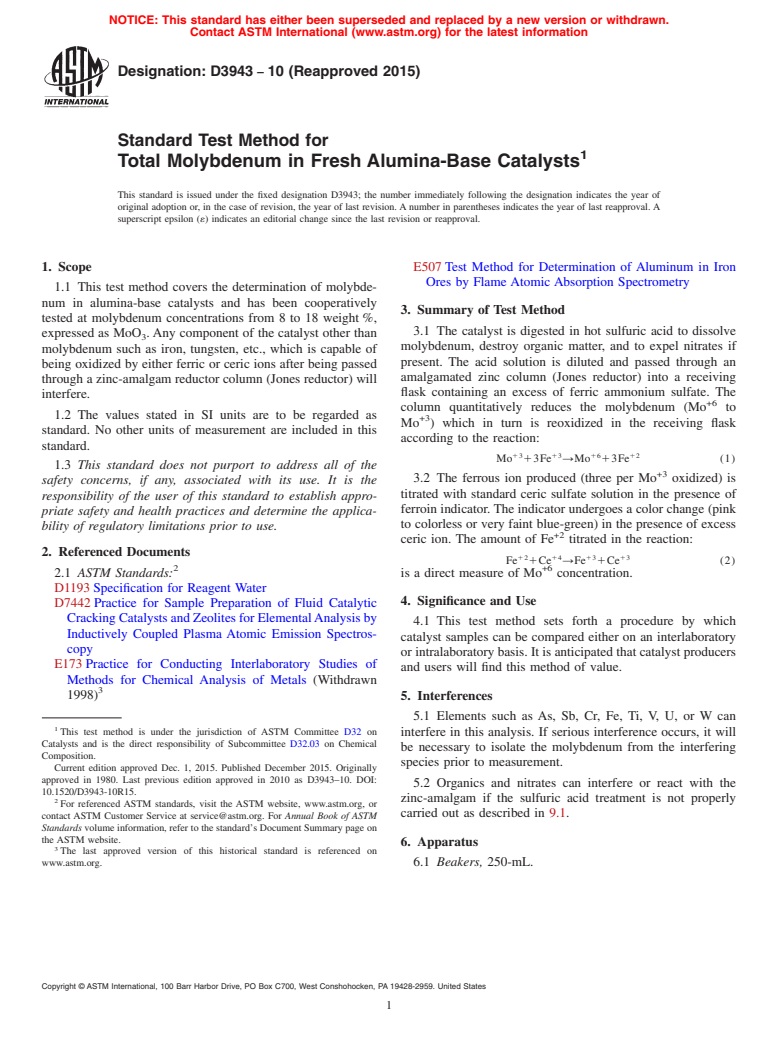
1.1 This test method covers the determination of molybdenum in alumina-base catalysts and has been cooperatively tested at molybdenum concentrations from 8 to 18 weight %, expressed as MoO3. Any component of the catalyst other than molybdenum such as iron, tungsten, etc., which is capable of being oxidized by either ferric or ceric ions after being passed through a zinc-amalgam reductor column (Jones reductor) will interfere.
1.2 The values stated in SI units are to be regarded as standard. No other units of measurement are included in this standard.
1.3 This standard does not purport to address all of the safety concerns, if any, associated with its use. It is the responsibility of the user of this standard to establish appropriate safety and health practices and determine the applicability of regulatory limitations prior to use.
General Information
Buy Standard
Standards Content (Sample)
NOTICE: This standard has either been superseded and replaced by a new version or withdrawn.
Contact ASTM International (www.astm.org) for the latest information
Designation: D3943 − 10 (Reapproved 2015)
Standard Test Method for
Total Molybdenum in Fresh Alumina-Base Catalysts
This standard is issued under the fixed designation D3943; the number immediately following the designation indicates the year of
original adoption or, in the case of revision, the year of last revision. A number in parentheses indicates the year of last reapproval. A
superscript epsilon (´) indicates an editorial change since the last revision or reapproval.
1. Scope E507 Test Method for Determination of Aluminum in Iron
Ores by Flame Atomic Absorption Spectrometry
1.1 This test method covers the determination of molybde-
num in alumina-base catalysts and has been cooperatively
3. Summary of Test Method
tested at molybdenum concentrations from 8 to 18 weight %,
3.1 The catalyst is digested in hot sulfuric acid to dissolve
expressed as MoO . Any component of the catalyst other than
molybdenum, destroy organic matter, and to expel nitrates if
molybdenum such as iron, tungsten, etc., which is capable of
present. The acid solution is diluted and passed through an
being oxidized by either ferric or ceric ions after being passed
amalgamated zinc column (Jones reductor) into a receiving
through a zinc-amalgam reductor column (Jones reductor) will
flask containing an excess of ferric ammonium sulfate. The
interfere.
+6
column quantitatively reduces the molybdenum (Mo to
1.2 The values stated in SI units are to be regarded as
+3
Mo ) which in turn is reoxidized in the receiving flask
standard. No other units of measurement are included in this
according to the reaction:
standard.
13 13 16 12
Mo 13Fe →Mo 13Fe (1)
1.3 This standard does not purport to address all of the
+3
3.2 The ferrous ion produced (three per Mo oxidized) is
safety concerns, if any, associated with its use. It is the
titrated with standard ceric sulfate solution in the presence of
responsibility of the user of this standard to establish appro-
ferroin indicator. The indicator undergoes a color change (pink
priate safety and health practices and determine the applica-
to colorless or very faint blue-green) in the presence of excess
bility of regulatory limitations prior to use.
+2
ceric ion. The amount of Fe titrated in the reaction:
2. Referenced Documents
12 14 13 13
Fe 1Ce →Fe 1Ce (2)
+6
2.1 ASTM Standards:
is a direct measure of Mo concentration.
D1193 Specification for Reagent Water
4. Significance and Use
D7442 Practice for Sample Preparation of Fluid Catalytic
CrackingCatalystsandZeolitesforElementalAnalysisby
4.1 This test method sets forth a procedure by which
Inductively Coupled Plasma Atomic Emission Spectros-
catalyst samples can be compared either on an interlaboratory
copy
or intralaboratory basis. It is anticipated that catalyst producers
E173 Practice for Conducting Interlaboratory Studies of
and users will find this method of value.
Methods for Chemical Analysis of Metals (Withdrawn
1998)
5. Interferences
5.1 Elements such as As, Sb, Cr, Fe, Ti, V, U, or W can
This test method is under the jurisdiction of ASTM Committee D32 on
interfere in this analysis. If serious interference occurs, it will
Catalysts and is the direct responsibility of Subcommittee D32.03 on Chemical
be necessary to isolate the molybdenum from the interfering
Composition.
species prior to measurement.
Current edition approved Dec. 1, 2015. Published December 2015. Originally
approved in 1980. Last previous edition approved in 2010 as D3943–10. DOI:
5.2 Organics and nitrates can interfere or react with the
10.1520/D3943-10R15.
2 zinc-amalgam if the sulfuric acid treatment is not properly
For referenced ASTM standards, visit the ASTM website, www.astm.org, or
carried out as described in 9.1.
contact ASTM Customer Service at service@astm.org. For Annual Book of ASTM
Standards volume information, refer to the standard’s Document Summary page on
the ASTM website.
6. Apparatus
The last approved version of this historical standard is referenced on
www.astm.org. 6.1 Beakers, 250-mL.
Copyright © ASTM International, 100 Barr Harbor Drive, PO Box C700, West Conshohocken, PA 19428-2959. United States
D3943 − 10 (2015)
6.2 Jones Reductor Column, 30-cm long by 2 cm in outer 7.10 Phosphoric Acid (H PO ), concentrated—Mix 130 mL
3 4
diameter, with a 100-mL reservoir. Attach a piece of vinyl of concentrated H SO with 250 mL of water. Add the acid
2 4
tubing to the end of the delivery tube long enough to extend to slowly with constant stirring. Add 140 mL of concentrated
the bottom of the filtering flask (see Test Method E507). H PO and 15 mL of a saturated solution of MnSO (approxi-
3 4 4
mately 60 g/100 mL). Dilute to 1000 mL with water.
6.3 Vacuum Filtering Flask, heavy-walled, 1000-mL.
7.11 Potassium Permanganate (KMnO ), approximately
6.4 Buret, 50-mL, Class A (0.1-mL divisions).
0.1 M solution.
6.5 Stirring Motor, magnetic, and TFE-fluorocarbon-
7.12 Sulfuric Acid (H SO ), concentrated, 1 + 1 and 1 + 19,
2 4
covered stirring bars, 7.11 by 14.2 mm.
dilutions with water, corresponding to 18 and 1.8 N solutions,
respectively. Cautiously add the concentrated sulfuric acid to
7. Reagents
the water, mix well, and allow to cool.
7.1 Purity of Reagents—Reagent grade chemicals shall be
7.13 Sulfuric Acid (H SO ), dilute, 1 + 99, warm, dilutions
2 4
used in all tests. Unless otherwise indicated, it is intended that
with water, corresponding to 0.18 N solution. Cautiously add
all reagents shall conform to the specifications of the Commit-
the concentrated sulfuric acid to the water and mix well.
tee onAnalytical Reagents of theAmerican Chemical Society,
7.14 Zinc Metal, 20 mesh, low iron content.
where such specifications are available. Other grades may be
used provided it is first ascertained that the reagent is of
8. Sampling
sufficiently high purity to permit its use without lessening the
8.1 The selection of a representative analytical sample from
accuracy of the determination.
the bulk material is outside the scope of the present method. It
7.2 Purity of Water—Unless otherwise indicated, references
is presumed that parties using this test method for comparison
to water shall be understood to mean reagent water conforming
purposes will have agreed on the selection of an analytical
to Specification D1193.
sample which is appropriate to their needs.
7.3 Ceric Sulfate, 0.10 N standardized using sodium molyb-
8.2 Pulverize the analytical sample to pass a 150-µm (No.
date following the procedure given in Annex A2.
100) sieve. Ignite the pulverized sample for 30 min at 550°C in
NOTE 1—Refer to Section 8 on Hazards in Practice D7442 for hazards
a muffle furnace. Allow to cool in a desiccator.
associated with handling of acids.
9. Procedure
7.4 Ferric Ammonium Sulfate Solution—[FeNH (SO ) ·12
4 4 2
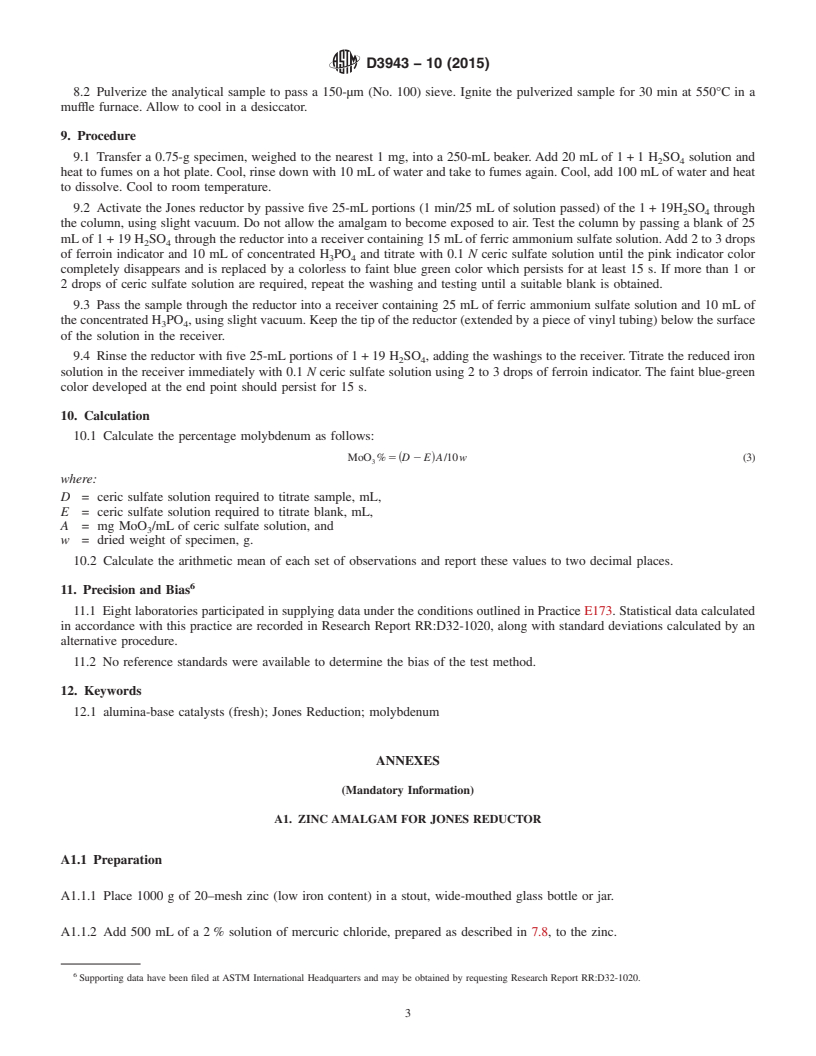
H O]—Dissolve 200 g of [FeNH (SO ) ·12 H O] in 1000 mL 9.1 Transfer a 0.75-g specimen, weighed to the nearest 1
2 4 4 2 2
of water containing 20 mL of concentrated sulfuric acid. Add mg, into a 250-mLbeaker.Add 20 mLof 1 + 1 H SO solution
2 4
potassium permanganate solution dropwise until a pink color and heat to fumes on a hot plate. Cool, rinse down with 10 mL
persists for 1 min. of water and take to fumes again. Cool, add 100 mL of water
and heat to dissolve. Cool to room temperature.
7.5 Ferroin Indicator, 0.025 M solution of 1, 10-
phenanthroline ferrous sulfate complex. 9.2 Activate the Jones reductor by passive five 25-mL
portions (1 min/25 mL of solution passed) of the 1 + 19H SO
2 4
7.6 Hydrochloric Acid (HCl), concentrated.
through the column, using slight vacuum. Do not allow the
7.7 Jones Reductor Amalgam.
amalgam to become exposed to air.Test the column by passing
a blank of 25 mL of 1 + 19 H SO through the reductor into a
7.8 Mercuric Chloride (HgCl ) Solution, approximately
2 4
receiver c
...
This document is not an ASTM standard and is intended only to provide the user of an ASTM standard an indication of what changes have been made to the previous version. Because
it may not be technically possible to adequately depict all changes accurately, ASTM recommends that users consult prior editions as appropriate. In all cases only the current version
of the standard as published by ASTM is to be considered the official document.
Designation: D3943 − 10 D3943 − 10 (Reapproved 2015)
Standard Test Method for
Total Molybdenum in Fresh Alumina-Base Catalysts
This standard is issued under the fixed designation D3943; the number immediately following the designation indicates the year of
original adoption or, in the case of revision, the year of last revision. A number in parentheses indicates the year of last reapproval. A
superscript epsilon (´) indicates an editorial change since the last revision or reapproval.
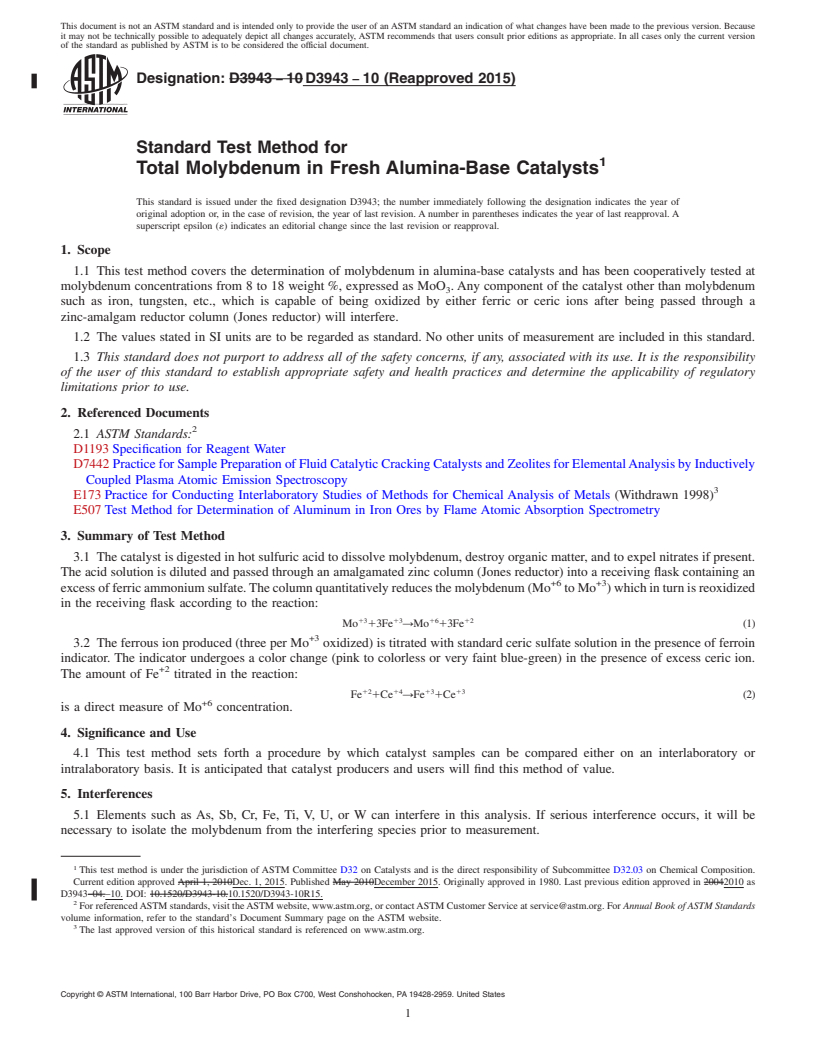
1. Scope
1.1 This test method covers the determination of molybdenum in alumina-base catalysts and has been cooperatively tested at
molybdenum concentrations from 8 to 18 weight %, expressed as MoO . Any component of the catalyst other than molybdenum
such as iron, tungsten, etc., which is capable of being oxidized by either ferric or ceric ions after being passed through a
zinc-amalgam reductor column (Jones reductor) will interfere.
1.2 The values stated in SI units are to be regarded as standard. No other units of measurement are included in this standard.
1.3 This standard does not purport to address all of the safety concerns, if any, associated with its use. It is the responsibility
of the user of this standard to establish appropriate safety and health practices and determine the applicability of regulatory
limitations prior to use.
2. Referenced Documents
2.1 ASTM Standards:
D1193 Specification for Reagent Water
D7442 Practice for Sample Preparation of Fluid Catalytic Cracking Catalysts and Zeolites for Elemental Analysis by Inductively
Coupled Plasma Atomic Emission Spectroscopy
E173 Practice for Conducting Interlaboratory Studies of Methods for Chemical Analysis of Metals (Withdrawn 1998)
E507 Test Method for Determination of Aluminum in Iron Ores by Flame Atomic Absorption Spectrometry
3. Summary of Test Method
3.1 The catalyst is digested in hot sulfuric acid to dissolve molybdenum, destroy organic matter, and to expel nitrates if present.
The acid solution is diluted and passed through an amalgamated zinc column (Jones reductor) into a receiving flask containing an
+6 +3
excess of ferric ammonium sulfate. The column quantitatively reduces the molybdenum (Mo to Mo ) which in turn is reoxidized
in the receiving flask according to the reaction:
13 13 16 12
Mo 13Fe →Mo 13Fe (1)
+3
3.2 The ferrous ion produced (three per Mo oxidized) is titrated with standard ceric sulfate solution in the presence of ferroin
indicator. The indicator undergoes a color change (pink to colorless or very faint blue-green) in the presence of excess ceric ion.
+2
The amount of Fe titrated in the reaction:
12 14 13 13
Fe 1Ce →Fe 1Ce (2)
+6
is a direct measure of Mo concentration.
4. Significance and Use
4.1 This test method sets forth a procedure by which catalyst samples can be compared either on an interlaboratory or
intralaboratory basis. It is anticipated that catalyst producers and users will find this method of value.
5. Interferences
5.1 Elements such as As, Sb, Cr, Fe, Ti, V, U, or W can interfere in this analysis. If serious interference occurs, it will be
necessary to isolate the molybdenum from the interfering species prior to measurement.
This test method is under the jurisdiction of ASTM Committee D32 on Catalysts and is the direct responsibility of Subcommittee D32.03 on Chemical Composition.
Current edition approved April 1, 2010Dec. 1, 2015. Published May 2010December 2015. Originally approved in 1980. Last previous edition approved in 20042010 as
D3943–04.–10. DOI: 10.1520/D3943-10.10.1520/D3943-10R15.
For referenced ASTM standards, visit the ASTM website, www.astm.org, or contact ASTM Customer Service at service@astm.org. For Annual Book of ASTM Standards
volume information, refer to the standard’s Document Summary page on the ASTM website.
The last approved version of this historical standard is referenced on www.astm.org.
Copyright © ASTM International, 100 Barr Harbor Drive, PO Box C700, West Conshohocken, PA 19428-2959. United States
D3943 − 10 (2015)
5.2 Organics and nitrates can interfere or react with the zinc-amalgam if the sulfuric acid treatment is not properly carried out
as described in 9.1.
6. Apparatus
6.1 Beakers, 250-mL.
6.2 Jones Reductor Column, 30-cm long by 2 cm in outer diameter, with a 100-mL reservoir. Attach a piece of vinyl tubing
to the end of the delivery tube long enough to extend to the bottom of the filtering flask (see Test Method E507).
6.3 Vacuum Filtering Flask, heavy-walled, 1000-mL.
6.4 Buret, 50-mL, Class A (0.1-mL divisions).
6.5 Stirring Motor, magnetic, and TFE-fluorocarbon-covered stirring bars, 7.11 by 14.2 mm.
7. Reagents
7.1 Purity of Reagents—Reagent grade chemicals shall be used in all tests. Unless otherwise indicated, it is intended that all
reagents shall conform to the specifications of the Committee on Analytical Reagents of the American Chemical Society, where
such specifications are available. Other grades may be used provided it is first ascertained that the reagent is of sufficiently high
purity to permit its use without lessening the accuracy of the determination.
7.2 Purity of Water—Unless otherwise indicated, references to water shall be understood to mean reagent water conforming to
Specification D1193.
7.3 Ceric Sulfate, 0.10 N standardized using sodium molybdate following the procedure given in Annex A2.
NOTE 1—Refer to Section 8 on Hazards in Practice D7442 for hazards associated with handling of acids.
7.4 Ferric Ammonium Sulfate Solution—[FeNH (SO ) ·12 H O]—Dissolve 200 g of [FeNH (SO ) ·12 H O] in 1000 mL of
4 4 2 2 4 4 2 2
water containing 20 mL of concentrated sulfuric acid. Add potassium permanganate solution dropwise until a pink color persists
for 1 min.
7.5 Ferroin Indicator, 0.025 M solution of 1, 10-phenanthroline ferrous sulfate complex.
7.6 Hydrochloric Acid (HCl), concentrated.
7.7 Jones Reductor Amalgam.
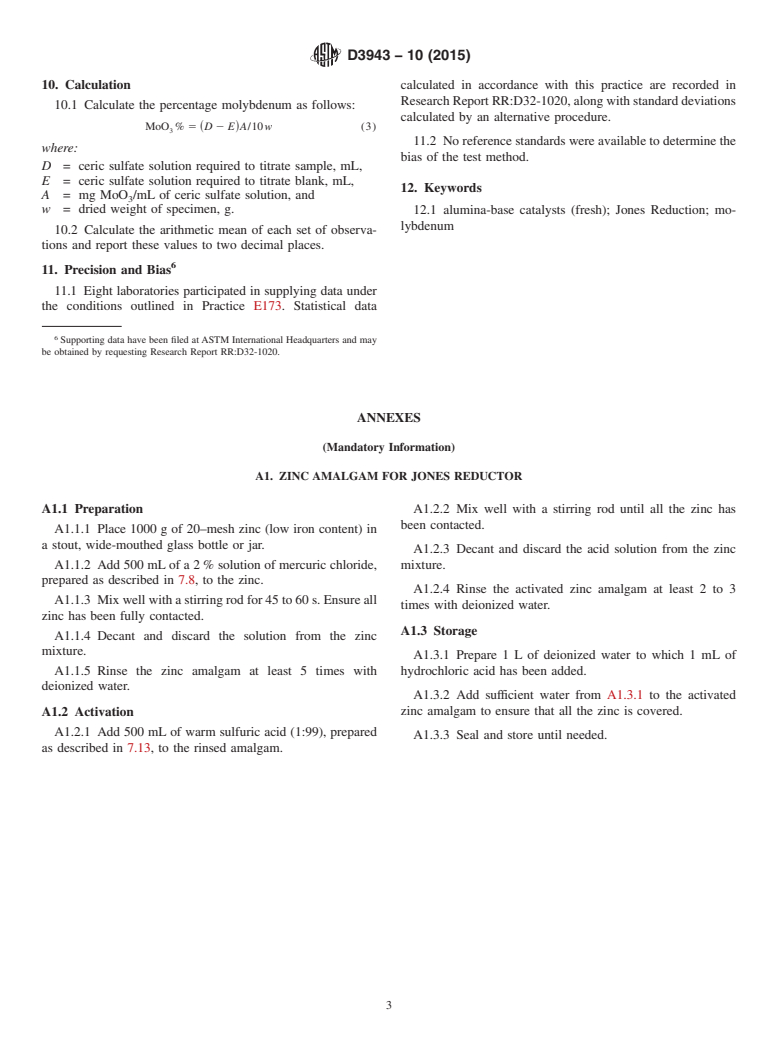
7.8 Mercuric Chloride (HgCl ) Solution, approximately 2 %. Dissolve 10 g of mercuric chloride (HgCl ) in water. Transfer to
2 2
a 500–mL volumetric flask, dilute to volume, and mix.
7.9 Molybdenum Standard Solution—Dissolve 1.0 g, weighed to the nearest 0.1 mg, of sodium molybdate dihydrate
(Na MoO ·2H O) in water containing 10 mL of H SO , transfer to a 1-L volumetric flask, dilute to volume, and mix (1 mL =
2 4 2 2 4
0.5948 mg MoO ).
7.10 Phosphoric Acid (H PO ), concentrated—Mix 130 mL of concentrated H SO with 250 mL of water. Add the acid slowly
3 4 2 4
with constant stirring. Add 140 mL of concentrated H PO and 15 mL of a saturated solution of MnSO (approximately 60 g/100
3 4 4
mL). Dilute to 1000 mL with water.
7.11 Potassium Permanganate (KMnO ), approximately 0.1 M solution.
7.12 Sulfuric Acid (H SO ), concentrated, 1 + 1 and 1 + 19, dilutions with water, corresponding to 18 and 1.8 N solutions,
2 4
respectively. Cautiously add the concentrated sulfuric acid to the water, mix well, and allow to cool.
7.13 Sulfuric Acid (H SO ), dilute, 1 + 99, warm, dilutions with water, corresponding to 0.18 N solution. Cautiously add the
2 4
concentrated sulfuric acid to the water and mix well.
7.14 Zinc Metal, 20 mesh, low iron content.
8. Sampling
8.1 The selection of a representative analytical sample from the bulk material is outside the scope of the present method. It is
presumed that parties using this test method for comparison purposes will have agreed on the selection of an analytical sample
which is appropriate to their needs.
The sole source of supply of the apparatus known to the committee at this time is Part No. 8035-J10 from Thomas Scientific, 99 High Hill Rd. at 295, Swedesboro, NJ
08085. If you are aware of alternative suppliers, please provide this information to ASTM International Headquarters. Your comments will recei
...
Questions, Comments and Discussion
Ask us and Technical Secretary will try to provide an answer. You can facilitate discussion about the standard in here.