


ASTM B766-86(2015)
(Specification)Standard Specification for Electrodeposited Coatings of Cadmium
Standard Specification for Electrodeposited Coatings of Cadmium
ABSTRACT
This specification covers the requirements for electrodeposited cadmium coatings on products of iron, steel, and other metals. Cadmium coatings are used for corrosion resistance and for corrosion prevention of the basis metal part. The as deposited coating (Type I) is useful for the lowest cost protection in a mild or noncorrosive environment where early formation of white corrosion products is not detrimental or harmful to the function of a component. The prime purpose of the supplementary chromate finishes (Types II and III) on the electroplated cadmium is to increase corrosion resistance.Electrodeposited cadmium coatings shall be classified on the basis of thickness as Class 25, 12, 8, and 5. The coating shall be essentially pure cadmium produced by electrodeposition usually from an alkaline cyanide solution. The basis metal shall be subjected to such cleaning procedures as necessary to ensure a surface satisfactory for subsequent electroplating. Cadmium shall be deposited directly on the basis metal part without an undercoat of another metal except when the part is either stainless steel or aluminum and its alloys. The plating shall be applied after all basis metal heat treatments and mechanical operations. The thickness of the coating everywhere on the significant surface shall conform to the requirements of the specified class. The cadmium coating shall be sufficiently adherent to the basis metal to pass the tests. The supplementary Type II chromate film shall be adherent, nonpowdery, and abrasion resistant. The thickness of electrodeposited cadmium coatings shall be determined by the applicable test methods.
SCOPE
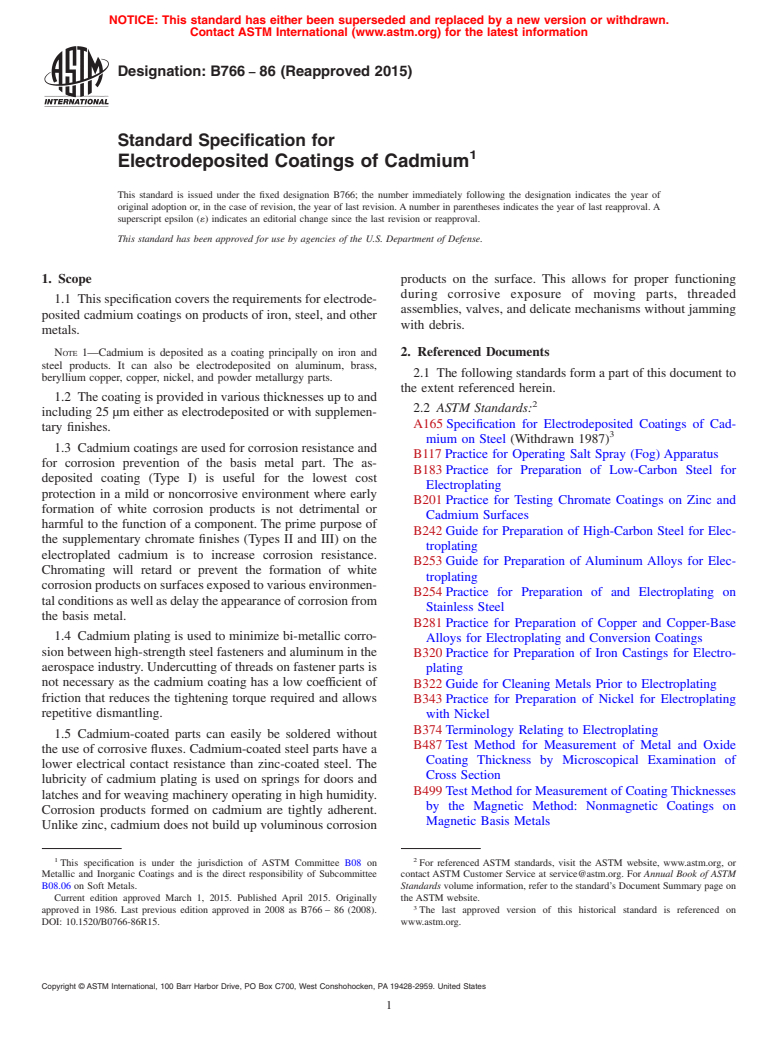
1.1 This specification covers the requirements for electrodeposited cadmium coatings on products of iron, steel, and other metals.
Note 1: Cadmium is deposited as a coating principally on iron and steel products. It can also be electrodeposited on aluminum, brass, beryllium copper, copper, nickel, and powder metallurgy parts.
1.2 The coating is provided in various thicknesses up to and including 25 μm either as electrodeposited or with supplementary finishes.
1.3 Cadmium coatings are used for corrosion resistance and for corrosion prevention of the basis metal part. The as-deposited coating (Type I) is useful for the lowest cost protection in a mild or noncorrosive environment where early formation of white corrosion products is not detrimental or harmful to the function of a component. The prime purpose of the supplementary chromate finishes (Types II and III) on the electroplated cadmium is to increase corrosion resistance. Chromating will retard or prevent the formation of white corrosion products on surfaces exposed to various environmental conditions as well as delay the appearance of corrosion from the basis metal.
1.4 Cadmium plating is used to minimize bi-metallic corrosion between high-strength steel fasteners and aluminum in the aerospace industry. Undercutting of threads on fastener parts is not necessary as the cadmium coating has a low coefficient of friction that reduces the tightening torque required and allows repetitive dismantling.
1.5 Cadmium-coated parts can easily be soldered without the use of corrosive fluxes. Cadmium-coated steel parts have a lower electrical contact resistance than zinc-coated steel. The lubricity of cadmium plating is used on springs for doors and latches and for weaving machinery operating in high humidity. Corrosion products formed on cadmium are tightly adherent. Unlike zinc, cadmium does not build up voluminous corrosion products on the surface. This allows for proper functioning during corrosive exposure of moving parts, threaded assemblies, valves, and delicate mechanisms without jamming with debris.
General Information
Buy Standard
Standards Content (Sample)
NOTICE: This standard has either been superseded and replaced by a new version or withdrawn.
Contact ASTM International (www.astm.org) for the latest information
Designation: B766 − 86 (Reapproved 2015)
Standard Specification for
Electrodeposited Coatings of Cadmium
This standard is issued under the fixed designation B766; the number immediately following the designation indicates the year of
original adoption or, in the case of revision, the year of last revision. A number in parentheses indicates the year of last reapproval. A
superscript epsilon (´) indicates an editorial change since the last revision or reapproval.
This standard has been approved for use by agencies of the U.S. Department of Defense.
1. Scope products on the surface. This allows for proper functioning
during corrosive exposure of moving parts, threaded
1.1 This specification covers the requirements for electrode-
assemblies, valves, and delicate mechanisms without jamming
posited cadmium coatings on products of iron, steel, and other
with debris.
metals.
NOTE 1—Cadmium is deposited as a coating principally on iron and 2. Referenced Documents
steel products. It can also be electrodeposited on aluminum, brass,
2.1 The following standards form a part of this document to
beryllium copper, copper, nickel, and powder metallurgy parts.
the extent referenced herein.
1.2 The coating is provided in various thicknesses up to and
2.2 ASTM Standards:
including 25 µm either as electrodeposited or with supplemen-
A165 Specification for Electrodeposited Coatings of Cad-
tary finishes.
mium on Steel (Withdrawn 1987)
1.3 Cadmium coatings are used for corrosion resistance and
B117 Practice for Operating Salt Spray (Fog) Apparatus
for corrosion prevention of the basis metal part. The as-
B183 Practice for Preparation of Low-Carbon Steel for
deposited coating (Type I) is useful for the lowest cost
Electroplating
protection in a mild or noncorrosive environment where early
B201 Practice for Testing Chromate Coatings on Zinc and
formation of white corrosion products is not detrimental or
Cadmium Surfaces
harmful to the function of a component. The prime purpose of
B242 Guide for Preparation of High-Carbon Steel for Elec-
the supplementary chromate finishes (Types II and III) on the
troplating
electroplated cadmium is to increase corrosion resistance.
B253 Guide for Preparation of Aluminum Alloys for Elec-
Chromating will retard or prevent the formation of white
troplating
corrosion products on surfaces exposed to various environmen-
B254 Practice for Preparation of and Electroplating on
tal conditions as well as delay the appearance of corrosion from
Stainless Steel
the basis metal.
B281 Practice for Preparation of Copper and Copper-Base
1.4 Cadmium plating is used to minimize bi-metallic corro-
Alloys for Electroplating and Conversion Coatings
sion between high-strength steel fasteners and aluminum in the
B320 Practice for Preparation of Iron Castings for Electro-
aerospace industry. Undercutting of threads on fastener parts is
plating
not necessary as the cadmium coating has a low coefficient of
B322 Guide for Cleaning Metals Prior to Electroplating
friction that reduces the tightening torque required and allows
B343 Practice for Preparation of Nickel for Electroplating
repetitive dismantling.
with Nickel
B374 Terminology Relating to Electroplating
1.5 Cadmium-coated parts can easily be soldered without
B487 Test Method for Measurement of Metal and Oxide
the use of corrosive fluxes. Cadmium-coated steel parts have a
Coating Thickness by Microscopical Examination of
lower electrical contact resistance than zinc-coated steel. The
Cross Section
lubricity of cadmium plating is used on springs for doors and
B499 Test Method for Measurement of Coating Thicknesses
latches and for weaving machinery operating in high humidity.
by the Magnetic Method: Nonmagnetic Coatings on
Corrosion products formed on cadmium are tightly adherent.
Magnetic Basis Metals
Unlike zinc, cadmium does not build up voluminous corrosion
1 2
This specification is under the jurisdiction of ASTM Committee B08 on For referenced ASTM standards, visit the ASTM website, www.astm.org, or
Metallic and Inorganic Coatings and is the direct responsibility of Subcommittee contact ASTM Customer Service at service@astm.org. For Annual Book of ASTM
B08.06 on Soft Metals. Standards volume information, refer to the standard’s Document Summary page on
Current edition approved March 1, 2015. Published April 2015. Originally the ASTM website.
approved in 1986. Last previous edition approved in 2008 as B766 – 86 (2008). The last approved version of this historical standard is referenced on
DOI: 10.1520/B0766-86R15. www.astm.org.
Copyright © ASTM International, 100 Barr Harbor Drive, PO Box C700, West Conshohocken, PA 19428-2959. United States
B766 − 86 (2015)
cessed as either Type II or Type III.
B504 Test Method for Measurement of Thickness of Metal-
lic Coatings by the Coulometric Method
5. Ordering Information
B507 Practice for Design of Articles to Be Electroplated on
Racks
5.1 In order to make the application of this specification
B558 Practice for Preparation of Nickel Alloys for Electro-
complete, the purchaser needs to supply the following infor-
plating
mation to the seller in the purchase order or other governing
B567 Test Method for Measurement of Coating Thickness
document:
by the Beta Backscatter Method
5.1.1 The name, designation, and date of issue of this
B568 Test Method for Measurement of Coating Thickness
specification.
by X-Ray Spectrometry
5.1.2 Deposit by class and type (4.1 and 4.2).
B571 Practice for Qualitative Adhesion Testing of Metallic
5.1.3 Composition and metallurgical condition of the sub-
Coatings
strate to be coated. Application to high-strength steel parts
B602 Test Method for Attribute Sampling of Metallic and
(6.2).
Inorganic Coatings
5.1.4 Heat treatment for stress relief, whether it has been
B697 Guide for Selection of Sampling Plans for Inspection
performed or is required (6.3).
of Electrodeposited Metallic and Inorganic Coatings
5.1.5 Additional undercoat, if required (6.5).
E8 Test Methods for Tension Testing of Metallic Materials
5.1.6 Plating process variation, if required (6.6).
F519 Test Method for Mechanical Hydrogen Embrittlement
5.1.7 Hydrogen embrittlement relief, if required (6.7).
Evaluation of Plating/Coating Processes and Service En-
5.1.8 Desired color of the Type II film (6.8.2).
vironments
5.1.9 Location of significant surfaces (7.1.2).
2.3 Federal Standard:
5.1.10 Coating luster (7.5).
QQ-P-416 Plating, Cadmium (Electrodeposited) 5.1.11 Whether non-destructive or destructive tests are to be
2.4 International Standard: used in cases of choice (Note 14).
ISO 2082 Metallic Coatings—Electroplated Coatings of 5.1.12 Configuration, procedures, and tensile load for hy-
Cadmium on Iron or Steel drogen embrittlement relief test (9.4, 10.6, Supplementary
Requirements S2, and S3).
2.5 Military Standard:
5.1.13 Whether certification is required (Section 12).
MIL-STD-1312 Fasteners, Test Methods
5.1.14 Whether supplementary requirements are applicable.
3. Terminology
6. Materials and Manufacture
3.1 Definitions—Definitions of terms used in this specifica-
tion are in accordance with Terminology B374.
6.1 Nature of Coating—The coating shall be essentially pure
cadmium produced by electrodeposition usually from an alka-
4. Classification
line cyanide solution.
4.1 Classes—Electrodeposited cadmium coatings shall be
6.2 High Tensile Strength Steel Parts—Steel parts having an
classified on the basis of thickness as follows:
ultimate tensile strength greater than 1650 MPa (approximately
Class Minimum Thickness, µm
50 HRC) shall not be plated by electrodeposition unless
authorized by the purchaser.
25 25
12 12
6.3 Stress Relief—Steel parts having an ultimate tensile
8 8
strength of 1050 MPa (approximately 35 HRC) and above, and
5 5
that have been machined, ground, cold-formed, or cold-
NOTE 2—Cadmium coatings thicker than 12 µm are normally not
straightened shall be heat-treated at 190 6 15°C for 5 h or
economical.
more for stress relief before cleaning and coating.
4.2 Types—Electrodeposited cadmium coatings shall be
6.4 Preparatory Procedures—The basis metal shall be sub-
identified by types on the basis of supplementary treatment
jected to such cleaning procedures as necessary to ensure a
required as follows:
surface satisfactory for subsequent electroplating. Materials
4.2.1 Type I—As electrodeposited without supplementary
used for cleaning shall have no damaging effects on the basis
treatment.
metal resulting in pits, intergranular attack, stress corrosion
4.2.2 Type II—With supplementary colored chromate treat-
cracking, or hydrogen embrittlement. If necessary, cleaning
ment.
materials for steel parts should be evaluated in accordance with
4.2.3 Type III—With supplementary colorless chromate
Method F519.
treatment.
NOTE 4—For basis metal preparation, the following standards should be
NOTE 3—It is strongly recommended that production items be pro-
employed depending upon the metallurgical composition: Practices B183,
B242, B253, B254, B281, B320, B322, B343, and B558.
Available from U.S. Government Printing Office, Washington DC 20402.
6.5 Substrate—Cadmium shall be deposited directly on the
Available from American National Standards Institute, 25 W. 43rd St., 4th
basis metal part without an undercoat of another metal except
Floor, New York, NY 10036.
6 when the part is either stainless steel or aluminum and its
Available from Standardization Documents Order Desk, Bldg. 4 Section D, 700
Robbins Ave., Philadelphia, PA 19111-5094, Attn: NPODS. alloys. An undercoat of nickel is permissible on stainless steel.
B766 − 86 (2015)
With aluminum and aluminum alloys, the oxide layer shall be 7. Coating Requirements
removed and replaced by a metallic zinc layer in accordance
7.1 Thickness:
with Guide B253. For better adherence, a copper strike or a
7.1.1 The thickness of the coating everywhere on the
nickel coating may be applied to the zinc layer before
significant surfaces shall conform to the requirements of the
electroplating with the cadmium.
specified class, as defined in 4.1.
7.1.2 Significant surfaces are those normally visible (di-
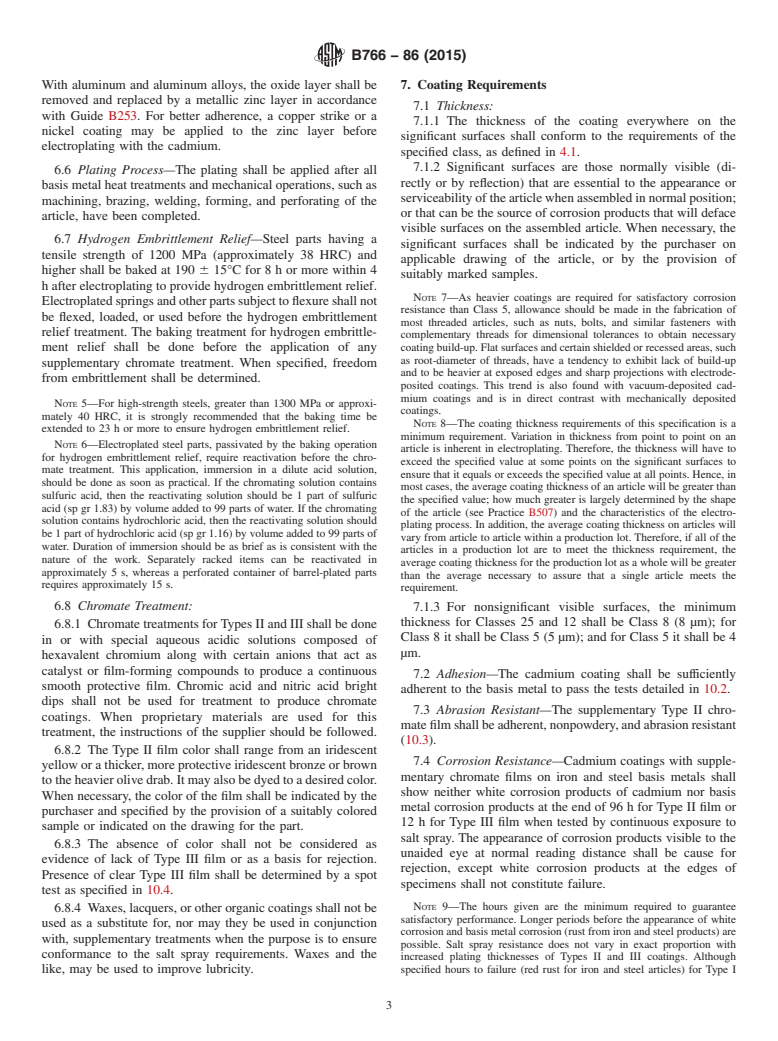
6.6 Plating Process—The plating shall be applied after all
rectly or by reflection) that are essential to the appearance or
basis metal heat treatments and mechanical operations, such as
serviceability of the article when assembled in normal position;
machining, brazing, welding, forming, and perforating of the
or that can be the source of corrosion products that will deface
article, have been completed.
visible surfaces on the assembled article. When necessary, the
6.7 Hydrogen Embrittlement Relief—Steel parts having a
significant surfaces shall be indicated by the purchaser on
tensile strength of 1200 MPa (approximately 38 HRC) and
applicable drawing of the article, or by the provision of
higher shall be baked at 190 6 15°C for 8 h or more within 4
suitably marked samples.
h after electroplating to provide hydrogen embrittlement relief.
NOTE 7—As heavier coatings are required for satisfactory corrosion
Electroplated springs and other parts subject to flexure shall not
resistance than Class 5, allowance should be made in the fabrication of
be flexed, loaded, or used before the hydrogen embrittlement
most threaded articles, such as nuts, bolts, and similar fasteners with
relief treatment. The baking treatment for hydrogen embrittle-
complementary threads for dimensional tolerances to obtain necessary
ment relief shall be done before the application of any coating build-up. Flat surfaces and certain shielded or recessed areas, such
as root-diameter of threads, have a tendency to exhibit lack of build-up
supplementary chromate treatment. When specified, freedom
and to be heavier at exposed edges and sharp projections with electrode-
from embrittlement shall be determined.
posited coatings. This trend is also found with vacuum-deposited cad-
mium coatings and is in direct contrast with mechanically deposited
NOTE 5—For high-strength steels, greater than 1300 MPa or approxi-
coatings.
mately 40 HRC, it is strongly recommended that the baking time be
NOTE 8—The coating thickness requirements of this specification is a
extended to 23 h or more to ensure hydrogen embrittlement relief.
minimum requirement. Variation in thickness from point to point on an
NOTE 6—Electroplated steel parts, passivated by the baking operation
article is inherent in electroplating. Therefore, the thickness will have to
for hydrogen embrittlement relief, require reactivation before the chro-
exceed the specified value at some points on the significant surfaces to
mate treatment. This application, immersion in a dilute acid solution,
ensure that it equals or exceeds the specified value at all points. Hence, in
should be done as soon as practical. If the chromating solution contains
most cases, the average coating thickness of an article will be greater than
sulfuric acid, then the reactivating solution should be 1 part of sulfuric
the specified value; how much greater is largely determined by the shape
acid (sp gr 1.83) by volume added to 99 parts of water. If the chromating
of the article (see Practice B507) and the characteristics of the electro-
solution contains hydrochloric acid, then the reactivating solution should
plating process. In addition, the average coating thickness on articles will
be 1 part of hydrochloric acid (sp gr 1.16) by volume added to 99 parts of
vary from article to article within a production lot. Therefore, if all of the
water. Duration of immersion should be as brief as is consistent with the
articles in a production lot are to meet the thickness requirement, the
nature of the work. Separately racked items can be reactivated in
average coating thickness for the production lot as a whole will be greater
approximately 5 s, whereas a perforated container of barrel-plated parts
than the average necessary to assure that a single article meets the
requires approximately 15 s.
requirement.
6.8 Chromate Treatment:
7.1.3 For nonsignificant visible surfaces, the minimum
thickness for Classes 25 and 12 shall be Class 8 (8 µm); for
6.8.1 Chromate treatments for Types II and III shall be done
Class 8 it shall be Class 5 (5 µm); and for Class 5 it shall be 4
in or with special aqueous acidic solutions composed of
µm.
hexavalent chromium along with certain anions that act as
catalyst or film-forming compounds to produce a continuous
7.2 Adhesion—The cadmium coating shall be sufficiently
smooth protective film. Chromic acid and nitric acid bright
adherent to the basis metal to pass the tests detailed in 10.2.
dips shall not be used for treatment to produce chromate
7.3 Abrasion Resistant—The supplementary Type II chro-
coatings. W
...
This document is not an ASTM standard and is intended only to provide the user of an ASTM standard an indication of what changes have been made to the previous version. Because
it may not be technically possible to adequately depict all changes accurately, ASTM recommends that users consult prior editions as appropriate. In all cases only the current version
of the standard as published by ASTM is to be considered the official document.
Designation: B766 − 86 (Reapproved 2008) B766 − 86 (Reapproved 2015)
Standard Specification for
Electrodeposited Coatings of Cadmium
This standard is issued under the fixed designation B766; the number immediately following the designation indicates the year of
original adoption or, in the case of revision, the year of last revision. A number in parentheses indicates the year of last reapproval. A
superscript epsilon (´) indicates an editorial change since the last revision or reapproval.
This standard has been approved for use by agencies of the U.S. Department of Defense.
1. Scope
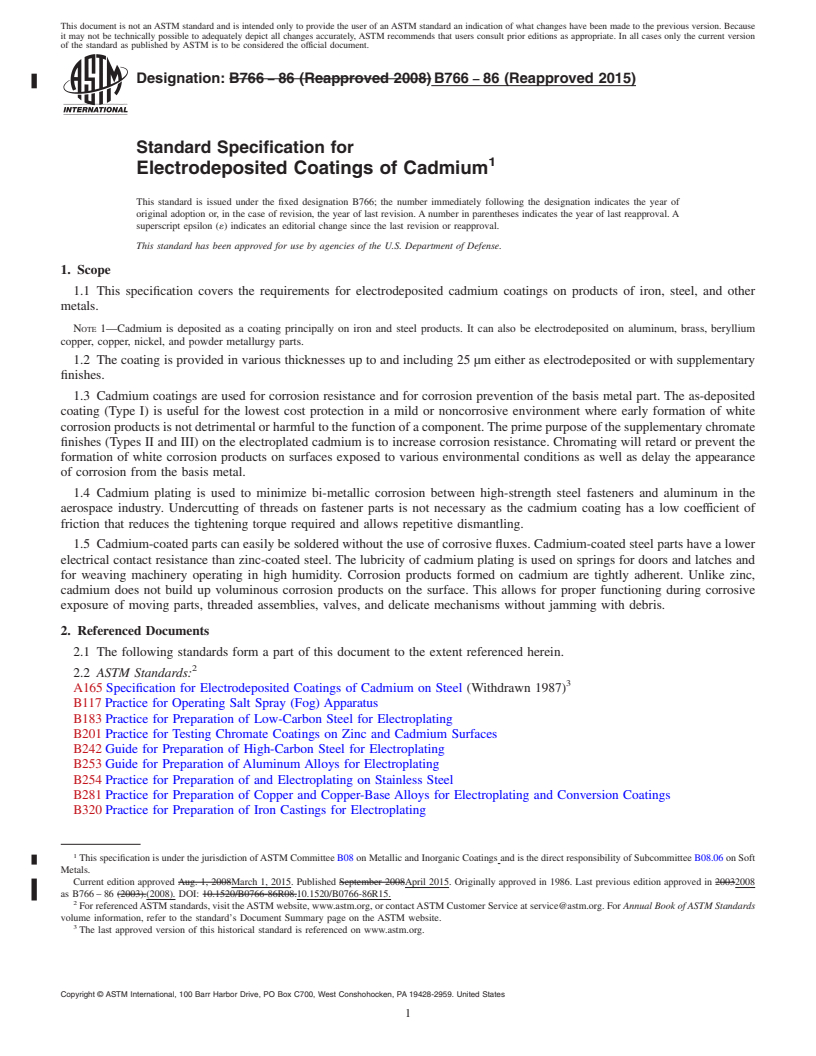
1.1 This specification covers the requirements for electrodeposited cadmium coatings on products of iron, steel, and other
metals.
NOTE 1—Cadmium is deposited as a coating principally on iron and steel products. It can also be electrodeposited on aluminum, brass, beryllium
copper, copper, nickel, and powder metallurgy parts.
1.2 The coating is provided in various thicknesses up to and including 25 μm either as electrodeposited or with supplementary
finishes.
1.3 Cadmium coatings are used for corrosion resistance and for corrosion prevention of the basis metal part. The as-deposited
coating (Type I) is useful for the lowest cost protection in a mild or noncorrosive environment where early formation of white
corrosion products is not detrimental or harmful to the function of a component. The prime purpose of the supplementary chromate
finishes (Types II and III) on the electroplated cadmium is to increase corrosion resistance. Chromating will retard or prevent the
formation of white corrosion products on surfaces exposed to various environmental conditions as well as delay the appearance
of corrosion from the basis metal.
1.4 Cadmium plating is used to minimize bi-metallic corrosion between high-strength steel fasteners and aluminum in the
aerospace industry. Undercutting of threads on fastener parts is not necessary as the cadmium coating has a low coefficient of
friction that reduces the tightening torque required and allows repetitive dismantling.
1.5 Cadmium-coated parts can easily be soldered without the use of corrosive fluxes. Cadmium-coated steel parts have a lower
electrical contact resistance than zinc-coated steel. The lubricity of cadmium plating is used on springs for doors and latches and
for weaving machinery operating in high humidity. Corrosion products formed on cadmium are tightly adherent. Unlike zinc,
cadmium does not build up voluminous corrosion products on the surface. This allows for proper functioning during corrosive
exposure of moving parts, threaded assemblies, valves, and delicate mechanisms without jamming with debris.
2. Referenced Documents
2.1 The following standards form a part of this document to the extent referenced herein.
2.2 ASTM Standards:
A165 Specification for Electrodeposited Coatings of Cadmium on Steel (Withdrawn 1987)
B117 Practice for Operating Salt Spray (Fog) Apparatus
B183 Practice for Preparation of Low-Carbon Steel for Electroplating
B201 Practice for Testing Chromate Coatings on Zinc and Cadmium Surfaces
B242 Guide for Preparation of High-Carbon Steel for Electroplating
B253 Guide for Preparation of Aluminum Alloys for Electroplating
B254 Practice for Preparation of and Electroplating on Stainless Steel
B281 Practice for Preparation of Copper and Copper-Base Alloys for Electroplating and Conversion Coatings
B320 Practice for Preparation of Iron Castings for Electroplating
This specification is under the jurisdiction of ASTM Committee B08 on Metallic and Inorganic Coatings and is the direct responsibility of Subcommittee B08.06 on Soft
Metals.
Current edition approved Aug. 1, 2008March 1, 2015. Published September 2008April 2015. Originally approved in 1986. Last previous edition approved in 20032008
as B766 – 86 (2003).(2008). DOI: 10.1520/B0766-86R08.10.1520/B0766-86R15.
For referenced ASTM standards, visit the ASTM website, www.astm.org, or contact ASTM Customer Service at service@astm.org. For Annual Book of ASTM Standards
volume information, refer to the standard’s Document Summary page on the ASTM website.
The last approved version of this historical standard is referenced on www.astm.org.
Copyright © ASTM International, 100 Barr Harbor Drive, PO Box C700, West Conshohocken, PA 19428-2959. United States
B766 − 86 (2015)
B322 Guide for Cleaning Metals Prior to Electroplating
B343 Practice for Preparation of Nickel for Electroplating with Nickel
B374 Terminology Relating to Electroplating
B487 Test Method for Measurement of Metal and Oxide Coating Thickness by Microscopical Examination of Cross Section
B499 Test Method for Measurement of Coating Thicknesses by the Magnetic Method: Nonmagnetic Coatings on Magnetic Basis
Metals
B504 Test Method for Measurement of Thickness of Metallic Coatings by the Coulometric Method
B507 Practice for Design of Articles to Be Electroplated on Racks
B558 Practice for Preparation of Nickel Alloys for Electroplating
B567 Test Method for Measurement of Coating Thickness by the Beta Backscatter Method
B568 Test Method for Measurement of Coating Thickness by X-Ray Spectrometry
B571 Practice for Qualitative Adhesion Testing of Metallic Coatings
B602 Test Method for Attribute Sampling of Metallic and Inorganic Coatings
B697 Guide for Selection of Sampling Plans for Inspection of Electrodeposited Metallic and Inorganic Coatings
E8 Test Methods for Tension Testing of Metallic Materials
F519 Test Method for Mechanical Hydrogen Embrittlement Evaluation of Plating/Coating Processes and Service Environments
2.3 Federal Standard:
QQ-P-416 Plating, Cadmium (Electrodeposited)
2.4 International Standard:
ISO 2082 Metallic Coatings—Electroplated Coatings of Cadmium on Iron or Steel
2.5 Military Standard:
MIL-STD-1312 Fasteners, Test Methods
3. Terminology
3.1 Definitions—Definitions of terms used in this specification are in accordance with Terminology B374.
4. Classification
4.1 Classes—Electrodeposited cadmium coatings shall be classified on the basis of thickness as follows:
Class Minimum Thickness, μm
25 25
12 12
8 8
5 5
NOTE 2—Cadmium coatings thicker than 12 μm are normally not economical.
4.2 Types—Electrodeposited cadmium coatings shall be identified by types on the basis of supplementary treatment required as
follows:
4.2.1 Type I—As electrodeposited without supplementary treatment.
4.2.2 Type II—With supplementary colored chromate treatment.
4.2.3 Type III—With supplementary colorless chromate treatment.
NOTE 3—It is strongly recommended that production items be processed as either Type II or Type III.
5. Ordering Information
5.1 In order to make the application of this specification complete, the purchaser needs to supply the following information to
the seller in the purchase order or other governing document:
5.1.1 The name, designation, and date of issue of this specification.
5.1.2 Deposit by class and type (4.1 and 4.2).
5.1.3 Composition and metallurgical condition of the substrate to be coated. Application to high-strength steel parts (6.2).
5.1.4 Heat treatment for stress relief, whether it has been performed or is required (6.3).
5.1.5 Additional undercoat, if required (6.5).
5.1.6 Plating process variation, if required (6.6).
5.1.7 Hydrogen embrittlement relief, if required (6.7).
5.1.8 Desired color of the Type II film (6.8.2).
5.1.9 Location of significant surfaces (7.1.2).
5.1.10 Coating luster (7.5).
Available from U.S. Government Printing Office, Washington DC 20402.
Available from American National Standards Institute, 25 W. 43rd St., 4th Floor, New York, NY 10036.
Available from Standardization Documents Order Desk, Bldg. 4 Section D, 700 Robbins Ave., Philadelphia, PA 19111-5094, Attn: NPODS.
B766 − 86 (2015)
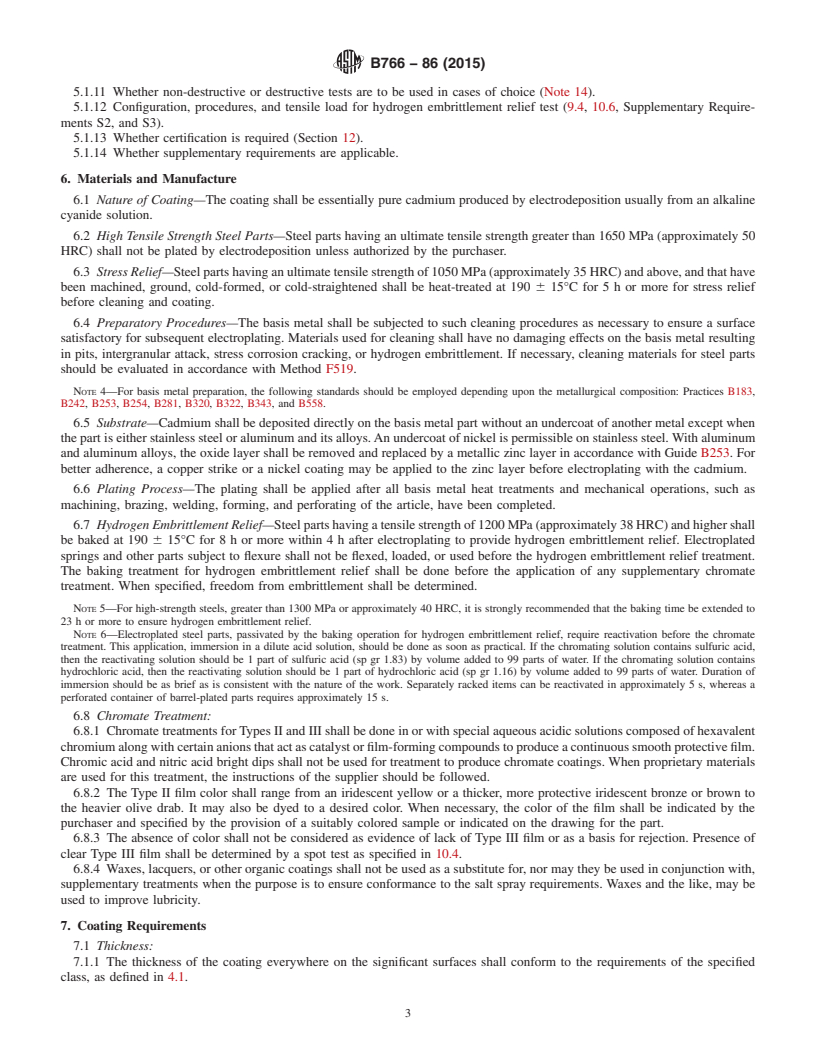
5.1.11 Whether non-destructive or destructive tests are to be used in cases of choice (Note 14).
5.1.12 Configuration, procedures, and tensile load for hydrogen embrittlement relief test (9.4, 10.6, Supplementary Require-
ments S2, and S3).
5.1.13 Whether certification is required (Section 12).
5.1.14 Whether supplementary requirements are applicable.
6. Materials and Manufacture
6.1 Nature of Coating—The coating shall be essentially pure cadmium produced by electrodeposition usually from an alkaline
cyanide solution.
6.2 High Tensile Strength Steel Parts—Steel parts having an ultimate tensile strength greater than 1650 MPa (approximately 50
HRC) shall not be plated by electrodeposition unless authorized by the purchaser.
6.3 Stress Relief—Steel parts having an ultimate tensile strength of 1050 MPa (approximately 35 HRC) and above, and that have
been machined, ground, cold-formed, or cold-straightened shall be heat-treated at 190 6 15°C for 5 h or more for stress relief
before cleaning and coating.
6.4 Preparatory Procedures—The basis metal shall be subjected to such cleaning procedures as necessary to ensure a surface
satisfactory for subsequent electroplating. Materials used for cleaning shall have no damaging effects on the basis metal resulting
in pits, intergranular attack, stress corrosion cracking, or hydrogen embrittlement. If necessary, cleaning materials for steel parts
should be evaluated in accordance with Method F519.
NOTE 4—For basis metal preparation, the following standards should be employed depending upon the metallurgical composition: Practices B183,
B242, B253, B254, B281, B320, B322, B343, and B558.
6.5 Substrate—Cadmium shall be deposited directly on the basis metal part without an undercoat of another metal except when
the part is either stainless steel or aluminum and its alloys. An undercoat of nickel is permissible on stainless steel. With aluminum
and aluminum alloys, the oxide layer shall be removed and replaced by a metallic zinc layer in accordance with Guide B253. For
better adherence, a copper strike or a nickel coating may be applied to the zinc layer before electroplating with the cadmium.
6.6 Plating Process—The plating shall be applied after all basis metal heat treatments and mechanical operations, such as
machining, brazing, welding, forming, and perforating of the article, have been completed.
6.7 Hydrogen Embrittlement Relief—Steel parts having a tensile strength of 1200 MPa (approximately 38 HRC) and higher shall
be baked at 190 6 15°C for 8 h or more within 4 h after electroplating to provide hydrogen embrittlement relief. Electroplated
springs and other parts subject to flexure shall not be flexed, loaded, or used before the hydrogen embrittlement relief treatment.
The baking treatment for hydrogen embrittlement relief shall be done before the application of any supplementary chromate
treatment. When specified, freedom from embrittlement shall be determined.
NOTE 5—For high-strength steels, greater than 1300 MPa or approximately 40 HRC, it is strongly recommended that the baking time be extended to
23 h or more to ensure hydrogen embrittlement relief.
NOTE 6—Electroplated steel parts, passivated by the baking operation for hydrogen embrittlement relief, require reactivation before the chromate
treatment. This application, immersion in a dilute acid solution, should be done as soon as practical. If the chromating solution contains sulfuric acid,
then the reactivating solution should be 1 part of sulfuric acid (sp gr 1.83) by volume added to 99 parts of water. If the chromating solution contains
hydrochloric acid, then the reactivating solution should be 1 part of hydrochloric acid (sp gr 1.16) by volume added to 99 parts of water. Duration of
immersion should be as brief as is consistent with the nature of the work. Separately racked items can be reactivated in approximately 5 s, whereas a
perforated container of barrel-plated parts requires approximately 15 s.
6.8 Chromate Treatment:
6.8.1 Chromate treatments for Types II and III shall be done in or with special aqueous acidic solutions composed of hexavalent
chromium along with certain anions that act as catalyst or film-forming compounds to produce a continuous smooth protective film.
Chromic acid and nitric acid bright dips shall not be used for treatment to produce chromate coatings. When proprietary materials
are used for this treatment, the instructions of the supplier should be followed.
6.8.2 The Type II film color shall range from an iridescent yellow or a thicker, more protective iridescent bronze or brown to
the heavier olive drab. It may also be dyed to a desired color. When necessary, the color of the film shall be indicated by the
purchaser and specified by the provision of a suitably colored sample or indicated on the drawing for the part.
6.8.3 The absence of color shall not be considered as evidence of lack of Type III film or as a basis for rejection. Presence of
clear Type III film shall be determined by a spot test as specified in 10.4.
6.8.4 Waxes, lacquers, or other organic coatings shall not be used as a substitute for, nor may they be used in conjunction with,
supplementary treatments when the purpose is to ensure conformance to the salt spray requirements. Waxes and the like, may be
used to improve lubricity.
7. Coating Requirements
7.1 Thickness:
7.1.1 The thickness of the coating everywhere on the significant surfaces shall conform to the requirements of the specified
class, as defined in 4.1.
B766 − 86 (2015)
7.1.2 Significant surfaces are those normally visible (directly or by reflection) that are essential to the appearance or
serviceability of the article when assembled in normal position; or that can be the source of corrosion products that will deface
visible surfaces on the assembled article. When necessary, the significant surfaces shall be indicated by the purchaser on applicable
drawing of the article, or by the provision of suitably marked samples.
NOTE 7—As heavier coatings are required for satisfactory corrosion resistance than Class 5, allowance should be made in the fabrication of most
threaded articles, such as nuts, bolts, and similar fasteners with complementary threads for dimensional tolerances to obtain necessary coating build-up.
Flat surfaces and certain shielded or recessed areas, such as root-diameter of threads, have a tendency to exhibit lack of build-up and to be heavier at
exposed edges and sharp projections with electrodeposited coatings. This trend is also found with vacuum-deposited cadmium coatings and is in direct
contrast with mechanically deposited coatings.
NOTE 8—The coating t
...
Questions, Comments and Discussion
Ask us and Technical Secretary will try to provide an answer. You can facilitate discussion about the standard in here.