


ASTM F1977-04(2010)
(Test Method)Standard Test Method for Determining Initial, Fractional, Filtration Efficiency of a Vacuum Cleaner System
Standard Test Method for Determining Initial, Fractional, Filtration Efficiency of a Vacuum Cleaner System
SIGNIFICANCE AND USE
It is well known that modern electrical appliances, incorporating electric motors that use carbon brushes for commutation, may emit aerosolized, particles into the surrounding environment. This test method determines the initial, fractional, filtration efficiency of a vacuum cleaner system, taking those emissions into consideration.
For all vacuum cleaner systems tested, the total emissions of the unit, whatever the source(s), will be counted at each of the six particle size levels identified in the test procedure. This test method determines the initial, fractional filtration efficiency of a vacuum cleaner system, with or without the motor emissions mathematically removed in the calculation of efficiency.
SCOPE
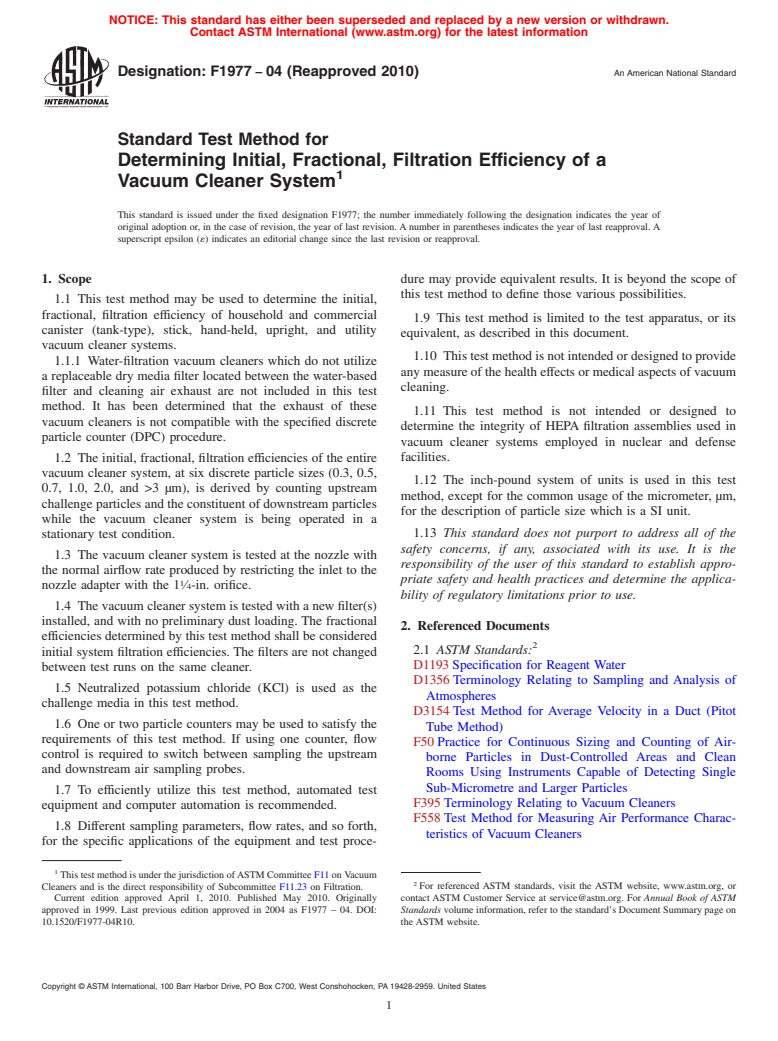
1.1 This test method may be used to determine the initial, fractional, filtration efficiency of household and commercial canister (tank-type), stick, hand-held, upright, and utility vacuum cleaner systems.
1.1.1 Water-filtration vacuum cleaners which do not utilize a replaceable dry media filter located between the water-based filter and cleaning air exhaust are not included in this test method. It has been determined that the exhaust of these vacuum cleaners is not compatible with the specified discrete particle counter (DPC) procedure.
1.2 The initial, fractional, filtration efficiencies of the entire vacuum cleaner system, at six discrete particle sizes (0.3, 0.5, 0.7, 1.0, 2.0, and >3 μm), is derived by counting upstream challenge particles and the constituent of downstream particles while the vacuum cleaner system is being operated in a stationary test condition.
1.3 The vacuum cleaner system is tested at the nozzle with the normal airflow rate produced by restricting the inlet to the nozzle adapter with the 1¼ -in. orifice.
1.4 The vacuum cleaner system is tested with a new filter(s) installed, and with no preliminary dust loading. The fractional efficiencies determined by this test method shall be considered initial system filtration efficiencies. The filters are not changed between test runs on the same cleaner.
1.5 Neutralized potassium chloride (KCl) is used as the challenge media in this test method.
1.6 One or two particle counters may be used to satisfy the requirements of this test method. If using one counter, flow control is required to switch between sampling the upstream and downstream air sampling probes.
1.7 To efficiently utilize this test method, automated test equipment and computer automation is recommended.
1.8 Different sampling parameters, flow rates, and so forth, for the specific applications of the equipment and test procedure may provide equivalent results. It is beyond the scope of this test method to define those various possibilities.
1.9 This test method is limited to the test apparatus, or its equivalent, as described in this document.
1.10 This test method is not intended or designed to provide any measure of the health effects or medical aspects of vacuum cleaning.
1.11 This test method is not intended or designed to determine the integrity of HEPA filtration assemblies used in vacuum cleaner systems employed in nuclear and defense facilities.
1.12 The inch-pound system of units is used in this test method, except for the common usage of the micrometer, μm, for the description of particle size which is a SI unit.
1.13 This standard does not purport to address all of the safety concerns, if any, associated with its use. It is the responsibility of the user of this standard to establish appropriate safety and health practices and determine the applicability of regulatory limitations prior to use.
General Information
Relations
Standards Content (Sample)
NOTICE: This standard has either been superseded and replaced by a new version or withdrawn.
Contact ASTM International (www.astm.org) for the latest information
Designation: F1977 − 04 (Reapproved 2010) An American National Standard
Standard Test Method for
Determining Initial, Fractional, Filtration Efficiency of a
1
Vacuum Cleaner System
This standard is issued under the fixed designation F1977; the number immediately following the designation indicates the year of
original adoption or, in the case of revision, the year of last revision.Anumber in parentheses indicates the year of last reapproval.A
superscript epsilon (´) indicates an editorial change since the last revision or reapproval.
1. Scope dure may provide equivalent results. It is beyond the scope of
this test method to define those various possibilities.
1.1 This test method may be used to determine the initial,
fractional, filtration efficiency of household and commercial
1.9 This test method is limited to the test apparatus, or its
canister (tank-type), stick, hand-held, upright, and utility
equivalent, as described in this document.
vacuum cleaner systems.
1.10 Thistestmethodisnotintendedordesignedtoprovide
1.1.1 Water-filtration vacuum cleaners which do not utilize
anymeasureofthehealtheffectsormedicalaspectsofvacuum
a replaceable dry media filter located between the water-based
cleaning.
filter and cleaning air exhaust are not included in this test
method. It has been determined that the exhaust of these
1.11 This test method is not intended or designed to
vacuum cleaners is not compatible with the specified discrete
determine the integrity of HEPA filtration assemblies used in
particle counter (DPC) procedure.
vacuum cleaner systems employed in nuclear and defense
1.2 The initial, fractional, filtration efficiencies of the entire facilities.
vacuum cleaner system, at six discrete particle sizes (0.3, 0.5,
1.12 The inch-pound system of units is used in this test
0.7, 1.0, 2.0, and >3 µm), is derived by counting upstream
method, except for the common usage of the micrometer, µm,
challengeparticlesandtheconstituentofdownstreamparticles
for the description of particle size which is a SI unit.
while the vacuum cleaner system is being operated in a
1.13 This standard does not purport to address all of the
stationary test condition.
safety concerns, if any, associated with its use. It is the
1.3 The vacuum cleaner system is tested at the nozzle with
responsibility of the user of this standard to establish appro-
the normal airflow rate produced by restricting the inlet to the
priate safety and health practices and determine the applica-
1
nozzle adapter with the 1 ⁄4-in. orifice.
bility of regulatory limitations prior to use.
1.4 Thevacuumcleanersystemistestedwithanewfilter(s)
installed, and with no preliminary dust loading. The fractional
2. Referenced Documents
efficiencies determined by this test method shall be considered
2
2.1 ASTM Standards:
initial system filtration efficiencies. The filters are not changed
D1193Specification for Reagent Water
between test runs on the same cleaner.
D1356Terminology Relating to Sampling and Analysis of
1.5 Neutralized potassium chloride (KCl) is used as the
Atmospheres
challenge media in this test method.
D3154Test Method for Average Velocity in a Duct (Pitot
1.6 One or two particle counters may be used to satisfy the
Tube Method)
requirements of this test method. If using one counter, flow
F50Practice for Continuous Sizing and Counting of Air-
control is required to switch between sampling the upstream
borne Particles in Dust-Controlled Areas and Clean
and downstream air sampling probes.
Rooms Using Instruments Capable of Detecting Single
Sub-Micrometre and Larger Particles
1.7 To efficiently utilize this test method, automated test
F395Terminology Relating to Vacuum Cleaners
equipment and computer automation is recommended.
F558Test Method for Measuring Air Performance Charac-
1.8 Different sampling parameters, flow rates, and so forth,
teristics of Vacuum Cleaners
for the specific applications of the equipment and test proce-
1
ThistestmethodisunderthejurisdictionofASTMCommitteeF11onVacuum
2
Cleaners and is the direct responsibility of Subcommittee F11.23 on Filtration. For referenced ASTM standards, visit the ASTM website, www.astm.org, or
Current edition approved April 1, 2010. Published May 2010. Originally contact ASTM Customer Service at service@astm.org. For Annual Book of ASTM
approved in 1999. Last previous edition approved in 2004 as F1977 – 04. DOI: Standards volume information, refer to the standard’s Document Summary page on
10.1520/F1977-04R10. the ASTM website.
Copyright © ASTM International, 100 Barr Harbor Drive, PO Box C700, West Conshohocken, PA 19428-2959. United States
1
---------------------- Page: 1 ----------------------
F1977 − 04 (2010)
3.1.7 primary motor(s), n—the motor(s) which drive(s) the
blower(s), producing airflow through the vacuum cleaner.
3.1.8 secondary motor(s), n—the motor(s) i
...
Questions, Comments and Discussion
Ask us and Technical Secretary will try to provide an answer. You can facilitate discussion about the standard in here.