


ASTM D4279-95(2017)
(Test Method)Standard Test Methods for Water Vapor Transmission of Shipping Containers—Constant and Cycle Methods
Standard Test Methods for Water Vapor Transmission of Shipping Containers—Constant and Cycle Methods
SIGNIFICANCE AND USE
4.1 These test methods are normally used for the following purposes:
4.1.1 To evaluate materials and constructions for a specific type of container,
4.1.2 To compare performance of different types of containers,
4.1.3 To determine adequacy of protection for a specific product or application, and
4.1.4 To maintain quality control.
SCOPE
1.1 These test methods cover the determination of water vapor transmission rates for bulk shipping containers, as follows:
1.1.1 Method A, for Reclosable Containers, and
1.1.2 Method B, for Containers Not Designed for Reclosing.
1.2 Within each procedure details are given for the constant and cycle methods of test atmosphere.
1.3 The test may be applied to the container as packed, or after one or more performance tests such as drum (Method D782), vibration (Methods D999), drop (Test Method D5276), impact resistance (Test Methods D880, D4003, and D5277), or performance tests (Practice D4169), as required.
1.4 For small shipping containers requiring greater accuracy in weighing, the water vapor transmission may be determined in accordance with Test Method D895 or Test Method D1251.
1.5 The values stated in inch-pound units are to be regarded as standard. The values given in parentheses are mathematical conversions to SI units that are provided for information only and are not considered standard.
1.6 This standard does not purport to address all of the safety concerns, if any, associated with its use. It is the responsibility of the user of this standard to establish appropriate safety and health practices and determine the applicability of regulatory limitations prior to use.
1.7 This international standard was developed in accordance with internationally recognized principles on standardization established in the Decision on Principles for the Development of International Standards, Guides and Recommendations issued by the World Trade Organization Technical Barriers to Trade (TBT) Committee.
General Information
Buy Standard
Standards Content (Sample)
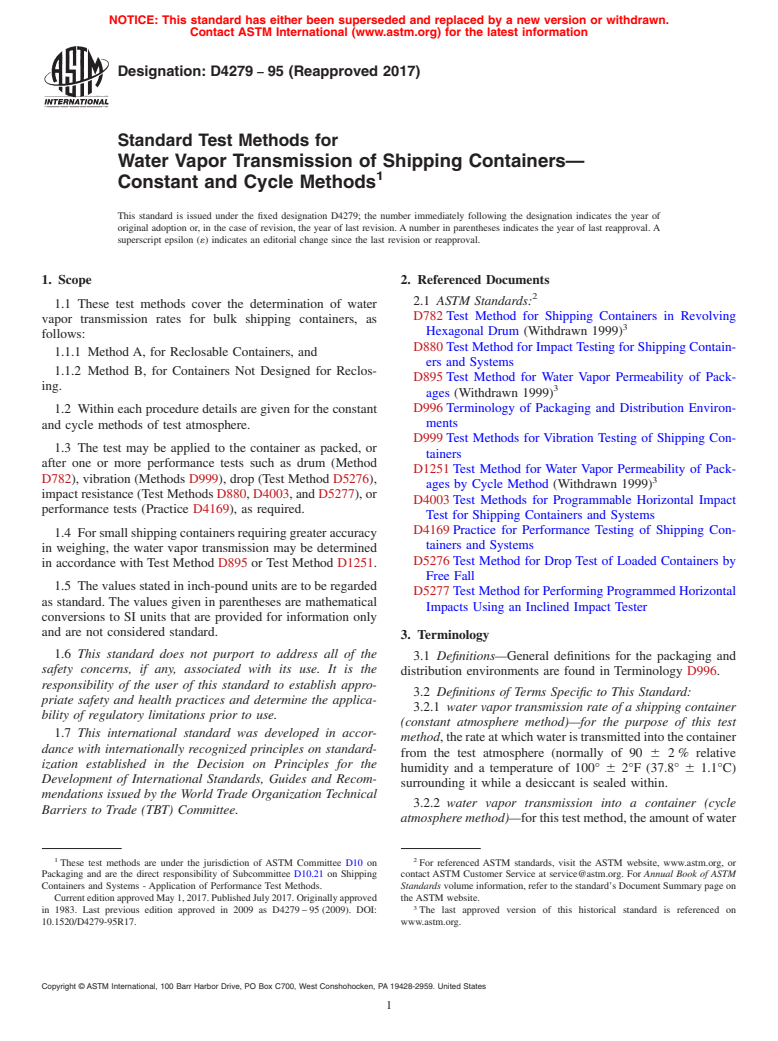
NOTICE: This standard has either been superseded and replaced by a new version or withdrawn.
Contact ASTM International (www.astm.org) for the latest information
Designation: D4279 − 95 (Reapproved 2017)
Standard Test Methods for
Water Vapor Transmission of Shipping Containers—
Constant and Cycle Methods
This standard is issued under the fixed designation D4279; the number immediately following the designation indicates the year of
original adoption or, in the case of revision, the year of last revision.Anumber in parentheses indicates the year of last reapproval.A
superscript epsilon (´) indicates an editorial change since the last revision or reapproval.
1. Scope 2. Referenced Documents
2.1 ASTM Standards:
1.1 These test methods cover the determination of water
D782Test Method for Shipping Containers in Revolving
vapor transmission rates for bulk shipping containers, as
Hexagonal Drum (Withdrawn 1999)
follows:
D880Test Method for ImpactTesting for Shipping Contain-
1.1.1 Method A, for Reclosable Containers, and
ers and Systems
1.1.2 Method B, for Containers Not Designed for Reclos-
D895Test Method for Water Vapor Permeability of Pack-
ing.
ages (Withdrawn 1999)
D996Terminology of Packaging and Distribution Environ-
1.2 Within each procedure details are given for the constant
ments
and cycle methods of test atmosphere.
D999Test Methods for Vibration Testing of Shipping Con-
1.3 The test may be applied to the container as packed, or
tainers
after one or more performance tests such as drum (Method
D1251Test Method for Water Vapor Permeability of Pack-
D782), vibration (Methods D999), drop (Test Method D5276), 3
ages by Cycle Method (Withdrawn 1999)
impactresistance(TestMethodsD880,D4003,andD5277),or
D4003Test Methods for Programmable Horizontal Impact
performance tests (Practice D4169), as required.
Test for Shipping Containers and Systems
D4169Practice for Performance Testing of Shipping Con-
1.4 Forsmallshippingcontainersrequiringgreateraccuracy
tainers and Systems
in weighing, the water vapor transmission may be determined
D5276Test Method for Drop Test of Loaded Containers by
in accordance with Test Method D895 or Test Method D1251.
Free Fall
1.5 The values stated in inch-pound units are to be regarded
D5277Test Method for Performing Programmed Horizontal
as standard. The values given in parentheses are mathematical
Impacts Using an Inclined Impact Tester
conversions to SI units that are provided for information only
and are not considered standard.
3. Terminology
1.6 This standard does not purport to address all of the
3.1 Definitions—General definitions for the packaging and
safety concerns, if any, associated with its use. It is the
distribution environments are found in Terminology D996.
responsibility of the user of this standard to establish appro-
3.2 Definitions of Terms Specific to This Standard:
priate safety and health practices and determine the applica-
3.2.1 water vapor transmission rate of a shipping container
bility of regulatory limitations prior to use.
(constant atmosphere method)—for the purpose of this test
1.7 This international standard was developed in accor-
method,therateatwhichwateristransmittedintothecontainer
dance with internationally recognized principles on standard-
from the test atmosphere (normally of 90 6 2% relative
ization established in the Decision on Principles for the
humidity and a temperature of 100° 6 2°F (37.8° 6 1.1°C)
Development of International Standards, Guides and Recom-
surrounding it while a desiccant is sealed within.
mendations issued by the World Trade Organization Technical
3.2.2 water vapor transmission into a container (cycle
Barriers to Trade (TBT) Committee.
atmosphere method)—forthistestmethod,theamountofwater
1 2
These test methods are under the jurisdiction of ASTM Committee D10 on For referenced ASTM standards, visit the ASTM website, www.astm.org, or
Packaging and are the direct responsibility of Subcommittee D10.21 on Shipping contact ASTM Customer Service at service@astm.org. For Annual Book of ASTM
Containers and Systems - Application of Performance Test Methods. Standards volume information, refer to the standard’s Document Summary page on
CurrenteditionapprovedMay1,2017.PublishedJuly2017.Originallyapproved the ASTM website.
in 1983. Last previous edition approved in 2009 as D4279–95(2009). DOI: The last approved version of this historical standard is referenced on
10.1520/D4279-95R17. www.astm.org.
Copyright © ASTM International, 100 Barr Harbor Drive, PO Box C700, West Conshohocken, PA 19428-2959. United States
D4279 − 95 (2017)
transmitted into the container from the test atmosphere during 6. Test Specimens
one cycle while a desiccant is sealed within.
6.1 Test specimens shall be representative of the containers
3.2.3 cycle—oneseriesoftestatmospherestowhichthetest
being tested, and shall be closed and sealed in the normal
specimens are exposed. Normally one cycle will consist of 1
manner.
week of exposure to a temperature of 0° 6 5°F (−17.8° 6
6.2 The performance shall be based on tests of not less than
2.8°C) to be followed by 3 weeks of exposure at a temperature
two representative specimens of a given size and type of
of 100° 6 2°F (37.8° 6 1.1°C) and a relative humidity of 90
container.
62%.
7. Procedure
4. Significance and Use
4.1 These test methods are normally used for the following 7.1 Locate the weighing receptacle or receptacles centrally
within the test specimen, using a nonabsorptive support when
purposes:
4.1.1 To evaluate materials and constructions for a specific required. Place the selected quantity of the desiccant in the
receptacle sufficient to uniformly cover the area of the recep-
type of container,
4.1.2 To compare performance of different types of tacletoadepthofnotlessthan ⁄2in.(13mm).Cover,andafter
weighing,immediatelytransferintothetestspecimen.Uncover
containers,
4.1.3 To determine adequacy of protection for a specific the receptacle and close and seal the specimen in the normal
manner. The desiccant may require one or more replacements
product or application, and
if it becomes noticeably moist during the test.
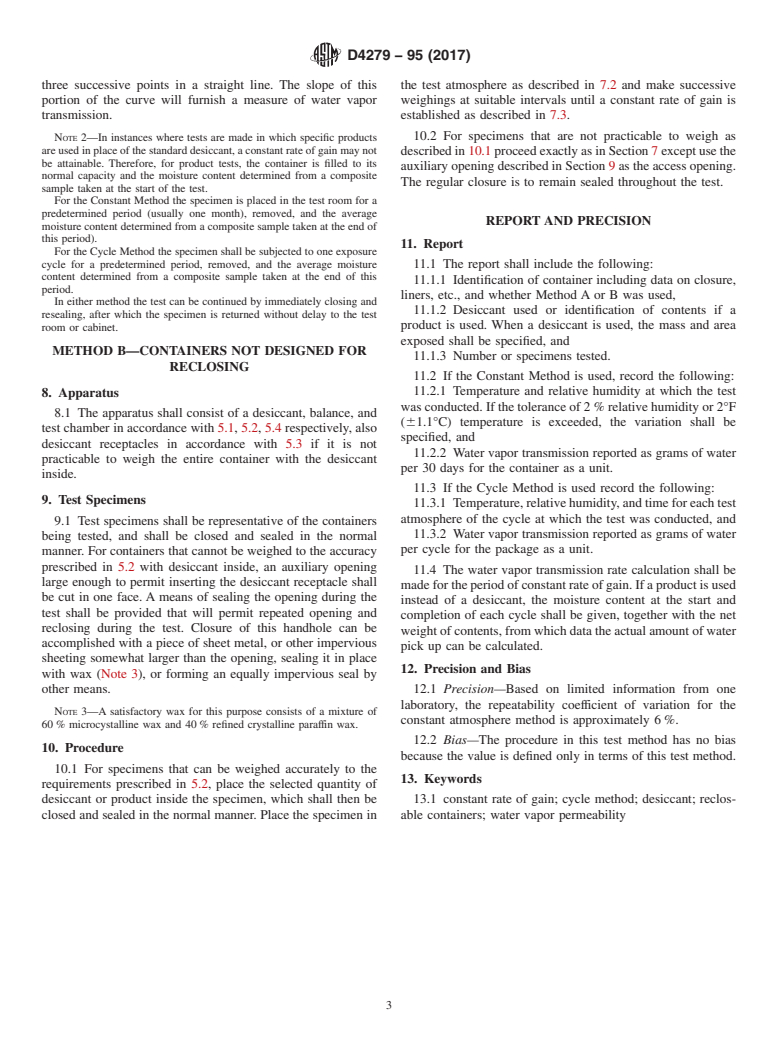
4.1.4 To maintain quality control.
NOTE 1—When the test is conducted to determine the water vapor
METHOD A—RECLOSABLE CONTAINERS
transmission of the shipping container for research, development, manu-
facturing control, specification acceptance, etc., a desiccant shall be used
5. Apparatus
as the water absorbing medium. When the test is used to determine the
5.1 Desiccant—Adesiccant shall be used that has a power-
suitability of the shipping container with respect to water vapor resistance
for a particular product, the product shall be used in lieu of the desiccant.
ful affinity for water and a high drying efficiency, that is, a low
vapor pressure after absorbing a large amount of water. The
7.2 Place the specimen inside the test room or cabinet in a
desiccant shall be in the form of small lumps that will pass a
position where free access of the conditioned circulating air is
No. 8 (2.36-mm) sieve and be free from fines that will pass a
provided on all surfaces of the container according to the
No. 30 (600-µm) sieve. Anhydrous calcium chloride and
following:
anhydrous magnesium perchlorate have been found suitable.
7.2.1 Constant Atmosphere Method—Normally surrounding
When the test is made to determine the suitability of a specific
conditionsare90 62%relativehumidityandatemperatureof
container for a particular product, that product may be used
100° 6 2°F (37.7° 6 1.1°C).
inside the test specimen instead of the desiccant, in which case
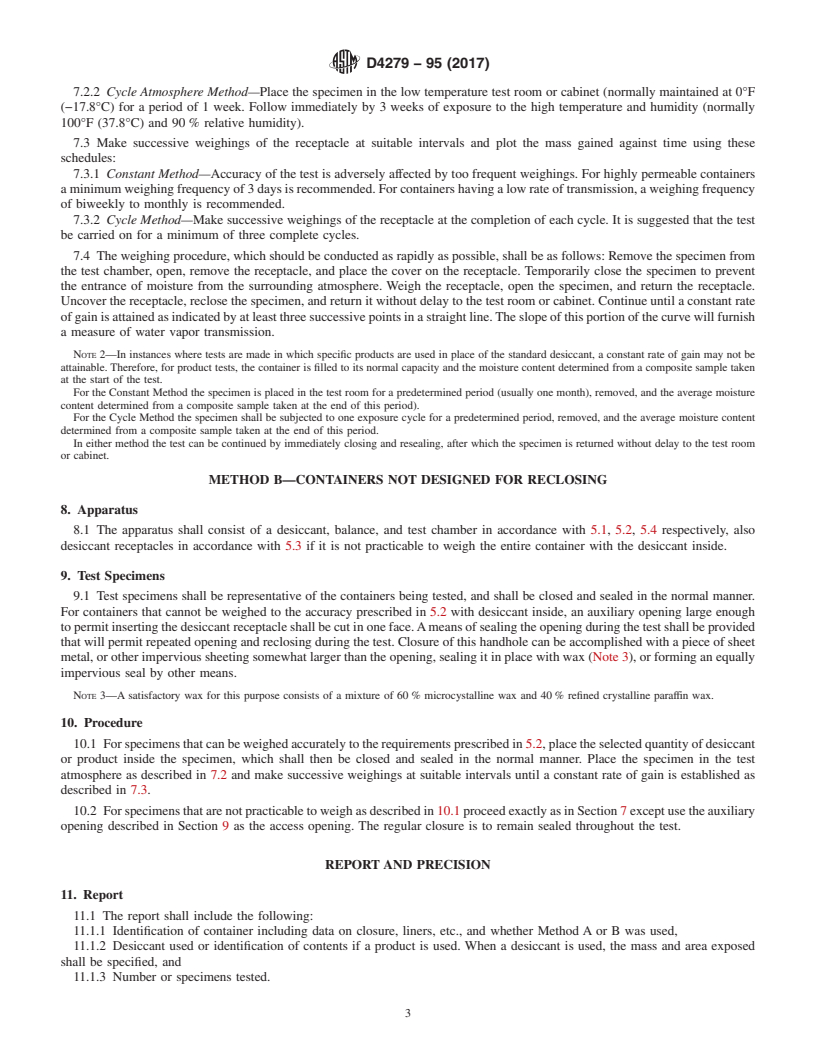
7.2.2 Cycle Atmosphere Method—Place the specimen in the
the specimen shall be filled to normal capacity.
low temperature test room or cabinet (normally maintained at
0°F (−17.8°C) for a period of 1 week. Follow immediately by
5.2 Weighing Balance—A weighing balance accurate to
3 weeks of exposure to the high temperature and humidity
within 1 g shall be used. When the required amount of
(normally 100°F (37.8°C) and 90% relative humidity).
desiccant is greater than can be weighed on a balance of this
sensitivity, two or more receptacles shall be used and weighed
7.3 Make successive weighings of the receptacle at suitable
individually.Whenproducttestsaremade,aregularlaboratory
intervals and plot the mass g
...
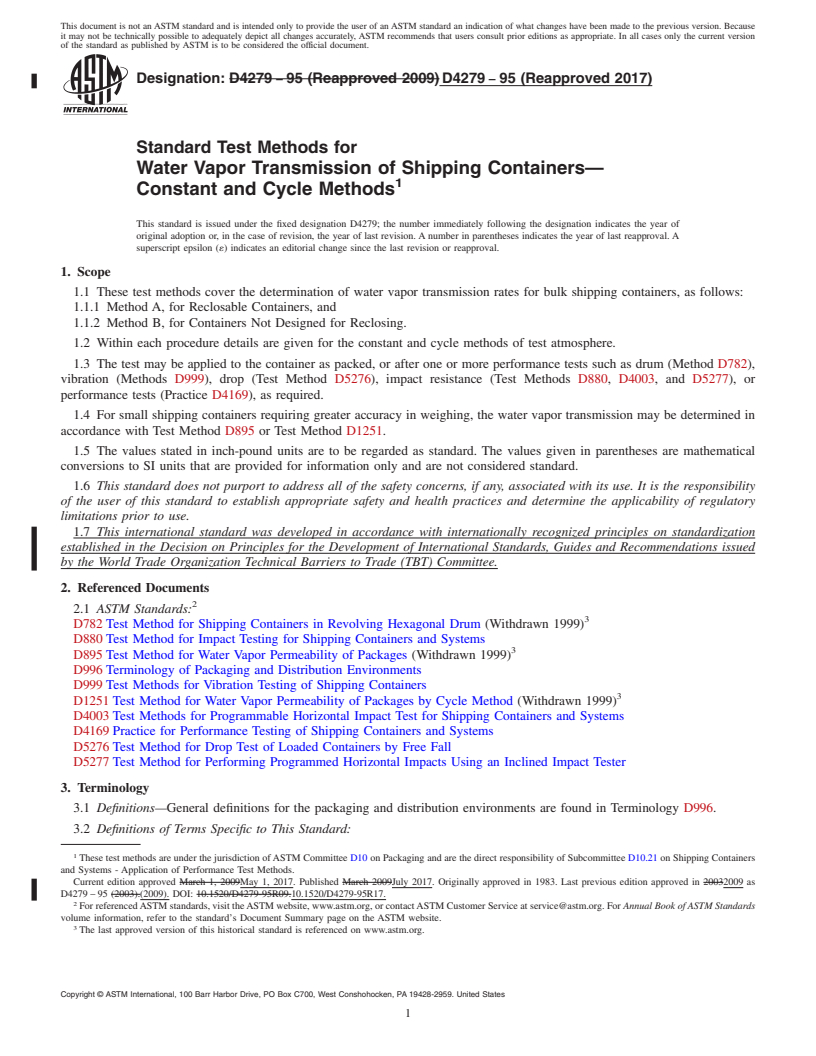
This document is not an ASTM standard and is intended only to provide the user of an ASTM standard an indication of what changes have been made to the previous version. Because
it may not be technically possible to adequately depict all changes accurately, ASTM recommends that users consult prior editions as appropriate. In all cases only the current version
of the standard as published by ASTM is to be considered the official document.
Designation: D4279 − 95 (Reapproved 2009) D4279 − 95 (Reapproved 2017)
Standard Test Methods for
Water Vapor Transmission of Shipping Containers—
Constant and Cycle Methods
This standard is issued under the fixed designation D4279; the number immediately following the designation indicates the year of
original adoption or, in the case of revision, the year of last revision. A number in parentheses indicates the year of last reapproval. A
superscript epsilon (´) indicates an editorial change since the last revision or reapproval.
1. Scope
1.1 These test methods cover the determination of water vapor transmission rates for bulk shipping containers, as follows:
1.1.1 Method A, for Reclosable Containers, and
1.1.2 Method B, for Containers Not Designed for Reclosing.
1.2 Within each procedure details are given for the constant and cycle methods of test atmosphere.
1.3 The test may be applied to the container as packed, or after one or more performance tests such as drum (Method D782),
vibration (Methods D999), drop (Test Method D5276), impact resistance (Test Methods D880, D4003, and D5277), or
performance tests (Practice D4169), as required.
1.4 For small shipping containers requiring greater accuracy in weighing, the water vapor transmission may be determined in
accordance with Test Method D895 or Test Method D1251.
1.5 The values stated in inch-pound units are to be regarded as standard. The values given in parentheses are mathematical
conversions to SI units that are provided for information only and are not considered standard.
1.6 This standard does not purport to address all of the safety concerns, if any, associated with its use. It is the responsibility
of the user of this standard to establish appropriate safety and health practices and determine the applicability of regulatory
limitations prior to use.
1.7 This international standard was developed in accordance with internationally recognized principles on standardization
established in the Decision on Principles for the Development of International Standards, Guides and Recommendations issued
by the World Trade Organization Technical Barriers to Trade (TBT) Committee.
2. Referenced Documents
2.1 ASTM Standards:
D782 Test Method for Shipping Containers in Revolving Hexagonal Drum (Withdrawn 1999)
D880 Test Method for Impact Testing for Shipping Containers and Systems
D895 Test Method for Water Vapor Permeability of Packages (Withdrawn 1999)
D996 Terminology of Packaging and Distribution Environments
D999 Test Methods for Vibration Testing of Shipping Containers
D1251 Test Method for Water Vapor Permeability of Packages by Cycle Method (Withdrawn 1999)
D4003 Test Methods for Programmable Horizontal Impact Test for Shipping Containers and Systems
D4169 Practice for Performance Testing of Shipping Containers and Systems
D5276 Test Method for Drop Test of Loaded Containers by Free Fall
D5277 Test Method for Performing Programmed Horizontal Impacts Using an Inclined Impact Tester
3. Terminology
3.1 Definitions—General definitions for the packaging and distribution environments are found in Terminology D996.
3.2 Definitions of Terms Specific to This Standard:
These test methods are under the jurisdiction of ASTM Committee D10 on Packaging and are the direct responsibility of Subcommittee D10.21 on Shipping Containers
and Systems - Application of Performance Test Methods.
Current edition approved March 1, 2009May 1, 2017. Published March 2009July 2017. Originally approved in 1983. Last previous edition approved in 20032009 as
D4279 – 95 (2003).(2009). DOI: 10.1520/D4279-95R09.10.1520/D4279-95R17.
For referenced ASTM standards, visit the ASTM website, www.astm.org, or contact ASTM Customer Service at service@astm.org. For Annual Book of ASTM Standards
volume information, refer to the standard’s Document Summary page on the ASTM website.
The last approved version of this historical standard is referenced on www.astm.org.
Copyright © ASTM International, 100 Barr Harbor Drive, PO Box C700, West Conshohocken, PA 19428-2959. United States
D4279 − 95 (2017)
3.2.1 water vapor transmission rate of a shipping container (constant atmosphere method)—for the purpose of this test method,
the rate at which water is transmitted into the container from the test atmosphere (normally of 90 6 2 % relative humidity and a
temperature of 100° 6 2°F (37.8° 6 1.1°C) surrounding it while a desiccant is sealed within.
3.2.2 water vapor transmission into a container (cycle atmosphere method)—for this test method, the amount of water
transmitted into the container from the test atmosphere during one cycle while a desiccant is sealed within.
3.2.3 cycle—one series of test atmospheres to which the test specimens are exposed. Normally one cycle will consist of 1 week
of exposure to a temperature of 0° 6 5°F (−17.8° 6 2.8°C) to be followed by 3 weeks of exposure at a temperature of 100° 6
2°F (37.8° 6 1.1°C) and a relative humidity of 90 6 2 %.
4. Significance and Use
4.1 These test methods are normally used for the following purposes:
4.1.1 To evaluate materials and constructions for a specific type of container,
4.1.2 To compare performance of different types of containers,
4.1.3 To determine adequacy of protection for a specific product or application, and
4.1.4 To maintain quality control.
METHOD A—RECLOSABLE CONTAINERS
5. Apparatus
5.1 Desiccant—A desiccant shall be used that has a powerful affinity for water and a high drying efficiency, that is, a low vapor
pressure after absorbing a large amount of water. The desiccant shall be in the form of small lumps that will pass a No. 8 (2.36-mm)
sieve and be free from fines that will pass a No. 30 (600-μm) sieve. Anhydrous calcium chloride and anhydrous magnesium
perchlorate have been found suitable. When the test is made to determine the suitability of a specific container for a particular
product, that product may be used inside the test specimen instead of the desiccant, in which case the specimen shall be filled to
normal capacity.
5.2 Weighing Balance—A weighing balance accurate to within 1 g shall be used. When the required amount of desiccant is
greater than can be weighed on a balance of this sensitivity, two or more receptacles shall be used and weighed individually. When
product tests are made, a regular laboratory balance and drying oven or other appropriate equipment are required for making
standard moisture determinations peculiar to the product.
3 1
5.3 Receptacle for Desiccant—A nonmoisture-absorptive receptacle ⁄4 to 1 ⁄2 in. (19 to 38 mm) deep shall be used for holding
the desiccant within the container being tested. It should be equipped with a cover that will rest on the top rim of the receptacle
to protect the desiccant from picking up moisture while being weighed. The size of the weighing receptacle or receptacles shall
be such that the exposed area of desiccant is not less than 10 % of the area of the test specimen. For testing large containers, this
may require using two or more weighing receptacles.
5.4 Test Chamber—A test room or cabinet provided with conditioned air that is continuously circulated around the specimens
under test. The conditions in the chamber shall be such that no condensation occurs on the specimens except during that portion
of the cycle when the exposure is changed from a low temperature to a high temperature.
6. Test Specimens
6.1 Test specimens shall be representative of the containers being tested, and shall be closed and sealed in the normal manner.
6.2 The performance shall be based on tests of not less than two representative specimens of a given size and type of container.
7. Procedure
7.1 Locate the weighing receptacle or receptacles centrally within the test specimen, using a nonabsorptive support when
required. Place the selected quantity of the desiccant in the receptacle sufficient to uniformly cover the area of the receptacle to
a depth of not less than ⁄2 in. (13 mm). Cover, and after weighing, immediately transfer into the test specimen. Uncover the
receptacle and close and seal the specimen in the normal manner. The desiccant may require one or more replacements if it
becomes noticeably moist
...
Questions, Comments and Discussion
Ask us and Technical Secretary will try to provide an answer. You can facilitate discussion about the standard in here.