


ASTM B816-00(2015)
(Specification)Standard Specification for Coatings of Cadmium-Zinc Mechanically Deposited
Standard Specification for Coatings of Cadmium-Zinc Mechanically Deposited
ABSTRACT
This specification covers the requirements for cadmium-zinc coatings deposited on metallic products by mechanical deposition. The coating shall be classified in four thickness classes namely, Class 7, Class 12, Class 25, and Class 50. The coating shall also be classified according to coating types defined as Type I, Type IIa, Type IIb, Type IIc, and Type IId. The materials shall be subjected to the following test methods: coating composition determination; thickness measurement; adhesion test; corrosion resistance test; appearance test; and hydrogen embrittlement test.
SIGNIFICANCE AND USE
6.1 Corrosion Resistance, General—This functional coating is used to provide corrosion resistance. The performance of this coating depends largely on its thickness and the kind of environment to which it is exposed. Published results of environmental corrosion studies have demonstrated that the coating provides corrosion resistance greater than equivalent thicknesses of zinc coatings in industrial environments and greater corrosion resistance than equivalent thicknesses of cadmium coatings in marine environments.4
6.2 Galvanic Corrosion Resistance—The galvanic couple that results in the corrosion of steel and aluminum parts in contact with each other in corrosive environments can also be minimized by plating the steel parts with this mechanically deposited coating.
6.3 Hydrogen Embrittlement, Absence of—The mechanical coating process does not produce any permanent hydrogen embrittlement in products made from high-strength steels, for example, fasteners or lock washers.
SCOPE
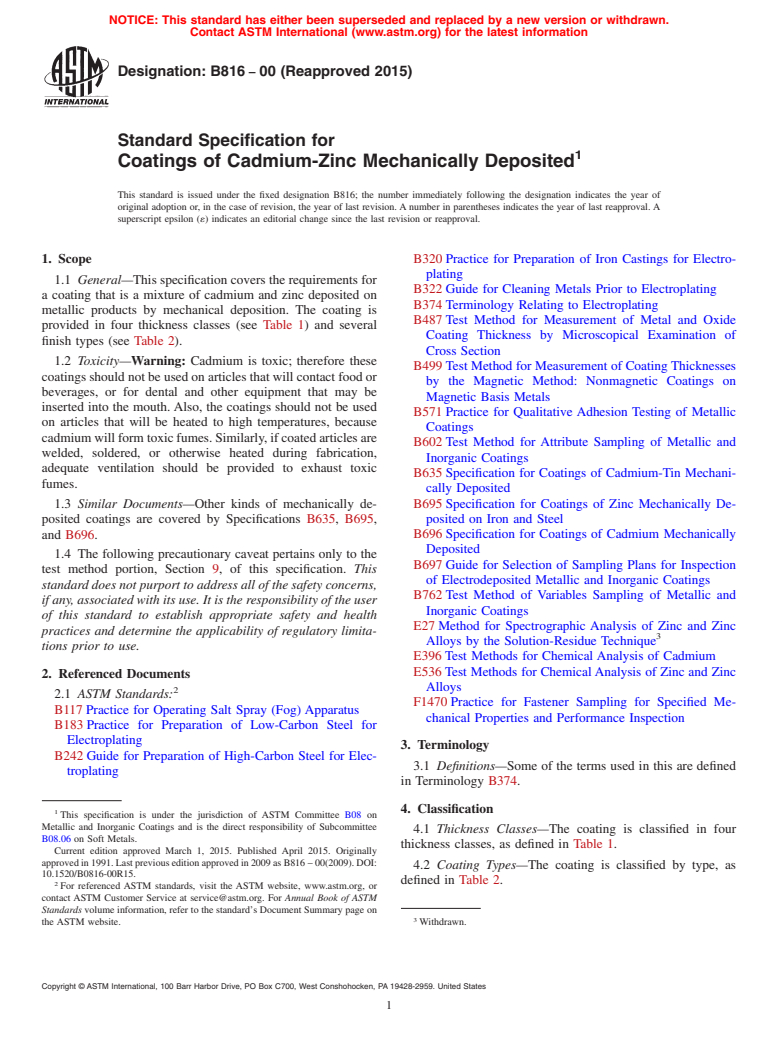
1.1 General—This specification covers the requirements for a coating that is a mixture of cadmium and zinc deposited on metallic products by mechanical deposition. The coating is provided in four thickness classes (see Table 1) and several finish types (see Table 2).
1.2 Toxicity—Warning: Cadmium is toxic; therefore these coatings should not be used on articles that will contact food or beverages, or for dental and other equipment that may be inserted into the mouth. Also, the coatings should not be used on articles that will be heated to high temperatures, because cadmium will form toxic fumes. Similarly, if coated articles are welded, soldered, or otherwise heated during fabrication, adequate ventilation should be provided to exhaust toxic fumes.
1.3 Similar Documents—Other kinds of mechanically deposited coatings are covered by Specifications B635, B695, and B696.
1.4 The following precautionary caveat pertains only to the test method portion, Section 9, of this specification. This standard does not purport to address all of the safety concerns, if any, associated with its use. It is the responsibility of the user of this standard to establish appropriate safety and health practices and determine the applicability of regulatory limitations prior to use.
General Information
Buy Standard
Standards Content (Sample)
NOTICE: This standard has either been superseded and replaced by a new version or withdrawn.
Contact ASTM International (www.astm.org) for the latest information
Designation:B816 −00 (Reapproved 2015)
Standard Specification for
Coatings of Cadmium-Zinc Mechanically Deposited
This standard is issued under the fixed designation B816; the number immediately following the designation indicates the year of
original adoption or, in the case of revision, the year of last revision.Anumber in parentheses indicates the year of last reapproval.A
superscript epsilon (´) indicates an editorial change since the last revision or reapproval.
1. Scope B320Practice for Preparation of Iron Castings for Electro-
plating
1.1 General—Thisspecificationcoverstherequirementsfor
B322Guide for Cleaning Metals Prior to Electroplating
a coating that is a mixture of cadmium and zinc deposited on
B374Terminology Relating to Electroplating
metallic products by mechanical deposition. The coating is
B487Test Method for Measurement of Metal and Oxide
provided in four thickness classes (see Table 1) and several
Coating Thickness by Microscopical Examination of
finish types (see Table 2).
Cross Section
1.2 Toxicity—Warning: Cadmium is toxic; therefore these
B499Test Method for Measurement of CoatingThicknesses
coatingsshouldnotbeusedonarticlesthatwillcontactfoodor
by the Magnetic Method: Nonmagnetic Coatings on
beverages, or for dental and other equipment that may be
Magnetic Basis Metals
inserted into the mouth.Also, the coatings should not be used
B571Practice for Qualitative Adhesion Testing of Metallic
on articles that will be heated to high temperatures, because
Coatings
cadmiumwillformtoxicfumes.Similarly,ifcoatedarticlesare
B602Test Method for Attribute Sampling of Metallic and
welded, soldered, or otherwise heated during fabrication,
Inorganic Coatings
adequate ventilation should be provided to exhaust toxic
B635Specification for Coatings of Cadmium-Tin Mechani-
fumes.
cally Deposited
1.3 Similar Documents—Other kinds of mechanically de- B695Specification for Coatings of Zinc Mechanically De-
posited on Iron and Steel
posited coatings are covered by Specifications B635, B695,
and B696. B696Specification for Coatings of Cadmium Mechanically
Deposited
1.4 The following precautionary caveat pertains only to the
B697Guide for Selection of Sampling Plans for Inspection
test method portion, Section 9, of this specification. This
of Electrodeposited Metallic and Inorganic Coatings
standard does not purport to address all of the safety concerns,
B762Test Method of Variables Sampling of Metallic and
if any, associated with its use. It is the responsibility of the user
Inorganic Coatings
of this standard to establish appropriate safety and health
E27Method for Spectrographic Analysis of Zinc and Zinc
practices and determine the applicability of regulatory limita-
Alloys by the Solution-Residue Technique
tions prior to use.
E396Test Methods for Chemical Analysis of Cadmium
E536Test Methods for ChemicalAnalysis of Zinc and Zinc
2. Referenced Documents
Alloys
2.1 ASTM Standards:
F1470Practice for Fastener Sampling for Specified Me-
B117Practice for Operating Salt Spray (Fog) Apparatus
chanical Properties and Performance Inspection
B183Practice for Preparation of Low-Carbon Steel for
Electroplating
3. Terminology
B242Guide for Preparation of High-Carbon Steel for Elec-
3.1 Definitions—Some of the terms used in this are defined
troplating
in Terminology B374.
4. Classification
This specification is under the jurisdiction of ASTM Committee B08 on
Metallic and Inorganic Coatings and is the direct responsibility of Subcommittee
4.1 Thickness Classes—The coating is classified in four
B08.06 on Soft Metals.
thickness classes, as defined in Table 1.
Current edition approved March 1, 2015. Published April 2015. Originally
approvedin1991.Lastpreviouseditionapprovedin2009asB816–00(2009).DOI:
4.2 Coating Types—The coating is classified by type, as
10.1520/B0816-00R15.
defined in Table 2.
For referenced ASTM standards, visit the ASTM website, www.astm.org, or
contact ASTM Customer Service at service@astm.org. For Annual Book of ASTM
Standards volume information, refer to the standard’s Document Summary page on
the ASTM website. Withdrawn.
Copyright © ASTM International, 100 Barr Harbor Drive, PO Box C700, West Conshohocken, PA 19428-2959. United States
B816−00 (2015)
TABLE 1 Thickness Classes
5.1.6.7 Absence of hydrogen embrittlement, waiting time
Coating prior to testing and testing loads (see 9.8), and
Class Thickness Typical Applications
5.1.7 The sampling plan to be used (see 8.1) and responsi-
Minimum, µm
bility for inspection (see section 13.1).
7 7 Automotive fasteners
12 12 Increased corrosion resistance (for ex-
6. Significance and Use
ample, bellville washers)
25 25 Exterior hardware
6.1 Corrosion Resistance, General—Thisfunctionalcoating
50 50 Pole line hardware in severe envi-
isusedtoprovidecorrosionresistance.Theperformanceofthis
ronments
coating depends largely on its thickness and the kind of
environment to which it is exposed. Published results of
TABLE 2 Coating Types
environmental corrosion studies have demonstrated that the
coating provides corrosion resistance greater than equivalent
Type Description Typical Applications
I As-coated, without supplemen- Lowest cost where white corro- thicknesses of zinc coatings in industrial environments and
ary treatments. ion products are acceptable.
greater corrosion resistance than equivalent thicknesses of
For elevated temperature ap-
cadmium coatings in marine environments.
lication that will degrade
Type II coatings (see 1.2).
6.2 Galvanic Corrosion Resistance—The galvanic couple
IIa With yellow to bronze color sup- Delay the appearance of white
that results in the corrosion of steel and aluminum parts in
lementary chromate coating. corrosion products. Increase
total corrosion protection.
contact with each other in corrosive environments can also be
IIb With brown to olive drab color Greater corrosion resistances
minimized by plating the steel parts with this mechanically
supplementary chromate than IIa. To provide a match
deposited coating.
coating. to military equipment.
IIc Type IIa, dyed. Color coding
6.3 Hydrogen Embrittlement, Absence of—The mechanical
Decorative purposes
IId Type IIa with an added lubricant Lubricity coating process does not produce any permanent hydrogen
or organic finish (oil, wax, lac- Maximum corrosion resistance
embrittlement in products made from high-strength steels, for
uer, etc.)
example, fasteners or lock washers.
7. Coating Requirements
7.1 Nature of Coating—Thecoatingshallbeamechanically
5. Ordering Information
deposited mixture of cadmium and zinc with the composition
5.1 In order to make the application of this specification 45 to 75 mass % zinc, remainder cadmium.
complete, the purchaser needs to supply the following infor-
7.2 Coating Process:
mation to the seller on the purchase order or other governing
7.2.1 Coating—The cadmium-zinc coating shall be pro-
documents:
ducedbymechanicaldepositioninaccordancewiththeprocess
5.1.1 The name, designation, and year of issue of this
Annex A1.
description given in
specification,
7.2.2 Supplementary Treatments—Type II coatings shall be
5.1.2 Thicknessclass(see4.1),includingamaximumthick-
produced by treatment with acidic solutions that contain
ness if appropriate,
hexavalent chromium compounds and anions that act as
5.1.3 Coating type (see 4.2), including required color if
catalysts or film-forming compounds.
Type IIc is used, and required lubricant or organic finish if
7.3 Appearance:
Type IId is used,
7.3.1 General—The coating on all readily visible surfaces
5.1.4 Nature of the substrate, for example: high-carbon
shall be uniform in appearance, well compacted, and complete
steel, mild steel, copper, brass:
in coverage. Superficial staining from rinsing and drying and
5.1.4.1 State if precoating stress relief heat treatment is
mild variations in color and luster are acceptable.
required and the time and temperature to be used if different
7.3.2 Surface Defects—Defects and variations in appear-
from the standard values (see section 12.1),
ance in the coating that arise from surface conditions of the
5.1.4.2 State if special pretreatments are required to modify
substrate(scratches,pores,rollmarks,inclusions,etc.)andthat
the surface of the article (see Note 1),
persist in the coating despite the observance of good metal
5.1.4.3 If special cleaning precautions are to be followed
finishing practices shall not be cause for rejection.
(see A1.1), and
5.1.5 Identification of significant surfaces (see 7.4.2).
NOTE 1—Coatings generally perform better in service when the
substrate over which they are applied is smooth and free of torn metal,
5.1.6 Requirements and methods of testing one or more of
inclusions, pores, and other defects. The specifications covering the
the following:
unfinished products should provide limits for these defects. A metal
5.1.6.1 Need for and type of special test specimens (see
finisher can often remove defects through special treatments, such as
9.1),
grinding, polishing, abrasive blasting, chemical etches, and electropolish-
5.1.6.2 Appearance (see 7.3), ing. However, these are not normal in the treatment steps preceding the
application of the coating. When they are desired, they are the subject of
5.1.6.3 Deposit composition (see 9.2),
5.1.6.4 Thickness (see 9.5),
5.1.6.5 Adhesion (see 9.6),
Holford, Raymond N., Jr., “Five Year Outdoor Exposure Corrosion
5.1.6.6 Corrosion resistance (see 9.7), Comparison,” Mechanical Finishing, July 1988.
B816−00 (2015)
special agreement between the purchaser and the seller.
TheorganiccoatingorlubricantshallberemovedfromType
IId coatings before the salt spray test or the test can be run on
7.4 Thickness:
articles that are withdrawn from processing before the organic
7.4.1 Conformance to Specified Class—Thethicknessofthe
coating is applied.
coatingeverywhereonthesignificantsurfacesshallconformto
the requirements of the specified class as defined in 4.1.
NOTE 4—In many instances, there is no direct relation between the
7.4.2 Significant Surfaces—Significant surfaces are usually
results of an accelerated corrosion test and the resistance to corrosion in
other tests or actual environments, because several factors that influence
definedasthosenormallyvisible(directlyorbyreflection)that
the progress of corrosion, such as the formation of protective film, vary
are essential to the appearance and serviceability of the article
greatly with the conditions encountered. The results obtained in the test
when assembled in normal position; or that can be the source
should not, therefore, be regarded as a direct guide to the corrosion
of corrosion products that deface visible surfaces on the
resistanceofthetestedmaterialsinallenvironmentswherethesematerials
may be used. Also, performance of different materials in the test cannot
assembled article. Significant surfaces are further defined at
always be taken as a direct guide to the relative corrosion resistance of
those surfaces that are identified as such by the purchaser, for
these materials in service.
example, by indicating them on an engineering drawing of the
product or by marking a sample item of product.
8. Sampling
7.4.3 Minimum Thickness Requirement—The coating re-
quirement of this specification is a minimum requirement; that 8.1 The purchaser and producer are urged to employ statis-
is, the coating thickness is required to equal or exceed the tical process control in the coating process. Properly
specified thickness everywhere on the significant surfaces. performed, statistical process control will assure coated prod-
Variation in the thickness from point to point on an article and
ucts of satisfactory quality and will reduce the amount of
from article to article in a production lot is inherent in acceptance inspection. The sampling plan used for the inspec-
mechanically deposited coatings. Therefore, if all of the
tion of the quality coated article shall be agreed upon between
articles in a production lot are to meet the thickness the purchaser and producer.
requirement, the average coating thickness for the production
8.1.1 When a collection of coated articles (inspection lot,
lot as a whole will be greater than the specified minimum.
see 8.2) is examined for compliance with the requirements
placed on the articles, a relatively small number of the articles
NOTE2—Thethicknessofmechanicallydepositedcoatingsvariesfrom
(sample)isselectedatrandomandisinspected.Theinspection
point to point on the surface of a product, characteristically tending to be
thicker on flat surfaces, and thinner at exposed edges, sharp projections, lot is then classified as complying with the requirements based
shielded or recessed areas, and interior corners and holes, depending on
on the results of the inspection of the sample. The size of the
the dimensions, with such thinner areas often being exempted from
sample and the criteria for compliance are determined by the
thickness requirements.
application of statistics. The procedure is known as sampling
NOTE3—ProcessesusedtoproduceTypeIIfinishesremovesomeofthe
inspection. Test Method B602, Guide B697, and Test Method
coating. Because thickness requirements apply to the finished article,
additionalthicknessesmayhavetobeappliedtocompensateforthemetal B762 contain sampling plans that are designed for sampling
removed in the Type II process.
inspection of coatings.
7.5 Adhesion—The coating shall be adherent, as defined or 8.1.2 TestMethodB602containsfoursamplingplans,three
tested in accordance with 9.6. forusewithteststhatarenondestructiveandonewhentheyare
destructive.TestMethodB602providesadefaultplanifoneis
7.6 Corrosion Resistance:
not specified.
7.6.1 Type I Coatings on Ferrous Articles—Type I coated
8.1.3 GuideB697providesalargenumberofplansandalso
ferrous articles shall not develop red corrosion products
gives guidance in the selection of a plan. GuideB697 provides
(“rust”) when submitted to the 5% salt spray test for the
a default plan if one is not specified.
following times:
8.1.4 Test Method B762 can be used only for coating
Class 7 36 h
requirements that have a numerical limit, such as coating
Class 12 72 h
Class 25 192 h
thickness. The test must yield a numeric value and certain
Class 50 300 h
statistical requirements must be met. Test Method B762
7.6.2 Type II Coatings, White Corrosion—Type II coatings
contains several plans and also gives instructions for calculat-
shall not develop white corrosion products when submitted to
ing plans to meet special needs. Test Method B762 provides a
the salt spray test for 72 h. The organic coating or lubricant default plan if one is not specified.
shall be removed from Type IId coatings before the test or the
8.1.5 Guide F1470 can be used for fasteners such as
test can be run on
...
This document is not an ASTM standard and is intended only to provide the user of an ASTM standard an indication of what changes have been made to the previous version. Because
it may not be technically possible to adequately depict all changes accurately, ASTM recommends that users consult prior editions as appropriate. In all cases only the current version
of the standard as published by ASTM is to be considered the official document.
Designation: B816 − 00 (Reapproved 2009) B816 − 00 (Reapproved 2015)
Standard Specification for
Coatings of Cadmium-Zinc Mechanically Deposited
This standard is issued under the fixed designation B816; the number immediately following the designation indicates the year of
original adoption or, in the case of revision, the year of last revision. A number in parentheses indicates the year of last reapproval. A
superscript epsilon (´) indicates an editorial change since the last revision or reapproval.
1. Scope
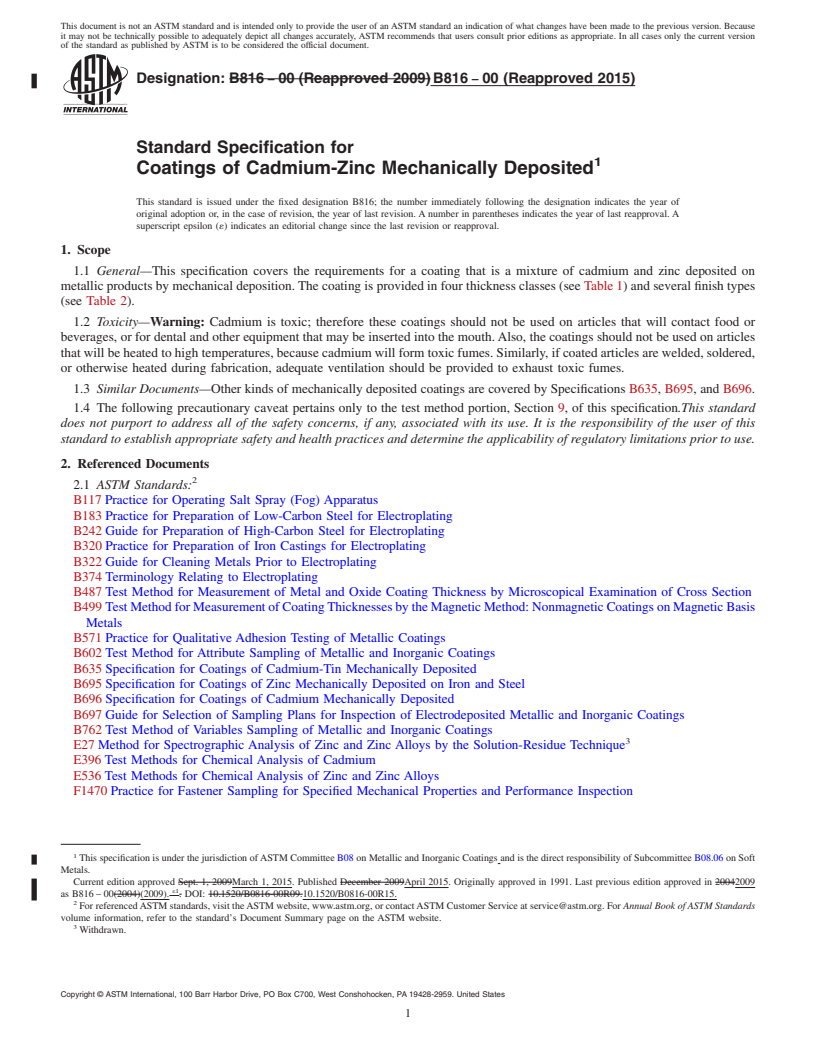
1.1 General—This specification covers the requirements for a coating that is a mixture of cadmium and zinc deposited on
metallic products by mechanical deposition. The coating is provided in four thickness classes (see Table 1) and several finish types
(see Table 2).
1.2 Toxicity—Warning: Cadmium is toxic; therefore these coatings should not be used on articles that will contact food or
beverages, or for dental and other equipment that may be inserted into the mouth. Also, the coatings should not be used on articles
that will be heated to high temperatures, because cadmium will form toxic fumes. Similarly, if coated articles are welded, soldered,
or otherwise heated during fabrication, adequate ventilation should be provided to exhaust toxic fumes.
1.3 Similar Documents—Other kinds of mechanically deposited coatings are covered by Specifications B635, B695, and B696.
1.4 The following precautionary caveat pertains only to the test method portion, Section 9, of this specification.This standard
does not purport to address all of the safety concerns, if any, associated with its use. It is the responsibility of the user of this
standard to establish appropriate safety and health practices and determine the applicability of regulatory limitations prior to use.
2. Referenced Documents
2.1 ASTM Standards:
B117 Practice for Operating Salt Spray (Fog) Apparatus
B183 Practice for Preparation of Low-Carbon Steel for Electroplating
B242 Guide for Preparation of High-Carbon Steel for Electroplating
B320 Practice for Preparation of Iron Castings for Electroplating
B322 Guide for Cleaning Metals Prior to Electroplating
B374 Terminology Relating to Electroplating
B487 Test Method for Measurement of Metal and Oxide Coating Thickness by Microscopical Examination of Cross Section
B499 Test Method for Measurement of Coating Thicknesses by the Magnetic Method: Nonmagnetic Coatings on Magnetic Basis
Metals
B571 Practice for Qualitative Adhesion Testing of Metallic Coatings
B602 Test Method for Attribute Sampling of Metallic and Inorganic Coatings
B635 Specification for Coatings of Cadmium-Tin Mechanically Deposited
B695 Specification for Coatings of Zinc Mechanically Deposited on Iron and Steel
B696 Specification for Coatings of Cadmium Mechanically Deposited
B697 Guide for Selection of Sampling Plans for Inspection of Electrodeposited Metallic and Inorganic Coatings
B762 Test Method of Variables Sampling of Metallic and Inorganic Coatings
E27 Method for Spectrographic Analysis of Zinc and Zinc Alloys by the Solution-Residue Technique
E396 Test Methods for Chemical Analysis of Cadmium
E536 Test Methods for Chemical Analysis of Zinc and Zinc Alloys
F1470 Practice for Fastener Sampling for Specified Mechanical Properties and Performance Inspection
This specification is under the jurisdiction of ASTM Committee B08 on Metallic and Inorganic Coatings and is the direct responsibility of Subcommittee B08.06 on Soft
Metals.
Current edition approved Sept. 1, 2009March 1, 2015. Published December 2009April 2015. Originally approved in 1991. Last previous edition approved in 20042009
ε1
as B816 – 00(2004)(2009). . DOI: 10.1520/B0816-00R09.10.1520/B0816-00R15.
For referenced ASTM standards, visit the ASTM website, www.astm.org, or contact ASTM Customer Service at service@astm.org. For Annual Book of ASTM Standards
volume information, refer to the standard’s Document Summary page on the ASTM website.
Withdrawn.
Copyright © ASTM International, 100 Barr Harbor Drive, PO Box C700, West Conshohocken, PA 19428-2959. United States
B816 − 00 (2015)
TABLE 1 Thickness Classes
Coating
Class Thickness Typical Applications
Minimum, μm
7 7 Automotive fasteners
12 12 Increased corrosion resistance (for ex-
ample, bellville washers)
25 25 Exterior hardware
50 50 Pole line hardware in severe envi-
ronments
TABLE 2 Coating Types
Type Description Typical Applications
I As-coated, without supplemen- Lowest cost where white corro-
ary treatments. ion products are acceptable.
For elevated temperature ap-
lication that will degrade
Type II coatings (see 1.2).
IIa With yellow to bronze color sup- Delay the appearance of white
lementary chromate coating. corrosion products. Increase
total corrosion protection.
IIb With brown to olive drab color Greater corrosion resistances
supplementary chromate than IIa. To provide a match
coating. to military equipment.
IIc Type IIa, dyed. Color coding
Decorative purposes
IId Type IIa with an added lubricant Lubricity
or organic finish (oil, wax, lac- Maximum corrosion resistance
uer, etc.)
3. Terminology
3.1 Definitions—Some of the terms used in this are defined in Terminology B374.
4. Classification
4.1 Thickness Classes—The coating is classified in four thickness classes, as defined in Table 1.
4.2 Coating Types—The coating is classified by type, as defined in Table 2.
5. Ordering Information
5.1 In order to make the application of this specification complete, the purchaser needs to supply the following information to
the seller on the purchase order or other governing documents:
5.1.1 The name, designation, and year of issue of this specification,
5.1.2 Thickness class (see 4.1), including a maximum thickness if appropriate,
5.1.3 Coating type (see 4.2), including required color if Type IIc is used, and required lubricant or organic finish if Type IId is
used,
5.1.4 Nature of the substrate, for example: high-carbon steel, mild steel, copper, brass:
5.1.4.1 State if precoating stress relief heat treatment is required and the time and temperature to be used if different from the
standard values (see section 12.1),
5.1.4.2 State if special pretreatments are required to modify the surface of the article (see Note 1),
5.1.4.3 If special cleaning precautions are to be followed (see A1.1), and
5.1.5 Identification of significant surfaces (see 7.4.2).
5.1.6 Requirements and methods of testing one or more of the following:
5.1.6.1 Need for and type of special test specimens (see 9.1),
5.1.6.2 Appearance (see 7.3),
5.1.6.3 Deposit composition (see 9.2),
5.1.6.4 Thickness (see 9.5),
5.1.6.5 Adhesion (see 9.6),
5.1.6.6 Corrosion resistance (see 9.7),
5.1.6.7 Absence of hydrogen embrittlement, waiting time prior to testing and testing loads (see 9.8), and
5.1.7 The sampling plan to be used (see 8.1) and responsibility for inspection (see section 13.1).
B816 − 00 (2015)
6. Significance and Use
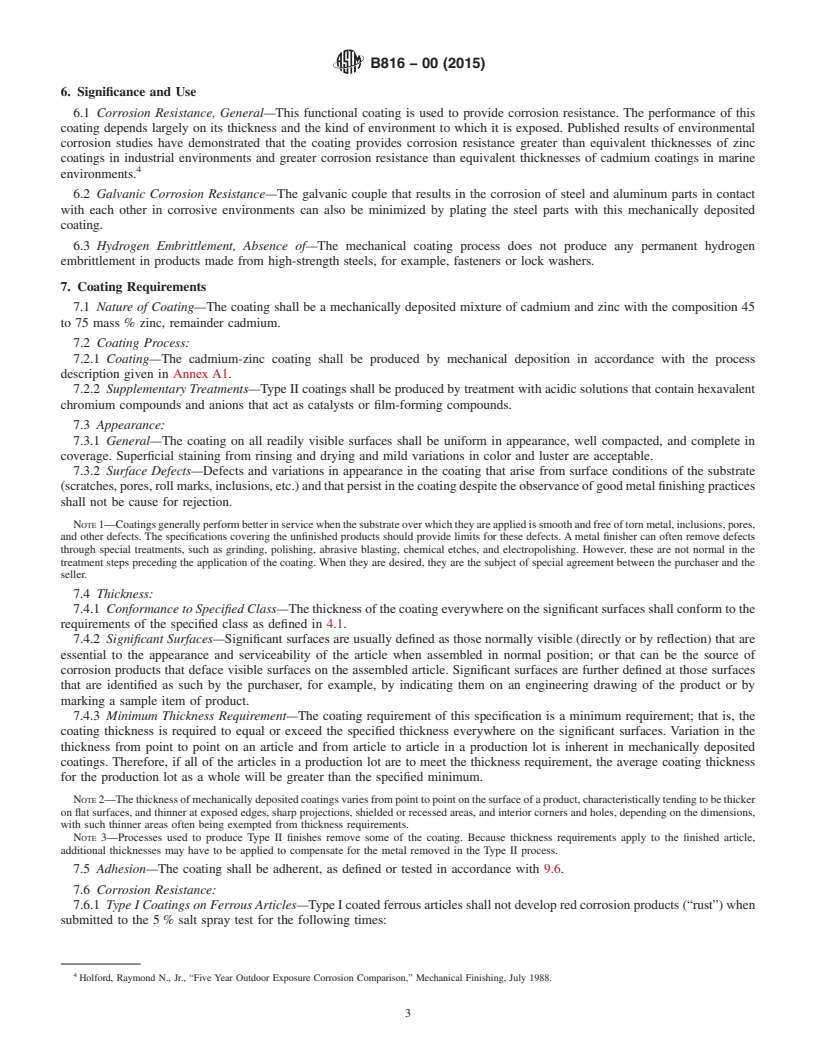
6.1 Corrosion Resistance, General—This functional coating is used to provide corrosion resistance. The performance of this
coating depends largely on its thickness and the kind of environment to which it is exposed. Published results of environmental
corrosion studies have demonstrated that the coating provides corrosion resistance greater than equivalent thicknesses of zinc
coatings in industrial environments and greater corrosion resistance than equivalent thicknesses of cadmium coatings in marine
environments.
6.2 Galvanic Corrosion Resistance—The galvanic couple that results in the corrosion of steel and aluminum parts in contact
with each other in corrosive environments can also be minimized by plating the steel parts with this mechanically deposited
coating.
6.3 Hydrogen Embrittlement, Absence of—The mechanical coating process does not produce any permanent hydrogen
embrittlement in products made from high-strength steels, for example, fasteners or lock washers.
7. Coating Requirements
7.1 Nature of Coating—The coating shall be a mechanically deposited mixture of cadmium and zinc with the composition 45
to 75 mass % zinc, remainder cadmium.
7.2 Coating Process:
7.2.1 Coating—The cadmium-zinc coating shall be produced by mechanical deposition in accordance with the process
description given in Annex A1.
7.2.2 Supplementary Treatments—Type II coatings shall be produced by treatment with acidic solutions that contain hexavalent
chromium compounds and anions that act as catalysts or film-forming compounds.
7.3 Appearance:
7.3.1 General—The coating on all readily visible surfaces shall be uniform in appearance, well compacted, and complete in
coverage. Superficial staining from rinsing and drying and mild variations in color and luster are acceptable.
7.3.2 Surface Defects—Defects and variations in appearance in the coating that arise from surface conditions of the substrate
(scratches, pores, roll marks, inclusions, etc.) and that persist in the coating despite the observance of good metal finishing practices
shall not be cause for rejection.
NOTE 1—Coatings generally perform better in service when the substrate over which they are applied is smooth and free of torn metal, inclusions, pores,
and other defects. The specifications covering the unfinished products should provide limits for these defects. A metal finisher can often remove defects
through special treatments, such as grinding, polishing, abrasive blasting, chemical etches, and electropolishing. However, these are not normal in the
treatment steps preceding the application of the coating. When they are desired, they are the subject of special agreement between the purchaser and the
seller.
7.4 Thickness:
7.4.1 Conformance to Specified Class—The thickness of the coating everywhere on the significant surfaces shall conform to the
requirements of the specified class as defined in 4.1.
7.4.2 Significant Surfaces—Significant surfaces are usually defined as those normally visible (directly or by reflection) that are
essential to the appearance and serviceability of the article when assembled in normal position; or that can be the source of
corrosion products that deface visible surfaces on the assembled article. Significant surfaces are further defined at those surfaces
that are identified as such by the purchaser, for example, by indicating them on an engineering drawing of the product or by
marking a sample item of product.
7.4.3 Minimum Thickness Requirement—The coating requirement of this specification is a minimum requirement; that is, the
coating thickness is required to equal or exceed the specified thickness everywhere on the significant surfaces. Variation in the
thickness from point to point on an article and from article to article in a production lot is inherent in mechanically deposited
coatings. Therefore, if all of the articles in a production lot are to meet the thickness requirement, the average coating thickness
for the production lot as a whole will be greater than the specified minimum.
NOTE 2—The thickness of mechanically deposited coatings varies from point to point on the surface of a product, characteristically tending to be thicker
on flat surfaces, and thinner at exposed edges, sharp projections, shielded or recessed areas, and interior corners and holes, depending on the dimensions,
with such thinner areas often being exempted from thickness requirements.
NOTE 3—Processes used to produce Type II finishes remove some of the coating. Because thickness requirements apply to the finished article,
additional thicknesses may have to be applied to compensate for the metal removed in the Type II process.
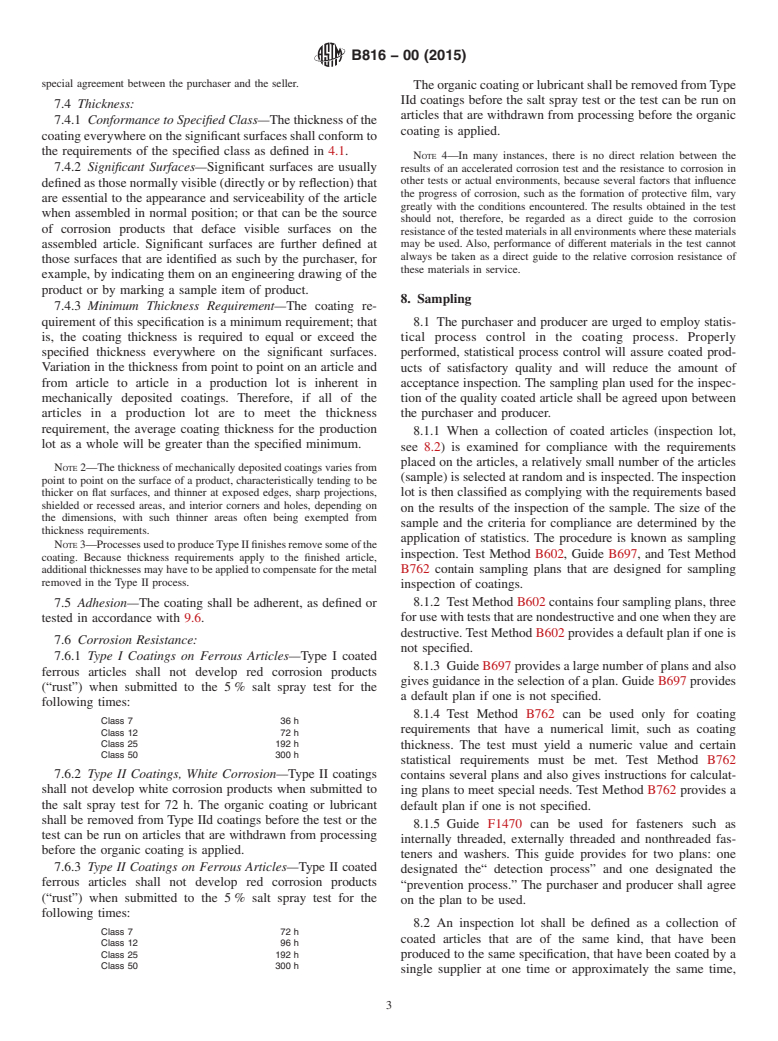
7.5 Adhesion—The coating shall be adherent, as defined or tested in accordance with 9.6.
7.6 Corrosion Resistance:
7.6.1 Type I Coatings on Ferrous Articles—Type I coated ferrous articles shall not develop red corrosion products (“rust”) when
submitted to the 5 % salt spray test for the following times:
Holford, Raymond N., Jr., “Five Year Outdoor Exposure Corrosion Comparison,” Mechanical Finishing, July 1988.
B816 − 00 (2015)
Class 7 36 h
Class 12 72 h
Class 25 192 h
Class 50 300 h
7.6.2 Type II Coatings, White Corrosion—Type II coatings shall not develop white corrosion products when submitted to the
salt spray test for 72 h. The organic coating or lubricant shall be removed from Type IId coatings before the test or the test can
be run on articles that are withdrawn from processing before the organic coating is applied.
7.6.3 Type II Coatings on Ferrous Articles—Type II coated ferrous articles shall not develop red corrosion products (“rust”)
when submitted to the 5 % salt spray test for the following times:
Class 7 72 h
Class 12 96 h
Class 25 192 h
Class 50 300 h
The organic coating or lubricant shall be removed from Type IId coatings before the salt spray test or the test can be run on
articles that are withdrawn from processing before the organic coating is applied.
NOTE 4—In many instances, there is no direct relation between the results of an accelerated corrosion test and the resistance to corrosion in other tests
or actual environments, because several factors that influence the progress of corrosion, such as the formation of protective film, vary greatly with the
conditions encountered. The results obtained in the test should not, therefore, be regarded as a direct guide to the corrosion resistance of the tested
materials in all environments where these materials may be used. Also, performance of different materials in the test cannot always be taken as a direct
guide to the relative corrosion resistance of these materials in service.
8. Sampling
8.1 The purchaser and producer are urged to employ statistical process control in the coating process. Properly performed,
statistical process control will assure coated products of satisfactory quality and will reduce the amount of acceptance inspection.
The sampling plan used for the inspection of the quality coated article shall be agreed upon between the purchaser and producer.
8.1.1 When a collection of coated articles (inspection lot, see 8.2) is examined for compliance with the requirements placed on
the articles, a relatively small number of the articles (sample) is selected at random and is inspected. The inspection lot is then
classified as complying with the requirements based on the results of the inspection of the sample. The size of the sample and the
criteria for compliance are determined by the application of statistics. The procedu
...
Questions, Comments and Discussion
Ask us and Technical Secretary will try to provide an answer. You can facilitate discussion about the standard in here.