


ASTM C509-06(2015)
(Specification)Standard Specification for Elastomeric Cellular Preformed Gasket and Sealing Material
Standard Specification for Elastomeric Cellular Preformed Gasket and Sealing<brk/> Material
ABSTRACT
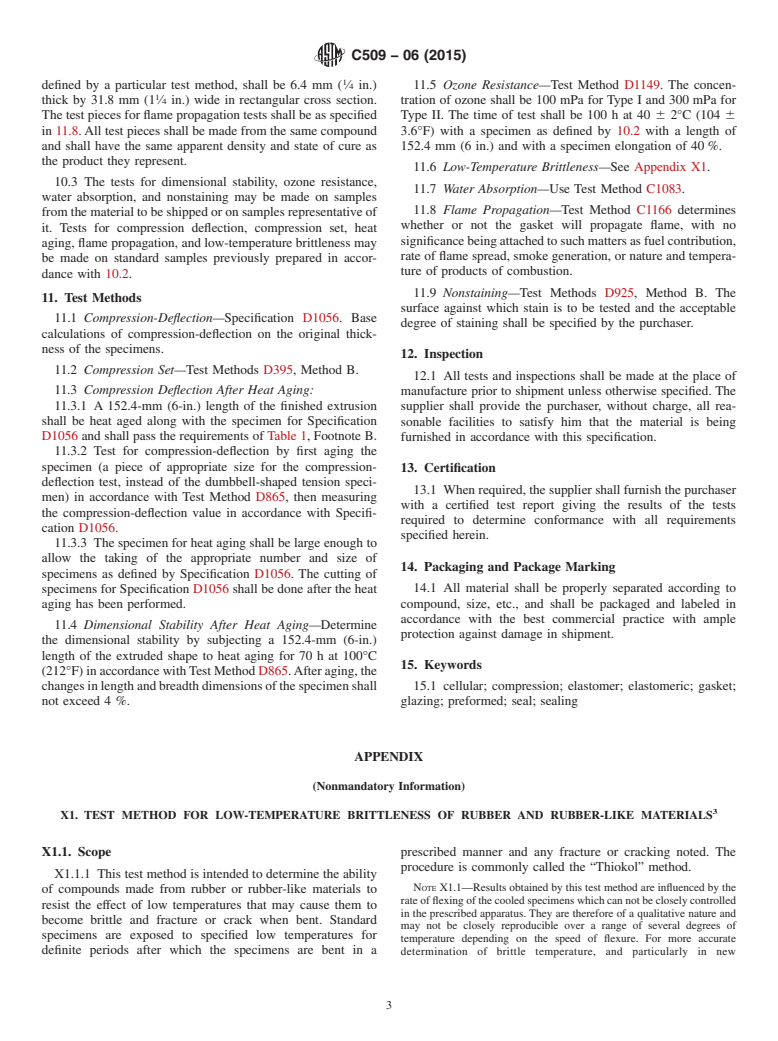
This specification covers elastomeric cellular preformed gasket and sealing materials. Elastomeric cellular materials shall be manufactured from natural rubber, synthetic rubber, rubber-like materials, or mixture of these, with added compounding ingredients. The material shall conform to the required physical properties such as: compression-deflection, compression set, heat aging, dimensional stability, ozone resistance, low-temperature brittleness, water absorption, flame propagation, and nonstaining. The two classifications of material according to ozone resistance are Type I and Type II. Test for each physical properties shall be made.
SIGNIFICANCE AND USE
9.1 Flame Propagation:
9.1.1 This specification has two options:
9.1.1.1 Option I—Flame propagation test is required.
9.1.1.2 Option II—Flame propagation test is not required.
9.1.2 In case no option is specified, Option I will apply.
9.2 This specification has two classifications as related to ozone resistance. These are Type I and Type II, with the latter having the greater resistance to ozone. The type should be specified when making reference to this specification but in the event that the type is not specified, Type II shall apply.
Note 2: Type II is included in this specification for use where greater ozone resistance is required.
SCOPE
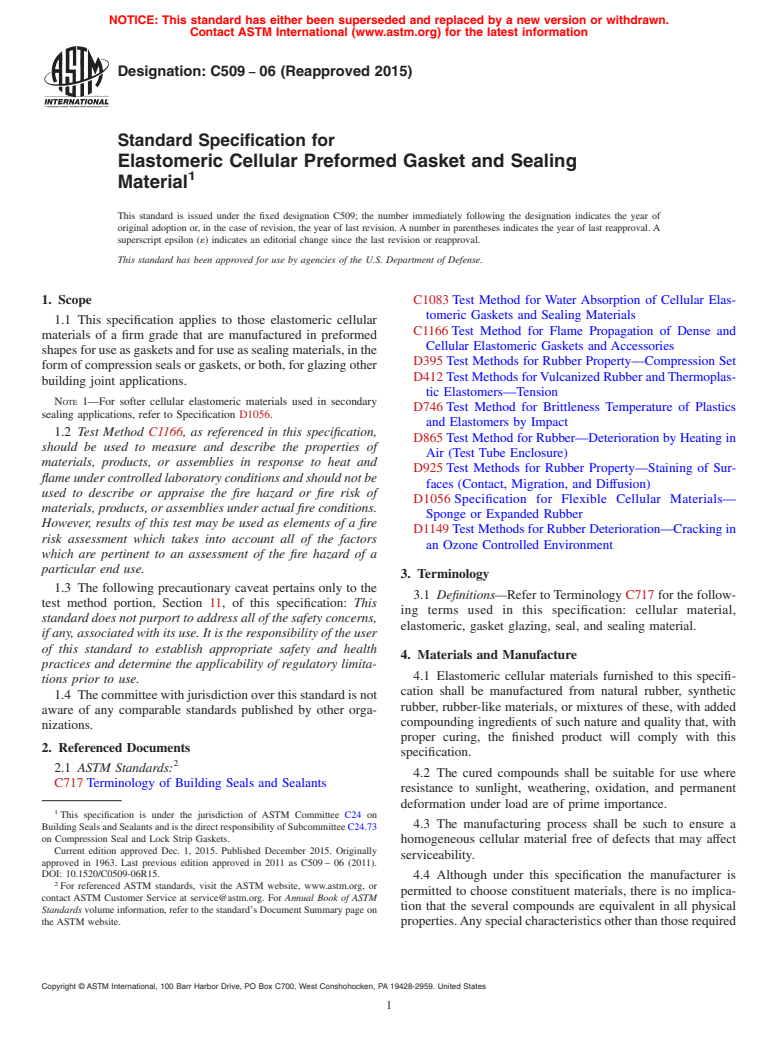
1.1 This specification applies to those elastomeric cellular materials of a firm grade that are manufactured in preformed shapes for use as gaskets and for use as sealing materials, in the form of compression seals or gaskets, or both, for glazing other building joint applications.
Note 1: For softer cellular elastomeric materials used in secondary sealing applications, refer to Specification D1056.
1.2 Test Method C1166, as referenced in this specification, should be used to measure and describe the properties of materials, products, or assemblies in response to heat and flame under controlled laboratory conditions and should not be used to describe or appraise the fire hazard or fire risk of materials, products, or assemblies under actual fire conditions. However, results of this test may be used as elements of a fire risk assessment which takes into account all of the factors which are pertinent to an assessment of the fire hazard of a particular end use.
1.3 The following precautionary caveat pertains only to the test method portion, Section 11, of this specification: This standard does not purport to address all of the safety concerns, if any, associated with its use. It is the responsibility of the user of this standard to establish appropriate safety and health practices and determine the applicability of regulatory limitations prior to use.
1.4 The committee with jurisdiction over this standard is not aware of any comparable standards published by other organizations.
General Information
Buy Standard
Standards Content (Sample)
NOTICE: This standard has either been superseded and replaced by a new version or withdrawn.
Contact ASTM International (www.astm.org) for the latest information
Designation:C509 −06 (Reapproved 2015)
Standard Specification for
Elastomeric Cellular Preformed Gasket and Sealing
Material
This standard is issued under the fixed designation C509; the number immediately following the designation indicates the year of
original adoption or, in the case of revision, the year of last revision.Anumber in parentheses indicates the year of last reapproval.A
superscript epsilon (´) indicates an editorial change since the last revision or reapproval.
This standard has been approved for use by agencies of the U.S. Department of Defense.
1. Scope C1083Test Method for Water Absorption of Cellular Elas-
tomeric Gaskets and Sealing Materials
1.1 This specification applies to those elastomeric cellular
C1166Test Method for Flame Propagation of Dense and
materials of a firm grade that are manufactured in preformed
Cellular Elastomeric Gaskets and Accessories
shapesforuseasgasketsandforuseassealingmaterials,inthe
D395Test Methods for Rubber Property—Compression Set
formofcompressionsealsorgaskets,orboth,forglazingother
D412TestMethodsforVulcanizedRubberandThermoplas-
building joint applications.
tic Elastomers—Tension
NOTE 1—For softer cellular elastomeric materials used in secondary
D746Test Method for Brittleness Temperature of Plastics
sealing applications, refer to Specification D1056.
and Elastomers by Impact
1.2 Test Method C1166, as referenced in this specification,
D865Test Method for Rubber—Deterioration by Heating in
should be used to measure and describe the properties of
Air (Test Tube Enclosure)
materials, products, or assemblies in response to heat and
D925Test Methods for Rubber Property—Staining of Sur-
flameundercontrolledlaboratoryconditionsandshouldnotbe
faces (Contact, Migration, and Diffusion)
used to describe or appraise the fire hazard or fire risk of
D1056 Specification for Flexible Cellular Materials—
materials, products, or assemblies under actual fire conditions.
Sponge or Expanded Rubber
However, results of this test may be used as elements of a fire
D1149TestMethodsforRubberDeterioration—Crackingin
risk assessment which takes into account all of the factors
an Ozone Controlled Environment
which are pertinent to an assessment of the fire hazard of a
particular end use.
3. Terminology
1.3 The following precautionary caveat pertains only to the
3.1 Definitions—Refer toTerminology C717 for the follow-
test method portion, Section 11, of this specification: This
ing terms used in this specification: cellular material,
standard does not purport to address all of the safety concerns,
elastomeric, gasket glazing, seal, and sealing material.
if any, associated with its use. It is the responsibility of the user
of this standard to establish appropriate safety and health
4. Materials and Manufacture
practices and determine the applicability of regulatory limita-
4.1 Elastomeric cellular materials furnished to this specifi-
tions prior to use.
cation shall be manufactured from natural rubber, synthetic
1.4 Thecommitteewithjurisdictionoverthisstandardisnot
rubber, rubber-like materials, or mixtures of these, with added
aware of any comparable standards published by other orga-
compounding ingredients of such nature and quality that, with
nizations.
proper curing, the finished product will comply with this
2. Referenced Documents
specification.
2.1 ASTM Standards:
4.2 The cured compounds shall be suitable for use where
C717Terminology of Building Seals and Sealants
resistance to sunlight, weathering, oxidation, and permanent
deformation under load are of prime importance.
This specification is under the jurisdiction of ASTM Committee C24 on
4.3 The manufacturing process shall be such to ensure a
BuildingSealsandSealantsandisthedirectresponsibilityofSubcommitteeC24.73
on Compression Seal and Lock Strip Gaskets.
homogeneous cellular material free of defects that may affect
Current edition approved Dec. 1, 2015. Published December 2015. Originally
serviceability.
approved in 1963. Last previous edition approved in 2011 as C509– 06 (2011).
DOI: 10.1520/C0509-06R15.
4.4 Although under this specification the manufacturer is
For referenced ASTM standards, visit the ASTM website, www.astm.org, or
permitted to choose constituent materials, there is no implica-
contact ASTM Customer Service at service@astm.org. For Annual Book of ASTM
tion that the several compounds are equivalent in all physical
Standards volume information, refer to the standard’s Document Summary page on
the ASTM website. properties.Anyspecialcharacteristicsotherthanthoserequired
Copyright © ASTM International, 100 Barr Harbor Drive, PO Box C700, West Conshohocken, PA 19428-2959. United States
C509−06 (2015)
TABLE 2 Standards for Cross-Sectional Tolerance
by this specification, which may be needed for specific
applications, shall be specified by the purchaser, since such
NOTE 1—Dimensional tolerances for outside diameters, inside
characteristics may influence the choice of base materials and
diameters, wall thickness, width, height, and general cross-sectional
dimensions of extrusions
other ingredients.
A
Rubber Manufacturers Association
5. Physical Properties RMA Class 1 RMA Class 1
Drawing Designation BEC 1 Drawing Designation BEC 1
5.1 The material shall conform to the requirements pre-
Dimensions (in inches) Dimensions (in Millimeters)
Above Up To Above Up To
scribed in Table 1.
0 0.25 ±0.016 0 6.4 ±0.4
0.25 0.50 0.025 6.4 12.7 0.63
6. Dimensional Tolerances
0.50 1.00 0.050 12.7 25.4 1.25
1.00 1.60 0.080 25.4 40.6 2.0
6.1 Permissiblevariationincross-sectionaldimensionsshall
1.60 & over multiply by 0.060 40.6 & over multiply by 0.06
be as specified in Table 2 unless otherwise agreed upon
A
Adapted from Rubber ManufacturersAssociation Handbook, Table 36, Fifth Ed.,
between the purchaser and the supplier.
7. Workmanship, Finish, and Appearance
7.1 Theelastomericcellularmaterialsshallbemanufactured
9.1.1.1 Option I—Flame propagation test is required.
and processed in a careful and workmanlike manner in
9.1.1.2 Option II—Flame propagation test is not required.
accordance with the best commercial practices.
9.1.2 In case no option is specified, Option I will apply.
7.2 Thesurfacesofthefinishedmaterialshallbereasonably
9.2 This specification has two classifications as related to
smooth and free of excessive talc or bloom.
ozone resistance. These are Type I and Type II, with the latter
7.3 Unless otherwise specified, the material shall be black. having the greater resistance to ozone. The type should be
specifiedwhenmakingreferencetothisspecificationbutinthe
Whencoloredmaterialisdesired,itisrecommendedthatother
tests, agreed upon between the purchaser and the supplier, be event that the type is not specified, Type II shall apply.
conducted to ensure color stability.
NOTE 2—Type II is included in this specification for use where greater
ozone resistance is required.
8. Number of Tests and Retests
10. Sampling
8.1 Any material that fails in one or more of the test
requirements may be retested by making two additional tests
10.1 When possible, the completed manufactured product
for the requirements in which failure occurs. Failure in one
ofasuitablesectionthereofshallbeusedforthetestsspecified.
such retest shall be cause for final rejection.
Representative samples of the lot being examined shall be
selected at random as required.
8.2 Rejectedmaterialshallbedisposedofasdirectedbythe
supplier.
10.2 When the finished product does not lend itself to
testing or to the taking of test specimens because of compli-
9. Significance and Use
catedshape,smallsize,metalorfabricinserts,orotherreasons,
9.1 Flame Propagation: standard test strips shall be prepared. The standard extruded
9.1.1 This specification has two options: specimens for testing, except where a specific specimen size is
TABLE 1 Physical Requirements of Cellular Elastomeric Materials
A
Property Limit ASTM Test Method
Compression-deflection, 25 % deflection limits:
kPa (psi) 91 to 168 (13 to 24) D1056
Compression set, 22 h @ 70°C (158°F) max, % 30 D395, Method B
B
Heat aging , 70 h @ 100°C (212°F), change in compression-deflection values:
kPa (psi) 0to+70(0to+10) D865 and D1056
Dimensional stability, change, max %, after heat aging, 70 h @ 100°C (212°F) 4 11.4
C
Ozone resistance at 40 % elongation, 100 h @ 40°C (104°F):
Type I 100 mPa ozone no cracks @ 7× magnifica- D1149
tion
Type II 300 mPa ozone no cracks @ 7× magnifica- D1149
tion
Low-temperature brittleness @ − 40°C (−40°F) pass see Appendix X1
Water absorption, max, % weight 5.0 C1083
Flame propagation:
Option I 101.6 mm (4 in.) max C1166
Option II no limit
D
Nonstaining no migratory stain D925
A
See Section 11.
B
After heat aging, surfaces of the specimen shall be neither hard nor brittle.A152.4-mm (6-in.) length of the finished extrusion shall exhibit no surface cracks when bent
on itself 180°.
C
The specimen shall exhibit no surface cracks when in the extended condition.
D
This requirement may be waived, subject to agreement between the purchaser and the supplier.
C509−06 (2015)
defined by a particular test method, shall be 6.4 mm ( ⁄4 in.) 11.5 Ozone Resistance—Test Method D1149. The concen-
thick by 31.8 mm (1 ⁄4 in.) wide in rectangular cross section. tration of ozone shall be 100 mPa
...
This document is not an ASTM standard and is intended only to provide the user of an ASTM standard an indication of what changes have been made to the previous version. Because
it may not be technically possible to adequately depict all changes accurately, ASTM recommends that users consult prior editions as appropriate. In all cases only the current version
of the standard as published by ASTM is to be considered the official document.
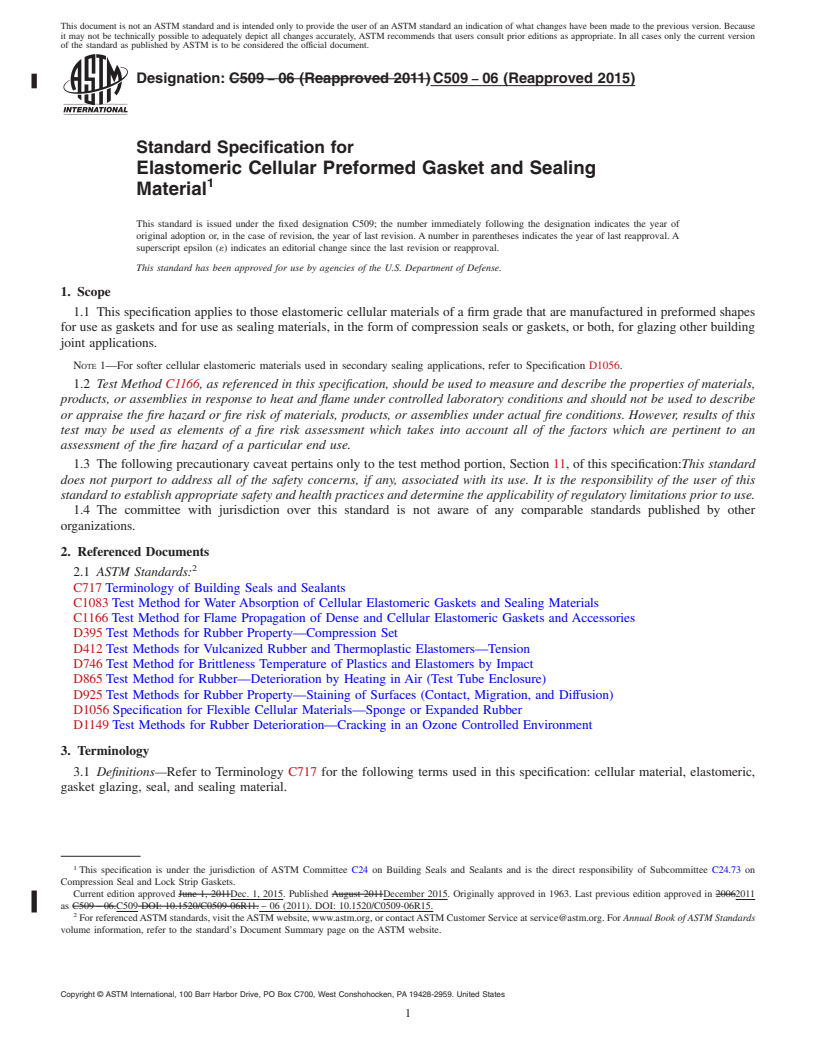
Designation: C509 − 06 (Reapproved 2011) C509 − 06 (Reapproved 2015)
Standard Specification for
Elastomeric Cellular Preformed Gasket and Sealing
Material
This standard is issued under the fixed designation C509; the number immediately following the designation indicates the year of
original adoption or, in the case of revision, the year of last revision. A number in parentheses indicates the year of last reapproval. A
superscript epsilon (´) indicates an editorial change since the last revision or reapproval.
This standard has been approved for use by agencies of the U.S. Department of Defense.
1. Scope
1.1 This specification applies to those elastomeric cellular materials of a firm grade that are manufactured in preformed shapes
for use as gaskets and for use as sealing materials, in the form of compression seals or gaskets, or both, for glazing other building
joint applications.
NOTE 1—For softer cellular elastomeric materials used in secondary sealing applications, refer to Specification D1056.
1.2 Test Method C1166, as referenced in this specification, should be used to measure and describe the properties of materials,
products, or assemblies in response to heat and flame under controlled laboratory conditions and should not be used to describe
or appraise the fire hazard or fire risk of materials, products, or assemblies under actual fire conditions. However, results of this
test may be used as elements of a fire risk assessment which takes into account all of the factors which are pertinent to an
assessment of the fire hazard of a particular end use.
1.3 The following precautionary caveat pertains only to the test method portion, Section 11, of this specification:This standard
does not purport to address all of the safety concerns, if any, associated with its use. It is the responsibility of the user of this
standard to establish appropriate safety and health practices and determine the applicability of regulatory limitations prior to use.
1.4 The committee with jurisdiction over this standard is not aware of any comparable standards published by other
organizations.
2. Referenced Documents
2.1 ASTM Standards:
C717 Terminology of Building Seals and Sealants
C1083 Test Method for Water Absorption of Cellular Elastomeric Gaskets and Sealing Materials
C1166 Test Method for Flame Propagation of Dense and Cellular Elastomeric Gaskets and Accessories
D395 Test Methods for Rubber Property—Compression Set
D412 Test Methods for Vulcanized Rubber and Thermoplastic Elastomers—Tension
D746 Test Method for Brittleness Temperature of Plastics and Elastomers by Impact
D865 Test Method for Rubber—Deterioration by Heating in Air (Test Tube Enclosure)
D925 Test Methods for Rubber Property—Staining of Surfaces (Contact, Migration, and Diffusion)
D1056 Specification for Flexible Cellular Materials—Sponge or Expanded Rubber
D1149 Test Methods for Rubber Deterioration—Cracking in an Ozone Controlled Environment
3. Terminology
3.1 Definitions—Refer to Terminology C717 for the following terms used in this specification: cellular material, elastomeric,
gasket glazing, seal, and sealing material.
This specification is under the jurisdiction of ASTM Committee C24 on Building Seals and Sealants and is the direct responsibility of Subcommittee C24.73 on
Compression Seal and Lock Strip Gaskets.
Current edition approved June 1, 2011Dec. 1, 2015. Published August 2011December 2015. Originally approved in 1963. Last previous edition approved in 20062011
as C509 – 06.C509 DOI: 10.1520/C0509-06R11. – 06 (2011). DOI: 10.1520/C0509-06R15.
For referenced ASTM standards, visit the ASTM website, www.astm.org, or contact ASTM Customer Service at service@astm.org. For Annual Book of ASTM Standards
volume information, refer to the standard’s Document Summary page on the ASTM website.
Copyright © ASTM International, 100 Barr Harbor Drive, PO Box C700, West Conshohocken, PA 19428-2959. United States
C509 − 06 (2015)
4. Materials and Manufacture
4.1 Elastomeric cellular materials furnished to this specification shall be manufactured from natural rubber, synthetic rubber,
rubber-like materials, or mixtures of these, with added compounding ingredients of such nature and quality that, with proper curing,
the finished product will comply with this specification.
4.2 The cured compounds shall be suitable for use where resistance to sunlight, weathering, oxidation, and permanent
deformation under load are of prime importance.
4.3 The manufacturing process shall be such to ensure a homogeneous cellular material free of defects that may affect
serviceability.
4.4 Although under this specification the manufacturer is permitted to choose constituent materials, there is no implication that
the several compounds are equivalent in all physical properties. Any special characteristics other than those required by this
specification, which may be needed for specific applications, shall be specified by the purchaser, since such characteristics may
influence the choice of base materials and other ingredients.
5. Physical Properties
5.1 The material shall conform to the requirements prescribed in Table 1.
6. Dimensional Tolerances
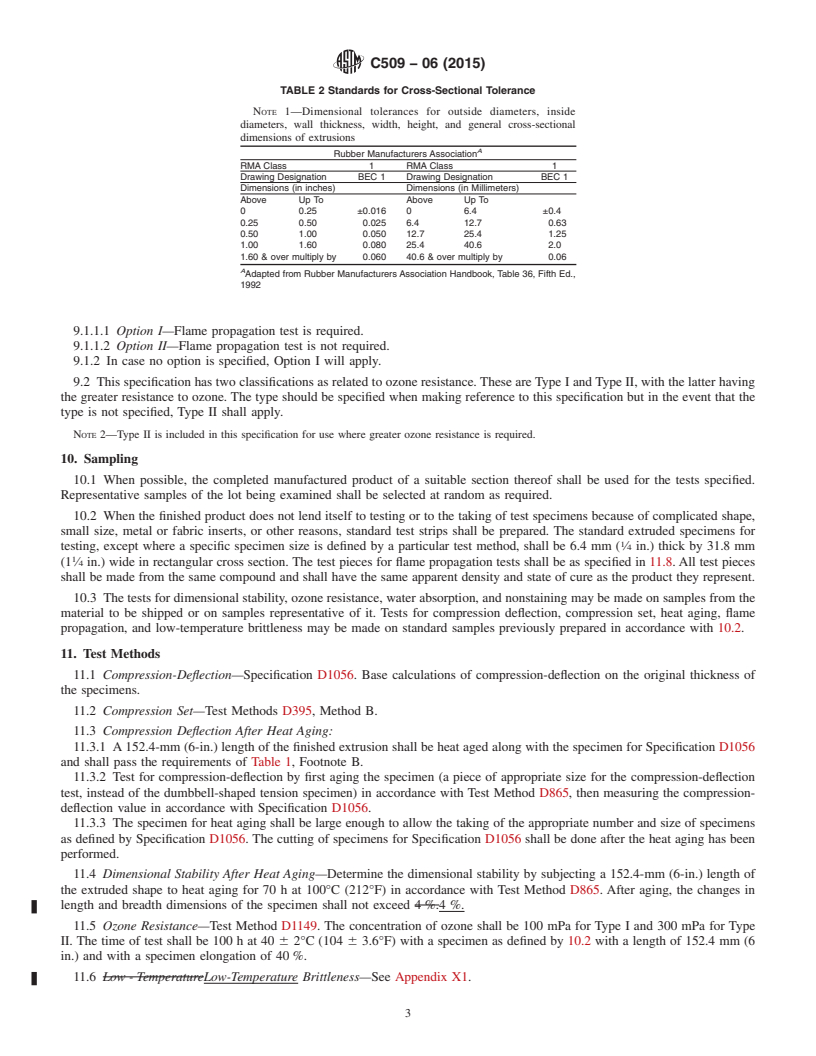
6.1 Permissible variation in cross-sectional dimensions shall be as specified in Table 2 unless otherwise agreed upon between
the purchaser and the supplier.
7. Workmanship, Finish, and Appearance
7.1 The elastomeric cellular materials shall be manufactured and processed in a careful and workmanlike manner in accordance
with the best commercial practices.
7.2 The surfaces of the finished material shall be reasonably smooth and free of excessive talc or bloom.
7.3 Unless otherwise specified, the material shall be black. When colored material is desired, it is recommended that other tests,
agreed upon between the purchaser and the supplier, be conducted to ensure color stability.
8. Number of Tests and Retests
8.1 Any material that fails in one or more of the test requirements may be retested by making two additional tests for the
requirements in which failure occurs. Failure in one such retest shall be cause for final rejection.
8.2 Rejected material shall be disposed of as directed by the supplier.
9. Significance and Use
9.1 Flame Propagation:
9.1.1 This specification has two options:
TABLE 1 Physical Requirements of Cellular Elastomeric Materials
A
Property Limit ASTM Test Method
Compression-deflection, 25 % deflection limits:
kPa (psi) 91 to 168 (13 to 24) D1056
Compression set, 22 h @ 70°C (158°F) max, % 30 D395, Method B
B
Heat aging , 70 h @ 100°C (212°F), change in compression-deflection values:
kPa (psi) 0 to + 70 (0 to + 10) D865 and D1056
Dimensional stability, change, max %, after heat aging, 70 h @ 100°C (212°F) 4 11.4
C
Ozone resistance at 40 % elongation, 100 h @ 40°C (104°F):
Type I 100 mPa ozone no cracks @ 7× magnifica- D1149
tion
Type II 300 mPa ozone no cracks @ 7× magnifica- D1149
tion
Low-temperature brittleness @ − 40°C (−40°F) pass see Appendix X1
Water absorption, max, % weight 5.0 C1083
Flame propagation:
Option I 101.6 mm (4 in.) max C1166
Option II no limit
D
Nonstaining no migratory stain D925
A
See Section 11.
B
After heat aging, surfaces of the specimen shall be neither hard nor brittle. A152.4-mm (6-in.) length of the finished extrusion shall exhibit no surface cracks when bent
on itself 180°.
C
The specimen shall exhibit no surface cracks when in the extended condition.
D
This requirement may be waived, subject to agreement between the purchaser and the supplier.
C509 − 06 (2015)
TABLE 2 Standards for Cross-Sectional Tolerance
NOTE 1—Dimensional tolerances for outside diameters, inside
diameters, wall thickness, width, height, and general cross-sectional
dimensions of extrusions
A
Rubber Manufacturers Association
RMA Class 1 RMA Class 1
Drawing Designation BEC 1 Drawing Designation BEC 1
Dimensions (in inches) Dimensions (in Millimeters)
Above Up To Above Up To
0 0.25 ±0.016 0 6.4 ±0.4
0.25 0.50 0.025 6.4 12.7 0.63
0.50 1.00 0.050 12.7 25.4 1.25
1.00 1.60 0.080 25.4 40.6 2.0
1.60 & over multiply by 0.060 40.6 & over multiply by 0.06
A
Adapted from Rubber Manufacturers Association Handbook, Table 36, Fifth Ed.,
9.1.1.1 Option I—Flame propagation test is required.
9.1.1.2 Option II—Flame propagation test is not required.
9.1.2 In case no option is specified, Option I will apply.
9.2 This specification has two classifications as related to ozone resistance. These are Type I and Type II, with the latter having
the greater resistance to ozone. The type should be specified when making reference to this specification but in the event that the
type is not specified, Type II shall apply.
NOTE 2—Type II is included in this specification for use where greater ozone resistance is required.
10. Sampling
10.1 When possible, the completed manufactured product of a suitable section thereof shall be used for the tests specified.
Representative samples of the lot being examined shall be selected at random as required.
10.2 When the finished product does not lend itself to testing or to the taking of test specimens because of complicated shape,
small size, metal or fabric inserts, or other reasons, standard test strips shall be prepared. The standard extruded specimens for
testing, except where a specific specimen size is defined by a particular test method, shall be 6.4 mm ( ⁄4 in.) thick by 31.8 mm
(1 ⁄4 in.
...
Questions, Comments and Discussion
Ask us and Technical Secretary will try to provide an answer. You can facilitate discussion about the standard in here.