


ASTM D4481-10(2015)
(Test Method)Standard Test Method for Total Nickel in Fresh Alumina-Base Catalysts
Standard Test Method for Total Nickel in Fresh Alumina-Base Catalysts
SIGNIFICANCE AND USE
4.1 This test method sets forth a procedure by which catalyst samples can be compared either on an interlaboratory or intralaboratory basis. It is anticipated that catalyst producers and users will find this method of value.
SCOPE
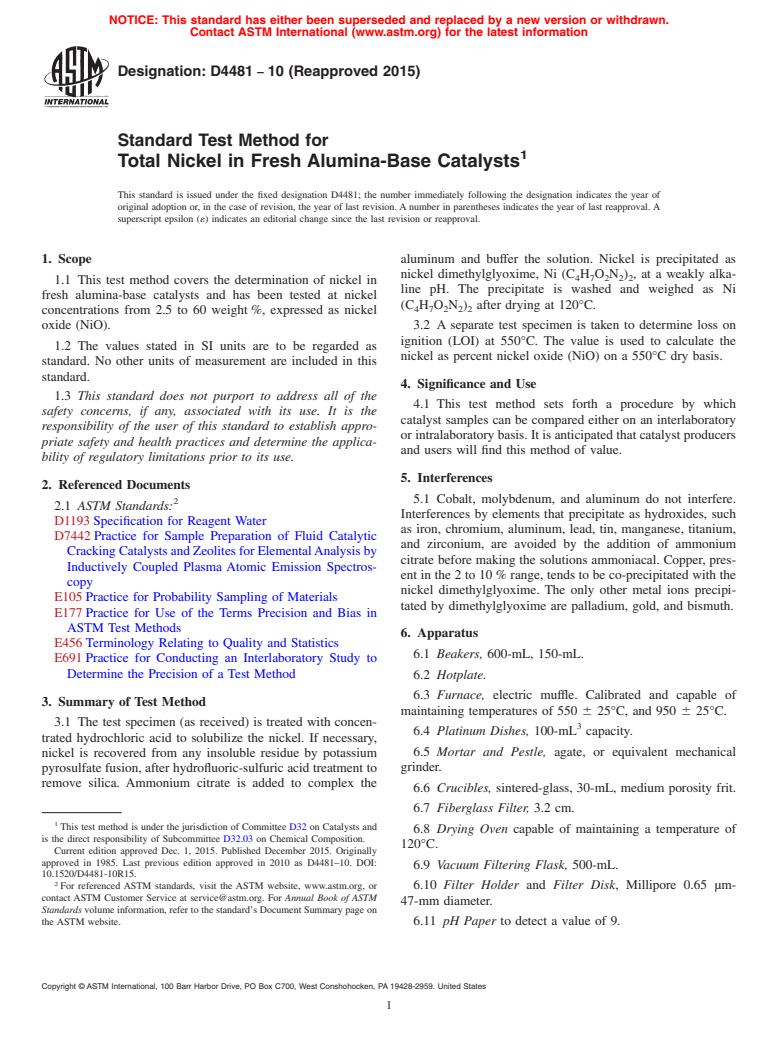
1.1 This test method covers the determination of nickel in fresh alumina-base catalysts and has been tested at nickel concentrations from 2.5 to 60 weight %, expressed as nickel oxide (NiO).
1.2 The values stated in SI units are to be regarded as standard. No other units of measurement are included in this standard.
1.3 This standard does not purport to address all of the safety concerns, if any, associated with its use. It is the responsibility of the user of this standard to establish appropriate safety and health practices and determine the applicability of regulatory limitations prior to its use.
General Information
Buy Standard
Standards Content (Sample)
NOTICE: This standard has either been superseded and replaced by a new version or withdrawn.
Contact ASTM International (www.astm.org) for the latest information
Designation: D4481 − 10 (Reapproved 2015)
Standard Test Method for
Total Nickel in Fresh Alumina-Base Catalysts
This standard is issued under the fixed designation D4481; the number immediately following the designation indicates the year of
original adoption or, in the case of revision, the year of last revision. A number in parentheses indicates the year of last reapproval. A
superscript epsilon (´) indicates an editorial change since the last revision or reapproval.
1. Scope aluminum and buffer the solution. Nickel is precipitated as
nickel dimethylglyoxime, Ni (C H O N ) , at a weakly alka-
4 7 2 2 2
1.1 This test method covers the determination of nickel in
line pH. The precipitate is washed and weighed as Ni
fresh alumina-base catalysts and has been tested at nickel
(C H O N ) after drying at 120°C.
4 7 2 2 2
concentrations from 2.5 to 60 weight %, expressed as nickel
oxide (NiO). 3.2 A separate test specimen is taken to determine loss on
ignition (LOI) at 550°C. The value is used to calculate the
1.2 The values stated in SI units are to be regarded as
nickel as percent nickel oxide (NiO) on a 550°C dry basis.
standard. No other units of measurement are included in this
standard.
4. Significance and Use
1.3 This standard does not purport to address all of the
4.1 This test method sets forth a procedure by which
safety concerns, if any, associated with its use. It is the
catalyst samples can be compared either on an interlaboratory
responsibility of the user of this standard to establish appro-
or intralaboratory basis. It is anticipated that catalyst producers
priate safety and health practices and determine the applica-
and users will find this method of value.
bility of regulatory limitations prior to its use.
5. Interferences
2. Referenced Documents
5.1 Cobalt, molybdenum, and aluminum do not interfere.
2.1 ASTM Standards:
Interferences by elements that precipitate as hydroxides, such
D1193 Specification for Reagent Water
as iron, chromium, aluminum, lead, tin, manganese, titanium,
D7442 Practice for Sample Preparation of Fluid Catalytic
and zirconium, are avoided by the addition of ammonium
CrackingCatalystsandZeolitesforElementalAnalysisby
citrate before making the solutions ammoniacal. Copper, pres-
Inductively Coupled Plasma Atomic Emission Spectros-
ent in the 2 to 10 % range, tends to be co-precipitated with the
copy
nickel dimethylglyoxime. The only other metal ions precipi-
E105 Practice for Probability Sampling of Materials
tated by dimethylglyoxime are palladium, gold, and bismuth.
E177 Practice for Use of the Terms Precision and Bias in
ASTM Test Methods
6. Apparatus
E456 Terminology Relating to Quality and Statistics
6.1 Beakers, 600-mL, 150-mL.
E691 Practice for Conducting an Interlaboratory Study to
Determine the Precision of a Test Method
6.2 Hotplate.
6.3 Furnace, electric muffle. Calibrated and capable of
3. Summary of Test Method
maintaining temperatures of 550 6 25°C, and 950 6 25°C.
3.1 The test specimen (as received) is treated with concen-
6.4 Platinum Dishes, 100-mL capacity.
trated hydrochloric acid to solubilize the nickel. If necessary,
6.5 Mortar and Pestle, agate, or equivalent mechanical
nickel is recovered from any insoluble residue by potassium
grinder.
pyrosulfate fusion, after hydrofluoric-sulfuric acid treatment to
remove silica. Ammonium citrate is added to complex the
6.6 Crucibles, sintered-glass, 30-mL, medium porosity frit.
6.7 Fiberglass Filter, 3.2 cm.
This test method is under the jurisdiction of Committee D32 on Catalysts and
6.8 Drying Oven capable of maintaining a temperature of
is the direct responsibility of Subcommittee D32.03 on Chemical Composition.
120°C.
Current edition approved Dec. 1, 2015. Published December 2015. Originally
approved in 1985. Last previous edition approved in 2010 as D4481–10. DOI:
6.9 Vacuum Filtering Flask, 500-mL.
10.1520/D4481-10R15.
For referenced ASTM standards, visit the ASTM website, www.astm.org, or 6.10 Filter Holder and Filter Disk, Millipore 0.65 µm-
contact ASTM Customer Service at service@astm.org. For Annual Book of ASTM
47-mm diameter.
Standards volume information, refer to the standard’s Document Summary page on
the ASTM website. 6.11 pH Paper to detect a value of 9.
Copyright © ASTM International, 100 Barr Harbor Drive, PO Box C700, West Conshohocken, PA 19428-2959. United States
D4481 − 10 (2015)
6.12 Screen, 250-µm openings, 60-mesh. method. It is presumed that parties using this test method for
comparison purposes will have agreed on the selection of an
6.13 Analytical Balance, capable of weighing to nearest 0.1
analytical sample. If a sampling procedure is desired, Practice
mg.
E105 is recommended.
6.14 Ashless Filter Pulp.
8.2 Grind the sample to pass through a 60-mesh screen.
6.15 Desiccator.
9. Procedure
7. Reagents
9.1 Weigh three test specimens sufficient to yield 50 to 75
7.1 Purity of Reagents—Reagent grade chemicals shall be
mg of NiO into 150-mL beakers. Record mass to the nearest
used in all tests. Unless otherwise indicated, it is intended that
0.1 mg as G.
all reagents shall conform to the specifications of the Commit-
tee onAnalytical Reagents of theAmerican Chemical Society,
9.2 Weigh three 1-g test specimens into platinum dishes or
where such specifications are available. Other grades may be
porcelain crucibles. Record mass to the nearest 0.1 mg as G .
used, provided it is first ascertained that the reagent is of
Calcine for2hina 550°C muffle furnace. Transfer to a
sufficiently high purity to permit its use without lessening the
desiccator containing freshly activated 4A molecular sieve.
accuracy of the determination.
Cool, weigh, record mass as G , and calculate percent solids.
7.2 Purity of Water—Unless otherwise indicated, references
9.3 To test specimens from 9.1, add 20-mL of concentrated
to water shall be understood to mean type IV reagent water as
hydrochloric acid and heat gently on a hotplate until only a
defined in Specification D1193.
paste of solids is left. Do not boil the solution. Do not bake
solids or subsequent re-solution will be difficult.
7.3 Ammonium Citrate, dibasic crystal, (NH ) HC H O .
4 2 6 5 7
9.4 Add 20 mLof concentrated hydrochloric acid and warm
7.4 Ammonium Hydroxide, 10 and 25 % solutions.
on a hotplate 15 to 30 min to dissolve salts. Cool and dilute to
NOTE 1—Refer to Section 8 on Hazards in Practice D7442 for hazards
about 100 mL with deionized water.
associated with handling of acids.
9.5 Filter solids on 0.45-µm filter, using a 500-mL filter
7.5 Hydrochloric Acid, concentrated 38 %.
flask as a receiver. Wash the beaker with four approximately
7.6 Hydrofluoric Acid, concentrated 48 %.
20-mL portions of deionized water, transferring the washes to
the filter. Wash the solids on the filter with three more 20-mL
7.7 Methyl Red Indicator (o-carboxy benzene
portions of deionized water. Quantitatively transfer the filtrate
azodimethylaniline)—Dissolve 0.02 g in 60-mL reagent grade
pluswashestoa600-mLbeaker.Keepthebeakercovereduntil
ethanol. Add 40.0 mL of distilled water.
ready to precipitate nickel.
7.8 4A Molecular Sieve, activated for2hat 275°C.
9.6 Put a filter disk into a platinum dish and cover with
7.9 Potassium Hydrogen Sulfate, fused power-acid-flux
ashless filter pulp. Carefully char over a gas burner, then ignite
grade.
at red heat until the carbon is essentially burned off. Put the
7.10 Sodium Dimethylglyoxime, 8-Hydrate, crystal,
dish in a muffle furnace at 960°C for 50 min.
CH C:NONaC:NONaCH ·8H O. Prepare a 1 weight % per
3 3 2
9.7 To sol
...
This document is not an ASTM standard and is intended only to provide the user of an ASTM standard an indication of what changes have been made to the previous version. Because
it may not be technically possible to adequately depict all changes accurately, ASTM recommends that users consult prior editions as appropriate. In all cases only the current version
of the standard as published by ASTM is to be considered the official document.
Designation: D4481 − 10 D4481 − 10 (Reapproved 2015)
Standard Test Method for
Total Nickel in Fresh Alumina-Base Catalysts
This standard is issued under the fixed designation D4481; the number immediately following the designation indicates the year of
original adoption or, in the case of revision, the year of last revision. A number in parentheses indicates the year of last reapproval. A
superscript epsilon (´) indicates an editorial change since the last revision or reapproval.
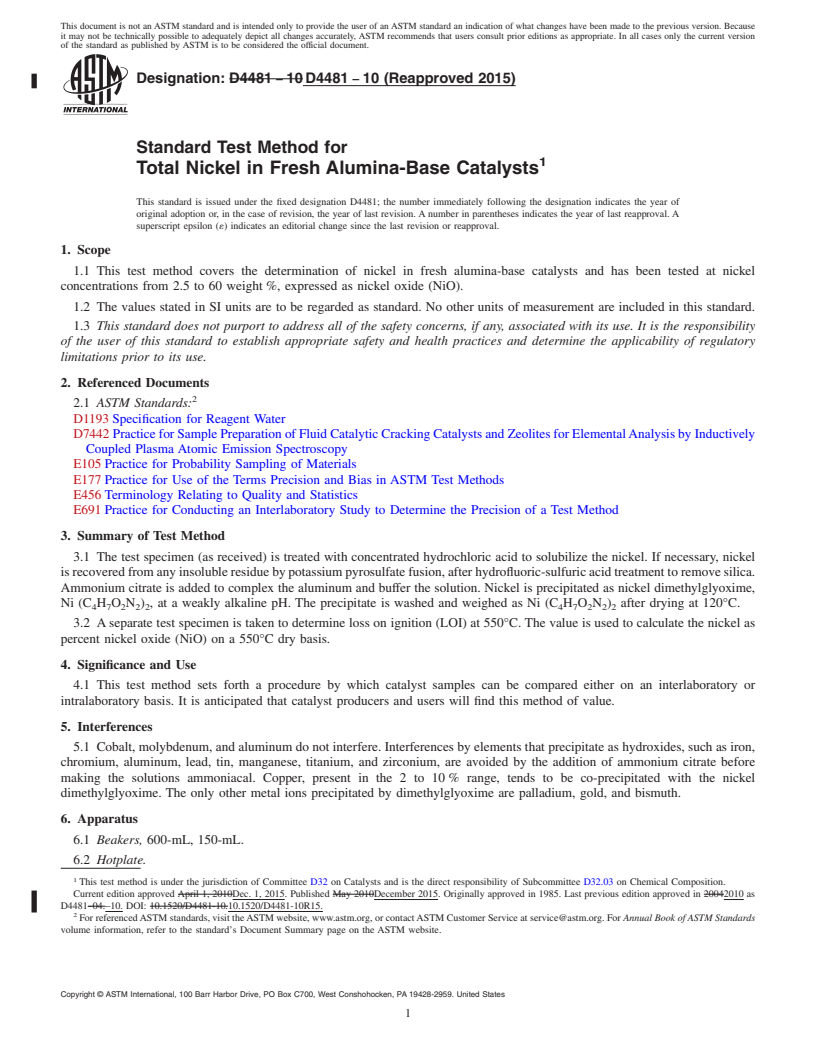
1. Scope
1.1 This test method covers the determination of nickel in fresh alumina-base catalysts and has been tested at nickel
concentrations from 2.5 to 60 weight %, expressed as nickel oxide (NiO).
1.2 The values stated in SI units are to be regarded as standard. No other units of measurement are included in this standard.
1.3 This standard does not purport to address all of the safety concerns, if any, associated with its use. It is the responsibility
of the user of this standard to establish appropriate safety and health practices and determine the applicability of regulatory
limitations prior to its use.
2. Referenced Documents
2.1 ASTM Standards:
D1193 Specification for Reagent Water
D7442 Practice for Sample Preparation of Fluid Catalytic Cracking Catalysts and Zeolites for Elemental Analysis by Inductively
Coupled Plasma Atomic Emission Spectroscopy
E105 Practice for Probability Sampling of Materials
E177 Practice for Use of the Terms Precision and Bias in ASTM Test Methods
E456 Terminology Relating to Quality and Statistics
E691 Practice for Conducting an Interlaboratory Study to Determine the Precision of a Test Method
3. Summary of Test Method
3.1 The test specimen (as received) is treated with concentrated hydrochloric acid to solubilize the nickel. If necessary, nickel
is recovered from any insoluble residue by potassium pyrosulfate fusion, after hydrofluoric-sulfuric acid treatment to remove silica.
Ammonium citrate is added to complex the aluminum and buffer the solution. Nickel is precipitated as nickel dimethylglyoxime,
Ni (C H O N ) , at a weakly alkaline pH. The precipitate is washed and weighed as Ni (C H O N ) after drying at 120°C.
4 7 2 2 2 4 7 2 2 2
3.2 A separate test specimen is taken to determine loss on ignition (LOI) at 550°C. The value is used to calculate the nickel as
percent nickel oxide (NiO) on a 550°C dry basis.
4. Significance and Use
4.1 This test method sets forth a procedure by which catalyst samples can be compared either on an interlaboratory or
intralaboratory basis. It is anticipated that catalyst producers and users will find this method of value.
5. Interferences
5.1 Cobalt, molybdenum, and aluminum do not interfere. Interferences by elements that precipitate as hydroxides, such as iron,
chromium, aluminum, lead, tin, manganese, titanium, and zirconium, are avoided by the addition of ammonium citrate before
making the solutions ammoniacal. Copper, present in the 2 to 10 % range, tends to be co-precipitated with the nickel
dimethylglyoxime. The only other metal ions precipitated by dimethylglyoxime are palladium, gold, and bismuth.
6. Apparatus
6.1 Beakers, 600-mL, 150-mL.
6.2 Hotplate.
This test method is under the jurisdiction of Committee D32 on Catalysts and is the direct responsibility of Subcommittee D32.03 on Chemical Composition.
Current edition approved April 1, 2010Dec. 1, 2015. Published May 2010December 2015. Originally approved in 1985. Last previous edition approved in 20042010 as
D4481–04.–10. DOI: 10.1520/D4481-10.10.1520/D4481-10R15.
For referenced ASTM standards, visit the ASTM website, www.astm.org, or contact ASTM Customer Service at service@astm.org. For Annual Book of ASTM Standards
volume information, refer to the standard’s Document Summary page on the ASTM website.
Copyright © ASTM International, 100 Barr Harbor Drive, PO Box C700, West Conshohocken, PA 19428-2959. United States
D4481 − 10 (2015)
6.3 Furnace, electric muffle. Calibrated and capable of maintaining temperatures of 550 6 25°C, and 950 6 25°C.
6.4 Platinum Dishes, 100-mL capacity.
6.5 Mortar and Pestle, agate, or equivalent mechanical grinder.
6.6 Crucibles, sintered-glass, 30-mL, medium porosity frit.
6.7 Fiberglass Filter, 3.2 cm.
6.8 Drying Oven capable of maintaining a temperature of 120°C.
6.9 Vacuum Filtering Flask, 500-mL.
6.10 Filter Holder and Filter Disk, Millipore 0.65 μm-47-mm diameter.
6.11 pH Paper to detect a value of 9.
6.12 Screen, 250-μm openings, 60-mesh.
6.13 Analytical Balance, capable of weighing to nearest 0.1 mg.
6.14 Ashless Filter Pulp.
6.15 Desiccator.
7. Reagents
7.1 Purity of Reagents—Reagent grade chemicals shall be used in all tests. Unless otherwise indicated, it is intended that all
reagents shall conform to the specifications of the Committee on Analytical Reagents of the American Chemical Society, where
such specifications are available. Other grades may be used, provided it is first ascertained that the reagent is of sufficiently high
purity to permit its use without lessening the accuracy of the determination.
7.2 Purity of Water—Unless otherwise indicated, references to water shall be understood to mean type IV reagent water as
defined in Specification D1193.
7.3 Ammonium Citrate, dibasic crystal, (NH ) HC H O .
4 2 6 5 7
7.4 Ammonium Hydroxide, 10 and 25 % solutions.
NOTE 1—Refer to Section 8 on Hazards in Practice D7442 for hazards associated with handling of acids.
7.5 Hydrochloric Acid, concentrated 38 %.
7.6 Hydrofluoric Acid, concentrated 48 %.
7.7 Methyl Red Indicator (o-carboxy benzene azodimethylaniline)—Dissolve 0.02 g in 60-mL reagent grade ethanol. Add 40.0
mL of distilled water.
7.8 4A Molecular Sieve, activated for 2 h at 275°C.
7.9 Potassium Hydrogen Sulfate, fused power-acid-flux grade.
7.10 Sodium Dimethylglyoxime, 8-Hydrate, crystal, CH C:NONaC:NONaCH ·8H O. Prepare a 1 weight % per volume solution
3 3 2
in water.
7.11 Sulfuric Acid, 10 and 50 % solutions.
NOTE 2—The sodium salt of dimethylglyoxime is recommended, rather than the organic reagent, dimethylglyoxime because the salt is water soluble.
Large excesses added to precipitate the nickel do no harm as the excess dimethylglyoxime is eliminated during the filtration and washing part of the
procedure. The organic reagent, dimethylglyoxime, is not very soluble in water and is often added as a 1 % solution in ethanol. When added in this way,
some of the excess reagent may contaminate the precipitated nickel complex. For this reason an aqueous solution of the sodium salt is preferred. If the
alcohol solution of dimethylglyoxime is to be used, add an amount so that the alcohol content of the sample solution does not exceed 50 % or some of
the precipitated nickel dimethylglyoxymate may dissolve.
8. Sampling
8.1 The selection of a representative analytical sample from the bulk material is outside the scope of the present test method.
It is presumed that parties using this test method for comparison purposes will have agreed on the selection of an analytical sample.
If a sampling procedure is desired, Practice E105 is recommended.
8.2 Grind the sample to pass through a 60-mesh screen.
Reagent Chemicals, American Chemical Society Specifications, American Chemical Society, Washington, DC. For Suggestions on the testing of reagents not listed by
the American Chemical Society, see Annual Standards for Laboratory Chemicals, BDH Ltd., Poole, Dorset, U.K., and the United States Pharmacopeia and National
Formulary, U.S. Pharmacopeial Convention, Inc. (USPC), Rockvi
...
Questions, Comments and Discussion
Ask us and Technical Secretary will try to provide an answer. You can facilitate discussion about the standard in here.