

ASTM E1179-13(2019)
(Specification)Standard Specification for Sound Sources Used for Testing Open Office Components and Systems
General Information
- Abstract
ABSTRACT
This specification states the requirements for sound sources used for measuring the speech privacy between open offices or for measuring the laboratory performance of acoustical components. The sound source shall be a loudspeaker enclosed in a box that has a maximum dimension of 0.30 m (1 ft) on a side, to reduce spurious sound reflections. The measurements shall be carried out in a free sound field. The measurement microphone, amplifier, and level meter used to measure sound pressure levels shall satisfy the requirements prescribed. When the sound source is driven with the qualification signal, the sound output shall be adequate to maintain one-third octave-band sound pressure levels at least 10 dB above the corresponding background noise in each band at each measurement location. The directivity of the sound source shall be verified by driving the source with the qualification signal and measuring the sound pressure levels at measurement points.
SCOPE
1.1 This specification states the requirements for sound sources used for measuring the speech privacy between open offices and for measuring the laboratory performance of acoustical components (see Test Methods E1111 and E1130).
1.2 The sound source shall be a loudspeaker located in an enclosure driven with an appropriate test signal.
1.3 This specification describes the sound source and method of qualifying it using a special qualification signal. Test signals required by open office test methods may differ.
1.4 The values stated in SI units are to be regarded as standard. No other units of measurement are included in this standard.
1.5 This international standard was developed in accordance with internationally recognized principles on standardization established in the Decision on Principles for the Development of International Standards, Guides and Recommendations issued by the World Trade Organization Technical Barriers to Trade (TBT) Committee.
- Status
- Published
- Publication Date
- 31-Mar-2019
- Technical Committee
- E33 - Building and Environmental Acoustics
- Drafting Committee
- E33.02 - Speech Privacy


Overview
ASTM E1179-13(2019) – Standard Specification for Sound Sources Used for Testing Open Office Components and Systems specifies the requirements for sound sources used to evaluate speech privacy and the acoustical performance of components in open office environments. Developed by ASTM International, this standard establishes consistent guidelines for the qualification, use, and verification of loudspeaker-based sound sources as part of objective acoustic testing procedures. It aligns with international principles of standardization and supports professionals in building and environmental acoustics who require reliable methods for measuring sound pressure levels and ensuring speech privacy within open-plan spaces.
Key Topics
Sound Source Requirements:
The standard requires that the sound source used for measurements be a loudspeaker enclosed in a box, with a maximum dimension of 0.30 m (1 ft) per side to minimize sound reflections.Qualification Testing:
The sound source must be driven with a qualification signal-typically broadband noise (white or pink noise)-to validate its performance characteristics for measurement accuracy.Directivity Verification:
Detailed procedures are outlined for measuring and validating the directivity of the sound source. Directivity measurements ensure uniform sound output within specified frequency bands and angular ranges.Measurement System Specifications:
Measurement instruments, such as microphones, amplifiers, and sound level meters, must comply with recognized standards (e.g., ANSI S1.4, ANSI S1.43, IEC 61672-1) to guarantee measurement reliability and reproducibility.Testing Environments:
Acoustic testing is to be conducted in a free sound field, typically an anechoic room or equivalent outdoor environment, to eliminate unwanted reverberations and ensure valid measurements.Qualification Reporting:
Documentation of all qualification test results is required, ensuring transparency and traceability in acoustic testing.
Applications
ASTM E1179 serves as a foundational reference for:
- Speech Privacy Measurement:
Providing accurate assessment of speech privacy levels in open office environments by ensuring sound sources meet consistent performance criteria. - Laboratory Testing of Acoustical Components:
Facilitating repeatable laboratory measurements of dividers, ceilings, furniture, and other open office elements to verify their impact on sound transmission and absorption. - Design and Commissioning of Open Plan Spaces:
Supporting architects, engineers, and facility managers in evaluating and improving the acoustic environment of new and existing open offices. - Verification of Acoustic Products:
Enabling manufacturers to demonstrate the performance of sound-masking systems, architectural products, and audio equipment in accordance with recognized international testing procedures.
Related Standards
ASTM E1179 references and complements several key standards, including:
- ASTM E1111 – Test Method for Measuring the Interzone Attenuation of Open Office Components
- ASTM E1130 – Test Method for Objective Measurement of Speech Privacy in Open Plan Spaces Using Articulation Index
- ASTM C634 – Terminology Relating to Building and Environmental Acoustics
- ANSI S1.4, S1.6, S1.11, S1.43 – Specifications for Sound Level Meters, Frequency Levels, Band Filters, and Integrating-Averaging Sound Level Meters
- IEC 61260, IEC 61672-1 – International standards for octave and fractional-octave band filters, and sound level meters
By providing detailed requirements and guidance on sound source selection, qualification, and verification, ASTM E1179-13(2019) ensures that professionals can achieve accurate, repeatable, and internationally-recognized results when testing and improving the acoustic performance of open office components and systems.
Relations
- Effective Date
- 01-Apr-2019
- Effective Date
- 01-Oct-2019
- Effective Date
- 01-Sep-2013
- Effective Date
- 01-Apr-2012
- Effective Date
- 01-Dec-2011
- Effective Date
- 01-Nov-2011
- Effective Date
- 01-Sep-2010
- Effective Date
- 01-Sep-2010
- Effective Date
- 01-Jun-2010
- Effective Date
- 01-Apr-2009
- Effective Date
- 01-Sep-2008
- Effective Date
- 01-Sep-2008
- Effective Date
- 15-Mar-2008
- Effective Date
- 15-Jan-2008
- Effective Date
- 01-Dec-2007
Get Certified
Connect with accredited certification bodies for this standard

BSMI (Bureau of Standards, Metrology and Inspection)
Taiwan's standards and inspection authority.
Sponsored listings
Frequently Asked Questions
ASTM E1179-13(2019) is a technical specification published by ASTM International. Its full title is "Standard Specification for Sound Sources Used for Testing Open Office Components and Systems". This standard covers: ABSTRACT This specification states the requirements for sound sources used for measuring the speech privacy between open offices or for measuring the laboratory performance of acoustical components. The sound source shall be a loudspeaker enclosed in a box that has a maximum dimension of 0.30 m (1 ft) on a side, to reduce spurious sound reflections. The measurements shall be carried out in a free sound field. The measurement microphone, amplifier, and level meter used to measure sound pressure levels shall satisfy the requirements prescribed. When the sound source is driven with the qualification signal, the sound output shall be adequate to maintain one-third octave-band sound pressure levels at least 10 dB above the corresponding background noise in each band at each measurement location. The directivity of the sound source shall be verified by driving the source with the qualification signal and measuring the sound pressure levels at measurement points. SCOPE 1.1 This specification states the requirements for sound sources used for measuring the speech privacy between open offices and for measuring the laboratory performance of acoustical components (see Test Methods E1111 and E1130). 1.2 The sound source shall be a loudspeaker located in an enclosure driven with an appropriate test signal. 1.3 This specification describes the sound source and method of qualifying it using a special qualification signal. Test signals required by open office test methods may differ. 1.4 The values stated in SI units are to be regarded as standard. No other units of measurement are included in this standard. 1.5 This international standard was developed in accordance with internationally recognized principles on standardization established in the Decision on Principles for the Development of International Standards, Guides and Recommendations issued by the World Trade Organization Technical Barriers to Trade (TBT) Committee.
ABSTRACT This specification states the requirements for sound sources used for measuring the speech privacy between open offices or for measuring the laboratory performance of acoustical components. The sound source shall be a loudspeaker enclosed in a box that has a maximum dimension of 0.30 m (1 ft) on a side, to reduce spurious sound reflections. The measurements shall be carried out in a free sound field. The measurement microphone, amplifier, and level meter used to measure sound pressure levels shall satisfy the requirements prescribed. When the sound source is driven with the qualification signal, the sound output shall be adequate to maintain one-third octave-band sound pressure levels at least 10 dB above the corresponding background noise in each band at each measurement location. The directivity of the sound source shall be verified by driving the source with the qualification signal and measuring the sound pressure levels at measurement points. SCOPE 1.1 This specification states the requirements for sound sources used for measuring the speech privacy between open offices and for measuring the laboratory performance of acoustical components (see Test Methods E1111 and E1130). 1.2 The sound source shall be a loudspeaker located in an enclosure driven with an appropriate test signal. 1.3 This specification describes the sound source and method of qualifying it using a special qualification signal. Test signals required by open office test methods may differ. 1.4 The values stated in SI units are to be regarded as standard. No other units of measurement are included in this standard. 1.5 This international standard was developed in accordance with internationally recognized principles on standardization established in the Decision on Principles for the Development of International Standards, Guides and Recommendations issued by the World Trade Organization Technical Barriers to Trade (TBT) Committee.
ASTM E1179-13(2019) is classified under the following ICS (International Classification for Standards) categories: 17.140.01 - Acoustic measurements and noise abatement in general. The ICS classification helps identify the subject area and facilitates finding related standards.
ASTM E1179-13(2019) has the following relationships with other standards: It is inter standard links to ASTM E1179-13, ASTM E1050-19, ASTM C634-13, ASTM E1050-12, ASTM C634-11, ASTM C384-04(2011), ASTM C634-10a, ASTM E1050-10, ASTM C634-10, ASTM C634-09, ASTM C634-08a, ASTM E1130-08, ASTM C634-08, ASTM E1050-08, ASTM E1050-07. Understanding these relationships helps ensure you are using the most current and applicable version of the standard.
ASTM E1179-13(2019) is available in PDF format for immediate download after purchase. The document can be added to your cart and obtained through the secure checkout process. Digital delivery ensures instant access to the complete standard document.
Standards Content (Sample)
This international standard was developed in accordance with internationally recognized principles on standardization established in the Decision on Principles for the
Development of International Standards, Guides and Recommendations issued by the World Trade Organization Technical Barriers to Trade (TBT) Committee.
Designation:E1179 −13 (Reapproved 2019)
Standard Specification for
Sound Sources Used for Testing Open Office Components
and Systems
This standard is issued under the fixed designation E1179; the number immediately following the designation indicates the year of
original adoption or, in the case of revision, the year of last revision. A number in parentheses indicates the year of last reapproval. A
superscript epsilon (´) indicates an editorial change since the last revision or reapproval.
1. Scope E1130 Test Method for Objective Measurement of Speech
Privacy in Open Plan Spaces Using Articulation Index
1.1 This specification states the requirements for sound
sources used for measuring the speech privacy between open 2.2 ANSI Standards:
offices and for measuring the laboratory performance of S1.4 Specification for Sound Level Meters
acoustical components (see Test Methods E1111 and E1130). S1.6 Preferred Frequencies, Frequency Levels, and Band
Numbers for Acoustical Measurements
1.2 The sound source shall be a loudspeaker located in an
S1.11 Specification for Octave Band and Fractional OB
enclosure driven with an appropriate test signal.
Analog and Digital Filters
1.3 This specification describes the sound source and
S1.43 Specifications for Integrating-Averaging Sound Level
methodofqualifyingitusingaspecialqualificationsignal.Test
Meters
signals required by open office test methods may differ.
2.3 IEC Standards:
1.4 The values stated in SI units are to be regarded as
61260 Electroacoustics—Octave and fractional-octave band
standard. No other units of measurement are included in this
filters
standard.
61672–1 Electroacoustics—Sound Level Meters—Part 1:
1.5 This international standard was developed in accor-
Specifications
dance with internationally recognized principles on standard-
ization established in the Decision on Principles for the
3. Terminology
Development of International Standards, Guides and Recom-
3.1 Definitions:
mendations issued by the World Trade Organization Technical
3.1.1 The acoustical terminology used in this specification
Barriers to Trade (TBT) Committee.
is consistent with Terminology C634.
3.2 Definitions of Terms Specific to This Standard:
2. Referenced Documents
3.2.1 directivity measurement—the measurement used to
2.1 ASTM Standards:
determine directivity as defined in 4.2.
C384 Test Method for Impedance andAbsorption ofAcous-
3.2.2 qualification signal—a test signal of broadband noise
tical Materials by Impedance Tube Method
or bands of white or pink noise as defined in Terminology
C634 Terminology Relating to Building and Environmental
C634.
Acoustics
E1050 Test Method for Impedance and Absorption of
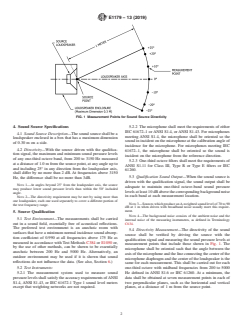
3.2.3 source point—the point at which the loudspeaker axis
Acoustical Materials Using aTube,Two Microphones and
intersects the front plane of the loudspeaker (see Fig. 1).
a Digital Frequency Analysis System
3.3 The following terms in this standard have specific
E1111 Test Method for Measuring the InterzoneAttenuation
meanings that are defined in Terminology C634:
of Open Office Components
3.3.1 background noise,
3.3.2 pink noise,
This specification is under the jurisdiction of ASTM Committee E33 on
3.3.3 sound pressure level, and
Building and Environmental Acoustics and is the direct responsibility of Subcom-
3.3.4 white noise
mittee E33.02 on Speech Privacy.
Current edition approved April 1, 2019. Published May 2019. Originally
approved in 1987. Last previous edition approved in 2013 as E1179 – 13. DOI:
10.1520/E1179-13R19.
2 3
For referenced ASTM standards, visit the ASTM website, www.astm.org, or Available from American National Standards Institute (ANSI), 25 W. 43rd St.,
contact ASTM Customer Service at service@astm.org. For Annual Book of ASTM 4th Floor, New York, NY 10036, http://www.ansi.org.
Standards volume information, refer to the standard’s Document Summary page on Available from International Electrotechnical Commission (IEC), 3, rue de
the ASTM website. Varembé, P.O. Box 131, CH-1211 Geneva 20, Switzerland, http://www.iec.ch.
Copyright © ASTM International, 100 Barr Harbor Drive, PO Box C700, West Conshohocken, PA 19428-2959. United States
E1179−13 (2019)
FIG. 1 Measurement Points for Sound Source Directivity
4. Sound Source Specifications 5.2.2 The microphone shall meet the requirements of either
IEC 61672–1 or ANSI S1.4, or ANSI S1.43. For microphones
4.1 Sound Source Description—The sound source shall be a
meeting ANSI S1.4, the microphone shall be oriented so the
loudspeaker enclosed in a box that has a maximum dimension
sound in incident on the microphone at the calibration angle of
of 0.30 m on a side.
incidence for the microphone. For microphones meeting IEC
4.2 Directivity—With the source driven with the qualifica-
61672–1, the microphone shall be oriented so the sound is
tion signal, the maximum and minimum sound pressure levels
incident on the microphone from the reference direction.
of any one-third octave band, from 200 to 3150 Hz measured
5.2.3 One-third octave filters shall meet the requirements of
at a distance of 1.0 m from the source point, at any angle up to
ANSI S1.11 for Class III, Type R or Type E filters or IEC
and including 25° in any direction from the loudspeaker axis,
61260.
shall differ by no more than 2 dB. At frequencies above 3150
5.3 Qualification
...