

ASTM F150-06(2018)
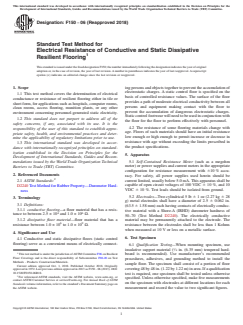
(Test Method)Standard Test Method for Electrical Resistance of Conductive and Static Dissipative Resilient Flooring
General Information
- Abstract
SIGNIFICANCE AND USE
4.1 Conductive and static dissipative floors (static control flooring) serve as a convenient means of electrically connecting persons and objects together to prevent the accumulation of electrostatic charges. A static control floor is specified on the basis of controlled resistance values. The surface of the floor provides a path of moderate electrical conductivity between all persons and equipment making contact with the floor to prevent the accumulation of dangerous electrostatic charges. Static control footwear will need to be used in conjunction with the floor for the floor to perform effectively with personnel.
4.2 The resistance of some flooring materials change with age. Floors of such materials should have an initial resistance low enough or high enough to permit increase or decrease in resistance with age without exceeding the limits prescribed in the product specifications.
SCOPE
1.1 This test method covers the determination of electrical conductance or resistance of resilient flooring either in tile or sheet form, for applications such as hospitals, computer rooms, clean rooms, access flooring, munition plants, or any other environment concerning personnel-generated static electricity.
1.2 This standard does not purport to address all of the safety concerns, if any, associated with its use. It is the responsibility of the user of this standard to establish appropriate safety, health, and environmental practices and determine the applicability of regulatory limitations prior to use.
1.3 This international standard was developed in accordance with internationally recognized principles on standardization established in the Decision on Principles for the Development of International Standards, Guides and Recommendations issued by the World Trade Organization Technical Barriers to Trade (TBT) Committee.
- Status
- Published
- Publication Date
- 30-Sep-2018
- Technical Committee
- F06 - Resilient Floor Coverings
- Drafting Committee
- F06.20 - Test Methods

Overview
ASTM F150-06(2018) is the internationally recognized standard test method for determining the electrical resistance of conductive and static dissipative resilient flooring. Developed by ASTM International, this standard provides key procedures and requirements for assessing flooring materials-such as tiles and sheets-used in environments where electrostatic discharge (ESD) control is critical. The methodology ensures the flooring's capability to prevent the accumulation of potentially harmful electrostatic charges by specifying controlled resistance values.
Key Topics
- Static Control Flooring: The standard defines both conductive and static dissipative flooring designed to minimize or eliminate static electricity buildup. These floors provide a moderate level of electrical conductivity between persons and objects, reducing the risk of ESD incidents.
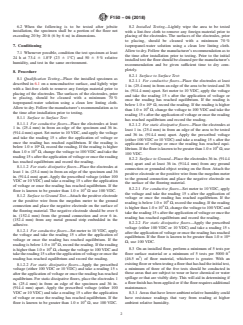
- Resistance Measurement: The test method details how to measure electrical conductance or resistance using specified instruments (such as a megohm meter), voltages (10 VDC and 100 VDC), and procedures for surface-to-surface and surface-to-ground tests.
- Testing Procedures: It provides step-by-step guidance for qualification testing in laboratory settings and for testing after installation on the job site. The procedures account for environmental conditioning, electrode placement, voltage selection, and multiple measurement locations to ensure consistency.
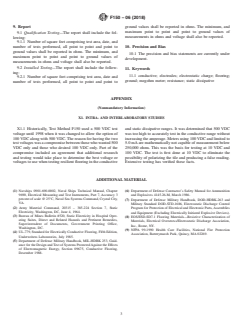
- Aging of Flooring Materials: Guidance is included on how the electrical resistance of certain flooring types may change with age, emphasizing the importance of initial resistance levels suitable for expected material changes.
- Reporting Requirements: The standard outlines the details required in test reports, including area size, number of tests performed, test conditions, and all resistance measurements in ohms.
Applications
The ASTM F150-06(2018) test method applies to resilient flooring utilized in areas where static control is essential for safety, equipment reliability, and regulatory compliance. Common application environments include:
- Hospitals and Medical Facilities: Reducing ESD risk to sensitive medical equipment.
- Computer Rooms and Data Centers: Preventing hardware damage or data loss due to static discharge.
- Clean Rooms: Protecting sensitive electronics and microchips during manufacturing or assembly.
- Ammunition and Munition Plants: Minimizing the chance of accidental ignition due to electrostatic discharge.
- Access Flooring Systems: Ensuring safety and ESD protection in raised floor installations found in commercial and industrial spaces.
This standard is crucial for manufacturers, installers, facility managers, and safety professionals who require reliable, verifiable methods to ensure their flooring systems meet industry ESD performance criteria.
Related Standards
Several standards and technical references complement ASTM F150-06(2018), providing broader guidance on ESD protection and testing of flooring materials:
- UL 779: Standard for Electrically Conductive Flooring.
- EOS/ESD-SD7.1: Flooring Materials-Resistive Characterization of Materials.
- NFPA 99: Health Care Facilities standard for ESD protection.
- DOD-HDBK-263 & DOD-STD-1686: U.S. Department of Defense electrostatic discharge control handbooks and standards.
- ASTM D2240: Test Method for Rubber Property-Durometer Hardness (referenced for electrode requirements in F150).
Referencing and complying with ASTM F150-06(2018) along with these related standards ensures comprehensive management of electrostatic discharge risks in critical environments, supporting safety, operational reliability, and regulatory alignment.
Relations
- Effective Date
- 01-Oct-2018
- Effective Date
- 01-Oct-2018
- Effective Date
- 01-Oct-2018
- Effective Date
- 01-Oct-2018
Frequently Asked Questions
ASTM F150-06(2018) is a standard published by ASTM International. Its full title is "Standard Test Method for Electrical Resistance of Conductive and Static Dissipative Resilient Flooring". This standard covers: SIGNIFICANCE AND USE 4.1 Conductive and static dissipative floors (static control flooring) serve as a convenient means of electrically connecting persons and objects together to prevent the accumulation of electrostatic charges. A static control floor is specified on the basis of controlled resistance values. The surface of the floor provides a path of moderate electrical conductivity between all persons and equipment making contact with the floor to prevent the accumulation of dangerous electrostatic charges. Static control footwear will need to be used in conjunction with the floor for the floor to perform effectively with personnel. 4.2 The resistance of some flooring materials change with age. Floors of such materials should have an initial resistance low enough or high enough to permit increase or decrease in resistance with age without exceeding the limits prescribed in the product specifications. SCOPE 1.1 This test method covers the determination of electrical conductance or resistance of resilient flooring either in tile or sheet form, for applications such as hospitals, computer rooms, clean rooms, access flooring, munition plants, or any other environment concerning personnel-generated static electricity. 1.2 This standard does not purport to address all of the safety concerns, if any, associated with its use. It is the responsibility of the user of this standard to establish appropriate safety, health, and environmental practices and determine the applicability of regulatory limitations prior to use. 1.3 This international standard was developed in accordance with internationally recognized principles on standardization established in the Decision on Principles for the Development of International Standards, Guides and Recommendations issued by the World Trade Organization Technical Barriers to Trade (TBT) Committee.
SIGNIFICANCE AND USE 4.1 Conductive and static dissipative floors (static control flooring) serve as a convenient means of electrically connecting persons and objects together to prevent the accumulation of electrostatic charges. A static control floor is specified on the basis of controlled resistance values. The surface of the floor provides a path of moderate electrical conductivity between all persons and equipment making contact with the floor to prevent the accumulation of dangerous electrostatic charges. Static control footwear will need to be used in conjunction with the floor for the floor to perform effectively with personnel. 4.2 The resistance of some flooring materials change with age. Floors of such materials should have an initial resistance low enough or high enough to permit increase or decrease in resistance with age without exceeding the limits prescribed in the product specifications. SCOPE 1.1 This test method covers the determination of electrical conductance or resistance of resilient flooring either in tile or sheet form, for applications such as hospitals, computer rooms, clean rooms, access flooring, munition plants, or any other environment concerning personnel-generated static electricity. 1.2 This standard does not purport to address all of the safety concerns, if any, associated with its use. It is the responsibility of the user of this standard to establish appropriate safety, health, and environmental practices and determine the applicability of regulatory limitations prior to use. 1.3 This international standard was developed in accordance with internationally recognized principles on standardization established in the Decision on Principles for the Development of International Standards, Guides and Recommendations issued by the World Trade Organization Technical Barriers to Trade (TBT) Committee.
ASTM F150-06(2018) is classified under the following ICS (International Classification for Standards) categories: 97.150 - Floor coverings. The ICS classification helps identify the subject area and facilitates finding related standards.
ASTM F150-06(2018) has the following relationships with other standards: It is inter standard links to ASTM F150-06(2013), ASTM F2195-18(2023), ASTM F2034-18, ASTM F1331-22. Understanding these relationships helps ensure you are using the most current and applicable version of the standard.
ASTM F150-06(2018) is available in PDF format for immediate download after purchase. The document can be added to your cart and obtained through the secure checkout process. Digital delivery ensures instant access to the complete standard document.
Standards Content (Sample)
This international standard was developed in accordance with internationally recognized principles on standardization established in the Decision on Principles for the
Development of International Standards, Guides and Recommendations issued by the World Trade Organization Technical Barriers to Trade (TBT) Committee.
Designation: F150 − 06 (Reapproved 2018)
Standard Test Method for
Electrical Resistance of Conductive and Static Dissipative
Resilient Flooring
ThisstandardisissuedunderthefixeddesignationF150;thenumberimmediatelyfollowingthedesignationindicatestheyearoforiginal
adoptionor,inthecaseofrevision,theyearoflastrevision.Anumberinparenthesesindicatestheyearoflastreapproval.Asuperscript
epsilon (´) indicates an editorial change since the last revision or reapproval.
1. Scope ingpersonsandobjectstogethertopreventtheaccumulationof
electrostatic charges. A static control floor is specified on the
1.1 This test method covers the determination of electrical
basis of controlled resistance values. The surface of the floor
conductance or resistance of resilient flooring either in tile or
providesapathofmoderateelectricalconductivitybetweenall
sheetform,forapplicationssuchashospitals,computerrooms,
persons and equipment making contact with the floor to
clean rooms, access flooring, munition plants, or any other
prevent the accumulation of dangerous electrostatic charges.
environment concerning personnel-generated static electricity.
Staticcontrolfootwearwillneedtobeusedinconjunctionwith
1.2 This standard does not purport to address all of the
the floor for the floor to perform effectively with personnel.
safety concerns, if any, associated with its use. It is the
4.2 The resistance of some flooring materials change with
responsibility of the user of this standard to establish appro-
age. Floors of such materials should have an initial resistance
priate safety, health, and environmental practices and deter-
low enough or high enough to permit increase or decrease in
mine the applicability of regulatory limitations prior to use.
resistance with age without exceeding the limits prescribed in
1.3 This international standard was developed in accor-
the product specifications.
dance with internationally recognized principles on standard-
ization established in the Decision on Principles for the
5. Apparatus
Development of International Standards, Guides and Recom-
5.1 Self-Contained Resistance Meter (such as a megohm
mendations issued by the World Trade Organization Technical
meter) or power supplies and current meters in the appropriate
Barriers to Trade (TBT) Committee.
configuration for resistance measurement with 610% accu-
2. Referenced Documents
racy. For safety, all power supplies used herein should be
current limited, usually below 5.0 mA. This apparatus shall be
2.1 ASTM Standards:
capable of open circuit voltages of 100 VDC 6 10 %, and 10
D2240TestMethodforRubberProperty—DurometerHard-
VDC 6 10 %. Test leads should be isolated from ground.
ness
5.2 Electrodes—Two cylindrical 5 lb 6 1 oz (2.27 kg 6 28
3. Terminology
g) metal electrodes shall have a diameter of 2.5 6 0.062 in.
3.1 Definitions:
(63.5 61.58mm)eachhavingcontactsofelectricallyconduc-
3.1.1 conductive flooring—a floor material that has a resis-
tive material with a Shore-A (IRHD) durometer hardness of
4 6
tance to between 2.5 × 10 and 1.0 × 10 Ω.
50–70 (Test Method D2240). The electrically conductive
3.1.2 dissipative floor material—floor material that has a material may be permanently attached to the electrode. The
6 9
resistance between 1.0 × 10 to 1.0 × 10 Ω.
resistance between the electrodes shall be less than 1 Kohms
when measured at 10 V or less on a metallic surface.
4. Significance and Use
6. Test Specimen
4.1 Conductive and static dissipative floors (static control
flooring) serve as a convenient means of electrically connect-
6.1 Qualification Testing—When mounting specimen, use
insulative support material ( ⁄4 in. (6.35 mm) tempered hard-
ThistestmethodisunderthejurisdictionofASTMCommitteeF06onResilient
board is recommended). Use manufacturer’s recommended
Floor Coverings and is the direct responsibility of Subcommittee F06.20 on Test
procedures, adhesives, and grounding method to install the
Methods - Products Construction/Materials.
sample floor. The specimen shall consist of a portion of floor
Current edition approved Oct. 1, 2018. Published October 2018. Originally
covering48by48in.(1.22by1.22m)inarea.Ifaqualification
approvedin1972.Lastpreviouseditionapprovedin2013asF150-06(2013).DOI:
10.1520/F0150-06R18.
test is required, one specimen shall be tested unless otherwise
For referenced ASTM standards, visit the ASTM website, www.astm.org, or
specified. Unless otherwise specified, make five measurements
contact ASTM Customer Service at service@astm.org. For Annual Book of ASTM
on the specimen with electrodes at different locations for each
Standards volume information, refer to the standard’s Document Summary page on
the ASTM website. measurement and record the value to two significant figures.
Copyright © ASTM International, 100 Barr Harbor Drive, PO Box C700, West Conshohocken, PA 19428-2959. United States
F150 − 06 (2018)
6.2 When the following is to be tested after jobsite 8.2 Installed Testing—Lightly wipe the area to be tested
installation, the specimen shall be a portion of the floor not with a lint-free cloth to remove any foreign material prior to
exceeding 20 by 20 ft (6 by 6 m) in dimensions. placing of the electrodes. The surfaces of the electrodes, prior
to placing, should be cleaned with a minimum 70 %
7. Conditioning isopropanol-water solution using a clean low linting cloth.
Allowtodry.Followthemanufacturer’srecommendationasto
7.1 Whenever possible, condition the test specimen at least
the time after installation prior to testing. Prior to the initial
24 h at 73.4 6 1.8°F (23 6 1°C) and 50 6 5% relative
installedtestthefloorshouldbecleanedperthemanufacturer’s
humidity, and test in the same environment.
recommendation and be given sufficient time to dry com-
pletely.
8. Procedure
8.2.1 Surface to Surface Test:
8.1 Qualification Testing—Place the installed specimen as
8.2.1.1 For conductive floors—Place the electrodes at least
described in 6.1 on a nonconductive surface, and lightly wipe
1in.(25.4mm)infromanedgeoftheareatobetestedand36
with a lint-free cloth to remove any foreign material prior to
in. (914.4 mm) apart. Set meter to 10 VDC, apply the voltage
placing of the electrodes. The surfaces of the electrodes, prior
and take the reading 15 s after the application of voltage or
to placing, should be cleaned with a minimum 70 %
once the reading has reached equilibrium. If the reading is
isopropanol-water solution using a clean low linting cloth.
below 1.0 × 10 Ω, record the reading. If the reading is higher
Allowtodry.Followthemanufacturer’srecommendationasto 6
than 1.0 × 10 Ω, change the voltage to 100VDC and take the
the time after installation prior to testing.
reading15saftertheapplicationofvoltageoroncethereading
8.1.1 Surface to Surface Test:
has reached equilibrium and record the reading.
8.1.1.1 For conductive floors—Place the electrodes at least
8.2.1.2 For static dissipative floors—Place the electrodes at
1 in. (25.4 mm) in from an edge of the specimen and 36 in.
least 1 in. (25.4 mm) in from an edge of the area to be tested
(914.4 mm) apart. Set meter to 10VDC, and apply the voltage
and 36 in. (914.4 mm) apart. Apply the prescribed voltage
and take the reading 15 s after the application of voltage or
(either 100 VDC or 10 VDC) and take a reading 15 s after the
once the reading has reached equilibrium. If the reading is
application of voltage or once the reading has reached equi-
below 1.0 × 10 Ω, record the reading. If the reading is higher
librium.Ifthefloorisknowntobegreaterthan1.0×10 Ω,use
than 1.0 × 10 Ω, change the voltage to 100VDC and take the
100 VDC.
reading15saftertheapplicationofvoltageoroncethereading
8.2.2 Surface to Ground—Place the electrodes 36 in. (914.4
has reached equilibrium and record the reading.
mm) apart and at least 36 in. (914.4 mm) from any ground
8.1.1.2 For static dissipative floors—Place the
...