

EN 1015-21:2002
(Main)Methods of test for mortar for masonry - Part 21: Determination of the compatibility of one-coat rendering mortars with substrates
- Abstract
This European Standard specifies a test method for the evaluation of the compatibility with given backgrounds of One-Coat (OC) rendering mortars. The evaluation is based on the determination of the adhesion strength and water permeability of the hardened render applied on tested substrates, after exposure to weathering cycles.
- Status
- Published
- Publication Date
- 03-Dec-2002
- Technical Committee
- CEN/TC 125 - Masonry
- Drafting Committee
- CEN/TC 125/WG 4 - Test methods
- Current Stage
- 9093 - Decision to confirm - Review Enquiry
- Start Date
- 23-Jan-2025
- Completion Date
- 14-Oct-2026

Overview
EN 1015-21:2002 is a CEN test standard that specifies a laboratory method to determine the compatibility of One‑Coat (OC) rendering mortars with substrates. Compatibility is assessed by measuring the adhesion strength and water permeability of hardened renders applied to representative substrates after exposure to prescribed weathering/conditioning cycles. The procedure helps manufacturers, specifiers and test laboratories verify that a one‑coat render will perform as intended on given backgrounds.
Key topics and technical requirements
- Scope: Evaluation of OC rendering mortars on defined substrates (strong and weak) using adhesion and permeability tests after conditioning.
- Substrates: Minimum two panel types representing worst‑case field conditions, typically:
- Strong substrate: concrete panel (300 × 300 × 40 mm minimum)
- Weak substrate: lightweight masonry unit (e.g. autoclaved aerated concrete)
- Render application: Two thicknesses per panel - 10 mm ±1 mm and 20 mm ±1 mm; applied on vertical substrates per manufacturer instructions.
- Curing and conditioning:
- Cure for at least 28 days at 20 °C ±2 °C and 65 % ±5 % RH.
- Two series of four cycles each: heating/freezing (infra‑red surface heating to 60 °C ±2 °C; freeze at –15 °C ±1 °C) and humidification/freezing (partial immersion, then freeze). Record damage after each cycle.
- Water permeability test:
- Apparatus uses a 200 mm diameter cone and a sustained 100 mm head of water.
- Measure water flow needed to keep level constant over 48 hours; express as ml/(cm²·48 h).
- Adhesion test:
- Performed after permeability test and conditioning, using the pull‑off method described in EN 1015‑12; report adhesive strength to 0.1 N/mm² and mode of failure.
- Reporting: Detailed test report including mortar designation, mixing ratio, flow, substrate description (including capillary absorption), specimen dimensions, individual permeability and adhesion values, and observed failure modes.
Applications and users
- Who uses it: mortar manufacturers, independent test laboratories, specifiers (architects, façade engineers), building product certifiers and compliance assessors.
- Practical uses:
- Validate compatibility of one‑coat renders with specific masonry or concrete substrates.
- Support product datasheets, CE marking and technical declarations.
- Inform substrate preparation and application guidance to minimize failures (delamination, excessive water ingress).
Related standards
- EN 1015‑12 (adhesive strength / pull‑off)
- EN 1015‑2, EN 1015‑3, EN 1015‑9 (sampling, consistency, workable life)
- EN 772‑11 (water absorption of masonry units)
- prEN 998‑1 (specification for rendering and plastering mortar)
Keywords: EN 1015-21, one‑coat rendering mortars, compatibility test, adhesion strength, water permeability, substrate compatibility, weathering cycles, CEN standard.
Relations
- Effective Date
- 28-Jan-2026
- Effective Date
- 28-Jan-2026
- Effective Date
- 28-Jan-2026
- Effective Date
- 28-Jan-2026
- Effective Date
- 28-Jan-2026
- Referred By
EN 998-1:2010 - Specification for mortar for masonry - Part 1: Rendering and plastering mortar - Effective Date
- 28-Jan-2026
- Referred By
EN 998-1:2016 - Specification for mortar for masonry - Part 1: Rendering and plastering mortar - Effective Date
- 28-Jan-2026
Get Certified
Connect with accredited certification bodies for this standard

DIBt (Deutsches Institut für Bautechnik)
German Institute for Building Technology.
DIN CERTCO
DIN Group product certification.

Aboma Certification B.V.
Specialized in construction, metal, and transport sectors.
Sponsored listings
Frequently Asked Questions
EN 1015-21:2002 is a standard published by the European Committee for Standardization (CEN). Its full title is "Methods of test for mortar for masonry - Part 21: Determination of the compatibility of one-coat rendering mortars with substrates". This standard covers: This European Standard specifies a test method for the evaluation of the compatibility with given backgrounds of One-Coat (OC) rendering mortars. The evaluation is based on the determination of the adhesion strength and water permeability of the hardened render applied on tested substrates, after exposure to weathering cycles.
This European Standard specifies a test method for the evaluation of the compatibility with given backgrounds of One-Coat (OC) rendering mortars. The evaluation is based on the determination of the adhesion strength and water permeability of the hardened render applied on tested substrates, after exposure to weathering cycles.
EN 1015-21:2002 is classified under the following ICS (International Classification for Standards) categories: 91.100.10 - Cement. Gypsum. Lime. Mortar. The ICS classification helps identify the subject area and facilitates finding related standards.
EN 1015-21:2002 has the following relationships with other standards: It is inter standard links to EN 1015-2:1998, EN 1015-12:2000, EN 1015-3:1999, EN 772-11:2011, EN 1015-9:1999, EN 998-1:2010, EN 998-1:2016. Understanding these relationships helps ensure you are using the most current and applicable version of the standard.
EN 1015-21:2002 is associated with the following European legislation: EU Directives/Regulations: 305/2011, 89/106/EEC. When a standard is cited in the Official Journal of the European Union, products manufactured in conformity with it benefit from a presumption of conformity with the essential requirements of the corresponding EU directive or regulation.
EN 1015-21:2002 is available in PDF format for immediate download after purchase. The document can be added to your cart and obtained through the secure checkout process. Digital delivery ensures instant access to the complete standard document.
Standards Content (Sample)
2003-01.Slovenski inštitut za standardizacijo. Razmnoževanje celote ali delov tega standarda ni dovoljeno.Prüfverfahren für Mörtel für Mauerwerk - Teil 21: Bestimmung der Verträglichkeit von Einlagenputzmörteln mit UntergründenMéthodes d'essai des mortiers pour maçonnerie - Partie 21: Détermination de la compatibilité des mortiers d'enduit extérieur mono-couche avec les supportsMethods of test for mortar for masonry - Part 21: Determination of the compatibility of one-coat rendering mortars with substrates91.100.10Cement. Mavec. Apno. MaltaCement. Gypsum. Lime. MortarICS:Ta slovenski standard je istoveten z:EN 1015-21:2002SIST EN 1015-21:2004en01-januar-2004SIST EN 1015-21:2004SLOVENSKI
STANDARD
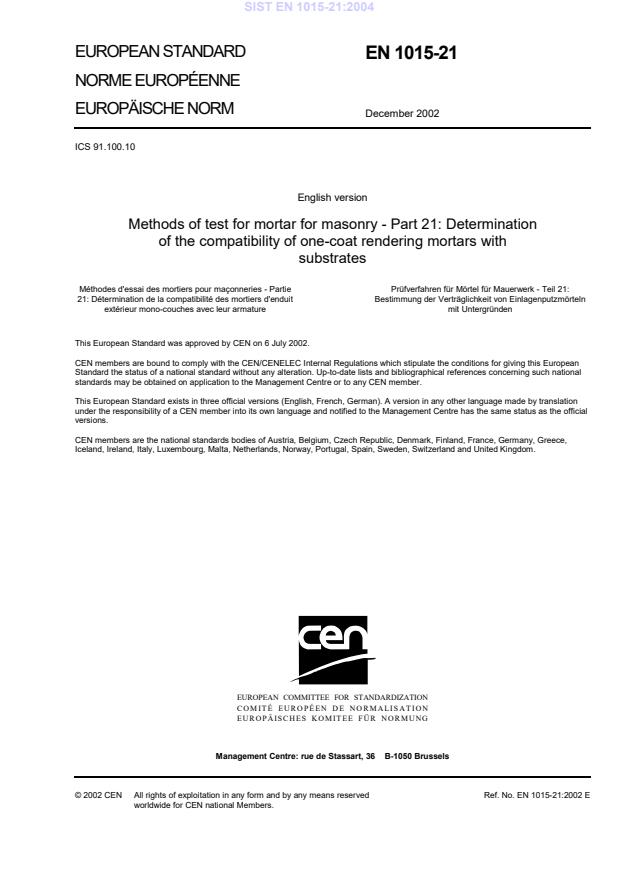
EUROPEAN STANDARDNORME EUROPÉENNEEUROPÄISCHE NORMEN 1015-21December 2002ICS 91.100.10English versionMethods of test for mortar for masonry - Part 21: Determinationof the compatibility of one-coat rendering mortars withsubstratesMéthodes d'essai des mortiers pour maçonneries - Partie21: Détermination de la compatibilité des mortiers d'enduitextérieur mono-couches avec leur armaturePrüfverfahren für Mörtel für Mauerwerk - Teil 21:Bestimmung der Verträglichkeit von Einlagenputzmörtelnmit UntergründenThis European Standard was approved by CEN on 6 July 2002.CEN members are bound to comply with the CEN/CENELEC Internal Regulations which stipulate the conditions for giving this EuropeanStandard the status of a national standard without any alteration. Up-to-date lists and bibliographical references concerning such nationalstandards may be obtained on application to the Management Centre or to any CEN member.This European Standard exists in three official versions (English, French, German). A version in any other language made by translationunder the responsibility of a CEN member into its own language and notified to the Management Centre has the same status as the officialversions.CEN members are the national standards bodies of Austria, Belgium, Czech Republic, Denmark, Finland, France, Germany, Greece,Iceland, Ireland, Italy, Luxembourg, Malta, Netherlands, Norway, Portugal, Spain, Sweden, Switzerland and United Kingdom.EUROPEAN COMMITTEE FOR STANDARDIZATIONCOMITÉ EUROPÉEN DE NORMALISATIONEUROPÄISCHES KOMITEE FÜR NORMUNGManagement Centre: rue de Stassart, 36
B-1050 Brussels© 2002 CENAll rights of exploitation in any form and by any means reservedworldwide for CEN national Members.Ref. No. EN 1015-21:2002 ESIST EN 1015-21:2004
...