

EN 1015-3:1999
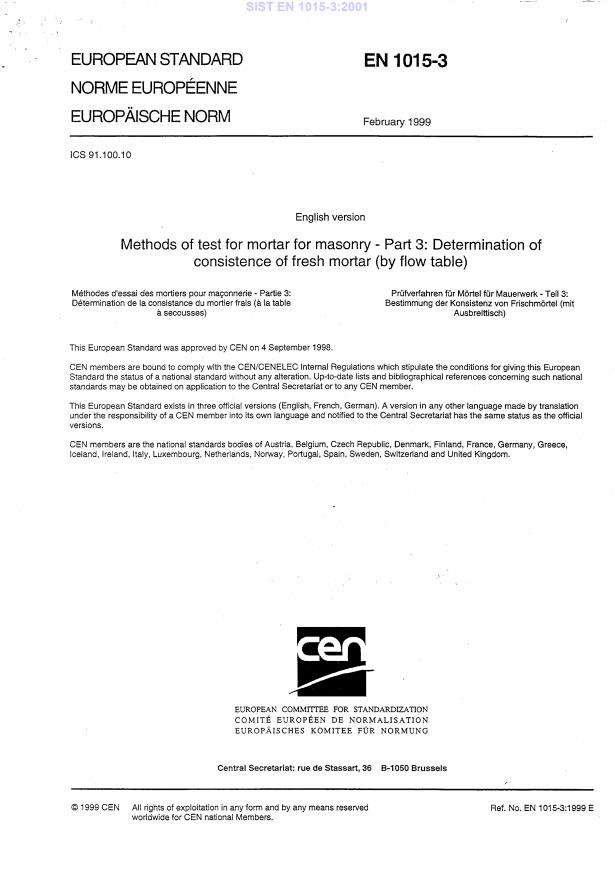
(Main)Methods of test for mortar for masonry - Part 3: Determination of consistence of fresh mortar (by flow table)
- Abstract
This European Standard specifies a method for determining the consistence of freshly mixed mortars (in the following briefly referred to as fresh mortars) including those containing mineral binders and both normal weight and lightweight aggregates, which is by means of the flow value.
- Status
- Published
- Publication Date
- 16-Feb-1999
- Withdrawal Date
- 30-Dec-2001
- Technical Committee
- CEN/TC 125 - Masonry
- Drafting Committee
- CEN/TC 125/WG 4 - Test methods
- Current Stage
- 9093 - Decision to confirm - Review Enquiry
- Start Date
- 05-Dec-2025
- Completion Date
- 14-Oct-2026

Overview
EN 1015-3:1999 is a European Standard established by CEN that defines the method for determining the consistence of fresh mortar used in masonry. This standard specifically covers the assessment of freshly mixed mortars, including those with mineral binders and both normal weight and lightweight aggregates. The consistence of mortar is evaluated by measuring its flow value using a flow table test. This ensures uniformity and quality control in mortar preparation, which is crucial for masonry durability and performance.
Key Topics
- Scope of Mortar Types: Covers a broad range of fresh mortars including cement, gypsum, and lime-based mortars, applicable with various aggregates.
- Flow Table Test Method: Defines a standardized procedure to determine mortar consistence by measuring the flow spread on a flow table.
- Consistency Measurement: The flow value obtained provides a quantitative indicator of the mortar’s workability and flow characteristics.
- Test Execution: Involves subjecting a sample of freshly mixed mortar to controlled jolting on a flow table, then measuring the spread diameter.
- Quality Control: Ensures mortar batches conform to specified consistence for optimal handling and structural integrity.
Applications
- Masonry Construction: Ensures consistent fresh mortar mix quality for bricklaying, stonework, and block masonry.
- Manufacturing Processes: Used by mortar manufacturers for batch consistency and product specification compliance.
- Quality Assurance: Enables contractors and laboratories to verify fresh mortar performance before application.
- Research and Development: Provides a reliable test method for evaluating new mortar formulations and admixtures.
- Compliance Verification: Helps meet national and international building codes and standards relating to mortar application.
Related Standards
- EN 1015-1: Methods of test for mortar for masonry - Sampling, preparing and conditioning test specimens - Covers preparation preceding the consistency test.
- EN 1015-2: Methods of test for mortar for masonry - Determination of bulk density of fresh mortar - Complements consistence by characterizing mortar density.
- EN 1015-4: Methods of test for mortar for masonry - Determination of consistence of fresh mortar by penetration test - Alternative method for mortar consistence.
- EN 998-2: Specification for mortar for masonry - Part 2: Masonry mortar - Defines mortar requirements where EN 1015-3 consistency testing is applicable.
By adhering to EN 1015-3:1999, stakeholders in construction and manufacturing ensure high-quality mortar consistence measurement - a critical factor for masonry durability and workability. This flow table method provides a practical, reliable, and widely recognized testing approach across the European construction industry and beyond.
Relations
- Effective Date
- 28-Jan-2026
- Effective Date
- 28-Jan-2026
- Referred By
EN 1052-1:1998 - Methods of test for masonry - Part 1: Determination of compressive strength - Effective Date
- 28-Jan-2026
- Effective Date
- 28-Jan-2026
- Effective Date
- 28-Jan-2026
- Effective Date
- 28-Jan-2026
- Effective Date
- 28-Jan-2026
- Referred By
EN 1052-2:2016 - Methods of test for masonry - Part 2: Determination of flexural strength - Effective Date
- 28-Jan-2026
- Effective Date
- 28-Jan-2026
- Effective Date
- 28-Jan-2026
- Effective Date
- 28-Jan-2026
- Effective Date
- 28-Jan-2026
- Effective Date
- 28-Jan-2026
- Effective Date
- 28-Jan-2026
- Effective Date
- 28-Jan-2026
Get Certified
Connect with accredited certification bodies for this standard

DIBt (Deutsches Institut für Bautechnik)
German Institute for Building Technology.
DIN CERTCO
DIN Group product certification.

Aboma Certification B.V.
Specialized in construction, metal, and transport sectors.
Sponsored listings
Frequently Asked Questions
EN 1015-3:1999 is a standard published by the European Committee for Standardization (CEN). Its full title is "Methods of test for mortar for masonry - Part 3: Determination of consistence of fresh mortar (by flow table)". This standard covers: This European Standard specifies a method for determining the consistence of freshly mixed mortars (in the following briefly referred to as fresh mortars) including those containing mineral binders and both normal weight and lightweight aggregates, which is by means of the flow value.
This European Standard specifies a method for determining the consistence of freshly mixed mortars (in the following briefly referred to as fresh mortars) including those containing mineral binders and both normal weight and lightweight aggregates, which is by means of the flow value.
EN 1015-3:1999 is classified under the following ICS (International Classification for Standards) categories: 91.100.10 - Cement. Gypsum. Lime. Mortar. The ICS classification helps identify the subject area and facilitates finding related standards.
EN 1015-3:1999 has the following relationships with other standards: It is inter standard links to EN 998-2:2016, EN 1015-2:1998, EN 1052-1:1998, EN 1015-11:2019, EN 1015-11:1999, EN 1015-9:1999, EN 1052-5:2005, EN 1052-2:2016, EN 13395-1:2002, EN 1015-10:1999, EN 846-8:2000, EN 846-5:2012, EN 1052-4:2000, EN ISO 11296-9:2022, EN 1015-18:2002. Understanding these relationships helps ensure you are using the most current and applicable version of the standard.
EN 1015-3:1999 is associated with the following European legislation: EU Directives/Regulations: 305/2011, 89/106/EEC. When a standard is cited in the Official Journal of the European Union, products manufactured in conformity with it benefit from a presumption of conformity with the essential requirements of the corresponding EU directive or regulation.
EN 1015-3:1999 is available in PDF format for immediate download after purchase. The document can be added to your cart and obtained through the secure checkout process. Digital delivery ensures instant access to the complete standard document.
Standards Content (Sample)
2003-01.Slovenski inštitut za standardizacijo. Razmnoževanje celote ali delov tega standarda ni dovoljeno.Prüfverfahren für Mörtel für Mauerwerk - Teil 3: Bestimmung der Konsistenz von Frischmörtel (mit Ausbreittisch)Méthodes d'essai des mortiers pour maçonnerie - Partie 3: Détermination de la consistance du mortier frais (a la table a secousses)Methods of test for mortar for masonry - Part 3: Determination of consistence of fresh mortar (by flo
...