


ETSI GS NFV-SEC 024 V1.1.1 (2026-04)
Network Functions Virtualisation (NFV); Security; Security Management
Network Functions Virtualisation (NFV); Security; Security Management
DGS/NFV-SEC024
General Information
- Status
- Not Published
- Technical Committee
- NFV SEC - Security
- Current Stage
- 12 - Completion
- Due Date
- 15-Apr-2026
- Completion Date
- 13-Apr-2026

Frequently Asked Questions
ETSI GS NFV-SEC 024 V1.1.1 (2026-04) is a standard published by the European Telecommunications Standards Institute (ETSI). Its full title is "Network Functions Virtualisation (NFV); Security; Security Management". This standard covers: DGS/NFV-SEC024
DGS/NFV-SEC024
ETSI GS NFV-SEC 024 V1.1.1 (2026-04) is available in PDF format for immediate download after purchase. The document can be added to your cart and obtained through the secure checkout process. Digital delivery ensures instant access to the complete standard document.
Standards Content (Sample)
GROUP SPECIFICATION
Network Functions Virtualisation (NFV);
Security;
Security Management
Disclaimer
The present document has been produced and approved by the Network Functions Virtualisation (NFV) ETSI Industry
Specification Group (ISG) and represents the views of those members who participated in this ISG.
It does not necessarily represent the views of the entire ETSI membership.
2 ETSI GS NFV-SEC 024 V1.1.1 (2026-04)
Reference
DGS/NFV-SEC024
Keywords
cyber security, network monitoring, NFV,
policy management, security,
security management, threat analysis,
threat intelligence
ETSI
650 Route des Lucioles
F-06921 Sophia Antipolis Cedex - FRANCE
Tel.: +33 4 92 94 42 00 Fax: +33 4 93 65 47 16
Siret N° 348 623 562 00017 - APE 7112B
Association à but non lucratif enregistrée à la
Sous-Préfecture de Grasse (06) N° w061004871
Important notice
The present document can be downloaded from the
ETSI Search & Browse Standards application.
The present document may be made available in electronic versions and/or in print. The content of any electronic and/or
print versions of the present document shall not be modified without the prior written authorization of ETSI. In case of any
existing or perceived difference in contents between such versions and/or in print, the prevailing version of an ETSI
deliverable is the one made publicly available in PDF format on ETSI deliver repository.
Users should be aware that the present document may be revised or have its status changed,
this information is available in the Milestones listing.
If you find errors in the present document, please send your comments to
the relevant service listed under Committee Support Staff.
If you find a security vulnerability in the present document, please report it through our
Coordinated Vulnerability Disclosure (CVD) program.
Notice of disclaimer & limitation of liability
The information provided in the present deliverable is directed solely to professionals who have the appropriate degree of
experience to understand and interpret its content in accordance with generally accepted engineering or
other professional standard and applicable regulations.
No recommendation as to products and services or vendors is made or should be implied.
No representation or warranty is made that this deliverable is technically accurate or sufficient or conforms to any law
and/or governmental rule and/or regulation and further, no representation or warranty is made of merchantability or fitness
for any particular purpose or against infringement of intellectual property rights.
In no event shall ETSI be held liable for loss of profits or any other incidental or consequential damages.
Any software contained in this deliverable is provided "AS IS" with no warranties, express or implied, including but not
limited to, the warranties of merchantability, fitness for a particular purpose and non-infringement of intellectual property
rights and ETSI shall not be held liable in any event for any damages whatsoever (including, without limitation, damages
for loss of profits, business interruption, loss of information, or any other pecuniary loss) arising out of or related to the use
of or inability to use the software.
Copyright Notification
No part may be reproduced or utilized in any form or by any means, electronic or mechanical, including photocopying and
microfilm except as authorized by written permission of ETSI.
The content of the PDF version shall not be modified without the written authorization of ETSI.
The copyright and the foregoing restriction extend to reproduction in all media.
© ETSI 2026.
All rights reserved.
ETSI
3 ETSI GS NFV-SEC 024 V1.1.1 (2026-04)
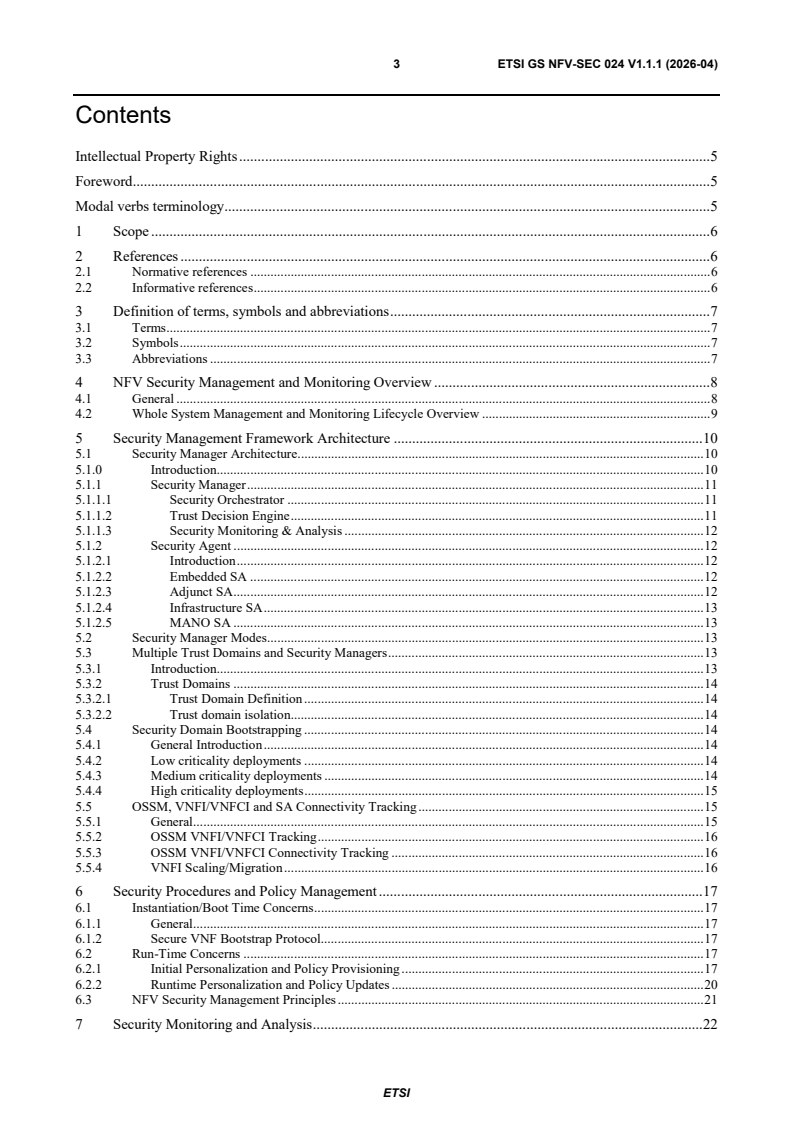
Contents
Intellectual Property Rights . 5
Foreword . 5
Modal verbs terminology . 5
1 Scope . 6
2 References . 6
2.1 Normative references . 6
2.2 Informative references . 6
3 Definition of terms, symbols and abbreviations . 7
3.1 Terms . 7
3.2 Symbols . 7
3.3 Abbreviations . 7
4 NFV Security Management and Monitoring Overview . 8
4.1 General . 8
4.2 Whole System Management and Monitoring Lifecycle Overview . 9
5 Security Management Framework Architecture . 10
5.1 Security Manager Architecture . 10
5.1.0 Introduction. 10
5.1.1 Security Manager . 11
5.1.1.1 Security Orchestrator . 11
5.1.1.2 Trust Decision Engine . 11
5.1.1.3 Security Monitoring & Analysis . 12
5.1.2 Security Agent . 12
5.1.2.1 Introduction . 12
5.1.2.2 Embedded SA . 12
5.1.2.3 Adjunct SA . 12
5.1.2.4 Infrastructure SA . 13
5.1.2.5 MANO SA . 13
5.2 Security Manager Modes . 13
5.3 Multiple Trust Domains and Security Managers . 13
5.3.1 Introduction. 13
5.3.2 Trust Domains . 14
5.3.2.1 Trust Domain Definition . 14
5.3.2.2 Trust domain isolation. 14
5.4 Security Domain Bootstrapping . 14
5.4.1 General Introduction . 14
5.4.2 Low criticality deployments . 14
5.4.3 Medium criticality deployments . 14
5.4.4 High criticality deployments . 15
5.5 OSSM, VNFI/VNFCI and SA Connectivity Tracking . 15
5.5.1 General . 15
5.5.2 OSSM VNFI/VNFCI Tracking . 16
5.5.3 OSSM VNFI/VNFCI Connectivity Tracking . 16
5.5.4 VNFI Scaling/Migration . 16
6 Security Procedures and Policy Management . 17
6.1 Instantiation/Boot Time Concerns . 17
6.1.1 General . 17
6.1.2 Secure VNF Bootstrap Protocol. 17
6.2 Run-Time Concerns . 17
6.2.1 Initial Personalization and Policy Provisioning . 17
6.2.2 Runtime Personalization and Policy Updates . 20
6.3 NFV Security Management Principles . 21
7 Security Monitoring and Analysis . 22
ETSI
4 ETSI GS NFV-SEC 024 V1.1.1 (2026-04)
7.1 Introduction . 22
8 End-to-end lifecycle . 23
Annex A (informative): Change history . 24
History . 25
ETSI
5 ETSI GS NFV-SEC 024 V1.1.1 (2026-04)
Intellectual Property Rights
Essential patents
IPRs essential or potentially essential to normative deliverables may have been declared to ETSI. The declarations
pertaining to these essential IPRs, if any, are publicly available for ETSI members and non-members, and can be
found in ETSI SR 000 314: "Intellectual Property Rights (IPRs); Essential, or potentially Essential, IPRs notified to
ETSI in respect of ETSI standards", which is available from the ETSI Secretariat. Latest updates are available on the
ETSI IPR online database.
Pursuant to the ETSI Directives including the ETSI IPR Policy, no investigation regarding the essentiality of IPRs,
including IPR searches, has been carried out by ETSI. No guarantee can be given as to the existence of other IPRs not
referenced in ETSI SR 000 314 (or the updates on the ETSI Web server) which are, or may be, or may become,
essential to the present document.
Trademarks
The present document may include trademarks and/or tradenames which are asserted and/or registered by their owners.
ETSI claims no ownership of these except for any which are indicated as being the property of ETSI, and conveys no
right to use or reproduce any trademark and/or tradename. Mention of those trademarks in the present document does
not constitute an endorsement by ETSI of products, services or organizations associated with those trademarks.
DECT™, PLUGTESTS™, UMTS™ and the ETSI logo are trademarks of ETSI registered for the benefit of its
Members. 3GPP™, LTE™ and 5G™ logo are trademarks of ETSI registered for the benefit of its Members and of the
3GPP Organizational Partners. oneM2M™ logo is a trademark of ETSI registered for the benefit of its Members and of ®
the oneM2M Partners. GSM and the GSM logo are trademarks registered and owned by the GSM Association.
Foreword
This Group Specification (GS) has been produced by ETSI Industry Specification Group (ISG) Network Functions
Virtualisation (NFV).
Modal verbs terminology
In the present document "shall", "shall not", "should", "should not", "may", "need not", "will", "will not", "can" and
"cannot" are to be interpreted as described in clause 3.2 of the ETSI Drafting Rules (Verbal forms for the expression of
provisions).
"must" and "must not" are NOT allowed in ETSI deliverables except when used in direct citation.
ETSI
6 ETSI GS NFV-SEC 024 V1.1.1 (2026-04)
1 Scope
The present document describes the whole-system security framework required to manage NFV-based virtualised
networks securely. The present document provides an architecture and capabilities for security management, which
includes MANO, NFVI (including the underlying compute hardware infrastructure), the virtualised function application
layer (e.g. 5G) and PNFs. The security management architecture addresses all network and VNF lifecycle stages from
VNF onboarding, instantiation, VNF instance runtime and post-VNF instance teardown cleanup.
The present document considers both baseline security requirements and policies which need to be applied across all
network functions and additional requirements that are applicable to sensitive network functions.
The present document is intended to include, update and replace NFV Security Management and Monitoring concepts
that were defined in ETSI GS NFV-SEC 013 [i.2].
2 References
2.1 Normative references
References are either specific (identified by date of publication and/or edition number or version number) or
non-specific. For specific references, only the cited version applies. For non-specific references, the latest version of the
referenced document (including any amendments) applies.
Referenced documents which are not found to be publicly available in the expected location might be found in the
ETSI docbox.
NOTE: While any hyperlinks included in this clause were valid at the time of publication, ETSI cannot guarantee
their long-term validity.
The following referenced documents are necessary for the application of the present document.
[1] ETSI GS NFV-IFA 026 (V3.2.1): "Network Functions Virtualisation (NFV) Release 3;
Management and Orchestration; Architecture enhancement for Security Management
Specification".
[2] ETSI GS NFV-SEC 025: "Network Functions Virtualisation (NFV)Release 4; Security; Secure
End-to-End VNF and NS management specification".
[3] ETSI GS NFV-SEC 021: "Network Functions Virtualisation (NFV) Release 5; Security; VNF
Package Security Specification".
[4] ETSI GS NFV-SEC 026: "Network Functions Virtualisation (NFV) Release 5; Security; Isolation
and trust domain specification".
[5] ETSI TS 104 000: "Lawful Interception (LI); Internal Network Interface X0".
[6] ETSI TS 104 007: "Lawful Interception (LI); Lawful Interception Architecture".
[7] NIST SP 800-88 Rev.2: "Guidelines for Media Sanitization".
2.2 Informative references
References are either specific (identified by date of publication and/or edition number or version number) or
non-specific. For specific references, only the cited version applies. For non-specific references, the latest version of the
referenced document (including any amendments) applies.
NOTE: While any hyperlinks included in this clause were valid at the time of publication, ETSI cannot guarantee
their long-term validity.
ETSI
7 ETSI GS NFV-SEC 024 V1.1.1 (2026-04)
The following referenced documents may be useful in implementing an ETSI deliverable or add to the reader's
understanding, but are not required for conformance to the present document.
ETSI GR NFV 003: "Network Functions Virtualisation (NFV); Terminology for Main Concepts in
[i.1]
NFV".
[i.2] ETSI GS NFV-SEC 013: "Network Functions Virtualisation (NFV) Release 3; Security; Security
Management and Monitoring specification".
3 Definition of terms, symbols and abbreviations
3.1 Terms
For the purposes of the present document, the terms given in ETSI GR NFV 003 [i.1] and the following apply:
Security Agent: distributed security function performing security monitoring/management with a local actionable
behaviour
Security Management: functionality that applies security policy to a virtualised network based on both predefined
default policy and active analysis of information provided through security monitoring
NOTE: Security management actions will consist of both passive default security policy automatically applied by
NFV-MANO (including through VNFDs or of vendor / CSP configuration) and active real-time security
management actions where the Security Management system actively updates or overrides default passive
policy.
Security Monitoring: functionality that collects and performs analysis of relevant events from across the virtualised
network, which allow the Security Management and Monitoring system to make informed security management
decisions
NOTE: Security monitoring is not restricted to real-time (or near real-time) collection and analysis of network
events. Virtual network-wide monitoring will include security analysis of longer-term logging, AI data set
analysis and human intelligence to predict and update monitoring criteria.
3.2 Symbols
For the purposes of the present document, the symbols given in ETSI GR NFV 003 [i.1] apply.
3.3 Abbreviations
For the purposes of the present document, the abbreviations given in ETSI GR NFV 003 [i.1] and the following apply:
ABAC Attribute Based Access Control
AI/ML Artificial Intelligence / Machine Learning
A-SA Adjunct Security Agent
CA Certificate Authority
CSP Communication Service Provider
DLP Data Loss Prevention
EOL End-Of-Life
E-SM Embedded Security Agent
FQDN Fully Qualified Domain Name
GUID Globally Unique Identifier
HA High Availability
HMEE Hardware-Mediated Execution Enclave
IDS Intrusion Detection System
IPS Intrusion Prevention System
I-SA Infrastructure Security Agent
M-SA MANO Security Agent
OSSM OSS/BSS Security Manager
ETSI
8 ETSI GS NFV-SEC 024 V1.1.1 (2026-04)
SA Security Agent
SIEM Security Information and Event Manager
SM Security Manager
SMA Security Monitoring & Analysis
SO Security Orchestrator
TDE Trust Decision Engine
TLS Transport Layer Security
VBS VNF Bootstrapping Service
4 NFV Security Management and Monitoring Overview
4.1 General
The security of any system or network is ultimately governed by the weakest link. Attackers will seek out points or
interfaces within a system or network that provide the easiest way in and those points of entry or exploit do not
necessarily need to be associated with the ultimate network resource or goal that the attacker wishes to access or obtain.
Therefore, security shall be implemented to an equally strong level throughout the system or network, from the
underlying NFVI, management systems and to the application layer containing end user services (e.g. 5G).
Similarly, while approaches such as Transport Layer Security (TLS) can provide a high level of security protection
against person in the middle attacks on network links or against unauthenticated attempts to access interfaces, they
provide limited protection if an attacker gains access to an insecure trusted endpoint and spreads their attack over the
encrypted TLS connections. All the encryption does is stop security monitoring systems from preventing or detecting
the attack. This is especially true in virtualised systems, as the encrypted virtual links and virtual endpoints all exist in
the same logical memory space. Therefore, if an attacker can access the resources used to implement the virtual
connection, they can also access the resources of the endpoints and management system.
Considering this from a system or network-wide monitoring perspective, the same applies. Focusing security defences
or threat detection in isolation at the application layer, NFV-MANO layer or NFVI will not allow the detection of
threats or attacks which cross the layers. Similarly, taking security mitigations at one layer without considering the big
picture of an attack across all layers may result in attack amplification or an attacker being able to force the use of
specific network resources which have been compromised. Security monitoring is described further in clause 7.
Therefore, it is necessary to consider security management using a system-wide architecture that is able to detect threats
in user services, network management, virtual network functions and underlying NFVI hardware, in order to apply
system-wide policies and take security actions which minimize both attack propagation and service disruption. Security
management is described in further detail in clauses 5 and 6.
Similarly, application layer functions do not magically appear for discovery in a service-based architecture and NFVI
server resources do not get allocated for use with a VNF without the OSS/BSS having requested (either directly or
indirectly through delegated policy) that the VNF was or resources were required. Security monitoring and management
needs to have a holistic view across the entire chain of events.
Conceptually, this should also include physical security systems used to protect the data centres. However, such
physical security is out of scope of the present document.
ETSI
9 ETSI GS NFV-SEC 024 V1.1.1 (2026-04)
CSP Network
Attacker
VNF
End Application
End User
Service
User
OSS / BSS
Attacker
Application Layer / User Service Domain
Attacker
Attacker
On-Boarding
System
Internet
Virtual
NFV-
Components
MANO
Vendor
Support and
License
Management
Manager
Systems
NFV Management Domain
Hardware Domain
Attacker
VNF Allocated
NFVI
Hardware
Resources
Internal Facing Security Management & Monitoring
Figure 4.1-1: Simplified High-Level Network Wide Security Management and Monitoring Architecture
Figure 4.1-1 shows a simplified high-level security management and monitoring architecture. The key concept here is
that security monitoring needs to be considered across the whole virtualised network (including any legacy PNF
components). Figure 4.1-1 makes a distinction between internal and external facing security, as there are differences in
functionality, actions and policies applied to external vs internal facing security functions. The 5 distinct "Attackers" in
Figure 4.1-1 illustrate that attacks can occur both internally and externally to the virtualised network, and to any layer of
the virtualised network. Furthermore, the attackers may be either external to functions within a given domain or internal
(i.e. attacker has legitimate credentials to perform certain actions not in the role of an attacker). Further consideration of
attack scenarios is described in ETSI GS NFV-SEC 025 [2].
4.2 Whole System Management and Monitoring Lifecycle
Overview
There are several philosophical reasons for implementing security as an overlay over the network and the need for
multiple sources of data to verify NFV-MANO reported information, especially in the case of compromise:
1) Holistic Protection: Security should be comprehensive and all-encompassing. By overlaying security measures
on top of the network infrastructure, a layered defence mechanism is created. This approach aligns with the
principle of "defence in depth", where multiple layers of security are employed to protect against various
threats. It is akin to having multiple lines of defence to safeguard critical assets.
2) Adaptability and Flexibility: Security should be adaptable and flexible, capable of evolving to counter
emerging threats. By having security as an overlay, it is easier to adapt to changing threat landscapes. This
aligns with the philosophy that security should not be static but should continuously evolve to address new
vulnerabilities and attack vectors.
3) Risk Mitigation: From a philosophical standpoint, risk mitigation is a fundamental principle in cybersecurity.
Overlaying security allows for risk management by creating virtual boundaries and control points. It is akin to
setting up checkpoints in a fortress to detect and stop potential threats. In essence, this approach aligns with the
philosophy of minimizing risk exposure.
Multiple sources of data are required to verify NFV-MANO-reported information, especially in the case of compromise,
so that:
1) Trust but Verify: While NFV-MANO systems are essential for the orchestration and management of network
resources and VNFs, it is crucial not to rely solely on their reports. Multiple sources of data provide
independent verification, reducing the risk of blind spots or deception in the event of a compromise.
ETSI
External Facing Security Management & Monitoring
External Facing Security Management & Monitoring
10 ETSI GS NFV-SEC 024 V1.1.1 (2026-04)
2) Resilience and Redundancy: By having multiple sources of data, ensures that even if one source is
compromised or manipulated, others can provide a more accurate picture of the network's state.
3) Transparency and Accountability: Multiple data sources enhance transparency by making it more difficult for
malicious actors to manipulate or cover up their activities within the network. This aligns with the philosophy
that accountability should be a cornerstone of any security system.
Implementing security as an overlay over the network aligns with the principles of comprehensive protection,
adaptability, and risk mitigation. Additionally, relying on multiple sources of data for NFV-MANO verification reflects
the concepts of trust but verify, resilience, and transparency in the realm of cybersecurity. These principles help create a
robust and reliable security posture in an ever-evolving threat landscape.
A comprehensive approach to NFV security management and monitoring is critical to effectively safeguard VNFs
throughout their lifecycle. This begins with the onboarding of VNFs, when security policies, controls, and trust
requirements are defined. During this phase, the security attributes of the VNF package shall be verified (see ETSI
GS NFV-SEC 021 [3] and ETSI GS NFV-SEC 025 [2], clause 5.3). This onboarding sets the foundation for consistent
enforcement and monitoring of security as the VNF transitions into an active service.
During the instantiation phase, the security properties and policies of the VNF shall be taken into account, this shall
include requirements for VNF isolation and any trust boundaries which exist within the Network Service and VNF
components, as well as within the NFV infrastructure (see ETSI GS NFV-SEC 026 [4] for more detail on isolation and
trust domains).
Once deployed and running, VNFs require ongoing security management that adapts to dynamic operational conditions.
Policy-driven enforcement, including the dynamic application, adjustment, and revocation of security controls in
response to lifecycle events such as scaling, migration, or modification is required. Security monitoring is equally
crucial: continuous health and anomaly monitoring across VNF, management, and infrastructure layers provides near
real-time insights and enables prompt mitigation of threats, unauthorized changes, or failures. The lifecycle perspective
ensures that monitoring is not static, but keeps pace with the evolving VNF ecosystem by integrating with NFV
orchestrators and security managers to enforce, verify, and, if necessary, remediate both security policy and posture as
the system evolves.
As VNFs are eventually decommissioned or retired, the security management lifecycle concludes with the secure
removal of instances, revocation of privileges, and cleanup of associated resources, configurations, and policies. This
step is vital to prevent residual data exposure and potential exploitation of stale entities. Adhering to a whole-lifecycle
security management approach offers assurance that security is both proactive and adaptive, addressing risk from the
earliest onboarding stage through to decommissioning, for the full duration of the VNF's presence in the network.
5 Security Management Framework Architecture
5.1 Security Manager Architecture
5.1.0 Introduction
The logical security management architecture in the context of NFV-MANO and OSS/BSS is depicted in
Figure 5.1.0-1.
ETSI
11 ETSI GS NFV-SEC 024 V1.1.1 (2026-04)
Figure 5.1.0-1: Security Management Architecture
This architecture defines the following functions and interfaces:
• Security Manager (SM) - A function that centralizes security concerns system-wide, for one, and only one,
security trust domain.
• Security Agent (SA) - I/A/E/M-SAs security function performing security monitoring/management with a
local actionable behaviour. For a given implementation, one or more SAs may be associated with or embedded
in VNFs, NFVI and MANO. Some SAs will have the ability to attest (as Figure 5.1.0-1 depicts), others will
not. The SM should therefore consider their output accordingly.
• Sm-Ossm Interface (Sm-Ossm) - An interface that passes security-related information between the
virtualisation and the application layer within one or more trust domains.
• Sm-Sa Interface (Sm-Sa) - An interface that passes security-related information between the SMs and the SAs.
In the present document, only the generic types of information to be reported by SAs to SMs are specified, i.e.
those agnostic to specific SA applications.
All dotted line interfaces are outside the scope of the present document. Interfaces Sc-Or, Sc-Vnfm, and Sc-Vi are
described in ETSI GS NFV-IFA 026 [1].
5.1.1 Security Manager
5.1.1.1 Security Orchestrator
The Security Orchestrator (SO) acts as a secure proxy between the sensitive Trust Decision Engine (TDE) and the rest
of the network, facilitating provisioning and other security events. It holds the network security state.
5.1.1.2 Trust Decision Engine
The TDE is the beating heart of the system. It manages the network-wide security primitives (keys, nonces, salts, etc.)
needed by the network functions. It contains the Relying Party in the attestation layer.
ETSI
12 ETSI GS NFV-SEC 024 V1.1.1 (2026-04)
The element of the SM responsible for the configuration of SAs contains a configuration repository function and the
attestation relying party.
5.1.1.3 Security Monitoring & Analysis
The security monitoring and analysis functionality of the SM incorporates such functions as the Security Information &
Event Management (SIEM) and threat hunting activities. As the amount of information consumed by the SM increases,
it is likely that Artificial Intelligence / Machine Learning (AI/ML) will be needed to aid in the analysis and alerting of
potential indicators of compromise.
5.1.2 Security Agent
5.1.2.1 Introduction
The SA is a security function performing security monitoring/management with a local actionable behaviour. In an
NFV-based environment, the SAs communicate with the corresponding SM in their security trust domain based on
configurable security policies. The SA may provide security data both to the SM and to the OSSM (via the SM), some
of which is only intelligible to the OSSM (see clause 5.5) at the application layer.
Preconfigured data for initial configuration is assumed to be injected or loaded at SA instantiation (e.g. from
NFV-MANO). An API for runtime configuration could also be available. Data which would need to be preconfigured
includes the likes of the SM to register/communicate with, authentication credentials and any required
identifiers/identities. The configuration of this data can be done via various out-of-band methods, for example, using
CloudInit, Infrastructure as Code templates, etc.
If an SA is allowed to take specific actions in its security trust domain, the access rights shall be explicitly authorized in
the security policy. SA management should be proven capable of guaranteeing SA security trust domain isolation.
NOTE: The security policy may cover two aspects:
a) how the SA agent is secured (e.g. where the SA is to be located, what trust domain it belongs to, what/where
are the keys); and
b) what the SA should do, e.g. enforce monitoring, filtering, collection options.
While different variants of SA can be envisioned (virtualised SA, NFVI SA, SA service, etc.), the present document
describes the differences in the management of such SAs with their NFV-MANO/SM interactions.
5.1.2.2 Embedded SA
The Embedded SA is an SA integrated with the VNF/VNFC that it monitors and/or protects. The E-SA contains
information relevant to the VNF. The E-SA will typically be supplied by the VNF supplier and is included in the VNF
package. The E-SA implicitly follows the NFV-MANO LCM of the VNF/VNFC it is embedded into and relies on
NFV-MANO to perform secure instantiation and to provide the SA initial application configuration.
5.1.2.3 Adjunct SA
The Adjunct SA (A-SA) is not embedded in a VNF/VNFC but can be associated with one or several VNF/VNFC. The
A-SA can monitor the functions of the VNF/VNFC exposed outside of the VNF/VNFC but has no access to the internal
architecture or operational state of the VNF/VNFC.
The A-SAs may form an overlay network of SAs and may be orchestrated by the SM. A-SAs could operate in a security
trust domain that is different from the VNF. The security policy shall state that the A-SAs trust domain is allowed to
monitor the VNF trust domain.
An SA associated with the VNF accesses the tenant network, including this VNF. Accessing NFVI from the VNF layer
is likely to require opening, for example, the OpenStack REST API or local orchestration to the SA. If the Operations,
Administration and Management (OAM) is deployed as a separate tenant, different from the tenant operating the VNF
and the SA, then the SA would also access the OAM network. Network isolation is therefore broken. If such network or
tenant boundary crossing is accepted by the operator, this shall be explicitly stated in the security policy and the risk in
case of a compromised SA shall be mitigated. As a result, the SA needs to be defined as a security asset to protect for
SM.
ETSI
13 ETSI GS NFV-SEC 024 V1.1.1 (2026-04)
5.1.2.4 Infrastructure SA
This SA functionality is associated with, and with concerns limited to one NFVI / CIS cluster. I-SAs communicate with
the corresponding SM for their given security trust domain. These SAs contain information relevant to the NFVI/CIS
cluster layer. They may be lifecycle managed by the NFV layer, or separately managed.
The type of information that the ISA will report is the existence or non-existence of HMEEs on a particular host,
geographical location for use in geofencing, etc.
5.1.2.5 MANO SA
The M-SA functionality is associated with the NFV-MANO components (NFVO, VNFM, VIM, CISM, CCM).
Although Figure 5.1-1 depicts a single M-SA for the whole of NFV-MANO it is expected that each NFV-MANO
component will have one or possibly more M-SAs. From an SM perspective NFV-MANO is simply another workload
which needs to be monitored. Like the I-SAs, the M-SA follows the NFV-MANO infrastructure blocks lifecycle.
It is expected that NFV-MANO entities have a long lifetime. The type of information MANO SAs should provide to the
SM is therefore left for implementation.
NOTE: How M-SA is implemented in a PaaS environment is for future study.
5.2 Security Manager Modes
The SM and NFV-MANO shall support three modes of operation:
• Passive: SM is able to subscribe to applicable lifecycle management events provided by NFV-MANO, but the
SM does not take any active part in the lifecycle management of the VNFs.
• Semi-Active: SM analyses applicable lifecycle management events passed to it by NFV-MANO. The SM may
provide security policies (e.g. geographical restrictions) to NFV-MANO as part of VNF lifecycle management,
but the SM takes an otherwise passive part in VNF lifecycle management. The SM is able to request
NFV-MANO, or other entities (e.g. other SMs, OSSM, OSS/BSS), to undertake security mitigation actions
(e.g. terminate a VNF instance, or surrounding it with firewalls without affecting its lifecycle). NFV-MANO
(or the other entities) can refuse to comply with the request.
• Fully-Active: NFV-MANO passes applicable VNF lifecycle events to the SM and requests approval from the
SM. The SM authorizes, modifies, or rejects NFV-MANO requests per applicable security policy. The SM is
also able to instruct NFV-MANO to take security mitigation actions (e.g. immediately terminate a VNF
instance). In fully active mode, the SM applied policy will supersede MANO-level attributes (e.g. in the
VNFD).
5.3 Multiple Trust Domains and Security Managers
5.3.1 Introduction
In networks with multiple trust domains or where a CSP wishes to achieve security role separation, there may be one or
more SMs. Each SM may operate in Passive, or Semi-Active or Fully Active mode as described in clause 5.2.
It shall be possible for the SMs to act independently of each other, or for SMs to operate in a hierarchical arrangement,
where one SM may be able to issue VNF termination instructions across trust domains of one or more sub SMs.
In hierarchy terms, a sub SM is an SM which is overseen or controlled by another higher security level SM. For
example, a sub SM in Semi-Active Mode may be subservient to a network-wide Fully Active SM. In this case, the sub
SM is able to fulfil its role autonomously, but the higher-level SM would be able to overrule it at any time.
NFV-MANO needs to be able to support such hierarchical models and provide interface instance isolation for such sub
SM to SM relationships.
ETSI
14 ETSI GS NFV-SEC 024 V1.1.1 (2026-04)
5.3.2 Trust Domains
5.3.2.1 Trust Domain Definition
A trust domain is a collection of functions that share the same set of administrative and security concerns and policies
(particularly access control). It is expected that compartmentalization of trust domains spans the vertical stack of
functionality in the CSP network, ideally from hardware to the application layer. Administrators in the CSP network are
assigned to one or more trust domains based on CSP criteria, using state of the art Attribute Based Access Controls
(ABAC). In virtual networks, multiple trust domains should be considered by CSPs during the deployment phase, where
a CSP wishes to achieve security role and management separation, security isolation, separation between sensitive and
non-sensitive components, etc.
5.3.2.2 Trust domain isolation
In this architecture, trust in the network is based on technical procedures and requirements placed on functions in an
attempt to replace the assumed trust of functions on the basis of their location only. Because the network functions
where the SAs reside are dynamically created, this architecture is designed to be able to integrate the orchestration and
management of network functions and the SAs. Consequently, the SM shall contain functions that handle the trust
establishment of SAa, as they are instantiated and as they evolve through their life cycle. In such context, this
architecture contains a logical separation of trust domains and requirements on how information exchange between trust
domains is to be handled to reduce the risk of compromise propagation.
While maximal sub-trust domain separation is clearly a good principle to drive implementation, this approach is costly
both in terms of network and personnel resources. An implementation may choose to collapse sub-trust domains, but the
risks of doing so can only be quantified if the implementation of the present document takes the most restrictive
approach. Every decision to collapse (sub) trust domains shall be accompanied by a thorough security analysis, coupled
with explicit security mitigations.
5.4 Security Domain Bootstrapping
5.4.1 General Introduction
In order for a new VNFI/VNFCI containing an SA to be configured for use, the VNFI/VNFCI needs to be able to
establish communication with the SM. This presents an issue, as instance-specific SA configuration data and keys
cannot be provided in the generic VNF image.
Clauses 5.4.2 and 5.4.3 consider two scenarios for establishing initial communication with the SM/OSSM. Where
practical, the trusted MANO is considered to be the preferred option. However, the aim of both clauses is to arrive at
the same secure running LI implementation.
5.4.2 Low criticality deployments
In the low criticality deployment scenarios (e.g. consumer retail services), MANO is trusted by the OSSM to issue
initial SA VNFI/VNFCI identities and communications certificates. Standard MANO lifecycle management is used for
OSSM. In this deployment, there will be minimal to no segregation and there is a high risk of OSSM bypass or
compromise. This deployment scenario is not covered in the present document.
5.4.3 Medium criticality deployments
In the medium criticality deployment scenario (e.g. enterprise services), MANO is considered sufficiently trusted by the
OSSM to issue initial SA VNFI/VNFCI identities and communications certificates. In addition, the OSSM acts as a sub-
CA for the security domain, under a common operator root CA, which is shared by both MANO and the OSSM.
When MANO instantiates a new VNFI/VNFCI containing an SA function, or a new VNFI/VNFCI with an SA function
associated with it, MANO will allocate a MANO-level identity to the VNFI/VNFCI. MANO performs initial
configuration based on the VNFD and other SA configuratio
...
Questions, Comments and Discussion
Ask us and Technical Secretary will try to provide an answer. You can facilitate discussion about the standard in here.
Loading comments...