


ETSI GR NFV 007 V3.7.1 (2023-11)
Network Functions Virtualisation (NFV); Release Description; Release 3
Network Functions Virtualisation (NFV); Release Description; Release 3
DGR/NFV-007ed371
General Information
Standards Content (Sample)
GROUP REPORT
Network Functions Virtualisation (NFV);
Release Description;
Release 3
Disclaimer
The present document has been produced and approved by the Network Functions Virtualisation (NFV) ETSI Industry
Specification Group (ISG) and represents the views of those members who participated in this ISG.
It does not necessarily represent the views of the entire ETSI membership.
2 ETSI GR NFV 007 V3.7.1 (2023-11)
Reference
DGR/NFV-007ed371
Keywords
NFV, Release
ETSI
650 Route des Lucioles
F-06921 Sophia Antipolis Cedex - FRANCE
Tel.: +33 4 92 94 42 00 Fax: +33 4 93 65 47 16
Siret N° 348 623 562 00017 - APE 7112B
Association à but non lucratif enregistrée à la
Sous-Préfecture de Grasse (06) N° w061004871
Important notice
The present document can be downloaded from:
https://www.etsi.org/standards-search
The present document may be made available in electronic versions and/or in print. The content of any electronic and/or
print versions of the present document shall not be modified without the prior written authorization of ETSI. In case of any
existing or perceived difference in contents between such versions and/or in print, the prevailing version of an ETSI
deliverable is the one made publicly available in PDF format at www.etsi.org/deliver.
Users of the present document should be aware that the document may be subject to revision or change of status.
Information on the current status of this and other ETSI documents is available at
https://portal.etsi.org/TB/ETSIDeliverableStatus.aspx
If you find errors in the present document, please send your comment to one of the following services:
https://portal.etsi.org/People/CommiteeSupportStaff.aspx
If you find a security vulnerability in the present document, please report it through our
Coordinated Vulnerability Disclosure Program:
https://www.etsi.org/standards/coordinated-vulnerability-disclosure
Notice of disclaimer & limitation of liability
The information provided in the present deliverable is directed solely to professionals who have the appropriate degree of
experience to understand and interpret its content in accordance with generally accepted engineering or
other professional standard and applicable regulations.
No recommendation as to products and services or vendors is made or should be implied.
No representation or warranty is made that this deliverable is technically accurate or sufficient or conforms to any law
rule and/or regulation and further, no representation or warranty is made of merchantability or fitness
and/or governmental
for any particular purpose or against infringement of intellectual property rights.
In no event shall ETSI be held liable for loss of profits or any other incidental or consequential damages.
Any software contained in this deliverable is provided "AS IS" with no warranties, express or implied, including but not
limited to, the warranties of merchantability, fitness for a particular purpose and non-infringement of intellectual property
rights and ETSI shall not be held liable in any event for any damages whatsoever (including, without limitation, damages
for loss of profits, business interruption, loss of information, or any other pecuniary loss) arising out of or related to the use
of or inability to use the software.
Copyright Notification
No part may be reproduced or utilized in any form or by any means, electronic or mechanical, including photocopying and
microfilm except as authorized by written permission of ETSI.
The content of the PDF version shall not be modified without the written authorization of ETSI.
The copyright and the foregoing restriction extend to reproduction in all media.
© ETSI 2023.
All rights reserved.
ETSI
3 ETSI GR NFV 007 V3.7.1 (2023-11)
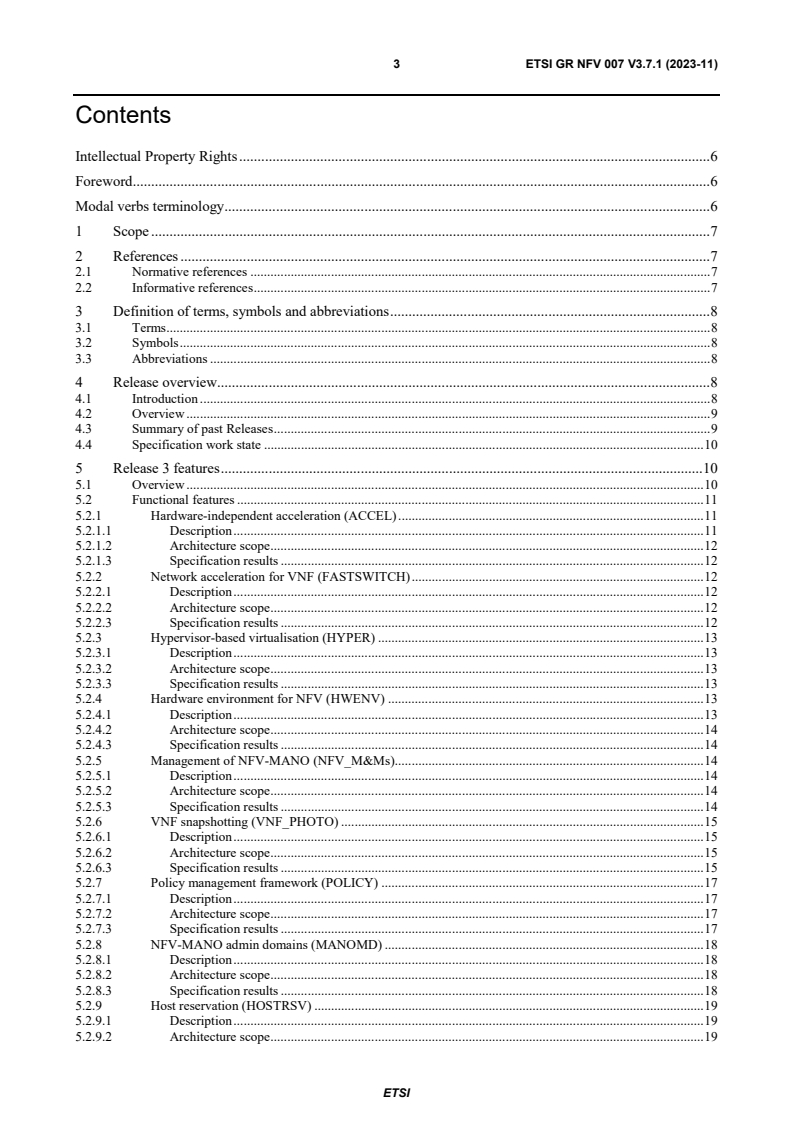
Contents
Intellectual Property Rights . 6
Foreword . 6
Modal verbs terminology . 6
1 Scope . 7
2 References . 7
2.1 Normative references . 7
2.2 Informative references . 7
3 Definition of terms, symbols and abbreviations . 8
3.1 Terms . 8
3.2 Symbols . 8
3.3 Abbreviations . 8
4 Release overview . 8
4.1 Introduction . 8
4.2 Overview . 9
4.3 Summary of past Releases . 9
4.4 Specification work state . 10
5 Release 3 features . 10
5.1 Overview . 10
5.2 Functional features . 11
5.2.1 Hardware-independent acceleration (ACCEL) . 11
5.2.1.1 Description . 11
5.2.1.2 Architecture scope . 12
5.2.1.3 Specification results . 12
5.2.2 Network acceleration for VNF (FASTSWITCH) . 12
5.2.2.1 Description . 12
5.2.2.2 Architecture scope . 12
5.2.2.3 Specification results . 12
5.2.3 Hypervisor-based virtualisation (HYPER) . 13
5.2.3.1 Description . 13
5.2.3.2 Architecture scope . 13
5.2.3.3 Specification results . 13
5.2.4 Hardware environment for NFV (HWENV) . 13
5.2.4.1 Description . 13
5.2.4.2 Architecture scope . 14
5.2.4.3 Specification results . 14
5.2.5 Management of NFV-MANO (NFV_M&Ms). 14
5.2.5.1 Description . 14
5.2.5.2 Architecture scope . 14
5.2.5.3 Specification results . 14
5.2.6 VNF snapshotting (VNF_PHOTO) . 15
5.2.6.1 Description . 15
5.2.6.2 Architecture scope . 15
5.2.6.3 Specification results . 15
5.2.7 Policy management framework (POLICY) . 17
5.2.7.1 Description . 17
5.2.7.2 Architecture scope . 17
5.2.7.3 Specification results . 17
5.2.8 NFV-MANO admin domains (MANOMD) . 18
5.2.8.1 Description . 18
5.2.8.2 Architecture scope . 18
5.2.8.3 Specification results . 18
5.2.9 Host reservation (HOSTRSV) . 19
5.2.9.1 Description . 19
5.2.9.2 Architecture scope . 19
ETSI
4 ETSI GR NFV 007 V3.7.1 (2023-11)
5.2.9.3 Specification results . 19
5.2.9.4 Parts carried over to Release 4 . 20
5.2.10 Management and connectivity of multi-site services (NFVWAN/MCMSS). 20
5.2.10.1 Description . 20
5.2.10.2 Architecture scope . 20
5.2.10.3 Specification results . 20
5.2.10.4 Parts carried over to Release 4 . 22
5.2.11 VNF software modification (SWUP VNF) . 22
5.2.11.1 Description . 22
5.2.11.2 Architecture scope . 22
5.2.11.3 Specification results . 22
5.2.12 Network slicing in NFV (NFVSLICE) . 24
5.2.12.1 Description . 24
5.2.12.2 Architecture scope . 24
5.2.12.3 Specification results . 24
5.2.13 NFVI software modification (SWUP NFVI) . 25
5.2.13.1 Description . 25
5.2.13.2 Architecture scope . 25
5.2.13.3 Specification results . 25
5.2.14 Service availability level (SAL). 26
5.2.14.1 Description . 26
5.2.14.2 Architecture scope . 26
5.2.14.3 Specification results . 26
5.2.15 Enhancements support for MEC in NFV deployments (MECinNFV) . 27
5.2.15.1 Description . 27
5.2.15.2 Architecture scope . 27
5.2.15.3 Specification results . 27
5.3 Security features . 27
5.3.1 Secure sensitive components in NFV Framework (SEC4SNC) . 27
5.3.1.1 Description . 27
5.3.1.2 Architecture scope . 28
5.3.1.3 Specification results . 28
5.3.2 Security management and monitoring for NFV (SECMM) . 28
5.3.2.1 Description . 28
5.3.2.2 Architecture scope . 28
5.3.2.3 Specification results . 28
5.4 Testing . 29
5.4.1 API Conformance Testing . 29
5.4.1.1 Description . 29
5.4.1.2 Architecture scope . 29
5.4.1.3 Specification results . 29
6 NFV Release 3 published deliverables . 29
6.1 Introduction . 29
6.2 Stage 1 and stage 2 Group Specifications . 30
6.2.1 Newly published Group Specifications. 30
6.2.2 Evolved/propagated published deliverables from a previous Release . 31
6.3 Stage 3 Group Specifications . 33
6.3.1 Newly published Group Specifications. 33
6.3.2 Evolved/propagated published deliverables from a previous Release . 34
6.3.3 Stage 3 publication packages . 36
6.4 Other Group Specifications . 37
6.4.1 Security specifications . 37
6.4.2 Testing specifications . 38
6.5 Newly published Group Reports . 38
6.6 Other documentation . 39
6.7 Map of ETSI NFV specifications and the NFV Architectural Framework . 40
7 Work Items planned for NFV Release 3 but not published as part of Release 3 . 40
Annex A: Versioning of published deliverables . 42
A.1 Introduction . 42
ETSI
5 ETSI GR NFV 007 V3.7.1 (2023-11)
A.2 Types of specifications/reports produced by the ETSI ISG NFV . 42
A.3 Deliverables naming and version semantics . 42
A.3.1 Deliverables naming and numbering . 42
A.3.2 Deliverables versioning . 43
A.3.3 Version alignments and relations . 43
Annex B: Release specification states . 45
B.1 Overview . 45
Annex C: Release Description of predecessor Release 2 . 46
C.1 to C.3 Void . 46
C.4 Release Description . 46
C.4.1 Introduction . 46
C.4.2 High-level description . 46
C.4.3 Release capabilities . 47
C.5 Release Group Specifications . 53
C.5.1 Published deliverables . 53
C.5.2 Map of ETSI NFV specifications and the NFV Architectural Framework . 57
C.6 Release associated active work items . 58
C.6.1 Introduction . 58
C.6.2 Active work items . 58
Annex D: Definition of the Release 3 at its beginning . 60
D.1 to D.3 Void . 60
D.4 Release Definition . 60
D.4.1 Introduction . 60
D.4.2 Objectives . 60
D.4.3 Release content . 61
D.4.3.1 NFV Release 3 Features . 61
D.4.4 NFV Release 3 active Work Items . 68
D.4.4.1 Introduction. 68
D.4.4.2 Work Items producing new specifications or reports . 69
D.4.5 NFV Release 3 published deliverables . 71
D.4.5.1 Introduction. 71
D.4.5.2 NFV Release 3 newly published specification and reports . 71
D.4.5.3 NFV Release 3 related published deliverables evolved/propagated from a previous Release . 73
D.5 Work Program composition . 74
Annex E: Change history . 79
History . 82
ETSI
6 ETSI GR NFV 007 V3.7.1 (2023-11)
Intellectual Property Rights
Essential patents
IPRs essential or potentially essential to normative deliverables may have been declared to ETSI. The declarations
pertaining to these essential IPRs, if any, are publicly available for ETSI members and non-members, and can be
found in ETSI SR 000 314: "Intellectual Property Rights (IPRs); Essential, or potentially Essential, IPRs notified to
ETSI in respect of ETSI standards", which is available from the ETSI Secretariat. Latest updates are available on the
ETSI Web server (https://ipr.etsi.org/).
Pursuant to the ETSI Directives including the ETSI IPR Policy, no investigation regarding the essentiality of IPRs,
including IPR searches, has been carried out by ETSI. No guarantee can be given as to the existence of other IPRs not
referenced in ETSI SR 000 314 (or the updates on the ETSI Web server) which are, or may be, or may become,
essential to the present document.
Trademarks
The present document may include trademarks and/or tradenames which are asserted and/or registered by their owners.
ETSI claims no ownership of these except for any which are indicated as being the property of ETSI, and conveys no
right to use or reproduce any trademark and/or tradename. Mention of those trademarks in the present document does
not constitute an endorsement by ETSI of products, services or organizations associated with those trademarks.
DECT™, PLUGTESTS™, UMTS™ and the ETSI logo are trademarks of ETSI registered for the benefit of its
Members. 3GPP™ and LTE™ are trademarks of ETSI registered for the benefit of its Members and of the 3GPP
Organizational Partners. oneM2M™ logo is a trademark of ETSI registered for the benefit of its Members and of the ®
oneM2M Partners. GSM and the GSM logo are trademarks registered and owned by the GSM Association.
Foreword
This Group Report (GR) has been produced by ETSI Industry Specification Group (ISG) Network Functions
Virtualisation (NFV).
Modal verbs terminology
In the present document "should", "should not", "may", "need not", "will", "will not", "can" and "cannot" are to be
interpreted as described in clause 3.2 of the ETSI Drafting Rules (Verbal forms for the expression of provisions).
"must" and "must not" are NOT allowed in ETSI deliverables except when used in direct citation.
ETSI
7 ETSI GR NFV 007 V3.7.1 (2023-11)
1 Scope
The present document describes the NFV Release 3 and in particular its version 3.7.1. It lists and defines the features
forming this release and their relation to work items. It also documents the versions of the related published
specifications and reports. The present document provides an overview of version 3.7.1 and is intended to help the user
as an entry point to ETSI NFV documentation.
2 References
2.1 Normative references
Normative references are not applicable in the present document.
2.2 Informative references
References are either specific (identified by date of publication and/or edition number or version number) or
non-specific. For specific references, only the cited version applies. For non-specific references, the latest version of the
referenced document (including any amendments) applies.
NOTE: While any hyperlinks included in this clause were valid at the time of publication, ETSI cannot guarantee
their long term validity.
The following referenced documents are not necessary for the application of the present document but they assist the
user with regard to a particular subject area.
[i.1] ETSI GS NFV 002: "Network Functions Virtualisation (NFV); Architectural Framework".
[i.2] ETSI GR NFV 003: "Network Functions Virtualisation (NFV); Terminology for Main Concepts in
NFV".
[i.3] ETSI GS NFV 006: "Network Functions Virtualisation (NFV) Release 2; Management and
Orchestration; Architectural Framework Specification".
[i.4] ETSI Work Programme (EWP).
[i.5] ETSI Search and Browse Standards.
[i.6] ETSI GS NFV-PER 001: "Network Functions Virtualisation (NFV); NFV Performance &
Portability Best Practises".
[i.7] ETSI GS NFV-SOL 005: "Network Functions Virtualisation (NFV) Release 3; Protocols and Data
Models; RESTful protocols specification for the Os-Ma-nfvo Reference Point ".
[i.8] ETSI GS NFV-IFA 005: "Network Functions Virtualisation (NFV) Release 3; Management and
Orchestration; Or-Vi reference point - Interface and Information Model Specification".
[i.9] ETSI GS NFV-SOL 015: "Network Functions Virtualisation (NFV); Protocols and Data Models;
Specification of Patterns and Conventions for RESTful NFV-MANO APIs".
[i.10] ETSI GS NFV-SOL 002: "Network Functions Virtualisation (NFV) Release 3; Protocols and Data
Models; RESTful protocols specification for the Ve-Vnfm Reference Point".
[i.11] ETSI GS NFV-SOL 003: "Network Functions Virtualisation (NFV) Release 3; Protocols and Data
Models; RESTful protocols specification for the Or-Vnfm Reference Point".
[i.12] ETSI GS NFV-SOL 009: "Network Functions Virtualisation (NFV) Release 3; Protocols and Data
Models: RESTful protocols specification for the management of NFV-MANO".
[i.13] ETSI GS NFV-SOL 011: "Network Functions Virtualisation (NFV) Release 3; Protocols and Data
Models; RESTful protocols specification for the Or-Or Reference Point".
ETSI
8 ETSI GR NFV 007 V3.7.1 (2023-11)
[i.14] ETSI GS NFV-SOL 012: "Network Functions Virtualisation (NFV) Release 3; Protocols and Data
Models; RESTful protocols specification for the Policy Management Interface".
NOTE: The release description includes tables, figures and lists of documents to define the versions of the
documents comprising the release. In these cases the documents are not listed as references in this clause.
3 Definition of terms, symbols and abbreviations
3.1 Terms
For the purposes of the present document, the terms given in ETSI GR NFV 003 [i.2] and the following apply:
capability: ability of an item to perform an action under given internal conditions in order to meet some demand
feature: functionality which represents added value to the system for a defined set of users
NOTE: A user could be a network operator, service provider, VNF provider, or some other defined actor.
function: abstract concept of a particular piece of functionality in a device, entity or service
functionality: sum of actions or any aspect an item can do
NOTE: Functionality can be associated to diverse items, including devices, entities, services and/or features.
release: set of deliverables that specify a well-defined, stable and internally consistent set of functions
NOTE: A Release differs from the previous Release by having added and/or improved functionality introduced as
a result of standardization work.
release definition: ensemble of features of a particular release
release description: description of specification outputs delivered by the release
3.2 Symbols
Void.
3.3 Abbreviations
For the purposes of the present document, the abbreviations given in ETSI GR NFV 003 [i.2] and the following apply:
GR Group Report
GS Group Specification
ISG Industry Specification Group
WI Work Item
4 Release overview
4.1 Introduction
ETSI ISG NFV Release 3 (hereinafter referred also as Release 3 or the present Release) builds on top and leverages the
results of ETS ISG NFV documents published by the end of 2014. The NFV Release 2 did not include any architectural
changes and the list of capabilities part of the Release were thus aligned with the ETSI NFV Architectural Framework,
see ETSI GS NFV 006 [i.3]. The Release 3 introduces new features on top of the Release 2 specified capabilities.
ETSI
9 ETSI GR NFV 007 V3.7.1 (2023-11)
A high-level description of the main outcomes of the Release 3 are provided in clause 5. Clause 4.2 provides a
statistical summary of the Release 3 in terms of number of specifications and reports. Clause 4.3 describes the
capabilities that have been specified in past Releases, namely the Release 2. Clause 6 lists the published GS comprising
the present Release.
4.2 Overview
At the time the present Description document version is delivered, the Release 3 is comprised of:
• 45 Group Specifications, among which:
- 20 new specifications.
- 25 specifications evolved from Release 2.
• 13 Group Reports, among which:
- 9 new reports.
- 4 reports evolved from Release 2.
4.3 Summary of past Releases
The Release 3 is built upon the capabilities and features specified as part of the NFV Release 2. The Release 2 specified
requirements, information models, data models and interface protocols to enable interoperable implementations of the
NFV Architectural Framework, see ETSI GS NFV 002 [i.1].
The NFV Release 2 specified in the following categories:
• Functional requirements applicable to the Virtualised Infrastructure Manager (VIM), VNF Manager (VNFM)
and Network Functions Virtualisation Orchestrator (NFVO) functional blocks of NFV-MANO identified by
the NFV Architectural Framework.
• Requirements applicable to the reference points Or-Vi, Vi-Vnfm, Or-Vnfm, Os-Ma-nfvo, Ve-Vnfm-vnf and
Ve-Vnfm-em identified by the NFV Architectural Framework and NFV-MANO Architectural Framework, see
ETSI GS NFV 006 [i.3].
• Requirements, specification of interfaces and protocols defined at the reference points Or-Vi, Vi-Vnfm,
Or-Vnfm, Os-Ma-nfvo and Ve-Vnfm identified by the NFV Architectural Framework and NFV-MANO
Architectural Framework, including:
- virtualised resources information management;
- virtualised resources management and change notification;
- virtualised resources reservation management and change notification;
- virtualised resources quota management and change notification;
- virtualised resources fault, performance and capacity management;
- VNF Packaging and software image management;
- Network Forwarding Path (NFP) management;
- VNF lifecycle management and change notification;
- granting of VNF lifecycle operation(s);
- VNF fault, performance and configuration management;
- VNF indicator(s);
- Network Service (NS) lifecycle management and change notification; and
ETSI
10 ETSI GR NFV 007 V3.7.1 (2023-11)
- NS fault and performance management.
• Requirements, information model specification and data models of Network Service Descriptor (NSD).
• Requirements for VNF Packaging and requirements, information model specification and data models of VNF
Descriptor (VNFD).
• Requirements for hardware-independent acceleration and virtual switch acceleration.
• Requirements related to the security aspects concerning the specified capabilities.
4.4 Specification work state
Table 4.4-1 summarizes the status of the specification work at different stages. Annex B describes the meaning of the
"state" of the specification work.
Table 4.4-1: Specification work state within the present Release
Stage Meaning State Additional notes
Informative Informative work within a Release used to study Closed None.
(stage 0) new use cases and technical features.
Stages 1 and 2 Normative work: Closed All work within this stage has been
Service and business requirements completed.
Architecture, interfaces and information models.
V3.7.1 is the latest published version of
relevant specifications, if applicable.
For more information, refer to
clause 6.2.
Stage 3 Normative work on protocols and data models. Closed The majority of the work within this
Informative work on studying potential profiling of stage has been completed.
existing solutions. Remaining parts of one feature have
been carried over to Release 4. See
details in Table 5.1-1.
V3.7.1 is the latest published version of
relevant specifications, if applicable.
For more information, refer to
clause 6.3.
Stage 4 Normative work on testing specifications for Open All work within this stage has been
protocols and data models. completed.
V3.6.1 is the latest published version of
relevant specifications, if applicable.
For more information, refer to
clause 6.4.2.
5 Release 3 features
5.1 Overview
The new features introduced as part of the Release 3 are listed in Table 5.1-1.
Table 5.1-1 lists only the Release 3 features whose specification has been completed with normative provisions at least
from an architecture, functional and information model perspective (stage 2). The table also lists the status of the
specification of normative provisions concerning protocols and data models (stage 3).
ETSI
11 ETSI GR NFV 007 V3.7.1 (2023-11)
Table 5.1-1: Release 3 features
Feature name Acronym Id (from the FEAT id (from the Stage 3 status
Definition Definition
document see document see
annex D) clause D.6))
Hardware-independent acceleration ACCEL R02.CAP12 N/A N/A
Network Acceleration for VNF FASTSWITCH R03.F07 N/A N/A
Hypervisor-based virtualisation HYPER R03.F16 N/A N/A
Hardware environment for NFV HWENV R03.F13 N/A N/A
Management of NFV-MANO NFV_M&Ms R03.F04 FEAT11 Completed. See
note 1.
VNF Snapshotting VNF_PHOTO R03.F11 FEAT15 Completed.
Policy management framework POLICY R03.F14 FEAT07 Completed. See
note 3.
NFV-MANO admin domains MANOMD R03.F18 FEAT08 Completed. See
note 1.
Host reservation HOSTRSV N/A FEAT04 Partially completed.
See note 7.
Secure sensitive components in NFV SEC4SNC R03.F09 N/A N/A
Framework
Security management and monitoring SECMM R03.F08 FEAT18 N/A
for NFV
Management and connectivity of multi- NFVWAN R03.F05 FEAT10 Partially completed.
site services (MCMSS) See note 2.
VNF software modification SWUP (VNF) R03.F10 FEAT02 Completed.
Network slicing in NFV NFVSLICE R03.F21 FEAT05 Completed.
See note 4.
NFVI software modification SWUP (NFVI) R03.F10 FEAT03 Completed.
See note 6.
Service availability level (SAL) SAL R03.F22 FEAT16 Completed.
See note 1.
Enhancements support for MEC in MECinNFV N/A FEAT12 Completed.
NFV deployments See note 4.
See note 5.
NOTE 1: The completion of the feature was realized in version V3.3.1 of the corresponding specifications.
NOTE 2: NFV-MANO APIs and NFV Descriptors are completed. Normative profiling of "protocol and data models" for
the interfaces exposed by WIM is in Release 4. See clause 5.2.10.4.
NOTE 3: The completion of the feature was realized in version V3.4.1 of the corresponding specifications.
NOTE 4: The completion of the feature was realized in version V3.5.1 of the corresponding specifications.
NOTE 5: Additional enhancements related to this feature were also carried over to Release 5.
NOTE 6: The completion of the feature was realized in version V3.6.1 of the corresponding specifications.
NOTE 7: Host reservation is completed. Capacity management is completed except for the case of using descriptor
based resource management. Normative profiling of descriptor based resource capacity management is in
Release 4. See clause 5.2.9.4.
5.2 Functional features
5.2.1 Hardware-independent acceleration (ACCEL)
5.2.1.1 Description
The feature provides NFV related management and orchestration operations to flexibly allocate VNFs to available
NFVI and acceleration components by exposing acceleration capabilities instead of specific acceleration resource
characteristics.
Four interfaces support the exchanges between the NFVI and VIM regarding acceleration resource management:
- acceleration Resource Discovery;
- acceleration Resource Lifecycle Management;
- acceleration Resource Fault Management; and
ETSI
12 ETSI GR NFV 007 V3.7.1 (2023-11)
- acceleration Image Management.
5.2.1.2 Architecture scope
The feature concerns the following main functional blocks and references points:
- Functional blocks: NFVI and VIM.
- Reference points: Nf-Vi.
5.2.1.3 Specification results
The feature has been specified in the specifications and reports listed in table 5.2.1.3-1. Refer to clause 6 for the latest
version available of the referred document.
Table 5.2.1.3-1: Specification results of feature "Hardware-independent acceleration"
Document Id. Stage Description of the feature specification
ETSI GS NFV-IFA 019 Stage 2 Functional requirements to support acceleration related interfaces on the Nf-Vi
reference point.
Functional requirements for the acceleration related interfaces: Acceleration
Resource Discovery, Acceleration Resource Lifecycle Management, Acceleration
Resource Fault Management and Acceleration Image Management.
Functional and information model description of four new interfaces listed above.
5.2.2 Network acceleration for VNF (FASTSWITCH)
5.2.2.1 Description
The feature encompasses the interaction (e.g. interfaces) between the virtualization layer and switching accelerator
drivers to enable network acceleration transparent to the VNF and to be independent of any accelerator vendor and type.
The feature specification is built on the use of the Dynamic Optimization of Packet Flow Routing (DOPFR) mechanism
which offers the capability to accelerate the data plane processing of a VNF on a dedicated switch
...
Questions, Comments and Discussion
Ask us and Technical Secretary will try to provide an answer. You can facilitate discussion about the standard in here.
Loading comments...