


ETSI TR 103 611 V1.1.1 (2020-06)
Satellite Earth Stations and Systems (SES); Seamless integration of satellite and/or HAPS (High Altitude Platform Station) systems into 5G and related architecture options
Satellite Earth Stations and Systems (SES); Seamless integration of satellite and/or HAPS (High Altitude Platform Station) systems into 5G and related architecture options
DTR/SES-00405
General Information
Standards Content (Sample)
TECHNICAL REPORT
Satellite Earth Stations and Systems (SES);
Seamless integration of satellite and/or HAPS
(High Altitude Platform Station) systems into 5G
and related architecture options
2 ETSI TR 103 611 V1.1.1 (2020-06)
Reference
DTR/SES-00405
Keywords
5G, cellular, HAPS, navigation, radio, satellite,
use case
ETSI
650 Route des Lucioles
F-06921 Sophia Antipolis Cedex - FRANCE
Tel.: +33 4 92 94 42 00 Fax: +33 4 93 65 47 16
Siret N° 348 623 562 00017 - NAF 742 C
Association à but non lucratif enregistrée à la
Sous-Préfecture de Grasse (06) N° 7803/88
Important notice
The present document can be downloaded from:
http://www.etsi.org/standards-search
The present document may be made available in electronic versions and/or in print. The content of any electronic and/or
print versions of the present document shall not be modified without the prior written authorization of ETSI. In case of any
existing or perceived difference in contents between such versions and/or in print, the prevailing version of an ETSI
deliverable is the one made publicly available in PDF format at www.etsi.org/deliver.
Users of the present document should be aware that the document may be subject to revision or change of status.
Information on the current status of this and other ETSI documents is available at
https://portal.etsi.org/TB/ETSIDeliverableStatus.aspx
If you find errors in the present document, please send your comment to one of the following services:
https://portal.etsi.org/People/CommiteeSupportStaff.aspx
Copyright Notification
No part may be reproduced or utilized in any form or by any means, electronic or mechanical, including photocopying
and microfilm except as authorized by written permission of ETSI.
The content of the PDF version shall not be modified without the written authorization of ETSI.
The copyright and the foregoing restriction extend to reproduction in all media.
© ETSI 2020.
All rights reserved.
DECT™, PLUGTESTS™, UMTS™ and the ETSI logo are trademarks of ETSI registered for the benefit of its Members.
3GPP™ and LTE™ are trademarks of ETSI registered for the benefit of its Members and
of the 3GPP Organizational Partners.
oneM2M™ logo is a trademark of ETSI registered for the benefit of its Members and
of the oneM2M Partners. ®
GSM and the GSM logo are trademarks registered and owned by the GSM Association.
ETSI
3 ETSI TR 103 611 V1.1.1 (2020-06)
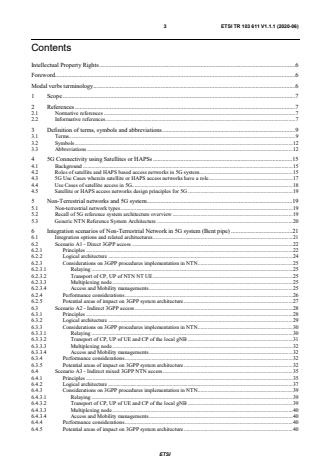
Contents
Intellectual Property Rights . 6
Foreword . 6
Modal verbs terminology . 6
1 Scope . 7
2 References . 7
2.1 Normative references . 7
2.2 Informative references . 7
3 Definition of terms, symbols and abbreviations . 9
3.1 Terms . 9
3.2 Symbols . 12
3.3 Abbreviations . 12
4 5G Connectivity using Satellites or HAPSs . 15
4.1 Background . 15
4.2 Roles of satellite and HAPS based access networks in 5G system . 15
4.3 5G Use Cases wherein satellite or HAPS access networks have a role . 17
4.4 Use Cases of satellite access in 5G . 18
4.5 Satellite or HAPS access networks design principles for 5G . 19
5 Non-Terrestrial networks and 5G system . 19
5.1 Non-terrestrial network types . 19
5.2 Recall of 5G reference system architecture overview . 19
5.3 Generic NTN Reference System Architecture . 20
6 Integration scenarios of Non-Terrestrial Network in 5G system (Bent pipe) . 21
6.1 Integration options and related architectures . 21
6.2 Scenario A1 - Direct 3GPP access . 22
6.2.1 Principles . 22
6.2.2 Logical architecture . 24
6.2.3 Considerations on 3GPP procedures implementation in NTN . 25
6.2.3.1 Relaying . 25
6.2.3.2 Transport of CP, UP of NTN NT UE . 25
6.2.3.3 Multiplexing node . 25
6.2.3.4 Access and Mobility managements . 25
6.2.4 Performance considerations . 26
6.2.5 Potential areas of impact on 3GPP system architecture . 27
6.3 Scenario A2 - Indirect 3GPP access . 28
6.3.1 Principles . 28
6.3.2 Logical architecture . 29
6.3.3 Considerations on 3GPP procedures implementation in NTN . 30
6.3.3.1 Relaying . 30
6.3.3.2 Transport of CP, UP of UE and CP of the local gNB . 31
6.3.3.3 Multiplexing node . 32
6.3.3.4 Access and Mobility managements . 32
6.3.4 Performance considerations . 32
6.3.5 Potential areas of impact on 3GPP system architecture . 32
6.4 Scenario A3 - Indirect mixed 3GPP NTN access . 35
6.4.1 Principles . 35
6.4.2 Logical architecture . 37
6.4.3 Considerations on 3GPP procedures implementation in NTN . 39
6.4.3.1 Relaying . 39
6.4.3.2 Transport of CP, UP of UE and CP of the local gNB . 39
6.4.3.3 Multiplexing node . 40
6.4.3.4 Access and Mobility managements . 40
6.4.4 Performance considerations . 40
6.4.5 Potential areas of impact on 3GPP system architecture . 40
ETSI
4 ETSI TR 103 611 V1.1.1 (2020-06)
6.5 Scenario A4 - Indirect access via transport network . 43
6.5.1 Principles . 43
6.5.2 Logical architecture . 44
6.5.3 Considerations on 3GPP procedures implementation in NTN . 46
6.5.3.1 Transfer capacity . 46
6.5.3.2 Transport of CP, UP of UE and CP of the local gNB . 46
6.5.3.3 Multiplexing node . 46
6.5.3.4 Access and Mobility managements . 46
6.5.4 Performance considerations . 47
6.5.5 Potential areas of impact on 3GPP system architecture . 47
6.6 Scenario A5 - Indirect untrusted access . 48
6.6.1 Principles . 48
6.6.2 Logical architecture . 49
6.6.3 Considerations on 3GPP procedures implementation in NTN . 51
6.6.3.1 Transfer capacity . 51
6.6.3.2 Transport of CP, UP of UE and CP of the local gNB . 51
6.6.3.3 Multiplexing node . 52
6.6.3.4 Access and Mobility managements . 52
6.6.4 Performance considerations . 52
6.6.5 Potential areas of impact on 3GPP system architecture . 52
7 Comparison of the integration scenarios . 55
8 Potential areas of impact on 3GPP standards . 56
Annex A: Clarifications . 59
A.1 N3IWF functions and Y1, Y2, NWu reference points . 59
A.2 Ni Reference Points (alias Ni interfaces) . 60
A.3 Distributed NTN enabled RAN architecture and 3GPP F1 interface principles . 61
A.3.1 Distributed RAN architecture . 61
A.3.2 3GPP F1 interface principles . 63
A.4 Protocols layers instantiation - Examples. 64
A.4.1 Scenario A1, Option 1 - Direct 3GPP access . 64
A.4.1.1 NTN NT UE User plane for a PDU session . 64
A.4.1.2 NTN NT UE Control plane . 67
A.4.2 Scenario A2 - Option 1 - Indirect 3GPP Access . 69
A.4.2.1 UE User plane for a PDU session . 69
A.4.2.2 UE Control plane . 71
A.4.3 Scenario A1, Option 2 - Direct 3GPP acces with distributed NTN enabled gNB, F1 interface between
NTN GW and NTN LT gNB . 74
A.4.3.1 Principles . 74
A.4.3.2 NTN NT UE User plane for a PDU session . 74
A.4.3.3 NTN NT UE Control plane . 75
A.4.4 Scenario A2, Option 2 – Indirect 3GPP acces with distributed NTN enabled gNB, F1 interface between
NTN GW and NTN LT gNB . 77
A.4.4.1 Principles . 77
A.4.4.2 UE User plane for a PDU session . 77
A.4.4.3 UE Control plane . 78
A.5 Statistical multiplexing gain principle . 79
A.6 Considerations on NTN implementation . 79
A.7 Considerations on protocol layers implementation in the NTN . 79
A.8 Performance considerations provided by the relaying & multiplexing functions in the NTN NT
UE. 80
A.9 Performance considerations provided by the relaying & multiplexing functions in the VSAT . 81
A.10 Latency estimations, per deployment scenario and per scenario A1 architecture option . 82
A.10.1 Methodology for latency estimations . 82
ETSI
5 ETSI TR 103 611 V1.1.1 (2020-06)
A.10.2 Latency for GEO deployment scenario . 82
A.10.3 Latency for MEO at 10 000 km scenario deployment . 83
A.10.4 Latency for LEO at 600 km deployment scenarios . 83
A.11 Other performance and dimensioning considerations . 84
A.12 Coordination with management systems . 85
History . 87
ETSI
6 ETSI TR 103 611 V1.1.1 (2020-06)
Intellectual Property Rights
Essential patents
IPRs essential or potentially essential to normative deliverables may have been declared to ETSI. The information
pertaining to these essential IPRs, if any, is publicly available for ETSI members and non-members, and can be found
in ETSI SR 000 314: "Intellectual Property Rights (IPRs); Essential, or potentially Essential, IPRs notified to ETSI in
respect of ETSI standards", which is available from the ETSI Secretariat. Latest updates are available on the ETSI Web
server (https://ipr.etsi.org/).
Pursuant to the ETSI IPR Policy, no investigation, including IPR searches, has been carried out by ETSI. No guarantee
can be given as to the existence of other IPRs not referenced in ETSI SR 000 314 (or the updates on the ETSI Web
server) which are, or may be, or may become, essential to the present document.
Trademarks
The present document may include trademarks and/or tradenames which are asserted and/or registered by their owners.
ETSI claims no ownership of these except for any which are indicated as being the property of ETSI, and conveys no
right to use or reproduce any trademark and/or tradename. Mention of those trademarks in the present document does
not constitute an endorsement by ETSI of products, services or organizations associated with those trademarks.
Foreword
This Technical Report (TR) has been produced by ETSI Technical Committee Satellite Earth Stations and Systems
(SES).
Modal verbs terminology
In the present document "should", "should not", "may", "need not", "will", "will not", "can" and "cannot" are to be
interpreted as described in clause 3.2 of the ETSI Drafting Rules (Verbal forms for the expression of provisions).
"must" and "must not" are NOT allowed in ETSI deliverables except when used in direct citation.
ETSI
7 ETSI TR 103 611 V1.1.1 (2020-06)
1 Scope
The present document identifies how to integrate satellite and/or HAPS communication systems in 5G system for
relevant use cases. The report identifies the necessary standardization activity in relation to the integration of satellite or
HAPS in the 5G system.
2 References
2.1 Normative references
Normative references are not applicable in the present document.
2.2 Informative references
References are either specific (identified by date of publication and/or edition number or version number) or
non-specific. For specific references, only the cited version applies. For non-specific references, the latest version of the
referenced document (including any amendments) applies.
NOTE: While any hyperlinks included in this clause were valid at the time of publication ETSI cannot guarantee
their long-term validity.
The following referenced documents are not necessary for the application of the present document but they assist the
user with regard to a particular subject area.
[i.1] ARIB 2020 and Beyond Ad Hoc Group White Paper, October 2014.
NOTE: Available at https://www.arib.or.jp/english/image/committee/adwics/02-00_2020bah/20bah-wp-100.pdf.
[i.2] NGMN 5G White Paper v1.0.
[i.3] ESOA 5G White Paper, "Satellite Communications Services: An integral part of the 5G
Ecosystem,", European and middle east Satellite Operator Association, 2017 (www.esoa.net).
NOTE: Available at https://www.esoa.net/cms-data/positions/ESOA5G%20Ecosystem.pdf
[i.4] European Commission H2020 5G PPP project "SaT5G" (Satellite and Terrestrial Network for 5G),
2017.
NOTE: Available at: http://sat5g-project.eu/.
[i.5] European Commission, "5G for Europe: An Action Plan,", 14 September 2016.
NOTE: Available at http://ec.europa.eu/newsroom/dae/document.cfm?doc_id=17131.
[i.6] 3GPP TR 38.811: "Study on New Radio (NR) to support non-terrestrial networks".
[i.7] ETSI TS 123 501: "5G; System architecture for the 5G System (5GS) (3GPP TS 23.501
Release 15)".
[i.8] ETSI TS 123 401: "LTE; General Packet Radio Service (GPRS) enhancements for Evolved
Universal Terrestrial Radio Access Network (E-UTRAN) access (3GPP TS 23.401 Release 15)".
[i.9] 3GPP TR 36.806: "Evolved Universal Terrestrial Radio Access (E-UTRA); Relay architectures for
E-UTRA (LTE-Advanced) (Release 9)".
[i.10] ETSI TS 123 502: "5G; Procedures for the 5G System (5GS) (3GPP TS 23.502 Release 15)".
[i.11] IETF RFC 4555: "IKEv2 Mobility and Multi-homing Protocol (MOBIKE)".
ETSI
8 ETSI TR 103 611 V1.1.1 (2020-06)
[i.12] Equivalent capacity and its application to bandwidth allocation in high-speed networks; R. Guerin,
H. Ahmadi, M. Naghshineh ; IEEE Journal on Selected Areas in Communications (Volume: 9,
Issue: 7, Sep 1991).
[i.13] "Communicating Systems & Networks: Traffic & Performance". Georges Fiche, Gérard
Hébuterne; London; Sterling, VA : Kogan Page Science, 2004.
[i.14] ETSI TS 138 470: "5G; NG-RAN; F1 general aspects and principles (3GPP TS 38.470
Release 15)".
[i.15] ETSI TS 136 300: "LTE; Evolved Universal Terrestrial Radio Access (E-UTRA) and Evolved
Universal Terrestrial Radio Access Network (E-UTRAN); Overall description; Stage 2 (3GPP
TS 36.300)".
[i.16] ETSI TS 138 300: "5G; NR; Overall description; Stage-2 (3GPP TS 38.300 Release 15)".
[i.17] ETSI TS 138 473: "5G; NG-RAN; F1 Application Protocol (F1AP) (3GPP TS 38.473
Release 15)".
[i.18] 3GPP TS 38.475: "Technical Specification Group Radio Access Network; NG Radio Access
Network (NG-RAN); F1 interface user plane protocol (Release 15)".
[i.19] ETSI TS 132 240: "Digital cellular telecommunications system (Phase 2+) (GSM); Universal
Mobile Telecommunications System (UMTS); LTE; Telecommunication management; Charging
management; Charging architecture and principles (3GPP TS 32.240)".
[i.20] ETSI TS 133 501: "5G; Security architecture and procedures for 5G System (3GPP TS 33.501
Release 15)".
[i.21] 3GPP TR 38.874: "Technical Specification Group Radio Access Network; Study on Integrated
Access and Backhaul (Release 15)".
[i.22] 3GPP TR 22.822: "Technical Specification Group Services and System Aspects; Study on using
Satellite Access in 5G; Stage 1 (Release 16)".
[i.23] ETSI TS 138 401: "5G; NG-RAN; Architecture description (3GPP TS 38.401 Release 15)".
[i.24] ETSI TS 128 530: "5G; Management and orchestration; Concepts, use cases and requirements
(3GPP TS 28.530 Release 15)".
[i.25] ETSI TS 102 354: "Satellite Earth Stations and Systems (SES); Transparent Satellite Star - B
(TSS-B); IP over Satellite (IPoS) Air Interface Specification [TIA-1008-B (April 2012)]".
[i.26] RESOLUTION 155 (WRC-15) "Regulatory provisions related to earth stations on board
unmanned aircraft which operate with geostationary-satellite networks in the fixed-satellite service
in certain frequency bands not subject to a Plan of Appendices 30, 30A and 30B for the control
and non-payload communications of unmanned aircraft systems in non-segregated airspaces".
NOTE: Available at https://www.itu.int/en/ITU-R/space/snl/Documents/RES-155.pdf
™
[i.27] IEEE 802.1ad -2005: "IEEE Standard for Local and Metropolitan Area Networks -- Virtual
Bridged Local Area Networks -- Amendment 4: Provider Bridges".
NOTE: Available at https://standards.ieee.org/standard/802_1ad-2005.html.
™
[i.28] IEEE 802.1ah -2008: "IEEE Standard for Local and metropolitan area networks -- Virtual
Bridged Local Area Networks Amendment 7: Provider Backbone Bridges".
NOTE: Available at https://standards.ieee.org/standard/802_1ah-2008.html.
ETSI
9 ETSI TR 103 611 V1.1.1 (2020-06)
™
[i.29] IEEE 802.11 -2016: "IEEE Standard for Information technology -- Telecommunications and
information exchange between systems Local and metropolitan area networks -- Specific
requirements -- Part 11: Wireless LAN Medium Access Control (MAC) and Physical Layer (PHY)
Specifications".
NOTE: Available at https://standards.ieee.org/standard/802_11-2016.html.
™
[i.30] IEEE Std 1914.3 (2018): "IEEE Standard for Radio over Ethernet Encapsulations and
Mappings".
NOTE: Available at https://standards.ieee.org/standard/1914_3-2018.html.
3 Definition of terms, symbols and abbreviations
3.1 Terms
For the purposes of the present document, the following terms apply:
3GPP defined NTN access network: NTN which implements a 3GPP Access Networks
5G Access Network: 3GPP Access Network (NR-RAN) connecting to a 5G Core Network
5G higher protocol layers: set of 5G protocols layers that include:
• In the control plane: NAS-MM, NAS-SM, NG-AP, RRC, SCTP over IP, IP
• In the user plane: PDU layer (e.g. IP), GTP-U, 5GUPE, UDP, IP
NOTE 1: NAS-MM, NAS-SM, PDU layer are defined at the UE- 5G CN interface (in the control plane).
NOTE 2: 5GUPE is defined at internal interface within the 5G CN (in the user plane).
NOTE 3: NG-AP, SCTP are defined at the NG-C interface between the RAN and the 5G CN (in the control plane).
NOTE 4: RRC is defined at the UE-gNB interface (both in the control and user planes). RRC is a cross-layer in the
UE, interfacing both with PDCP, MAC and Physical local sub-layers.
NOTE 5: GTP-U is defined at the NG-U interface between the RAN and the 5G CN (in the user plane).
5G Service Enablers: enabling features for the 5G service types including eMBB (Enhanced Mobile Broadband),
mMTC (Massive Machine Type Communications), and URLLC (Ultra-Reliable and Low Latency Communications)
5G Use Case: particular case of how the 5G system is used
NOTE: See "Use case" definition.
access point: network entity providing an access to UEs or local RAN to the 5G CN, this access being either a 3GPP
access or a non-3GPP access
NOTE: This definition conforms to the following ETSI terminology "device providing an interface between a
Wide Area Network (WAN) and a local network".
aircraft: airborne vehicle including High Altitude Platforms (HAPs)
NOTE 1: As part of wireless network, aircraft embarks relay nodes or base stations for connection with UE's.
Aircraft may also be interconnected together by means of Inter-HAPS Links.
NOTE 2: This may also refer to Unmanned Aircraft Systems (UAS) but preferably use HAPS in the present
document.
bent-pipe vehicle: satellite or HAPS based on a transparent architecture
NOTE: Another wording is non-regenerative architecture.
ETSI
10 ETSI TR 103 611 V1.1.1 (2020-06)
feeder link: link between the vehicle (satellite or HAPS) and the Feeder Link terminal, at NTN Gateway side
gNB: 5G Base station i.e. 5G Access Controller, serving the UE, local to the UE
HAPS access: access network using an HAPS embarking a transmission equipment relay node or base station and
providing connectivity with user equipment
"Higher" NR Data Link Layers: link layers protocols such as SDAP, PDCP, RLC
L1 or Layer 1: physical layer
L2 or Layer 2: data Link layer
L3 or Layer 3: network layer
line termination gNB: gNB that serves a Relay UE or a network termination UE
mobile network operator: actor that operates the mobile cellular system (including UEs, RAN, CN)
NOTE: A company may or endorse both "NTN operator" and MNO roles or not.
multiplexer node: network entity that multiplexes single flows into aggregate flows and forwards them to the next
network entity in the transmission chain
NOTE: Endorses also the role of de-multiplexer node, which de-multiplexes aggregate flows into single flows
and forwards them to next network entities or terminals, in the transmission chain, according to their
destination.
N3IWF: non-3GPP Interworking Function
NOTE: Non-3GPP access networks can be connected to the 5G Core Network via the Non-3GPP Interworking
Function (N3IWF). The N3IWF interfaces the 5G Core Network CP and UP functions via N2 and N3
interfaces, respectively. In case of untrusted non-3GPP access, an IPSec tunnelling is setup between the
UE with non 3GPP access and the 5G Core Network (see ETSI TS 123 501 [i.7]).
N3IWFg: extension of N3IWF
NOTE: Extension to enable establishment of IPsec tunnel(s) between the 5G CN and the local security gateway
connected to the local gNB, over an untrusted Non-3GPP Access Network. At 5G CN side, N3IWFg
relays signalling and data.
Nadir: point of the celestial sphere that is directly opposite the zenith and vertically downward from the observer
network termination UE: network termination for which UE management applies
non-3GPP layer: protocol layer not defined by 3GPP
NOTE: For example, layer of radio protocols not defined by 3GPP, such as specified by ETSI (DVB-S2X, DVB-
RCS2). For the mixed 3GPP access, 5G higher protocol layers (see the definition) and "Higher" NR Data
Link layers (see the definition) may be implemented onto this Non-3GPP layer, providing adaptations of
these 5G and NR layers.
non-3GPP access network: access network which is not fully defined by 3GPP but may support an interface with the
CN
NOTE: The "mixed 3GPP NTN access network" enters in this category but implements some 3GPP defined NR
radio interface protocols.
Non-Access Stratum (NAS): signalling between the UE and the Core Network
non-GEO: non geostationary satellite systems such as LEO or MEO
NR: New Radio interface for 5G system
NR data link layers: set of 5G protocol layers defined as: SDAP, PDCP, RLC, MAC
NR-radio access: 5G Access Network based on NR interface
ETSI
11 ETSI TR 103 611 V1.1.1 (2020-06)
Non-Terrestrial Network (NTN): network, or segments of network, using an airborne or space-borne vehicle to
embark transmission equipment, a relay node or base station
NOTE: See 3GPP TR 38.811 [i.6].
NTN Access: access that is provided by a NTN access network based on a satellite or a HAPS system
NTN enabled line termination gNB: function able to serve NTN enabled network termination UE, via an NTN
infrastructure
NOTE: It is either centralized (located at core network side) or distributed over the NTN infrastructure. It may be
either located in the ground segment or embedded in an OBP payload.
NTN enabled LT gNB: short name for NTN enabled line termination gNB
NTN enabled network termination UE: network termination UE that terminates a NTN Service Link
NOTE: It may be integrated in a NTN Relay UE or be a standalone equipment. The NTN enabled network
termination UE interfaces a dedicated gNB, namely the NTN enabled line termination gNB and a Core
Network, via satellite or HAPS link(s).
NTN enabled NT UE: NTN enabled network termination UE
NTN enabled relay UE: relay UE able to be served by a NTN access
NOTE: This NTN enabled relay UE implements local gNB function and NTN enabled network termination UE
functions.
NTN Gateway: gateway located in the ground segment, linked to the Core Network and Feeder Link terminal(s)
NTN gNB-CU: short name for NTN enabled gNB Central Unit
NTN gNB-DU: short name for NTN enabled gNB Distributed Unit
NTN NT UE: NTN enabled network termination UE
NTN NT UE radio bearer: NR radio bearer associated with a NTN enabled network termination UE
NTN NT UE radio transport container: non-3GPP radio transport container associated with a NTN enabled network
termination UE
NTN operator: actor that operates the NTN. A company may endorse both "NTN operator" and MNO roles or not
NTN radio transport container: generic term which stands for a radio transport container associated with NTN
network termination
NTN relay UE: NTN enabled relay UE
NTN terminal radio transport container: non-3GPP radio transport container associated with a NTN enabled
terminal
NTN UE: NTN enabled network termination UE
Radio Access Network (RAN): access network based on 5G radio interface, local to the UEs
relay UE: equipment that implements local gNB function and network termination UE functions
satellites: space borne vehicles including Low Earth Orbiting (LEO) satellites, Medium Earth Orbiting (MEO) satellites
as well as Geostationary Earth Orbiting (GEO) satellites
NOTE: As part of a wireless network, satellites embark relay nodes or base stations for connection with UE's.
Satellites can be interconnected together by means of Inter-Satellite Links.
ETSI
12 ETSI TR 103 611 V1.1.1 (2020-06)
satellite access: access network using a space borne vehicle embarking a transmission equipment relay node or base
station and providing connectivity with user equipment
NOTE: By extension, a satellite access may also rely on a multiplicity of satellites which relay nodes or base
stations may or may not be interconnected with inter-satellite links.
satellite use cases: particular case of how the SatCom system is used in the 5G system to provide or to support the
provisioning of a set of 5G services
scenario: instantiation of a Use Case for the accomplishment of a specific duty and driving the network topology and
the architecture design
service link: link between the NTN terminal (NTN NT UE or VSAT) and the vehicle (satellite or HAPS)
trusted network: network or sub-network which are considered secured by the mobile network operator
rd
NOTE: It depends on the commercial agreement between the MNO and the 3 party operator (such as the
Transport Network operator).
UE management: set of procedures and protocols over NR, N1 and NG interfaces to manage a UE
NOTE: Procedures (see ETSI TS 123 502 [i.10]).
EXAMPLE: Initial Access, Connection Management, PDU session management, Mobility Management, Radio
resource Management.
UE mobility management: mobility management addresses the registration of an UE at a RAN, its location (how to
keep track of an UE) and the handover (how to maintain service continuity following a mobility event)
NOTE: The mobility management and the afferent procedures are described in [i.7], [i.10] and [i.16] for the 5G
and [i.8], [i.15] for LTE-A, updated for R15. In a 5G system, these mobility procedures are supported
across several interfaces, such as NR, N1 and NG according to architectures specifications [i.16]. In the
indirect scenarios, when embedded in a moving platform, the NTN NT UE may be considered as a mobile
UE. In the Direct scenario, the NTN NT UE is mobile UE, as any handset.
untrusted network: network or sub-network which are considered unsecured by the Mobile Network Operator.
rd
NOTE: It depends on the commercial agreement between the MNO and the 3 party operator.
use case: particular example (a case) of how a system is used, literally a "case of system use", in order to achieve a
specific goal
NOTE: The way a system is used corresponds to the interaction between a stakeholder and the system.
vehicle: satellite or HAPS
3.2 Symbols
Void.
3.3 Abbreviations
For the purposes of the present document, the following abbreviations apply:
rd
3GPP 3 Generation Partnership Project
NOTE: See https://www.3gpp.org/.
th
4G 4 Generation
th
5G 5 Generation
5G CN 5G Core Network (in the present document).
5G-EIR 5G Equipment Identity Register
ETSI
13 ETSI TR 103 611 V1.1.1 (2020-06)
5GMF The fifth generation mobile communications promotion forum
NOTE: See https://5gmf.jp/en/.
5G PPP 5G Infrastructure Public Private Partnership
NOTE: See https://5g-ppp.eu/
5GUPE 5G User Plane Encapsulation
NOTE: The wording is defined in 3GPP but not the acronym.
5QI 5G QoS Identifier
AF Application Function
AMF Access and Mobility management Function
AN Access Network
AP Access Point
ARIB Association of Radio Industries and Businesses
NOTE: See https://arib.or.jp/english/.
AUSF AUthentication Server Function
CA Carrier Aggregation
CN Core Network
CoS Class of Service
CP Control Plane
CPRI Common Public Radio Interface
CU Central Unit
DeNB Donor eNodeB
DL Downlink
DN Data Network
DRB Data Radio Bearer
DSCP Differentiated Service Code Point
DU Distributed Unit
EMEA European, Middle East and Africa
eMBB enhanced Mobile Broadband
eNB eNodeB
ESOA European and middle east Satellite Operator Association
NOTE: See https://www.esoa.net/.
F1AP F1 Application Protocol
F1-C F1 Control plane interface
F1-U F1 User plane interface
FFS For Further Study
FOTA Firmware Over-the-Air
GBR Guaranteed Bit Rate
GEO Geostationary Earth Orbit
gNB Next-Generation Node B
NOTE: Alias 5G base station.
gNB-CU gNB Central Unit
gNB-DU gNB Distributed Unit
GPRS General Packet Radio Service
GTP GPRS Tunnelling Protocol
GTP-U GPRS Tunnelling Protocol, for the User Plane
GW GateWay
H2020 Horizon 2020
HAPS High Altitude Platform Station
HPLMN Home Public Land Mobile Network
IAB Integrated Access and Backhaul
ETSI
14 ETSI TR 103 611 V1.1.1 (2020-06)
™
IEEE Institute of Electrical and Electronics Engineers
NOTE: See https://www.ieee.org/.
IP Internet Protocol
IPsec Internet Protocol Security
IoT Internet of Things
ISL Inter-Satellite Link
LEO Low Earth Orbit
LT Line Termination
LT gNB Line Termination gNB
M2M Machine to Machine
MAC Media Access Control
MEC Multi-access Edge Computing
MEO Medium Earth orbit
MNO Mobile Network Operator
MOBIKE MOBility and multihoming extension to Internet Key Exchange
MUX MUltipleXing
N3IWF Non-3GPP InterWorking Function
N/A Not Applicable
NAS Non-Access Stratum
NAS-MM NAS, Mobility Management part
NAS-SM NAS, Session Management part
NF Network Function
NG Next Generation
NG-AP NG Application Protocol
NGMN Next Generation Mobile Network alliance
NOTE: See https://www.ngmn.org.
NG-U Next Generation User plane
NTN 5G RAN NTN enabled 5G Radio Access Network
NMS Network Management System
Non GBR Non-Guaranteed Bit Rate
NR 5G New Radio interface
NRF NF Repository Function
NSSF Network Slice Selection Function
NT Network Termination
NT UE Network Termination UE
NTN Non-Terrestrial Network
NTN LT gNB NTN enabled line termination gNB
NTN NT UE NTN enabled network termination UE
OBP On-Board Processing
PHY PHYsical layer
PCF Policy Control Function
PDCP Packet Data Convergence Protocol
PDN Packet Data Network
PDU Protocol Data Unit
P-GW PDN GateWay
NOTE: This a 3GPP functional network entity.
PLMN Public Land Mobile Network
PPP Public Private Partnership
QFI QoS Flow Identifier
QoS Quality of Service
R15 Release 15 of 3GPP
RAN Radio Access Network
RRC Radio Resource Control
RLC Radio Link Control
RN Relay Node
RNTI Radio Network Temporary Identifier
RRH Remote Radio Head
ETSI
15 ETSI TR 103 611 V1.1.1 (2020-06)
SA Service Architecture
SCTP Stream Control Transmission Protocol
SDAP Service Data Adaptation Protocol
SEC SECurity gateway
SEPP Security Edge Protection Proxy
SMF Session Management Function
SRB Signalling Radio Bearer
SOTA Software Over-the-Air
TCO Total Cost of Ownership
TN Transport Network
TNL Transport Network Layer
TS Technical Specification
UAS Unmanned Aircraft System
UDP User Datagram Protocol
UDM Unified Data Management
UE User Equipment
UDP/IP User Datagram Protocol/Internet Protocol
UL UpLink
UP User Plane
UPF User Plane Function
VHTS Very High Throughput Satellite
VNF Virtual Network Function
VSAT Very Small Aperture Terminal
WLAN Wireless Local Area Network
WRC World Radiocommunication Conference
4 5G Connectivity using Satellites or HAPSs
4.1 Background
Several white papers among which, the ARIB's 5G white paper [i.1], the 5GMF's presentation at the 3GPP RAN 5G
workshop referenced satellite-terrestrial cooperation as part of the mobile networks of 2020 and beyond. Similarly, the
NGMN white paper [i.2], as part of its technology candidate analysis, has also listed satellites as an example of an
emerging technology that could be relevant as part of 5G. Moreover, the EMEA Satellite Operators Association
(ESOA) has recently published a 5G White Paper on the SatCom services' role as an integral part of the 5G ecosystem
[i.3]. In addition, the European Commission funded H2020 5G PPP project "SaT5G" (Satellite and Terrestrial Network
for 5G) has recently defined the Use Cases and Scenarios for satellite positioning into the eMBB (Enhanced Mobile
Broadband) Service Enabler for 5G [i.4]. Furthermore, the European Commission [i.5] recognizes that satellite
networks will be key element of the 5G infrastructure.
4.2 Roles of satellite and HAPS based access networks in 5G
system
The roles of satellite AN and HAPS AN are discussed in this clause. HAPS AN has advantages similar to satellites in
certain cases: ubiquity, broadcast, resiliency, as described below. Besides, the satellites can support any kind of moving
platform while the HAPSs are designed to serve moving platforms on the ground. The area covered by a satellite is
larger than the one served by an HAPS.
The consensus and wider agreement on the key advantages of satellite networks which can add value to the 5G
ecosystem are:
• Ubiquity: Satellite provides high speed capacity across the globe using
...
Questions, Comments and Discussion
Ask us and Technical Secretary will try to provide an answer. You can facilitate discussion about the standard in here.
Loading comments...