


ETSI GS F5G 028 V1.1.1 (2025-04)
Fifth Generation Fixed Network (F5G); F5G-A SME Service and Network Quality Classification
Fifth Generation Fixed Network (F5G); F5G-A SME Service and Network Quality Classification
DGS/F5G-0028
General Information
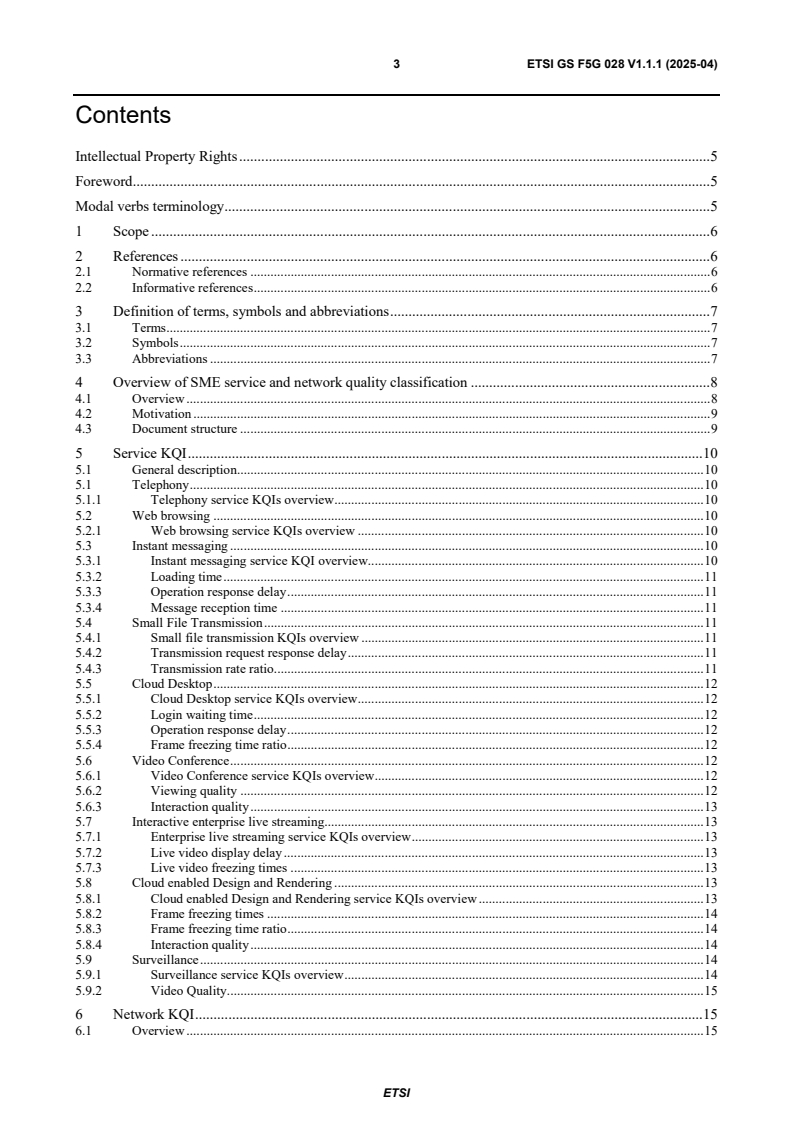
Standards Content (Sample)
GROUP SPECIFICATION
Fifth Generation Fixed Network (F5G);
F5G-A SME Service and Network Quality Classification
Disclaimer
The present document has been produced and approved by the Fifth Generation Fixed Network (F5G) ETSI Industry
Specification Group (ISG) and represents the views of those members who participated in this ISG.
It does not necessarily represent the views of the entire ETSI membership.
2 ETSI GS F5G 028 V1.1.1 (2025-04)
Reference
DGS/F5G-0028
Keywords
F5G advanced, network KQI, QoE, QoS, service
KQI, SME
ETSI
650 Route des Lucioles
F-06921 Sophia Antipolis Cedex - FRANCE
Tel.: +33 4 92 94 42 00 Fax: +33 4 93 65 47 16
Siret N° 348 623 562 00017 - APE 7112B
Association à but non lucratif enregistrée à la
Sous-Préfecture de Grasse (06) N° w061004871
Important notice
The present document can be downloaded from the
ETSI Search & Browse Standards application.
The present document may be made available in electronic versions and/or in print. The content of any electronic and/or
print versions of the present document shall not be modified without the prior written authorization of ETSI. In case of any
existing or perceived difference in contents between such versions and/or in print, the prevailing version of an ETSI
deliverable is the one made publicly available in PDF format on ETSI deliver repository.
Users should be aware that the present document may be revised or have its status changed,
this information is available in the Milestones listing.
If you find errors in the present document, please send your comments to
the relevant service listed under Committee Support Staff.
If you find a security vulnerability in the present document, please report it through our
Coordinated Vulnerability Disclosure (CVD) program.
Notice of disclaimer & limitation of liability
The information provided in the present deliverable is directed solely to professionals who have the appropriate degree of
experience to understand and interpret its content in accordance with generally accepted engineering or
other professional standard and applicable regulations.
No recommendation as to products and services or vendors is made or should be implied.
No representation or warranty is made that this deliverable is technically accurate or sufficient or conforms to any law
and/or governmental rule and/or regulation and further, no representation or warranty is made of merchantability or fitness
for any particular purpose or against infringement of intellectual property rights.
In no event shall ETSI be held liable for loss of profits or any other incidental or consequential damages.
Any software contained in this deliverable is provided "AS IS" with no warranties, express or implied, including but not
limited to, the warranties of merchantability, fitness for a particular purpose and non-infringement of intellectual property
rights and ETSI shall not be held liable in any event for any damages whatsoever (including, without limitation, damages
for loss of profits, business interruption, loss of information, or any other pecuniary loss) arising out of or related to the use
of or inability to use the software.
Copyright Notification
No part may be reproduced or utilized in any form or by any means, electronic or mechanical, including photocopying and
microfilm except as authorized by written permission of ETSI.
The content of the PDF version shall not be modified without the written authorization of ETSI.
The copyright and the foregoing restriction extend to reproduction in all media.
© ETSI 2025.
All rights reserved.
ETSI
3 ETSI GS F5G 028 V1.1.1 (2025-04)
Contents
Intellectual Property Rights . 5
Foreword . 5
Modal verbs terminology . 5
1 Scope . 6
2 References . 6
2.1 Normative references . 6
2.2 Informative references . 6
3 Definition of terms, symbols and abbreviations . 7
3.1 Terms . 7
3.2 Symbols . 7
3.3 Abbreviations . 7
4 Overview of SME service and network quality classification . 8
4.1 Overview . 8
4.2 Motivation . 9
4.3 Document structure . 9
5 Service KQI . 10
5.1 General description. 10
5.1 Telephony . 10
5.1.1 Telephony service KQIs overview . 10
5.2 Web browsing . 10
5.2.1 Web browsing service KQIs overview . 10
5.3 Instant messaging . 10
5.3.1 Instant messaging service KQI overview. 10
5.3.2 Loading time . 11
5.3.3 Operation response delay . 11
5.3.4 Message reception time . 11
5.4 Small File Transmission . 11
5.4.1 Small file transmission KQIs overview . 11
5.4.2 Transmission request response delay . 11
5.4.3 Transmission rate ratio . 11
5.5 Cloud Desktop . 12
5.5.1 Cloud Desktop service KQIs overview . 12
5.5.2 Login waiting time . 12
5.5.3 Operation response delay . 12
5.5.4 Frame freezing time ratio . 12
5.6 Video Conference . 12
5.6.1 Video Conference service KQIs overview . 12
5.6.2 Viewing quality . 12
5.6.3 Interaction quality . 13
5.7 Interactive enterprise live streaming. 13
5.7.1 Enterprise live streaming service KQIs overview . 13
5.7.2 Live video display delay . 13
5.7.3 Live video freezing times . 13
5.8 Cloud enabled Design and Rendering . 13
5.8.1 Cloud enabled Design and Rendering service KQIs overview . 13
5.8.2 Frame freezing times . 14
5.8.3 Frame freezing time ratio . 14
5.8.4 Interaction quality . 14
5.9 Surveillance . 14
5.9.1 Surveillance service KQIs overview . 14
5.9.2 Video Quality . 15
6 Network KQI . 15
6.1 Overview . 15
ETSI
4 ETSI GS F5G 028 V1.1.1 (2025-04)
6.2 Throughput . 15
6.3 Latency . 16
6.4 Connectivity . 17
6.5 Cloud and networking integration . 17
6.6 Security . 17
6.7 Smart O&M . 18
7 User experience evaluation . 19
7.1 General description. 19
7.1.1 Introduction. 19
7.1.2 The Concept of a MOS value. 19
7.2 Telephony . 19
7.3 Web browsing . 19
7.4 Instant messaging . 19
7.4.1 MOS mapping of Loading Time (LT) . 19
7.4.2 MOS mapping of Operation Response Delay (ORD) . 20
7.4.3 MOS mapping of Message reception time (MRT) . 21
7.4.4 Comprehensive service score . 22
7.5 Small File Transmission . 22
7.5.1 MOS mapping of Transmission Request Response Delay (TRRD) . 22
7.5.2 MOS mapping of Transmission Rate Ratio (TRR) . 22
7.5.3 Comprehensive service score . 23
7.6 Cloud Desktop . 23
7.6.1 MOS mapping of Operation Response Delay (ORD) . 23
7.6.2 MOS mapping of Login Waiting Time (LWT). 24
7.6.3 MOS mapping of Frame Freezing Time Ratio (FFTR) . 25
7.6.4 Comprehensive service score . 26
7.7 Video conference . 26
7.7.1 MOS mapping of Viewing Quality (VQ) . 26
7.7.2 MOS mapping of Interaction Delay (ID) . 27
7.7.3 Comprehensive service score . 28
7.8 Interactive Enterprise Live Streaming . 28
7.8.1 MOS mapping of Live Video Display Delay (LVDD) . 28
7.8.2 MOS mapping of Live Video Freezing Times (LVFT) . 28
7.8.3 Comprehensive service score . 29
7.9 Cloud enabled Design and Rendering . 29
7.9.1 MOS mapping of Frame Freezing Times (FFT) . 29
7.9.2 MOS mapping of Frame Freezing Time Ratio (FFTR) . 30
7.9.3 MOS mapping of Interaction Quality (IQ) . 31
7.9.4 Comprehensive service score . 31
7.10 Surveillance . 32
7.10.1 MOS mapping of Frame Freezing Times (FFT) . 32
7.10.2 MOS mapping of Frame Freezing Time Ratio (FFTR) . 32
7.10.3 Comprehensive service score . 33
7.11 User experience classification and evaluation framework for service bundles . 33
7.11.1 Service bundle evaluation framework. 33
7.11.2 Calculation of integrated MOS for SME network service bundles . 34
8 SME Service classification . 35
8.1 Overview . 35
8.2 SME Service classification into network characteristics levels . 35
8.3 Network evaluation . 35
8.3.1 Introduction. 35
8.3.2 Detailed network evaluation . 35
8.3.3 Basic network evaluation . 38
History . 39
ETSI
5 ETSI GS F5G 028 V1.1.1 (2025-04)
Intellectual Property Rights
Essential patents
IPRs essential or potentially essential to normative deliverables may have been declared to ETSI. The declarations
pertaining to these essential IPRs, if any, are publicly available for ETSI members and non-members, and can be
found in ETSI SR 000 314: "Intellectual Property Rights (IPRs); Essential, or potentially Essential, IPRs notified to
ETSI in respect of ETSI standards", which is available from the ETSI Secretariat. Latest updates are available on the
ETSI IPR online database.
Pursuant to the ETSI Directives including the ETSI IPR Policy, no investigation regarding the essentiality of IPRs,
including IPR searches, has been carried out by ETSI. No guarantee can be given as to the existence of other IPRs not
referenced in ETSI SR 000 314 (or the updates on the ETSI Web server) which are, or may be, or may become,
essential to the present document.
Trademarks
The present document may include trademarks and/or tradenames which are asserted and/or registered by their owners.
ETSI claims no ownership of these except for any which are indicated as being the property of ETSI, and conveys no
right to use or reproduce any trademark and/or tradename. Mention of those trademarks in the present document does
not constitute an endorsement by ETSI of products, services or organizations associated with those trademarks.
DECT™, PLUGTESTS™, UMTS™ and the ETSI logo are trademarks of ETSI registered for the benefit of its
Members. 3GPP™, LTE™ and 5G™ logo are trademarks of ETSI registered for the benefit of its Members and of the
3GPP Organizational Partners. oneM2M™ logo is a trademark of ETSI registered for the benefit of its Members and of ®
the oneM2M Partners. GSM and the GSM logo are trademarks registered and owned by the GSM Association.
Foreword
This Group Specification (GS) has been produced by ETSI Industry Specification Group (ISG) Fifth Generation Fixed
Network (F5G).
Modal verbs terminology
In the present document "shall", "shall not", "should", "should not", "may", "need not", "will", "will not", "can" and
"cannot" are to be interpreted as described in clause 3.2 of the ETSI Drafting Rules (Verbal forms for the expression of
provisions).
"must" and "must not" are NOT allowed in ETSI deliverables except when used in direct citation.
ETSI
6 ETSI GS F5G 028 V1.1.1 (2025-04)
1 Scope
The present document specifies the evaluation criteria of the SME service quality experience on a per-service base and
for aggregated multiple services using F5G-A networks. The present document quantifies and evaluates the services
experience, while classifying network performance.
2 References
2.1 Normative references
References are either specific (identified by date of publication and/or edition number or version number) or
non-specific. For specific references, only the cited version applies. For non-specific references, the latest version of the
referenced document (including any amendments) applies.
Referenced documents which are not found to be publicly available in the expected location might be found in the
ETSI docbox.
NOTE: While any hyperlinks included in this clause were valid at the time of publication, ETSI cannot guarantee
their long term validity.
The following referenced documents are necessary for the application of the present document.
[1] ETSI GS F5G 015: "Fifth Generation Fixed Network (F5G); F5G Residential Services Quality
Evaluation and Classification Release 2".
2.2 Informative references
References are either specific (identified by date of publication and/or edition number or version number) or
non-specific. For specific references, only the cited version applies. For non-specific references, the latest version of the
referenced document (including any amendments) applies.
NOTE: While any hyperlinks included in this clause were valid at the time of publication, ETSI cannot guarantee
their long term validity.
The following referenced documents are not necessary for the application of the present document but they assist the
user with regard to a particular subject area.
[i.1] ETSI GS F5G 005: "Fifth Generation Fixed Network (F5G) F5G High-Quality Service Experience
Factors Release#1".
[i.2] BBF TR126: "Triple-play Services Quality of Experience (QoE) Requirements".
[i.3] ETSI TR 103 702: "Speech and multimedia Transmission Quality (STQ); QoS parameters and test
scenarios for assessing network capabilities in 5G performance measurements".
[i.4] Broadband Development Alliance (BDA) 2022: "White paper: QoE classification of SME network
service".
[i.5] Broadband Development Alliance (BDA) 2021: "White paper: Gigabit high quality service
experience and network optimization".
[i.6] CCSA TC615 2024: "White paper: SME FTTR-B Construction Guide White Paper".
[i.7] ETSI GR F5G 001: "Fifth generation fixed network (F5G); F5G generation definition release #1".
[i.8] European Commission 2003: "Internal Market, Industry, Entrepreneurship and SMEs".
ETSI
7 ETSI GS F5G 028 V1.1.1 (2025-04)
3 Definition of terms, symbols and abbreviations
3.1 Terms
For the purposes of the present document, the following terms apply:
SME subscriber: SME person or department signing the contract and responsible for the SME internal network
including network management and the relationship with the wide area broadband service provider
SME User: SME employees, customers of SME who use an SMEs network for different tasks
subscribed bandwidth: contractually promised network bandwidth for the broadband service purchased by the SME
enterprise
3.2 Symbols
Void.
3.3 Abbreviations
For the purposes of the present document, the following abbreviations apply:
BBF Broadband Forum
CAD Computer Aided Design
CPU Central Processing Unit
DDoS Distributed Denial-of-Service
DNS Domain Name Server
E2E End-to-End
FFT Frame Freezing Times
FFTR Frame Freezing Time Ratio
FTTR Fiber to the Room
GUI Graphical User Interface
HD High Definition
ID Interaction Delay
iOS iPhone Operation System
IQ Interaction Quality
ITU International Telecommunication Union
KQI Key Quality Indicator
LAN Local Area Network
LT Loading Time
LVDD Live Video Display Delay
LVFT Live Video Freezing Times
LWT Login Waiting Time
MOS Mean Opinion Score
MRT Message Reception Time
NAC Next Generation Firewall
O&M Operation & Management
ORD Operation Response Delay
PC Personal Computer
PON Passive Optical Network
PSTN Public Switched Telephone Network
QoE Quality of Experience
RWV Relative Weighted Value
SME Small and Medium Enterprise
TCP Transmission Control Protocol
TRR Transmission Rate Ratio
TRRD Transmission Request Response Delay
UHD Ultra-High-Definition
ETSI
8 ETSI GS F5G 028 V1.1.1 (2025-04)
VPN Virtual Private Network
VQ Viewing Quality
4 Overview of SME service and network quality
classification
4.1 Overview
The present document specifies the service Key Quality Indicators (KQIs) for a set of Small and Medium Enterprise
(SME) applications and services. Such service KQIs reflect the service quality. To have a quantitative evaluation of the
service KQIs, a corresponding MOS calculation and evaluation criteria is specified. To achieve a good service quality, a
certain level of F5G network performance and functionality is necessary. Network KQIs are specified to quantify the
network in terms of F5G network performance and functionality.
There are a number of service KQIs specified by other organizations or newly defined in the present document:
a) Telephony is defined in ETSI GS F5G 005 [i.1]: call completion ratio, call setup time, conversational quality,
call drop rate.
b) Web browsing is defined in ETSI GS F5G 005 [i.1]: page response time, first screen display time, full load
time.
c) Instant messaging:
1) message loading, operation response and real-time messaging;
2) loading time, operation response time and message receiving time.
d) Small file transmission: transmission request response delay, transmission rate ratio.
e) Video conference: viewing quality including audio quality, interaction delay.
f) Interactive enterprise live streaming (including audio and video): live video display delay, live video freezing
times.
g) Cloud desktop: login waiting time, operation response time, frame freezing time ratio.
h) Cloud enabled Design and Rendering: frame freezing times, frame freezing time ratio, interaction quality.
The method to quantify service KQIs is based on MOS values, which reflect the user experience. They are defined in
clause 7 of the present document.
A number of network KQIs are used to support the services quality measurement which are as follows:
a) Throughput: the maximum transmission data rate of SME network.
b) Latency: the E2E communication time interval between request and response. ®
c) Connectivity: the connected number of end user devices to the Wi-Fi access point.
d) Cloud and networking integration: network supported cloud-based services experience for SME enterprises.
e) Security: network security of SME network.
f) Smart O&M: smart operation & management of SME network.
A number of network KQIs (including throughput, latency, connectivity, cloud and networking integration, security,
smart O&M) and the key MOS mapping of each KQI are defined in clause 6 and clause 7 respectively.
ETSI
9 ETSI GS F5G 028 V1.1.1 (2025-04)
In general, the staff headcounts of medium-sized, small & micro enterprises are within 250, 50 & 10, respectively
which is defined in European Commission 2003 [i.8]. Based on the network demand of the different SME services, the
network services have been classified into different levels. SME enterprises need the basic network capability to meet
L0 level service requirements, and higher network capability is necessary for L1 and L2 level services. L2 level services
have stricter requirements for network:
a) Level 0 (L0): telephony, web browsing, small file transmission, instant messaging.
b) Level 1 (L1): video conference, enterprise streaming (HD), cloud desktop.
c) Level 2 (L2): Cloud enabled Design and Rendering.
The detailed network requirements are specified in clause 8 of the present document.
To achieve the SME user experience evaluation, several aspects are considered as follows:
1) The service KQI for SME services listed above are used to estimate the user experience from a user's
perspective, (shown in Figure 1).
2) MOS value as a quality scoring mechanism is used to quantify the service KQI, shown in Figure 1. Firstly, the
MOS value is calculated for each KQI of a dedicated service. Secondly, a comprehensive MOS value is
created for the dedicated service. Finally, the MOS value for the SME network could be estimated by the
combination of the MOS value of different service.
3) To support good user experience as perceived by the users, the network KQI listed above are specified as the
basis to ensure sufficient network performance. The detailed network requirements are discussed in the present
document for different levels of service classification.
Figure 1: The framework of user experience evaluation
4.2 Motivation
The present document may be leveraged by the SME user to evaluate their SME network and thus improve it by
updating the network hardware, optimizing networking topology and so on. Depending on the services provided to the
end users, the service operator may utilize the present document as a reference to deploy an SME network to enable
good user experience. To target a good user experience, the service operator may choose specific technologies to
support a god experience. Obviously, further measurement methodology or measurement tool could be developed based
on the content of the present document.
4.3 Document structure
Clause 4 introduces the context of the present document, including the motivation and framework. Clause 5 specifies
the individual service KQIs for specific network services while network KQI are specified in clause 6. The evaluation
methodology is described in clause 7 specifying concrete formulas and algorithms for calculating the MOS value for
each service KQI. In clause 8, the classification of network service and corresponding network requirements are then
discussed based on the network demand of various service.
ETSI
10 ETSI GS F5G 028 V1.1.1 (2025-04)
5 Service KQI
5.1 General description
The following is a list of service KQIs discussing in this clause:
• Telephony.
• Web browsing.
• Instant Message.
• Small File Transmission.
• Cloud Desktop.
• Video Conference.
• Interactive Enterprise Live Streaming.
• Cloud enabled Design and Rendering.
The network performance influences the user experience. When determining service quality indicators, consideration is
given to how the network affects the user experience. A number of services KQIs are defined in both ETSI and ITU, the
present document refers to these relevant standards. Other service KQIs are defined in the present document in order to
specify appropriate evaluation methods.
5.1 Telephony
5.1.1 Telephony service KQIs overview
Telephony in SME includes different scenarios, such as Private Branch Exchange (PBX) system and telephony over
PSTN. Telephony service KQIs includes call completion ratio, call setup time, call drop rate and conversational quality.
The corresponding definitions can be referred to the residential scenarios that are defined in ETSI GS F5G 015 [1],
more SME-oriented telephony functions are for further study.
5.2 Web browsing
5.2.1 Web browsing service KQIs overview
Web browsing is one of the basic Internet applications in SME scenario. SME Employees who do not used cloud based
services such as cloud desktops can complete their tasks through web browsing when available in the requested quality.
Page response time, first screen display time and full load time are the key indicators defined in ETSI GS F5G 015 [1].
5.3 Instant messaging
5.3.1 Instant messaging service KQI overview
The most commonly used messaging tool in SME scenario is instant messaging, allowing multiple colleagues to
exchange instant information by text, images, small file, voice or even video.
The basic experience of user in instant messaging includes message loading, operation response and real-time
messaging. Therefore, the service KQIs of instant messaging includes loading time, operation response time and
message reception time.
ETSI
11 ETSI GS F5G 028 V1.1.1 (2025-04)
5.3.2 Loading time
The loading time indicates the duration from the start of loading the message list or message interface to the completion
of loading the message list or message interface. The better experience requires short loading time. For the dedicated
instant messaging application, the loading time depends on:
• The size of communication list and communication message.
• The capability of end user device.
• The network performance.
NOTE: This indicates that when using short messaging application to interact with people, the messaging
application will load the interaction content of both parties at regular intervals or when the messaging
application is just connected to the network.
5.3.3 Operation response delay
Operation response delay is the time duration between the SME user action and the corresponding received response.
The lower the delay, the better the user experience is provided.
EXAMPLE: The SME user action could be hitting a send button, clicking the mouse, type on the keyboard in
the messaging application. Then the corresponding received response could show that the message
is successfully sent in the messaging application.
5.3.4 Message reception time
Message reception time indicates the time between leaving the messaging transmission side and the message reception /
appearing on the target receiving side.
5.4 Small File Transmission
5.4.1 Small file transmission KQIs overview
In Small and Medium Enterprise (SME) office applications, small files such as documents, programs, videos, photos
and various other file types are downloaded or uploaded to a cloud server or transferred between employees.
A file less than 50 MBytes is defined as a small file.
The Key Quality Indicators (KQIs) for SME individual user experience in small file transmission include:
• Transmission request response delay.
• Transmission rate ratio.
NOTE: Larger files are transfer over other services not in the scope of this KQI.
5.4.2 Transmission request response delay
Transmission request response delay refers to the delay from the time the user initiates a request to transfer a file to the
time the file transfer connection is successfully set up, including the DNS lookup and TCP connection setup time to
initiate a file transmission.
5.4.3 Transmission rate ratio
Transfer rate ratio indicates the ratio of the download rate of the specific remote server to the subscribed bandwidth.
This KQI reflects the network transmission capability.
ETSI
12 ETSI GS F5G 028 V1.1.1 (2025-04)
5.5 Cloud Desktop
5.5.1 Cloud Desktop service KQIs overview
Cloud desktop is a well-established cloud computing application. It centralizes computing and storage resources that are
originally distributed on personal computers, laptops or other devices to a data centre implementing virtualization and
centralized management. Users can use cloud terminals (low performance PC, software client or Android/iOS mobile
client) to access the personal cloud desktop space in the cloud. The cloud desktop service described in the present
document is oriented to common office scenarios with medium to low computing needs. The KQIs of cloud desktop
experience experienced by users are as follows:
• The login waiting time.
• The operation response time.
• The frame freezing time ratio.
5.5.2 Login waiting time
Login waiting time indicates the time duration from when the user initiates a login operation to the time the user can use
the virtual desktop.
5.5.3 Operation response delay
Operation response delay refers to the time between a user completing a keyboard or mouse input operation to the cloud
desktop terminal updating the corresponding screen frame.
5.5.4 Frame freezing time ratio
The frame freezing time ratio refers to the ratio of the freezing duration to the total usage period when users use the
cloud terminals for office work.
5.6 Video Conference
5.6.1 Video Conference service KQIs overview
A video conference uses technologies such as remote control and audio (i.e. speaking) and video interaction (i.e. live
video streaming or slides sharing) to implement information sharing and interaction between participants located in
different places.
EXAMPLE: Video conferencing, applications such as remote office and remote assistance have developed
rapidly.
Video conference KQIs include:
• Viewing quality.
• Interaction quality, which includes audio and video quality.
5.6.2 Viewing quality
The viewing quality refers to the signal quality of an image during video transmission, that is, whether the video image
is discontinuous or abnormal. Two factors are used: number of frames freezing times during viewing and frame freezing
time ratio.
ETSI
13 ETSI GS F5G 028 V1.1.1 (2025-04)
5.6.3 Interaction quality
Interaction delay is the main factor affecting interaction quality. Interaction delay refers to the delay from speaking to
listening or displaying slides or files during a video conference. The evaluation is usually based on the voice delay time
between users.
5.7 Interactive enterprise live streaming
5.7.1 Enterprise live streaming service KQIs overview
Interactive enterprise live streaming refers to the use of internet and streaming media technologies for live sales
presentation broadcasts. Viewers can send comments and ask questions in real-time while watching the live streaming,
and speakers or hosts can respond to this feedback in real time. Interactive Enterprise live streaming has strong
immediacy and interactivity. The interactive live streaming video integrates rich elements which includes images, text,
and sound, offering a vivid and excellent effect, which is gradually becoming a mainstream mode of expression on the
internet. This form of expression has gained prominence as a mainstream method within the digital landscape. An
enterprise live stream is categorized as an Enterprise High Definition (HD) broadcast when its video resolution reaches
1080P. Enterprise live streaming achieving resolutions of 4K or 8K are designated as Enterprise Ultra High Definition
(UHD) (4K/8K) live streams.
Key Quality Indicators (KQIs) for user experience in enterprise live streaming include:
• Live video display delay.
• Live video freezing times.
5.7.2 Live video display delay
Enterprise live streaming is an interactive form of real-time enterprise content sharing. If there is a large delay during
the live video display, the participants will wait for each other or repeat their words, which will lead to confusion and
affect the user experience.
NOTE: Network issues may lead to issues with the audience and the content of the live broadcast not being
guaranteed to be real-time during the live broadcast process. When an audience asks a question, the
problem cannot be immediately reported to the host, resulting in a situation where the audience is waiting.
EXAMPLE: During the process of live streaming sales of a certain product, if the audience raises questions
about some of the content of the live broadcast and the questions are not displayed on the host's
screen in a timely manner, and the host receives the questions after continuing his speech for a
period of time, the content spoken when answering the questions will no longer be the same as
when the questions were asked, which will cause confusion for new listeners.
5.7.3 Live video freezing times
For enterprise live streaming, live video freezing times is defined as the number of times the viewer observed instances
that the live video had no visual content change, no sound or poor quality sound within the measurement period.
Generally, only 0 live video freezing time satisfies the requirements of good experience.
5.8 Cloud enabled Design and Rendering
5.8.1 Cloud enabled Design and Rendering service KQIs overview
Cloud enabled design and rendering in the office environment of SMEs refers to design type where the SMEs that
deploy the design environment in the cloud to enable designers to realize functions including multi-user collaboration,
cross device access and data security through cloud technology.
ETSI
14 ETSI GS F5G 028 V1.1.1 (2025-04)
Cloud enabled design is based on cloud computing capability to integrate design tools and activities into the cloud
resource pool to maximize efficiency. Sufficient bandwidth is needed to upload large design files or download updated
content, especially when it involves high-resolution images or complex models, the amount of data can be extremely
large. Cloud enabled rendering is also used for cloud computing capability to put the rendering function in the cloud,
and the user terminal may access the cloud resource through a high-speed network work station. The cloud side
executes the corresponding rendering task according to the user's instructions and transmits the rendering image back to
the user terminal, therefore, sufficient bandwidth
...
Questions, Comments and Discussion
Ask us and Technical Secretary will try to provide an answer. You can facilitate discussion about the standard in here.
Loading comments...