


ETSI GS ENI 030 V4.1.1 (2024-03)
Experiential Networked Intelligence (ENI); Transformer Architecture for Policy Translation
Experiential Networked Intelligence (ENI); Transformer Architecture for Policy Translation
DGS/ENI-0030v411_Trans_Arch
General Information
Standards Content (Sample)
GROUP SPECIFICATION
Experiential Networked Intelligence (ENI);
Transformer Architecture for Policy Translation
Disclaimer
The present document has been produced and approved by the Experiential Networked Intelligence (ENI) ETSI Industry
Specification Group (ISG) and represents the views of those members who participated in this ISG.
It does not necessarily represent the views of the entire ETSI membership.
2 ETSI GS ENI 030 V4.1.1 (2024-03)
Reference
DGS/ENI-0030v411_Trans_Arch
Keywords
artificial intelligence, cognition, language,
policy management
ETSI
650 Route des Lucioles
F-06921 Sophia Antipolis Cedex - FRANCE
Tel.: +33 4 92 94 42 00 Fax: +33 4 93 65 47 16
Siret N° 348 623 562 00017 - APE 7112B
Association à but non lucratif enregistrée à la
Sous-Préfecture de Grasse (06) N° w061004871
Important notice
The present document can be downloaded from:
https://www.etsi.org/standards-search
The present document may be made available in electronic versions and/or in print. The content of any electronic and/or
print versions of the present document shall not be modified without the prior written authorization of ETSI. In case of any
existing or perceived difference in contents between such versions and/or in print, the prevailing version of an ETSI
deliverable is the one made publicly available in PDF format at www.etsi.org/deliver.
Users of the present document should be aware that the document may be subject to revision or change of status.
Information on the current status of this and other ETSI documents is available at
https://portal.etsi.org/TB/ETSIDeliverableStatus.aspx
If you find errors in the present document, please send your comment to one of the following services:
https://portal.etsi.org/People/CommiteeSupportStaff.aspx
If you find a security vulnerability in the present document, please report it through our
Coordinated Vulnerability Disclosure Program:
https://www.etsi.org/standards/coordinated-vulnerability-disclosure
Notice of disclaimer & limitation of liability
The information provided in the present deliverable is directed solely to professionals who have the appropriate degree of
experience to understand and interpret its content in accordance with generally accepted engineering or
other professional standard and applicable regulations.
No recommendation as to products and services or vendors is made or should be implied.
No representation or warranty is made that this deliverable is technically accurate or sufficient or conforms to any law
rule and/or regulation and further, no representation or warranty is made of merchantability or fitness
and/or governmental
for any particular purpose or against infringement of intellectual property rights.
In no event shall ETSI be held liable for loss of profits or any other incidental or consequential damages.
Any software contained in this deliverable is provided "AS IS" with no warranties, express or implied, including but not
limited to, the warranties of merchantability, fitness for a particular purpose and non-infringement of intellectual property
rights and ETSI shall not be held liable in any event for any damages whatsoever (including, without limitation, damages
for loss of profits, business interruption, loss of information, or any other pecuniary loss) arising out of or related to the use
of or inability to use the software.
Copyright Notification
No part may be reproduced or utilized in any form or by any means, electronic or mechanical, including photocopying and
microfilm except as authorized by written permission of ETSI.
The content of the PDF version shall not be modified without the written authorization of ETSI.
The copyright and the foregoing restriction extend to reproduction in all media.
© ETSI 2024.
All rights reserved.
ETSI
3 ETSI GS ENI 030 V4.1.1 (2024-03)
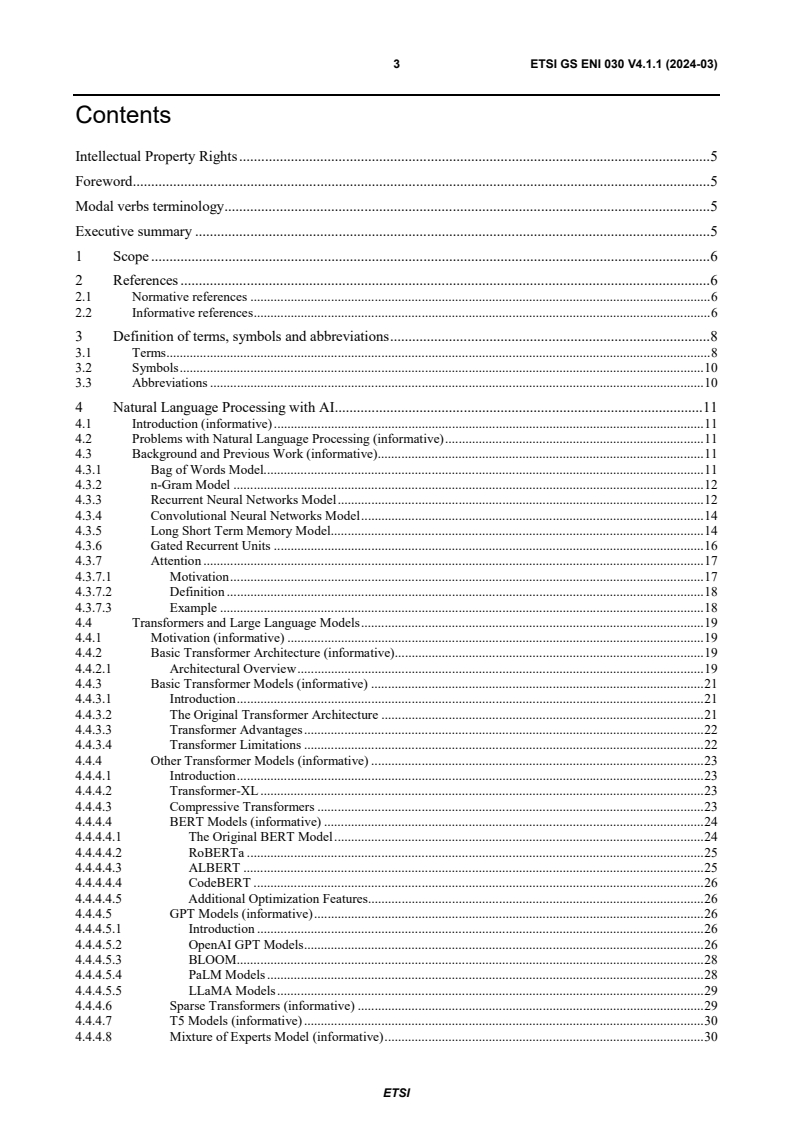
Contents
Intellectual Property Rights . 5
Foreword . 5
Modal verbs terminology . 5
Executive summary . 5
1 Scope . 6
2 References . 6
2.1 Normative references . 6
2.2 Informative references . 6
3 Definition of terms, symbols and abbreviations . 8
3.1 Terms . 8
3.2 Symbols . 10
3.3 Abbreviations . 10
4 Natural Language Processing with AI . 11
4.1 Introduction (informative) . 11
4.2 Problems with Natural Language Processing (informative) . 11
4.3 Background and Previous Work (informative). 11
4.3.1 Bag of Words Model. 11
4.3.2 n-Gram Model . 12
4.3.3 Recurrent Neural Networks Model . 12
4.3.4 Convolutional Neural Networks Model . 14
4.3.5 Long Short Term Memory Model . 14
4.3.6 Gated Recurrent Units . 16
4.3.7 Attention . 17
4.3.7.1 Motivation . 17
4.3.7.2 Definition . 18
4.3.7.3 Example . 18
4.4 Transformers and Large Language Models . 19
4.4.1 Motivation (informative) . 19
4.4.2 Basic Transformer Architecture (informative). 19
4.4.2.1 Architectural Overview . 19
4.4.3 Basic Transformer Models (informative) . 21
4.4.3.1 Introduction . 21
4.4.3.2 The Original Transformer Architecture . 21
4.4.3.3 Transformer Advantages . 22
4.4.3.4 Transformer Limitations . 22
4.4.4 Other Transformer Models (informative) . 23
4.4.4.1 Introduction . 23
4.4.4.2 Transformer-XL . 23
4.4.4.3 Compressive Transformers . 23
4.4.4.4 BERT Models (informative) . 24
4.4.4.4.1 The Original BERT Model . 24
4.4.4.4.2 RoBERTa . 25
4.4.4.4.3 ALBERT . 25
4.4.4.4.4 CodeBERT . 26
4.4.4.4.5 Additional Optimization Features. 26
4.4.4.5 GPT Models (informative) . 26
4.4.4.5.1 Introduction . 26
4.4.4.5.2 OpenAI GPT Models . 26
4.4.4.5.3 BLOOM. 28
4.4.4.5.4 PaLM Models . 28
4.4.4.5.5 LLaMA Models . 29
4.4.4.6 Sparse Transformers (informative) . 29
4.4.4.7 T5 Models (informative) . 30
4.4.4.8 Mixture of Experts Model (informative) . 30
ETSI
4 ETSI GS ENI 030 V4.1.1 (2024-03)
4.4.5 Conclusions (normative) . 31
4.5 Prompting for LLMs, Transformers, and Chatbots . 31
4.5.1 Introduction (normative) . 31
4.5.2 Prompting . 31
4.5.2.1 Introduction (normative) . 31
4.5.2.2 Input-Output Prompts. 32
4.5.2.2.1 Introduction (informative) . 32
4.5.2.2.2 Zero-Shot Prompts (informative) . 32
4.5.2.2.3 Few-Shot Prompts (informative) . 32
4.5.2.3 Self-Consistency Prompts (normative) . 32
4.5.2.4 Chain-of-Thought Prompts (normative) . 32
4.5.2.5 Tree-of-Thought Prompts (normative) . 33
4.5.2.6 Skills-in-Context Prompts (informative) . 33
4.5.2.7 Graph-of-Thought Prompts (normative) . 34
4.5.2.8 Common Procedures to Increase the Value of Prompting . 34
4.5.2.8.1 Introduction (informative) . 34
4.5.2.8.2 Active Learning (normative) . 34
4.5.2.8.3 Information Retrieval (informative) . 35
4.5.3 Prompt Tuning (informative) . 35
4.5.4 Prompt Templates (normative) . 35
4.5.5 Prompt Pipelines (informative) . 37
4.5.6 Prompt Drift (informative) . 37
4.5.7 The Use of Prompts in an ENI System (normative) . 37
4.6 Instruction Tuning (normative) . 39
4.7 The Use of Knowledge Graphs to Improve Reasoning (normative) . 39
4.8 Retrieval Augmented Generation (normative) . 40
5 Transformer Architectural Requirements (normative) . 41
5.1 Introduction . 41
5.2 Transformer and LLM Usage in an ENI System . 41
5.3 Transformer and LLM Architectural Requirements . 42
5.4 Transformer and LLM Reference Point Requirements . 42
6 Transformer Architecture for ENI (normative) . 43
6.1 Introduction . 43
6.2 Design Principles . 43
6.2.1 Use Case . 43
6.2.2 Overview . 43
6.2.3 Using Transformers vs. Traditional Compilers and Parsers . 44
6.3 Transformer Management Functional Block Architecture . 44
6.3.1 Introduction. 44
6.3.2 RAG Framework Functional Block . 45
6.3.3 Prompting Framework Functional Block . 46
6.3.4 Transformer Processing Functional Block . 47
6.3.4.1 Overview . 47
6.3.4.2 Choice of Transformer to Use . 47
6.3.4.3 Open Source Components Availability for the Transformer Processing FB. 48
6.3.5 Output Generation Functional Block . 49
6.4 Interaction with Other ENI System Functional Blocks . 50
7 Transformer Internal Reference Points (normative) . 50
7.1 Introduction . 50
7.2 External Reference Points . 50
7.3 Internal Reference Points . 50
8 Areas of Future Study (informative) . 51
8.1 Open Issues for the present document . 51
8.2 Issues for Future Study . 51
History . 52
ETSI
5 ETSI GS ENI 030 V4.1.1 (2024-03)
Intellectual Property Rights
Essential patents
IPRs essential or potentially essential to normative deliverables may have been declared to ETSI. The declarations
pertaining to these essential IPRs, if any, are publicly available for ETSI members and non-members, and can be
found in ETSI SR 000 314: "Intellectual Property Rights (IPRs); Essential, or potentially Essential, IPRs notified to
ETSI in respect of ETSI standards", which is available from the ETSI Secretariat. Latest updates are available on the
ETSI Web server (https://ipr.etsi.org/).
Pursuant to the ETSI Directives including the ETSI IPR Policy, no investigation regarding the essentiality of IPRs,
including IPR searches, has been carried out by ETSI. No guarantee can be given as to the existence of other IPRs not
referenced in ETSI SR 000 314 (or the updates on the ETSI Web server) which are, or may be, or may become,
essential to the present document.
Trademarks
The present document may include trademarks and/or tradenames which are asserted and/or registered by their owners.
ETSI claims no ownership of these except for any which are indicated as being the property of ETSI, and conveys no
right to use or reproduce any trademark and/or tradename. Mention of those trademarks in the present document does
not constitute an endorsement by ETSI of products, services or organizations associated with those trademarks.
DECT™, PLUGTESTS™, UMTS™ and the ETSI logo are trademarks of ETSI registered for the benefit of its
Members. 3GPP™ and LTE™ are trademarks of ETSI registered for the benefit of its Members and of the 3GPP
Organizational Partners. oneM2M™ logo is a trademark of ETSI registered for the benefit of its Members and of the ®
oneM2M Partners. GSM and the GSM logo are trademarks registered and owned by the GSM Association.
Foreword
This Group Specification (GS) has been produced by ETSI Industry Specification Group (ISG) Experiential Networked
Intelligence (ENI).
Modal verbs terminology
In the present document "shall", "shall not", "should", "should not", "may", "need not", "will", "will not", "can" and
"cannot" are to be interpreted as described in clause 3.2 of the ETSI Drafting Rules (Verbal forms for the expression of
provisions).
"must" and "must not" are NOT allowed in ETSI deliverables except when used in direct citation.
Executive summary
The present document specifies how a transformer architecture may be used to translate intent policies from an
end-user, application, or other external source to ENI Policies for use in cognitive networking and decision making in
modern system design. The primary use cases are twofold:
1) to translate a natural language intent policy into an ENI Policy that uses a Domain-Specific Language; and
2) to translate an ENI Domain Specific Language intent policy into an implementation that uses a programming ®
language, such as Python™ or Java .
ETSI
6 ETSI GS ENI 030 V4.1.1 (2024-03)
1 Scope
The present document enhances the information described in ETSI GR ENI 018 [i.1] and specifies how a transformer
architecture can be used to translate input policies from an end-user, application, or other external source to ENI
Policies for use in cognitive networking and decision making in modern system design.
The present document specifies a transformer-based architecture that can be used to parse, understand, and translate
text. This enables different types of input policies to be translated into an appropriate ENI Policy using a transformer
architecture.
2 References
2.1 Normative references
References are either specific (identified by date of publication and/or edition number or version number) or
non-specific. For specific references, only the cited version applies. For non-specific references, the latest version of the
referenced document (including any amendments) applies.
Referenced documents which are not found to be publicly available in the expected location might be found at
https://docbox.etsi.org/Reference.
NOTE: While any hyperlinks included in this clause were valid at the time of publication, ETSI cannot guarantee
their long term validity.
The following referenced documents are necessary for the application of the present document.
[1] ETSI GS ENI 005 (V3.1.1): "Experiential Networked Intelligence (ENI); System Architecture".
[2] ETSI GS ENI 019 (V3.1.1): "Experiential Networked Intelligence (ENI); Representing, Inferring,
and Proving Knowledge in ENI".
2.2 Informative references
References are either specific (identified by date of publication and/or edition number or version number) or
non-specific. For specific references, only the cited version applies. For non-specific references, the latest version of the
referenced document (including any amendments) applies.
NOTE: While any hyperlinks included in this clause were valid at the time of publication, ETSI cannot guarantee
their long term validity.
The following referenced documents are not necessary for the application of the present document but they assist the
user with regard to a particular subject area.
[i.1] ETSI GR ENI 018 (V2.1.1) (08-2021): "Experiential Networked Interlligence (ENI); Introduction
to Artificial Intelligence Mechanisms for Modular Systems".
[i.2] A. Vaswani, N. Shazeer, N. Parmar, J. Uszkoreit, L. Jones, A. Gomez, L. Kaiser, I. Polosukhin:
st
"Attention Is All You Need", 31 Conference on Neural Information Processing Systems, 2017.
[i.3] J. Wei, et al.: "Chain-of-Thought Prompting Elicits Reasoning in Large Language Models",
January 2023.
[i.4] Z. Dai, et al.: "Transformer-XL: Attentive Language Models Beyond a Fixed-Length Context",
th
57 Conference for the Association for Computational Linguistics, 2019.
[i.5] J. Rae, et al.: "Compressive Transformers for Long-Range Sequence Modelling", November 2019.
[i.6] J. Devlin, et al.: "BERT: Pre-training of Deep Bidirectional Transformers for Language
Understanding", Google AI, March 2019.
ETSI
7 ETSI GS ENI 030 V4.1.1 (2024-03)
[i.7] Y. Liu, et al.: "RoBERTa: A Robustly Optimized BERT Pretraining Approach", University of
Washington and Facebook AI, 2019.
[i.8] Z. Lan, et al.: "ALBERT: A Lite BERT for Self-supervised Learning of Language
Representations", International Conference on Learning Representation, February 2020.
[i.9] A. Radford, et al.: "Improving language understanding by generative pre-training", Technical
Report, OpenAI blog, 2018.
[i.10] A. Radford, et al.: "Language models are unsupervised multitask learners", OpenAI blog, 1(8):9,
2019.
[i.11] T. Brown, et al.: "Language models are few-shot learners", Advances in Neural Information
Processing Systems, 2020.
[i.12] L. Ouyang, et al.: "Training language models to follow instructions with human feedback",
Advances in Neural Information Processing Systems, 2022.
[i.13] N. Stiennon, et al.: "Learning to Summarize from Human Feedback", Proceedings of the 34th
International Conference on Neural Information Processing Systems, 2020.
[i.14] OpenAI: "GPT-4 Technical Report", March 2023.
[i.15] Big Science Workshop: "BLOOM: A 176B-Parameter Open-Access Multilingual Language
Model", June 2023 (final version, v4).
[i.16] A. Chowdery, et al.: "PaLM: Scaling Language Modelling with Pathways", October 2022.
[i.17] P. Barham, et al.: "Pathways: Asynchronous Distributed Dataflow for ML", March 2022.
[i.18] D. Driess, et al.: "PaLM-E: An Embodied Multimodal Language Model", March 2023. ®
: "PaLM 2 Technical Report", May 2023.
[i.19] Google
[i.20] K. Singhal, et al.: "Large language models encode clinical knowledge", July 2023.
[i.21] H. Touvron, et al.: "LLaMA: Open and Efficient Foundation Language Models", February 2023.
[i.22] H. Touvron, et al.: "Llama 2: Open Foundation and Fine-Tuned Chat Models", July 2023.
[i.23] H. Shirzad, et al.: "Exphormer: Sparse Transformers for Graphs", July 2023.
[i.24] C. Raffel, et. al.: "Exploring the Limits of Transfer Learning with a Unified Text-to-Text
Transformer", Journal of Machine Learning Research, June 2020.
[i.25] H. Chung, et al.: "Scaling Instruction-Finetuned Language Models", December 2022.
[i.26] S. Zuo, et al.: "MoEBERT: from BERT to Mixture-of-Experts via Importance-Guided
Adaptation", April 2022.
[i.27] S. Yao, et al.: "Tree of Thoughts: Deliberate Problem Solving with Large Language Models",
May 2023.
[i.28] J. Chen, et al.: "Skills-in-Context Prompting: Unlocking Compositionality in Large Language
Models", August 2023.
[i.29] J. Johnson, M. Douze, H. Jégou: "Billion-scale similarity search with GPUs", February 2017.
[i.30] P. Christiano, et al.: "Deep reinforcement learning from human preferences", originally published
June 2017, revised February 2023.
[i.31] Z. Feng, et al.: "A Pre-Trained Model for Programming and Natural Languages", September 2020.
[i.32] Y. Wang, et al.: "CodeT5: Identifier-aware Unified Pre-trained Encoder-Decoder Models for Code
Understanding and Generation", September 2021.
ETSI
8 ETSI GS ENI 030 V4.1.1 (2024-03)
[i.33] Y. Wang, et al.: "CodeT5+: Open Code Large Language Models for Code Understanding and
Generation", May 2023.
[i.34] S. Mahdavi: "Large Language Models Encode Clinical Knowledge", December 2022.
[i.35] P. Lewis, et al.: "Retrieval-Augmented Generation for Knowledge-Intensive NLP Tasks",
April 2021.
[i.36] S. Pan, et al: "Unifying Large Language Models and Knowledge Graphs: A Roadmap", June 2023.
[i.37] Y. Wu, et al.: "Google's Neural Machine Translation System: Bridging the Gap between Human
and Machine Translation", 2016. ®
[i.38] Microsoft : "Megatron-DeepSpeed".
3 Definition of terms, symbols and abbreviations
3.1 Terms
For the purposes of the present document, the following terms apply:
active learning: learning algorithm that can query a user interactively to label data with the desired outputs
NOTE: The algorithm proactively selects the subset of examples to be labelled next from the pool of unlabelled
data. The idea is that an ML algorithm could potentially reach a higher level of accuracy while using a
smaller number of training labels if it were allowed to choose the data it wants to learn from.
attention: part of a neural architecture that dynamically computes a weighted distribution on input text, assigning
higher values to more relevant elements
NOTE: Attention mimics cognitive attention as performed in the human brain. It selectively enhances some parts
of the input data while diminishing other parts. Instead of encoding the input sequence into a single fixed
context vector, the attention model develops a context vector that is filtered specifically for each output
time step. The model then predicts next word based on context vectors associated with these source
positions and all the previous generated target words.
batch learning: type of offline learning algorithm that is updated (i.e. retrained) periodically
catastrophic forgetting: tendency of an artificial neural network to forget previously learned information when
learning new information
chatbot: computer program that simulates human conversation through text or voice interactions
concept drift: underlying statistical properties of the data an algorithm is trained on change over time
NOTE: Concept drift means that the LLM or transformer is not taking changing data and its meanings into
account during inference time.
domain specific language: small human-understandable language that uses a higher level of abstraction to
communicate and configure software systems for a particular application domain
embedding: vector that represents the meaning of a word or phrase to the LLM
ensemble model: technique created by combining the predictions of multiple base models
Extended Backus-Naur Fom: notation used to define the syntax of a formal language
foundation model: type of LLM trained on a vast quantity of data at scale (often by self-supervised learning or
semi-supervised learning) such that it can be adapted to a wide range of downstream tasks
generative artificial intelligence: type of artificial intelligence that can create new content (e.g. text, images or music)
by learning the patterns and structures of existing data and then using those patterns to generate new data that is similar
to the original data
ETSI
9 ETSI GS ENI 030 V4.1.1 (2024-03)
graph transformer: type of transformer that generalizes the transformer architecture to graphs
instruction tuning: making a language model more generic by training the model on a large set of varied instructions
language model: use of probabilistic and/or statistical mechanisms to determine the probability of a given sequence of
words occurring in a sentence
large language model: type of self-supervised language model whose number of parameters in the model can change
autonomously as it learns
mixture of experts model: technique where multiple expert models are used to divide a problem space into
homogeneous regions, where only one or a few expert models will be run
one-cold vector: 1 × N matrix (vector) used to distinguish each word in a vocabulary from every other word in the
vocabulary, where the vector consists of 1s in all cells with the exception of a single 0 in a cell used uniquely to identify
the word
one-hot vector: 1 × N matrix (vector) used to distinguish each word in a vocabulary from every other word in the
vocabulary, where the vector consists of 0s in all cells with the exception of a single 1 in a cell used uniquely to identify
the word
pipeline: end-to-end construct that orchestrates a flow of events and data in response to a trigger
prompt: input that an LLM responds to
prompt drift: degradation of a model's performance due to changes in the prompts that it is given
prompt engineering: process of designing a set of prompts to generate a specific output
prompt injection: attack against applications that have been built on top of AI models
prompt tuning: efficient, low-cost method of adapting an AI foundation model to new downstream tasks without
retraining the model and updating its weights
prompt pipeline: pipeline that takes a user request and translates into a prompt or set of prompts
NOTE: A prompt pipeline typically uses one or more prompt templates and may also use external knowledge.
prompt template: pre-defined structure that can be used to generate text
prompting, chain-of-thought: concatenating a series of prompts that serve as intermediate steps to achieve desired
behaviour
prompting, few-shot: prompting an LLM with a small number of examples of expected behaviour
prompting, skills-in-context: instructs an LLM how to compose basic skills to resolve more complex problems
prompting, tree-of-thought: prompting an LLM with a starting point and then asking it to explore different possible
outcomes or conclusions that serve as intermediate steps toward problem solving
prompting, zero-shot: prompting an LLM without any examples of expected behaviour
retrieval augmented generation: framework for improving the performance of LLMs by providing them with access
to external knowledge sources
reinforcement learning: use of software agents to take actions in an environment in order to maximize a cumulative
reward
reinforcement learning with human feedback: trains the reward model in reinforcement learning from human
feedback
transfer learning: mechanism where knowledge learned from one task is reused to improve performance on a related
task
transformer: deep learning transduction model that utilizes attention, weighing the influence of different parts of the
input data
ETSI
10 ETSI GS ENI 030 V4.1.1 (2024-03)
transpiler: translates one language into an equivalent language
NOTE: A transpiler works at a high level of abstraction. More specifically, while it may ultimately produce
source code, that code is human-readable and cannot be directly executed (it requires its own compiler).
vector database: type of database that stores data as vectors
3.2 Symbols
Void.
3.3 Abbreviations
For the purposes of the present document, the following abbreviations apply:
AI Artificial Intelligence
AIIMS All India Institutes of Medical Sciences
ANN Artificial Neural Network
API Application Programming Interface
BERT Bidirectional Encoder Representations from Transformers
BoW Bag of Words
BSS Business Support System
CNN Convolutional Neural Network
CoT Chain-of-Thought
DPR Dense Passage Retrieval
DSL Domain Specific Language
EBNF Extended Backus-Naur Fom
EBNF Extended Backus-Naur Form
FAISS Facebook AI Similarity Search
FB Functional Block
FLAN Finetuned LAnguage Net
GoT Graph-of-Thought
GPT Generative Pre-trained Transformer
GPU Graphics Processing Unit
GRU Gated Recurrent Unit
LLM Large Language Model
LM Language Model
LSTM Long Short-Term Memory
MedQA Medical Question Answering
MoE Mixture of Experts
NEET National Eligibility cum Entrance Test
NLP Natural Language Processing
OSS Operational Support System
PHP Hypertext Preprocessor
PPO Proximal Policy Optimization
RAG Retrieval Augmented Generation
ReLU Rectified Linear Unit
RLHF Reinforcement Learning from Human Feedback
RNN Recurrent Neural Network
SiC Skills-in-Context
SOP Sentence-Order Prediction
ToT Tree-of-Thought
TPU Tensor Processing Unit
TRPO Trust Region Policy Optimization
USMLE United States Medical Licensing Examination
VLM Visual Language Model
ETSI
11 ETSI GS ENI 030 V4.1.1 (2024-03)
4 Natural Language Processing with AI
4.1 Introduction (informative)
Natural Language Processing (NLP) is a branch of machine learning that enables machines to "understand" human
language. A combination of linguistics, computer science, and machine learning, NLP works to transform regular
spoken or written language into a form that can be processed by machines.
The purpose of this clause is to explain why a Transformer Architecture is preferred to other approaches.
4.2 Problems with Natural Language Processing (informative)
There are a number of fundamental problems in processing natural language. The most obvious first problem is that the
amount of text to be processed is variable. A linear algebra model cannot deal with vectors with varying dimensions.
This means that vector processing is recommended to be used. However, the size of the vectors grow as the size of the
text grows (see clause 4.3.1 for a naïve solution and its attendant problems).
Word order is critical, as the ordering often provides important semantics. This causes the size of the vectors used to
increase. Vector space model or term vector model is an algebraic model for representing text documents (and any
objects, in general) as vectors of identifiers (such as index terms). It is used in information filtering, information
retrieval, indexing and relevancy rankings. Its first use was in the SMART Information Retrieval System.
Both of these problems dictate an increased computational cost as size increases.
4.3 Background and Previous Work (informative)
4.3.1 Bag of Words Model
The Bag of Words (BoW) model represents the input text as a vector. The size of the vector is the size of the number of
terms in the text. Hence, most of the vector elements will be zeros. To minimize the size of the vector for computation,
only the positions of the presented terms are stored.
Each element denotes the normalized number of occurrence of a term in the present document. BoW uses exact term
matching to count the number of occurrences of each term.
For example, given the two sentences:
John likes to read books. Kim also likes books.
Kim also likes to watch game shows.
The corresponding BoW models are:
BoW1 = {"John":1,"likes":2,"to":1,"read":1,"books":2,"Kim":1,"also":1};
BoW2 = {"Kim":1,"also":1,"likes":1,"to":1,"watch":1,"game":1,"shows":1}.
The Bag-of-words model is an orderless document representation. The only thing that matters is the counts of terms.
This means that simple patterns present in the text cannot be found. For example, note that in all three sentences, the
verb "likes" always follows a person's name in this text.
Another critical problem with the BoW model is that it ignores the ordering of the words. For example: "Work to live"
is different from "Live to Work." To keep the data order, it is necessary to increase the dimension of the graph (n-gram)
to add the order into our equation.
ETSI
12 ETSI GS ENI 030 V4.1.1 (2024-03)
4.3.2 n-Gram Model
The n-gram model is an alternative to the BoW model. This model is a contiguous sequence of n items from a given
sample of text. The items can be phonemes, syllables, letters, words or base pairs according to the application Applying
to the same example above, a bigram model will parse the text from the first sentence into the following units and store
the term frequency of each unit as before.
[
"John likes",
"likes to",
"to read",
"read books",
"Kim also",
"also likes",
"likes books",
]
In n-gram models, the probability of a word depends on the (n-1) previous comments, which means that the model will
not correlate with words earlier than (n-1). To overcome that, n is increased, which increases the computational
complexity exponentially.
While variations of both the BoW and n-gram models exist, none provide enough improvements to make them
competitive with other models below (especially transformers).
4.3.3 Recurrent Neural Networks Model
The Recurrent Neural Network (RNN) is the same as the n-gram model, except that the output of the current input will
depend on the output of all of the previous computations. More specifically, an RNN has connections between nodes
that form a directed or undirected graph along a temporal sequence (e.g. the ingesting of the characters of a word one
character at a time), enabling it to exhibit temporal dynamic behaviour. This is shown in Figures 4.3.3-1a and 4.3.3-1b.
Figure 4.3.3-1a: Rolled RNN Figure 4.3.3-1b: Unrolled RNN
Figure 4.3.3-1a is a shorthand version of Figure 4.3.3-1b. The term "rolled" means that the structure is collapsed upon
itself. Given a sentence, the output of the Rolled RNN is the predicted output, while the Unrolled RNN shows each
individual step in determining the predicted output. The RNN handles a variable-length sequence by having a recurrent
hidden state whose activation at each time is dependent on that of the previous time.
The key element of the RNN is the hidden layer, which is used to remember some information about a sequence. This
enables the RNN to predict the next word of a sentence by examining the previous words that it found. This also makes
the RNN fundamentally different from other artificial neural networks (which work in a linear fashion in both the
feedforward and back-propagation processes), since the RNN follows a recurrent relation and uses back-propagation
through time to learn (i.e. the errors at each time step are calculated to update the weights).
ETSI
13 ETSI GS ENI 030 V4.1.1 (2024-03)
A neural network is a series of nodes, or neurons. The weight is the parameter within a neural network that transforms
input data within the network's hidden layers. A weight can be thought of as the strength of the connection, and affects
how much influence a change in t
...
Questions, Comments and Discussion
Ask us and Technical Secretary will try to provide an answer. You can facilitate discussion about the standard in here.
Loading comments...